Trimble introduced today several new features to further enhance its Connected Farm solution. Connected Farm is an integrated operations management solution that provides information exchange across the entire farm. New features include additional viewing capabilities between vehicles operating in the same field, and reports on the productivity and delay of field equipment.
Trimble’s Connected Farm vehicle-to-vehicle communication allows real-time wireless data transmission between multiple vehicles and mixed fleets operating in the same field. The new features allow operators to:
View virtual tank levels of nearby devices that are planting or applying product, allowing applicators to coordinate seed and chemical refill.
Share instant yield, instant moisture, and combined coverage layers for yield and moisture with different displays that are in the same field.
Share “as-applied” coverage layers between displays for vehicles conducting the same operation with the same material.
View coverage data from multiple vehicles in the same field that are performing different operations without affecting row shutoff. For example, when tilling and planting simultaneously, operators can assess which areas have been covered by the other vehicle.
View a combined coverage map with a legend of multiple vehicles in the same field to quickly pinpoint each vehicle’s covered area.
Trimble’s Connected Farm solution provides a Web-based application for managing fleets including real-time vehicle position and a cab dashboard showing valuable engine information. New, expanded features of the solution give managers the ability to analyze the efficiency and productivity of their fleet by providing reports that detail total time spent idling, traveling, speeding, moving, working and delayed. When used with a Trimble FmX integrated display, operators will be prompted to select a “Delay Reason” when they stop working. These reasons are available in reports using the Connected Farm Web application to assess the productivity of fleet operations.
“These new Connected Farm features are designed to help customers save time and make better decisions about the management of their farms,” said Ian Harley, business area director for Trimble’s Agriculture Division. “By providing farmers with access to information where and when they need it, and by providing the right type of information, farmers can more easily determine how best to increase the productivity and efficiency of their fleet and farm operations.”
The new Connected Farm features are expected to be available in December.
Symmetricom, Inc., today launched a new small cells-focused category within its SyncWorld Ecosystem Program. Developed to support the integration with Symmetricom’s SCr/SCe NTP/ PTP and sGPS SoftClocks and interoperability between Symmetricom Grandmaster clocks and other small cells solutions, the category aims to facilitate validated deployments of timing and synchronization with various small cells products in 3G and 4G/LTE architectures. Current partners in the program include leading small cell players Alcatel-Lucent, Broadcom, Cavium, Contela, CS Corporation, Mindspeed, Node-H, Qualcomm Atheros, and Rakon.
Small cells are a key component of 3G and 4G architectures as they add capacity to the mobile network and allow service providers the maximum leverage of scarce spectrum resources. Successful HetNet deployments require small cells to synchronize seamlessly with the macro base stations irrespective of backhaul type. Also, small cell design cycles need to be short to meet the fast evolving market needs. SyncWorld brings together all players in the ecosystem including semiconductors, oscillators, software, test equipment and system vendors to drive cost effective and shortened design cycles by enabling architectural harmony and interoperability.
Analyst firm Infonetics forecasts the global small cell market to grow to $2.1 billion in 2016 as small cells have emerged as a key solution to deliver increased network capacity. Symmetricom has delivered a number of solutions with partners along with the introduction of the industry’s first small cell synchronization solution, SCr/SCe NTP/ PTP and sGPS SoftClocks for residential and enterprise small cells. The small cells segment within the SyncWorld Ecosystem Program will ensure that interoperability needs are met as service providers accelerate their deployment plans.
“The small cells category represents leaders across the entire value chain,” said Manish Gupta, vice president of marketing and business development for Symmetricom. “Working together, SyncWorld small cell members will be able to give service providers a comprehensive, integrated and simplified solution that is interoperable and supports the specifications required to support 4G/LTE networks.”
The SyncWorld Ecosystem Program enables vendors to cooperate with the goal of providing complete solutions that interoperate with the most recognized timing and synchronization solution provider in the industry. Vendors that produce silicon, small cell access point, software and oscillators are invited to apply for the program online.
With solutions deployed globally in more than 150 networks, Symmetricom is committed to partnering with trusted end-to-end technology providers which deploy and maintain networks on behalf of operators.
earthmine, Inc., announced today that it is has entered into an agreement to be acquired by Nokia. earthmine, based in Berkeley, California, is a privately owned company that develops a powerful end-to-end 3D street level imaging solution — from collection hardware to processing workflows, cloud hosting and client software.
The earthmine team is expected to join the Nokia location and commerce business, and Berkeley will become a key site for the development of 3D reality capture technology. “We are very excited to be joining Nokia, a company with a huge presence and vision in mapping,” said John Ristevski, co-CEO of earthmine Inc. “We could not hope for a better place to fulfill and accelerate our mission of indexing the world in 3D.”
The transaction is expected to close by the end of 2012. The terms of the transaction are confidential.
earthmine, Inc., provides 3D street-level imagery, delivering an end-to-end solution including 3D mobile mapping systems, automated data-processing pipelines, cloud-based hosting services and server software, desktop software, client-side developer tools, and direct integration with GIS software. earthmine technology is being used in local search, mobile, mapping, GIS, safety, and security markets in the United States, Mexico, Brazil, Canada, France, Australia, Japan, Malaysia, Singapore, Korea, Saudi Arabia, as well as other countries around the world.
General Designer of Russia’s GLONASS satellite navigation system Yuri Urlichich has been dismissed from his post in the wake of an embezzlement scandal, a spokesperson for RF Deputy Prime Minister Dmitry Rogozin, who is in charge of the military-industrial complex, told Itar-Tass.
Urlichich still holds the position of Director General of Russian Space Systems (RSS), but is no longer the chief designer of Russia’s GLONASS system.
The personnel decision is apparently related to a scandal involving embezzlement of 6.5 billion rubles ($200 million) of the GLONASS programs funds at RSS, Deputy Prime Minister Dmitry Rogozin told the RIA Novosti news service on Sunday. Rogozin heads the government’s military-industrial commission.
According to Igor Bozhkov, head of the Moscow Metro Internal Affairs Department, RSS’ initial contract with Russian space agency Roscosmos allowed the company several avenues for embezzlement.
No charges were reported against Urlichich or other GLONASS makers as of late Sunday.
The Washington Post is reporting that President Vladimir Putin’s chief of staff was aware of alleged embezzlement of state funds earmarked for GLONASS. Sergei Ivanov said he discussed the probe with police officials but didn’t speak publicly about it for several years, to prevent the culprits from covering up their deeds. Ivanov, a KGB veteran like Putin, said years in the spy service taught him to be sly with the enemy. As a former cabinet member, Ivanov previously oversaw the development of the GLONASS system.
A new report from Juniper Research has found that with brands and retailers increasingly keen to deploy augmented reality (AR) capabilities within their apps and marketing materials, AR applications will generate close to $300 million in revenues globally in 2013.
The report found that while the traditional pay-per-download payment model would continue to account for the largest share of revenues in the medium term, the scale of retailer engagement with AR suggested that ad spend had upscaled dramatically in 2012 and was poised for further strong growth next year.
Crucially, it also found that many retailers now perceived AR as a key means of increasing engagement with consumers, both as a means of providing additional product information or in the form of branded virtual games and activities.
Consumer Expectations Not Yet Met. The report cautioned that while lack of consumer awareness of AR remained a key hurdle which needed to be overcome, it was by no means the only barrier to growth. It argued that technological limitations of AR-enablers such as the phone camera, GPS, digital compasses and marker-less tracking meant that in many cases, the AR experience was failing to live up to consumer expectations.
The report claimed that even some higher-end smartphone cameras lacked sufficient sensitivity to trigger an AR experience unless light conditions were optimal. Furthermore, the need to recalibrate digital compasses — allied to poor in-building functionality of GPS – means that under certain circumstances the level of location accuracy would not be sufficient for many potential corporate applications. As a result, the report stated that enterprise adoption would be limited in the medium term.
Other key findings from the report include:
More than 2.5 billion AR apps to be downloaded to smartphones and tablets each year by 2017, with games accounting for the largest share of downloads.
AR is increasingly being deployed in prototype wearable devices, with Google Glass the most high-profile innovation.
u-blox, the Swiss positioning and wireless module and chip company, announces UC530M, a tiny parallel GPS/GLONASS module with built-in antenna. The antenna module can be embedded in space-restricted environments because of its tiny footprint of 9.6 x 14.0 x 1.95 millimeters. The highly integrated SMT design reduces the need for external components and minimizes manufacturing costs, u-blox said.
“Location-aware functionality in ever-smaller consumer and industrial devices is a clear market trend. This presents an increasing challenge to OEMs,” said Thomas Nigg, vice president of product marketing at u-blox. “Manufacturers are confronted with the difficult task of providing fast and accurate positioning in compact devices, while time-to-market and price pressure call for minimal R&D effort and low cost. The new UC530M is built to address these requirements: a complete low-power, high performance multi-GNSS receiver with integrated antenna. The module is easy to integrate in a wide variety of devices cost-effectively.”
With high sensitivity, -165 dBm in tracking, and very low power consumption, typically only 66 mW average power consumption, the UC530M can be directly connected to a lithium battery, eliminating costly voltage regulators. Advanced low-power modes are also supported along with three days self-assistance support. Additional functionality includes a logger function which stores location information in internal memory. With a typical log interval of 15 seconds, log capacity can be up to 16 hours.
The integrated antenna of the UC530M exhibits significantly better radiation efficiency than small patch antennas, and performs well against larger and heavier patch antennas. Its circular radiation pattern brings flexibility to hardware designs, u-blox said. The optional connectivity to an external antenna extends the applicability of the module to a wider range of devices from handheld computers to asset tracking systems. The module is drop-in compatible with the UC530 GPS antenna module announced in June 2012.
Engineering samples of the UC530M modules are available in December 2012.
Topcon Positioning Systems has launched the second annual “How do you Topcon?” video contest with the slogan, “However and whenever you Topcon, we want to see it!”
The contest includes four categories:
Most innovative or creative use of Topcon equipment;
Funniest video or infomercial;
Best testimonial or “on-the-job” story;
The “wow” Factor.
The contest will run through December 15, 2012.
Participants will upload a short video (maximum length of three minutes) showing how they use Topcon products and services. Any use of Topcon equipment across all business segments — construction, survey, emerging business and agriculture — will be eligible. Prizes for the contest range from a preselected Topcon product, iPad or gift cards from $50 to $750.
“We want to engage our customers in a fun way through a social media forum and are finding that the video contest, and the recent ‘Topcon is Everywhere’ and ‘Spirit of Agriculture’ photo contests are excellent ways for everyone to get involved, from first-time-users of Topcon equipment to those who rely on it heavily for extensive projects,” Scott Langbein, director of product marketing said.
Esri has released ArcGIS for Windows Mobile 3.1, coinciding with the release of Trimble Positions field collection software. The Trimble Positions software suite extends the ArcGIS for Windows Mobile application and software developer kit (SDK) with support for high-accuracy GNSS mobile GIS data collection.
The Trimble Positions software suite is designed for users who require high-accuracy data collection workflows using Esri’s ArcGIS for Windows Mobile technology. The latest version of ArcGIS for Windows Mobile, combined with Trimble Positions software, simplifies field collection activities and requires little to no GNSS or GIS data collection experience, Esri said. ArcGIS for Windows Mobile and Trimble Positions support both real-time and postprocessing workflows, streamlining the process of collecting GPS data.
With ArcGIS for Windows Mobile, data collected with Trimble Positions can be automatically synced to an enterprise server when Trimble Positions Desktop is used to manage data from incoming field crews. Office administrators can easily check for new sessions, differentially correct the data, and verify that it meets accuracy requirements before updating the enterprise database at the touch of a button, Esri said.
Trimble has expanded coverage of its satellite-delivered Trimble RTX technology for surveyors to most of the world. Trimble has also introduced post-processing capability for its CenterPoint RTX positioning service for farmers. Both announcements were made at the Trimble Dimensions 2012 conference being held in Las Vegas this week.
RTX technology enables Trimble xFill, a new technique in RTK and VRS surveying that allows surveyors to continue working in the event the primary RTK or VRS correction stream is not available.
Trimble RTX technology, first introduced in 2011, combines real-time data and positioning algorithms to deliver centimeter accuracy around the world. While RTX technology is available worldwide via IP and cellular delivery methods, Trimble RTX has been available via satellite L-Band only in North and South America. Now, the expanded satellite coverage includes most of Europe, Russia, and the Commonwealth of Independent States (CIS), Africa, Asia, and Australasia.
Powered by Trimble RTX technology, Trimble xFill, a feature integrated into the new Trimble R10 GNSS Receiver, enables a new and innovative technique in RTK surveying, according to Trimble. It seamlessly “fills in” for RTK or VRS corrections for up to five minutes in the event of a temporary connection outage with the primary correction source. Minimizing downtime, Trimble xFill enables higher productivity for field survey crews, allowing them to continue working until radio or cellular connectivity is restored, Trimble said.
“The expanded coverage of satellite-delivered Trimble RTX technology further extends our commitment to providing different ways of realizing high accuracy positioning solutions,” said Patricia Boothe, general manager of Trimble’s Positioning Services Division. “The power of RTX is proven. Trimble RTX is the backbone of Trimble’s latest positioning innovations including the Trimble CenterPoint RTX service for farmers, the Trimble Pivot RTX App, and Trimble Pivot RTX-PP App infrastructure solutions and now, the Trimble xFill feature for surveyors.”
Trimble xFill feature allows satellite corrections to be delivered directly to the receiver with no need for additional equipment such as radios and antennas. With its built-in capability, the Trimble R10 automatically tracks these corrections and will use them when needed. Trimble xFill across the expanded satellite coverage area is expected to be available by late November 2012.
CenterPoint RTX Positioning Services. Enabled by Trimble RTX technology, CenterPoint RTX provides centimeter level positions in real time via satellite L-band and IP/cellular. The new post-processing capability delivers better than one-centimeter accuracy and is available worldwide.
Trimble CenterPoint RTX post-processing is a cloud-based service accessed through www.TrimbleRTX.com, allowing users around the globe to upload static GNSS observation data and receive positioning corrections calculated in the well-defined ITRF 2008 reference frame. The post-processed solution can be transformed to a variety of regional reference frames by selecting a coordinate system and tectonic plate.
“With the introduction of post-processing capability to the CenterPoint RTX portfolio, we continue to extend the breadth of the service,” said Patricia Boothe, general manager of Trimble’s Positioning Services Division. “CenterPoint RTX post-processing gives geospatial professionals another tool for their toolbox, utilizing Trimble’s globally available RTX technology to enable higher-accuracy positioning solutions.”
The open service allows any user to post process 10 data sessions per month.
The European Navigation Conference 2013 will be the 17th conference within the ENC series held under the auspices of the European Group of Institutes of Navigation (EUGIN). The conference will be hosted by the Austrian Institute of Navigation (AIN) and will take place April 23-25, 2013, in Vienna, Austria. The conference venue is located at the Austria Center Vienna next to the Vienna International Center.
The scientific program will be a combination of plenary lectures, parallel sessions and poster presentations. Each year the conference attracts researchers, students, policy makers, manufacturers, users, and service providers from all over the world. With the wide variety of topics in navigation and the expertise of the attending speakers, the aim is to bring together more than 600 experts.
The conference will focus on the present status as well as on future developments in navigation technologies and systems. The ENC 2013 will be a showcase for state-of-the-art technology and, more importantly, for innovations in the field of terrestrial and satellite-based navigation regarding positioning, trajectory determination, routing, guidance, surveillance, and other areas.
The program schedule will include ample time to visit the industrial and commercial exhibition which will run in parallel to the conference.
The official language of the symposium will be English. No simultaneous translation will be provided.
Firing on all cylinders — to use a slightly outmoded technological metaphor — GNSS moved forward on virtually every front in the past month. GPS made major advances both on the ground and in space, Galileo took a giant step, Compass continued on its roll, GLONASS has good news pending in only a day or two (knock on wood), and GAGAN is settling into space. But the best news of all is a very quiet, indeed somewhat hidden item: the UK patent applications against the interoperative GPS/Galileo signal design appear to have been dropped.
Let’s eat dessert first, since life is uncertain.
Patent Dispute Evaporates
Vague rumblings emerged throughout spring and summer this year that two British technologists, backed by the U.K. Ministry Defense, had filed patents on the future interoperable GPS and Galileo binary-offset carrier signal designs. If granted and enforced, the patents would have severely disrupted modernization plans for both systems and levied unexpected costs upon receiver manufacturers. And in fact a company called Ploughshare Innovations Ltd. Started dialing up said manufacturers and asking for payment of royalties, based on the patent filings.
After significant uproar and negotiations before and behind the scenes, it now appears that the initiative has been quietly scuttled. The file on application number 11/774,412, Modulation Signals for a Satellite Navigation System, on the U.S. Patent Office’s website, now reads “Expressly Abandoned — During Examination.” The status is dated September 16, 2012, some time ago, but that I’m aware of, no parties involved, whether as filers or negotiators, ever made any kind of announcement about it.
Checking the European Patent Office and its registry — which by the way is no trivial task of website navigation — I found a note under the docket for EP1830199, Modulations Signals for a Satellite Navigation System stating “Patent surrendered.” Dated September 24, 2012. A few days later, another note: “Lapsed in a contracting state announced via postgrant inform. From Nat. Office to EPO,” with further information to the effect of “lapse because of failure to submit a translation or the description or to pay the fee within the prescribed time limit.” And for good measure, a final docket not on October 3, “Lapsed due to resignation by the proprietor.”
However abstruse and arcane, we’ll take good news however we find it. Another bullet dodged.
GPS Ground Segment Benchmark
The GPS Directorate announced on October 26 that the U.S. Air Force and Raytheon have successfully met all requirements to enter into the engineering and manufacturing development phase of the Next-Generation Operational Control System (OCX). OCX will replace the current GPS operational control segment in managing the satellite constellation and providing command and control for all modernized signals.
OCX is being developed and fielded in blocks of GPS capability, to align with GPS III and military equipment deliveries.
OCX Block 0, also known as the Launch and Checkout System, scheduled to be available in the fourth quarter of Fiscal Year 2014, will allow OCX to support the launch of GPS III satellites.
OCX Block 1, scheduled to transition to operations in the first quarter of 2016, will deliver the operational capability to command and control the entire GPS constellation including GPS II and GPS III satellites. This block will also control the legacy civil and military signals, as well as two modernized civil and military signals, L2C and L5.
OCX Block 2 will specifically support advanced capabilities for civilian and military signals, the international civil signal, L1C, and the military signal, M-Code. OCX Block 2 is currently synchronized with modernized signal broadcast and timing.
GPS Block IIF-3 satellite.
GPS Block IIF Satellite Rises, Reaches Station, and Transmits
On October 11, The L5 transmitter aboard GPS Block IIF-3 satellite SVN65/PRN24 was switched on, transmitting the civilian safety-of-life GPS signal, designed to meet demanding requirements for safety-of-life transportation and other high-performance applications.
A day earlier, SVN65 began transmitting L1 and L2 signals as PRN24 on October 8. A number of stations of the International GNSS Service are tracking the satellite. As of press date for this magazine (October 25) the satellite is included in broadcast almanacs although it is set unhealthy and will continue to be so until satellite commissioning is completed. The satellite is drifting towards its designated orbital position of Slot 1 in Plane A.
The launch of the GPS Block IIF-3 satellite took place as scheduled October 4, aboard a United Launch Alliance Delta IV rocket from Cape Canaveral, Florida.
Galileo Turns Four. Validation Satellites, That Is.
The Galileo control room.
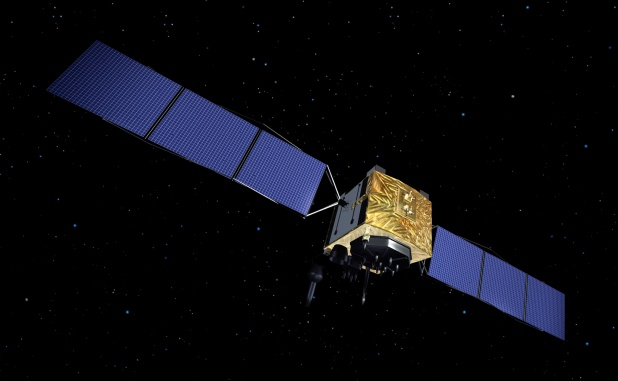
On October 12, a Soyuz launcher carrying two Galileo In-Orbit Validation (IOV) satellites deployed its twins into orbit within four hours after take-off, at close to 23,200 kilometers altitude. They join two earlier IOV spacecraft launched in October 2011. Once all four are operational in space, they will provide the minimum number of satellites required for navigational fixes — enabling system validation testing when all are visible in the sky.
A week after the dual liftoff from Kourou, French Guiana, the two satellites completed the critical Launch and Early Orbit Phase on October 19-20.
Satellites FM3 and FM4 satellites were handed over from the joint ESA/CNES Launch and Early Orbit Phase (LEOP) team in Toulouse, France, to the Galileo Control Centre, Oberpfaffenhofen, Germany, from where Spaceopal will manage operations of the Galileo constellation.
Three orbit maneuvers were conducted for each satellite to start them on drift orbits towards their operational positions, where they are expected to arrive on November 10 (FM3) and November 12 (FM4) after a series of drift-stop and fine-positioning movements.
The satellites were configured into a secure mode shortly after handover. While underway to their final positions, they will also undergo a series of tests to confirm the performance of their subsystems before switching on the payload.
The satellites were built by a consortium led by the Astrium division of EADS, which produced the platforms and has responsibility for the payloads, while Thales Alenia Space handled assembly and testing.
Compass up to Eleven
The two BeiDou-2/Compass satellites launched on September 18 reached their circular medium-Earth orbits on October 1 and started transmitting navigation signals. Several stations participating in the International GNSS Service’s Multi-GNSS Experiment as well as some in the Cooperative Network for GNSS Observation started tracking the satellites on September 26.
Although semi-official rumors had circulated that China was preparing for the Compass G6 (G2R) satellite launch on October 25, we have not found any announcement that the event has occurred.
The November issue of GPS World will appear in a few weeks’ time, with a cover story on “What Is Achievable with the Current Compass Constellation?” The technical article by Chinese researchers gives data from a 12-station tracking network distributed through China, the Pacific region, Europe, and Africa. It demonstrates the capacity of Compass with a constellation comprising four geostationary Earth-orbit (GEO) satellites and five inclined geosynchronous orbit (IGSO) satellites in operation. The regional system will be completed around the end of 2012 with a constellation of five GEOs, five IGSOs, and four medium-Earth orbit (MEO) satellites. By 2020 it will be extended into a global system.
GLONASS News in a Day or Two
As we go to e-press with this e-newsletter on October 30, we look forward to a Russian rocket rising on November 2 with a Luch data-relay satellite payload to service the the Russian satnav system. The second of a set of three geostationary satellites launched to reactivate Roscosmos’s Luch Multifunctional Space Relay System, it will also carry transponders for the System for Differential Correction and Monitoring (SDCM), Russia’s satellite-based augmentation system. The transponders will broadcast GNSS corrections on the standard GPS L1 frequency using C/A PRN codes assigned by the GPS Directorate. According to the most recent announcement, it will be positioned at 16 degrees West longitude, joining Luch-5A, already in an orbital slot at 95 degrees East longitude.
GAGAN Unfolding
The Indian Space Research Organization announced on October 3 that orbit-raising maneuvers placed the GSAT-10 satellite, launched September 30, in an orbit with 35,000-kilometer high orbit, with an orbit period of 23 hours 50 minutes, and a designated location of 83 degree East. GSAT-10 contains a payload to support the Indian GPS and GEO Augmented Navigation (GAGAN) satellite-based augmentation system. The satellite will likely use PRN code 128.
Another Dispute Headed for Resolution?
Finally, another pink dawn on the horizon. The European Union (EU) and China will reportedly meet in December in Paris to discuss overlapping radio frequencies both plan to use for their future encrypted government/military satellite navigation services.
The meeting will be conducted under what the Joint Statement on Space Technology Cooperation specifies as the ITU Framework. ITU is the International Telecommunication Union of Geneva, a United Nations affiliate that regulates satellite orbital slots and frequencies.
The statement was signed as an annex to a broader EU-China summit held September 20 in Brussels. The two sides continue collaboration on satellite navigation despite the signal conflict, which has been a subject of debate for at least two years.
The 27-nation EU and China have agreed to continue the China-Europe GNSS Technology Training and Cooperation Center.