Author: GPS World Staff

  • Trimble’s Yuma 2 Rugged Tablet Provides Full Office Capabilities

    Logo: Trimble
    Logo: Trimble

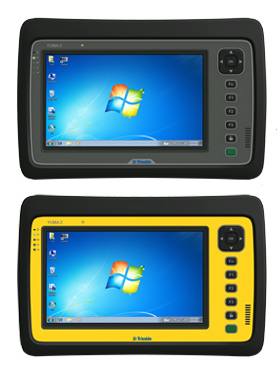
    Trimble introduced today the Yuma 2 rugged tablet computer, which it says is a powerful mobile computing solution that provides full office capabilities in the field for construction, transportation, public safety, field service, forestry, utilities, mapping, insurance and any other outdoor or service-related industry.

    The Yuma 2 offers a seven-inch capacitive multi-touchscreen in an easy-to-hold form factor that measures 6.3 x 9.6 inches, and weighs less than three pounds. Featuring new display technology for clearer readability in direct sunlight, the Yuma 2 can be used by mobile workers in the brightest outdoor conditions. The 3.75G dual-mode cellular data capability enables connectivity anywhere GSM or CDMA cellular networks are available.

    Featuring the Microsoft Windows 7 Professional operating system, the Yuma 2 is a fully functional field computer with a 1.6-GHz Intel Atom dual-core processor, 4 GB of DDR3 DRAM, a 64-GB solid state drive (SSD), and a dual battery with eight hours of typical run-time. Optional features include a 128-GB SSD, 3.75G cellular data connectivity and an extended battery set that provides up to 16 hours of operation.

    With the multi-touch capacitive touchscreen, users can type with fingers, stylus, or capacitive gloves and can control the size of the keyboard on the display for ease of use. Controlled zoom can optimize the user experience with maps and detailed information. The display supports use in landscape or portrait mode and is configurable to hold the orientation or to alter it in response to the accelerometer. The 5-megapixel camera provides video and photo capture with geotagging. The GPS receiver provides 2 to 4 meter accuracy, and is designed for data collection in applications such as distributed asset management, work order management, fleet logistics and more.

    “Ruggedness and connectivity in the field are vital for mobile workers — and Trimble has a history of providing innovative computing solutions to the market,” said Jim Sheldon, general manager of Trimble’s Mobile Computing Solutions Division. “Today, users demand solutions that are even tougher, faster, more reliable and easier to use, so they can be more efficient and productive. With new features and functionality, the Yuma 2 is an ideal solution that provides even more computing power to mobile professionals — more memory, computing speed, drive capacity, connectivity options and better display readability.”

    As with other Trimble rugged mobile computers, the Yuma 2 meets stringent MIL-STD-810G military standards for drops, vibration and humidity; and with an IP65 rating, it is protected against dust and water.

    Four different configurations are available to provide the tablet that meets the right need at the right price. Options include a larger SSD and 3.75G GSM and CDMA cellular data capability, as well as three different color schemes.

    The Trimble Yuma 2 tablet computer is expected to be available early in the fourth quarter of 2012.

  • European Navigation Conference Opens Call for Papers

    The 2013 European Navigation Conference (ENC 2013) will be held April 23-25 in Vienna, Austria. This will be the 17th conference in the GNSS series held under the auspices of the European Group of Institutes of Navigation (EUGIN) and is hosted by the Austrian Institute of Navigation (OVN).

    ENC 2013 will focus on the present status as well as on future developments in navigation systems, with special emphasis on Galileo. The conference will be a showcase for state of the art and, more important, for innovations in the field of terrestrial and satellite navigation. The implementation of new technologies in navigation will be illustrated by the industry exhibition, running in parallel to the conference. The theme is “Navigation — Expanding our Horizons.”

    The scientific program will be a combination of plenary lectures, parallel sessions, and poster presentations. Abstracts (paper or poster) with a maximum length of 1,000 words must be electronically submitted for peer-review. Submission deadline for abstracts is December 17.

  • Public Transport ITS Market in Europe Expected to Reach €1.5B by 2016

    According to a new research report from the analyst firm Berg Insight, the market value for Intelligent Transport Systems (ITS) deployed in public transport operations in Europe was €0.76 billion in 2011. Growing at a compound annual growth rate of 15 percent, this number is expected to reach €1.5 billion by 2016. Berg Insight is of the opinion that the European market for ITS for public transport is in a growth phase which will last for several years to come.

    In a statement, Berg Insight said the fluctuating economic climate has in most countries had little effect on the market as the public investments which underpin a major part of the ITS initiatives have remained stable throughout the periods of crisis. The vendor landscape for public transport ITS consists of a variety of actors. The companies INIT, Trapeze Group and IVU have emerged as leaders in Europe, having broad product portfolios and large numbers of installed systems in many countries. There are also local players with considerable market shares on regional markets in Europe, including Ineo Systrans and Vix. Another group of vendors are focused on specific parts of complete ITS such as specialized hardware units or software applications.

    ”The public transport ITS market in Europe is favored by several concurrent developments, including UITP’s sought-after doubling of the public transport ridership, the EBSF EU project, and generally higher expectations among travelers,” said Rickard Andersson, telecom analyst, Berg Insight. “Increasingly sophisticated solutions for traffic management and passenger information are available which – if implemented correctly – eventually can put public transport on par with private transportation modes in terms of traveling times and flexibility.” Andersson adds that a noteworthy development is the increasing integration of smartphone-based solutions in public transport ITS, used for various traveler-centric applications as well as business performance overviews for operators, and most recently also as affordable tracking solutions enabling real-time passenger information (RTPI). “Travelers increasingly expect real-time information also from smaller operators with low propensity to invest in ITS,” concluded Andersson.

  • Leica CS25 Tablet Offers Integrated GNSS for Asset Management

    Leica Geosystems has launched the Leica Zeno CS25 GNSS, a tablet computer with GNSS functionality and a large screen. The CS25 GNSS doesn’t require a backpack or a pole mount or additional batteries. A compact L1/L2 antenna is attached, but for high-accuracy data collection, it can connect with an external GNSS antenna mounted on a pole.

    The rugged Leica CS25 GNSS integrates an upgradable GNSS board and an attachable helix antenna. The new handheld rover is designed to combine the power of high-accuracy GNSS with the benefit of a large-screen tablet and the Windows 7 environment. With its large seven-inch display, the Leica CS25 GNSS is designed to make it easy to read and operate, even in brightest sunlight. The CS25 GNSS provides accurate and reliable results to deliver higher productivity for field crews.

    “Our customers can scale the CS25 GNSS to fit any accuracy needs, by offering a range of options, including meter, sub-meter or sub-decimeter accuracy all through a simple license model,” said GIS Business Development Manager Mauricio Jaimes. “They can also connect an external antenna to the CS25 GNSS to achieve centimeter accuracy. This flexibility, combined with the choice of Leica Zeno Field, Leica MobileMatriX or 3rd party partner software, offers versatile solutions to provide the right fit for any GIS data collection job.”

    The direct integration of GNSS into a tablet computer gives users full flexibility for efficient field data capture and benefits including:

    • Tablet computer, GNSS, and modem in one device that is light enough to carry in one hand
    • Large screen tablet with integrated GNSS RTK receiver, no backpack or pole required
    • One single charging unit for batteries, tablet computer and GNSS receiver
    • No external mobile phones are required to receive RTK corrections
    • User upgradable accuracy levels
      • Differential GNSS (GPS and optionally GLONASS): 50-cm accuracy
      • L1/L2 GNSS (GPS and optionally GLONASS) extension: <10-cm accuracy, with external antenna up to cm-accuracy
    • DGNSS, Real-time or post-processed GIS workflows, fully integrated into ArcGIS from Esri
    • Open support of third-party software applications via Leica Zeno Connect
    • Reliable components that have been engineered to operate in the most demanding work environments

    The CS25 GNSS provides an all-day battery life and IP65 rating, to ensure reliable operation, even after continued work in extreme environments with continuous exposure to water and dust. It is designed to be easily held in one hand and provides the largest GNSS data collection screen on the market.

    Mauricio Jaimes states, ”Shortly after the release of the entry-level GPS handheld Zeno 5 and the GG03 SmartAntenna, the CS25 GNSS is another unique product making the Zeno GIS series the most versatile product basket available for the GIS data collection.”

    The new Leica CS25 GNSS is expected to be available from late October 2012 onwards.

  • FCC Hosts Public Workshop on Indoor Location this Wednesday

    The FCC sees indoor location as a critical safety concern for E911 emergency response. The commission has tasked an advisory committee to evaluate indoor location positioning technologies. A public workshop on this testing is being held at the FCC on Wednesday, October 24, and can be watched online at www.fcc.gov/live.

    TechnoCom has been chosen to conduct the independent testing as a neutral third party. The test bed is in about 20 structures of various types, in locations that range from highly dense urban to sparse landscape. The following companies are submitting technology for the testing: Qualcomm (AGPS/AFLT/Cell ID), NextNav (GPS-like terrestrial beacons), Boeing (LEO satellites using the Iridium constellation), and Polaris (RF fingerprinting). Additional companies submitted technology, but later withdrew. Test results should be made public in March of 2013. 

  • Telenav Launches Scout Advertising, Acquires ThinkNear

    By Janice Partyka.

    TeleNav has announced that it has acquired Local Merchant Services, Inc., d.b.a. ThinkNear, a privately held hyper-local mobile advertising company in Los Angeles, California, for consideration of $22.5 million, consisting of approximately $18.5 million in cash, plus restricted stock and assumed options. The acquisition, which closed on October 10, added ThinkNear’s team of 12 employees, including its two co-founders, to Telenav’s mobile local advertising group. Telenav will combine ThinkNear’s targeting technology with the existing Telenav Drive-To Advertising solution to create a new mobile local advertising platform called Scout Advertising.

    ThinkNear states that it helps advertisers reach consumers within 100 meters of any location. ThinkNear’s targeting technology enables situational targeting, which reportedly takes into account where consumers are, what they are doing, and what is happening around them.

    “Real-time location is a nuanced and difficult problem and we have spent almost two years working on the technology to do it right,” said Eli Portnoy, CEO and co-founder of ThinkNear who will be joining the Scout Advertising team. “We have built technology to target mobile consumers based on true location and real-time context across billions of monthly impressions.”

    “Most mobile ad networks struggle with targeting because they are trying to apply online technologies in the mobile space,” said Dariusz Paczuski, vice president of products, marketing, and monetization at Telenav. “This is frustrating for brick and mortar advertisers because, although the growth in mobile Internet use is astounding, the ROI for mobile has been difficult to measure. We now solve that problem by driving more customers at scale with hyper-local targeting and measurable results.”

    “We are extremely excited to combine ThinkNear’s technology and expertise with our own to provide an even more comprehensive solution for advertisers to reach and drive more customers,” stated Paczuski. “This is a platform built from the ground up to leverage the mobile experience. We will help advertisers reach the right people while deploying the right mobile measurement tools. We expect this to change the game for advertisers. We are 100 percent focused on providing them with a clear and remarkable ROI on their mobile advertising spend. The proof will be the increase in customers driving to their front door.”

  • Geoloqi Merges with Esri

    By Janice Partyka.

    Esri has announced that Geoloqi, a platform for next-generation location-based services (LBS), will merge its staff and product capabilities into Esri’s existing geospatial platform and launch a new Esri Research and Development (R&D) Center in Portland, Oregon, where Geoloqi is headquartered. Terms of the agreement were not disclosed.

    “We are excited to have the team at Geoloqi and its technology become part of the Esri family,” said Jack Dangermond, president of Esri. “Geoloqi’s capabilities and relationships with the developer community will build on Esri’s already impressive suite of ArcGIS products to create more dynamic mobile and web applications.”

    Geoloqi’s platform enables rapid development of cross-platform, geography-based applications using a single API in any development language. Geoloqi provides specialized algorithms that help preserve battery life while location runs in the background or at stated intervals.

    “It’s the perfect fit,” said Amber Case, CEO of Geoloqi. “Our tools and platforms are very complementary. We’ve seen a lot of other companies and start-ups try to work on only one piece of the location equation, but location doesn’t work with just one element. The entire system has to work together to add value, and Esri has just that.”

    Geoloqi’s service for existing developers will not be interrupted. The Esri R&D Center in Portland will be focused on developing new tools and functionality to create improved, integrated products that accentuate the strength of a combined platform.

  • Funding for ByteLight Pinpoints Indoor Location Using LED Lighting

    By Janice Partyka.

    ByteLight, a provider of LED (light-emitting diode) based indoor positioning technology, announced that it has received $1.25 million in funding from individual and institutional investors, led by VantagePoint Capital Partners. ByteLight will use the funding to build its team, deploy at pilot locations, and expand its ecosystem of lighting partners.

    Using ByteLight’s LED lighting-based indoor positioning solution, commercial and enterprise building owners, public safety officials, retail outlets and public spaces such as airports, museums and convention centers can target customized information, special offers and other data directly to users based on their precise location inside a building.

  • Leica Geosystems SmartNet Adjusted to National Spatial Reference System

    On September 29, North America’s largest real-time GNSS network, Leica Geosystems’ SmartNet, became the first network to adopt the draft NGS RTN Guidelines across multiple states, and can now provide an accurate tie to the new NAD83 (NA2011) National Spatial Reference System. For the first time, SmartNet users throughout the U.S. are working within a common frame of reference.

    The Leica Geosystems SmartNet, which provides real-time positioning to more than 2,000 subscribers in 17 U.S. states and four Canadian provinces, became the first network to adopt the draft National Geodetic Service’s (NGS) RTN guidelines across its entire network. “This is huge for our subscribers,” said Director, Reference Station Operations Wendy Watson, “We are now providing centimeter-level accuracy, on a common frame of reference, everywhere in our network. That’s never been done before, and we’re proud to be first.”

    The adjustment was a significant technical challenge, and will require some adaptations by current SmartNet subscribers. “It’s critical for subscriber and all their field crews to understand the effects of this adjustment in the field,” said Watson, “It affects all SmartNet users and all SmartNet stations. For most of the US subscribers there will be minor shifts in their positional data but in some areas like California the shift is greater.  To compensate for these changes in the field, users will need to perform a transformation, localization, or calibration, and tie to existing control. We’ve provided webinars on this, which are archived at our site, and SmartNet representatives are happy to answer any and all questions. And also, we have a complete suite of online tools to assist users at http://adjustment.smartnetna.com.”

    The SmartNet Adjustment Launch commenced on Saturday, September 29, at 9:00 p.m. ET and the SmartNet network was only down for the weekend—service resumed without a hitch on Monday, October 1, at 12:00 a.m.

    “All SmartNet stations are now positioned to ensure an unprecedented level of internal precision and consistency between themselves, while at the same time providing an accurate tie to the new NAD83 (NA2011) National Spatial Reference System,” Watson explained, “By implementing the draft NGS RTN Guidelines, we positioned all of our stations to provide the requisite 2 cm horizontal and 4-cm vertical accuracy to the NSRS, while at the same time achieving the 1 cm level internal consistency needed to provide the high-precision and high-quality network corrections our users have come to expect. While we understand this change may have its challenges short term for some of our users, getting our entire network on the same, NGS-approved basis will improve the quality and consistency of everyone’s work.”

  • Topcon Unveils B110 GNSS Receiver Board


    Topcon Positioning Systems announces the light, ultra-compact dual-frequency positioning engine, the B110 GNSS receiver board. The B110 is the first GNSS board with Topcon’s new Vanguard ASIC, supporting 226 universal channels for GPS, GLONASS and Galileo tracking and scalable positioning from sub-meter DGPS to sub-centimeter RTK.

    The B110 board’s small size, low power consumption and flexible communication interfaces make it easy to integrate into any precise positioning application, reducing the time-to-market for OEM customers.

    Features that facilitate easy integration include:

    • Compact 40 x 55mm footprint with low power consumption
    • 226 universal channels with GPS + GLONASS L1/L2, Galileo E1 and SBAS “all in view” tracking
    • High performance RTK engine
    • Industry-leading position update rate of 100Hz
    • SD/MMC card interfaces for quick and easy support for data logging – just add a memory card holder
    • Serial, USB, CAN, I2C, PPS and EVENTIN.
  • Galileo Launch Goes off Without a Hitch

    The Soyuz ST-B launcher carrying the next two Galileo In-Orbit Validation satellites took off as scheduled on 18:15:00 GMT (11:15 PDT) October 12. Deployment of its twin satellites into orbit took place 3 hours 44 minutes after take-off. All the stages of the Soyuz vehicle performed as planned and the
    Fregat-MT upper stage released the Galileo satellites into their targeted orbit at close to 23 200 km altitude.

    CANSPACE Listserv reports, “NORAD/JSpOC are tracking three objects from the launch:

    1 38857U 12055A   12287.39028510 -.00000010  00000-0  00000+0 0    40
    2 38857 055.3417 239.5297 0002857 220.9108 309.5819 01.70229112    21

    1 38858U 12055B   12287.39028542 -.00000010  00000-0  00000+0 0    24
    2 38858 055.3421 239.5258 0011396 234.3183 295.7952 01.70006115    13

    1 38859U 12055C   12287.39161626 -.00000010  00000-0  00000+0 0    37
    2 38859 055.3444 239.5347 0072340 243.6619 284.3270 01.68014156    19

    “Presumably, the first two (A and B) are the Galileo satellites. They are drifting towards their designated orbits.”

    The European Space Agency (ESA) launched this second pair of Galileo IOV satellites from Europe’s Spaceport in French Guiana.

    This flight is designated VS03 in Arianespace‘s mission numbering system, and it was the Spaceport’s third launch since Soyuz was introduced at this near-equatorial facility one year ago. Arianespace is the launch contractor.

    The two Galileo satellites will join the first two spacecraft orbited by Arianespace’s historic VS01 flight on October 21, 2011, marking Soyuz’ introduction at the Spaceport. Once all four are operational in space, they will provide the minimum number of satellites required for navigational fixes — enabling system validation testing when all are visible in the sky.

    As a European initiative, the Galileo satellite navigation system is being developed in a collaborative effort of the European Union and the European
    Space Agency. The In-Orbit Validation (IOV) satellites weigh 700 kg. each and were built by a consortium led by the Astrium division of EADS — which
    produced the platforms and has responsibility for the payloads, while Thales Alenia Space handled the assembly and testing tasks.

  • GTX Corp Brings GPS Shoes for Alzheimer’s to UK, Ireland

    GTX Corp has announced today that its patented GPS tracking smart shoe will be commercially available in the U.K and Ireland this month. The Aetrex Navistar GPS shoes will be made under license by comfort footwear maker Aetrex Worldwide, Inc., and will be distributed by Tipp Toes, an Aetrex Worldwide distributor located  in Ireland.

    The Alzheimer’s Society in the U.K estimates there are 800,000 people in the UK and Ireland afflicted with Alzheimer’s and Dementia who are prone to wandering. Statistics show that if not found within the first 24 hours, more than half may be found seriously harmed. The GPS technology embedded inside comfortable walking shoes designed for seniors were first introduced in the U.S. and Australia. EE, the UK digital communications company, will be the wireless SIM provider for the GPS shoes after having recently signed a global contract with GTX Corp that will enable the shoes to work in more than 50 countries across the globe which utilize the GSM network.

    The shoe wearer can be monitored remotely, thereby helping to  ensure  their safety, providing peace of mind to their caregivers and  reducing the cost of remote oversight. The shoes are embedded with a miniaturized proprietary module that contains the locator’s integrated GPS/cellular chipset and the SIM card unique to each wearer. The GPS shoes communicate via EE’s cellular network and sends location coordinates via a wireless data connection, similar to sending SMS messages on a cell phone. If the wearer wanders outside of a pre-set location determined by the caregiver, an SMS or email message will alert the caregiver instantly.

    The GPS shoes have been heralded by healthcare and technology authorities around the world and is featured in the “100 Most Important Inventions of Mankind” Exhibit in the National Museum of Science and Technology in Sweden.