Author: GPS World Staff

  • UPDATE: EGNOS Satellite Launch Set for August 6


    News courtesy of CANSPACE Listserv.

    UPDATE: The Interfax news agency has announced that the rescheduled launch date for SES-5 from the Baikonur Cosmodrome, originally scheduled for June 18, is August 6, 2012.

    The launch is being delayed due to a problem with a first stage subsystem on the Proton launch vehicle. The rocket has been rolled back to the assembly building for further tests.

    SES-5 is also known as Sirius 5 stemming from the development of the Sirius satellite constellation by Nordic Satellite AB, now owned by Luxembourg’s SES.

    The satellite carries a transponder for the European Geostationary Navigation Overlay Service (EGNOS). The transponder is intended to eventually replace or one of those on the currently used EGNOS satellites (Inmarsat 3-F2 at 15.5 degrees west using PRN 120, Artemis at 21.5 degrees east using PRN124, and Inmarsat-4-F2 at 25 degrees east using PRN 126 and designated for industry tests).

    Unlike the present L1-only EGNOS satellites, SES-5 will have transponders on both the L1 and E5 frequencies similar to the setup on the Wide Area Augmentation System satellites, which broadcast on L1 and L5.

    SES-5 is to be stationed at 5 degrees east longtiude.

    A second SES satellite with EGNOS transponders is under construction. The SES Astra 5B satellite is scheduled for launch in the second quarter of 2013 and will be positioned at SES Astra’s 31.5 degrees east orbital position.

    Role Switch. On March 22 and 23, Inmarsat-4-F2 at 25 degrees east using PRN126 and Artemis at 21.5 degrees east using PRN124 switched roles. PRN126 became an EGNOS operational signal-in-space satellite while PRN124 became the test satellite, transmitting message type 0. PRN120 and PRN126 returned to service around 17:00 UTC on Tuesday, June 26.

    According to an EGNOS service announcement dated April 3, the switch was due to the aging state of the Artemis satellite.

  • Magellan eXplorist GIS Pro 10 GPS Now Offers Effigis OnPOZ Data Collection and Post-Processing Software

    Magellan and Effigis announced a partnership and reseller agreement to create a comprehensive out-of-the-box solution for Magellan customers to collect and post-process geo-localized data using Effigis OnPOZ software on the Magellan eXplorist GIS Pro 10.


    According to the announcement, as part of the partnership, three Effigis OnPOZ precision positioning software products are available for the Magellan eXplorist GIS Pro 10, a rugged, lightweight and waterproof handheld GPS device specifically designed for professional GPS/GIS data collection.   

    • EZTag CE, geospatial data acquisition software, facilitates the collection of geospatial data including points, lines and polygons plus their specific attributes, and valuable GNSS observations necessary for post-processing.  Users can customize the data capture properties to match their office database structure. 
    • GNSS Driver for ArcPad, software extension that improves the quality of data collected using ESRI ArcPad GIS software.
    • EZSurv, GNSS post-processing software, provides a reliable, efficient RTK offline solution for data integrity. Users can play back their RTK survey for QA control, make corrections to non-RTK GNSS field data, or significantly improve GIS data accuracy.  

    “The combination of Effigis OnPOZ software and the Magellan eXplorist GIS Pro 10 device creates a powerful and accurate, yet cost-effective solution for collecting and post-processing GIS data,” said Stig Pedersen, Associate Vice President of Product Management for Magellan. “Our partnership with Effigis enables Magellan to continue providing GIS professionals with complete GIS data collection solutions to facilitate their biggest GIS mobile application challenges.”   

    Magellan reports that with its rugged IPX-7 waterproof casing, the eXplorist GIS Pro 10 device is designed for GIS professionals who need to collect GPS/GIS data. The GPS device can deliver 3 to 5 meters accuracy in real-time using its internal GPS receiver and works with supported Bluetooth-enabled GPS receivers to achieve 1 to 3 meter accuracy. Powered by Windows Mobile v6.5 OS, the Pro 10 GPS device allows GIS professionals to run powerful GIS data collection software, such as Effigis, and a wide range of Windows Mobile data collection applications.

    “Partnering with a leading GPS manufacturer like Magellan will allow Effigis to reach a wider range of GNSS users,” said Denis Parrot, President of Effigis. “With this agreement, we are very pleased to continue to bring an enhanced level of data accuracy and reliability to users.”

    Effigis OnPOZ software for the Magellan eXplorist GIS Pro 10 is available now from Magellan’s authorized GIS resellers as a bundled option with the GPS device, or as a software-only add-on for users who previously purchased the Pro 10 model. More details are available at www.MagellanGPS.com/GIS.

  • Webb Simpson Wins the 2012 U.S. Open on Putting Surfaces Built with Topcon Precision Measurement Technology

    Last Sunday, when 156 of the world’s best golfers gathered together at The Olympic Club Lake course in San Francisco, California, to compete in the 2012 Men’s U.S. Open golf tournament, it signaled the culmination of years of work at The Olympic Club Lake course that included the complete tear-down and reconstruction of all 18 green complexes using Topcon’s precision measurement technology. Webb Simpson took the title, the first major for the Charlotte, North Carolina, resident.

    Over the course of many months in 2008 and 2009, all 18 green complexes were completely torn down and rebuilt in preparation for the 2012 U.S. Open. Roundworms were eating away at the greens and drainage needed to be fine-tuned. The challenge was issued: members at the privately held Olympic Club were happy with the slopes and contours of fourteen of the eighteen greens at the Lake course. That meant fourteen greens had to be torn down and rebuilt exactly the same. Every contour, every slope and every shape had to be precisely recreated in order for a golf ball to roll the same.

    The Lake Course superintendent Brian Koffler said “the membership washappy with those 14 surfaces. The club was very adamant about putting the exact contours back on those putting surfaces, exactly as-is.”

    In order to precisely rebuild the greens, high-precision construction equipment capable of vertical and horizontal measurement precision within six millimeters was required.

    Golf course builder Frontier Golf of Jones Mills, Pennsylvania was selected as the contractor to perform the work. Frontier’s support team included Topcon sales consultant Dave Krautz of Productivity Products and Services, Inc (PPS). Krautz recommended Topcon’s high-precision GPS/GNSS receiver technology as well as Topcon’s patented Millimeter GPS laser leveling technology. Krautz recommended Topcon’s Millimeter GPS technology because it improves vertical precision up to 300 percent over existing GPS-based systems.

    “The whole process moved much quicker than we originally had planned”, said superintendent Koffler. He said other contractors who had expressed interest in the project were forecasting two to three times the manpower to complete the project than what Frontier accomplished with Topcon equipment.

    With the success at the Olympic Club's Lake course, Topcon's Millimeter GPS technology left Nicholas Scigliano, president and CEO of Frontier Golf, suitably impressed. "On our next greens restoration project, I'm going to turn to (Topcon’s) Millimeter GPS right out of the gate. The vertical accuracy is right on," he said. "It's pretty neat stuff," he said of the Lake Course project. "We are doing stuff here that’s unique in our field."

    In addition to rebuilding 14 greens, Topcon’s Millimeter GPS technology was used to reshape the 18th green at the Olympic Club Lake course that was the source of controversy at the end of the 1998 U.S. Open. With the pin placed on a ridge at No. 18, a number of putts were rolling well past the pin. As a result, the green was flattened in 2000, but as Koffler explained, Olympic Club members felt it had become a little too flat; it had gone from perhaps too challenging to not challenging enough – they could two-putt from anywhere on the green, so the Olympic Club decided to return some of the challenge on the 18th green.

  • Juniper Systems Introduces Microsoft Windows Embedded Handheld 6.5 Upgrade for the Mesa Notepad

    Juniper Systems introduced Microsoft Windows Embedded Handheld 6.5 for the Mesa Rugged Notepad. This latest operating system version includes operating system updates from Microsoft, several new features requested by customers, and other various improvements. The new operating system is now shipping on new Mesa Rugged Notepads and is available to download for all existing Mesa Rugged Notepads on the Juniper Systems website. 

    “As senior product manager at Juniper Systems, I am constantly looking for ways to further improve our rugged handheld computers and enhance the data collection experience for our customers,” said John Florio. “This new operating system upgrade for the Mesa includes several new user-requested features and I believe the Mesa is now better positioned to lead the rugged handheld industry as the most rugged and unique mobile device on the market.” 

    One of the most significant changes to the operating system is the renaming of Microsoft Windows Mobile 6.5 to Microsoft® Windows Embedded Handheld 6.5, solidifying the commitment by Microsoft to this platform. Additionally, Microsoft Office Mobile has been upgraded to Office Mobile 2010 and supports Office 2010 file formats for simplified compatibility.

    New additions and feature enhancements have been added, including the new finger-friendly “Mega Keys” on-screen keyboard with larger keys and more special characters available. This keyboard is specially designed to run on the Mesa and is available to use in any text-entry field. The GPS function of the Mesa has been improved to allow enabling/disabling of WAAS/SBAS corrections, as well as an increased GPS breadcrumb trail point size to 36,000 points. The integrated camera application now allows users to emboss the image file name directly on to the photo and to embed a user note into an image file. Portuguese (Brazil version) has been added as an available language on the new Mesa operating system.

    The Mesa Rugged Notepad is a rugged handheld computer designed for dedicated field data collection in extreme environments. Described as featuring the combined advantages of a handheld computer and a tablet PC without the disadvantages of either, the Mesa’s large 5.7 inch display and compact design create the ultimate, one-of-a-kind data collection companion.

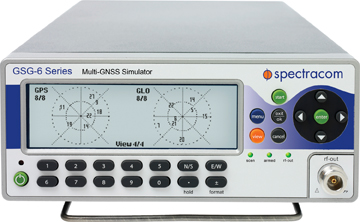
  • Multi-GNSS Simulator

    Multi-GNSS Simulator

    Spectracom announced its new L1+L2 dual-frequency 32-channel multi-GNSS simulator, the GSG-62. The GSG-62 offers multiple frequency band operation, multiple GNSS constellation simulation, and expansion capability for more frequency bands and channels, the company said.

    The new simulator provides expanded capabilities for those who are testing more than GPS L1, according to the company. “We understand the challenges our customers have in fast-paced development, migration and delivery of products with ever changing embedded GNSS receivers,” said John Fischer, Spectracom CTO. “As such, we are excited to introduce this next-generation multi-signal instrument that allows for real-time scenarios, is intuitive to understand, quick to deploy and, given its design to support upgrades to L2C, L5, and future GNSS frequencies and systems, protects our customer’s investment in test gear.

    Fischer continued, “In addition to a wide variety of technical challenges, we also understand our customers must balance the ability to quickly develop solutions and improve cost performance in their operations. We believe the price, unique features, and form factor of the GSG-62 will allow them to do both.”

    The GSG-62 is designed for manufacturing and development testing with its ability to simulate all the visible satellites for the receiver under test. With 16 channels for L1 frequency and 16 channels for L2 frequency, channels can be assigned to GPS or GLONASS, P-code or C/A code. Channels may also be used for SBAS simulation of EGNOS, WAAS, GAGAN, or MSAS satellites, or for multipath and interference signals.

The GSG-62 incorporates all the features of Spectracom’s previous models, including compatibility with GSG StudioView PC software for creation and editing of simulation scenarios via Google Maps.

  • GPS-Enabled Sports Watch

    TomTom and Nike have unveiled a new range of the Nike+ Sportwatch, coinciding with the launch of a brand new Nike+ website. The range includes several editions and color combinations, and introduces a starter product for those new to running.

Whether they own an original or new edition, all Nike+ Sportwatch users can now access Nike’s intelligent measure of athletic ability, Nikefuel. This converts a runner’s mileage into universal units that measure movements in a wide variety of different sports. As a result, it’s easy for people to compare their performance against that of athletes in other sports, and share their achievements with friends, the companies said.

”Our extended range of products will be very useful to those adding running into their exercise regime. And the new NikeFuel measurement brings added motivation, allowing people to share and compare their performance with friends in other sports,” says Corinne Vigreux, managing director, TomTom.

The new Nike+ Sportwatch colors have been chosen to match Nike’s apparel and shoe ranges. They include black/anthracite, anthracite/blue glow, and high-impact volt green. The anthracite/blue glow edition is available as a starter product, priced at €149.

    CONTACT INFO

    Company: TomTom
    Country: United States (USA)
    URL: http://www.tomtom.com

  • GPS Satellite Simulator

    CAST Navigation of Tewksbury, Massachusetts introduced its SGX GPS Satellite Simulator. With its compact size — 7 × 11× 3 inches — and weighing in at just over 4 pounds, the SGX is CAST’s newest and smallest fully capable simulator to date.
    The new SGX replaces the CAST-SIMCOM Simulator which was a 17-inch, 50-pound simulator. The SGX lightweight portability operates on AC or battery power, features 16 channels of L1 C/A and P codes, and is extremely accurate and repeatable, according to the company.
    Features include touch screen, individual satellite power control, and start and stop scenarios with a touch of a button.
    The CAST-SGX is portable, affordable, lightweight and utilizes CAST long standing proven technology.
    CAST has been in the GPS simulation and support business for more than 25 years, designing, developing, manufacturing, and integrating innovative GPS/INS simulators and associated equipment for government, military, prime vendor, and consumer markets.

    CONTACT INFO

    Company: CAST Navigation
    Country: United States (USA)
    Email: [email protected]
    URL: http://www.castnav.com

  • GLONASS Antenna

    Taoglas is launching the AA.16X Dominator series of antennas, which have a wider bandwidth to cover the GLONASS operating frequencies up to 1610 MHz, a good axial ratio, and a double resonance design for optimum reception at the center frequencies.

    Taoglas’ GPS antennas are being used in the field by many different M2M solution providers including tracking, telematics, and GPS manufacturers, the company said.

    The AA.161 Dominator is a magnetic mount GPS-GLONASS IP67, external antenna incorporating a 35-millimeter ceramic patch. It is a wide-band active patch antenna product with a large integral ground that delivers a gain up to 35 dB. With the Dominator antenna series, Taoglas has a comprehensive range of GPS-GLONASS active embedded antennas (AGGP series) and passive embedded (CGGP) antennas for automotive first-tier TS16949 and after-market applications.

    “In the coming months, for the first time the true availability of GPS and GLONASS satellites along with the latest generation of GNSS receivers are going to dramatically change the performance of M2M location devices,” said Ronan Quinlan, Director Taoglas. “With close to double the amount of satellites to draw from compared to a stand-alone GPS constellation, we are now going to see quicker time to first fixes with accuracy improving from meters to sub one meter. The ability to view and lock on four or more satellites in traditionally difficult reception areas such as urban canyons, city centers or locations with restricted views of the horizon, will give M2M manufacturers the ability to triangulate and pinpoint locations with greater accuracy and with quicker time to first fix.

    Taoglas’ new Dominator antennas have been rigorously tested and pre-approved by the GNNS receiver companies worldwide and have been shown to display higher and more consistent gain in comparison to competing antennas, the company claimed. Two key components have been engineered from scratch for the Dominator series, a wide-band front-end SAW filter (critical to prevent out of band noise entering on both GPS and GLONASS degrading the signal) and a high-gain 35-mm patch.

    CONTACT INFO

    Company: Taoglas
    Country: United States (USA)
    URL: http://www.taoglas.com

  • Core Positioning Receiver Chip

    u-blox is launching the u-blox 7, its next-generation core positioning technology platform. Supporting all deployed as well as soon-to-be deployed GNSS, the platform is based on the UBX-G7020 multi-GNSS receiver integrated chip with low power consumption.

    With 7 mW power consumption during continuous navigation, u‑blox’ UBX-G7020 is designed for small portable and power-sensitive devices requiring long battery life, high sensitivity, small size, and fast positioning. GPS, GLONASS, Compass, Russian, QZSS, and Galileo satellite positioning systems plus all satellite-based augmentation systems (SBAS) are supported.

    “As the satellite systems expand beyond GPS, u-blox 7 is an important step for our customers to design systems that work with all available global navigation standards, particularly GLONASS which is now fully operational. Our multi-GNSS UBX-G7020 integrated circuit does exactly that while achieving two of the most important features that our customers demand: minimum power consumption and small size,” said Andreas Thiel, executive vice president of R&D Hardware and co-founder of u-blox.

    The chip has been designed to support the lowest cost stand-alone solution via minimum eBOM; only eight external components are required resulting in a receiver occupying only 30 mm2 on a two-layer PCB. Standard crystal and TCXO are supported. The chip also provides low-power, autonomous log data output of position, velocity, and time. Support for A-GPS and u-blox’ CellLocate hybrid GNSS/cellular positioning technology is embedded to facilitate advanced telematics applications including indoor positioning. Standard and automotive grade are supported.

    First samples of the multi-GNSS receiver chip UBX-G7020 are available for customer evaluation. Shortly afterwards, module customers can migrate to the MAX, NEO, and LEA form factors, u-blox’ module series which will all be upgraded to the new u-blox 7 platform.

    u-blox 7 maintains software compatibility with u-blox 5 and u-blox 6, and modules provide drop-in compatibility. Both previous generation platforms remain fully supported, the company said. u-blox’ capability of delivering GNSS technology in both integrated circuit and module form provides maximum design flexibility for a wide variety of applications. To evaluate the performance of the u-blox 7 multi-GNSS platform, evaluation kits supporting all u-blox 7 based chips and modules can be ordered.

  • Flurry Announces Ad Analytics for Mobile Apps

    Flurry has announced Flurry Ad Analytics, an analytics-powered service for mobile app marketers to measure the effectiveness of traffic acquisition campaigns across ad networks. The service enables app marketers to track the quality, follow-on behavior, and return on investment of traffic sourced from campaigns across major mobile ad networks including Apple iAd, Google Admob, Millenial Media, InMobi, Jumptap, and Flurry AppCircle.

    “Flurry estimates that during 2012 app marketers will spend over one billion dollars worldwide on app traffic acquisition without the ability to measure user quality, assign attribution or easily determine ROI,” said Simon Khalaf, Flurry president and chief executive. “Flurry Ad Analytics empowers app marketers to change the way they think about acquisition and focus on quality not just quantity.”

  • SCVNGR LevelUp Raises $12 Million

    SCVNGR, makers of the location-based social game SCVNGR, and LevelUp, the app that lets users pay by phone, announced that it has 12 million in funding with participation from existing investors Highland Capital Partners, Google Ventures, Balderton Capital, and new investors Continental Investors and Transmedia Capital.

    Part of a larger round of fundraising, the $12 million in financing will support the growth of LevelUp, the mobile payment app which is now available at more than 3,000 merchant partners in 8 U.S. cities, including well-known fast-casual chains like boloco, Johnny Rockets, and Ben & Jerry’s. LevelUp has nearly 200,000 users who are spending at a volume of $2 million per month with the app, and the fundraising round at large will be focused on the product’s nationwide expansion.

    “LevelUp adds tremendous value for both merchants and consumers and has quickly accelerated to become a leading player in a highly competitive space,” said Google Ventures Partner Rich Miner. “We’re impressed by the product’s success to date and are excited to provide additional support as LevelUp scales nationally and the mobile payments industry continues to evolve at a fast pace.”

    Launched by Boston-based SCVNGR in July 2011, LevelUp enables its users to pay with their phones by linking their credit or debit card to the app and scanning it at checkout. In turn, businesses on LevelUp are able to attract new customers with incentives while motivating them to become regular customers with loyalty rewards.

    LevelUp is also expanding its staff to accommodate the product’s rapid growth, adding 40 new recruits to its sales team in recent months. At the executive level, LevelUp has also appointed Paul Purcell of Continental, a participant in the $12 million funding round , as an observer on the Board of Directors.

  • Weather Channel Is First Publisher to Launch Hyperlocal Advertising with PlaceIQ

    The Weather Channel Companies announced they will partner with hyperlocal data company PlaceIQ to provide advertisers with new audience targeting that can deliver highly contextually relevant ads to consumers. With 30 million monthly mobile users, The Weather Channel can offer hyperlocal audience targeting at scale. This targeting is now available on The Weather Channel iPhone App and will be rolling out on The Weather Channel Android App in July and all mobile platforms later this year.

    PlaceIQ extracts intelligence from large amounts of place, social, and mobile location-based data to create hyperlocal, targetable audience profiles informed by time of day as well as location, giving advertisers the power to connect with consumers. These anonymous audience profiles can provide powerful targeting opportunities for advertisers. For example, financial services clients can target ads to mobile phones in areas with a high propensity for business travelers, such as airports during peak commuting hours, or in areas with a high concentration of hotels in the morning or evening that score high for business travelers. An ad on The Weather Channel app can be served during lunch on mobile phones on certain blocks populated with office workers, or served targeting late-night diners in an area that has a high concentration of nightlife and social activity. 

    "Consumers expect to receive the most accurate local weather news and information when they use The Weather Channel mobile products, which gives us the opportunity — and our advertisers the advantage — to deliver messages highly targeted to their location that will feel completely organic to their user experience," said Patrick McCormack, vice president, mobile sales and strategy, The Weather Channel Companies. "We feel strongly that our premium content and ability to target a specific mobile audience provides an unparalleled ad solution to our advertising clients."

    "The combination of PlaceIQ's hyperlocal audience targeting, with The Weather Channel's tremendous reach and ability to transform hyperlocal impressions into specific audiences, is an extremely powerful one. The combination of weather, location and audience creates a set of offerings we think represent true innovation in mobile advertising, and we're extremely excited to partner with The Weather Channel to deliver this to market," said Duncan McCall, CEO and co-founder, PlaceIQ.

    The product is launching with a number of high profile advertisers, including Chevy Silverado,Frito-Lay, and the Ram Truck brand, among others.