Author: GPS World Staff

  • CMTINC.com Announces a Real Estate App for iOS

    CMTINC.com Announced the Release of Deed Calls, Area, Perimeter App for iOS (iPad, iPhone, iTouch), enabling real-estate agents, property financing officers, title officers, attorneys, construction contractors, and anyone working with real property to quickly convert angles and distance data into a boundary map. 


    According to the announcement, the app will label the resultant deed plot and display the completed figure, its area and perimeter, as well as the closure error. There is an Auto-close option to automatically close the figure. The users may generate a PDF report containing the map drawing and the deed calls data. They may also save the Deed Calls data file and send it to other users via email. 
     
    If the users wish to pin the deed plot to a geographic location, they may specify the actual coordinates of the initial node. For devices equipped with GPS, this app provides the ability to pick the GPS position as the point of beginning. In these cases, the app can display the deed plot on top of a Google Earth map.
     
    The Deed Calls – Area – Perimeter app is available from the App Store by clicking here
     
  • Boeing Completes 5th GPS IIF Satellite for U.S. Air Force


    GPS IIF pulse line Boeing is building 12 Air Force GPS IIF satellites on its innovative pulse line at the Satellite Development Center in El Segundo, CA. The pulse line enables simultaneous construction of multiple satellites, increasing savings, quality and efficiency. Photo credit: The Boeing Company

    The Boeing Company has completed the fifth of 12 Global Positioning System (GPS) IIF satellites the company is building for the U.S. Air Force. The spacecraft was built at the Satellite Development Center in El Segundo using the GPS IIF pulse-line manufacturing approach, which draws on commercial production line practices to build satellites faster and more efficiently.

    Of the five completed GPS IIF satellites, two are on orbit as part of the current 31-satellite constellation; both satellites are meeting mission requirements. Three satellites are in storage on standby for launch by the Air Force. The remaining seven are in various stages of pulse-line production and will likely be added to the constellation over the next three to five years as determined by the Air Force to ensure robust constellation availability.

    "Boeing, in close partnership with the U.S. Air Force, is focused on execution and mission assurance — we are committed to sustaining the GPS constellation with GPS IIF," said Craig Cooning, Boeing vice president and general manager of Space & Intelligence Systems. "The GPS IIF spacecraft feature more capability and improved mission performance for the warfighters and civilians who depend on this critical system."

    The next GPS IIF launch is scheduled for the fourth quarter of 2012. The satellite will be launched aboard a United Launch Alliance Delta IV vehicle from Cape Canaveral Air Force Station, Florida.

    GPS is a space-based, worldwide navigation system providing users with highly accurate, three-dimensional position, velocity and timing information 24 hours a day in all weather conditions. GPS IIF satellites provide enhanced capabilities, including a jam-resistant military signal, greater accuracy through improved atomic clock technology, and a protected, civilian L5 signal to aid commercial aviation and safety-of-life applications. Boeing also is the prime contractor for the GPS Operational Control Segment, which has supported an expanding set of GPS services and capabilities since 2007.

  • Spectratime Atomic Clocks Selected for Eight Galileo Satellites

    Spectratime, a provider of atomic clocks and a business of the Orolia Group, has announced it has been selected to provide the Rubidium atomic clocks and passive hydrogen masers for eight satellites for Europe’s Galileo GNSS. Spectratime expects this Authorization to Proceed will lead to a final contract for the manufacture of these two types of high precision clocks, estimated at 14 million euros, by summer 2012.

    “This new authorization to proceed, just a year after the signing contracts totaling nearly 20 million euros for the supply of the clocks for the first 14 operational satellites for the Galileo satellite navigation system, confirms Spectratime’s position as a world leading supplier of space atomic clocks,” said Jean-Yves Courtois, CEO of the group. “Each satellite carries on board two rubidium atomic clocks and a passive hydrogen maser, the most stable type of atomic clock in the world. In a few years, after the execution of the contract, which will be implemented in partnership with Astrium and Selex Galileo, we will have the most currently active atomic clocks in space, including 72 for the Galileo system alone.”

  • NovAtel SAASM to See First Action in Aerial Drones

    The new OEM625S Selective Availability Anti-Spoofing Module (SAASM) GNSS receiver from NovAtel, launched in a cooperative effort with SAASM expert L-3 Interstate Electronics Corporation (IEC), will get its first applications in the unmanned aerial vehicle (UAV) sector. NovAtel has brought forth the new product in part to meet requirements of UAV manufacturers who are now mandated to have SAASM onboard as well, for in-theater operations in areas of military activity.

    “The new SAASM regulations meant that integrators were looking at having to incorporate another receiver alongside their NovAtel unit, complicating user interface factors and increasing onboard space requirements,” said NovAtel Product Manager Neil Gerein. “The OEM625S gives our customers a drop-in form factor that easily replaces their existing NovAtel OEM receiver.”

    “NovAtel has supplied UAV integrators on the civil scientific side almost since our inception,” Gerein said, adding, “the military has become more and more involved in this market in recent years for budget and various other strategic reasons.” He mentioned that in its 20-year history selling GPS products, for the last 17 years NovAtel has provided receivers and expertise to U.S. and Canada defense contractors, and to defense research labs in Allied countries. Antcom, a wholly-owned NovAtel subsidiary specializing in antennas and microwave products, makes the majority of its sales into military areas.

    Examples of such products in this area — not necessarily from NovAtel customers, who remain unidentified — include hand-launched mini-UAVs like the Aerovironment RQ-11 Raven and Elbit Skylark I, and runway-capable tactical UAVs such as Textron RQ-7 Shadow, Aeronautics DS Aerostar, IAI Searcher II, and InSitu’s ScanEagle UAV system, quickly evolving into a mainstay with the U.S. Navy and its allies thanks to a partnership with Boeing.

    The InSitu ScanEagle was first developed to track dolphins and tuna from fishing boats, to ensure that fish labeled “dolphin-safe” actually are so. The same characteristics needed by commercial fishing boats — low infrastructure launch and recovery, small size, 20-hour long endurance, automated flight patterns — are key for naval operations from larger vessels, and for battlefield surveillance.

    At present the OEM625S, combining a commercial dual-frequency NovAtel GNSS receiver with an L-3 IEC XFACTOR SAASM, provides single-point positioning with SAASM for authorized defense customers. The SAASM position is provided via a dedicated communication port, as well as through NovAtel’s software command protocol, allowing for maximum flexibility. The small form factor and low power consumption expands range of potential defense applications requiring robust SAASM GPS positioning.

    The OEM625S measures 60 x 100 x 9.1 millimeters, and runs on field-upgradeable software. NovAtel will accept orders for the OEM625S from authorized customers starting in Q3 2012.

  • Blue Sky Launches SkyRouter for Fleet Management Applications

    Blue Sky Network has launched the SkyRouter, a fleet management portal for land mobile, aviation, and marine applications. SkyRouter is a feature-rich, cloud-based solution designed to support connectivity with remotely dispersed mobile assets including Blue Sky Network’s advanced dual-mode GSM and iridium tracking and communications services, the company said.

    SkyRouter enables seamless connectivity with assets in problematic cellular reception areas, where only 10 percent of the Earth is covered, and in remote locations, Blue Sky Network said, adding that only Iridium-based communications devices and services work globally through connectivity via the world’s furthest reaching network.

    Today’s fleet managers require around-the-clock communication with widely distributed mobile assets. Overall safety and fleet efficiency can be achieved through alerts, monitoring of position data, and unique event reporting. New SkyRouter leverages the integration of Blue Sky Network’s HawkEye 5300, which enhances coverage of GSM cellular tracking capabilities with global coverage to deliver dual-mode tracking and event reporting of assets located anywhere in the world. Fleet managers can receive real-time updates that include GPS location information, messages, and on board diagnostic (OBDII) alerts, among others, everywhere.

    “Our next-generation New SkyRouter for land mobile fleet applications furthers our commitment to be a market leader in advanced tracking products for customers who demand customized solutions and exceptional customer service,” said Jon Gilbert, CEO and founder of Blue Sky Network. “This new platform, in concert with our superb products, means more mobile asset sectors can benefit from smooth integration of tracking hardware with a cloud-based portal for seamless command and control across multiple asset types and deployments.”

    SkyRouter works in combination with Blue Sky Network’s certified hardware, which can be installed on land, aviation, and marine assets. Features include over-the-air parameter settings, automated event reporting, local sensor data capture, and two-way messaging capability.

    “The new SkyRouter is an innovative solution from an important Iridium partner enabling fleet manager’s global visibility of their important assets though the cloud,” said Greg Ewert, executive vice president of global distribution channels at Iridium. “This level of visibility provides vital data delivery to fleet operators who are driving further efficiencies into their business, meeting regulatory requirements or protecting the safety of their personnel or assets.”

  • City of Edmonton Launches Pilot for Intergraph and Leica Geosystems GIS Solution

    Intergraph announced that the City of Edmonton, Canada, has implemented a pilot program that will use Intergraph and Leica Geosystems combined products for enhanced tracking of assets within its expansive network of public parks. The City of Edmonton is utilizing the Leica CS25 ultra rugged tablet and the GG02+ GNSS Smart Antenna, the most accurate data collection and update system available today for GIS professionals, in conjunction with Intergraph's GeoMedia, a powerful GIS management product. Together, Intergraph and Leica Geosystems contribute to Hexagon's comprehensive portfolio, addressing all aspects of the geospatial life cycle – from capture to delivery.

    Leica Zeno GG02 with CS25 Tablet

    Managed by the Parks Branch within the City of Edmonton, the pilot program will allow city workers and officials to track the condition of park-related assets through the use of a Leica Geosystems device running Intergraph's GeoMedia software. For the past five years, the Parks Branch has been collecting information in the field regarding these assets. This integrated solution provides a means to easily track and better perform maintenance and condition assessments for all of its properties.

    "We have spent a significant amount of time collecting data regarding all of our assets, and now we need to continually assess their condition," said Michael Boychuk, GIS Coordinator, Parks Branch. "By running this pilot program, we now have a mechanism for our workers in the field to report back the condition of any asset within our expansive park system."

    The Parks Branch is currently using devices to download the existing asset data from its GIS database. The new mobile data will be updated when field workers perform condition inspections, as well as add on new data regarding new assets – streamlining the entire workflow.

    GeoMedia enables users to realize the maximum value of their geospatial resources, integrating them to present clear, actionable information. It provides simultaneous access to geospatial data in almost any form, uniting them in a single map view for efficient processing, analysis, presentation and sharing. GeoMedia's intuitive, dynamic analysis functionality enables concatenation of analysis processes so the results of one operation feed directly into the next process, as well as automatic updating of results in response to data changes.

    The Leica CS25 is a versatile tablet computer combining a 7'' screen, fully rugged and lightweight. It provides a highly useable means for accomplishing data collection tasks efficiently, taking the office to the field. The GG02+ Smart Antenna is the most accurate system for GIS data collection and update. It brings high-accuracy RTK positions to the GIS user in a seamless way. Centimeter accuracy can be achieved either in post-process or real time by using the Leica SmartNet correction service or radio links. Coupled with GeoMedia's flexible architecture, the two products provide a dynamic solution.

    "This pilot is a prime example of how two Hexagon companies can be fully integrated to provide real-world solutions for any organization that is tracking assets in the field," said Mladen Stojic, Vice President, Geospatial at Intergraph SG&I. "The combined offering provides a complete end-to-end solution for making data relevant and actionable, allowing any organization to be more efficient and effective."

    The City of Edmonton has more than 460 parks and hosts the largest expanse of urban parkland in North America with its North Saskatchewan River Valley parks.

  • Telmap Launches Parking Space Locator on the Telmap Mobile Location Companion

    Telmap announced a partnership with Decell, a leading provider of traffic information including real-time road status and related transportation services. By collaborating with Decell, Telmap is now able to provide a unique navigation service to its users in Israel by providing them with real-time information on available parking spaces with regards to the users’ location.

    According to the announcement, this innovative service is currently available to subscribers using the Telmap Mobile Location Platform on all four leading Israeli cellular operators (Orange, Pelephone, Cellcom and Hot Mobile). Users can at any time get recommendations on parking lots with available vacancies relative to their current proximity. Currently this service is available in a selection of car parks in Tel Aviv and in the coming weeks it will be expanded to include cooperation in dozens of car parks across the country.

    “We are always seeking to provide added-value services to our users who are on-the-go and we classify finding a parking space as one of the recurring tasks that we all encounter while on-the-go. Our collaboration with Decell in Israel aims to provide a functional, innovative and substantially useful solution that empowers the Telmap user to find a parking spot on demand.” – Motti Kushnir, Chief Marketing Officer

    Telmap reports that Decell is Telmap’s premium traffic information and services provider in Israel for the past four years. Decell’s traffic services are designed to shorten drivers’ arrival time to their final destination as much as possible. Real-time data regarding the availability of parking lots holds a great value to drivers by saving time not only on the roads, but throughout their entire journey.

    “We are very proud to present another unique service in cooperation with Telmap. Relevant information regarding parking spaces at any given time is a natural completion to Decell’s rich real-time traffic data. As a premium traffic information provider, Decell constantly expands its offering and promotes the best experience for drivers.”- Jonathan Silverberg, CEO of Decell

  • Esri Releases ArcGIS Online for Organizations

    Esri officially released ArcGIS Online for organizations, a groundbreaking service that offers expanded collaboration tools for cataloging, visualizing, and sharing geospatial information.

    "ArcGIS Online is a new cloud-based mapping system for organizations that is essentially changing how GIS managers, as well as IT managers, think about mapping and GIS," said Jack Dangermond, president, Esri. "ArcGIS Online works with all types of data and is built on a powerful enterprise mapping platform that lets users simply manage their geospatial content, such as data, maps, images, applications, and other geographic information."

    According to the announcement, early adopters of ArcGIS Online have realized immediate benefits from extending their existing geographic information to reach more people across the enterprise and the public. The system supports better collaboration among teams and departments by allowing data to be easily integrated and shared. ArcGIS Online provides on-demand, self-serve mapping and is closely integrated with Excel for making maps from spreadsheet data commonly accessible. ArcGIS Online provides new insights and opportunities for organizations to visualize their information spatially and quickly turn these visualizations into web services that can be shared anywhere. Organizations can mash up map services coming from a variety of sources and configure an array of ready-to-use applications that can be embedded and run in browsers and on mobile devices.

    Through the purchase of an annual subscription, an organization can obtain a private and secure instance in Esri's cloud that's scalable and ready to use. No additional hardware or software has to be purchased or installed. An organization has access to tools for mapping and location analytics, global basemaps and imagery, demographic information, a library of templates, and applications for browsers and mobile devices.

    Users can catalog and discover maps and applications, set up groups to collaborate, and share items with each other, the entire organization, or publicly. For example, without any programming, any user that's part of an ArcGIS Online subscription can quickly share maps by embedding them in a website or blog, through social media, or using a preconfigured web application template.

    Because ArcGIS Online is integrated with ArcGIS for Desktop and ArcGIS for Server, maps created by GIS professionals can now be made accessible to others in the organization using the same system. Everyone in the organization can view and interact with these maps via a browser, smartphone, tablet, or other mobile device.

    Registering ArcGIS for Server services in ArcGIS Online only takes a few steps and puts them into the hands of those who need this information to get their work done. In addition, non-GIS professionals, such as knowledge workers who have a need for GIS, now have a way to quickly create maps from the unstructured information they work with in spreadsheets and text files and share these maps with others who can access them on any device.

    This type of on-demand and self-serve mapping frees up GIS professionals from having to respond to constant requests for maps and instead concentrate on making and publishing authoritative information products. An ArcGIS Online subscription also includes access to an API that developers in the organization can use to extend the system or integrate a custom solution with the ArcGIS system.

    A flexible, annual subscription plan structured to accommodate different sizes of organizations or departments is available—from small workgroups to an enterprise-wide implementation. What plan to purchase depends on the size of an organization and the online resources it plans to consume. You can purchase separate subscriptions for each department or one large subscription for the entire organization.

    The subscription plans start as small as 5 users and 2,500 service credits all the way to a multidepartment plan with 1,000 users and 110,000 service credits or even larger for enterprise plans. Regardless of which plan your organization chooses, more users and service credits can be added to the plan at any time.

    Service credits are the currency of the ArcGIS Online system. Each service credit entitles your organization to consume a set amount of ArcGIS Online services, such as storing features or tiled map services and geocoding. Providing a pool of credits gives your organization flexibility to use the system to fit your organizational workflows and other needs. Organizations that have an existing enterprise license agreement (ELA) with Esri receive an ArcGIS Online subscription as part of their agreement with a certain number of service credits allocated and unlimited users.

    There are three roles in ArcGIS Online: administrators, publishers, and users. Administrators of the ArcGIS Online subscription have the ability to publish and use content and also monitor service consumption through a dashboard. If the dashboard indicates that the service credits are at a low level, more credits can be purchased either online or by contacting Esri. Administrators also have the ability to invite and add users, remove users, assign user roles, delete content and groups, and set and manage the security policy.

    Administrators also have the ability to customize an organization's ArcGIS Online home page to represent the organization's brand and identity. Customization options include adding a logo and banner, creating a custom URL, and featuring maps and applications important to the organization.

    Publishers do not have administrative privileges but can publish content and use content published by others. Users can interact with and consume content but not publish it. It is important to note that organizations retain all the rights and title to, and interest in, any content they publish in ArcGIS Online.

    For organizations that didn't have the opportunity to participate in the ArcGIS Online beta program or be part of the early adopters program, a 30-day evaluation is available. To get more details about ArcGIS Online and sign up for the free 30-day trial, visit esri.com/agol.

  • Locata and Leica Geosystems Extend Partnership

    Leica Geosystems Mining and Locata Corporation have announced the extension of their technology partnership in the Mine Machine Automation and Mine Fleet Management Market until June 30, 2014. The extension guarantees the ongoing, commercial provision to the global mining industry of the Leica Jigsaw Positioning System (Jps), powered by Locata technology. 

    The continuance of the technology partnership between Leica Geosystems Mining and Locata Corporation comes on the back of a huge body of work, which has resulted in the first successful operational deployment of the Leica Jps network. The technology at the core of the Leica Jps is a combination of the “Local Constellation” (pioneered by Locata Corporation and adopted by the U.S. Air Force) and Leica Geosystems’ technology portfolio.

    The co-developed Leica Jps network is a high-precision solution that augments standard RTK GPS/GLONASS signals with Locata signals, ensuring no positioning signal loss or machine down time, even against high walls or in the deepest open pit mines, Leica said.

    “It is with great pleasure that we officially announce our continued alliance with Locata Corporation,” said Haydn Roberts, CEO, Leica Geosystems Mining. “Through this partnership, the Jigsaw Positioning System (Jps) will continue to meet and exceed industry expectations. In being available to augment any GPS/GNSS network on any site, we are truly providing a new capability for mining applications, enabling them to operate with unprecedented signal up time and benefit from the huge associated financial return. And we know it works — we have the data.”

    “Through Jps we offer autonomy from sole reliance on satellite-based positioning networks," Roberts said. "In accordance with Leica Geosystems Mining strategy, our technology for machine automation and now HP RTK positioning is completely OEM independent. No longer will machines stop work while waiting for the elusive satellite signal to reconnect. The Jps will seamlessly augment the signals, no matter on what machine, on what system, in what fleet.”

    Nunzio Gambale, CEO and co-founder of Locata Corporation, said, “Locata is truly delighted to extend, for a further two years, the global exclusive rights Leica Geosystems has to integrate and sell our revolutionary technology into the mining market. They deserve this extension. Mr. Haydn Roberts runs a team that is talented, experienced and motivated. They have proven to us many times over that they are some of the finest GPS engineers in the world.”

    The success of the combined technologies and continued relationship between both parties ensures the Leica Jigsaw Positioning System will be commercially available to the mining industry globally from August this year.

    “This Leica-Locata relationship has blossomed over what is now many years of cooperation, and it is one which we value highly,” said Gambale. “The Locata team is proud to be partnering with such a respected and incredibly innovative company.”

  • Russian SBAS Satellite on the Move

    News courtesy of CANSPACE Listserv.

    According to tracking information supplied by NORAD/JSpOC, spacecraft controllers have adjusted the orbit of the Luch-5A relay satellite. Luch-5A is the first of a set of three geostationary satellites being launched to reactivate Roscosmos's Luch Multifunctional Space Relay System. The system will be used to relay communications and telemetry between low-Earth-orbiting spacecraft, such as the Russian segment of International Space Station, and Russian ground facilities.

    The satellites also carry transponders for the System for Differential Correction and Monitoring (SDCM), Russia's satellite-based augmentation system. The transponders will broadcast GNSS corrections on the standard GPS L1 frequency using C/A PRN codes assigned by DoD's Global Positioning Systems Directorate. Luch-5A was assigned PRN 125; Luch-5B, PRN 140; and Luch-5V (previously called Luch-4), PRN 141.

    Luch-5A was launched on 11 December 2011 and was placed in a temporary geostationary orbit with a sub-satellite longitude of about 58.5 degrees east. The previously announced operational location for the satellite is 16 degrees west longitude.

    The satellite's orbit was lowered on or about 30 May and the satellite is now drifting slowly eastwards at a rate of about 1.6 degrees per day. At this rate, the satellite will reach 16 degrees west by November. Today, the sub-satellite longitude is about 81.5 degrees east.

    If the intended destination is actually 16 degrees west, it is not known why the spacecraft operators didn't arrange for the satellite to move westwards so that it would reach the destination in a shorter time. One thought is that to achieve such a move, the satellite's orbit would need to be raised and that could have put it into the graveyard region where defunct geostationary satellites are put to rest and where the chance of a collision might be higher. On the other hand, perhaps the satellite is being moved to another temporary location.

    Luch-5B is scheduled for launch on August 30, 2012.

  • Trial by Vacuum Brings Next Galileo Satellites Closer to Launch

    Source: GPS world staff
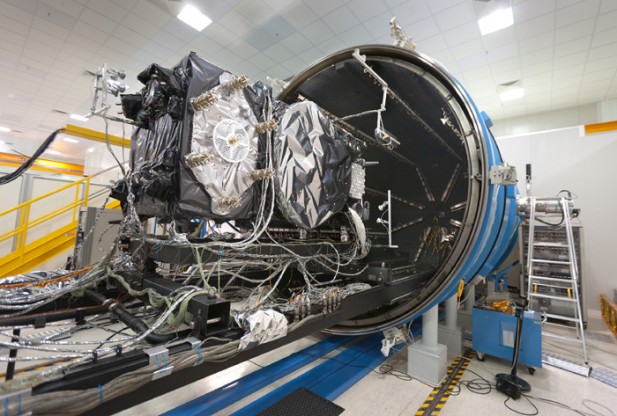
    The fourth Galileo In-Orbit Validation flight model satellite, FM4, pictured at the start of thermal vacuum testing at Thales Alenia Space Italy’s facility in Rome in May 2012. The third Galileo flight model, FM3, had already undergone this testing. Credits: ESA/EADS Astrium – R. Kieffer

    The next two Galileo navigation satellites have now endured the harsh vacuum and temperature extremes of space on the way to their scheduled 28 September launch, according to the European Space Agency. The fourth satellite completed 20 days of thermal vacuum testing at Thales Alenia Space Italy’s plant in Rome at the start of June. The third satellite completed the same tests the previous month.

    “These two satellites are almost identical to the first two Galileo satellites that were launched last 21 October,” explained ESA’s Nigel Watts. “So we don’t need to carry out full-scale qualification tests because we already know from our in-orbit test campaign that the design performs to our expectations. Instead, what we are carrying out is acceptance testing: checking the workmanship, performance and readiness to launch of these new satellites.”

    Thermal vacuum testing involves placing each satellite into a vacuum chamber and pumping out all the air. Its external surfaces are then variously heated and cooled while the satellite is operated. With no air in orbit to moderate temperatures, any part of a satellite in sunlight can become extremely hot, while those parts in shadow or facing deep space grow extremely cold. Critical systems must be kept within a set temperature range, however.
    “To give an idea, Galileo’s laser retroreflector on its exterior reached –110°C during the cold phase of testing,” said Guido Barbagallo, Galileo thermal engineer. “Meanwhile, the navigation high-power amplifiers could be driven to more than +40°C during the hot phase.”

    Like most satellites, Galileo’s uses a variety of methods to maintain its temperature range, including multi-layer insulation, heaters, heat pipes relying on evaporating ammonia to shift heat, and radiators to dump waste heat out to space. Galileo’s passive hydrogen maser atomic clock at the heart of its navigation services is precise to a second in three million years.

    But it requires extremely stable thermal conditions to achieve this. Its operating temperature needs to be regulated within a single degree, though in practice a tenth of that can be achieved.
    “The passive hydrogen maser is mounted on a 3 mm-thick aluminium plate to help hold a uniform temperature, with waste heat finally radiated to space from the external satellite surface,” added Guido.

    The atomic clock and the mounting plate are wrapped in multi-layer insulation and attached to the top panel of the satellite, which is itself kept permanently out of the Sun.

  • L-3 Announces First-Ever Successful Gun Firing of Next-Generation M-Code GPS Receiver

    L-3 Communications announced that its Interstate Electronics Corporation (L-3 IEC) business successfully completed multiple test firings of its next-generation Military Code (M-code) GPS receiver technology. The milestone represents a significant breakthrough in GPS receiver modernization and validates the unit’s survivability and performance in extreme, guided munitions environments, according to the company.

    L-3’s gun-hardened, next-generation M-code GPS receiver prototype was fired from a 155-mm howitzer and tracked the M-Prime signal from several modernized satellites to successful target impacts. This represents the first-ever use of the M-code GPS technology in a weapon system, and provides critical validation of the hardware and software performance in a projectile.

    The successful test supports a Congressional mandate to implement M-code technology on all future and existing U.S. Department of Defense (DoD) platforms and their objectives for technical innovations capable of offsetting future threats. L-3’s new design presents a flexible hardware and software configuration for GPS integrators and is capable of tracking legacy and modernized signals. The receiver will be applicable on a variety of host platforms, including guided munitions, unmanned aerial systems, soldier systems and ground mobile systems.

    “Our backward- and forward-compatible next-generation receiver provides a proven, low-cost solution for development programs as well as an upgrade option for current fielded systems,” said Todd Gautier, president of L-3’s Precision Engagement sector. “Our solution supports a seamless technology transition when M-code is fully operational and deployed, and the design meets long-term security and information assurance standards.”

    Based in Anaheim, Calif., L-3 Interstate Electronics Corporation has a long history in GPS receiver and translator-based products currently in use on multiple aircraft, missiles and precision-guided weapons. L-3 IEC also produces C4ISR hardware and software systems for military and government applications and has been a long-term supplier of critical navigation, test instrumentation and missile tracking systems for the U.S. Navy’s Fleet Ballistic Missile (FBM) weapon systems, including the Trident submarine.