ITT Corporation has been awarded a contract for the next-generation GPS Command and Control Systems designated OCX by the U.S. Air Force. ITT is part of a team, led by Raytheon Company, that will develop a system design and prototype of the OCX system. A system design review and prototype demonstration is scheduled for early 2009.
“This is a significant achievement for ITT,” said Chris Young, president of ITT Space Systems Division. “OCX represents our first, strong push into the GPS control segment.”
OCX is intended to improve command and control of the GPS constellation, improve mission capabilities, and provide a more user-oriented environment. Once implemented, Air Force Space Command can improve operational services for civil and military customers worldwide. The first phase of the contract will focus on defining the long-range architecture, technical requirements, concepts of operations, and fielding capabilities incrementally. Issues related to the introduction of future GPS III satellite blocks into the constellation also will be part of the OCX’s first contract phase.
“The cornerstone of our solution is a versatile, service oriented architecture,” said Young. “Our design will enable the government to implement low-cost, targeted software upgrades that won’t ripple undesirably throughout the system.”
NovAtel Inc. announced today that Hexagon Canada Acquisition Inc. has successfully taken up all of the shares tendered and not validly withdrawn pursuant to its tender offer for all the outstanding common shares of NovAtel, at an offer price of U.S. $50 in cash per share.
The tender offer and withdrawal rights expired at 5:00 p.m., New York time, on November 27 2007. According to the depositary for the offer, a total of 8,647,240 common shares of NovAtel were tendered and not validly withdrawn prior to the expiration of the offer (including 306,716 shares delivered pursuant to the guaranteed delivery procedures). Shareholders who validly tendered prior to the expiration of the offer and whose shares were not validly withdrawn will promptly receive the offer price of US $50 in cash per share.
As a result of the purchase of the common shares of NovAtel in the tender offer, Hexagon, through Hexagon Canada Acquisitions Inc., now owns approximately 93.3% of the outstanding common shares of NovAtel, including shares owned by Hexagon or any of its affiliates prior to the offer.
Hexagon intends to acquire the remaining outstanding common shares of NovAtel not previously tendered by means of a compulsory acquisition in accordance with Canadian law, on the same terms as the common shares acquired under the tender offer. After the consummation of the compulsory acquisition, Hexagon intends to cause NovAtel’s common shares to cease to be traded on the Nasdaq Global Select Market.
Following the completion of the compulsory acquisition, NovAtel will become a wholly owned subsidiary of Hexagon but will conduct its business relations with other subsidiaries of Hexagon on an arms length basis.
“Hexagon is excited for NovAtel to be joining the Hexagon group. We expect great things from NovAtel as it continues to operate independently and grow as a pure play supplier in the market for high precision Global Navigation Satellite System technology solutions to OEMs,” said Ola Rollen, CEO and president of Hexagon AB.
The European Commission (EC) is taking a closer look at TomTom’s planned acquisition of TeleAtlas; it looks as if it might have a tough European road to hoe. The EC only initiates a second review in about 3 percent of the mergers it reviews, so it’s a bit of an extraordinary step. The probe will examine whether the deal would push up the price of digital maps for rival portable navigation device makers or limit their access to these maps, the EC said. It set an April 17 deadline for the probe to end.
TomTom and Tele Atlas said in a joint statement they expect to have a clearer idea about whether the deal can go through by early next year. TomTom extended its offer for Tele Atlas shares until March 31, assuming it would know the outcome of the probe by then.
Navteq Corp. said Monday that it has scheduled a special meeting of stockholders next month to consider approval of the previously announced merger agreement between the company and Nokia.
Finnish mobile phone maker Nokia and digital map supplier Navteq first announced on October 1 that they had reached a definitive merger agreement to the tune of $8.1 billion (€5.7 billion). In the meantime, PND rivals Garmin and TomTom became involved in a bidding war over Tele Atlas, a Navteq competitor.
Navteq stockholders of record at the close of business on November 13, 2007, are entitled to notice of the special meeting and to vote on the adoption of the merger agreement, according to the company. The special meeting will be held on December 12 in Chicago. Proxy statements and the accompanying proxy card were mailed to Navteq stockholders earlier this month, the company said.
Completion of the merger is subject to the adoption of the merger agreement by Navteq stockholders at the special meeting and the satisfaction of the other closing conditions set forth in the merger agreement. Navteq currently expects to complete the proposed merger in Q1 of next year.
Geospatial Systems, Inc. (GSI) has announced the development of a new Tactical Airborne Mapping and Surveillance (TAMS) system designed to produce National Imagery Transmission Format (NITF)-compliant imagery supporting forward area mapping requirements. TAMS is platform-agnostic, with a multisensor payload capable of in-theater fixed wing, helicopter, and unmanned aerial vehicles and unmanned aerial systems (UAV/UAS) deployment.
GSI and LGGI recently began testing the tactical mapping system, responding to interest in end-to-end sensor software capabilities within the DoD, and specifically by military services responsible for in-theater data collection. The team completed its initial testing of the TAMS system during NGA’s Empire Challenge 2007. During the July 2007 exercises, the team produced NITF-compliant image products from more than a terabyte of raw data.
The TAMS system is built upon GSI’s metric mapping-grade camera line. The plug-and-play camera modules include 2-megapixel high definition, 11MP, 39MP and Thermal IR metric cameras. The cameras are connected to a small, lightweight controller that stores, processes, compresses, and disseminates the map information to a ground station in NITF format.
“Geospatial Systems is pleased to collaborate with Leica Geosystems Geospatial Imaging on this considerable undertaking. We are excited to use our technology and breadth of products to satisfy the needs of the defense intelligence community,” said Maxime Elbaz, CEO, Geospatial Systems, Inc.
Christopher Tucker, senior vice president, National Programs, Leica Geosystems Geospatial Imaging, said, “Developing this partnership with Geospatial Systems further enables us to address our customer’s priority mission challenges, with a modular, and rapidly deployable suite of sensors and software.”
As we look forward in the modernization of GPS, and we’re looking at the spectrum of other systems that are coming online, GPS today has fundamentally the preeminent position in terms of positioning and navigation. If we don’t shoot ourselves in the foot in the transition from the GPS we have today to GPS III, which is 10 years out, GPS will probably remain the fundamental standard, because the only way non-military uses of these additional systems will get early use is by receiver manufacturers putting in dual-reception capability and using the new satellites as they go up, fundamentally as additional ranging signal augmentations. It’s the only way you get early use out of getting a few satellites in the sky.
A lot of whether GPS will retain its standard position has to do with worldwide confidence in the system. We’ve done a pretty good job of maintaining a level playing field for everyone in the world with regard to GPS. There haven’t been the problems that were experienced with Loran systems which were occasionally turned off, creating consternation in Europe. But the possibility, currently under consideration, of actually dropping an important accuracy augmentation element of GPS — the Nationwide Differential GPS (NDGPS) — before alternatives are available would certainly undermine worldwide confidence in the U.S. commitment to continuing to provide service equal to or better than what is already there.
The key issue here: You can have all the paper designs in the world you want, but fundamentally the question is once you have a given level of capability, how well is that maintained — and is it improved over time?
With all the machinations that have gone on, the United States has done a pretty good job. It basically delivers a set of signals that are better than promised. The system, especially with its augmentations, is clearly better today than it was 10 years ago.
Now, the U.S. from a policy standpoint does need to transition from where we are to GPS III. We simply need to do it in a wise manner. The problem that I see with zeroing out the budget for NDGPS is that we save very little money — about $10 million a year to maintain the system. For any accountancy firm, this would fall below the line of relevance in the budget. And the effect, in undermining international confidence in GPS and in direct costs to state and local governments, would far outweigh any such savings.
Until we have something in GPS III that provides accuracies in the half-meter range, which is what’s required for civil Geographic Information Systems (GIS) work, it would be foolish to turn NDGPS off. We would be degrading a system without any real alternative.
Furthermore, you’re probably going to cost state and local and federal governments, who use NDGPS extensively for local mapping, far more than $10 million by turning the system off.
I believe the main commercial use of NDGPS, outside of the GIS realm, is precision agriculture. The arguments to put it in originally were to provide the people on the interior of our continent the same sort of services that the coastal regions are provided. The issue we have is we don’t have a strong vocal constituency, and frankly state and local governments can’t provide much of a hue and cry for degradation of service.
And losing confidence, undermining international confidence in the U.S. to maintain a stable system, is not a party to the table, either.
Granted, international users do not actually use NDGPS itself. But they have invested the money to put in comparable base stations in their countries. For the U.S. to discontinue NDGPS undermines and brings into question whether their investment was a good investment — and whether, as an international user, you can comfortable continue to rely on GPS.
It’s a confidence issue. There is no economic damage to foreign users. But it’s a perception of undermining GPS credibility across the globe if we pull back support from a system that just a few years ago we deemed to be important and almost essential.
Some precision ag and other potential NDGPS users have switched over to WAAS, the Wide Area Augmentation System. There’s no question that WAAS is a good system, but you’re not going to get below a couple of meters, and you’re certainly not going to be able to farm above buried water tape. There’s clearly a market and I believe it’s part of the mix. It turns out it’s really tough to get at the 20-centimeter accuracy level over large distances, and WAAS will not give you that.
At some point in our transition — I don’t know whether it’s five years from now or 10 years from now — the world is going to be a different place in terms of satellite services and the level of satellite services. It may very well be at some point in the future, this space of 20–50 centimeter accuracy can be very well delivered by a private service (without interference in the RF spectrum), or let’s just say, can be delivered by satellite.
At that time, when there are truly other alternatives, I’m not going to be beating my shoe on the desk to maintain a legacy system. The issue in this whole positioning and navigation field is that as people are starting to get economic value out of information, introducing hiccoughs into the user stream of productivity enhancement is not a good thing.
We say that until there is a viable alternative for the 20–50 centimeter space, we ought to continue sending out the signals. Once there is a viable alternative, then you can certainly transition; look at the cost of transition, and you will probably transition.
But it turns out this is a relatively cheap way of providing information in this space and, frankly, we’re a long ways away from using GPS in automated systems that are directly related to safety of life. To get that, you have to play the game that the FAA plays, and worry about seven nines of reliability [99.9999999 percent]. GPS in its augmentation is probably at the one to two nine level. But as the usage increases, by having multiple augmentation systems and using them, there is no reason that reliability can’t be increased.
Fundamentally, the word to government is it’s premature to shut off the lights. It may be the right decision at some point in the future, but I think it would cause a lot more problems than the $10 million it would save if it’s done now.
CHARLES R. TRIMBLE is chairman of the U.S. GPS Industry Council.
WhiteStar Corp. has introduced SpotOn, a Web-delivered service which enables users to reach out over the Internet to convert a well’s public land survey legal description into a precise geographic coordinate. Users can enter a few well legal descriptions into the Web site to try the service.
“SpotOn determines well locations in real time, adding flexibility and saving an enormous amount of time compared to manual methods or the expense and time delays of using a data vendor,” said Robert White, WhiteStar president and CEO. “The service reduces errors and provides an easy way for oil and gas companies to keep their well locations up-to-date. Often companies change a well’s legal location just before the well is actually drilled and SpotOn provides the means for keeping the company’s mapping systems up-to-date as well as to improve or check the accuracy of existing well location data.”
To obtain an accurate well location, the user enters the well’s “footage call,” “quarter call” or a combination of both. Subscribers will be able to upload and download comma-separated files for batch processing. Using the national Public Land Survey database hosted on the WhiteStar server, SpotOn then reads the description and returns the longitude/latitude coordinate representing the well’s location in terms of either the NAD27 or NAD83 datum.
“We built SpotOn using technology developed over the course of calculating millions of well locations for our oil and gas clients during the past 19 years,” said White. “Well locations can be quite complex, but WhiteStar has developed an extensive rule base to generate latitude/longitude coordinates for any well having a public land survey system legal description.”
Developers will have access to a programming-language independent software API that can easily add SpotOn functionality to new or existing software applications.
The SpotOn product references the WhiteStar Unlimited Grid Access (UGA) product, a seamless digital mosaic of the public land survey grid covering all public land survey states including Alaska, and also incorporating survey data for Texas and the Gulf of Mexico state and federal waters. An UGA subscription is not required to utilize SpotOn as the service automatically references the public land survey on the WhiteStar server via the web.
In a statement late Tuesday, the White House said that President Bush has agreed with the U.S. Department of Defense recommendation to permanently do away with Selective Availability, the intentional degradation of the civil GPS signal.
Specifically, the statement said that the U.S. would no longer require that the ability to introduce timing errors in the GPS signal reserved for civilian use be built into future generations of GPS satellites; it specifically cited Block III spacecraft.
The White House acknowledged that this was following on the decision in 2000 to turn Selective Availability off. “Although the United States stopped the intentional degradation of GPS satellite signals in May 2000, this new action will result in the removal of SA capabilities, thereby eliminating a source of uncertainty in GPS performance that has been of concern to civil GPS users worldwide,” the statement said.
In simple terms, GPS satellites currently issue two different sets of signals used for determining location: one for the U.S. military and its allies, dubbed the Precise Positioning Service, or PPS, and one for civilian use, dubbed Standard Positioning Service, or SPS. PPS actually comprises two signals and is encrypted, whereas SPS only uses one and is unencrypted; it was designed from the start to be less accurate than PPS. When GPS came about, the military — the GPS satellite fleet is maintained through the U.S. Air Force — didn’t want its own technology being used against it in a conflict, so it intended to make the civilian signal less accurate.
Early on, however, SPS proved more accurate than was comfortable for the military, so it introduced Selective Availability (SA). SA degraded the accuracy of the civilian signal on a global basis by introducing intentional timing errors into the civilian signal.
Back in 2000, the U.S. government decided to turn off SA indefinitely, which is one of the factors in the growing adoption of GPS technology in consumer electronics today. This latest pronouncement from Washington D.C. effectively makes the policy change with regard to SA a permanent one.
The U.S. military says SA is no longer necessary, as it has a range of capabilities and technology to implement regional denial of service of civilian GPS signals when needed in the area of conflict — which is why it originally recommended doing away with SA back in 2000. Furthermore, since the advent of GPS, a range of technologies including supplemental satellite and ground-based navigation systems (such as DGPS, WAAS and EGNOS) have grown up to improve the accuracy of civilian GPS, essentially rendering SA moot.
Furthermore, the U.S. Air Force has acknowledged that a recent upgrade to the GPS ground control system will in the future provide a new “security architecture” for supporting troops in combat.
The U.S. Air Force Space and Missile Systems Center (SMC) announced in late August that the long-planned upgrade of the GPS command and control system will occur during the second week of September, fulfilling a major program commitment for 2007.
Dubbed the Architecture Evolution Plan (AEP), the upgrade will replace the entire GPS master control station, including both software and hardware, some of which dates back to GPS’s inception in the 1970s. The upgrade will, among other things, begin preparing the master control station to work with the latest generation of Block IIF satellites when they go into orbit; further work with the next-generation OCX, however, will be necessary for managing M-code and the new L5.
“The delivery of SMC’s new GPS ground segment to the 50th Space Wing [will enable] transition of satellite operations from a 1970s-era GPS mainframe computer to a new server-based AEP ground segment,” said Lt. Gen. Michael Hamel, SMC Commander. “I am very proud of the team that has thoroughly tested the new system to ensure no change to the GPS signal during the changeover to the new system. The best analogy I could make is that this is like changing the engine on a car while traveling 50 miles an hour down the road.”
Col. David Madden, GPS Wing Commander, added “The replacement of the legacy system to AEP is a benefit to both the warfighter and the civil community. AEP is designed to improve operations, increase efficiency, and provide a foundation for new capabilities as they become available. The replacement from the legacy mainframe system to a distributed architecture provides the capability to command and control the next generation of GPS satellites and lays the foundation for a new security architecture to support the warfighter in the field.”
The AEP transition will take place over a period of four to six days; the total cost of the new ground control system amounts to approximately $800 million. The Air Force will not announce the exact date and time of transition, but will inform users 48 hours after completion.
The upgrade features a new satellite control foundation that replaces the legacy system and adds new digital communications. This means installing and activating a new master control station at Schriever Air Force Base which includes new hardware and software to generate navigation messages, a new system for controlling satellites, and new capability to command satellites through the Air Force Satellite Control Network (AFSCN). Adding the AFSCN will increase the number of available antennas for contacting satellites. The upgrade also involves installing and activating the alternate Master Control Station at Vandenberg AFB in California, and upgrading the current GPS ground antennas.
Ground control at Schriever AFB will phase in a few satellites in the GPS constellation at a time; the process will be completely reversible if it encounters any problems. Before it begins, both old and new ground control systems will be synchronized in terms of positioning data, namely their reception of satellites’ timing and navigation signals, down to the millimeter level. GPS users should not notice the transition, according to the Air Force.
The AEP will retain all of the legacy monitoring stations around the world currently utilized by the U.S. Air Force, as well as the National Geospatial-Intelligence Agency (NGA) monitoring stations around the globe originally added as part of the Legacy Accuracy Improvement Initiative. Additional NGA monitoring station sites are in the process of being brought online for future inclusion within the AEP.
Galileo Tests; Rescue Role
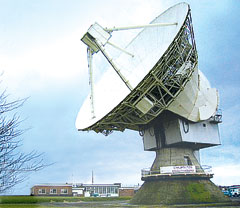
The antenna dish at Chilbolton Observatory.
The test campaign using the large antenna at Chilbolton Observatory to analyze the navigation signals transmitted by GIOVE-A, the first Galileo satellite, has been successfully completed, the European Space Agency (ESA) announced in mid-August.
Analysis of the satellite’s signals since January 2006, to verify their conformance with the Galileo system specification, has involved the Navigation Laboratory at ESA’s European Space Research and Technology Centre (ESTEC) in the Netherlands, the ESA ground station at Redu, Belgium, and the Rutherford Appleton Laboratory (RAL) Chilbolton Observatory in the United Kingdom.
Following signal analysis, operators have made some adjustments, re-programming the spacecraft’s navigation signal generation unit to compensate for changes to the signals introduced by the amplifier that boosts them for transmission to Earth and by a filter that protects adjacent frequency bands from interference.
To achieve the correct solution, the calibrated Chilbolton station was used to receive the signals from GIOVE-A. ESA’s Navigation Laboratory processed the resulting data. The signal generator manufacturer, TAS (France), calculated the new settings for the unit. Finally, the satellite manufacturer, Surrey Space Technology Limited (SSTL), uploaded the new values to the payload using their ground station at Guildford, in the United Kingdom.
According to ESA, “GIOVE-A is now transmitting optimized signals. Research and testing continues, and manufacturers are using the signals as they develop the receivers that users will need when Galileo enters operational service.”
Global Search and Rescue. Once operational sometime after 2012, Galileo will improve the detection of emergency beacons, according to program representatives whoattended the annual Joint Committee Meeting of COSPAS-SARSAT, the international program for satellite-aided search and rescue. Galileo satellites will carry transponders to relay distress signals to search and rescue organizations. Galileo partners have committed to developing a search and rescue component as an integral part of Medium Earth Orbit Search And Rescue (MEOSAR), the future worldwide search and rescue satellite system.
COSPAS-SARSAT already has systems operating in low-Earth orbit and geostationary orbit. The low-Earth orbit satellites can determine the location of emergency beacons using the Doppler effect as they pass overhead. However, there is a delay in relaying the distress signal because the satellites can only “see” a part of the Earth’s surface at any given time and a beacon is only detected when the satellite passes nearly overhead. Also, the satellites must store the location of the emergency and transmit it to a ground station once one comes into range, creating further delay.
Search and rescue transponders on geostationary satellites can constantly view a large, fixed area of the Earth, eliminating the time delay in detecting distress signals. However, they cannot automatically determine the location of the distress beacon as the low-Earth orbit system does, but must rely on the beacon to use a navigation system to find its position and include it in the distress call.
Emergency beacons require a direct line-of-sight to the geostationary satellites. There are some situations where this is impossible, such as near the Earth’s poles, where the satellites are too low in the sky, or when an accident occurs where surrounding terrain obscures the satellite.
Future Improvements. To improve performance of the overall COSPAS-SARSAT system, plans are now being made to fly search and rescue payloads on future navigation satellites. The various navigation satellite constellations will each have about 20 to 30 satellites in medium-Earth orbit, providing global coverage, including at the Earth’s poles, and with multiple viewing angles to the satellites, eliminating terrain blocking.
The Galileo search and rescue component will provide two services. The Forward Link Alert Service, backward-compatible with current COSPAS-SARSAT components and interoperable with all other planned MEOSAR elements, detects activated distress beacons and notifies the appropriate rescue body. A new Return Link Service will send a return message to the emergency beacon, notifying the emergency victims that their distress signal has been received and help is on its way.
The Galileo In-Orbit Validation Programme, which will have four satellites fitted with search and rescue transponders, will demonstrate the Galileo MEOSAR services — although its flight timetable has yet to be finalized or announced.
DOT Weighs NDGPS Future, Asks Public Input
The U.S. Department of Transportation’s (DOT) Research and Innovative Technology Administration (RITA) is preparing an assessment on the inland component of the Nationwide Differential Global Positioning System (NDGPS) that will determine its future.
As part of that assessment, it is seeking public input from users of the system.
The current expansion of the NDGPS has been placed on hold pending congressional review of the system’s funding; RITA’s assessment is part of that review. Differential GPS uses the fixed location of a reference station on the ground to improve the positioning resolution provided by civilian GPS satellite signals down to 1–3 meters. NDGPS facilities also monitor GPS satellites for anomalous behavior and issue integrity warnings when necessary.
The NDGPS program is operated jointly with the DOT’s Federal Highway Administration, Federal Railroad Administration, and Office of the Secretary of Transportation; the Department of Homeland Security’s U.S. Coast Guard; the Departmentof Commerce’s National Geodetic Survey and Forecast Systems Laboratory; and the Department of Defense’s Air Force and Army Corps of Engineers. Begun in 1997, to date there are 37 operational NDGPS sites. Two additional sites are ready for construction and could be operational in a matter of months, according to the Coast Guard.
As part of the assessment, RITA published a notice in the Federal Register addressing the current user requirements for the inland or terrestrial component of the NDGPS. This assessment is in preparation for making a recommendation to the National Space-Based Positioning, Navigation and Timing (PNT) Executive Committee, which oversees the entire GPS, on the need to continue to operate inland NDGPS and to make a decision on its future funding.
If no transportation requirements or other federal user requirements are identified as a result of the needs assessment, and if there are no other federal or other funding sources willing to sponsor or partner in sponsoring NDGPS, the DOT will develop a decommissioning plan for NDGPS, according to RITA.
The deadline for public comment is October 1, 2007. Comments may be submitted via the Internet at the Department of Transportation Web site. Instructions for other methods of submitting comments, including via postal service and fax, can also be found there in the docket management portion of the site.
The Robots of DARPA
The U.S. Defense Advanced Research Projects Agency (DARPA) has named 36 teams as semifinalists for its Urban Challenge to take place later this year.
The DARPA Urban Challenge will feature autonomous ground vehicles executing simulated military supply missions in a mock urban area. It will take place November 3at an urban military training facility located on the former George Air Force Base in Victorville, California.
The 36 semifinalists will compete in the Urban Challenge National Qualification Event (NQE), October 26–31. The top 20 teams from the NQE will move on to the Urban Challenge final event on November 3, and compete for cash prizes worth $2 million for first, $1 million for second, and $500,000 for third place.
At the NQE and the final event, the robots must operate entirely autonomously, without human intervention, and obey California traffic laws while performing maneuvers such as merging into moving traffic, navigating traffic circles, and avoiding moving obstacles. DARPA conducted competitive site visits across the United States to select the semi-finalists.
“The depth and quality of this year’s field of competitors is a testimony to how far the technology has advanced since the first Grand Challenge in 2004,” said DARPAdirector Tony Tether.
Stanford University’s winning robot vehicle from the last DARPA Challenge in 2005, which ran across the Mojave Desert, consisted of a stock Volkswagen Touareg R5 thatincorporatesd measurements from GPS, a 6DOF inertial measurement unit, and wheel speed for pose estimation.
Ken Hudnut (KH), U.S. Geological Survey geophysicist and leader of the Southern San Andreas Fault Evaluation (SoSAFE) Project, spoke with Managing Editor Tracy Cozzens (TC) on June 28.
Ken Hudnut uses GPS to locate a boulder offset 560 meters by the San Andreas fault
TC: Can you give us an update on the L1C finalization and approval process?
KH: L1C has been specified in a document called the IS-GPS-800, and the initial public release of that was in April 2006. So we’re now over one year through the public review process called the Interface Control Working Group (ICWG). That’s a formal process whereby the GPS Wing, through a Federal Register announcement, asks for public input from the international GPS user community. And that formal process of accepting and handling comments is nearing conclusion. So all public comments that have come in have been addressed in the current version of this IS-GPS-800 document. Interested people can find the document online at the GPS Wing website.
The IS-GPS-800 specifies all details of L1C signal design, and that’s in common with the earlier interface control documents for other GPS signals. That makes it so that people can begin designing receivers today, well in advance of launch. That’s the whole idea, to make it so that signal designs are entirely open and entirely specified for manufacturers and other users and stakeholders so that they can see every detail of the signal design.
This “ShakeMap” of estimated seismic ground-shaking intensity shows the San Andreas Fault during a Big One scenario, a magnitude 7.8 earthquake. California is heavily ‘wired’ with GPS stations that measure plate motion.
That review process is basically wrapping up and the intent of the GPS Wing is to move forward. They would like to get everything pinned down on GPS Block III before going out for the next stages of their acquisition and procurement process.
TC: When do you think we can expect the first Block III launch?
KH: People have been saying for some time now that initial launch of Block III would occur in August 2013.
TC: How long thereafter until L1C is operationally useful?
KH: It’s a gradational thing, and I think the anticipated rate of satellite launch would be at three per year, optimistically. So IOC (initial operational capability) would be expected about five years into Block III, around September 2018. IOC to FOC (full operational capability) is also gradational, but FOC would be in the neighborhood of 2021.
TC: At either stage, you’d still be able to make use of the signal.
KH: Yes, so as soon as a new signal is introduced, people are going to start jumping on it and using it. One example of that is L2C, which is currently being broadcast and received, and people are starting to make use of it. As more and more satellite signals are introduced, GPS becomes more and more useful. L2C is significant because it gives civilians a signal on L2 that they can legitimately use, so that’s a plus for civil users. Having that L1/L2 combination is very powerful for civil users. In the future with the introduction of L5, it will allow us to do tri-laning, which we are also looking forward to.
This map represents the Plate Boundary Observatory, funded by the NationalScience Foundation and built by UNAVCO, which increases the accuracy of real-time earthquake, volcano, and tsunami alerts.
TC: What other new opportunities exist for further enhancing GPS in later segments of Block III?
KH: Overall, the mindset is that people want to see to GPS sustainment with Block III, so the initial Block III satellites are going to have that as their priority. But there have been several interesting proposals for things that could be added to later Block IIIs. The hope is that there will be an opportunity to test those new ideas while at the same time, very importantly, minimizing risk. People would like to test and insert new technologies as early as possible within Block IIIs, but not at the risk of threatening constellation sustainment. Whatever is done will be done cautiously. There’s a lot of interest in several things that might be done to make GPS even better.
TC: Can you give me some examples?
KH: It’s probably a little too early. There are several really interesting concepts being floated right now. But they’re really not ready for prime time.
TC: How do you see the addition of the L1C signal improving early-warning systems?
KH: L1C itself is significant in that regard because we hope to phase it in along with new Galileo signals, so we’re talking about having many more satellites in the overall GNSS in that timeframe. Overall, the improvement for real-time uses — that we’re needing and looking forward to — have to do with improved accuracy and robustness in real time. L1C will help on robustness. The accuracy and precision, we’re looking at seeing those improvements even before L1C gets introduced. But basically, some of the techniques being used today — real-time precise point positioning (PPP), for example — are allowing decimeter , or better, level positioning in real time. We are starting to make better use of that in our early-warning systems on a test basis.
We’re doing work now that allows us to make use of GPS as it exists today. One limitation is simply the number satellites, but other limitations result in the ways in which people are doing dual-frequency carrier-phase positioning today, and doing carrier-aided pseudoranging through precise point positioning. All of these techniques are doing what you can with the existing GPS signal. Some of the future enhancements for GPS, and also other GNSS improvements, will definitely be helping us with real-time ambiguity resolution and therefore also with real-time precise point positioning that’s more robust, that’s more precise. Those are the areas where we really need improvement, possibly even beyond what currently is planned for GPS.
TC: As the leader of the Southern San Andreas Fault Evaluation (SoSAFE) Project, can you describe how GPS helps predict earthquakes?
KH: The overall project goal is to get a better idea of past earthquake behavior on the San Andreas Fault. That’s primarily studying evidence from trenches and using radiocarbon dating. So we’re trying to piece together the past history of earthquakes over the last 2,000 on the fault system as a way of better anticipating what may happen in the future. That’s the main purpose of the main SoSAFE project itself, which is part of a broader activity called the USGS Multi-Hazards Initiative.
As part of that, we’re also going to conduct a large-scale exercise on November 13, 2008, called ShakeOut. We’re going to try to get everyone in Southern California, actually statewide, engaged in an enactment of the Big One on the San Andreas Fault. My involvement has been to specify all the earth science details of that earthquake, using all the scientific information we have available, and taking into account the input of all the experts. From that, we’ve created an earthquake, and we’re doing modeling to simulate the effects of that earthquake on the socioeconomic fabric of Southern California. We’re going to do a full-scale simulation exercise and try to have everybody involved — news media, schools. This is the kind of thing emergency responders do all the time. It’s something people do to plan and be ready for future actual events. In our case, we’re hoping to do this on a scale that’s never been done before, at least in Southern California.
TC: So your GPS data will be used to help create this hypothetical earthquake?
KH: At this point, we have more than 410 continuously operating GPS stations in Southern California. Those are an integral part of earthquake monitoring. Right after the Northridge earthquake in 1994 is when we got our funding. Between 1996 and 2001, we built the first 250 stations and called that the Southern California Integrated GPS Network (SCIGN). We then, along with many other colleagues throughout the earth sciences, were able to get funding from the National Science Foundation to build EarthScope (www.earthscope.org), part of which is the Plate Boundary Observatory, which includes 875 additional new key GPS sites throughout the entire Western U.S.
So, since about 2002 that array has been constructed. The Plate Boundary Observatory is nearing completion. Now Southern California is really wired with continuous GPS receivers. What we’re doing is tracking the accumulation of strain on the fault system with that array. As the plate tectonic movements build up across Southern California, we can see that happening. Every day we measure the positions of these sites to within a couple millimeters. In the event of a big earthquake, of course, the ground is going to shake like crazy, and then each GPS receiver ends up in a different position. Afterward we can actually image the fault slip at depth by using the GPS data along with seismic data. With the SoSAFE project in particular and the GPS array we’ve built, we aren’t out to predict earthquakes in the usual non-scientific sense. What we’re doing is trying to understand them as scientists, and we call this forecasting. We are studying the physics of the earthquake source, which is chaotic because of friction, and trying to predict aspects of earthquake behavior at the system level.
Another thing I’m excited about is the use of GPS technology to do what we call earthquake early warning. It’s different than earthquake prediction or forecasting. You see the earthquake has started, and then much faster than the shaking has arrived, you send the word down the wire literally. You outrace the earthquake. Typically that’s been done with seismic instruments — accelerometers, basically. If you have an array of accelerometers along the fault system and distributed throughout the whole region, then as soon as the shaking starts you can detect that and triangulate the position of where the earthquake has begun, and then you can send word ahead that an earthquake is coming.
What we can do with GPS is actually build what I call a zipper array along the fault. In California, the source of future Big Ones will be the San Andreas Fault System and one of the branches of it, the San Jacinto fault. Either one could be the source of a future Big One. Over two-thirds of the plate motion happens on these two faults. Since it’s conceivable that a large, damaging earthquake could happen on another fault, we have to hedge our bets. It’s not like waiting and wondering which storm track some hurricane’s going to take, where you don’t know exactly where landfall’s going to occur. In our case, we can put a pretty sure bet on it. These faults are the big players. So if we put out instrumentation along these faults, it can help us with early warning for the Big One.
GPS can actually “see” the fault slip right when it happens. Seismic instrumentation is also good at that, but if you picture that the fault actually starts slipping, and you have a road that crosses the fault perpendicularly, the road will actually be laterally offset by the fault. So imagine that you have GPS receivers next to the road on either side of the fault, and as soon as it slips, you can see that happen. GPS is going to be crucial to future development of improved early warning systems.
The big problem with earthquake early warning has been false alarms. The seismic systems that don’t have an independent measurement technique built in are prone to false alarms because it’s a single technology. If you have a glitch that affects many instruments at once, it’ll set off a false alarm. Whereas if you have a system that includes other independent technologies along with the seismic, such as GPS, then you’re building in robustness to the system and it will be far less prone to false alarms.
That’s the future vision that I have; GPS will become embedded in our earthquake early-warning systems. In the next decade, we hope to fully embed GPS alongside inertial sensors for our future earthquake monitoring systems.
TC: In the past decade, you’ve come a long way in embedding GPS along with seismic monitoring. But you’re not using GPS in earthquake early-warning yet?
KH: We’re not doing earthquake early warning yet. It’ll cost some $20 million to $40 mmillion to do it right. We’re not doing as much as we could for very rapid estimation of the fault source. We’re working right now to get GPS even better integrated with the existing earthquake monitoring systems. We’re trying to do more with GPS in real-time.
TC: You’re mostly using GPS to do the research you were describing before.
KH: We’re very effectively using GPS for research. When an earthquake occurs, we’re now able to use GPS within a day. At the time of the Northridge earthquake in 1994, it took a week to make full use of the GPS data. In the future we want to be able to use the data within 10 minutes, and even instantly. Though we’re testing new ideas for this now, there’s a long way to go.
A group of us just sent in a major coordinated proposal to NASA. We’re trying to pursue the use of GPS in precise point positioning mode to do early warning for earthquakes, tsunamis, and volcanoes, all using these robust techniques for precise real-time positioning. We’re hoping to make some important technological advances, just using GPS as it exists currently. As new GPS capabilities come along, and new GNSS capabilities come along, we hope to make full use of those signals as well.
For real-time positioning today, it does help to have GPS and GLONASS. It certainly helps with any real-time positioning application to have more satellites in view, so I look forward to the future of several GNSS constellations with interoperable signals on several frequencies. For early warning of natural hazards, these advances will help greatly.
High-precision Global Navigation Satellite System (GNSS) positioning results are obtained with carrier phase measurements, once the integer cycle ambiguities have been successfully resolved.
2. Integer solution: real-valued float ambiguities mapped to integer-valued ambiguities.Examples of integer estimators (Teunissen, 1998a):
Integer Least-Squares: optimal, requires search to obtain solution.
Integer Bootstrapping: may perform close to optimal (decorrelating ambiguity transformation required), no search required (e.g. widelaning, CIR, TCAR).
Integer Rounding: the simplest of all methods.
3. Integer acceptance test: decision whether or not to accept integer ambiguity solution. Examples: ratio test, distance test, projector test.
4. Fixed solution: if the integer solution is accepted, the fixed baseline is computed.
The third step is often referred to as the ‘integer validation’ problem. In Verhagen (2004) this problem was addressed, and different approaches were compared.
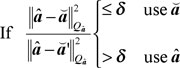
As an example, we will now consider the popular ratio test, which is defined as:
Where ȃ is the float solution with Qȃ, the corresponding variance matrix; and ă and ă’, the corresponding integer estimate and the second-best integer candidate, respectively; δ is the critical value. Note: in practice, often the reciprocal of the ratio test, as specified here, is used.
The underlying principle of the ratio test can be explained with a 2-dimensional example, see the figure below. Assume we have two ambiguities in our model. The black hexagons are the so-called integer least-squares pull-in regions: if the float ambiguity estimate falls inside a certain hexagon, the integer solution is equal to the grid point in the center of this pull-in region. Applying the ratio test, however, implies that this integer solution is only accepted if it falls inside one of the red regions. Otherwise, the float ambiguity is considered to be too close to the boundary of a pull-in region, such that the integer solution is not sufficiently more likely than the second-best integer candidate.
Note that the size of the regions is controlled by the critical value, δ, see Verhagen and Teunissen (2006), and Teunissen and Verhagen (2007), where it is described how this value should be chosen.
It can be seen that the acceptance regions are invariant for translations with an integer value. As such, the ratio test is invariant to integer biases. In fact, the ratio test is not suitable for testing the correctness of the solution. A model error, such as a bias in the observations, will propagate into the float ambiguities, but it does not necessarily mean that the float ambiguity will be close to the boundary of a pull-in region.
Hence, the ratio test is not a model validation test, and should only be applied in order to test whether or not the integer solution can be regarded sufficiently more likely than any other integer candidate.
With regard to GNSS model validation, we can make the following remarks:
1. Classical testing theory based on statistical hypothesis testing is not applicable due to the integer nature of the carrier-phase ambiguities (Teunissen, 1998b).
2. Testing theory for testing the presence/absence of a model error is not yet available.
3. Questions that need to be answered are:
What are the appropriate test statistics?• How are they distributed under the null-hypothesis and alternative hypothesis?
What are the appropriate acceptance/rejection regions?
References
Teunissen, P.J.G. (1998). “A class of unbiased integer GPS ambiguity estimators.” Artificial Satellites, 33(1): 4-10.
Teunissen, P.J.G. (1998b). “GPS carrier phase ambiguity fixing concepts.” In: Teunissen, P.J.G. and A Kleusberg. GPS for Geodesy, Springer-Verlag, Berlin.
Teunissen, P.J.G. and Verhagen, S. (2007). “GNSS phase ambiguity validation: a review.” Proceedings Space, Aeronautical and Navigational Electronics Symposium SANE2007, The Institute of Electronics, Information and Communication Engineers (IEICE), Japan, 107(2): 1-6.
Verhagen, S. (2004). “Integer ambiguity validation: an open problem?” GPS Solutions, 8(1): 36-43.
Verhagen, S. and Teunissen, P.J.G. (2006). “New global navigation satellite system ambiguity resolution method compared to existing approaches.” Journal of Guidance, Control and Dynamics, 29(4): 981-991.
Telecom chip maker Broadcom Corp. said Thursday evening that it had completed its acquisition of Global Locate Inc., a privately held provider of GPS and assisted-GPS chips and related software.
The acquisition is a strategic one for Broadcom, which specializes in wired and wireless semiconductors, and is known for its RF technology. The company notes that consumer interest in GPS applications is driving the market for GPS silicon; the market is expected to top $1 billion annually by 2012, Broadcom says, citing market research firm Forward Concepts.
Broadcom envisions combining Global Locate’s GPS technology with its own Bluetooth, Wi-Fi and cellular technologies, and supplying that combination to mobile handset makers.
Broadcom first announced plans to acquire Global Locate in June. Broadcom, which saw nearly $3.7 billion in revenues last year, paid approximately $143 million in cash for all outstanding shares of capital stock in Global Locate. Under the terms of the deal a portion of that payable to Global Locate’s stockholders was put in escrow; up to $80 million in cash will be reserved for future payment to these stockholders, provided certain future performance goals are met.
In connection with the transaction, certain former stockholders of Global Locate are purchasing $3 million of Broadcom’s shares at Thursday’s closing price on the Nasdaq Global Select Market. Broadcom may record a one-time charge for in-process R&D expenses related to the acquisition in its current fiscal quarter, which ends Sept. 30. The amount of that charge, if any, has not yet been determined.