Author: GPS World Staff

  • Hexagon helps Ghana utility modernize electricity distribution

    Hexagon helps Ghana utility modernize electricity distribution

    Hexagon’s Safety, Infrastructure & Geospatial division successfully deployed an advanced utility geographic enterprise asset management (EAM) system for the Electricity Company of Ghana (ECG). The smart EAM, featuring Hexagon’s G/Technology, will allow ECG to plan, manage and efficiently operate its distribution network to meet the growing needs of 4.5 million customers.

    The enterprise system from Hexagon unifies data from a variety of geographic information systems (GIS), enabling bi-directional data flow with other systems based on the Common Information Model (CIM) standard. The system enhances ECG’s ability to geographically reference and manage assets with integrated tools for data surveying, capture and maintenance and network planning and calculation.

    Mobile capabilities enable efficient inspections and maintenance, while a web portal assists employees with locating assets, reviewing the network and more. Migrating to Hexagon’s system will increase process efficiency and reduce asset-management costs by harmonizing systems, validating existing data and capturing missing data.

    “The utility GIS is the critical component that fuels innovation in the utility,” said Keli Gadzekpo, board chairman of ECG. “This project is the foundation and the first step to modernizing ECG operations. It is the platform for digitization of electrical network assets, a prerequisite for bringing efficiency in the wire business.”
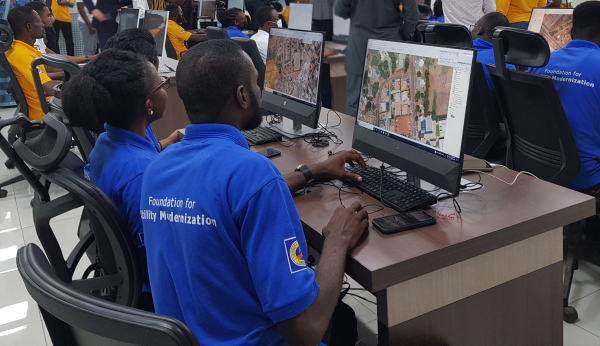
    Photo: Hexagon
    Photo: Hexagon

    Part of ECG’s Modernizing Utility Operations Activity, the project was commissioned by Millennium Development Authority (MiDA), Ghana, on behalf of the Government of Ghana’s Millennium Challenge Account Entity Program and funded by the U.S. government.

    “We are exceedingly grateful to Hexagon for working tirelessly to deliver this innovative product,” said Julius K. Kpekpena, Ag CEO and COO, Millennium Development Authority. “The technology sets Ghana’s biggest electric distribution utility on the path to modernizing its operations. The GIS is the foundation for modern tools to help ECG plan its networks, reduce losses, collect revenues and serve customers more efficiently.”

    The project included procurement and installation of system software, server hardware, mobile field units and services for data migration by Hexagon, field validation of assets by PDSA Ghana (part of Hexagon), and production of aerial imagery by ILV Wagner using Hexagon’s Leica Geosystems surveying and airborne imaging technologies.

    “Reliable electricity requires accurate data and tools to plan, design and manage networks, which can also reduce overall maintenance costs,” said Maximillian Weber, senior vice president, Global Utilities & Communications, Hexagon’s Safety, Infrastructure & Geospatial division. “We are proud to support Electricity Company of Ghana in delivering quality service to its customers.”


  • Improved 1Data Gateway provides new localization options

    Improved 1Data Gateway provides new localization options

    1Spatial logo1Spatial is improving its platform, adding a new language option and user experience enhancements to its data submission portal 1Data Gateway.

    Features in 1Data Gateway 2.5 are designed to make it easier for data contributors to submit their data. An Optional Data Submission feature allows contributors to submit exceptions to validations, and new integration with Esri ArcGIS Online adds a simple method of user authentication and authorization.

    A new Welsh-language option and updated support for 1Integrate 3.2 are included. Areas improved include schema mapping, allowing contributors to see the target schema and easily select attributes from dropdown menus.

    “This release is great for data contributors and streamlining our processes,” said Michael Martin, director of Consultancy at 1Spatial Inc. “We’re using new email notifications to receive an email upon successful submission, or for submissions that need my attention. Authenticating and authorizing via ArcGIS Online makes user-group maintenance easier, and the new Schema mapping is now also so much quicker, with easy selection of attributes from the target schema. Overall, this release is a huge time saver.”

    “This new release comes with many improvements to the user interface,” said Ricardo Cifres, senior product manager for 1Data Gateway. “The possibility of copying assignments as well as deleting projects, specifications and assignments makes the administrators’ lives even easier, and new PDF reports provide clear and concise information. We’ve also continued expanding our localization options, adding Welsh language to support a national project, and we have more languages in the pipeline. 1Data Gateway truly brings our rules-based technology to a worldwide audience.”

    1Data Gateway is used with 1Integrate to ensure compliance of data for use across the enterprise and provides automated data validation, cleaning, transformation and enhancement. It enables users to assess the quality of data to ensure it meets defined specifications and is fit for purpose.

  • UAVOS announces S1-V300 MALE unmanned platform prototype

    UAVOS announces S1-V300 MALE unmanned platform prototype

    UAVOS has successfully completed the S1-V300 medium-altitude long-endurance (MALE) unmanned aerial system (UAS) prototype designed to check basic aircraft systems.

    The advanced UAS model is based on the Saker MALE UAS design that achieved operational capability in 2020. The S1-V300 MALE UAS prototype is an upgrade to the unmanned system and features a new design and a more powerful heavy fuel engine with 260 HP offering greater speed, payload, and endurance of 28 hours with a range of 4,020 km.

    Work performed under UAVOS’ MALE UAS program using its proven Saker aircraft capabilities has enabled it to create a new-generation S1-V300 MALE unmanned platform. The aircraft features unique UAVOS avionics solutions and a redundant flight control system that will enable complex missions.

    The S1-V300 UAS will be able to support a variety of overland and maritime intelligence, surveillance and reconnaissance (ISR) missions. The improved S1-V300 prototype is equipped with both line-of-sight (LOS) and beyond-visual-line-of-sight (BVLOS) datalink systems for over-the-horizon operations. Additionally, the aircraft can be integrated with multiple ISR sensors, including electro-optical infrared (EO/IR) cameras and a synthetic aperture radar (SAR) that offers all-weather, day/night performance for a wide-area search capability.

    The S1-V300 MALE UAS next-generation capabilities combined with medium-altitude persistence make it a suitable platform to add with long-range radar, signals intelligence (SIGINT) payloads,  communication-relay payloads, and counter electronic-warfare systems. Additional retrofits include stronger wings and extra hard points for carrying an external payload of 300 kg.

    The S1-V300 has fully autonomous operation capability. It is equipped with automatic taxi-takeoff and landing systems, satellite communication for extended range, and fully redundant avionics. It is designed to operate in harsh environments and is adapted to perform in extremely hostile, dry and dusty ambient air. The aircraft features a 8.7-meters-long fuselage and a 18.7 meters wingspan, is capable of flying at 220 km/h, and has an endurance of more than 28 hours.

    The S1-V300 MALE prototype. (Photo UAVOS)
    The S1-V300 MALE prototype. (Photo UAVOS)
  • PAR Government rebrands GIS situational awareness solution

    PAR Government rebrands GIS situational awareness solution

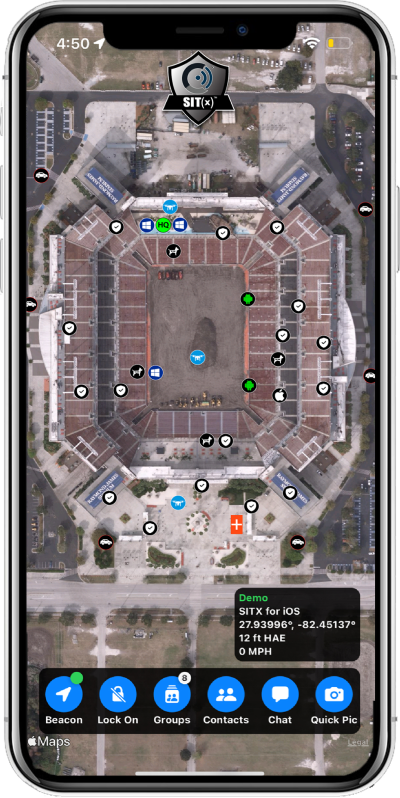
    Sit(x) running on an iPhone. (Photo: PAR Government))
    Sit(x) running on an iPhone. (Photo: PAR Government))

    PAR Government, a provider of geospatial and decision support solutions for 57 years, has rebranded its TeamConnect cloud-based situational awareness suite as Sit(x). The commercial Sit(x) solution is designed for enhanced collaboration among government and civilian public safety organizations. PAR Government Systems Corporation (PGSC) is a wholly owned subsidiary of PAR Technology Corporation.

    The Sit(x) solution enables individuals and teams to communicate directly by text or symbology and share real-time full-motion video (FMV), geographic information system (GIS) layers, imagery, GPS-derived locations, raster maps, photos and documents.

    To complement the Android and Windows support already available in Sit(x), PAR is offering a free iOS app, giving Apple smartphone users access to the technology.

    “The Sit(x) name better reflects the ability to provide effective situational awareness for any situation,” said Mark Kozak, PAR Government vice president of Product Innovation. “This results in faster, more informed decision making at the command level and in the field.”

    Sit(x) is a TAK server-as-a-service solution based on the Team Awareness Kit (TAK) situational awareness technology that PAR Government developed for the U.S. defense and intelligence community under contract to the Department of Defense. This technology has been deployed under demanding conditions by every branch of the U.S. armed forces over the past decade.

    PAR Government created the Sit(x) TAK server-as-a-Service offering specifically to enable real-time communication and information sharing between non-connected public safety personnel during rapidly evolving multi-jurisdictional situations, both planned and unexpected. These include large public gatherings, such as sports events or concerts, and emergency incidents related to terror attacks or natural disasters.

    “Sit(x) can save lives, time, and resources by federating unrelated police and fire departments, U.S. government agencies, volunteer search-and-rescue groups, and even private security firms to collaborate as one coordinated entity during a major event,” Kozak said. “Due to its TAK lineage, Sit(x) opens the lines of communications between civilian public safety and the U.S. military, as well as our allies, with no export restrictions.”

    The PAR Government Sit(x) offering is a subscription to the Sit(x) TAK Server-as-a-Service software suite in the cloud. Ready in minutes, Sit(x) scales to handle teams of any size and is protected with end-to-end secure connectivity. The suite provides complete lifecycle management – event preparation, rehearsal, training, dynamic response, post-mission playback and analysis, and new response simulation.

    The investment by subscribing agencies is minimal because there is no computer hardware to purchase, and the end-user applications are available from the Google Play Store or Apple App Store for free. All server operations and software maintenance are managed 24/7 in the cloud by PAR.

  • Nearmap and DroneShield join forces to protect against unmanned aerial threats

    Nearmap and DroneShield join forces to protect against unmanned aerial threats

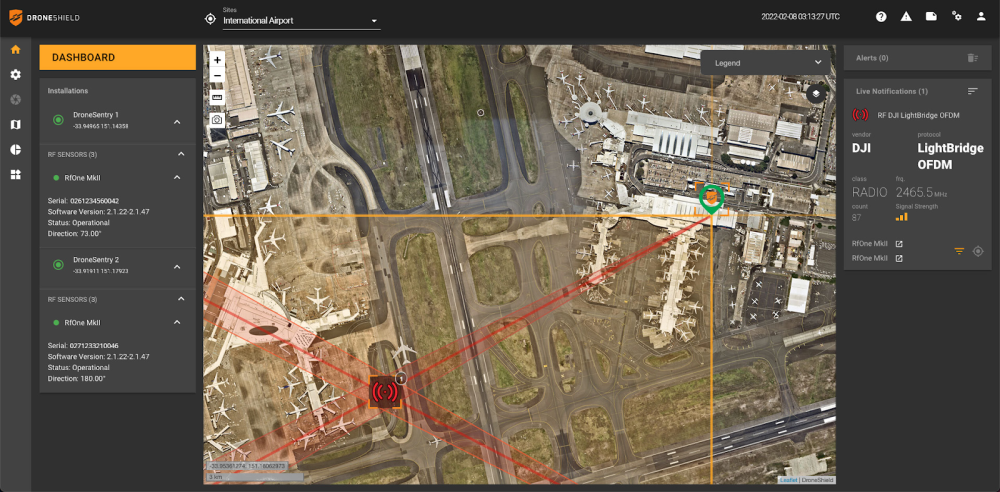
    DroneSentry-C2 with Nearmap location data. (Screenshot: DroneShield)
    DroneSentry-C2 with Nearmap location data. (Screenshot: DroneShield)

    DroneShield Limited, an Australian/U.S. global leader in artificial-intelligence-based platforms for protection against advanced threats such as drones and autonomous systems, has announced an enhanced version of its DroneSentry-C2 command-and-control software in partnership with location intelligence firm Nearmap.

    Nearmap provides city-scale 3D content, artificial-intelligence data sets, geospatial tools, and high-resolution aerial imagery in Australia, New Zealand and North America.

    DroneSentry-C2 provides an intuitive and feature-rich software platform, providing counter-UAS awareness and reporting capability. It integrates both DroneShield and third-party C-UAS sensors and effectors. Those include multiple AI-enabled sensing and tracking products, such as RfOne long-range direction-finding sensors for UAS detection and tracking, and camera-agnostic DroneOptID optical/thermal camera AI software.

    DroneSentry-C2 will come with a standard mapping solution for cost-sensitive customers, and an optional Nearmap mapping upgrade for mapping data for markets requiring high performance, such as government, intelligence, Homeland Security and defense.

    The software comes as an on-premises, air-gapped solution for intelligence, Homeland Security and defense users, or secure cloud for enterprise customers. The on-premises solution also includes a high-grade physical server. Both options come with regular mapping updates, including the ability for the user to load their own maps for sensitive locations.

    “One of DroneShield’s differentiators is that we are both a sensor manufacturer and an integrator,” said Oleg Vornik, DroneShield CEO. “Providing a streamlined and standardized hardware / software bundle that gives our user community an easy-to-deploy and run command-and-control software will be critical as more fixed and pop-up site users seek to deploy counter-UAS products. Importantly, the offering is already validated by deployments such as U.S. Air Force and Australian Army, among a number of other tier 1 end users globally.”

  • Successor to original Michibiki satellite passes functional tests

    Successor to original Michibiki satellite passes functional tests

    Mitsubishi Electric Corp. has completed initial verification of the functions and performance of equipment aboard the orbiting QZS-1R satellite.

    QZS-1R was launched Oct. 26, 2021, from Tanegashima Island in Kagoshima Prefecture and is now in quasi-zenith orbit as the successor to the original Quasi-Zenith Satellite (QZS-1), nicknamed Michibiki.

    Logo and patch for the QZS-R1 satellite (Image: Miitsubishi Electric)
    Logo and patch for the QZS-R1 satellite (Image: Miitsubishi Electric).

    With Quasi-Zenith Satellite System services also having completed testing of related ground systems, the Cabinet Office will begin launching various positioning services via the QZS-1R today.

    Mitsubishi Electric built and delivered QZS-R1 to the Cabinet Office of Japan. In addition to supporting these services, Mitsubishi Electric will continue developing satellite systems for forthcoming satellites QZS-5 to QZS-7, which will support advanced, sustainable, high-precision positioning in Japan.

    Compared to the first Michibiki satellite, the QZS-1R has improved durability that is expected to extend the satellite’s design life by about five years compared to its predecessor. QZS-1R, together with QZS-2, 3 and 4 (all launched in 2017), will support positioning, high-precision positioning augmentation and other satellite services.

    Name QZS-1R
    Mass Dry mass (i.e., without propellant): approx. 1.6 tons; at launch: approx. 4.0 tons
    Dimensions Stowed: approx. 5.4m x 2.9m x 2.9m; wing span: approx. 19m
    Orbit Quasi-zenith orbit
    Design life More than 15 years


    Illustration of QZS-1R. (Mitsubishi Electric)
    Illustration of QZS-1R. (Mitsubishi Electric)
  • Topcon offers MC-X Platform and MC-Max machine control solution

    Topcon offers MC-X Platform and MC-Max machine control solution

    Photo: Topcon
    Photo: Topcon

    Topcon Positioning Group has announced its MC-Max machine control solution. Based on its MC-X machine control platform, and backed by Sitelink3D — the company’s real-time, cloud-based data management ecosystem — MC-Max is a scalable solution for mixed-fleet heavy equipment environments. It is designed to adapt to owners’ machine control and data integration needs as their fleets and workflows expand.

    MC-Max increases processing power, speed, accuracy, versatility and reliability; and can be installed on a full range of dozers and excavators, using the same basic modular components. Modern, redesigned user and product interfaces were developed based on real-world applications and customer feedback and provide a simplified and immersive user experience that allows operators to learn the system easily.

    “With MC-Max, we’ve created a solution that is flexible and can continue to grow as a contractor’s needs and capabilities expand,” said Jamie Williamson, executive vice president, Topcon Positioning Group. “This new solution provides improved scalability and precision in the field and offers business owners real-time data integration, connectivity and resource management capabilities across their entire workflow.”

    The MC-Max solution offers flexible mounting solutions, as well as optional automatic blade and bucket control for a variety of machines. The system also provides a full battery of positioning technologies ranging from slope control to laser, multi-constellation GNSS, robotic total station and millimeter GPS systems.

    MC-Max provides project managers a real-time view of machine positions, activities and onsite progress, and is compatible with a wide range of site communications systems.

    Topcon MC-X Platform

    The Topcon MC-X Platform is designed to make machine control easy to use and affordable for all contractors. The platform ties together mixed fleets by interacting with multiple versions of 3D-MC, providing connectivity to Sitelink3D and taking advantage of the multi-constellation capabilities of GNSS antennas. 

  • Hexagon AB freezes business operations in Russia

    Hexagon AB freezes business operations in Russia

    Logo: Hexagon ABBecause of circumstances following Russia’s invasion of Ukraine, Hexagon AB has made the decision to freeze all business activities in Russia. Hexagon AB is a global leader in digital reality solutions combining sensor, software and autonomous technologies.

    Hexagon already suspended all exports of hardware and software licenses to Russia and is now taking further steps to adapt to the current business situation.

    Given the uncertainty of the outlook, these steps are constantly under review and will be adjusted if the situation changes.

    About 2 percent of Hexagon’s annual turnover can be attributed to business in Russia, with approximately 200 people employed in the country.

  • Software simplifies surveying with both GPS and total station

    Software simplifies surveying with both GPS and total station

    Photo: Carlson Software
    Photo: Carlson Software

    A module for SurvCE version 6 software enables surveying with mixed brands of GNSS receivers and total stations. SurvCE is a data-collection software package from Carlson Software. SurvPC Hybrid + provides driver support for numerous devices, allowing the surveyor to interface with both types.

    Features of SurvPC Hybrid+ include:

    Follow Me. An alternative to optical tracking, Follow Me continuously turns the total station towards the prism using the location as determined using GNSS. This eliminates stray reflectors and lengthy searches.

    Smart Lock. The software will automatically detect when a user is slowing to take a measurement and lock on the prism so that it’s ready to go.

    Smart Staking. With smart staking, it will no longer be necessary to maintain optical tracking during stakeout. Stakeout directions are kept fresh using the GNSS receiver as the surveyor approaches a stakeout point. When close to the point, the total station will automatically turn and lock on the prism for the final staking precision needed.

    Cross Check. SurvCE will automatically cross-check the total station and positions determined using GNSS and warn the surveyor when they differ.

    Backup Tracking. With backup tracking, SurvCE will automatically show the position determined using GNSS on the map when the total station isn’t locked.

    Hybrid-Resection. Easy hybrid-resection allows for setup anywhere using positions determined using GNSS to calculate the total station occupied point and orientation. Measurements from the GPS and total station are time-synchronized for an accurate and simple one-tap resection measurement.

    Auto-Localize. Simplify setup by seamlessly auto-localizing the GPS receiver as total-station points are stored.

    Easy Setup Wizard. The easy setup wizard walks users through setup using auto-localization, hybrid resection or hybrid localization, then finishes with a cross-check for quick project start.

  • Russia jamming aircraft satnav, French official warns

    Russia jamming aircraft satnav, French official warns

    pesian1801/iStock Editorial/Getty Images Plus/Getty Images
    Photo: pesian1801/iStock Editorial/Getty Images Plus/Getty Images

    The Russian military has disrupted flight systems in three regions since the invasion of Ukraine, highlighting the need for robust alternatives, according to a French safety regulator and as reported by Bloomberg.

    Airline pilots have reported jamming of satellite navigation systems around the Black Sea, eastern Finland and the Kaliningrad enclave, said Benoit Roturier, head of satellite navigation at France’s civil aviation authority DGAC.

    The jamming signals appear to originate from Russian trucks intent on protecting troops and installations against GPS-guided missiles. While the signals are not aimed at civil aviation, however, they force the pilots to deal with distracting alerts.

    “Airplanes hit by jamming can continue to fly using inertial navigation systems — that is standard and works with GPS,” Roturier said. “This could be less accurate, but can be used when GPS goes down.” Yet regulators are realizing the potential for massive airspace disruptions, especially as the European Union pushes for increasing reliance on satellite navigation.

  • IP-Solutions adds Eagle-2 receiver to SDR lineup

    IP-Solutions adds Eagle-2 receiver to SDR lineup

    iP-Solutions has added a GNSS receiver to its software-defined-receiver (SDR) front-end family. The new Eagle-2 works with software receivers in real time or records GNSS signals for post-processing.

    For post-processing, Eagle-2 it supports most third-party receivers, such as MATLAB and C/C++ receivers.

    The front end allows a user to work with two perfectly synchronized channels connected to two antennas.

    The Eagle-2 supports GPS, Galileo, GLONASS , BeiDou, QZSS and SBAS.

    Photo: IP-Solutions
    Photo: IP-Solutions
  • Seen & Heard: Hitchhiking marine life heads to Antarctica

    Seen & Heard: Hitchhiking marine life heads to Antarctica

    “Seen & Heard” is a monthly feature of GPS World magazine, traveling the world to capture interesting and unusual news stories involving the GNSS/PNT industry.


    Photo: Anton Rodionov/iStock/Getty Images Plus
    Photo: Anton Rodionov/iStock/Getty Images Plus

    UNWANTED HITCHHIKERS

    Antarctica’s pristine marine ecosystem, isolated for 15–30 million years, could be threatened by species such as mussels, barnacles, crabs and algae arriving on ships from 1,500 ports worldwide. A research team from the British Antarctic Survey and the University of Cambridge used automatic identification system (AIS) data, which relies on GNSS navigation data, and shipping databases to determine traffic to the Antarctic. The study is published in the Proceedings of the National Academy of Sciences, January 2022.


    Photo: FrankRamspott/iStock/Getty Images Plus
    Photo: FrankRamspott/iStock/Getty Images Plus

    QUAKE PREDICTION

    Within the next 30 years, a highly destructive Nankai Trough megathrust earthquake is predicted to hit southwest Japan. Understanding long-term slow slip events under the Bungo Channel is essential for pinpointing when such an earthquake will happen. Kobe University’s Yoshioka Shoichi and Seshimo Yukinari analyzed the 2018–2019 Bungo Channel slow-slip event using longitudinal GNSS data provided by the Geospatial Information Authority of Japan. The data revealed that even though the 2018–2019 event was shorter than others, it was bigger in terms of slippage and slip velocity, as well as magnitude. Results appear in Scientific Reports, Jan. 10, 2022.


    Photo: Bluesky
    Photo: Bluesky

    SUPPORTING SOLAR 

    British aerial mapping company Bluesky is helping Derby Homes roll out integrated solar photovoltaic systems across its housing stock. A project to identify suitable roof coverings assessed more than 8,000 addresses for size, pitch, aspect, existing structures and infringing vegetation. Using its ultra-high-resolution imagery, Bluesky determined the solar suitability of each property, the number of panels needed, and their potential output. Derby Homes recently installed its first integrated solar array on an initial batch of trial properties identified by Bluesky.


    Photo: JohnCarnemolla/iStock/Getty Images Plus
    Photo: JohnCarnemolla/iStock/Getty Images Plus

    TAKING MOM TIME 

    CQUniversity’s precision livestock management research team is using GNSS to detect calving events in extensive grazing herds. The discovery could provide beef producers in Australia with a way to remotely monitor their cattle and improve calf survival rates, one of their biggest challenges. The research project used GNSS collars with motion-detecting accelerometers on 30 cows in a 28-hectare paddock over an eight-week period at Belmont Research Station. The collars captured the animals’ location information every 10 minutes. Because the distance between mother and herd increases during calving, the data helped predict calving events, which were then visually confirmed by the research team.