Author: Tracy Cozzens

  • Study warns Southern California beaches eroding from sea-level rise

    Using a newly developed computer model called CoSMoS-COAST (Coastal Storm Modeling System – Coastal One-line Assimilated Simulation Tool), scientists predict that with limited human intervention, 31 to 67 percent of Southern California beaches may become completely eroded (up to existing coastal infrastructure or sea cliffs) by the year 2100 under scenarios of sea-level rise of one to two meters.

    Exposed bedrock on the beach, below the University of California, Santa Barbara, in February 2017. (Credit: Daniel Hoover, USGS.)
    Exposed bedrock on the beach, below the University of California, Santa Barbara, in February 2017.
    (Credit: Daniel Hoover, USGS.)

    “Beaches are perhaps the most iconic feature of California, and the potential for losing this identity is real,” said Sean Vitousek, who was a post-doctoral fellow at the U.S. Geological Survey when he conducted this study.

    “The effect of California losing its beaches is not just a matter of affecting the tourism economy,” Vitousek said. “Losing the protecting swath of beach sand between us and the pounding surf exposes critical infrastructure, businesses and homes to damage. Beaches are natural resources, and it is likely that human management efforts must increase in order to preserve them.”

    Vitousek is now a professor in the Department of Civil and Materials Engineering at the University of Illinois at Chicago, and lead author of a new study accepted for publication in Journal of Geophysical Research: Earth Surface, a publication of the American Geophysical Union.

    Installing large boulders as rip-rap to armor the shore against further erosion at Goleta Beach in Southern California. The tide is very low (negative). (Credit: Daniel Hoover, USGS.)
    Installing large boulders as rip-rap to armor the shore against further erosion at Goleta Beach in Southern California. The tide is very low (negative).
    (Credit: Daniel Hoover, USGS.)

    Although a majority (72 percent) of beaches in Southern California show historical trends of accretion or getting larger (due to large artificial beach nourishments since the 1930s), future predictions indicate that nearly all of the beaches will experience erosion (will get smaller) due to accelerated sea-level rise.

    “Beaches in Southern California are a crucial feature of the economy, and the first line of defense against coastal storm impacts for the 18 million residents in the region,” said USGS geologist and coauthor, Patrick Barnard. “This study indicates that we will have to perform massive and costly interventions to preserve these beaches in the future under the erosive pressures of anticipated sea-level rise, or risk losing many of the economic and protective benefits beaches provide.”

    Important for coastal hazard assessment and management planning, CoSMoS–COAST is a numerical model used to predict shoreline-change due to both sea level rise and changing storm patterns driven by climate change.

    Exposed bedrock on the beach during very low (negative) tide at Isla Vista, California, in February 2017. (Credit: Alex Snyder, USGS.)
    Exposed bedrock on the beach during very low (negative) tide at Isla Vista, California, in February 2017.
    (Credit: Alex Snyder, USGS.)

    The model takes into consideration sand transport both along the beach (due to longshore currents) and across the beach (cross-shore transport) by waves and sea-level rise.

    Although Southern California beaches are a complex mixture of dunes, bluffs, cliffs, estuaries, river mouths and urban infrastructure, the model is applicable to virtually any coastal setting.

    Additionally, the CoSMoS-COAST model uses information about historical shoreline positions and how beaches change in response to waves and climate cycles such as El Niño, to improve estimates and improve confidence in long-term prediction of coastline changes in Southern California.

    Although shoreline change is difficult to predict, scientists are confident in the accuracy and reliability of the model’s predictive capability applied to the forecast period (2010-2100), because of how accurately the model is able to reproduce the historical shoreline change between 1995 and 2010.

    An example of the shoreline data for La Jolla Shores, used in the CoSMoS COAST model. The many squiggly colored lines indicate the changing location of the shoreline through time. [Basemaps from Google Earth] (Credit: USGS.)
    An example of the shoreline data for La Jolla Shores, used in the CoSMoS COAST model. The many squiggly colored lines indicate the changing location of the shoreline through time. [Basemaps from Google Earth]
    (Credit: USGS.)
    “The public already has to overcome obstacles in getting to the beach, from limited public transportation to illegally blocked pathways,” said California Coastal Commission Executive Director John Ainsworth.

    “The prospect of losing so many of our beaches in Southern California to sea-level rise is frankly unacceptable,” Ainsworth said. “The beaches are our public parks and economic heart and soul of our coastal communities. We must do everything we can to ensure that as much of the iconic California coast is preserved for future generations.”


  • Remote Geosystems provides Google Earth extension

    RemoteGeo-Google-Earth-LV-O

    Remote GeoSystems Inc. has released a new LineVision Google Earth Extension. The extension is commercial software for UAV, airborne and terrestrial mobile inspection and survey projects requiring georeferenced video playback, analysis, collaboration and reporting using Google Earth and other GIS applications.

    Unlike its stand-alone predecessor, the new LineVision Google Earth is a true application extension and gives users the full functionality of native Google Earth, including Pro edition. Now anyone with a GPS-enabled video camera, drone or geospatial DVR that can geotag video in the proper format can immediately load their videos and photos to Google Earth along with compatible KML and other traditional geospatial data.

    As the video plays, a position marker moves along an aerial or terrestrial GPS track positioned three-dimensionally in Google Earth, continuously indicating where the current frames were recorded. Users may also geospatially “navigate” a video recording by simply clicking a single point along an aerial or terrestrial GPS track.

    The video then automatically advances to that point in the recording so that users can visually interpret what was recorded at that specific place and time. If something of interest is detected in the video, users may also “snap” a still image from the video, which is geotagged and saved for future analysis.

    The LineVision Google Earth Extension was designed to be an open and versatile tool for geotagged video analysis. The software is compatible with properly formatted georeferenced video files from a variety of consumer handheld and action video cameras, drones and specialized mobile geospatial DVRs, including Remote GeoSystems’ own geoDVR geospatial FMV recorder.

    In addition to video, users can import oblique photos and KML data from survey and inspection projects. All these imported data types can be saved in a Remote GeoSystems geoProject file for data portability, reporting and future analysis in other versions of LineVision desktop, cloud and server applications.

    Features include:

    • Playing videos from single and multi-camera data collection platforms
    • “Click-on-Map” video navigation
    • Setting a custom geo-fence around the moving position marker
    • Loading any Google Earth-compatible KML or shapefiles
    • Saving video and photo work as geoProjects for simple project reporting, archive and search

    Those interested can request a free seven-day trial by completing an online form.

  • Esri Story Map shows how US infrastructure needs serious work

    On March 9, the American Society of Civil Engineers (ASCE) released its 2017 Infrastructure Report Card, giving the United States a D+ grade. Mapping company Esri has created a Story Map to help put the infrastructure issues into context.

    The Esri Story Map “A Network Derailed” presents a comprehensive overview and analysis of all major transportation infrastructure systems and networks, including highways, bridges, railroads, ports, waterways and airports. Using interactive maps, users can pan and zoom to areas of interest.

    The latest authoritative data is incorporated, including the ASCE report card and the 2016 National Bridge Inventory released in earlier this year. The story also cites the latest figures from the Congressional Budget Office (CBO), Congress and the Trump administration.

    Some interesting facts:

    • In 2016, 47 percent of urban interstate vehicle miles traveled were over structurally deficient pavement.
    • The 10 worst trucking chokepoints for 2016 are displayed on the map (Atlanta, New York, and Chicago).
    • Bridges are scaled according to truck traffic and colored according to their structural status. Individual bridges are indicated.
    • Viewing rail bridges illuminates the fragility of the transportation system — one untimely bridge collapse could bring the regional rail system to a halt with few alternative routes.
    • The 50 busiest airports in the U.S. by total cargo landed can be viewed.

    Infrastructure-Esri-O

    Media: Esri


  • OGC approves new standard for geological science data

    The membership of the Open Geospatial Consortium (OGC) has approved GeoSciML as an OGC Standard. The OGC GeoSciML Standard defines a model and encoding for geological features commonly described and portrayed in geological maps, cross sections, geological reports and databases.

    GeoSciML provides a mechanism for storage and exchange of a broad range of geologic data enabling users to generate geologic depictions (such as maps) in a consistent and repeatable fashion.

    The model was developed by the IUGS CGI (Commission for the Management and Application of Geoscience Information), and version 4.1 is the first version officially submitted as an OGC standard. This standard describes a logical model and GML/XML encoding rules for geological map data, geological time scales, boreholes, and metadata for laboratory analyses.

    “Earlier versions of GeoSciML have been used for several years by geological data sharing projects around the world when GeoSciML was only an IUGS (International Union of Geological Sciences) standard. These include OneGeology, INSPIRE, the US Geoscience Information Network (USGIN), and the Australian AuScope and AusGIN projects,” said Ollie Raymond, chair of the GeoSciML SWG.

    “Having GeoSciML version 4 ratified as an official OGC standard is a huge step forward for GeoSciML, particularly to reassure application developers that GeoSciML is the way forward for geoscience data transfer,” Raymond said. “The collaboration of the previous IUGS GeoSciML working group and OGC has been a great example of effective cooperation between standards organisations.”

    “The formal documentation and approval of the GeoSciML 4.1 standards by OGC allows us to expand the exchange of highly interoperable geoscience data throughout the South American continent with the support of the OneGeology standards support network and allowed us to achieve the maximum 5 stars of OneGeology interoperability,” said Maria Glícia da Nóbrega Coutinho. head of the International Affairs Office of CPRM (The Geological Survey of Brazil) and OneGeology Board representative for South America.

    The GeoSciML standard includes a Lite model, used for simple map-based applications; a basic model, aligned with INSPIRE, for basic data exchange; and an extended model to address more complex scenarios. The standard also provides patterns, profiles (most notably of OGC Observations and Measurements; also ISO 19156), and best practices to deal with common geoscience use cases.

    For more information, contact [email protected].

  • Black Swift summits extreme altitude mapping test with small UAV

    Crisp orthophotos map 300 acres with sUAS flying over 14,000 feet

    Overcoming the challenges of mapping terrain in difficult conditions at altitudes exceeding 14,000 feet using a small unmanned aircraft system (sUAS), Black Swift Technologies demonstrated that a sUAS can successfully be deployed at extreme altitudes.

    Black Swift Technologies (BST), a specialized engineering firm based in Boulder, Colorado, was able to obtain geo-referenced digital aerial images with detailed actionable information, obtained cost-effectively without concern for a surveyor’s well being or equipment malfunctions.

    Using BST’s SwiftTrainer, a turnkey sUAS flight system designed specifically for GIS mapping applications, BST captured millions of data points in a fully autonomous flight over Colorado’s Mount Evans. The geotagged images were easily integrated into processing software, resulting in an accurate 3D orthomosaic (a highly detailed map in true scale).

    “Surveyors have been using sUAS in place of more expensive manned aerial missions for quite some time now,” said Jack Elston, Ph.D., CEO of Black Swift Technologies. “Being able to demonstrate that a sUAS can be an effective and accurate mapping platform in areas inaccessible to vehicles or at extreme altitudes solidifies the added value surveyors can offer their clients.”

    Using BST’s own Mission Planning Software, surveyors can program the SwiftTrainer in minutes to calculate the area under review and then begin collecting data for immediate analysis and decision making. Leveraging an intuitive tab-driven interface, flight planning is simple and easy to accomplish. Mission monitoring and mapping is all done from a handheld Android Tablet loaded with BST’s SwiftTab software. Intuitive gesture-based controls enable users to confidently deploy their SwiftTrainer with minimal training while being able to collect data over geography that is topically diverse with confidence.

    Unlike other sUAS offerings that cobble together hardware and software from a variety of sources to assemble their solutions, BST’s aerospace and software engineers designed the hardware, flight management system, and essential software from the ground up. This unified, fully integrated approach ensures that users have the right airframe and sensor suite to address their specific application requirements without compromise.

  • MDA to acquire DigitalGlobe, creating end-to-end GIS company

    Global information company MDA is acquiring DigitalGlobe under a merger agreement. MDA (MacDonald, Dettwiler and Associates Ltd.) entered into a definitive merger agreement with the Earth imagery company in February.

    MDA-Corporation-LogoMDA is Canada-based a global communications and information company providing technology solutions to commercial and government organizations worldwide. DigitalGlobe is a Westminster, Colorado-based vendor of space imagery and geospatial content, and operator of civilian remote sensing spacecraft.

    MDA will acquire DigitalGlobe for $35 per share in a combination of cash and stock. The transaction values DigitalGlobe at an equity value of $2.4 billion and an enterprise value $3.6 billion, including assumption of DigitalGlobe’s $1.2 billion in net debt. The transaction has been unanimously approved by the boards of directors of both companies, and is expected to close in the second half of 2017.

    The combination will bring together complementary space-related capabilities, creating a stronger company uniquely positioned to capture growth in the U.S., Canadian and global Earth observation and geospatial services markets given its ability to provide complete, end-to-end space systems, earth imagery and geospatial solutions.

    DigitalGlobe_LogoTogether, the combination will leverage a full suite of space-related capabilities, including communications and Earth observation satellites and robotics, ground stations, integrated electro-optical and radar imagery, and advanced data analytics. Additionally, the combined company will lead in cloud-based information services that allow commercial and government customers worldwide to better understand activity across the changing planet.

    As part of the transaction, MDA will apply to list its shares on the NYSE in addition to the TSX. Upon completion of the transaction, the combined Company will continue to execute its U.S. Access Plan strategy. This will include further reorganization of all or part of the combined Company’s corporate and operating structure to ensure that the ultimate parent of DigitalGlobe is incorporated in the U.S. by the end of 2019, subject to customary approvals. MDA undertook a corporate reorganization in 2016 that included the formation of SSL MDA Holdings Inc. (“SSL MDA Holdings”), the U.S. Operating Company of MDA, under the guidance and approval of the U.S. Department of Defense (DoD). SSL MDA Holdings currently operates under a Security Control Agreement (SCA) with DoD, allowing it to pursue and execute U.S. Government programs that require security clearances.

    “Today’s announcement creates a new company that will lead the industry, offering space systems and imaging solutions from inception to execution, able to make design decisions with our customer’s needs in mind,” said Howard L. Lance, president and chief executive officer of MDA. “This combination has the scale, resources and technology to serve the large and increasingly complex needs of government and commercial customers globally. By combining MDA and DigitalGlobe, we are significantly expanding our total addressable market by broadening both companies’ capabilities and facilitating future growth.”

    Lance continued, “MDA remains fully committed to its enduring and valued partnership with the Canadian Government and our Canadian employees. This combination offers the opportunity to deliver future economic and job growth in both Canada and the United States, as we focus on driving sustainable revenue expansion from our investments and create value for all our stakeholders.”

    Lance further stated, “The transaction is a major step forward in our previously announced U.S. Access Plan. We are committed to serving the U.S. Government as a mission-critical partner with an expanded portfolio of end-to-end solutions. DigitalGlobe will operate as a stand-alone division under SSL MDA Holdings, in the same way as SSL and MDA’s Canadian businesses.”

    Jeffrey R. Tarr, president and chief executive officer of DigitalGlobe, said, “Following a thorough review of strategic alternatives, we believe that joining forces with MDA will enable us to deliver more value to our customers, expand opportunities for our team members and maximize value for shareowners. This compelling transaction will deliver immediate cash value to shareowners with further upside through ownership in the combined entity, position DigitalGlobe to reach its next phase of growth and provide greater opportunities for our team members by being part of a larger, more diversified company.”

    Tarr continued, “Upon completing the transaction, DigitalGlobe will accelerate our vision of being the leading source of information about our changing planet. We look forward to working with the MDA team to ensure a seamless transition and to realize the potential of this exciting combination.”

    MDA is one of Canada’s leading technology companies, and has provided government and commercial customers with innovative space systems and solutions for decades. Since its founding more than 60 years ago in Palo Alto, Calif., MDA’s subsidiary company SSL (Space Systems Loral) has been the recognized global leader in communications satellite design and manufacturing. SSL’s global customers operate more than 85 communications satellites in geostationary orbit. SSL also produces small satellites for Earth observation and communications applications.

    In addition, SSL executes programs for NASA and other U.S. Government agencies, and was recently awarded two U.S. Government spacecraft program contracts for NASA, including Restore-L and Psyche. MDA Information Systems, based in Gaithersburg, Md. and Ypsilanti, Mich., is a leading provider of geospatial processing solutions and mission systems to U.S. Government and commercial customers.

    MDA in Canada is the leading supplier of radar satellites, geospatial services, integrated systems and robotics to the Canadian Department of National Defence (DND), the Canadian Space Agency (CSA) and commercial customers through its operations in Vancouver, Toronto, Montreal, Ottawa, and Halifax.

    DigitalGlobe brings to the combined company the industry’s most sophisticated satellite imaging constellation, a 17-year time-lapse image library, a world-class ground infrastructure, and a growing ecosystem of geospatial content producers and consumers leveraging artificial intelligence and machine learning to address complex global problems at scale. DigitalGlobe recently acquired The Radiant Group, which dramatically expands its capabilities in advanced geospatial expertise and analytics.

    DigitalGlobe is a trusted mission partner to the U.S. government and friendly foreign governments, serving customers in 90 countries around the globe and a diverse set of industry-leading commercial customers that rely on the highest quality imagery and advanced geospatial expertise to make decisions with confidence.

    The company is engaged in extending its industry lead through its investment in its next generation constellation, WorldView-Legion, and its partnership with KACST and TAQNIA Space to build a fleet of small satellites, SCOUT, which will allow the company to image the most rapidly changing places on Earth up to 40 times per day.

    According to the companies, the combination of MDA and DigitalGlobe’s technology offer attractive vertical integration benefits, including lower costs, increased speed-to-market and enhanced analytics capabilities. Combining MDA’s leadership in satellite design and manufacturing, radar capabilities, ground systems and systems engineering with DigitalGlobe’s constellation, archive, platform and advanced geospatial expertise and analytics will drive value and open channels for growth in adjacent markets.

    MDA’s technology in large and small satellites and ground stations will enhance DigitalGlobe’s future constellations, the companies said, positioning the combined company to extend its lead in the collection, dissemination and analysis of commercial Earth imagery collected with unrivaled resolution, accuracy, revisit and refresh of the most rapidly changing places on the planet.

    The transaction is expected to be accretive to MDA’s Operating EPS in 2018 and the combined company will deliver meaningful revenue and cost synergies of $75-150 million on a run-rate basis by 2019. Revenue synergies include accelerating SSL’s penetration into U.S. government markets, international market expansion, cross-selling opportunities and the ability to target larger geospatial services contract awards. Cost synergies include elimination of duplicative public company costs, procurement cost savings, efficiencies gained by leveraging SSL’s manufacturing capabilities for future Earth observation satellite constellations, and the operational benefits of increased scale.

    Lance, president and chief executive officer of MDA and president and chief executive officer of SSL MDA Holdings, will lead the combined company. Lance’s extensive experience in the global aerospace, defense and security markets will help guide and inform the transition and will position the combined company to capture growing demand for end-to-end space systems solutions, the companies said.

    The DigitalGlobe name, brand and headquarters in Westminster will be maintained. In addition, three of DigitalGlobe’s current directors will be appointed to the MDA Board of Directors. The combined company will have approximately 4,600 employees in the United States and will continue to employ more than 1,800 in Canada.


  • Topcon offers Bentley reality modeling with UAS solutions

    Topcon Positioning Group introduced Topcon ContextCapture, powered by Bentley Systems, a reality modeling software solution that will be offered with Topcon UAS (unmanned aerial systems).

    Context Capture software by Topcon.
    Context Capture software by Topcon.

    The system is designed for mapping, construction and surveying professionals to quickly turn simple photographs and or point-cloud data into true-to-life, highly detailed 3D models for use throughout a project lifecycle.

    “The offering will include Topcon ContextCapture Standard and Topcon ContextCapture Advanced,” said Charles Rihner, vice president of the Topcon GeoPositioning Solutions Group. “The standard package will be bundled with Falcon 8 and Sirius Basic/Pro and allows operators to process data from these UAS into textured 3D reality meshes, point clouds and orthophotos. ContextCapture Advanced allows users to process data from any UAS. It also includes ContextCapture Editor, which enables operators to take advantage of all project data by integrating reality meshes and point clouds, into infrastructure workflows. The result is access to a wide variety of reality modeling tools to help increase productivity.”

    The ContextCapture Advanced integration includes computer-aided design (CAD), inspection, GIS, civil engineering, and survey workflows on desktop and mobile devices, in multiple formats.

    “This represents the next step in the Topcon and Bentley collaboration to advance the concept of constructioneering — allowing users to start from a reality-captured survey context and leverage and update their digital engineering models throughout the construction process, and finally deliver the as-built infrastructure in real time,” Rihner said.

    “We are excited to bring to market this new joint offering that enables greater efficiency and productivity in the global construction market,” said Phil Christensen, Bentley vice president of reality modeling. “Our reality modeling solution for mapping, construction, and surveying professionals will enable them to quickly turn UAS imagery into engineering-ready 3D reality models that can be used immediately and updated throughout the construction lifecycle. Since we announced our constructioneering partnership last November, we see this as only one of many new integrations between Bentley and Topcon that will enable better project outcomes.”

  • Sentinel-2B satellite launched for Europe’s Copernicus program

    Artist's rendering of Sentinel-2B.
    Artist’s rendering of Sentinel-2B.

    The Sentinel-2B satellite was launched for the European Commission on Monday, March 6, at 10:49 p.m. local time from the Guiana Space Center (CSG), Europe’s Spaceport in Kourou, French Guiana.

    Following the successful launches of Sentinel-1A, Sentinel-2A and Sentinel-1B, the mission with Sentinel-2B marks the fourth satellite in the European Commission’s Copernicus Earth observation program to be orbited by Arianespace from the Guiana Space Center, within the scope of a contract with the European Space Agency (ESA).

    The Sentinel-2B Earth observation satellite mainly focuses on monitoring land masses and coastal zones around the world. It will be positioned in an orbit opposite that of Sentinel-2A to ensure optimum coverage and data delivery. The pair of Sentinel-2 satellites will cover the Earth’s entire surface in five days. This high frequency means they will capture brand-new views of the Earth, driving considerable progress in monitoring and predicting changes in vegetation and aquatic pollution.

    Sentinel-2B combines a multispectral, wide-swath, very-high-resolution optical imaging instrument with a dedicated platform developed by Airbus, a long-standing partner to Arianespace. It is the 61st Earth observation satellite to be launched by Arianespace.

    ESA’s Sentinel program includes six families of satellites:

    • Sentinel-1 will ensure data continuity with the ERS and Envisat radar satellites.
    • Sentinel-2 and Sentinel-3 are designed to help provide a better understanding of how climate change impacts our daily lives.
    • Sentinel-4 and Sentinel-5 are dedicated to meteorology and climatology, with a special focus on studying the composition of the Earth’s atmosphere.
    • Sentinel-6 will measure ocean topography, mainly for operational oceanography and climatology.

    This was the third launch of the year for Arianespace and the first in 2017 with the Vega light launcher. It also marked the ninth successful launch in a row for Vega, which made its debut at the Guiana Space Center in 2012.

  • Esri honors Microsoft for innovation in location strategy

    Esri has awarded Microsoft Corporation with the New Technology Integration Award at the Esri Partner Conference in Palm Springs. The award honors a company in Esri’s Partner Network for taking map visualization and location analytics to the next level by integrating ArcGIS in a new or innovative way.

    Microsoft was recognized for integrating Esri’s ArcGIS Maps into Microsoft Power BI, a set of business analytics tools. Power BI allows users to share insights in the form of interactive maps layered with authoritative data in one process. Users can access valuable geographic information in order to make better business decisions more efficiently without having to export data from numerous sources online, Esri said.

    Power BI enables users to create dashboards, reports, and visualizations of data through a cloud-based service. This allows anyone in an organization to use Power BI’s powerful analytical capabilities anywhere, and access them via an application that can be downloaded to mobile devices. For instance, a retailer surveying a new location can use ArcGIS Maps within the Power BI mobile app from the field to determine its proximity to potential affluent consumers.

    “We’re excited and humbled to receive the 2017 Esri Partner Conference New Technology Integration award,” said Kamal Hathi, general manager, Power BI, Microsoft Corp. “Thanks to the dedicated team across Esri and Microsoft, we delivered a sophisticated solution in record time. This was made possible by the open and extensible Microsoft Power BI platform which makes it easy for partners such as Esri to plug in and add value to our mutual customers. ArcGIS Maps for Power BI continues to iterate and improve based on customer feedback, reflecting the agility and customer oriented approach of both companies.”

    Armed with what Esri calls The Science of Where, a transformational way to unlock data’s full potential, Power BI users can create informed location-based analyses for everything from allocating resources to the best places to start a new business.

  • Trump administration proposes slashing NOAA funding

    Hurricane Fran at peak intensity on Sept.4, 1996. (Image: NOAA)
    Hurricane Fran at peak intensity on Sept.4, 1996. (Image: NOAA)

    The Washington Post reported March 3 that the Trump administration proposes slashing the budget of the National Oceanic and Atmospheric Administration (NOAA) by 17 percent, cutting steeply into climate change research funding and satellite programs.

    The Post cited a four-page budget memo it obtained. In the memo, NOAA’s Office of Oceanic and Atmospheric Research would lose $126 million, or 26 percent, of its funding, while NOAA’s satellite data division would lose $513 million, or 22 percent, of its funding.

    The proposed cuts to NOAA would also eliminate funding for f smaller programs, including external research, coastal management, estuary reserves and “coastal resilience,” which seeks to bolster the ability of coastal areas to withstand major storms and rising seas.

    NOAA is part of the Commerce Department, which would be hit by an overall 18 percent budget reduction from its current funding level.

  • Udee backpack could answer protection needs for mobile workers

    Udee backpack could answer protection needs for mobile workers

    The Udee backpack was designed to be comfortable as well as utilitarian.
    The Udee backpack was designed to be comfortable as well as utilitarian. Photo: Udee

    A new backpack could be the perfect answer for field workers, remote workers and people who travel with expensive equipment.

    The Udee backpack has 19 features, and was made possible through an IndieGoGo Kickstarter campaign. The versatile and user-friendly design is equipped with 19 features designed specifically for serious travelers and outdoor workers who need to stay connected and protect valuable equipment while belongings remain readily accessible.

    The designers of the Udee backpack integrated functions that make it adaptable to any situation. Functions include a portable cooler, a USB port for charging electronic devices, and an earphone pocket that allows users to keep their earphones in their backpack while listening to audio.

    Udee also has an anti-theft feature, important for anyone with a laptop or GNSS receiver. It has a port for a battery pack as well.

    The backpack, introduced this month, has already received an award from Forbes, and one from PC Advisor, which named it one of the top 14 laptop bags.

    The backpack is made of high-end padding and waterproof fabric, and has sturdy, roomy compartments. This reporter was able to carry inside her DSLR camera and 13-inch Macbook Pro (on which this review was written), as well as plenty of other material.

    The inside of the Udee backpack has padded sections to protect a laptop, camera, smartphone and other electronics.
    The inside of the Udee backpack has padded sections to protect a laptop, camera, smartphone and other electronics.

    Here is the full list of 19 features:

    1. Charging port
    2. Earphone port
    3. Lightweight build
    4. Anti-theft combination lock
    5. Safety LED light
    6. Portable cooler
    7. Photography bag
    8. Waterproof material
    9. Phone pocket
    10. Power bank pocket
    11. Notebook pocket
    12. Pen pocket
    13. Passport/cards holder
    14. Carabiner
    15. Safety reflective stripes
    16. Security pocket
    17. Luggage belt
    18. Large volume, 25-liter capacity
    19. Expandable volume

    To learn more about the backpack or place an order, visit the Udee backpack page.

  • PNT Roundup: Scaling down GPS-reliant devices

    By Ramki Ramakrishnan

    In many respects, the story of innovation in electronics has been about miniaturization: designers pack more features, functionality and performance into electronics that are smaller, lighter and more power-efficient. However, this has traditionally been applied only to a limited extent to atomic clocks, which electronic devices employ to maintain correct time if their GPS signal is lost.

    Atomic clocks have significant limitations in terms of scalability and portability, so until recently the best designers could use were ovenized crystal oscillators (OCXOs), which were smaller, lighter and consumed less power than atomic clocks.

    However, they were also less accurate and precise. Now, micro-atomic clocks enable addressing an entirely new range of use cases. A miniature atomic clock (MAC) is not the same clock made smaller; it’s a different clock.

    Timing Quality Measurements. A clock is accurate if its time agrees with a standard such as cesium reference or GPS. A clock is precise if its interval between ticks — its frequency of oscillation — is the same as a reference clock’s interval, even if the reference clock is inaccurate.

    A stern measure of precision is syntonicity, which is a measure of consistency in the occurrence of ticks within the environment. Radar requires syntonicity. To obtain a clear image of a scanned object, the receiver of the signal bounced off the object needs to know the exact instant the associated pulse was sent from the transmitter.

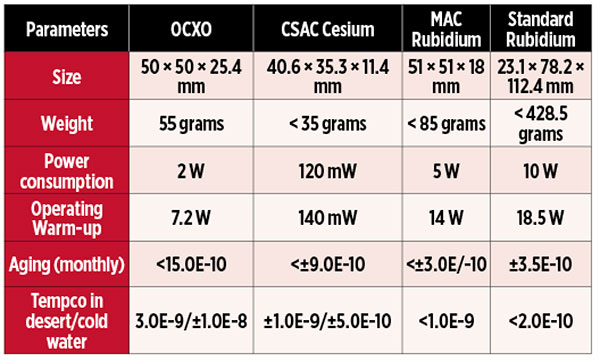
    It’s All About SWaP. One challenge of any timing miniaturization is whether the clock’s size, weight and power (SWaP) meet the needs of a given application. For example, a cesium chip-scale atomic clock (CSAC) is the smallest sized atomic clock in the current market; see the table below. By contrast, the rubidium MAChas the lowest power consumption after the CSAC (that is, 40 times more than CSAC). Before the introduction of the MAC, the standard rubidium clock was the clock with the lowest power consumption and with similar performance.

    Performance metrics of clock technologies.

    Benefits of small SWaP values are easily seen. Devices that required an external power source can now operate on batteries, without a heat sink. A person or a drone can now carry devices that were stationary or required a truck.

    Improvements in SWaP only matters if application requirements for accuracy and precision are also met. What happens if an application’s GPS access is lost? All clocks tend to drift once they no longer reference an external time source. This is known as aging. A key factor that affects aging is temperature. While operating in extreme environments (such as, deserts, high altitudes or under sea), the rate of timing error increases due to temperature variation; the amount of temperature-related error is called tempco.

    The availability of clocks with tight specifications signifies that designers can now employ accurate and precise timing in many ways and places. However, one must specify, analyze and select the clock carefully to meet the requirements of the application. For example, replacing the OCXO with a standard rubidium clock is typically not an option because the standard rubidium clock does not fit in to the OCXO form factor. Designers may consider replacing an OCXO with a CSAC or MAC if greater portabiity and better timing accuracy and precision are the key requirements.

    The choice often comes to one between the CSAC’s lower power consumption and weight versus the MAC’s superior aging performance in the event of GPS loss. The difference between the two clocks lies in how gas atoms trapped into resonance by a microwave synthesizer are excited and then interrogated, a concept known as coherent population trapping.

    Applications suitable for rubidium atomic clocks (MAC) include the following.

    Cellular Base Stations. Rubidium atomic clocks can meet the tight timing requirements for 4G-/LTE-base stations up to 24 hours (even longer for 3G and 4G). Moreover, rubidium’s superior aging ensures longer holdover, meaning the network can remain operational for longer even if the sync reference is lost. The MAC’s lower power consumption compared to a standard rubidium clock also contributes to a lower power and heat density overall, potentially reducing the need for external cooling while increasing the electronic reliability and reducing its size. Low tempco is also critical, considering the environments in which these stations often operate.

    Radar Base Stations. Radars require highly precise synchronization between transmitter and receiver signals. MACs are increasingly replace OCXO in these applications, which also benefit from the technology’s lower power.

    Applications suitable for CSACs include these.

    IED Jammers. Low-power consumption is critical in dismounted intelligent electronic devices (IED) jammers, which must be small, light and battery-powered. Yet they must be precise enough to tightly synchronize and allow pre-defined time slots in the signals (known as look windows) to allow friendly communications through.

    Dismounted Military Radios. Portability and precise synchronization are critical, especially given the higher bandwidth waveforms required to handle encoded video and other data-rich signals.

    Tactical Unmanned Aerial Vehicles (UAVs). In addition to relying on GPS (or clock holdover) for navigation, unmanned aircraft drones also require precise timing for their encoded data-rich and video communications. They also present challenges in terms of the size, weight and power consumption of payloads.

    Undersea Seismic Sensing. Differences in time measurements of acoustic pulses across sensor nodes are used to map subterranean formations such as oil deposits. In the absence of GPS under water, precise synchronization and very good aging performance are critical to harvesting reliable data during the duration of a survey deep under the ocean.

    More innovation lies ahead! Low-powered SWaP-friendly atomic clocks are revolutionizing the world without compromising clock performance, enabling many mission-critical applications.


    RAMKI RAMAKRISHNAN is director of product line management and business development, Clocks Business Unit, Microsemi Corporation.