URISA has released the program details of its Seventh Caribbean GIS Conference, taking place October 26-30 at the Santa Barbara Resort in Curacao. The conference, themed “Spatial Technologies: Fueling Economic Growth and Development” features regional conversations, pre-conference courses and workshops, comprehensive education, and opportunities to connect with experts, peers and private sector sponsors.
Regional Conversations
Geospatial Information High Level Meeting: Targeted at key decision makers in the industry particularly, senior personnel of international and regional bodies with responsibility for the management of geospatial data and information, senior government officials, experts on geospatial related issues in academia, members of the donor community, and private sector companies.
General Session: The Importance of Geospatial Technology in the Caribbean: An examination of the various issues that organizations are facing in the region as well as what is the overall value proposition that geospatial technology brings to the Caribbean economy. Participants will include senior representatives from national governments, donor agencies, academia, as well as experts from the vendor/consultant community.
Special Interest Group Roundtables: Important conversations including Geodetics, Open Source, Women in GIS, and Education.
Preconference Courses and Workshops:
Getting Started with GIS
Caribbean Decision Support System for a Climate Resilient Marine Managed Areas Network
Mobile and Server GIS: Field to Finish (two-day course)
URISA Certified Workshop: Addressing
URISA Certified Workshop: GIS Return on Investment
ArcGIS Online
UAV Workshop
Comprehensive Education:
Nearly 50 presenters in sessions covering important topics including:
Climate Change and Sea Level Rise
Disaster Mitigation/Modeling
Harnessing the Power of GIS for Utility, Asset and Infrastructure Management
Environmental Hazards
GIS in Disaster Management
Innovations in GIS
National GI Policy Development & NSDI
Public Participation GIS
Public Safety, GIS for Emergency Response
Addressing Systems
Change Detection
Geosciences & Regional Economic Development
Enterprise GIS and Mobile Technologies
Best Practices in Today’s Digital Organization
Spatial Technologies for Water Resource Management
GIS in Public Health
K-12 Education
Using UAVs (Drones) for Aerial Imagery Acquisition
Topcon Positioning Group has released the latest edition to the MS line of high-precision total stations in the North and South American markets. The MS AXII measuring station series is designed for precision-intensive tasks, such as monitoring, bridge construction, and other highly detailed engineering projects.
The series includes the MS1 AXII with 1-inch angle accuracy, and the MS05 AXII with 0.5-inch angle accuracy. “The MS1 AXII is perfect for long-distance measurement activities, while the MS05 AXII is built for high-accuracy survey and construction projects,” said Ray Kerwin, Topcon director of global surveying products.
“The fully robotic MS AXII models are vastly superior to conventional systems that simply lock on to the nearest targets,” said Kerwin. “The MS AXII auto-collimation system allows the instruments to lock on to targets that are closest to the center view of the telescope, providing long-rage precision and accuracy even in low-light conditions.”
Additional features include integrated Bluetooth connectivity options, durability with an IP65 rating, and TSshield technology for security and maintenance.
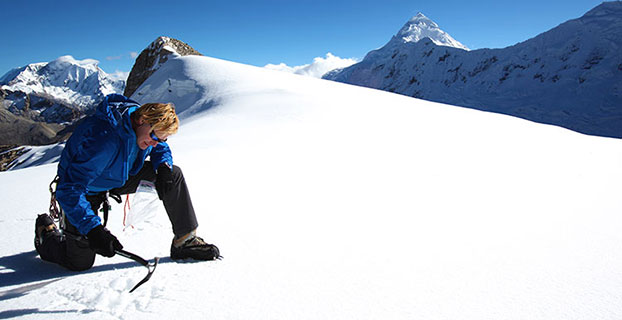
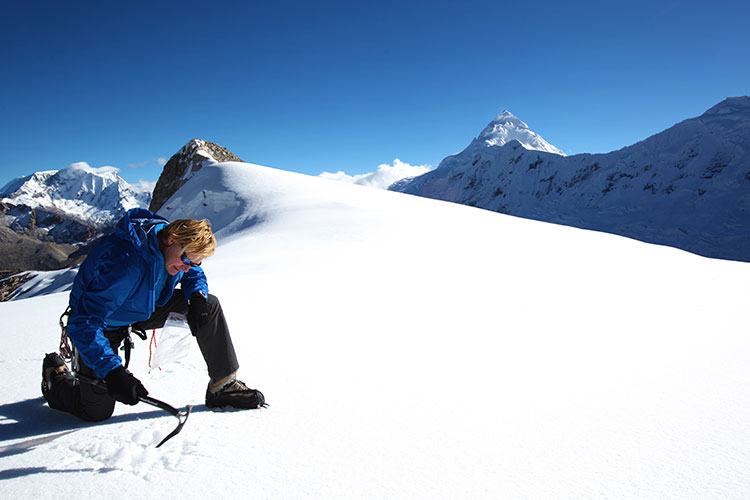
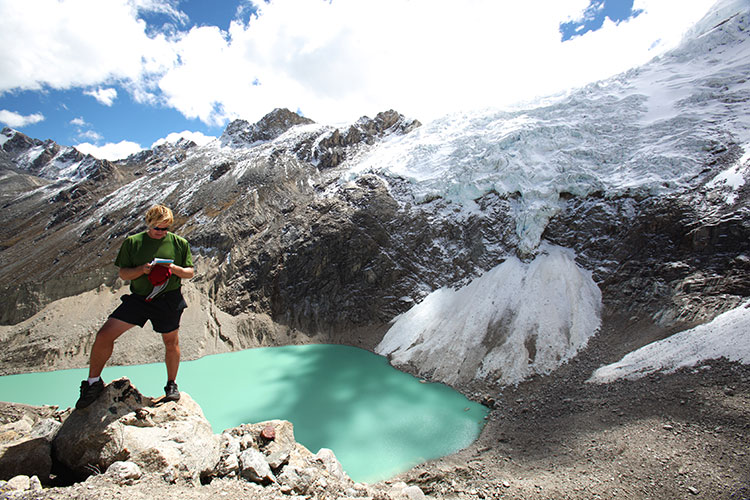
John All takes an ice sample from a glacier in the Ishinca Valley, Peru.
A climate scientist relies on a GPS satellite communicator to get him out of tight spots.
By Tracy Cozzens Photos by Clinton Lewis, Western Kentucky University
Please call Global Rescue.
John broken arm, ribs, internal bleeding.
Fell 70 ft crevasse.
Climbed out.
Himlung camp 2.
Please hurry.
That simple text message, sent May 19 via the DeLorme inReach communicator, alerted search-and-rescue monitors that the leader of a Himalayan research team was in dire straits.
Dr. John All, director of the American Climber Science Program (ACSP), was leading a team collecting snow samples in the highest mountain range in the world to study the impacts of climate change when he tumbled into a crevasse. “After crawling back for hours to my tent, I sent texts via my sat messenger for help,” All told the local Kathmandu newspaper.
Friends and family of the expedition followed the rescue efforts every step of the way as text messages were sent via the InReach to the ACSP’s Facebook page.
The climate scientist was rescued via a helicopter and admitted to Norvic International Hospital in Kathmandu with five broken ribs, a dislocated shoulder, and internal bleeding. After a day in the ICU, he was discharged for a week of rest before returning for further care in the United States.
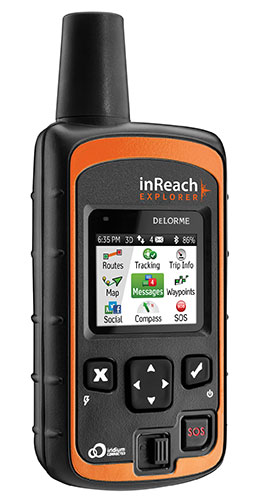
The DeLorme inReach Explorer.
In an emergency such as All experienced, the interactive SOS capability of the inReach automatically triggers remote tracking and allows users to communicate via text with responders at GEOS, DeLorme’s partner for international 24/7 search-and-rescue monitoring.
Going Out Again. All and his ACSP team departed for Huascaran National Park in Peru on June 23, just a month after his harrowing rescue in the Himalayas, for a two-month research expedition. All and several of his team members will be carrying the inReach devices.
Just like in the Himalayas, the inReach will give the team the ability to send and receive 160-character text messages from the remotest locations, provide location updates with GPS tracking, and keep them within reach of rescue with its SOS capabilities.
Besides providing peace of mind, the latest version of the inReach — the Explorer — allows the team to plan a route, mark waypoints, and create detailed track logs of their expedition.
“Knowing we would consistently be out of cell-phone range, we researched all satellite communication options to keep us connected,” All said. “A satellite phone was more than we really needed, and as a volunteer-driven non-profit program, it wasn’t very cost effective. We needed to be able to communicate back and forth in the event of an emergency, but we also wanted to keep everyone updated on the day-to-day status of the mission.”
Checking on the team’s status is as easy as visiting their Facebook page. Team members regularly post messages from anywhere in the world they might travel.
In Peru, the team of 20 students and scientists will examine changing climate conditions and the impact of human land use in the mountainous Cordillera Blanca region of the Andes, where Huascaran National Park is located. The park, a magnet for American climbers, has more than 33 peaks higher than 6,000 meters and hundreds of 5,000+ meter peaks. ACSP has been sampling snow in the region for the past three years in an effort to quantify the glacial contamination levels.
“Our work in Peru will be much more comprehensive than our high-elevation work in the Himalayas and will cover whole gamut of environmental parameters, from vegetation to water quality. The region is very remote and we will be collecting some samples from the walls of a crevasse to assess the seasonality of pollutants and their impact over time, so having an inReach with us is critical — both to communicate with each other and our team back home,” All said. Plus, he added, the students on his team will be able to communicate with their parents, providing their parents with peace of mind as their children travel to remote regions.
“Now that we’ve seen how well inReach works, we are looking forward to having more of them on this next trip — especially the newest Explorer model, which will allow us to mark waypoints during data collection,” All said.
In addition to the messaging, tracking and SOS capabilities, users of the company’s latest product inReach Explorer can view, create or navigate routes and waypoints. A map view displays routes, waypoints, tracks, and messages geo-located onscreen for backtracking or self-rescue. The built-in digital compass, barometric altimeter, and accelerometer sensors ensure accuracy and provide heading and bearing information, elevation readings, speed, and other useful trip statistics.
inReach communicates over the Iridium satellite network, providing global two-way satellite connections, high network reliability and low-latency data links (less than 60-second delivery of messages end-to-end) anywhere on Earth, with no gaps, fringe or weak signal areas. inReach has the ability to maintain a satellite signal lock even in difficult GPS environments, such as in a steep canyon or under a heavy forest canopy, DeLorme said.
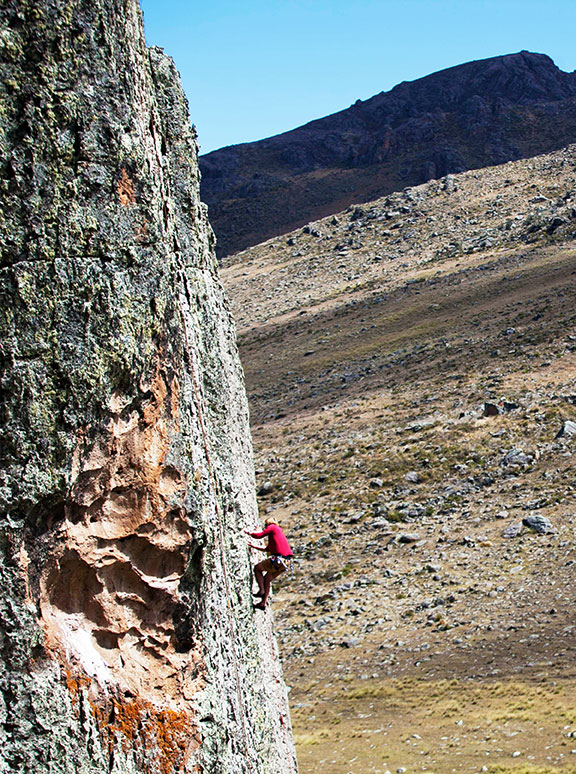
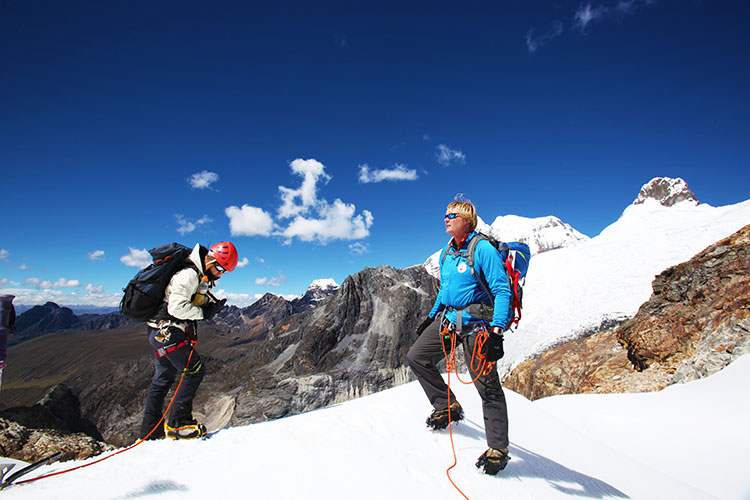
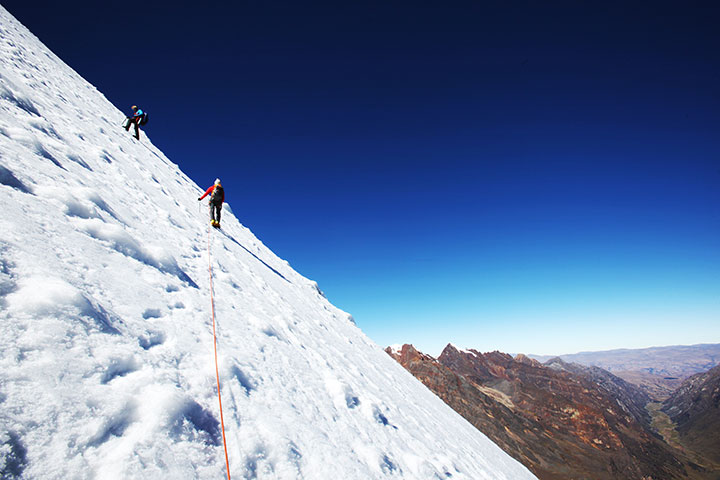
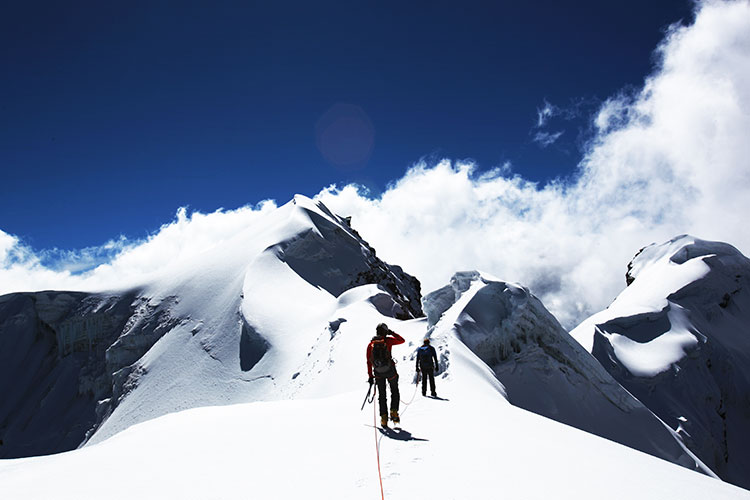
The ACSP has visited Peru for climate research for three years, including in 2013 the Quillcayhuanca Valley (left) and the Ishinca Valley, places so remote that staying in touch can be a challenge. (Photos: Clinton Lewis/WKU)
The U.S. Patent and Trademark Office has issued 10 U.S. patents to TeleCommunication Systems, Inc. during the second quarter of 2014. TCS also received two foreign patents during the quarter.
The 10 U.S. patents describe innovations in messaging, location-based services, GIS/mapping and wireless. They include the following three:
TCS reported in the first quarter that it was issued a Prepaid Short Messaging Services patent. In the second quarter, TCS received notice that another prepaid patent was issued to the company that will serve as one of the cornerstone patents in a monetization program that TCS is planning to launch later this year. The prepaid market has grown into a multibillion-dollar per year industry, with 86 million prepaid users comprising 27 percent of all U.S. wireless users, according to a J.P. Morgan 2013 market report. The recently issued Prepaid Short Messaging patent (U.S. 8,738,496) is a continuation of earlier TCS prepaid patents, bringing TCS’ prepaid messaging portfolio to eight, with one additional pending. Most prepaid phone systems allow users a prescribed amount of prepaid messaging and wireless call time. The ‘496 patent describes techniques for determining if a recipient’s account is sufficiently funded to receive a message. If it is not, the system prevents the delivery of messages until the recipient’s account is sufficiently funded, when follow-on messages will be delivered.
A geofence defines a virtual spatial boundary for creating triggers when a mobile device either enters or exits that boundary. Geofences are commonly used in child location services to alert parents when a child’s mobile device leaves the boundary of a school or park, or by enterprises to track the location of a mobile workforce or equipment. Establishing a geofence can be complicated, requiring that the user manually draw the boundary on an electronic map. The recently issued TCS patent covering a Method and System for Identifying and Defining Geofences (U.S. 8,731,813) describes techniques to simply and easily create geofences based on real-world objects or places. Using the map/navigation application on a mobile device, the user simply selects the desired location, using its pre-defined boundary to create the geofence.
Thousands of portable computing platforms have emerged that have the capability of directly connecting to the Internet either through a wireless wide area network (such as cellular network or campus Wi-Fi network) via a front-end built into the device (smartphone, etc.), or, via Bluetooth or other short-range wireless communication, to a wireless proxy device such as a modem or a smartphone. With various low-cost, short-range wireless devices installed in vehicles for navigation or entertainment purposes, it has become increasingly important to provide an easy and efficient method for a motor vehicle manufacturer, parent or other authority to monitor and control access to certain sites when those devices are connected to the Internet. The recently issued Remotely Provisioned Wireless Proxy patent (U.S. 8,712,408) describes techniques to create white lists (allowed URLs) and black lists (disallowed URLs) within a wireless/mobile device acting as a proxy so that access to certain sites can be controlled effectively.
The remaining seven U.S. patents issued in the period are: Integrated, Detachable Ear Bud Device for a Wireless Phone (U.S. 8,688,174); N-Dimensional Affinity Confluencer (U.S. 8,688,087); Login Security with Short Message (U.S. 8,712,453); Intelligent Reverse Geocoding (U.S. 8,731,585); Secure Location Session Manager (U.S. 8,687,511); System and Method for Location Assurance of a Mobile Device (U.S. 8,718,673); and Wireless Network Tour Guide (U.S. 8,744,491).
The U.S. Patent and Trademark Office has issued 10 U.S. patents to TeleCommunication Systems, Inc. during the second quarter of 2014. TCS also received two foreign patents during the quarter.
The 10 U.S. patents describe innovations in messaging, location-based services, GIS/mapping and wireless. They include the following three:
TCS reported in the first quarter that it was issued a Prepaid Short Messaging Services patent. In the second quarter, TCS received notice that another prepaid patent was issued to the company that will serve as one of the cornerstone patents in a monetization program that TCS is planning to launch later this year. The prepaid market has grown into a multibillion-dollar per year industry, with 86 million prepaid users comprising 27 percent of all U.S. wireless users, according to a J.P. Morgan 2013 market report. The recently issued Prepaid Short Messaging patent (U.S. 8,738,496) is a continuation of earlier TCS prepaid patents, bringing TCS’ prepaid messaging portfolio to eight, with one additional pending. Most prepaid phone systems allow users a prescribed amount of prepaid messaging and wireless call time. The ‘496 patent describes techniques for determining if a recipient’s account is sufficiently funded to receive a message. If it is not, the system prevents the delivery of messages until the recipient’s account is sufficiently funded, when follow-on messages will be delivered.
A geofence defines a virtual spatial boundary for creating triggers when a mobile device either enters or exits that boundary. Geofences are commonly used in child location services to alert parents when a child’s mobile device leaves the boundary of a school or park, or by enterprises to track the location of a mobile workforce or equipment. Establishing a geofence can be complicated, requiring that the user manually draw the boundary on an electronic map. The recently issued TCS patent covering a Method and System for Identifying and Defining Geofences (U.S. 8,731,813) describes techniques to simply and easily create geofences based on real-world objects or places. Using the map/navigation application on a mobile device, the user simply selects the desired location, using its pre-defined boundary to create the geofence.
Thousands of portable computing platforms have emerged that have the capability of directly connecting to the Internet either through a wireless wide area network (such as cellular network or campus Wi-Fi network) via a front-end built into the device (smartphone, etc.), or, via Bluetooth or other short-range wireless communication, to a wireless proxy device such as a modem or a smartphone. With various low-cost, short-range wireless devices installed in vehicles for navigation or entertainment purposes, it has become increasingly important to provide an easy and efficient method for a motor vehicle manufacturer, parent or other authority to monitor and control access to certain sites when those devices are connected to the Internet. The recently issued Remotely Provisioned Wireless Proxy patent (U.S. 8,712,408) describes techniques to create white lists (allowed URLs) and black lists (disallowed URLs) within a wireless/mobile device acting as a proxy so that access to certain sites can be controlled effectively.
The remaining seven U.S. patents issued in the period are: Integrated, Detachable Ear Bud Device for a Wireless Phone (U.S. 8,688,174); N-Dimensional Affinity Confluencer (U.S. 8,688,087); Login Security with Short Message (U.S. 8,712,453); Intelligent Reverse Geocoding (U.S. 8,731,585); Secure Location Session Manager (U.S. 8,687,511); System and Method for Location Assurance of a Mobile Device (U.S. 8,718,673); and Wireless Network Tour Guide (U.S. 8,744,491).
Organized by decade, the interactive map lets users explore inductees in the Pro Football Hall of Fame from the initial class in 1963 to this year’s seven inductees. Users can see where each gridiron great is from and explore biographical information from the Pro Football Hall of Fame about each inductee.
American Sentinel University’s new e-book, GIS for Crime Analysis, Law Enforcement and Public Safety, profiles how GIS has become an effective new crime-fighting tool used by law enforcement agencies to uncover criminal patterns that would be otherwise impossible to identify. The complimentary e-book is available for download.
GIS technology merges and manages massive amounts of law enforcement data into geodatabases that instantly analyze, map and aggregate data and provide law enforcement agencies with actionable intelligence to fight crime.
Senior Cpl. D.J. Beaty, police GIS and geospatial analyst for the Dallas Police Department, is featured in the e-book and shares insight about how his use of GIS and geospatial analysis has improved the ability to fight crime to ensure public safety.
“Crime is not uniformly distributed and identifying high crime areas or hot spots is significant for strategic and tactical approaches for law enforcement agencies,” says Sr. Cpl. Beaty. “New situations require new strategies and solutions. GIS analysis helps law enforcement agencies prioritize and allocate resources to targeted areas to address specific criminal activity. By implementing a geographic approach to analyze crime, the Dallas Police Department can efficiently and effectively meet the challenge of reducing crime in our community.”
The advanced spatial analysis of crime data continues to change the ways in which modern policing occurs. GIS provides the geographic advantage for law enforcement agencies to combat crime by using computers, analysis and programming skills to make predictions based on proprietary algorithms.
GIS for Crime Analysis, Law Enforcement and Public Safety is aimed at law enforcement professionals whose organization or company plans to implement new or enhance existing GIS technology. The e-book provides valuable insight about why GIS is on forefront of cutting-edge technology, the Dallas Police Department’s successful use of GIS to combat crime and offers a guide for law enforcement professionals to enhance their educational and professional goals.
Topics include:
Technology and Its Application
Types of Users
Training and Background
“As more law enforcement agencies embrace GIS, overall public safety can be enhanced through better crime prevention strategies, improved response times, interagency data sharing, cooperation and collaboration to ultimately see reduced crime rates through the community,” says Stephen A. McElroy, Ph.D., GIS program chair at American Sentinel University. “GIS has opened a world of new tools for law enforcement and given practitioners in the field a way to advance their careers while making a significant contribution to public safety and order.”
Spatial Wave, Inc., has announced that its latest releases, Mapplet, Field Mapplet, and MapLibrary are now compatible with Esri’s latest version of ArcGIS 10.2. New customers and existing customers on maintenance will receive the new release.
Mapplet is an advanced GIS viewer for viewing utility operational data that has unique capabilities to link to external data sources. Mapplet uses the latest ArcGIS technology for setup and configuration purposes and takes advantage of Arcgis.com base maps to enrich the experience of the users that are using map services from ArcGIS.com platform.
Field Mapplet is an advanced mapping and GIS-enabled framework designed to optimize utility workflows with an easy-to-use and implement solution. Field Mapplet takes advantage of ArcGIS Version 10.2 and includes a map-centric user interface. These new enhancements help bring together field and office workers, which in turn streamlines the daily workflow processes between crews, supervisors, and management.
MapLibrary is being further enhanced with support for displaying map services from ArcGIS Server 10.2 or ArcGIS.com platform depending on the choice of users.
Through the use of many powerful components, Mapplet, Field Mapplet and MapLibrary are designed for both utilities and local government agencies interested in developing GIS portals and maintaining geographic assets without additional programming.
F4 Tech is contributing to future foresters’ education by providing complementary SilvAssist software to colleges accredited by the Society of American Foresters (SAF). SilvAssist is a set of GIS tools for managing forest inventory data.
Institutions with SAF accreditation will be eligible for licensing of the SilvAssist solution to integrate within their curriculum.
“Understanding the forest inventory process and how it relates to GIS is critical for today’s students of forest resource management,” said Mark Milligan, president of F4 Tech. “We believe that providing SilvAssist free of charge to SAF accredited schools is the right thing to do, and we look forward to getting that started immediately.”
F4 Tech is confident that this new partnership with forestry schools will help to enhance and improve education in the design, management, reporting and analysis of forest inventory data.
SilvAssist is a toolbar for Esri’s ArcGIS that helps to improve productivity by providing information needed for crucial business decisions. SilvAssist is compatible with: ArcGIS 9.3, 10, 10.1, 10.2, and 32 and 64-bit computers.
The Army Corps’ GIS Cadre working at the Corps’ Recovery Field Office in Joplin, Missouri, after a multiple-vortex tornado struck Joplin on May 22, 2011. (Credit: U.S. Army Corps of Engineers)
When rescue and recovery crews make their way through communities devastated by hurricanes, tornados and wildfires, they need maps to help them to get around safely. One of the most relied on sources of these maps has been the U.S. Army Corps of Engineers, Geographic Information System (GIS) Cadre.
The cadre has successfully created maps to assist many federally declared disasters since 2002, including Hurricane Katrina and most recently Super Storm Sandy.
The Corps already had Planning Response Teams for disaster rescue and recovery, including teams to perform temporary housing, power, water and ice missions, and decided a GIS cadre would also be useful. The GIS cadre is made up of Corps employees from throughout the nation who are GIS subject-matter experts.
Wildfire Damage Maps. (Credit: U.S. Army Corps of Engineers)
When a federally declared disaster occurs, the team gets ready to deploy and can be on the ground in just hours, setting up their own equipment even before other agencies are on the scene. At the disaster location, they provide their GIS expertise in support for USACE Emergency Support Teams and for the Federal Emergency Management Agency (FEMA) and other state, federal and volunteer agencies.
Stephen McDevitt was one of the national action officers responsible for deploying and managing GIS teams during nationally declared disasters. “The GIS takes data from various sources, including aerial photographs and electronic data, and combines these layers of information in various ways to create maps. These maps can be used to perform many different missions and solve complex problems.”
“FEMA has called us for every major disaster since the team started in 2002,” McDevitt said. These missions have included ice storms, hurricanes, typhoons, tornados, floods, wild fire disasters and could also include manmade terrorist events if needed.
For these missions, a wide variety of maps have been created to help agencies to make important decisions to support relief and recovery efforts after a disaster strikes. Following are a few of these maps:
Rescue & Recovery: The cadre creates maps using geospatial information on where hurricane victims are located so that search and rescue workers can locate and recover stranded individuals.
Building Temporary Homes & Critical Facilities: Temporary housing and critical public facilities can’t be constructed on flood-prone land. The cadre creates maps that show agencies where there are flood zones. In addition, they create maps that show where there is safe land to place housing and facilities away from the devastation and near water, sewer and electric lines and services, such as schools and hospitals.
Debris Removal: The cadre creates maps that show field workers the location of debris, as well as clear land to use as staging areas for debris removal equipment. Maps can also show field workers the optimal routes for removing and transporting debris. This is needed when street signs have been blown away and many structures destroyed.
Pumping Water: The cadre creates maps that show agencies how long it will take for flood waters to subside, using different rates of pumping. The cadre can also take data on the locations and functionality of pump stations to create maps that help agencies figure out how long it will take to pump water out of a region.
Identifying Impacted Communities: The cadre can create maps that show the locations of damaged homes and businesses. These maps show agencies like FEMA where displaced citizens requiring assistance may be located and where recovery centers should be stationed. The cadre can also create demographic maps so that agencies know where economically challenged individuals may live who do not have transportation to reach the nearest recovery center. In these cases, a mobile center can be sent to these areas.
Preventing Future Safety & Environmental Problems: The cadre creates maps that can help communities prevent future dangers. For example, in the aftermath of the Southern California wildfires in 2008, the cadre created soil burn severity maps. These maps show where the fires burned the valley the most and where there is soil erosion. These large pieces of hardened soil can cause mud slides during the rainy season, creating dangerous landslides. These maps also show agencies where people should be evacuated.
Stephen McDevitt, former action officer for the U.S. Army Corps of Engineers GIS Cadre and former coordinator for the Enterprise GIS for the Army Corps’ New York District. (Credit: Dan Desmet, Public Affairs, USACE, New York District)
The Army Corps’ GIS Cadre is unique from other national GIS teams because these individuals are not only GIS specialists, but are also from other disciplines with the Army Corps. These professions include geographers, cartographers, physical scientists, civil engineers, park rangers, environmental scientists and others.
“Because of this, they bring a lot to the table,” McDevitt said. “We have engineers and hydrologists who use GIS to support district projects. These additional skills are very valuable when it comes to disaster situations. For example, if flood zones need to be identified before temporary housing can be set up; those with both GIS and water resources skills are especially useful for working with this data.”
He added, “If there wasn’t a GIS Cadre, FEMA would be constantly contacting the Army Corps for information needed during a disaster, pulling Army Corps personnel away from other important projects. By having this specialized GIS team, the team can focus their time and energy to the mission on hand. This is more efficient and makes better use of taxpayer money.”
McDevitt, a former action officer for the cadre and former coordinator for the Enterprise GIS for the Corps’ New York District, has been active with the cadre since it was created 11 years ago. Now as he nears his retirement he says he hopes the cadre, that is unique from other GIS teams, will continue well into the future. “I am proud to have had the opportunity to serve with the GIS Cadre since its creation. After 30 years of service with the federal government, I can honestly say it has been one of the most rewarding experiences,” said McDevitt.
McDevitt said that the cadre’s future is bright and he hopes it will continue strong for another decade or more. He says what will contribute to its success are team members who have GIS skills. These skills can come from having experience working with remote sensing, computer-aided design (CAD) and other geospatial data and systems technology.
There is also an increased need for individuals with advanced computer skills because many of the new mapping applications are web-based. This includes knowledge of HTML 5, Java and Silver Light as well as good database skills, such as working with Oracle, because the team works with large data sets.
“The Army Corps’ GIS Cadre stands ready to serve the nation, whenever and wherever there is a need for dedicated GIS subject-matter experts,” McDevitt said.
McDevitt (Far right) when he was an action officer with members of his GIS Cadre team. (Credit: U.S. Army Corps of Engineers)
The latest book from Esri Press provides a comprehensive view of the American Land Records System (ALRS). Modernizing American Land Records: Order upon Chaos examines the history of American land concepts, governance, and records systems and their use. The book considers institutional land record trends and the latest technical developments of location-oriented land data systems such as geographic and land information systems (GIS/LIS). Both the institutional and technical concepts are reconciled in the authors’ proposed design of a modern ALRS that is consistent with current attitudes, practices, and technological development.
The book is coauthored by Earl F. Epstein and Bernard J. Niemann Jr. Epstein is professor emeritus in the School of Environment and Natural Resources at Ohio State University. Niemann is professor emeritus in the Department of Urban and Regional Planning and director of the Land Information and Computer Graphics Facility at the University of Wisconsin-Madison.
Getmapping has posted strong growth for the 2013 financial year. The recently released financial results showed Getmapping post record turnover and profits on the back of strong growth in both the United Kingdom and African markets.
Getmapping is a public limited company, and terms itself the UK’s leading supplier of aerial photography, mapping products and data hosting solutions.
Group turnover was up 34% overall from £3.5m in 2012 to £4.7m in 2013, with the contribution from African operations up 86% on the previous year. Getmapping’s strong performance has also been reflected in its share price which has tripled in the last three years as interest in the company from investors grows, the company said.
Getmapping has been working hard to extend both the range of products and services that it can offer as well as its global reach. In 2013, for example, Getmapping established a new LiDAR division in Centurion, South Africa, which has enabled it to extend its range of services and provide them across a wider geographical area.
While the UK remains a challenging market, Getmapping continues to work hard to retain its strong position. As an example, Getmapping, together with Bluesky, was recently awarded a multi-million pound contract for the supply of geographic data to Central Government organizations. The contract, awarded by the Department for Environment, Food and Rural Affairs (DEFRA), covers high resolution aerial photography, detailed 3D height models and colour infrared imagery for the whole of England, Wales and Scotland. Under the new Aerial Photography for Great Britain (APGB) contract, Getmapping and Bluesky can also provide training, consultancy and workshops to contract members.
“Getmapping delivered strong growth in 2013 across all of our core business streams. The company has invested heavily in new sensor and processing technology and the investment is already delivering strong results which we expect to carry through 2014 and beyond,” said Dave Horner, managing director of Getmapping. “The recent DEFRA contract and winning the aerial photography contract for the Scottish government in 2013 has reinforced our position as the leading supplier of aerial photography services in the UK. The financial results are an endorsement of our strategy, but we won’t be resting on our laurels and aim to continue to improve our performance in 2014 and beyond.”

 Esri’s updated


