Author: Tracy Cozzens

  • Esri Launches Small Government Departmental Platform Program

    Esri’s new Small Government Departmental Platform Agreement allows for unlimited deployments of core ArcGIS software within one governmental department. Departments that have plans to integrate GIS in multiple workflows — such as assessors, health and human services, public works, fire, and planning departments — can use this program to rapidly achieve their goals.

    “Esri is always seeking to support departments that have a real vision for using GIS throughout their operations,” said Christopher Thomas, director of government markets, Esri. ”This program helps them get there faster.”

    This program is designed for departments that want to:

    • increase ArcGIS software and Software as a Service (SaaS) deployments.
    • have flexibility when deploying GIS to desktops, servers, and mobile devices.
    • have a predictable annual licensing model.

    The County of Tazewell, Virginia, population 45,936, was the first to participate. “This program has given the Tazewell County Engineering Department access to more tools and programs to help create and maintain better GIS data,” said Kenneth Dunford, assistant county engineer.

    The Small Government Departmental Platform Agreement program is open to all governments in the United States with populations of 100,000 or less. For more information, call Esri at 800-447-9778.

  • Ubisense Partners with Google Enterprise Maps

    Ubisense, a location intelligence solutions company, has become an Authorized Partner of solutions based on Google’s Enterprise Maps for Business technologies. This new designation from Google enables customers to more easily assess Ubisense’s expertise advising on and deploying Google products.

    In conjunction with the partnership, Ubisense formally announced Ubisense myWorld 2.0, an intuitive location intelligence platform that integrates Google Maps for Business technologies and provides visibility into an enterprise’s operations, enhancing operational awareness and enabling businesses to operate more effectively.

    Ubisense provides location intelligence solutions that address enterprise visibility challenges, and as an Authorized Partner, Ubisense can now provide Google Maps for Business integration and OEM licenses to its customers in a simple and cost-efficient manner. Ubisense myWorld brings critical enterprise information together into a single application that can be accessed via any standard web browser on any smart device. Ubisense myWorld incorporates network asset data, work orders, customer information, and other critical operational data from a variety of spatial and enterprise systems vendors. Additionally, Ubisense myWorld can be integrated with Google Maps for Business solutions, including Google Maps, Google Search, Google Earth, Google Elevation and Google Street View with Ubisense myWorld.

    “Google Maps give our customers a smart, simple, and fast way to view complex business operations so they can quickly understand the state of operations and make better and more informed business decisions,” said Jay Cadman, vice president of business development, Ubisense. “In, say, an outage caused by a natural disaster, having this detailed view of an organization’s operations in real time enables our customers to respond to safety issues, such as downed power lines, with the right equipment and safety precautions the first time. They can keep their employees and customers safer and restore services faster. Every telecommunications and utility company in the world strives for that and now we’re able to deliver a solution that enables them to achieve both goals.”

    Using Ubisense myWorld with Google Maps technologies, Ubisense customers can realize a number of benefits that can significantly impact an organization’s bottom line and improve customer service. Ubisense myWorld customers gain the ability to react to issues and potentially harmful situations sooner and are better prepared to solve issues faster, work more efficiently, and enhance their customer service and support. Rapidly gaining traction among telecommunications and utility companies, Ubisense myWorld is already used by 26 customers spanning five continents. Ubisense customers are using Ubisense myWorld for many critical business processes, including storm damage assessment, network operations, gas leak surveying, field mobility and customer service.

    Google Maps for Business brings the power of Google Maps to an organization, providing simple, familiar mapping technology to the workplace. Users can layer their data on top of Google’s base map and create their own maps and geospatial applications that can be used by anyone — anytime, anywhere. By using any of Google Maps business solutions, including Google Maps Engine, Google Maps Engine Pro, Google Maps Coordinate or the Google Maps APIs, organizations and their employees can rely on maps that are comprehensive, easy-to-use and always up to date.

    The Google Maps Partner Program includes companies globally that sell, service and customize Google Maps for business solutions for their customers. As a part of the Google Maps Partner Program, Ubisense receives training, support and deployment tools from Google.

  • Ubisense Partners with Google Enterprise Maps

    Ubisense, a location intelligence solutions company, has become an Authorized Partner of solutions based on Google’s Enterprise Maps for Business technologies. This new designation from Google enables customers to more easily assess Ubisense’s expertise advising on and deploying Google products.

    In conjunction with the partnership, Ubisense formally announced Ubisense myWorld 2.0, an intuitive location intelligence platform that integrates Google Maps for Business technologies and provides visibility into an enterprise’s operations, enhancing operational awareness and enabling businesses to operate more effectively.

    Ubisense provides location intelligence solutions that address enterprise visibility challenges, and as an Authorized Partner, Ubisense can now provide Google Maps for Business integration and OEM licenses to its customers in a simple and cost-efficient manner. Ubisense myWorld brings critical enterprise information together into a single application that can be accessed via any standard web browser on any smart device. Ubisense myWorld incorporates network asset data, work orders, customer information, and other critical operational data from a variety of spatial and enterprise systems vendors. Additionally, Ubisense myWorld can be integrated with Google Maps for Business solutions, including Google Maps, Google Search, Google Earth, Google Elevation and Google Street View with Ubisense myWorld.

    “Google Maps give our customers a smart, simple, and fast way to view complex business operations so they can quickly understand the state of operations and make better and more informed business decisions,” said Jay Cadman, vice president of business development, Ubisense. “In, say, an outage caused by a natural disaster, having this detailed view of an organization’s operations in real time enables our customers to respond to safety issues, such as downed power lines, with the right equipment and safety precautions the first time. They can keep their employees and customers safer and restore services faster. Every telecommunications and utility company in the world strives for that and now we’re able to deliver a solution that enables them to achieve both goals.”

    Using Ubisense myWorld with Google Maps technologies, Ubisense customers can realize a number of benefits that can significantly impact an organization’s bottom line and improve customer service. Ubisense myWorld customers gain the ability to react to issues and potentially harmful situations sooner and are better prepared to solve issues faster, work more efficiently, and enhance their customer service and support. Rapidly gaining traction among telecommunications and utility companies, Ubisense myWorld is already used by 26 customers spanning five continents. Ubisense customers are using Ubisense myWorld for many critical business processes, including storm damage assessment, network operations, gas leak surveying, field mobility and customer service.

    Google Maps for Business brings the power of Google Maps to an organization, providing simple, familiar mapping technology to the workplace. Users can layer their data on top of Google’s base map and create their own maps and geospatial applications that can be used by anyone — anytime, anywhere. By using any of Google Maps business solutions, including Google Maps Engine, Google Maps Engine Pro, Google Maps Coordinate or the Google Maps APIs, organizations and their employees can rely on maps that are comprehensive, easy-to-use and always up to date.

    The Google Maps Partner Program includes companies globally that sell, service and customize Google Maps for business solutions for their customers. As a part of the Google Maps Partner Program, Ubisense receives training, support and deployment tools from Google.

  • Scout Goes Global with GPS Navigation Powered by OpenStreetMap

    Telenav-OpenStreetMapTelenav’s free U.S. Scout for iPhone app will use the crowd-sourced and free OpenStreetMap (OSM) for all of its map data. OSM, the “Wikipedia of Maps,” offers users a more accurate and up-to-date map than what is available via commercial maps, the company said.

    The rollout of OSM starts today for some Scout users and will be fully implemented for all users by the end of this week. The company plans to switch to OSM for Scout for Android in the U.S. in June. Scout’s companion website, scout.me, is already using OSM.

    Telenav also announced today that through a rebrand of the popular skobbler GPS Navigation app for iOS and Android, Scout is now available in more than 50 app store markets with maps and navigation for almost 200 countries. skobbler’s GPS Navigation app was the first OSM navigation app in the world. Telenav acquired skobbler in January.

    With this launch, Scout is supporting a growing community of global OSM editors. The OSM community has doubled year over year to more than 1.6 million registered editors, with people mapping every country around the world, ranging from the U.S. to Germany and Lesotho to North Korea.

    The OSM crowd-sourced model enables edits to be published every minute, resulting in maps that are often more detailed and more up to date than commercially available maps. In addition to reporting traffic or accidents, now anyone using Scout can send mapping feedback directly from the app to Scout OSM editors who will let the person know once the data has been reviewed and updated.

    “As a mapping platform, OSM is a credible alternative to proprietary solutions, with the added advantage of instant updates, resulting in a more accurate and up-to-date map,” said Steve Coast, founder of OpenStreetMap and Telenav’s head of OSM. “Roads change, subdivisions are built, and freeways expand so, just like all other maps, it needs updates on an ongoing basis. Today’s launch has effectively added millions of editors to the OSM global community, breathing even more life into an already exploding free and open-sourced project. Compare this to the billions of dollars that Google has spent — and will have to continue to spend — on keeping its maps updated and I think you can understand why we have switched to OSM.”

    “This is a turning point for the mapping industry,” continued Coast. “The amount of effort and investment needed in order to provide high-quality turn-by-turn navigation using OSM crowd-sourced map data cannot be understated. We expect a significant return on our investments to create a better map platform for navigation using the free OSM. It took Telenav years of OSM community engagement, advanced algorithms, technology development, and road testing to reach a point where we felt it was ready for consumers. Now that we are here, we can’t wait for the world to try Scout with OSM. As for the global community of editors, this is true validation that their enthusiasm and passion for making a free, editable map of the world has made a dramatic impact on the evolution of maps and navigation.”

    The OSM rollout is automatic for Scout users and does not require an app update. Separately, Telenav also announced today that it has launched a Scout Maps and Navigation SDK, the first GPS navigation SDK that allows mobile app and developers to integrate OpenStreetMap-based GPS navigation and maps within their own products. The new Scout for Developers program also includes a new Scout Maps API for desktop and mobile websites using OSM, allowing developers to replace Google Maps. More information is available at developer.scout.me.

    Telenav is also sharing in the celebration of its OSM launch by kicking off a map-editing contest at scout.me/osmcontest where map editors have a chance to win various prizes including cash and tablets.

  • Blue Marble Releases Global Mapper v15.2 with New Automation

    A flattened terrain surface model with 3D Vector features using Global Mapper.
    A flattened terrain surface model with 3D Vector features using Global Mapper.

    Blue Marble Geographics has released Global Mapper version 15.2, a minor release that adds functionality to automate the New Feature Creation process, as well as the addition of new online datasources, including OpenStreetMap vector data links via Web Mapping Services (WMS).

    Blue Marble’s geospatial data manipulation, visualization and conversion solutions are used worldwide by GIS analysts at software, oil and gas, mining, civil engineering, surveying, and technology companies, as well as governmental and university organizations.

    The minor release features updates to both the Global Mapper base product and the Global Mapper LiDAR Module. In particular, new functionality has been added to allow the user to automate the New Feature Creation process. Users can now create a series of features that share the same attribute structure, target layer, and other characteristics without having to repeatedly confirm these settings in the Modify Feature Info dialog box. This release also features the addition of free online datasources including full access to the Maine GIS catalog, as well as access to Aviation Charts and OpenStreetMap vector data via WMS.

    Other enhancements include support for creating buffer areas around line features with variable width from beginning to end and for creating buffers on just one side of a selected line feature. New scripting functionality has been added to allow conditional (IF/THEN/ELSE) processing within a script file. 3D models from Collada DAE files have been updated with the option to load BMP, JPG, PNG, and TIFF images with no geo-position information directly, improved 3DPDF support, and enhancements to CityGML.

    “These great new features and functions will streamline the user’s workflow, as well as save them time and money with the ease-of-access to a growing list of cloud based publicly available data,” stated Blue Marble President, Patrick Cunningham “This release is another great example of our mission to deliver a low-cost and easy-to-use GIS solution for everyone.”

    Enhancements to the LiDAR Module in v15.2 include added support for the transformation (shift/rotate/scale) of LiDAR point clouds and the option to filter selected LiDAR points to a certain elevation range and/or set of colors. A new LIDAR_CLASSIFY script command for classifying ground points in a script has been added. Users now have the option to keep the original file offset/scale, or to specify a new one when exporting to LiDAR LAS/LAZ files. They also now have the ability to crop to a selected area when specifying the bounds to import from a LiDAR point cloud and the ability to export point cloud to Esri File Geodatabases (GDB) as normal 3D point features. These LiDAR enhancements are a great addition to an already powerful module for those interested in adding advanced LiDAR functionality to Global Mapper.

  • Ebook Looks at GIS in Health Care

    ebook-healthcare-GIS

    American Sentinel University’s new e-book,The State of the Modern Health Care Industry in the 21st Century: Technology and Business Intelligence Leads the Way, profiles the technology shifts in health care and offers an inside look into how geographic information systems (GIS) can be applied in health care organizations and the industry’s growing need for professionals with GIS knowledge.

    GIS has quickly become an important tool for contemporary health care organizations to run more efficiently and effectively. While some organizations are using GIS to its full potential, others seek additional opportunities to apply geospatial tools and concepts and created an increased demand for GIS professionals.

    Watch the e-book trailer here.

    “Legislation calling for the transition to electronic health records (EHRs) and pay-for-performance initiatives has brought GIS tools front and center,” said Stephen A. McElroy, Ph.D., GIS program chair at American Sentinel University.  “GIS tools provide dynamic data visualization techniques to health care organizations to help them better understand the geographic relationships that affect health outcomes, public health risks, and disease transition to improve their overall strategic decision-making processes.”

    The e-book provides information to those who want to learn how GIS helps improve patient outcomes; increase efficiencies; gain important career insight about the tech shifts in health care; and understand how these changes have resulted in unlimited career opportunities for GIS professionals.

    Topics include:

    • What GIS does for the health industry
    • Health care’s increasing need for GIS insight
    • Job outlook for GIS professionals in health and human services
    • American Sentinel’s GIS programs
    • GIS program comparison worksheet

    “The health care industry is strong and growing. Projected to create 28 percent of all new jobs, this industry is expected to increase its reliance on geospatial technologies. Now is a great time to consider earning a GIS degree as the future looks promising in health care for GIS professionals,” said Dr. McElroy.

  • Avenza Releases MAPublisher 9.4 for Adobe Illustrator

    mapublisher-adobe-O

    Avenza Systems Inc., producers of the PDF Maps app for mobile and geospatial plugins for Adobe Creative Suite, including Geographic Imager for Adobe Photoshop, has released MAPublisher 9.4 for Adobe Illustrator. This latest update includes new  features such as streamlined import, support for additional formats when exporting a document to web tiles, and a new image attribute type to support images imported from the PDF Maps app on both iOS and Android platforms.

    “We’re excited to release MAPublisher 9.4 because of its continued evolution to make it even easier to create great looking maps with enhanced cartography tools,” said Ted Florence, President of Avenza. “The enhancements and features in this release have been developed from customer feedback with significant improvements to import and export interoperability. The primary focus of this release is to increase productivity for cartographers and GIS professionals by enabling them to easily and quickly import data, create high-quality map products, and easily publish or export to print and digital formats.”

    Enhancements and new features of MAPublisher 9.4 include:

    • Streamlined data import: Import (formerly Simple Import) and Multiple Data Import (formerly known as Advanced Import). Improved interface provides additional coordinate system information and easier access to format specific Adobe Illustrator options that affect how data is imported.
    • New image attribute type to store an image for each record in a layer’s MAP Attribute table. Image attributes are supported when importing from the PDF Maps app (in KMZ format) and exporting to Google Earth (in KMZ format).
    • Export Document to Web Tiles now supports MapBox and Tile Map Service map providers. A new anti-aliasing option to optimize art or type is now available.
    • New ability to export a coordinate system file for non-geospatial image formats.
    • New ability to specify grid constraints to limit the geographical extent of a Measured Grid. In addition, a new option is available for ticks to follow the line at the grid boundary.
    • New file export option to assign metadata for TAB/MIF and KML/KMZ formats. The metadata assignment option allows layer attributes to be assigned to format specific metadata fields.
    • Improved preview quality makes it easier to see how settings affect the scale bar.
    • Newly designed MAP Layer icons and feature type icons.
    • Various user interface and performance enhancements to improve usability.

    MAPublisher for Adobe Illustrator is powerful map production software for creating cartographic-quality maps from GIS data. MAPublisher tools leverage the superior graphics design capabilities of Adobe Illustrator to manipulate GIS data and to produce high-quality maps with accuracy and efficiency.

    MAPublisher 9.4 for Adobe Illustrator is available free of charge to all MAPublisher users with an active maintenance subscription and as an upgrade for non-maintenance users at US$599. New licenses start at US$1399. MAPublisher FME Auto and MAPublisher LabelPro are also available as add-ons to MAPublisher 9.4 at prices starting at US$399 per license. Academic, floating and volume pricing are also available. Prices include one year of full maintenance.

  • Smart Mapping SuperSurv Available on App Store and Google Play

    SuperSurv-2Supergeo Technologies, a provider of GIS software and solutions, has launched SuperSurv, a mobile GIS app, on the App Store and Google Play.

    SuperSurv contains comprehensive GIS data-collection functions. Designed for both iOS and Android powered devices, it integrates with GIS and GPS technologies to provide functions in field survey, such as Map Display, Query, Measure, etc. With SuperSurv, the collected data can be saved as feature layer (point, line, polygon) in SHP or GEO format in offline mode. SuperSurv supports OpenStreetMap as the base map.

    SuperSurv has been successfully applied in various industries worldwide, including environment protection, pollution prevention, and facility management. The free trial version is now available on Apple App Store and Google Play, allowing users to experience complete functions for seven days before purchase.

    SuperSurv-1For users in North America, Supergeo has released the SuperSurv M3 version to provide easy-to-use and useful data collection and map display functions. SuperSurv M3 supports feature-layer display and offline editing functions. Furthermore, cached maps can be adopted as the base map to facilitate data capture tasks.

    SuperSurv (iOS)

    SuperSur M3 (iOS)

    SuperSurv (Android)

    SuperSurv M3 (Android)


    Screenshot: SuperSurv, Supergeo Technologies

  • Geospatial Corp. Unveils Latest Version of Cloud-Based GeoUnderground

    Geospatial Corporation has unveiled the company’s newest version of GeoUnderground, its proprietary cloud-based GIS platform custom designed around the Google Maps API and Google Maps Engine.

    “The economic and social benefit gained through accurately locating, mapping and managing the world’s underground infrastructure assets in a systematic fashion is huge,” said Mark A. Smith, Geospatial CEO. “To accomplish this, Geospatial has developed a comprehensive suite of technologies capable of gathering accurate 3D positional data on most underground or underwater pipelines. The combination of these data acquisition technologies with our cloud-based GeoUnderground GIS platform provides our clients with a total solution to their underground asset management needs.”

    Geospatial Corporation utilizes integrated technologies to determine the accurate location and position of underground pipelines, conduits and other underground infrastructure data, allowing Geospatial to create accurate three-dimensional digital maps and models of underground infrastructure.

    The company manages the infrastructure data on its cloud-based GIS portal called GeoUnderground, its proprietary GIS platform custom designed around the Google Maps API and Google Maps Engine.

    .

  • SPOT Satellite Devices Mark 3,000 Rescues


    SPOT LLC, a wholly owned subsidiary of Globalstar, Inc., says its SPOT products have been used to initiate 3,000 rescues around the world since the technology’s launch in 2007. With more than 200,000 SPOT units in service, that averages to one rescue a day. SPOT delivers affordable and reliable satellite-based connectivity and real-time GPS tracking, completely independent of cellular coverage.

    “Lifesaving rescues around the globe are now a daily occurrence for our SPOT products. SPOT is an absolute must for the outdoor recreation market and aviation, as well as an essential government and enterprise solution,” said Jay Monroe, CEO and Chairman of Globalstar. “With 3,000 confirmed rescues, saving lives continuously drives us to innovate, creating affordable satellite communications solutions that reach a market well beyond traditional mobile satellite users, including millions of people globally.”

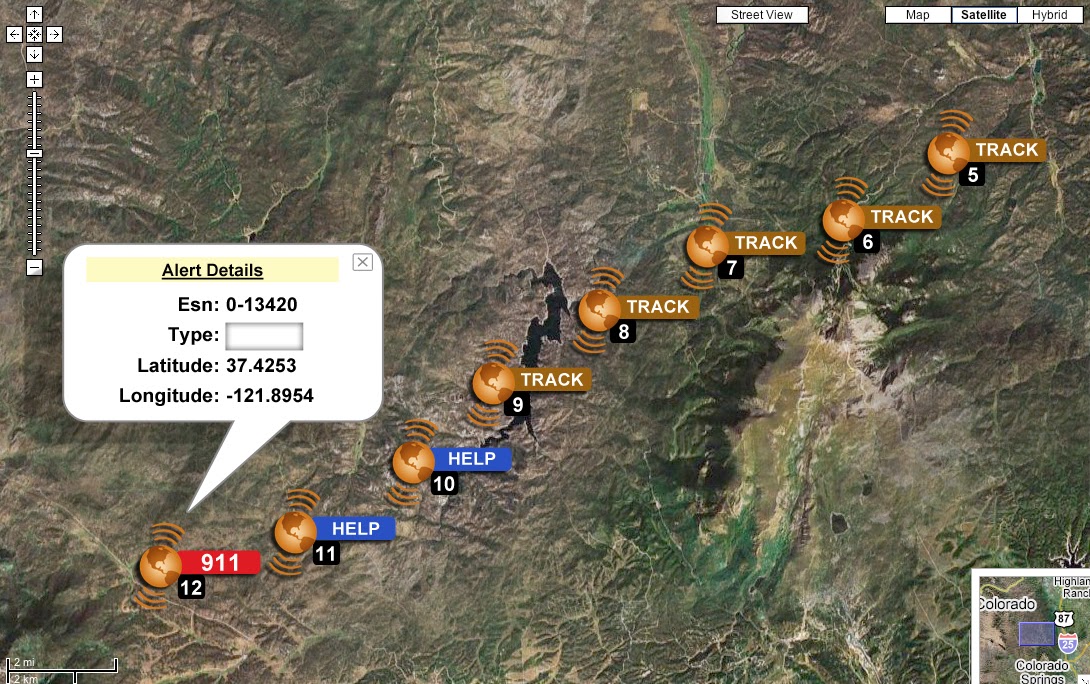
    Spot-Google-MapSPOT products allow users to track their assets, use location-based messaging and emergency notification services, and make calls beyond the boundaries of cellular. SPOT products work around the world, including virtually all of the continental United States, Canada, Mexico, Europe and Australia, portions of South America, Northern Africa, North-Eastern Asia and thousands of miles offshore of these areas. Over the past seven years, boaters, hunters, recreational pilots, hikers, off-road travelers and outdoor enthusiasts have come to depend on the lifesaving capabilities of SPOT.

    The 3,000th rescue occurred in the Hayman Fire area of Central Colorado. Two dirt bikers were outside of cell range when an accident occurred. One of the riders, Kevin, activated the SOS button on his SPOT Satellite GPS Messenger. The GEOS International Emergency Response Coordination Center was alerted and coordinated the rescue with local law enforcement. “SPOT worked really well. Without it, getting out would have been more difficult and time consuming and who knows what could have happened in that time. There were a lot of different variables involved,” Kevin said.

    SPOT products and services include:

    • SPOT Gen3, a device that provides off-the-grid messaging, emergency alerts, extended battery life, and extreme GPS tracking at 2½-minute intervals.
    • SPOT Trace, a GPS tracking device that uses satellite technology to track anything, anytime, anywhere.
    • SPOT Global Phone, a satellite phone that allows users to make calls virtually anywhere beyond the boundaries of cellular.
    • The SPOT App, a web-based interface allowing users to view their SPOT messages, show their track points, and monitor their assets via smartphone or tablet.
  • Trimble and Infinicon Offer Surface Methane Monitoring Solution

    Trimble and Infinicon, Inc., are offering a portable Infinicon DataFID Flame Ionization Detector and Trimble SEMonitor software as a solution for surface methane monitoring of landfills. The landfill gas solution provides a more streamlined workflow for the environmental services professional, improving efficiency and reducing rework.

    The announcement was made at WasteExpo 2014, a North American solid waste and recycling tradeshow.

    In the past, field technicians had to carry notebooks, maps, plans and the sensor to locate, mitigate and audit trouble points on site. The Trimble SEMonitor and Infinicon DataFID solution combine to eliminate the need for pen and paper, increase communication capabilities in the field and improve work flow demands for field technicians, maximizing productivity and streamlining the workflow.

    By leveraging Trimble’s innovation and expertise in geospatial software solutions with Infinicon’s proficiency in portable, intrinsic safe detection equipment, environmental professionals can see increased efficiency in conducting their landfill methane surface emission monitoring, analysis and reporting.

    “Collaborating with Infinicon allows us to offer a more robust software solution while simultaneously addressing the entire environmental workflow from data collection through analysis for compliance and operational optimization,” said John Rice, general manager of Trimble’s Environmental Solutions Division. “Together, we offer the environmental industry a complete end-to-end solution for landfill methane monitoring.”

    “The Trimble SEMonitor adds a unique dimension to traditional monitoring practices by streamlining surface landfill gas data collection, analysis and compliance reporting. Communicating via the Bluetooth connection, the hardware and software solutions combine to improve efficiency, accuracy and effectiveness of surface methane monitoring,” said ChingYue Yeung, product manager for the INFICON DataFID.

  • deCarta Expands L2 Geospatial Search to 120 Countries

    deCarta, Inc., an independent LBS platform company, has expanded coverage of its advanced local search technology, the L2 Geospatial Search Engine, to 120 countries including Europe, North America, and most major countries around the world.

    L2 is a high-performance, scalable local search engine with single line input to enable a more intuitive user interface, the company said. deCarta sources and indexes premium map and POI (Points of Interest) content but also enables customers to  index and control their own content using the L2 Index tools.

    deCarta’s L2  has advantages over most other search engines in that it can be used as a pure geocoder for address search, or for POI search….or simultaneously as a combination of the two mixed in a single line search query – with the additional ability to tune this behavior at runtime. This gives developers maximum flexibility and creativity in producing their mobile and desktop applications. The new expanded country coverage now enables deCarta customers to offer truly global services.

    The L2 Search engine is an integral component of deCarta’s LBS platform which provides specialized geospatial technologies for maps, routing, navigation, geocoding, local search and geo-data integration and processing. deCarta offers two deployment models for its LBS platform: a Hosted LBS Platform Service (PaaS) or, alternatively, customers can self-host the platform either on-premise or in a cloud service such as Amazon’s AWS.  Both approaches utilize deCarta’s advanced REST API architecture and can scale to support billions of maps and searches and millions of users per month.

    L2 enables deCarta’s customers to offer flexible, advanced local search capabilities that are on par with Google Maps but beyond other search engines, deCarta said. Examples include:

    • Single line entry of POI or address or both
    • Fast typeahead, predictive entry – ideal for mobile devices and web interfaces
    • High tolerance for misspellings and partial entries
    • Random ordering of address parameters
    • Search for a POI near a POI, such as:
      • “Coffee near XYZ company”
      • “Restaurants on Main Street”
      • “ATMs near AMC Theater”
    • Search for POI near a specific address, such as “Parking near 1234 Main Street”

    Furthermore, the ability to integrate L2 with deCarta’s patented “Search Along A Route” technology gives automotive OEMs and Telematics Service Providers the ability to offer more advanced and helpful “driver-centric” connected car services.

    “We are excited by the market reaction to L2 since its introduction last year,” said J. Kim Fennell, CEO of deCarta. “We’re winning business competing with, and in some cases replacing, major local search engines such as Google Maps based on the merits of L2’s technology advantages, customization capabilities, flexible content offerings, less restrictive license terms and our superior customer service – all of which creates a more satisfied customer experience.”

    deCarta offers a “house blend” of premium map and POI content with L2. It works closely with worldwide and regional map data providers including TomTom, Nokia/HERE, OpenStreetMap (OSM), AND, Sensis, IPC, Nav2 and eMapgo; as well as leading POI providers and other content sources (traffic, parking, weather, speed cameras, etc). deCarta integrates and de-duplicates multiple content sources for optimum search results.

    deCarta provides the tools to let companies index and search on their own content for maximum control and commercial advantage. This content can stand alone or be merged with industry map and POI content. Customers can “boost” content and control rankings to suit their needs. These capabilities provide huge benefits for local search companies, Automotive OEMs and telematics service providers seeking to offer their users the best customer care and connected car services.

    For more information on L2, please visit deCarta’s web site at www.decarta.com or go straight to the demo. Developers can find more technical details at deCarta’s DevZone.