Category: Mapping

  • EuroGeographics, EuroSDR to Join on European Spatial Research

    EuroGeographics and EuroSDR have announced that they will work together to provide a framework for European spatial data research and development.

    The cooperation agreement will further the development of the EuroSDR Research Plan and the activities of the EuroGeographics Knowledge Exchange Networks. As a result, members of both not-for-profit organizations will benefit from greater opportunities for professional development. They will also be able to take part in joint projects and hand over tasks more appropriate to the other organisation’s expertise.

    “We have a common interest in carrying out and applying relevant research and developments in the field of geographic information and spatial data infrastructures,” said Ingrid Vanden Berghe, president of EuroGeographics, the membership association of the European National Mapping, Land Registry and Cadastral Authorities.

    “With rapid technological advances generated by a digital information society, the time from research via development to operation has never been faster. This agreement will ensure our members remain up to date with and understand the possibilities presented by new technologies and methodologies so they can react more quickly to user demands.”

    Martin Salzmann, president of EuroSDR, which links national mapping, land registry and cadastral authorities with research institutes and universities in Europe, added: “Achieving synergy in our activities benefits both our members and society by strengthening research and development, sharing results of common interest and making these operational. At the same time, we will foster and stimulate a vibrant research community with which to capitalise on future technologies and to be responsive to user demands. By working together we also avoid the risks of duplication of work between us and our member organisations.”

    EuroGeographics and EuroSDR are both committed to supporting wide range of initiatives that will benefit people across Europe, the companies said. These include the European Spatial Data Infrastructure, Copernicus, Galileo, Horizon2020, European Location Framework and the European Digital Single Market.

  • Geomatics Offers Portable Surveying and Mapping System

    Editor’s note: GPS World explored use of the new system from Geomatics in the March 2015 issue.


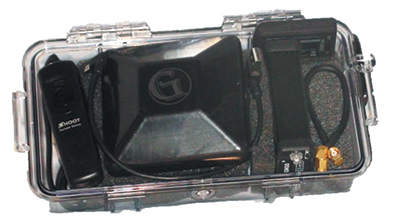
    Geomatics USA from Gainesville, Fla., has designed a precision surveying and mapping system that can be easily stowed in an overhead compartment for airline travel. Surveyors can fit everything needed for important mapping and surveying jobs into a baseball-style bag, including tripods. The compact, light-weight system offers differential sub-foot accuracy.

    Components easily pack into a baseball-style case.
    Components easily pack into a baseball-style case.

    The G1-m1 receiver system has many advantages over conventional GNSS receivers, Geomatics said. The system is designed for precision surveying jobs that require travel to remote areas of the world, and for traveling to job sites by commercial airline. The complete base and rover kit, including the tripods, rods, and batteries, fits into a single baseball style bag and weigh less than 10 kg, making it easy to stow as carry-on luggage.

    The Geomatics USA G1 system is scalable from a simple single-frequency semi-mobile receiver — ideal for control networks and some semi-kinematic mapping applications — to a dual-frequency network RTK solution. All of the Geomatics USA G1 solutions perform precision-quality tasks at a fraction of the cost of major-brand equipment.

    The G1-m1 system comes with a free processing software license for the first 50 systems that supports carrier-phase relative positioning and CA-code differential correction. The software is designed with a simple user interface for easy selection of base and rover data or automatic data download of the closest Continuously Operating Reference Station (CORS) from the U.S. National Geodetic Survey database. It is compatible with other RINEX based post-process systems around the world.

    Complete survey set including GNSS receiver, antenna, battery and cables, fits in a small handheld plastic case.
    Complete survey set including GNSS receiver, antenna, battery and cables, fits in a small handheld plastic case.

    According to Geomatics USA Chief Technology Officer Ahmed Mohamed, “The G1 product line fills the gap between survey applications, where cm-level precision is an absolute necessity, and mapping applications, where meter-level precision is acceptable. In fact, the G1-m1 product offers sub-foot precision in most cases and cm-level precision in ideal situations. Geomatics USA uses readily available components and open-source code to develop its end user product solutions. The objective is to make sure the software performs correctly with a very short learning curve for the user.”

    For a limited time, Geomatics is offering a specially priced configuration for the first 50 systems through NavtechGPS, its worldwide distributor.

  • LandWorks Tightens Integration with Esri in Land Management Software Upgrades

    Landworks-webmaps-spain2

    LandWorks Inc., a developer of innovative land management solutions, has introduced Release 5.20 of its three primary software suites — LandWorks Property Management, LandWorks GIS, and WebMaps Enterprise GIS. All three have been re-written for easier use, enhanced industry-specific functionality, and tighter integration with Esri GIS solutions.

    “In Release 5.20, we rebuilt the software from the ground up with a combination of C# [Sharp] .NET and a service-oriented architecture,” said LandWorks President Jerry Bramwell. “This modern architecture allows for integration of live Esri GIS maps and builds a foundation for hosting in the cloud.”

    Deployed extensively for land asset management and mapping in the oil and gas, utility, mining, pipeline, renewable energy and government sectors, the upgraded LandWorks software suites are expected to appeal to an even wider audience. In addition, their applicability within organizations will expand beyond land management to project planning, acquisition and development.

    The flagship LandWorks Property Management (LPM) suite is a complete solution for land asset management designed for easy storage and retrieval of data relating to any type of land right. In the new LPM version 5.20, clients may open an oil and gas lease or right-of-way agreement and instantly access a live GIS map displaying the relevant polygons. Direct integration with Esri’s ArcGIS Server gives the client full web-based GIS functionality from within the LPM interface and the ability to update the live map with new information on the fly.

    “LPM is the only land asset management software with embedded live access to Esri GIS maps,” Bramwell said.

    The LandWorks suites, used worldwide, also have been internationalized to support the language, date, currency and measurement formats preferred by individual end users based on their locations. A large mining company with operations in multiple countries, for example, may deploy the LandWorks suites across its enterprise. End users in Portugal, Spain and Canada are able to view the same information presented in Portuguese, Spanish or English.

    In addition to a more intuitive interface with a modern look and feel, LandWorks has added new functionality to the software products designed for greater ease-of-use in specific industries. The ability to make land royalty payments for mining and wind energy operations has been expanded. LPM and LandWorks GIS have been enhanced to better manage and present linear-based land rights.

    “The enhancement of our products to better manage land rights associated with linear assets will make the LandWorks suites more attractive to transportation and telecommunications industries,” said Bramwell.

    LandWorks has built new modules to the LPM suite to extend its usability across the entire land management workflow. LPM now manages land-related projects of any type or size including acquisition, surveying and encroachment investigation.

    The three LandWorks suites comprise a total of 18 individually licensed software products, many of which can function alone or interface with LPM. LandWorks GIS integrates the Esri GIS functionality into LPM. WebMaps Enterprise GIS Suite extends web-based mapping via ArcGIS Server across the enterprise to all departments, not just the land department.

    “All LandWorks software products currently reside behind the client’s firewall, however, we will soon offer hosting in the cloud as an additional licensing optional for our clients,” said Bramwell.

  • Air Pollution Monitoring Rocket Set for Second Launch Attempt

    air_pollution_rocket_blueskyScientists at the University of Leicester will make a second attempt to launch a rocket equipped with air pollution monitoring equipment on June 11 at the university’s Capesthorne Hall in Cheshire. The first launch attempt on Feb. 4 failed, according to airqualitynews.com.

    As part of a wider air pollution mapping project supported by Bluesky, an aerial survey company, a pollution monitoring system was developed by scientists at the University of Leicester to record how dangerous gases such as nitrogen dioxide dissipate with vertical distance from the earth. The micro sensors will be integrated with other technologies and launched into the atmosphere using Starchaser Industries‘ Tempest Research Rocket. The launch follows previous work mapping air pollution across entire cities from planes, cars and ground sensors.

    “We have already had great success mapping air pollution from an aerial survey plane giving us a better understanding of how dangerous gases, such as nitrogen dioxide, operate in the vertical plane,” says James Eddy, Bluesky’s technical director and industrial associate at the University of Leicester. “However, we hope this launch will take air pollution monitoring to another level.”

    The Tempest is a 14-foot-tall rocket that can reach speeds of up to 200 miles per hour and will hit an altitude of 3,000 feet on its flight before being safely recovered via parachute. In addition to the air pollution monitoring sensors, Tempest will also be carrying vital electronic systems that will be used aboard Starchaser’s future Space Tourism Rockets, an experimental GPS package with video cameras.

    “Air Quality continues to be a critical issue in our urbanising society, requiring us to explore novel solutions for monitoring, management and damage mitigation. We are grateful to Starchaser Industries for the opportunity to test our novel air quality monitoring techniques as part of this spectacular launch event,” says Dr. Roland Leigh, academic supervisor at the University of Leicester. “This project builds on work to date of Starchaser Industries, key academic expertise in instrument design and data manipulation, and once again benefits from a strong industrial partnership with Bluesky.”

    The latest phase of the Bluesky supported air pollution monitoring project will add to results already obtained from trials of the University of Leicester’s Compact Air Quality Spectrometer. Originally mounted on a dedicated aerial survey aircraft, the device monitors visible light and measures how much light is lost at specific wavelengths absorbed by nitrogen dioxide. The technology has previously been used as part the CityScan project with devices mounted on tall buildings in Leicester, Bologna and London during the Olympics to build 3D maps of pollution across the cities, according to the company.

  • ASPRS Releases New Accuracy Standards for Digital Geospatial Data

    The American Society for Photogrammetry and Remote Sensing (ASPRS) has released new Positional Accuracy Standards for Digital Geospatial Data. The PDF is available here.

    The new ASPRS accuracy standards fill a critical need for map users and map makers alike. For centuries, map scale and contour interval have been used as an indication of map accuracy. Users want to know how accurately they can measure different things on a map, and map makers want to know how accurate maps need to be in order to satisfy user requirements. Those contracting for new maps depend on some form of map accuracy standard to evaluate the tradeoff between the accuracy required vs. how much time and expense are justified in achieving it, and then to describe the accuracy of the result in a uniform way that is reliable, defensible, and repeatable, ASPRS explains in a statement.

    The new ASPRS standards address recent innovations in digital imaging and non-imaging sensors, airborne GPS, inertial measurement units (IMU) and aerial triangulation (AT) technologies. Unlike prior standards, the new standards are independent of scale and contour interval, they address higher levels of accuracies achievable by the latest technologies (such as unmanned aerial systems and LiDAR mobile mapping systems), and they provide enough flexibility to be applicable to future technologies as they are developed. Finally, the new standards provide cross references to older standards, as well as detailed guidance for a wide range of potential applications.

    No prior U.S. accuracy standard comprehensively addresses the current state of mapping technology, which is why the new ASPRS standards were developed. The National Map Accuracy Standards (NMAS), developed in 1947, are still used because they are simple, but there is no scientific correlation between those standards and current mapping methodologies.

    The ASPRS 1990 Standards were an improvement over NMAS; however, they did not do well in representing the capabilities of LiDAR, orthoimagery, digital mapping cameras or other current technologies in wide-spread use today.

    The National Standard for Spatial Data Accuracy (NSSDA) is a reporting standard that references the old ASPRS 1990 standards and is cross-referenced in the new ASPRS standards.  NSSDA provides no accuracy thresholds and does not by itself provide any new or updated guidance on how to select or specify an appropriate accuracy for intended applications.

    The new ASPRS standards were developed by the ASPRS Map Accuracy Standards Working Group, a joint committee under the Photogrammetric Applications Division, Primary Data Acquisition Division and LiDAR Division, which was formed for the purpose of reviewing and updating ASPRS map accuracy standards to reflect current technologies. A subcommittee of this group, consisting of Qassim Abdullah, David Maune, Doug Smith, and Hans Karl Heidemann, was responsible for drafting the document.

    Draft versions of the standard underwent extensive review, both within ASPRS as well as through public review by other key geospatial mapping organizations, prior to final approval by the ASPRS Board of Directors on November 17, 2014.

  • A Milestone in Digital Mapping

    Janice Partyka
    Janice Partyka

    Editor’s Note: Janice Partyka is principal of JGP Services, a consulting practice. She is GPS World’s editor for wireless, writing a monthly column for the Wireless LBS Insider newsletter. The views expressed are her own.

    Hard to believe, we have only now reached the 10th anniversary of Google Maps. As important as digital maps have become, their purpose is much the same as the printed and drawn maps that preceded them. Digital maps emerged in the 1960s with the Census Bureau’s DIME maps. These first digital maps were used for analysis of place-specific data, such as populations within census tracts or cities. Digital maps in turn led to geographic information systems (GIS) for spatial analysis. Though GIS had uses in fields like city planning, the main stimulus for digital maps came in the 1990s with the convergence of the completion of GPS infrastructure, and affordable and portable computers.

    Naturally, just knowing where you are doesn’t have huge value, but if that information can be fused with a digital map, which could generate a route to the destination of your choice, or access information on the places that surround you, then you have something. This is why companies like Etak, Tele Atlas and Navteq began the painstaking process of converting satellite images, printed topographic maps and data that could only be observed with one’s eyes (such as street signs, addresses, speed limits, and turn restrictions) into digital form.

    One of my projects during the 1990s was to compare the accuracy of competing digital maps. It was a tedious process, entailing two-person driving crews traveling each street. The passenger recorded all relevant information and made periodic readings with a large, costly GPS receiver. At the time, digital maps could only be accessed by complicated GIS programs which restricted their usefulness.

    Since then, digital maps have grown in significance due to the advent of smartphones, a growing suite of digital-map-enabled applications, and of course Google Maps. Google has made maps friendlier to developers through its application program interfaces (APIs), which also improved the user experience for scrolling across locations from a map view.

    Google has mastered the process of data capture from roadways. Rather than rely on the eyes of people in the field, sensors and cameras collect mapping data. Image-processing software extracts and geo-codes textual data, automating and enhancing map creation. And Google has incorporated overhead and street-level photographic images into maps, adding substantial value.

    We will never arrive at having a perfect digital map. The work to keep mapping accurate and give it more context will be ongoing. The next challenge in digital mapping is making it work offline and creating accurate maps of the indoors. These next innovations will not be led by GPS, but by sensors, including beacons. GPS has already done the heavy lifting.

  • MAPPS Fall Conference Planned in Conjunction with Drone Expo

    Drone World Expo, an event for commercial drone technologies and applications, is partnering with MAPPS to bring together stakeholders, constituents, and all levels of government in the surveying, mapping, and geospatial fields. The MAPPS Conference will be held as a part of Drone World Expo, set for November 17-18 at the San Jose, Calif., Convention Center.

    “With all of the exciting developments taking place in the UAV industry, we are thrilled to bring the breadth and depth of knowledge from MAPPS to our event,” said Joel Davis, CEO, JD Events, producers of the show. “Attendees to the MAPPS conference will have free access to the Drone World Expo trade show floor, general sessions and networking events, and we look forward to welcoming their members to this must-attend event.”

    The MAPPS Conference will be a forum for discussion on issues and policies, sharing of information and provision of education, and collaboration, specifically related to the geospatial applications of UAV technology.

    “MAPPS is thrilled to be part of Drone World Expo,” said John Palatiello, MAPPS executive director. “We believe UAVs will play an integral role in the future of surveying and mapping, and it is vitally important we lead the discussion in terms of investment, technology, applications and regulations.  MAPPS looks forward to presenting quality content on the geospatial market for UAVs at Drone World Expo.”

    In addition to the MAPPS Conference, Drone World Expo will also offer a two-day conference that will feature sessions and case studies addressing data collection and processing, sensors, piloting and safety management, FAA updates, certification standards, and commercial strategies, and will offer informative sessions on the impact drones are having on geographic information systems (GIS), Big Data and the Internet of Things (IoT).

    The Drone World Expo Conference is being developed with the help of an advisory board on which Palatiello serves.

  • Routescene Showcases 3D LiDAR at ILMF in Denver

    routescene-lidarpod-uav-fullThe Routescene LidarPod 3D mapper, a self-contained turnkey solution new to the market, is being showcased for the first time in the United States at the International Lidar Mapping Forum in Denver, Colo., Feb. 23-25. Routescene is based in Edinburgh, United Kingdom.

    The flexible LidarPod was developed for use on unmanned aerial vehicles, but can also be fitted onto any mobile platform such as a car or boat. The flexibility makes it attractive for many sectors and situations where accurate mapping is essential but difficult to achieve, enabling surveys to be conducted in areas that previously would not have been considered, Routescene said.

    routescene-uav-flightThe technology offers a non-intrusive method to obtain detailed and precise geo-referenced 3D datasets, Routescene said. LidarPod 3D can be used for 3D mapping; powerline inspection; scoping, planning and management of mines; forestry design, management and operation; large-scale topographic surveys; and city planning and management.

    Routescene LidarPod costs less than a vehicle-based mobile mapping system, Routescene said. The turnkey solution includes LidarViewer, specially developed software to turn the raw data into valuable business information. It enables users to convert, analyze and filter huge volumes of point cloud data to improve productivity and workflow. Powerful filters enable users to extract relevant data for use in third party software, such as GIS and CAD packages, which are unable to cope with such large data volumes.

    Routescene can be found at booth 65 at ILMF.

  • Phase One Aerial Cameras Support IGI’s GNSS/IMU

    AEROcontrol with export-free FOG IMU.
    AEROcontrol with export-free FOG IMU.

    All Phase One Industrial aerial cameras now fully support the IGI AEROcontrol, GNSS/IMU positioning system, the companies announced. Aerial camera models include iXA-R, iXA, and iXU.

    Phase One aerial cameras are high-quality industrial-grade camera systems, which have found wide success in the photogrammetry market, both among end users and OEM integrators.

    AEROcontrol is a GNSS/IMU system for the precise determination of position and altitude of multiple airborne sensors. Beside the choice of MEMS- and FOG-based IMUs, the system is also suitable for mobile mapping applications. Used together with IGIplan and CCNS-5, a complete and comprehensive solution for mission planning, aircraft guidance with sensor management and geo-referencing is available to Phase One aerial camera users.

    “With the addition of IGI’s AEROcontrol, users of Phase One aerial cameras are able to use IGI’s popular AEROcontrol, GNSS/IMU positioning system with a single camera or as part of an array,” said Dov Kalinski, general manager of Phase One Industrial.

    “With the integration of the IGI AEROControl GNSS/IMU with the Phase One aerial cameras, all Phase One users now have access to geo-referencing with different IGI IMU models and IMU-based, precise stabilized mount control. This smart geospatial solution helps users obtain the best possible aerial photography results,” added Philipp Grimm, IGI marketing and sales manager.

  • Connect with Bluetooth GNSS Devices Using SuperSurv

    SuperSurv_measureTo meet the needs of high-accuracy field data collection and better workflow with modern GNSS technology, Supergeo’s latest SuperSurv GIS mapping app allows users to connect with and operate external Bluetooth GNSS devices. The app also elevates field-work efficiency with new averaging algorithms.

    SuperSurv is designed for field data collection on Android and iOS-powered devices. Integrating with GIS and GPS technologies, SuperSurv provides functions like Map Display, Query, Measure, and supports to overlay OpenStreetMap as the basemap. Also, users can capture point, line and polygon features and attribute data, and save the data as SHP or GEO format in both offline and online modes.

    With the new external GNSS device connection function, users can choose between internal positioning information and an outer GNSS source via Bluetooth. When pairing the GNSS receiver with an Android device, SuperSurv allows users to fully control and present detailed messages of navigation within system status. In addition, data collection via GNSS is enhanced with options such as a coordinate data averaging function or vertex collecting threshold, bringing users modernized and highly accurate field survey experience.

    The external GNSS device connection and advanced data-collecting functions are fully supported and available with the SuperSurv Pro version. For SuperSurv M3 users, the newly added functions come as an optional plug-in that users can purchase and download.

    Free trials of the software are available:
    iTunes Store
    Google Play

  • In a Surprising Move, the FAA Proposes Lightweight Commercial Rules for Small UAS

    JAVAD_GNSS_TRIUMPH-F1-clouds-1-O

    After much criticism in the mainstream and technology media about the commercial use of UAS (unmanned aerial systems), the Federal Aviation Administration (FAA) has been remarkably proactive in integrating the commercial use of UAS in the United States National Airspace System (NAS) the past two months. Just last summer, media like the Washington Post, fueled by a government audit, were reporting that the FAA will miss the September 2015 deadline, which is spelled out in the FAA Reauthorization and Reform Act of 2012, to integrate commercial UAS usage into the NAS.

    By proactive, I mean the rate at which the FAA is issuing UAS exemptions for commercial use. Two weeks ago, the FAA issued eight more commercial UAS exemptions, bringing the total to 24 since June 2014, with the vast majority of those being issued in the last two months. The latest exemptions issued were for aerial mapping, motion picture and television production, and bridge inspection. You can view the entire list of exemptions and the intended applications here. All of the exemptions have more than 30 conditions and limitations the operator must follow, of which a FAA private pilot (or better) certificate and a FAA third-class medical certificate is required, as well as a second person, the Visual Observer (VO). That’s fine. There’s nothing new on that front since I last reported on this.

    However, earlier this week, the FAA issued an NPRM (Notice of Proposed Rule Making) for commercial operations of “small” UAS, with surprisingly lightweight conditions compared to the exemptions granted thus far. Following are the key points of the NPRM:

    • Pilot must be 17 years of age or older.
    • Pass an FAA-approved aeronautical knowledge test and retest every two years.
    • Obtain an unmanned aircraft operator certificate with a small UAS rating.
    • Obtain an FAA Class II airman medical certificate.
    • Be vetted by the Transportation Security Agency (TSA).
    • Maintain visual line of sight without aids (except corrective lenses).
    • Not operate over any person who is not part of the mission.
    • Maximum UAS weight is 55 pounds.
    • Maximum airspeed of 100 mph.
    • Maximum altitude of 500 feet above ground level.
    • Minimum weather visibility of three miles.
    • Yield right-of-way to other manned and unmanned aircraft.
    • Contact air traffic control or airport operator when flying within five miles of an airport.

    These conditions are certainly lighter than the conditions imposed on the exemptions issued thus far. However, instead of requiring an FAA private pilot certificate, the FAA proposes creating a new type of certificate named an “unmanned aircraft operator certificate.” Digging into the documentation, the new “small UAS pilot certificate” consists generally of the following:

    • At least 17 years of age, although the FAA seems open to reducing it to 16 years of age.
    • Read, write, speak English (with exceptions).
    • Pass an initial aeronautical knowledge test, which tests the applicant’s understanding of FAA regulations, airspace, flight restrictions, collision avoidance, weather/meteorology, weight/balance calculations, emergency response, aeronautical decision-making, airport operations, and drug/alcohol impairment.
    • Demonstrate flight proficiency and aeronautical experience. The FAA is asking for suggestions on these two.

    For a summary description of the proposed Small UAS Limitations and Certifications, click here.

    For a detailed description of the proposed requirements for the FAA small UAS pilot certificate, click here.

    The FAA Class II Airman medical certificate requirement is somewhat surprising because it’s more stringent than the Class III medical certificate required in the exemptions issued thus far. Perhaps the FAA is rethinking this because of the line-0f-sight requirement that puts a premium on sharp vision for UAS pilots. Class II requires distance vision of 20/20 in each eye separately while Class III only requires distance vision of 20/40 in each eye separately. Click here to see the requirements for Class I, II and III medical certificates. To give you some idea, I had an FAA Class III medical exam completed last month. It took about an hour. Although I have an FAA private pilot certificate, one is not needed to obtain an FAA medical certificate.

    FAA Class III Medical Certificate
    FAA Class III Medical Certificate

    Perhaps a bigger challenge than passing the FAA medical exam, which wasn’t difficult, was finding a certified FAA medical examiner near you. You can search for an examiner near you by clicking here.

    So, it seems the FAA is making progress, and we should give them credit for that. But, we are still very early in the process, and as the mainstream and other media predict, the FAA will likely burn through the September 2015 deadline well into next year, albeit chipping away and issuing exemptions on a regular basis as they have been for the past two months. You can bet that exemption applications are piling up. To view the growing list of exemption applications, click here. In reading the FAA Reauthorization and Reform Act of 2012, it states “The FAA is required to initiate a Notice of Proposed Rulemaking (NPRM) for site integration of UAS within 18 months of the date of enactment of the integration plan.” Hmmm, 18 months from now = October 2016, and this NPRM is for small UAS only. Stay tuned….

    Thanks, and see you next month.

    Follow me on Twitter at https://twitter.com/GPSGIS_Eric

  • Big Data Reveals Patterns of Urban Bacteria

    An interactive map allows residents of New York to see what bacteria was mapped at their neighborhoods subway stops. (Image: Wall Street Journal)
    An interactive map allows residents of New York to see what bacteria was mapped at their neighborhoods subway stops. (Image: Wall Street Journal)

    A Big Data project in New York last summer set out to map germs on the city subway system, reports the Wall Street JournalThe scientists, from Weill Cornell Medical College, identified hundreds of types of bacteria in the transit system as a way to study the microbiology of urban environments.

    In the 18-month study, researchers found germs that can cause bubonic plague uptown, meningitis in midtown, stomach trouble in the financial district and antibiotic-resistant infections throughout the boroughs, the WSJ writes. The team also found bacteria that keep the city livable, by sopping up hazardous chemicals or digesting toxic waste. They even tracked the trail of bacteria associated with cheese and sausage, popular snack foods among commuters.

    The study is the first genetic profile of a metropolitan transit system. Microbiologists hope to discover new ways to track disease outbreaks, detect bioterrorism attacks, and combat the antibiotic resistance among microbes, which causes about 1.7 million hospital infections every year. Similar projects are taking place in Oregon (classrooms), Virginia (plumbing in buildings), and Chicago (hospitals).

    The research team gathered DNA from turnstiles, ticket kiosks, railings and benches, then sequenced the genetic material and sorted it by supercomputer. They compared the results to databases of known bacteria, viruses and other life-forms. The findings uncovered how commuters seed the city subways every day with bacteria from the food they eat, the pets or plants they keep, and their shoes, trash, sneezes and unwashed hands. The team detected signs of 15,152 types of life-forms.

    An online database at the Wall Street Journal allows residents to see what microbes were found at the stations they frequent.