Raytheon UK has been awarded a significant contract by the UK Ministry of Defence for delivery of a new GPS anti-jam antenna land system. The contract is for an undisclosed number of advanced systems for deployment in operational theaters spanning multiple vehicle platforms. This UOR (Urgent Operational Requirement) contract is the first award for Raytheon’s GPS Anti-Jam (AJ) Land product family.
“Raytheon UK has a track record of on-time delivery for GPS AJ systems, having delivered over 7,000 units for air and naval capabilities in the UK and U.S., said Bob Delorge, chief executive, Raytheon UK. “Many of the military platforms used in operations are protected by the proven Raytheon GPS anti-jam technology, and the first order for our Land GPS AJ product family marks a significant success.”
The contract will see the deployment of the systems under a very short timescale, with final delivery of the capability expected to be completed six months from contract award.
Raytheon UK is a subsidiary of Raytheon Company. It is a prime contractor and major supplier to the UK Ministry of Defence. Raytheon UK also designs, develops and manufactures a range of high-technology electronic systems and software at facilities in Harlow, Glenrothes, Uxbridge, Waddington and Broughton.
Threat Development Parallels Information/Communication Technology
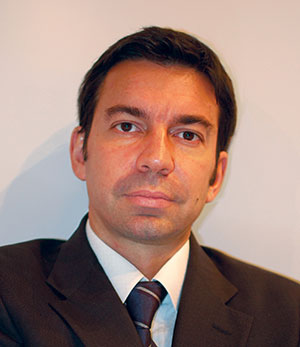
Headshot: Oscar Pozzobon
By Oscar Pozzobon
The GNSS interference session this year at the ION-GNSS conference in Nashville was one of the most crowded, confirming the need of all sectors of the community to understand the threats in GNSS and how they can be mitigated. In that context I received one of the most challenging questions of my career: “Can we predict the future of GNSS security?” What is the status of civil and commercial GNSS security today? Which are the threats and risks and how they are mitigated? Where are we going and what shall we expect from the future?
I decided to tackle this topic carefully, using as a basis and inspiration the history of information and communication technology (ICT) security: from the first threats and attacks of the 1980s to a glance at what technology offers today.
Secondly, to obtain different perspectives — and shift the blame to someone else if one day these predictions should prove to be wrong — I solicited the opinions of three other experts and colleagues in the domain of GNSS and security: Logan Scott, Todd Humphreys, and David Last.
Snapshots from History
The Internet was officially born in 1969 when the U.S. Defense Advanced Research Projects Agency (DARPA) crated the Advanced Research Projects Agency Network (ARPANET). A short 11 years later, the 414 Gang, a computer-hacking organization (the term hacking was coined at the Massachusetts Institute of Technology as early as the 1960s) performed one of the first attacks and frauds upon computer systems. In 1983 the first computer virus was discovered. In 1988 the Computer Emergency Response Team (CERT) was created to report and disseminate information on the threats, and AT&T Bell Labs created the first concept of firewalls. Some readers may recall the 1983 movie War Games, which found Hollywood hard at work on cyber-attacks, denial, and deception to computer systems at a time when we had only six GPS satellites in orbit. One year later, Steven M. Bellovin published a paper on the possibility of performing a transmission control protocol/internet protocol (TCP/IP) Spoofing attack.
Six years after that paper, in 1995, the Computer Incident Advisory Committee (CIAC) reported the first TCP/IP spoofing attack to a system. In another four years, the first denial of service (DoS) attack to computer networks was reported by the CERT. A DoS attack consists of several computer systems sending unsolicited requests to the target, causing a saturation of network and computer resources. In terms of objectives, it could be compared to what jamming causes in GNSS systems.
Between 1984 and 1986, Dorothy Denning and Peter Neumann researched and developed the first model of a real-time intrusion detection system (IDS). This prototype was initially a rule-based expert system trained to detect known malicious activity. I like to think that this could be compared to today’s jamming detection and localization systems.
In the 1990s, the need for guidelines to provide general outlines as well as specific techniques for implementing security became a pressing one for all organizations. The first standard, originally published by the British Standards Institution (BSI) in 1995 was the BS 7799, was later adopted by the International Organization for Standardization (ISO) as the ISO/International Electrotechnical Commission (IEC) 27000 series.
Information technology today can be security-evaluated via the Common Criteria (CC) standard (ISO/IEC 15408), which allows computer-systems certification. CC is a framework in which computer system users can specify their security functional and assurance requirements. The Federal Information Processing Standard (FIPS) 140 is an alternative standard for cryptographic modules, developed by the U.S. Federal Information Processing Standards.
The Nessus Project, started by Renaud Deraison in 1998, set as its objective the provision of an open-source vulnerability-assessment tool. Since 2000, Nessus has become one of most popular tools for computer-network security and vulnerability assessment, used by more than 75,000 organizations worldwide.
ICT security today is assured in a lifecycle composed by CERT managing the threats notifications, ISO/IEC 27000 managing the processes, and CC/FIPS 140 defining the security requirements for the system and vulnerability assessment tools to certify the robustness.
Now, Where Are We in GNSS?
Radio-frequency interferences (RFI) or jamming cases can hardly be tracked, as they are difficult to detect and have a long history in the military domain. Recent incidents such the one at Newark International Airport show that the threat is increasing and demonstrate the need for mitigation strategies. GNSS signal falsification frauds, or spoofing, seems to as yet have no evident cases in the civil domain.
The Volpe Report of September 10, 2001 is one of the first government public announcements of GNSS threats, including jamming and spoofing. More than 10 years, later the unmanned aerial vehicle (UAV) experiment coordinated by Todd Humphreys at the University of Texas proved that such attacks are feasible.
In GNSS, jamming detection (and sometime mitigation) are nowadays commercial options for some professional and mass-market GNSS receivers. Spoofing detection has been available in commercial prototype receivers since 2008 (among others, the Trusted GNSS Receiver (TIGER) funded by the European GNSS Agency. In 2012 we have seen the presentation of the first civil GNSS security testbed. For examples of the latter, see the University of Texas TEXBAT initiative, mentioned on page 37, and the GNSS Authentication and User Protection System Simulator (GAUPSS) project, which involved the development of software and algorithms that were integrated and tested in the radio navigation laboratory of the European Space Agency/ European Space Research and Technology Centre (ESA/ESTEC) in Noordwijk, the Netherlands.
I will make the assertion that compared to ICT security, civil GNSS security seems to be reliving the early days of the 1980s: first publication of attack concepts, first publicly known attacks, no standards, and only prototype mitigation strategies. With a gap of almost 30 years, at least four mid-Earth orbit GNSS systems becoming operational in the next few years, and an annual 10 percent growth rate of GNSS applications, the era of civil GNSS security begins now.
The Question Why
Logan Scott is a consultant specializing in radio-frequency signal processing and waveform design for communications, navigation, radar, and emitter location. His opinion on the future threat leaves no doubts:
“In assessing security threats, an important starting question is ‘Why would someone do that?’ If there is no motivation, chances are, there won’t be an attack. Over the last five years or so, the combination of ubiquitous, low-cost communications systems and satellite navigation has moved civil GNSS positioning and timing into use domains where there are stronger motivations for an attack. Specifically, widespread use in asset monitoring and tracking encourages jamming attacks and so, we are seeing more such attack. As GNSS becomes more deeply embedded into societal infrastructure, we can expect to see more attacks of increasing sophistication. Motivation will be there.”
David Last is a consultant engineer and expert witness specializing in radio-navigation and communications systems. He operates in the domain of covert tracking and law enforcement,, an area where interference can be tempting. As expert in the field, and to the best of his knowledge, he believes that “although there are some cases of jamming, we have seen no events of spoofing — so far. To date, all we have seen from criminals are crude jamming attacks. Attacks by technically sophisticated aggressors who understand GNSS vulnerability have yet to start. They will be much more serious.
“Furthermore, when the receiver stops receiving data in a court case, we can’t say it’s jamming: we can mention that is one of the things that stops the signal. Law enforcement is now beginning to use receivers that can perform jamming detection.”
David Last’s opinion on the issue of potential low-cost spoofers appearing in the near future was also provocative: “Criminals don’t buy things, they steal them.”
The Time is Right, Now
An ICT security standard arrived about 10 years after the first publication and case reports of attacks. Are we at the right time, now, to consider security certification of GNSS receivers?
Logan Scott’s opinion is that receivers should be certified in order to provide awareness of the attacks:
“Today, essentially all houses and buildings have smoke alarms. Smoke alarms don’t put out fires but they do alert the occupants to the probability that there is a problem. Similarly, GNSS receiver situation awareness regarding jamming and spoofing is a first step towards militating against attacks on GNSS components. As civil receivers stand today, many don’t discriminate between loss of lock due to signal attenuation and loss of lock due to jamming. This needs to change.
“Fairly simple algorithms can detect most types of jamming and spoofing. Jammers and simple spoofers almost invariably affect automatic gain control gain settings. They are easy to detect. More sophisticated spoofers have difficulty covering apparent direction of arrival and can be detected using some simple antenna techniques.
“The problem for the user community at large is in knowing whether or not a receiver maintains adequate situational awareness. This is where test-based receiver certification can play a role.”
Awareness is indeed needed to notify to the application the security and authentication state. GNSS authentication integrated in the system still lies far off.
Not only is implementing authentication without compromising user cost and simplicity challenging, but the impact on the ground and space segment in GNSS to maintain legacy signals compatibility is also considerable.
We believe that user-based authentication will be the Plan B for the next 5–10 years. This requires the development of receiver techniques and the use of security testbeds as the baseline for vulnerability assessment, in the same way the Nessus tool was used in the 1990s for computer network assessment.
On the test approach, Logan Scott stresses that “Using a series of canned scenarios, GNSS receivers can be tested to determine how well they maintain situational awareness. Do well enough, and the receiver can be stamped as certified, much like an Underwriters Laboratory (UL) label. The test process can be automated and conducted by an independent third party, similar to the way cellular equipment is certified.
“Additional certifications might include cyber security aspects such as accepting only digitally-signed software updates and maps, providing attestation capabilities, and use of authenticatable GNSS signals.
“The benefit for the non-expert user community is that they have a basis for selecting GNSS receivers, secure in the knowledge that they meet minimum performance standards.”
Testing, Testing
Ringing in my third fellow expert, I asked Todd Humphreys, assistant professor in the Department of Aerospace Engineering at the University of Texas at Austin, for his opinion regarding the future of GNSS security testing.
“A testbed capable of simulating realistic spoofing attacks is needed so that the efficacy of proposed civil GPS signal authentication techniques can be experimentally evaluated. A generic testbed capable of evaluating all known authentication techniques would be prohibitively expensive; for example, it would require a large anechoic chamber for evaluating receiver-autonomous antenna-oriented techniques. But if the scope of evaluation is limited to receiver-autonomous signal-processing-oriented techniques and networked techniques, then it is possible not only to develop an inexpensive testbed but to share the testbed’s data component so that the tests can be replicated in laboratories across the globe.
“In October, we released the Texas Spoofing Test Battery (TEXBAT), a set of six high-fidelity digital recordings of live static and dynamic GPS L1 C/A spoofing tests conducted by the Radionavigation Laboratory of the University of Texas at Austin. National Instruments is hosting TEXBAT on cloud servers so that anyone can download it.
“The battery can be considered the data component of an evolving standard meant to define the notion of spoof resistance for civil GPS receivers. According to this standard, successful detection of or imperviousness to all spoofing attacks in TEXBAT, or a future version thereof, could be considered sufficient to certify a civil GPS receiver as spoof-resistant.
“This is a spoofing-specific version of the ‘not stupid’ certification that Logan Scott has suggested for GNSS receivers. In my July congressional testimony, I advocated requiring a ‘spoof resistance’ certification for GNSS devices that are used in critical infrastructure.”
Looking into the Future
Now I turn and attempt to answer the final question: Can we predict the future of civil GNSS security?
I believe that we can predict that, unfortunately, attacks will increase, and new attacks will be discovered. For example, we have been talking about deception jammers (also known as intelligent, PRN, or gold code jammers) only in the last few years, as an emerging threat. We will see certification and standards for security in GNSS, and we expect them to come in the next five years. Tools for GNSS security testing are already available commercially, for example the Qascom GNSS Security testbed (GST). As ICT has CERT for notification of threat, we will also see the raising of a GNSS emergency response team — possibly called a GERT.
In conclusion, whether my predictions turn out to be correct or not, the good news is that GNSS security also has a history in Hollywood’s annals: the 1997 James Bond movie Tomorrow Never Dies narrates a spoofing attack on the GPS navigation system of a submarine, performed via a GPS encoder that modifies the time.
Again, 007 anticipated the future, and he did it 15 years before a handful of world renowned GNSS security experts.
I have not yet seen the 2012 James Bond film Skyfall. I wonder what it portends?
Oscar Pozzobon is the director and co-founder of Qascom S.r.l., based in Bassano del Grappa, Italy. He received a Masters degree in telecommunication engineering from the University of Queensland, Australia, and is the Italian contact for the Civil Global Positioning System Service Interface Committee (CGSIC).
earthmine, Inc., announced today that it is has entered into an agreement to be acquired by Nokia. earthmine, based in Berkeley, California, is a privately owned company that develops a powerful end-to-end 3D street level imaging solution — from collection hardware to processing workflows, cloud hosting and client software.
The earthmine team is expected to join the Nokia location and commerce business, and Berkeley will become a key site for the development of 3D reality capture technology. “We are very excited to be joining Nokia, a company with a huge presence and vision in mapping,” said John Ristevski, co-CEO of earthmine Inc. “We could not hope for a better place to fulfill and accelerate our mission of indexing the world in 3D.”
The transaction is expected to close by the end of 2012. The terms of the transaction are confidential.
earthmine, Inc., provides 3D street-level imagery, delivering an end-to-end solution including 3D mobile mapping systems, automated data-processing pipelines, cloud-based hosting services and server software, desktop software, client-side developer tools, and direct integration with GIS software. earthmine technology is being used in local search, mobile, mapping, GIS, safety, and security markets in the United States, Mexico, Brazil, Canada, France, Australia, Japan, Malaysia, Singapore, Korea, Saudi Arabia, as well as other countries around the world.
GTX Corp, which makes customizable, patented two-way GPS solutions, has announced the approval of a custom designed GPS tracking device for use on the cargo airlines AirNet and Cargolux. The custom configured device will be made available as an add-on service to customers of MNX, a provider of expedited transportation and logistics services, to provide a new level of visibility and control for high value and mission critical shipments.
“We have been working diligently with AirNet and Cargolux to gain the necessary approvals to bring this one-of-a-kind offering to market. We are very pleased to see this day finally come to fruition,” said Patrick Bertagna, GTX Corp cChairman and CEO. “Over the next few weeks we will work closely with the MNX team to formulate a domestic and international deployment strategy to introduce this offering to MNX customers around the world.”
Designed for customers that ship high value, time or temperature sensitive materials, the technology is well-suited for customers in the life sciences industry. The GPS solution will bring extra security to sensitive shipments, including the transportation of items such as organs, blood, tissue, medications, clinical trial samples and medical devices.
“The GTX Corp tracking platform gives us the ability to better identify and resolve any unforeseen challenges throughout the entire transport and gives our customers added confidence and peace of mind that their shipment is secure at every step,” said Scott Cannon, MNX CEO. “By providing our clients with real-time tracking of their shipments, MNX will offer an unmatched layer of service, security, temperature integrity and reliability.”
The GPS device transmits the latitude and longitude, speed, bearing, altitude and temperature of the plane or vehicle carrying the shipment. The device and GTX platform also provide an easy-to-use customer interface with live shipment tracking and geo-fencing capabilities, allowing customers to know exactly when their mission critical shipments depart and arrive in key destinations. The GTX device is small and light weight (comparable to the size of a standard garage door opener), making it easy to insert in even the smallest packages.
“We realize the capability to track valuable shipments with such detail is especially important to the life sciences industry, especially as this industry continues to expand so rapidly,” said Bertagna.
AirNet, a leading domestic specialty cargo airline specializing in life sciences transportation, and Cargolux, one of the leading scheduled all-cargo airlines, were among the first airlines to conduct a thorough testing process to certify the GTX device, while MNX and GTX continue collaborating to expand the use of the offering to other partner airlines.
In this column, I normally write about satellites, signals, and space (as in outer), and the policies or controversies pertaining to those entities. This week we are headed indoors. Inner space, where GNSS has difficulties going, but must go, somehow, to prove itself commercially and governmentally. To do so, it needs powerful friends.
The most rigorous indoor location testing to date got underway two weeks ago in the San Francisco Bay Area, in trials organized by a Federal Communication Commission’s (FCC) advisory committee, the Communications Security, Reliability and Interoperability Council (CSRIC). The tests seek to lay the groundwork for future FCC rulings on indoor location requirements, to which wireless carriers must adhere. The trials run through December 31, in dense urban, urban, suburban, and rural test blocks around the Bay.
For the sake of the GPS/GNSS industry and community, whatever technology solution emerges from these trials as the favorite, GPS/GNSS had better prove itself as a part of it, not only to gain a foothold in indoor markets and applications, but to preserve its standing in outdoor environments. Other positioning technologies have sprouted up like mushrooms, filling in vacant micro-niches. The indoor environment as a whole is just that, an environment, not a niche, and where it goes — taking the money with it — outdoor may likely follow. Wi-Fi, for example, is gaining installment base by leaps and bounds, and probably currently supplies the best unaided indoor location — where it is installed.
“Retailers are desperate for more customer data, this [indoor location data] is golden,” says Janice Partyka, GPS World’s contributing editor for wireless. “They probably won’t wait for the requirements or for the wireless carriers to push out the solution. Some venues like airports can track you now. This time around, commercial uses will precede E911.”
Although the need for accuracy is arguably greater indoors, so too are the difficulties — and the costs. At stake is getting room-level and floor-level location accuracy from a mobile 911 call to emergency responders during the Golden Hour, a term used in heart-attack, stroke, and trauma situations, but which applies equally to fires, violent crimes, and virtually by definition to any sort of emergency. Responders need to know “which side of the wall” he/she/it is on, and which floor — even before they enter the building.
In the floor-level or vertical component of the location coordinates resides one of the key challenges. The vertical or Z-coordinate in a GPS/GNSS solution has always had the lowest degree of accuracy. To be sure, the barriers imposed by steel, glass, and concrete, as well as the confusion generated by multipath in dense environments, apply just as much to the X- and Y-axes, but getting to Z (since getting from floor to floor in case a mistake is made would be most time-consuming) may constitute the largest challenge.
The FCC hosted a workshop in Washington D.C. on October 24 in preparation for the tests. The workshop introduced public-safety officials’ expectations for indoor coverage, test mechanics, the technologies under test, and more. CSRIC will draft a report for the FCC based on the test results by March 2013.
The Candidates, Please. Four companies are actively participating in the CSRIC tests, submitting their diverse indoor solutions for rigorous and repeatable performance proof: Boeing, NextNav, Polaris Wireless, and Qualcomm.
The CSRIC test bed discussions started in 2010 with seven potential technologies for Stage 1:
Polaris Wireless (RF fingerprinting)
Qualcomm (assisted-GPS/AFLT/cell ID)
NextNav (Wide-Area Positioning System (WAPS) of GPS-like terrestrial beacons, described here.)
Boeing (low-Earth orbit Iridium satellites; because much closer to Earth than GPS, hence 30-dB penetration margin; a range of Iridium solutions, some of them in combination with GPS
CSR (AGPS/WiFi/MEMS)
TruePosition (UTDOA)
CommScope (DAS proximity).
The latter three have since dropped out of the testing for reasons not stated.
Polaris Wireless is the only cellular-network-based location technology provider in the tests, as all other network-based location technology providers withdrew from participation in the CSRIC trials. The trial includes Polaris Wireless’ Wireless Location Signatures (WLS), a software-based radio-frequency (RF) pattern-matching approach that requires no changes to the wireless device or the wireless service provider’s base stations. The June issue of GPS World carried an article on this technology; see “Location by Database.”
Norman Shaw, Polaris Wireless executive director of government affairs and business development, serves as co-chairman of CSRIC’s efforts on improving indoor location technology. “RF does funny things. But there are cultural issues as well. It’s natural for us to expect technology to get us all the way to the goal line. However, we often overlook the challenges. Can we deliver Z-location? And can we do it in an actionable way for the emergency responder? That person needs to know, not that the emergency is 185 meters above the ground, but the number of the floor. For this and for other reasons, you need to marry different technologies.”
“This test is a great start,” Shaw concludes. “But this test bed will need to be maintained to continue testing and to test future technologies. Additionally, a second test bed will be needed in a denser, older city, probably East Coast; perhaps Chicago or New York. We should all be aware that once the testing concludes and the regulations appear, this is the emergency service we’re going to be living with for the next 20 years.”
Ganesh Pattabiraman, co-founder, president, and chief operating officer at NextNav, adds that in addition to providing data to drive regulation, the testing “brings awareness to the public safety operators and the FCC that here are reliable technologies that can address the problem of indoor location. As opposed to 10 years ago, or even six years ago. Not just ours, but others too.”
According to the NextNav website, “For devices equipped with NextNav’s technology, when a subscriber calls 911, the first responder won’t be left guessing about where they are. Providing a unique height capability, with vertical precision of up to 1 – 2 meters, first responders can move rapidly to the correct floor to ensure that not a second is wasted in the emergency response process. NextNav’s transmission is encrypted, secure and is available for carriers as a standalone service for E911 only. A carrier can implement the NextNav solution to enhance location performance of the E911 system separate from any decision to use NextNav capabilities as part of their commercial location-based services.”
Pattabiraman continues, “The need for accurate indoor location is greater [than for outdoor], but is the technology and the cost to the wireless carriers of implementing it up to the task? It all comes down to economics. If we or anyone can provide a solution that is incremental, reasonably priced, and commercially viable, then we can move forward.”
Particularly, he adds, “If we can build on the existing blocks of GPS at minor incremental cost, then we see the possibility of delivering the best possible accuracy for the lowest price.”
Test Administrator and Parameters. TechnoCom, a location-technology-neutral business, is conducting the Bay Area tests. TechnoCom is an active contributor to the Alliance for Telecommunications Solutions (ATIS) Emergency Services Interconnection Forum (ESIF). The ATIS conducts long-term research that serves as a basis for CSRIC findings and recommendations. The two organizations have many of the same members, although CSRIC consists of FCC-nominated members who serve one-year terms and thus doesn’t have “the consistency needed to do good science,” in one participant’s words.
The TechnoCom test parameters consist, broadly, of: a variety of locations (environments) and building types (also known as morphology), multiple test spots in each building, and each test spot to have at least 100 test calls. Researchers are looking for an indoor ground truth accuracy of 3 meters, something that would warm the hearts of public safety responders, but a level which, other experts say privately, is highly unlikely to be implemented as a requirement.
Public safety advocates would ideally want 5 meters, to the extent of “knowing which side of a wall a heart-attack victim is lying on.” Technology vendors such as those supplying solutions for test would probably settle for a 50-meter requirement, even if their solutions can do better. That’s at least in part because they are caught between the public safety folks on the one side and the wireless carriers — to whom they must sell — on the other. The wireless carriers are the most conservative of all, and may not want anything more stringent that the current outdoor requirements: 50-meter accuracy 67 percent of the time, and 150 meters 90 percent.
TechnoCom will test the following locations:
Dense urban: a four-block area north of Market Street in San Francisco’s financial district; as one participant pointed out, this is still not the densest urban environment to be found in the United States. For that, you have to look at older, Eastern cities such as New York or Chicago.
Urban: San Francisco and downtown San Jose
Suburban: Santa Clara County (malls, homes, condos and some high-rises)
Rural: Between Gilroy and Hollister, California.
All kinds of structures, about 20, typically found in the four basic environments, will serve as test spots: high-rise, mid-rise, mall, apartment building, house, warehouse, and barn. Various test points will be sited in each as appropriate, probably at 5-floor intervals in multi-storey buildings.
This is the next frontier for personal and machine navigation — and many are out there now, working diligently on it. In just one example, a new chip fuses input from several sensors, using the best combination at any given time to maximize coverage and accuracy while keeping power draw to a minimum. This produces continuous position availability in indoor environments, as demonstrated by performance measurements in real-world test environments.
The senior product manager responsible for this development joins us to talk about the inner workings and the outer manifestations of this new solution. He’ll be joined by other guest experts to be announced.
J. Blake Bullock was senior product manager responsible for CSR’s next generation of GNSS solutions. He has now transferred to Samsung System LSI Business and is responsible for GNSS and indoor positioning solutions. He holds a M.Sc. degree in geomatics engineering from the University of Calgary, an MBA from Arizona State University, and several patents in LBS and navigation.
Magellan today announced its first 5-inch RV GPS model, the Magellan RoadMate RV5365T-LMB GPS, designed for RVs with smaller dashboard spaces. Magellan will display its new RoadMate RV5365T-LMB at the RVIA Show (Booth H) this week in Louisville, Kentucky.
The ideal travel companion for drivers of Class B and Class C RVs and those who tow other recreational vehicles such as fifth-wheel trailers or boats, the Magellan RoadMate RV5365T-LMB helps when planning trips and promotes safety while on-the-road, the company said.
When preparing for their trips, the Magellan RoadMate RV5365T-LMB makes it easier for RV drivers to set up profile data about their vehicle’s dimensions, vehicle type, hazmat materials, as well as navigational preference so they can customize the best routes.
The Good Sam Campground Directory and Good Sam discount locations, pre-loaded into the RoadMate RV5365T-LMB, provide RV travel resources featuring comprehensive North America campground information and amenities to facilitate locating available facilities, RV services, pet-friendly campgrounds and parks, tent spaces, Wi-Fi and more.
During trips, the Magellan RoadMate RV5365T-LMB helps drivers navigate on its 5-inch high-definition touch screen that adjusts color and contrast for the most optimal night visibility. To help drivers keep their eyes on the road, the RoadMate RV5365T-LMB features Spoken Street Name guidance to announce street names and give turn-by-turn directions. The integrated Bluetooth wireless technology enables RV drivers to safely talk hands-free when the GPS is paired with a compatible Bluetooth phone.
In addition to free lifetime map updates and free lifetime traffic alerts, the Magellan RoadMate RV5365T-LMB GPS navigator includes many of Magellan’s latest high-end features to make navigation safer and easier.
Junction View displays a realistic image of the road and highway signs to help guide RV drivers to the correct lane that the vehicle needs to be in for safe merging and exits during their trip.
Next Turn visibility prepares drivers with valuable information about which lane to stay in or enter when approaching the next turning location.
Landmark Guidance gives RV drivers an easier way to navigate to their destinations by telling them to turn at familiar landmarks such as gas stations, stores or other large, easily-seen places instead of only street names that may be hard to locate and read.
The Magellan RoadMate RV5365T-LMB includes one year of free service to ‘Traffic Camera Alerts,’ powered by PhantomALERT, to warn drivers about upcoming red light and speed cameras on their route.
OneTouch, another Magellan-exclusive feature, enables drivers to bookmark and assign a button to their favorite destinations or searches for faster access.
Continuing to enhance the driver safety and peace-of-mind to see behind their RV, the Magellan RoadMate RV5365T-LMB is compatible with Magellan’s award-winning Wireless Back-up Camera ($149.99 MSRP). When the vehicle is in reverse-mode, the RoadMate RV5365T-LMB will automatically switch from navigation mode to become a rear-view monitor that allows the driver to see what is behind the vehicle including children, pets and toys, or for assistance when parking into a tight parking space.
“Driving an RV or towing any size recreational vehicle can be very challenging on today’s crowded roadways and Magellan is dedicated to giving RV drivers the best navigational tools for the safest journey,” said Stig Pedersen, Associate Vice President of Product Management for Magellan. “We are pleased to offer the RV community the most innovative navigation features plus a choice of RoadMate RV GPS devices to best fit their needs.”
Available in January through Magellan’s consumer electronics and online partners including Camping World, Canadian Tire Corp. and Amazon.com, the Magellan RoadMate RV 5365T-LMB is $299.99 (MSRP).
Ray Kolibaba, Raytheon VP and Program Manager for OCX, took part in a candid conversation with Don Jewell, our defense editor at GPS World. Kolibaba gives us an unprecedented look at the GPS ground control segment, warts and all, as it exists today. His updates about a viable program are good news because at one time the OCX program was close to being terminated. Join us now for a look at OCX today and the way ahead for the GPS ground control segment.
By Don Jewell
Ray Kolibaba, Raytheon vice president and program manager for OCX.
DJ: Ray, thanks for taking time to be with us today. Perhaps we should start off with your title, your bona fides if you will, and just what you do at Raytheon in Aurora, Colorado.
RK: Don, I am a vice president at Raytheon here in Aurora and the GPS OCX program manager.
DJ: Concentrating on the OCX program, how many people do you oversee and how many people do you have on your team including sub-contractors? In other words, just how big an effort is OCX when it comes to manpower?
RK: We currently have 450 people at Raytheon working OCX, and with our subs, an additional 300 personnel. Altogether we have 750 personnel working GPS and OCX issues. This does not include the military and civilian personnel at AFSPC and SMC. [ed. Air Force Space Command and Space and Missile Systems Center].
DJ: It sounds like a thousand people when you account for all the different players. An important part of the Raytheon team has to be your subcontractors. Let’s talk about your subs and the roles they play, just so our readers have an idea of the expertise required for OCX to succeed.
RK: Don, our subs are a critical part of our team and we could not succeed without them. First of all, our major subcontractors on board include ITT Exelis — their primary role is navigation, along with JPL [ed. Jet Propulsion Laboratory]. JPL is active in the Kalman Filter area. Key management and global monitoring station receivers are also part of Exelis’ efforts. They are based in New Jersey and have been a key part of this team from the beginning. I am happy to say they survived the recent storms and did not miss a beat. For the overall GPS enterprise, ITT Exelis also supports the navigation side with Lockheed Martin for the space vehicle.
We have a number of small company subcontractors — all experts in their chosen fields of endeavor. First, we have Infinity Systems, from Colorado Springs, Colorado, and they do primarily training, technical documentation, and opscon [ed. Operations Concepts] work. We are also teamed with Braxton Technologies, which you know well, also out of Colorado Springs. Braxton does our modeling and simulations as well as the command and control or C2 segment. We also have Soladyne Solutions, from Colorado Springs, supporting C2 and mission management and some of our infrastructure support. Geologics Corporation primarily provides staffing support and other key resources. RT Logic is on board for front-end processor work. All in all about 10% of the entire OCX program is being handled by our small business partners.
We also have several large subcontractors such as Boeing out of Aurora and Colorado Springs. Boeing is focused on the transition from AEP, the current operating C2 system, to OCX as well as operational activities, such as networking and data storage. Then we have our own Raytheon Network Centric Systems (NCS) folks out of Fullerton, California, who are our key connectivity into the FAA [ed. Federal Aviation Administration] and the civil world. NCS developed the GPS-based Wide Area Augmentation System or WAAS for the FAA and similar systems for Japan and India.
So, as you can see, this a very specific and highly qualified team put together to address OCX requirements.
DJ: Thanks, Ray. Perhaps this would be a good time to review the history of the OCX program and how we arrived where we are today.
RK: Absolutely. The history of OCX at Raytheon goes back much farther than you might think. There are actually two aspects of the history. Let’s start by looking at the OCS, or the operational control system for GPS that came on board in 2007.
When I was here at Raytheon in the 2002-2003 time frame, one of the primary objectives that we had was based on my and others experiences in space and ground development projects. The issue was this — the majority of space programs’ critical decisions were primarily based on the need to support the space segment. Most space programs contracted with a single space prime to build the ground, payload, and space segments. When push came to shove, decisions were made favoring the space and payload needs thereby often depriving the ground segment. Too many trades were made from the space segment perspective. For most of my career in the US Air Force and in the aerospace industry, decisions were made the same way. In other words, the ground segment would suck it up and do whatever it had to do to make it work with what assets remained.
DJ: It sounds like you are saying the ground segment was often an afterthought.
RK: Exactly, Don. It was truly an afterthought. When additional money was needed to pay for issues on the spacecraft or payload side, it was always an easy decision to go pull money out of the ground segment, because management was always primarily spacecraft or hardware guys. Now many of these decisions may have been the best decisions given the flexibility of the ground segment and its ability to respond to changes in space, but the ground was not always an equal partner when it came to system level trades. Now I have to admit that the hardware, the spacecraft, and the sensors are sexy because it is great to be able to go out and touch and feel something, but it just does not work without the core capability of the ground segment and software that makes the system truly operational. This mindset, as I said, goes all the way back to my ops days in the Air Force in Sunnyvale, California, in the 1970s. Some of the stuff I saw back then helps me with OCX today from an ops viewpoint, because knowing what it takes to build and deliver a system and then make it operational are often two totally different areas of expertise. So having operational experience in running a ground control system and seeing what it takes to get there is important.
Don, this brings me to an item concerning testing that I will talk more about later, but in Sunnyvale in the 1970s we often found system software deliveries with numerous problems. We were launching three vehicles a year and had 30-60 days between missions. We had issues primarily because the software developers — and this goes back to a whole “day in the life” testing, or “test it as you fly” paradigm — did not test software against real life databases or actual flight commands, like we do today. So in the ’70s we went down to the contractor’s integration facility and started running our own tests before the software ever officially came into the facility; this added step greatly improved our capability to test and run the system. They delivered the right stuff the first time and it actually worked.
These are the types of things that, when you have a ground segment and operations background, help you improve the overall system. That history is part of the motivation for the changes we are looking at with the government today; it applies to OCX as well as other space programs. There is a genuine need to separate ground and space acquisitions. So that is part of the history of what this organization, Raytheon, started to do and was pushing for in the early 2000s in Air Force Space Command. Fortunately for GPS, we were able to get the ground segment broken out as a separate acquisition. This is a concept we have been chasing and pushing since the early 2000 time frame.
For instance, in 2007 the competition for OCX was between Northrop Grumman, Raytheon, and Lockheed Martin. I think our separate ground approach really helped us put together a winning bid and a system and capability that in the end will optimize and drive the overall system performance so that we all benefit. We have a very operable system, and we support the navigation needs of the civil and the military user.
DJ: So, Ray, what you are saying is that Raytheon, since the early 2000s, came to the realization that just because a company knows how to build a rocket does not necessarily mean they know anything about the ground system, the command and control system, or even the satellite and payload. They may have some expertise in those areas but it is not a given.
RK: That is absolutely correct, Don. Those are all different specialties, and as you go forward you need people that are smart in all regimes so you can figure out how to optimize the system and work from the system perspective.
DJ: Ray, you mentioned your Air Force career several times and the perspective it gave you. Give us just a bit more background and clarify how you wound up as the OCX PM.
RK: Sure, Don, I was very fortunate. I spent from 1971-79 in the U.S. Air Force. The first couple of years I attended graduate school at AFIT in Dayton, Ohio, at Wright Patterson Air Force Base [Ed: Air Force Institute of Technology]. Then I went off to Sunnyvale, California, to the Air Force Satellite Control Facility, or the Blue Cube as it was often called at the time, for four years, where I did my satellite operations stint. I did satellite ops in the days when we generated our command messages to the satellite on an old IBM 29 keypunch card and a CDC 3800 computer. We used telephone networks to transmit the data to the remote tracking stations where it was uploaded to the satellites. It was a totally different world of Command and Control in the days before relay satellites. We had remote tracking stations. We were ready with our data every ninety minutes in a message format that was sent up to the vehicle. It taught us a lot about schedule and timeliness and the ability to respond to the needs of the system.
After Sunnyvale I went down the road to Los Angeles to work in the Special Projects Organization. I worked the mission SPO and the ground systems for some future space capabilities. I spent two and a half years in LA, and then got out of the Air Force after nine years. I really enjoyed my time in the Air Force and I learned a great deal, but I made a personal decision to get out based on family considerations. Plus I really did not enjoy moving all the time.
I kept working in the industry and I worked for a small company doing orbit determination and mission management work for a number of programs. We had an opportunity to support a couple of programs in the Denver area with the old Martin Marietta Company, and one thing led to another, and in 1981 we moved to Colorado and we have been here ever since. I worked various programs for Martin Marietta and then Lockheed Martin. Then I worked for the Hughes Raytheon Group, and Northrop Grumman, basically working ground support systems for DoD and intelligence programs.
I left Raytheon in 2006, spent five years with Northrop Grumman, and decided to retire. I quickly got bored with retirement, and Bill Jones at Raytheon allowed me to come back as his deputy. So I returned in February 2011, and since we were making changes on the OCX program, I volunteered to run the program. I really thought I could come in, make a difference and help. I came to this job last December [ed. 2011].
I know you want to talk about the management changes made back then and why they came about. I can only give you Raytheon’s viewpoint. You should talk to the government about its changes. For Raytheon, part of the reason for change is because there is a huge difference — as I found out when I was working for Lockheed Martin with some really creative people who know how to put a concept and a message together concerning what you should build and why — between the planners and marketers and how you actually get it done. The same group that sells the program is not always the best group to go off and execute and make a program successful.
DJ: So, Ray, even though some old-school types make think this is heresy, you’re saying that a good or even great capture manager does not always a good or great program manager make.
RK: Yeah. Most of my background has been on the mission execution side of the house. When management discussed making changes, I talked with Bill Jones and Lynn Dugle about OCX and managing the program to see if we could move it in the right direction. So far, we have been successful in making changes that have benefited the program. We have more challenges to tackle, but that happens on big programs — and GPS OCX is a big program. We are making progress.
The changes we made on the program would not be possible without the partnership of an exceptional government team. They have solid program management and development experience. In particular Mr. Leonard, who is running the ground system for the GPS Directorate, and Lt. Col. Blevins [ed. USAF] who is our COTR or Contracting Officer’s Technical Representative, understand what it takes to build a complete system. Still, we continue to work through the new mindset of separate ground segment development. This is the first major program where the Air Force has separate space and ground primes. It takes a strong partnership across the enterprise to make this work.
DJ: Ray, pardon my interruption, but I think you are being a bit too modest. You have been on board since last December, and I will frankly tell you that my sources, and they are considerable and closely connected to the GPS program, indicate that a year ago OCX was in dire danger, some would even say imminent danger of being cancelled. The PMs for both Raytheon and the government were both pointing fingers at each other, acrimonious arguments ensued, and I’m told the Raytheon PM at the time blamed the customer for most of the problems. It was, so my sources say, a “my way or the highway” paradigm on the part of Raytheon… Then you stepped in and changed all that. It was a sea-state change of major proportions and a complete change of attitude, a more mature attitude if you will. Of course the government also changed its program managers around the same time, and now things seem to be back on an even keel. Plus, since you successfully negotiated Milestone B, things are looking up.
In all seriousness, I am sanguine that a year ago the whole OCX program was within a hair’s breadth of being cancelled, and you have to or should take some of the credit for saving the program. It goes back to the earlier assertion that a good capture manager does not always translate or make the transition to a good program manager. It is nothing for anyone to be ashamed of, and in my opinion the positions just require different strengths. Raytheon obviously saw the need for a change, and I for one think and the evidence bears out that they made the right decision.
RK: Don, in all modesty, I do too, but once again if it had just been a change with me coming over I am not sure if we would have been successful. The government made changes as well, and it is a partnership at this point, and that is how we have been able to work with the customer and that is the only way we are going to be successful on this program. And we have been successful. As you said we successfully negotiated Milestone B and we have to keep our nose to the grindstone and make it happen if we are going to continue to be successful. We still have a lot of work to do. We also needed our technical team to buy into a new way of doing business on the program. We have an excellent team that is building a quality product and, we and the government, are focused on program execution. This was demonstrated by our achievement of program performance milestones that were used as part of the Milestone B decision.
DJ: Ray since you took over, there have been several programmatic changes. Capabilities have been modified, deleted, and moved to the right in some cases. Talk about what Raytheon originally hoped to achieve on OCX and how the contract changes and modifications have affected those original goals and if they are even achievable today.
RK: Don, part of what we originally wanted to achieve with OCX goes back to my earlier comments about expertise. We demonstrated that separating the ground from the space segment and making the ground segment agnostic from the space segment is important…that is really objective one as we get into working with different GPS vehicles. Particularly as we look at the future and installation options, one of the abilities we have, here at Raytheon, is that we continue to build that agnostic mindset, and let’s say an expandable ground system. So if we come in with different kinds of smaller vehicles, different kinds of obits with different capabilities, we are in a position to build architectures that are able to accommodate those. We are not tethered to a given hardcore set of requirement. I think that gives the government a lot of capability in the future to transform GPS operations and really make it a much more active and dynamic kind of environment that provides the necessary data for both civil and military users.
We truly need to look at how we automate and allow easier access for the end user to some of the navigation data. We are looking at this as part of our CIP team or Capability Insertion Program. We are looking at future enhancements to expedite the process rather than requiring everyone to go to a central node to get things taken care of.
A little bit more on CIP: Today all major developments, on a back-to-basics approach, have a CIP to help mature technologies for on-ramping new capabilities in the program. In fact, Don, if you remember, you actually saw the outcome of one of our CIP demos at the National Space Symposium last year.
The key is getting data to the user faster and helping them in their situational awareness and planning activities. These are the keys we have in place and now we need to perform and demonstrate that the concepts we had up front make sense for the Air Force and the civil community.
DJ: Ray, that is an excellent historical synopsis, and with that perspective, just where are we today in the OCX program? Outline some recent highlights and give us a current status.
RK: One of the highlights is successfully passing Milestone B — which, while it is not an official contractor event, it is a government event and it is certainly a strong message that we do have an executable program. We now better understand what it is going to take to get us there. The government has the FYDP [ed. Future Years Defense Program] budget dollars to make it happen. I think that message, especially given the concerns we had with the program less than a year ago, is a substantial highlight for the whole program.
DJ: Ray, did you read the tea leaves as many of us did — had Raytheon failed to successfully negotiate Milestone B, recognized official pivotal event or not, it could have spelled the end of the OCX program?
RK: Yep, we understood that and so there was pressure. And I will once again say that I really admire the work accomplished by the program office to prepare and get us there. They busted their tails in making sure they responded to all the requests from OSD [ed. Office of the Secretary of Defense].
DJ: As you said previously, both sides are now cooperating to make OCX a success. However, there are still major issues concerning cyber and information assurance. Almost every program today is struggling with these requirements. Is OCX any different?
RK: During the whole Milestone B process, there were issues regarding information assurance or IA, and whether we have the right approach. Initially, there was clearly some doubt. I will say that some early comments were not necessarily clear…they were misinterpreted or misstated, which led folks to say, “gee we don’t think you have a solution.” Consequently, we got to spend a quality day with the OSD CIO [ed. Chief Information Officer] team. Actually I think that was probably one of the most beneficial days we spent with any of the government review groups. When the CIO group came in… Well, to say they were skeptical is probably an understatement. One of the statements from the chairman was, “I don’t know why I’m here… I don’t think you have the right answer.” That is how it started.
At the end of the day, and again I give credit to Lt. Col. Blevins and the government team, the IA team had a solid understanding of exactly what we were doing for information assurance, how we were looking at things. How we ensured that all the STIG [ed. Defense Information Systems Agency’s Security Technical Implementation Guides] updates came out and how we updated and drove forward with our coding standards. We had the right approach to work the security vulnerabilities for our legacy code, which is still an issue, in that we have a lot of old C and C++ that was never designed to operate in this kind of IA world; even with test plans, and I know we will spend more time with them on test plans. I think getting the acknowledgement that we have a solid activity going forward was a big message. Then last week we learned that, according to Lt. Col. Blevins and Mr. Leonard, it now appears our IA program is the poster child for DoD and space programs.
DJ: Ray, my colleagues and I have been hearing those same IA and cyber concerns and what you just said is huge for OCX. It appears that you made believers out of what is known to be a tough bunch of critics from OSD and even 24th Air Force.
RK: Success can be good and bad, Don, because it now puts additional pressure on us and gains us additional visibility from DoD, but I think it also speaks for the quality of the Information Assurance activity. And let’s face it, IA and cyber security are critical for the enterprise given the dependence of the system by both the DoD and civil users.
DJ: You alluded to the fact that many IA concerns are due to code reuse, which if I remember correctly was a large part of your response to the initial RFP for OCX. In other words, reusing legacy code is a big part of your program and planning going forward. Correct?
RK: Indeed, some concerns were over code reuse. We showed what we had accomplished to solve problems with regards to code reuse and how we isolate and treat vulnerabilities. Some issues are simple, like typically when you use C and C++, memory leaks are a common occurrence, but with IA you can’t allow that to happen. If you go to some of the old C-code stuff, one of the big issues is that C-code typically requires a root authority or a system administrator authority for the code, and you can’t do that in an IA environment. So we need to solve those issues going forward in the legacy code. Now, let’s face it, as you said, there is a lot of legacy code in the OCX program and we need to address it. There is a lot of COTS [ed. Commercial Off The Shelf) code on this program, and the COTS and the hardware require a lot of capabilities be built in to support hardening and configuring the system. So there is a lot of effort going into these solutions. We must ensure we’ve got the secure coding standards right as we develop our modified or new code going forward and most importantly we have to test it all.
DJ: Ray, that is a testimony to all the hard work Raytheon and the government team have put into the OCX program. I can tell you that a year ago most pundits thought if OCX was going to be a poster child, it would be simply be for how not to conduct a program of this complexity and magnitude. However, it appears you have turned it around. I think we all better understand the comment by General Shelton during our conversation last month when he said, he was sanguine that, “OCX had turned the corner.”
RK: Thanks, Don, and we hope he is right. Another important event is Exercise One. Exercise One completed in August of this year, and it was our first exercise with Lockheed Martin and the GPS III Team. Actually, it was amazing because we started delivering data back in April that were crucial to the August test. Exercise One was the first of five exercises and five rehearsals that led up to the first launch of a GPS III space vehicle. Exercise One was primarily a command and telemetry exercise utilizing Lockheed simulators and our Iteration 1.4 core system. Part of the importance of the Exercise One process is the HMI [ed. Human Machine Interface]. We used the event to sit down with Lockheed Martin and make sure they understand the HMI, focusing on how to inject commands into the system, how to build command plans that go into what we call “procs” or procedures that basically are a linked number of commands that will command, in this case, the simulator, or ultimately the vehicle, to do whatever…turn on the command unit, turn on power or heat… whatever is required. We ingest command measurement lists from Lockheed, which are basically here are the commands and here is the format, back to bits in zeroes and ones to send out, and then these are the responses or telemetry coming back. Then we look for the nominal or yellow and red range where you would have the telemetry. Getting that done was Exercise One, a huge event for the enterprise. It put everybody, all segments of the program, in a great position going forward.
Next is Exercise Two, which is scheduled for January or February. Exercise Two moves into mission management aspects: planning, scheduling, orbit determination, maneuver determination, and maneuver simulation. It demonstrates some of the navigation capabilities, but the real test is to make sure we have all the capability to do the launch and checkout of the GPS III system when it is ready for launch in 2014.
Along the way we are going to do a significant amount of parallel testing and ultimately when we deploy the system there will be parallel ops with regards to OCS and OCX. We will conduct parallel ops until folks say, “OK, I am ready to start the real transition.” During that time, we will do some basic forward and backward data migration to ensure that ultimately with the switch over to OCX we have not lost access to the historical data the program requires.
DJ: I am assuming that, while you can run the systems in parallel, only one can be active. They can’t both be active and simultaneously commanding the GPS constellation, correct?
RK: That’s right, they can’t. We run parallel for testing only, and that is why the actual transition needs to take place sooner rather than later.
DJ: Ray, I was present for the whole buildup phase and ultimate transition from OCS to AEP, and while it went well, it was not without issues. I personally never cared for the metaphor of changing an engine on a car traveling down the freeway without the driver noticing. That is simply ludicrous, and the transition did not go that smoothly. Plus, if the users do not notice the difference, then why are we spending a billion dollars to make the change? I would hope your philosophy on transition is a bit more realistic and is built around dealing with the contingencies that invariably arise.
RK: I totally agree, Don. We are looking at it now, totally separate from the development of the minimized crew manning and automation study, and how we move forward. Reportedly the government will brief General Shelton [ed. Commander AFSPC] on these issues sometime just before the holidays.
DJ: Ray, since you took over as the new PM, there has been talk of capabilities and functions that have been deleted or moved to the right on the schedule to make the program more affordable and timely — fact or fiction?
RK: Frankly, I cannot address some of these issues in this venue. I will tell you that neither we nor AFSPC have moved much functionality to the right. The most important program that has moved is global M-code.
One of the areas that is straightforward and we can address here concerns ground antennas. OCX will use the ground antennas we have today. There will be a toggle switch, determining whether the ground antennas support OCX or OCS, and we will toggle that switch as necessary. We are working out the protocols for exactly how that will work and who makes the decisions on the position of the switch. It sounds like a simple thing, but frankly nothing is simple. Except for maybe the AFSCN [ed. Air Force Satellite Control Network] where OCS and OCX are totally transparent.
DJ: Ray, one of the big issues from a user standpoint is that OCX is currently not tasked to support the remaining active and residual GPS IIA satellites when transitioned. Rumor has it that IIA functionality is delegated to one of your subs, Braxton Technologies, which conducts LADO [ed. Launch, Anomaly, and Disposal Operations] today and maintains the residual satellites as well. We currently have GPS IIA satellites that have been in orbit and operating for more than 20 years. There could still be quite a few GPS IIAs in orbit if OCX sticks to the original deployment schedule. Any comment?
RK: Don, I knew you would ask about GPS IIAs, and right, that issue is still up in the air. As soon as these issues are finalized we can have a discussion about GPS IIAs and residual satellites. Sorry I can’t be of more help.
DJ: So now to a more timely topic, cost and schedule. Where is the OCX program in the budget and do you think it will be affected by sequestration, should it occur? Plus what is the RTO date? Is it the date OCX comes on line, or the date you do a DD250 handover to the government?
RK: Basically we are nearly on cost for the OCX contract. The current contract value is $925M; the original cost estimate was $886M. We are driving forward on that and the Block 1 date or Ready to Operate (RTO) date. Right now, the customer team is working on finalizing a new enterprise schedule that will show the PMD [ed. Program Management Directive] dates. So, we don’t know the exact date the government envisions. I expect an official date either late this year or early next year. I encourage you to ask Colonel Gruber [ed. Director GPS Directorate] this question and maybe then we will also get an answer. We have given them our recommendations.
Concerning sequestration, I am not worried. I believe we have a reasonable level of support from Congress to maintain and continue OCX. That doesn’t mean something won’t change. Our Washington folks tell us that OCX appears to be on solid footing. The Air Force FY13 RDT&E [ed. Research, Development, Test & Evaluation] budget request for OCX, to include Raytheon, support contractors, the GPS Directorate, FFRDCs [ed. Federally Funded Research and Development Centers] and the like, was $371.6M, and the CR or Continuing Resolution amount was $369.4 — given the current budget environment that is strong Congressional support.
DJ: Whether you know it or not you are echoing General Shelton’s comments in our last conversation when, to paraphrase, he indicated that in his view space programs were so important to the nation that he thought they would fare well in the budget debates and allocations.
Now Ray the bottom line is, so what? What will the successful deployment of OCX mean to civil and military users? Where’s the real bang for the buck?
RK: Don the successful completion of OCX will make a huge difference on a number of fronts. For instance even though the FAA and DOT don’t have a whole lot of funding to ante up, we are going to make a difference in how they operate in the future. Some actions are transparent, but not all, as we implement their requirements and as we move forward with OCX.
For example, you and I both do a lot of flying in our respective jobs; the sooner we implement the true capabilities of GPS on airliners and stop adhering only to the fixed air routes, the sooner we will start saving time and money with a vastly more efficient and flexible air routing system.
So, from the civil side, there is certainly a difference, and when we bring other signals in they will be key for us, such as L2C, L5, and L1C. We have the solutions to do that with our receivers at this point in time and I think it is fairly low risk. Indeed that is probably another of my unofficial milestones.
We accomplished a lot of work with ITT Exelis to ensure we have a good solid solution in Block 1 and Block 2 for URE or User Range Error. We are working to get the receiver elements deployed, which at one point was considered to be a high-risk item, but that is now in the works. This will allow all users to achieve greater accuracy.
I have not addressed the navigation side, but GPS accuracy will noticeably improve, and we will use a new Kalman Filter. We are working the new Kalman filter with ITT Exelis and JPL to enhance capabilities. Couple that with better information assurance, increased integrity and predictability, along with system safety, and you have many of the key differences in the OCS system going forward.
DJ: Ray, Steve Moran from Raytheon and I were in meetings last week where we discussed the requirements for and capabilities and accuracy resulting from adding a significant number of new GPS monitoring stations to the mix. Will OCX be able to handle the increase?
RK: We will accommodate them. We can always add more nodes to the system and building additional receivers is not an issue, unless you are an anti-tamper guru.
DJ: More pragmatically we have an arbitrary 31 PRN limit on the current AEP system. Can you tell me what the number of permissible PRNs will be with OCX, everything else being equal? Without any artificial constraints, what will OCX support?
RK: We are required to support 40 PRNs at a minimum, with growth potential to 63 PRNs, and we may be able to support more. I’m not sure there is a limit on the system as such.
DJ: Ray, thank you for your time today, and this wonderful conversation about one of my favorite topics. Considering there are more than 3 billion GPS users worldwide, it should be the favorite topic for lots of folks. Any closing comments?
RK: Having dealt with space programs all my career, I can say that it is not often that you see a program that generates developments in your career that make such a difference.
GPS and its utilization is such that the people in this country and around the world would not know what to do without it. How many cars or cell phones do you find today that do not have GPS? Something that started as a program to support military objectives has made such a substantial change in everyone’s lives around the world, whether they realize it or not.
Unfortunately, GPS is a lot like NASA space programs: most people don’t realize the impact these programs or other space programs have on their lives. It is truly a unique program from that aspect. Most of the stuff I dealt with earlier in my career has stayed behind closed doors and that is where it will remain. The GPS program is out there where you can see the benefit for everybody in the global community. That has probably been one of the best parts of the last 10-12 years in my career, because GPS supports so many of the programs I worked. What we do from space today, supporting this country and the rest of the world, along with the real applications that enhance activities and benefit individuals, is phenomenal and I think we have just scratched the surface.
My conversation with Congressman Pearlmutter’s Legislative Director was interesting from the aspect that he looked at what we could do concerning Tropical Storm Sandy. For instance the subways in New York pump over one million gallons of water out of the tunnels on a normal day. Using GPS, you can now determine vulnerable areas with respect to tidal and wave actions. It is amazing what you get when you connect weather and GPS data; it allows you to prevent some events that typically occur during these storms. Hopefully, the next generation will be able to use this data much more effectively.
There are people like Dr. Penny Axelrad at the University of Colorado and Professor Per Enge at Stanford, that I work with routinely on GPS matters, and I know they are working to make GPS data more useful and effective for all users. GPS adds extreme value to what we can do as a country at home and around the world. I am proud to be part of that.
So, that’s the story on GPS OCX, past, present and future.
Hemisphere GPS, Inc., has announced a new corporate strategy that focuses exclusively on the agriculture business. The company, which appointed Rick Heiniger chief executive in September, said it expects to save $7 million annually from the restructuring. The workforce will be reduced from 273 to about 170, and the headquarters will be moved from Calgary, Alberta, Canada, to Hiawatha, Kansas, where Hemisphere GPS’s agricultural operations are located.
Hemisphere GPS said diversification into marine, construction, and other industries had increased costs, absorbed cash, and distracted management focus from its core agriculture business. The agriculture business contributed 81 percent of the company’s revenue in the first nine months of 2012. Hemisphere’s agriculture products include the Outback line, OEM boards and antennas, and precision agriculture systems.
The company has hired an investment banking firm to pursue strategic alternatives for the Precision Products (non-agriculture) business. “Given the agricultural focus of the Company, the board believes that the Precision Products business can grow more quickly with another organization that is more strategically aligned,” the company stated.
“The agricultural industry is entering a period of exceptional opportunity. We’re in the early stages of transformational adoption of high-definition production practices,” said Hemisphere GPS’ new CEO, Rick Heiniger. “We are a data driven society, and agriculture is no different. Agronomic specialized data-management and cloud information services, combined with a new generation of connected devices and machines, will not only enable emerging technologies, but will simplify existing workflows and deliver productivity gains for the industry. We will be wholly focused on the essential core technologies while at the same time assisting the industry in its adoption.”
It’s all about knowing where people are located. The government and private companies are taking hundreds of millions of geo-coded photos of license plates creating huge databases of where you’ve been. Meanwhile, hyper local mobile ads don’t work when ad networks sometimes receive grossly inaccurate locations of targeted consumers. Xad has developed a way to evaluate and score the accuracy of location positions they get from publishers. Also, mobile ad spending may reach $2.6 billion by year’s end, and Nokia is fighting back against rivals with a new mapping solution for Apple users and automating 3D mapping collection through a purchase of Earthmine. Keep reading for details.
License Plate Snapshots. There hasn’t been much of an outcry over privacy from a huge location tracking operation that doesn’t require consent of the subject. Hundreds of millions of geo-coded photos are being taken of license plates throughout the country. These databases are being created by private companies and the government who use vehicle-mounted cameras. Records include a photo of the vehicle, license plate numbers/letters, time and location. Over two years the Riverside California police have collect two million unique license plate pictures using 49 camera-equipped vehicles. A citizen filed a California Public Record Act request and received a report containing 112 images of his cars. In some of the pictures he can identify car occupants and even the clothes they are wearing.
Private companies that started photographing license plates were initially in the business of repossessing vehicles. With a mounted license plate camera, they drive as many miles as possible through back alleys, parking lots and streets. An alert sounds when a license plate matches the repossession database. Some of these companies are evolving to focusing solely on license plate data collection and have gathered hundreds of millions of photographs. One of the companies, MVTrac , claims to have geo-coded photos of the majority of U.S. registered vehicles.
The data can be used for ill purposes. It can show who may be present at a political gathering, parked at a rehab center, or located at a cancer treatment center. In 1998 a police officer in Washington D.C. pled guilty for extorting owners of vehicles parked at a gay bar. The databases will grow. The Department of Homeland Security has provided more than $50 million in federal grants to police for more cameras.
A Drop in the Advertising Bucket. Advertisers will pay out $2.6 billion for ads on phones and tablets in 2012, predicts eMarketer. This is a small fraction of total ad revenue, less than two percent of advertisers’ overall spend. Yet, mobile ad spending is growing; it is currently triple 2010 spending. The king of mobile advertising is Google, which receives 56 percent of all mobile advertising.
Disparity among Apps. The amount of revenue from mobile advertising varies greatly among applications. Facebook reported 14 percent of its total ad revenue in the third quarter came from mobile. Almost 60 percent of Pandora’s ad revenue came from mobile in the second quarter. Twitter indicates that some days the majority of its ad revenue has come from mobile.
Problematic Location Accuracy. One of the issues of mobile advertising is the accuracy of the mobile user’s location. It is problematic to send a hyper local ad if the ad network receives a grossly inaccurate location position, perhaps a geo-code at the center of a zip code. xAd, a local mobile advertising network, has developed a technology that analyzes the multitude of location signals being passed by each publisher and scores them according to accuracy and performance. “The industry cannot take location signals at face value,” said Chi-Chao Chang of xAd. “What we have found through our SmartLocation technology is that location inputs are often inconsistent on a per ad request basis. In fact, some of these signals are just plain wrong.” As a result, ad campaigns may be running on inventory that is not suitable for granular targeting, resulting in wasted ad impressions and overall lackluster performance.
Automated 3D Mapping. Nokia, fighting to get back to the top of the heap, is acquiring 3D map-technology maker Earthmine and revamping Nokia’s mapping tools to win back customers from its rivals. The company announced a new mapping app for Apple mobile devices and unveiled the new brand name “Here” for its location services and website. Earthmine will provide Nokia with a complete solution for collecting, processing, managing, and hosting 3D street-level imagery. “This will add competitive advantages and increased differentiation to HERE‘s Location Content and Location Platform, sustaining competitiveness in B2B (e.g., data for in-car navigation systems) and drive highly engaging user experiences,” reads a blog on the Nokia website. The company believes that the Earthmine data collection vehicles are massively scalable and expect to be using them in 31 countries next year.
National Instruments has announced the NI 9467 GPS synchronization module, which accurately synchronizes a large-scale CompactRIO system with features such as data time-stamping and system clock setting.
The NI 9467 is one of six new C Series modules designed for NI CompactRIO embedded control systems and NI CompactDAQ modular data acquisition systems. By expanding the C Series platform, NI provides engineers and scientists with new and improved options for a wide variety of embedded control, monitoring and data acquisition applications. Channel counts on the individual modules range from three to 32 channels to accommodate a wide range of system requirements, and the majority of C Series modules work in both the NI CompactDAQ and CompactRIO measurement platforms with no modification.
“We rely on National Instruments hardware and software to provide the rugged, distributed control we need for our wind turbine system,” said Jonathan C. Berg, mechanical engineer at Sandia National Laboratories. “The site-wide architecture uses NI VeriStand and the NI 9467 GPS module to choreograph all of the data acquisition and control operations.”
“This is the largest C Series module release in several years, reflecting our ongoing commitment to expanding the NI LabVIEW RIO architecture,” said Jamie Smith, director of industrial embedded marketing at National Instruments. “At NI, we constantly innovate and build upon our systems to help engineers simplify development.”
Features of the NI 9467 include:
Pulse per second (PPS) accuracy of ±100 ns, >99 percent typical
SMA female antenna connector type (antenna sold separately)
+5 VDC (up to 30 mA) for active GPS antenna
Returns stationary global position after self-survey (module does not work for mobile applications)
NI CompactRIO support only
NI recommends using the NI 9467 with the NI FPGA Timekeeper.
Despite relatively stunted growth thus far, the tablet and camera markets are forecast to be the next major market for location-based services and GPS IC penetration.
ABI Research’s latest Report, “Location Applications for Tablets, eReaders, Digital Cameras & Handheld Gaming,” forecasts the uptake of LBS and how it will affect the adoption of location technologies. The tablet market has largely been dominated by Apple and its GPS/Modem strategy. GPS shipments are forecast to reach 37 million in 2012, yet it is still much less than had been previously anticipated. There has been mixed news of late, with the launch of Google’s Nexus 7 and Apple’s iPad mini. Wi-Fi location is a standard feature across all major tablets and while it is complementary, it does act as a barrier to GPS integration.
Senior analyst Patrick Connolly said, “When we look at the adoption of applications on tablets, it is forecast to largely mirror that of smartphones, with a focus on local search, social, enterprise, navigation, and ambient intelligence.” Android will lead the way, as ubiquitous location becomes a necessary component.
The camera market has huge potential, with geotagging a clear driver. With more than 30 GPS-enabled cameras on the market, shipments are expected to break 10 million in 2013, and a second wave of new applications emerging around tracking, maps and points of interest, and dead-reckoning. As an industry, there needs to be a complete overhaul of how cameras are designed, to find a way to leverage the photography revolution occurring on smartphones. ABI Research has forecast that this will open the door to GPS, alternative location, and LBS in future.
The launch of the Sony Vita was expected to kick-start the location-based gaming (LBG) industry, featuring Wi-Fi location as standard, and an optional GPS/modem module. Practice director Dominique Bonte said, “Irrespective of limited device sales, location-based gaming and community applications still have fundamental barriers concerning critical mass and where and how the device is used. As a result, LBG is expected to initially flourish on smartphones, with GPS forecast to remain subdued on gaming devices.”
These findings are part of ABI Research’s Location Based Services which includes Research Reports, Market Data, and Insights.
Snap Secure, Snap MyLife, Inc.’s cloud-service mobile and personal security application for consumers and families, is now available in the United Kingdom via an automatic carrier billing option provided by mobile payment and analytics leader Bango. The agreement allows Snap MyLife, Inc. to deliver convenience and peace of mind to consumers and their families throughout the UK.
With thousands of mobile devices lost or stolen in the UK each year, mobile security is a concern. The issue is compounded by the fact that new technological capabilities mean people are increasingly relying on their mobile devices to conduct daily activities involving sensitive information, such as banking and personal communications. This leaves them vulnerable if that information falls into the wrong hands when a device is lost or stolen.
Snap Secure addresses these issues and more by providing a broad range of protection for smartphones, including backing up and restoring data; preventing viruses, spyware and spam; protecting and managing privacy; tracking and locating family members in real-time; locating and remotely controlling lost or stolen phones and tablets; and wiping data remotely.
To illustrate just some of Snap Secure’s comprehensive security features, the application enables users to remotely control a lost or stolen smartphone by locking the device to protect important data and contact information or wiping all data contained in the phone to prevent unauthorized access. Snap Secure leverages smartphone GPS technology to help parents keep tabs on their child’s whereabouts by tracking their mobile device location on a map via their web dashboard. Parents can also use the Snap Secure Geo-fence to establish virtual geographic boundaries for their children and receive alerts when a child leaves the area or does not arrive at a specified location within a designated time period.
The Snap MyLife, Inc.-Bango partnership gives UK mobile device users a quick, convenient way to access this critical protection. UK customers can purchase Snap Secure for Android phones and tablets and BlackBerry phones. Fees for the service are added to the users’ monthly mobile phone bill.
“Protecting personal data and securing mobile devices is a concern everywhere as people become more dependent on their technology assets,” said Jiren Parikh, President and CEO of Snap MyLife, Inc. “We’re excited to work with Bango to offer consumers in the UK a complete family and data security solution.”
“Snap Secure offers UK consumers the peace of mind they need to confidently use their mobile devices without concerns about theft, loss or viruses,” noted Ray Anderson, CEO and Founder of Bango. “We’re looking forward to working with Snap MyLife, Inc. to provide customers with a frictionless payment experience, via their mobile operator.”
Snap Secure has been downloaded more than 2 million times. In addition to the UK, Snap Secure is currently available in Italy, Spain, and the U.S. with additional global market launches in process.