Category: Transportation

  • Uber’s recent deals expand its autonomous vehicle strategy

    Uber’s recent deals expand its autonomous vehicle strategy

    Uber has made big moves implementing location technology by signing a deal with TomTom, buying Microsoft’s mapping technology, and outright purchasing deCarta this year. The company is working with Carnegie Mellon University in Pittsburg to develop autonomous vehicle technology. In other location news, distinct technology is cropping up in the indoor location market to make widespread implementation possible.

    Kevin Dennehy
    Kevin Dennehy

    Uber is becoming a big player in the location industry with its announcement this month that it will use TomTom’s maps and traffic data for its ride-hailing service. The deal’s financial terms were not disclosed.

    While Uber unsuccessfully made a $3 billion bid for Nokia’s mapping business, it also acquired Microsoft’s mapping technology and the key personnel that came with it. The San Francisco-based company, currently operating in 300 cities worldwide, also acquired veteran location industry deCarta earlier this year.

    The mapping data will be key in Uber’s strategy to be a major force in autonomous vehicle development. To research driverless cars, Uber has leased a 53,000-square-foot facility in Pittsburgh.

    The question is, what market segment will be first for major autonomous vehicle rollout? At least one executive believes such technology companies as Uber have the advantage. “Because the continued success of [Uber’s] business depends on it, and they have the money to spend on it to gain a competitive advantage,” explained Scott Frank, Airbiquity vice president of marketing. “If ride share companies can reduce the variability and expense of physical drivers, they can reduce the cost of their services — even while improving their margins, and compete more effectively for market share versus private ride services, like taxis/limousines and public transportation, which is more limiting in terms of availability and comfort.”

    Frank says his company sees the market differently than others when it comes to autonomous vehicle development and rollout. “Google has been clear since the beginning about their automotive end goal, which takes a very long-range view — produce fully autonomous vehicles connected to public infrastructure with everything connected by Android and enabled by Google computing, data management, service delivery and advertising capability,” he said.

    Apple and Tesla’s ambitions are more in close and short-term, in that they want to produce electric vehicles that are better than what the traditional automakers are able to churn out, Frank said.

    “Uber is a recent entry into the fray, so it’s a bit premature to put them in the ‘build a vehicle platform’ class, although it’s becoming evident that they are very interested in developing underlying technologies that autonomous cars will certainly rely on,” he said. “In the last couple of months we’ve seen public statements from large traditional automakers referencing their autonomous vehicle ambitions, so they are definitely going to step up and not simply concede the autonomous opportunity to Google — or any another automotive industry newcomers.”

    Frank believes there are distinct areas in the United States where autonomous vehicle rollouts make sense. “[Companies are looking at] transportation pain points that autonomous will solve like urban traffic and lack of easy and affordable parking, public transportation infrastructure that can more easily accommodate the necessary changes to integrate and support autonomous, and metro sizes that aren’t so large that it would impossible and/or too costly to get anything done,” he said. “So cities like Portland, Minneapolis, Austin, Raleigh and [such areas as] Silicon Valley come to mind, to name just a few.”

    Either way, autonomous vehicles will present huge societal and business changes and such questions as will the public trust the new technology and get them where they need to go, safely and reliably, Frank said. “As with all new technologies there will be an adoption curve at play here with early adaptors taking the lead ahead of the mainstream,” he said. “We saw the same thing with horseless carriages, by the way. People placed more trust in their horses before they began to understand and allow themselves to realize the benefits of motorized transportation.”

    In other autonomous vehicle news, Ford said last week it was ramping up its driverless car efforts by being the first automaker to test its self-driving cars at Mcity, a 32-acre prototype town with private roads in Ann Arbor, Mich.

    Indoor Location Market Finds Low-Cost Technology

    Recent advancements in chip-based indoor location position technology are allowing developers to find a low-cost way to get the capability into multiple devices, said Bruce Krulwich, Grizzly Analytics founder.

    “The most exciting aspect of recent advances in chip-based indoor location positioning technologies is that indoor positioning is being added to the next generations of chipsets already being used in today’s smartphones,” said Krulwich, who recently released a new study, Chip-Based Indoor Location Technologies, which profiles GPS, Wi-Fi and sensor processing chips. “This means that the chips that device makers already include in their designs will soon include indoor location capabilities.”

    The biggest advantage of chip-based approaches is that they can integrate data from GPS, Wi-Fi and MEMS motion sensors at a very low level, using data direct from the chips, without requiring work by the CPU to enable more efficient and continuous location positioning, Krulwich said.

    “While there are many approaches being taken by the chip makers, the one that I’m most excited about is the combination of motion sensing with GPS. In this approach, the same chips that process GPS signals also use data from MEMS sensors, such as accelerometers, gyroscopes and magnetometers, to track locations when GPS signals are unavailable,” he said. “Motion-sensing approaches don’t work forever, since errors in the sensors accumulate over time, but should be able to give reasonable location estimates for 10-15 minutes after a person walks inside. This should be long enough to be a very valuable source of location positioning in between GPS or Wi-Fi signals.

    Krulwich said this positioning approach can work anywhere, without Wi-Fi hotspots, BLE beacons or even maps of the site. “This is the closest to ubiquitous location positioning that I’ve seen,” he said.

    Krulwich believes the new chip technology will allow the first large-scale incorporation of location technologies into electronic devices, appliances, wearables, Internet of Things (IoT) and others. “A cool example is a camera that tracks an athlete’s location automatically as they run around the basketball court.”

    In other location news:

    A new agenda is out for Driverless, which will be March 22-23, 2016, at the Crowne Plaza Hotel, San Francisco Airport. The autonomous vehicle conference will feature more than 30 speakers and 15 exhibitors. Go to www.driverlessmarket.com for more information.

     

  • FieldLogix releases ‘Goose’ fleet management app

    News ImageFieldLogix, a fleet management service company, has released its newest mobile application for iPhones, Goose.

    Goose allows dispatchers to optimize drivers’ routes and remain in direct communication. “It ensures that drivers have optimized routes, job details and navigation all on their iPhone,” the company said in a news release. “Goose simultaneously notifies the company’s clients of the driver’s ETA to ensure they are ready for the driver’s impending arrival via text messaging. Goose even accounts for Google’s real-time traffic speeds in its ETA calculations.”

    “Goose provides an Uber-like experience for the clients of delivery and service companies.” said Yukon Palmer, FieldLogix’s founder and CEO. “Rather than waiting around for a four-hour time window, a company’s clients now have more accurate ETA’s for driver arrival times. Plus, drivers will be much more efficient with their time on the road, allowing them to get home to their families in a timely manner. Dispatchers also benefit by properly planning their drivers’ workdays and staying on top of their statuses. Goose is a significant step into the future of GPS fleet management.”

    Goose provides ETA notifications via text message.

  • Project Overlord keeps your wheels safe with GPS

    Project Overlord keeps your wheels safe with GPS

    Photo: Project Overlord

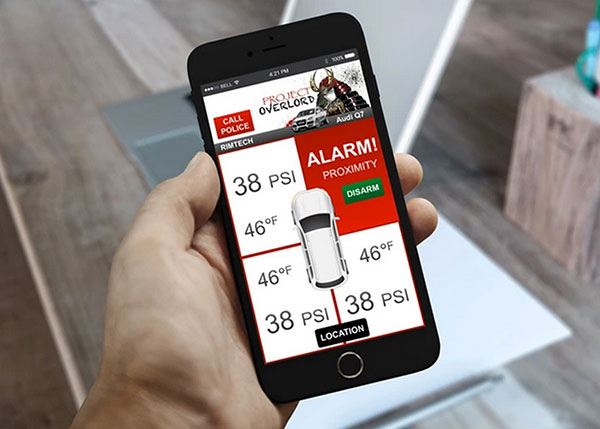
    Project Overlord has launched RimTech in the U.S. Developed by former Nokia, IBM and Motorola executives, RimTech has a built-in GPS, motion sensor and camera, which attach to the tire and act as a security guard for automobile wheels. The vehicle owner controls the device through the accompanying iPhone and Android app, providing total control and surveillance at all times.

    Using a two-stage system to eliminate false alarms to police departments, the vehicle owner is immediately alerted of a security compromise. When the car’s tires are approached closer than 3 inches or moved over 3 mm, RimTech will sound a continuous alarm to deter the thief and alert the owner through a push notification on their phone. If the thief proceeds to remove the wheels from the vehicle, a second mobile alert will notify the owner of the movement while police are simultaneously informed of the property’s location and owner’s vehicle information. The owner can use their mobile RimTech app to track the wheel’s real-time location with an accuracy of less than 10 feet.

    “The auto industry has yet to introduce a fully comprehensive and effective wheel theft prevention system to the marketplace. Wheel locks are totally ineffective and can be removed in seconds. RimTech is the solution,” said Terrence Gaskin, founder and CEO of Project Overlord. “Project Overlord not only wants to protect your vehicle and its wheels, but also intends to partner with insurance companies to offer discounts for protected drivers.”

    According to a recent Yahoo! News article, “Tires and wheels offer a near-perfect combination of attributes to thieves. They’re easy to haul, quick to remove, untraceable on online auction or classified sites, and frequently usable on several different vehicles, with a value that can hit $3,000 and higher per set.”

    Product Highlights

    • App notifies users of tampered or stolen wheels
    • Alarm sounds if parked wheels are approached or move more than 3mm
    • App tracks stolen wheels and notifies authorities
    • Battery lasts a minimum of two days in tracking mode
    • Device captures at least 25 photos of surroundings and thief
  • TomTom to provide data for Uber driver app

    TomTom has signed a global, multi-year agreement to provide maps and traffic data for the Uber driver app.

    TomTom’s advanced map-making technology, combined with its traffic information, will ensure Uber has a seamless navigation experience, accurate arrival times and efficient journeys in more than 300 cities around the world, according to a TomTom news release.

    “We are excited to provide Uber with our best-in-class location data,” said Charles Cautley, managing director, Maps and Licensing at TomTom. “TomTom is a truly independent map provider with the platform for the future. With this platform, TomTom is the trusted partner for innovative and future proof location technology for the global automotive and consumer technology industry.”

    “We look forward to working with TomTom, a leader in the mapping and navigation space,” said Matt Wyndowe, head of Product Partnerships at Uber. “Their mapping and traffic data will help ensure we continue to provide a great experience for drivers everywhere.”

  • Omnitracs Updates Roadnet Anywhere Fleet Management Platform

    Omnitracs-logoOmnitracs Roadnet Technologies has made available Roadnet Anywhere v3.8, the newest version of its SaaS vehicle routing, tracking, mobile workforce, telematics and fleet management platform. The updated software now delivers improved performance tracking with the Insight data visualization application and advanced capabilities to analyze Service Patterns in order to support strategic analysis, says the company.

    “In the past, fleets were forced to analyze multiple data points across various disparate systems, making it difficult to conduct cross-metric analysis across such things as driver safety, miles driven and customer commitments met,” said Kevin Haugh, general manager of Omnitracs Roadnet Technologies. “By rolling out the newest update to the Roadnet Anywhere platform, Omnitracs is reinforcing its commitment to its comprehensive, cloud-based platform. As the company continues to rapidly deploy new features to its SaaS fleet management platform — integrating routing, dispatching, telematics, customer notifications and analytics in a single, web-based tool — fleets can better monitor and reduce risk, promote safety and secure savings.”

    New to Roadnet Anywhere, Service Pattern Analyzer evaluates planned and/or actual deliveries and automates the information needed to create strategic plans. The tool saves fleets time and labor costs and streamlines the once-cumbersome process of manually collecting and collating data from several systems, says Omnitracs.

    The Insight tool now gives users the ability to easily define metric oriented rules as well as create and view multiple measures as part of one form of data visualization. Available metrics through Insight span the complete range of information from Roadnet routing, dispatching, proof of delivery and telematics products.

    “The Omnitracs Roadnet Anywhere platform is on a constant path to evolve. By continuing to update the Roadnet Anywhere SaaS platform, we’re able to provide customers with actionable control and insights in real time,” said Cyndi Brandt, senior director of product marketing and alliances for Omnitracs Roadnet. “With these enhancements, Omnitracs is empowering fleets to operate more efficiently without compromising service or profits.”

  • GPSTrackIt.com Adds Playback Feature to Fleet Manager

    gpstrackit_logoGPSTrackIt.com has enhanced Fleet Manager, its vehicle tracking and fleet management system, with new features that control how vehicles are displayed. Fleet Manager can now provide simultaneous playback of multiple vehicle trails as well as controls to turn on and off the display of landmark clusters on the map.

    The playback of multiple vehicle trails makes it possible for fleet managers to visually assess their routes to determine if there are overlaps where one driver’s route is encroaching on another’s. Routes can then be modified to increase operational efficiency.

    If a single vehicle is driven by multiple drivers during the course of a day this feature can display each shift by using different colors.

    “This was another suggestion from one of our customers,” said Eddie Bermudez, GPSTrackIt’s product development manager, in a news release. “We thought it was a great idea and immediately put it into development.”

    Another suggested enhancement from a customer was the ability to turn on and off the display of landmark clusters on the map.

    “We pride ourselves in being responsive to requests for enhancements from customers,” Bermudez said. “This just gives our customers that much more flexibility in configuring how objects on the map are displayed.

  • GPS-powered advertising geo-targets moving vehicles

    GPS-powered advertising geo-targets moving vehicles

    MediaSignage-GPS-LBS
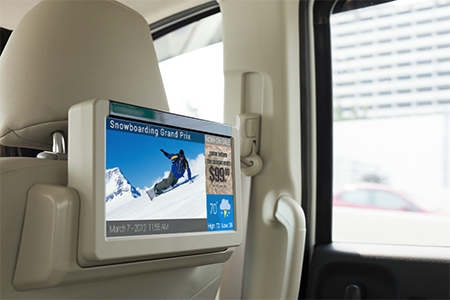
    With the service, media players display a content loop with information specific to the vicinity of the vehicle.

    MediaSignage has released GPS-powered, location-based services (LBS) for digital signage. The tool provides specific geo-targeting of advertising campaigns based on the location of the screen.

    The GPS-enabled location targeting works well for buses, taxis and trains, because advertisers can more easily target their digital signage content based on a targeted geographic radius, MediaSignage said in a press release.

    For instance, a taxicab may provide digital signage behind the headrest and allow local advertisers to target messages to patrons that ride within the cab. When a moving car, bus or train enters the desired radius (such as close to a specific restaurant or local venue), the installed media player displays a new content loop with information specific to the vicinity. Once the media player moves out of that vicinity, the original content loop resumes.

    MediaSignage has designed the tool to be simple and affordable, enabling any business owner to have their message presented in a matter of a few minutes. Users can log in to StudioLite, set the radius on a map, and set the priority duration for each content resource that is to be displayed. Users can set radius location information for several desired areas within a geographic footprint.

    When users combine the power of GPS tracking into moving digital signage, the ability to target for advertising purposes becomes extremely powerful, MediaSignage said. Placing local advertisements in taxi, bus, train and even Uber cars provides a powerful tool for selling ads and targeting customers.

    “We are extremely pleased and excited by this latest feature implementation within our system,” said MediaSignage president Nate Nead. “It provides an additional value-adding tool for digital signage business owners and operators, allowing them to better monetize their display screens in a host of different and non-traditional environments. We hope our users will take full advantage of the new features and that the features will provide a profit-enhancing tool for their businesses.”

  • Driverless conference focuses on strategies for autonomous car

    With automakers and Silicon Valley technology companies rolling out their strategies for the autonomous car, keeping on top of the latest technology, worldwide markets and regulation will be critical. Enter Driverless, a conference that will be held March 22-23, 2016, at the Crowne Plaza Hotel, San Francisco Airport.

    Attendees at the conference can find out what technology and markets will prevail from both Detroit and Silicon Valley perspectives from some of the most important executives in the business, explains event organizer and GPS World LBS Editor Kevin Dennehy.

    Driverless will feature more than 30 executive speakers covering the most important issues facing the autonomous vehicle industry. Driverless is an exclusive one-day conference that features an early bird reception on the evening before, a hosted luncheon, and an industry-best two-and-a-half hour reception with more than 15 exhibits from prominent companies.

    Those attending can learn the answers to these questions:

    • What technological, social and legal issues face ADAS and autonomous vehicle progression?
    • What technologies are solving the high cost of rolling out autonomous systems?
    • How can companies adequately test vehicles?
    • How will car sharing revolutionize the autonomous vehicle industry?
    • Who are the most innovative players and what are their intentions?
    • What are consumer expectations?
    • What systems are evolving… and for what markets?
    • Who owns this market? The technology companies or traditional automakers?

    Learn more at the conference website.

  • ŠKODA App Lets Kids Drive along with Parents

    ŠKODA App Lets Kids Drive along with Parents

    Photo: ŠKODA

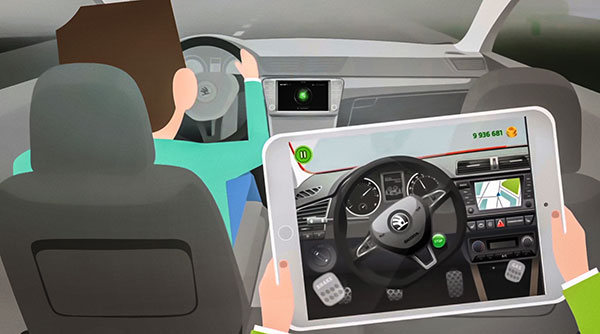
    Czech automaker ŠKODA is offering a tablet game that gives kids in the backseat the opportunity to follow along as their parent drives.

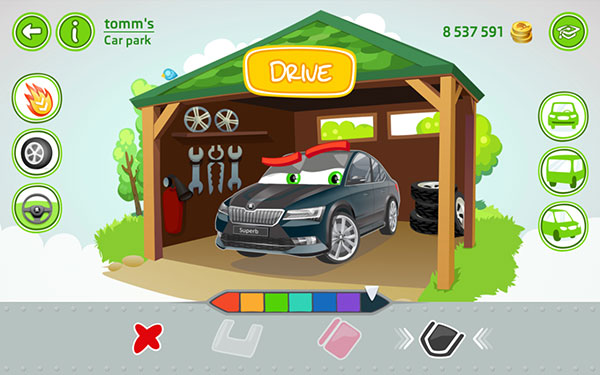
    With the ŠKODA LittleDriver app, children can imitate the driver’s actions using real data from the car. The app makes use of ŠKODA’s SmartGate interface, which uses Wi-Fi to send vehicle data to a connected device.

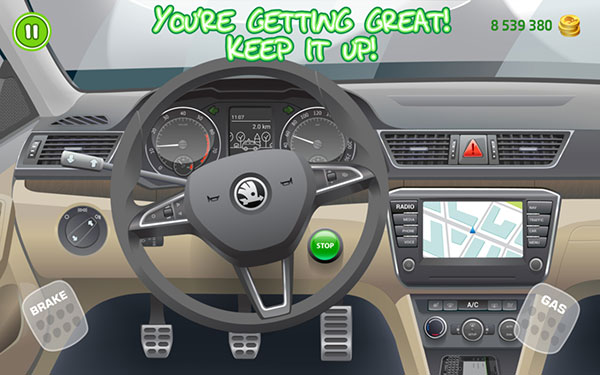
    LittleDriver is fully interactive: children can copy the actions of the real driver and collect points when they are correct. Steering, acceleration, turning, braking — everything that the driver does, the player can imitate on a tablet in real time. Speed, fuel level, brake status and oil pressure are also displayed.

    At the end of the game, points earned can be used to design a virtual ŠKODA, which can be configured individually in the app. The ŠKODA LittleDriver app is available on the Apple and Android app stores, and is aimed at ages 9–12.

    Skoda-littledriver-3-W Skoda-littledriver-app-W

  • NovAtel to Develop WAAS G-III—Galileo Reference Receiver for FAA

    NovAtel to Develop WAAS G-III—Galileo Reference Receiver for FAA

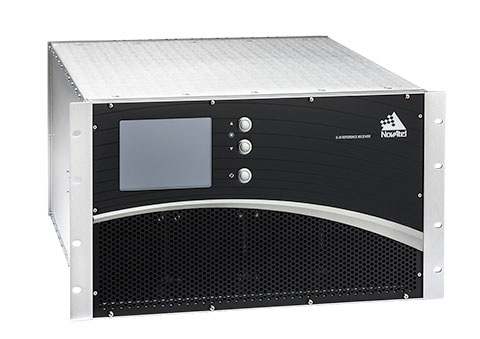
    NovAtel's WAAS G-III—Galileo Reference Receiver.
    NovAtel’s WAAS G-III—Galileo Reference Receiver.

    The U.S. Federal Aviation Administration (FAA) and NovAtel have exercised a bilateral option to produce a Wide Area Augmentation System (WAAS) G-III—Galileo prototype receiver. Maintaining core NovAtel WAAS G-III functionality for GPS and SBAS signal processing, the new receiver will operate in the WAAS reference station test environment to facilitate research on multiple GNSS constellation utilization.

    The prototype receiver will also add functionality to support tracking and demodulating associated navigation data for Galileo satellites including:

    • Galileo E1 and E5a tracking
    • Ephemeris and almanac reporting/processing from E1 or E5a
    • Automatic channel assignments
    • Time solution computed from Galileo
    • Correlator information for signal deformation on Galileo signals

    The WAAS G-III—Galileo prototype receiver will be developed on NovAtel’s existing WAAS G-III receiver hardware and application software, and delivered as a field-loadable firmware package. The WAAS G-III—Galileo receiver will not be qualified to DO-178B Level D as part of this contract.

    NovAtel’s WAAS G-III reference receiver platform was designed with expandability and multi-GNSS SBAS evolution in mind, and can be customized to meet the needs of individual satellite networks. NovAtel has already delivered G-III based reference receivers to several programs worldwide, including the WAAS G-III receiver (US WAAS, FAA), IRIMS G-III receiver (India IRNSS, ISRO),  and QZSS G-III receiver (Japan QZSS, NEC) variants.

    The company’s reference receivers and uplink station equipment have been a central element of the U.S. WAAS since its inception. The WAAS third-generation reference receiver (G-III) uses fully updated hardware, and tracks all GPS signals including the legacy GPS L1 C/A, L2P(Y) (semi-codeless), and the modernized L2C, L5, L1C signals as well as the WAAS L1 C/A and L5 signals.

    The WAAS G-III reference receiver provides a rich set of range measurement data, signal integrity metrics, and logs for processing by the system’s data communication processor, NovAtel said. The WAAS G-III – Galileo prototype receiver is the first G-III platform evolution for the FAA, an important step towards possible GPS + Galileo dual-GNSS SBAS operations in the future.

  • Tesla Rolls Out Autopilot


    In October 2014, Tesla started equipping its Model S with hardware to allow for the incremental introduction of self-driving technology: a forward radar, a forward-looking camera, 12 long-range ultrasonic sensors positioned to sense 16 feet around the car in every direction at all speeds, and a high-precision digitally controlled electric assist braking system.

    Version 7.0 of Tesla’s software has now been released with Autopilot, which allows those tools to deliver a range of new features designed to work in conjunction with the automated driving capabilities already offered in Model S.

    Tesla calls Autopilot a major step toward autonomous driving. “Tesla Autopilot relieves drivers of the most tedious and potentially dangerous aspects of road travel,” according to a Tesla blog. “While truly driverless cars are still a few years away, Tesla Autopilot functions like the systems that airplane pilots use when conditions are clear. The driver is still responsible for, and ultimately in control of, the car. What’s more, you always have intuitive access to the information your car is using to inform its actions.”

    The combined suite of features represents an integrated autopilot system involving four different feedback modules: camera, radar, ultrasonics and GPS. “These mutually reinforcing systems offer real-time data feedback from the Tesla fleet, ensuring that the system is continually learning and improving upon itself,” the Tesla blog said.

    Autopilot allows Model S to steer within a lane, change lanes with the tap of a turn signal, and manage speed by using active, traffic-aware cruise control. Digital control of motors, brakes and steering helps avoid collisions from the front and sides, as well as prevent the car from wandering off the road. “Your car can also scan for a parking space, alert you when one is available, and parallel park on command,” Tesla said.

    Release of version 7.0 also features a significant visual refresh of the digital display. The instrument panel is focused on the driver and includes more functional apps to help monitor the ride.

    Tesla founder Elon Musk said during a press conference that drivers should exercise caution in the initial months of the rollout, and consider Version 7.0 a beta release. “We’re advising drivers to keep their hands on the wheel at this early stage,” Musk said. The car’s dash alerts drivers when they need to take the wheel.

    Just days after the launch, videos began appearing on the Internet showing near misses and other errors.

  • PCTEL Launches High Rejection GNSS Antenna Portfolio Using SkyLink Technology

    PCTEL Inc. has launched a new GNSS multi-satellite antenna portfolio for mobile and base-station timing applications. PCTEL’s new SkyLink antenna technology features out-of-band rejection characteristics that provide exceptional GPS/Galileo and GLONASS L1 support and performance in heavy RF traffic environments for fixed and mobile timing and asset tracking applications.

    The new portfolio consists of two product lines:

    • SkyCompass for fleet management and asset tracking applications
    • SkyStamp base-station antennas for timing and synchronization of 4G LTE cellular networks.

    SkyCompass comprises six new configurable antenna platforms, including single-band or multiband GNSS options that address the majority of fleet management installation needs. SkyStamp offers two timing reference and synchronization antenna models that provide maximum mitigation of the effects from nearby LTE interference sources.

    “Over the last decade, PCTEL has been the industry’s technology leader in high rejection GPS products. These antennas are deployed worldwide by OEM customers in aviation, defense, and fleet management public safety projects,” said Rishi Bharadwaj, vice president and general manager of PCTEL’s Connected Solutions. “True to our commitment to support global communications and evolving requirements, PCTEL’s SkyLink technology provides global multi-satellite GNSS coverage and precision tracking by rejecting RF noise or interference that can negatively affect communications in performance critical situations.”

    SkyCompass and SkyStamp antennas will be available for shipment in November.