Category: GLONASS

  • The System: Galileo Slips, EGNOS Operates

    Four Galileo in-orbit validation (IOV) satellites scheduled to launch next year have already missed their first pad date.The European version of Russia’s Soyuz rocket is now scheduled to carry the four IOV satellites into orbit in two launches in November 2010 and early 2011, as announced by European Space Agency (ESA) Director-General Jean-Jacques Dordain on October 9.

    Both launches had been set for earlier in 2010, but ESA has encountered difficulties with the satellites, built by a consortium led by Astrium Satellites and Thales Alenia Space. Introduction of Russia’s Soyuz rocket at Europe’s Guiana Space Center in French Guiana, on the north coast of South America, has also been repeatedly delayed.

    The European Union and ESA plan to select a builder for the remaining 28 satellites late this year. Final bids from 11 companies bidding for on six Galileo work packages are expected by November 11.

    Experimental Satellite Moved. In July and August, Surrey Satellite Technology Ltd (SSTL) repositioned GIOVE-A, the first Galileo test satellite, to an orbit 113 kilometers above the orbit that the operational Galileo navigation satellites will occupy.

    Since its December 2005 launch, GIOVE-A has achieved all of its mission objectives and remains in excellent condition well beyond its design life of two years, SSTL stated.

    The test satellite secured the Galileo frequency filings with the International Telecommunication Union (ITU), collected data to characterise the medium-Earth Orbit (MEO) environment, and flight-proved technologies such as highly accurate atomic clocks.

    GIOVE-A remains fully operational, and has sufficient propellant remaining for further maneuvers. A further repositioning exercise may be performed to raise the orbit higher still before GIOVE-A is finally decommissioned.

    SSTL and its new owner, OHB of Germany, jointly form one of the two consortia now bidding for the development and construction of 28 satellites for the operational Galileo service.

    EGNOS. The European Commission (EC) declared on October 1 the official start of operations by the European Geostationary Navigation Overlay Servic (EGNOS), with its Open Service available free of charge to businesses and consumers. EGNOS is Europe’s first contribution to satellite navigation and a precursor of Galileo, the global satellite navigation system in development.

    EGNOS is a satellite-based augmentation system that improves the accuracy of satellite navigation signals over Europe. The system is composed of transponders aboard three geostationary satellites hovering high above the Eastern Atlantic and the European continent, linked to a ground network of about 40 positioning stations and four control centers, all interconnected. The EGNOS ground stations receive signals sent out by GPS satellites. Information on the accuracy and reliability of these signals is relayed to users via the geostationary satellite transponders. This allows them to determine their position to within two meters in real-time, according to EC spokespersons.

    The EGNOS coverage area includes most European states and has the built-in capability to be extended to other regions, such as North Africa and European Union neighboring countries.

    The commission seeks to support new applications in sectors such as agriculture (high-precision spraying of fertilizers) and transport (for example, automatic road-tolling or pay-per-use insurance schemes). EGNOS can also support much more precise personal navigation services, both for general and specific uses, such as systems to guide blind people and to improve signal reception in urban areas.

    EGNOS will be certified for use in aviation and other safety-critical areas in compliance with the Single European Sky regulation. Through EGNOS a safety-of-life service is expected to be in place by mid 2010. This service will provide a valuable warning message informing the user within six seconds in case of a malfunction of the system. A commercial service is under test and will also be made available in 2010.

    EGNOS operations are managed by the European Satellite Services Provider, ESSP SaS, a company based in Toulouse, France, founded by seven air navigation services providers. A contract between the EC and ESSP SaS covers management of the EGNOS operations and maintenance until the end of 2013.

    The EGNOS Open Service is accessible, without service guarantee or resulting liability, to any user equipped with a GPS/SBAS compatible receiver within the EGNOS coverage area. Most receivers sold today in Europe meet that requirement. No authorization or receiver-specific certification is required.

    GLONASS Signal Generates Slip

    A planned late-September launch of a three new GLONASS-M satellites from the Baikonur space center was postponed due to a problem with signals emanating from a previously launched GLONASS-M satellites, now on orbit. Initially, a new launch date of October 29 was set by Roscosmos, the Russian space agency, but no word had yet come at press time regarding investigation of a problem with the signal generator aboard the orbiting satellite, detected in late August. The spacecraft was taken out of service on August 31.

    GPS Wiggles: SVN49, CNAV

    The GPS Wing held an extraordinary session at ION GNSS in Savannah, Georgia, September 23, frankly explaining the SVN 49 satellite’s problem and probable solutions.

    SVN49, the IIR-M) + L5 civil-signal satellite, will be set healthy in the coming months and it will be useable, the GPS Wing said. Its L1 an L2 signals contain a pseudorange error that remains within specifications for compliant GPS user equipment.

    On the ground, a receiver sees from this satellite both a direct signal and a weaker reflected signal, which looks like a multipath component. According to models, if the direct and reflected L1 signals are in phase at zenith, a standard code-correlating receiver will measure a C/A-code pseudorange that is 1.62 meters too long. The error becomes smaller as the elevation angle drops, reaching zero at an elevation angle of about 42 degrees, and then rising slightly as the elevation angle drops to zero.

    During audience input following the Savannah panel presentations, Javad Ashjaee of JAVAD GNSS proposed simply turning the satellite on as is and using it as an opportunity, given the “defined multipath” that it effectively transmits, to study multipath and other phenomena. JAVAD GNSS Triumph receivers have demonstrated the ability to remove almost all anomalies and satellite multipath from the SVN49 signal.

    An as-yet-unconfirmed report has it that U.S. Air Force representatives and others, in an informal meeting after the session, came to a provisional agreement as to the best course. However, this has not yet worked its way through channels nor been announced.

    New Message. The first test of the CNAV navigation message format to be used in the future on Block IIR-M and IIF satellites was announced at the September CGSIC meeting in Savannah, and will begin soon. A Type 0 message will be broadcast on the L2C signal by SVN49. By the end of the year, this message is to be switched on, on all IIR-M satellites. However, this initial message type will not contain useful information for end users.

    Message Type 0 consists of a 12-second, 300-bit long message including the preamble, satellite pseudorandom noise (PRN) number, message type ID (=0), GPS time of week, a sequence of alternating 1s and 0s, and a cyclic redundancy check (CRC) parity block. The GPS time of week will change every 12 seconds, as will the CRC bits.

    Penny Axelrad Honored

    Penina Axelrad, professor of aerospace engineering sciences at the University of Colorado, received the Institute of Navigation’s 2009 Kepler Award for her “contributions in the field of satellite navigation and dedication to the education of future generations of navigation engineers.”

    Axelrad has done advanced research in topics including receiver autonomous GPS integrity monitoring (RAIM), GPS bistatic radar, satellite formation flying using GPS, GPS-based orbit and satellite attitude determination, and multipath characterization, modeling, and mitigation.

    She received a Ph.D. in aeronautics and astronautics from Stanford University and S.B. and S.M. degrees from the Massachusetts Institute of Technology. She has taught for 17 years at the University of Colorado.

  • “What Can GLONASS, GPS L2C, and GPS L5 Do for You?” Webinar Q&A Follow-up

    I hope you’ve enjoyed and benefited from the webinar series as much as I have. I think that given the limited travel budgets in this economy, they are one of the most powerful tools for collaborating. I consider it collaboration because I learn also. Your questions and comments make me think about topics I might not normally consider.

    I also have to give credit to our marketing folks in spreading the word about our webinars. I’ve spoken to others who conduct webinars and I don’t hear of anyone attract the attendance numbers that ours are do (if I may be so bold as to toot our horn). I didn’t see the final attendance numbers on the last webinar, but I think we had over 600 registered. By early next year, I think the number should reach 1,000 for each of the survey/construction/GIS webinars. Hopefully, in the next few months we’ll also start up a webinar series for GeoSpatial Solutions, which I started working on earlier this month.

    As I’ve been accustomed to doing, this newsletter addresses the questions you submitted during the Sept. 15 webinar entitled “What Can GLONASS, GPS L2C, and GPS L5 Do for You?”.

    There were some great questions during the webinar, and a lot of them. There were so many, in fact, that I’m going to break them up into a couple of different newsletter issues. Also, I need to update you on my trip to ION GNSS a couple of weeks ago. I might mix up the next newsletter with more Q&A as well as the ION GNSS update.

    Lastly, don’t feel the need to wait until the next webinar to send me your comments/questions. I can guarantee you that many others have the same questions that you do.


    Question #1: Recent Statement: GLONASS satellite signals are not used nearly as much as the GPS satellite signals (domestically) — is this true? If so, what is the percentage of GPS usage vs. GLONASS in the states?

    Gakstatter: The general statement is true. GLONASS is used predominately in high-precision RTK (real-time kinematic) applications that require centimeter-level accuracy. Even in that segment, I think only a minority of the existing survey receivers utilize GLONASS. But that’s considering legacy receivers that have been in operation for many years. You should remember that GLONASS only became a widely adopted technology in the last few years and it’s still an option on most survey receivers unless you purchase the top-of-the-line model. As recent as five years ago, several mainstream manufacturers still didn’t support GLONASS.

    Also, consider that the popular entry-level GPS L1 survey receivers such as the Magellan ProMark 3 line don’t support GLONASS at all.

    On the GIS front, GLONASS is just starting to make its way into mapping-grade receivers such as the Trimble GeoXH and Topcon GMS-2 Pro. But realize that correctors for GLONASS aren’t supported by real-time correction systems such as WAAS/EGNOS/MSAS or DGPS/NDGPS or OmniSTAR. GLONASS isn’t supported by OPUS or other online post-processing services either.

    But make no mistake about it, GLONASS usage is increasing substantially. This is mainly due to GPS “brownout” periods where there aren’t enough GPS satellites throughout the day to be productive. It’s simply too expensive for work crews to sit idle while waiting for the GPS constellation to improve during parts of the day.

    Lastly, next year the Russians are introducing a significant change with their new generation GLONASS-K satellites. They are going to begin supporting CDMA (vs. FDMA they support now). You can think of this like VHS vs. Beta VCRs of 20 years ago. Today, a GPS/GLONASS receiver is basically two receivers in one box, just like a VCR player that would support VHS and Beta formats. This makes a GPS/GLONASS receiver difficult to design, power hungry and generally inefficient. This is the reason you do not find GPS/GLONASS receivers in the consumer GPS market and rarely in GIS/GPS receivers. However, this is going to begin changing next year as Russia will begin to support CDMA signal structure. This will be the start of a new era in simplifying the design of GPS/GLONASS receivers. I believe it will mark the beginning of the wide-spread adoption of GLONASS. However, this is not an overnight process. It will be many, many years before enough operational GLONASS-K satellites are in orbit to support a CDMA GPS/GLONASS receiver. Of course, it’s also critical that the Russian space program stay focused (politically and financially) in order to achieve this.

    Question #2: Will current GLONASS receivers work with the new (GLONASS) “K” satellites?

    Gakstatter: It is my understanding that the GLONASS-K satellite will support legacy signals and signal structures. Essentially, they would be broadcasting FDMA and CDMA signals. So, the answer is yes. I will report back to you if I hear anything different as this is a critical issue given the large number of GPS/GLONASS receivers in use today.

    Question #3: What does the “k” stand for in RTK?

    Gakstatter: I apologize for “flinging around” acronyms so loosely.

    RTK is an acronym for Real-Time Kinematic. Essentially, it’s a GNSS technology that’s capable of providing centimeter-level positioning in real time while it is moving. RTK utilizes the message carrier (carrier phase) rather than the message itself.

    Question #4: Why will traditional GPS L1/L2 receivers become obsolete after Dec 31, 2020?

    Gakstatter: It’s probably best for you to read the article I wrote about this last year. I also conducted a webinar on the subject you can listen to here.

    It’s important to note that the Dec 31, 2020 date is not a date in which your legacy receiver will stop working. After that date, the US Department of Defense says they won’t guarantee support of semicodeless techniques. In other words, it may work and it may not. The risk is with the user.

    Question #5: What about the accuracy of L2C code? Is it like C/A or P code?

    Gakstatter: L2C provides a pilot carrier for L2. Before L2C, the architects of the original GPS never intended for the civil community to be able to utilize L2. But some very smart engineer/entrepreneurs figured out a way to track the L2 carrier in a “round-about” way via the semicodeless technique mentioned above. With L2C, the semicodeless technique isn’t required any longer so the L2C signal-to-noise (SNR) value is stronger.

    However, there aren’t enough satellites (only 7) in orbit broadcasting L2C at this point to make a significant difference.

    Secondly, L2C has a code similar to C/A code broadcast on L1, but much improved. However, this isn’t being broadcast on L2C at this point due to the ground control segment of GPS not being ready yet. Last indication I received was that it was about two years away from being ready.

    Question #6: If there is a black out in GPS in a GPS/GLONASS receiver, how will it affect? No Black out in GLONASS.

    Gakstatter: I’m assuming you are referring to a total black out of GPS signals. GLONASS isn’t at the point where you can rely on it as a stand-alone system. It lacks a sufficient number of satellites (17) and the quality/reliability of the measurements isn’t nearly as good as GPS.

    Question #7: Are certain frequencies more stable/reliable than others.

    Gakstatter: GPS sign
    als/frequencies (L1 C/A and L2C) are very stable and reliable. They are the most reliable satellite navigation signals in the world. I wouldn’t say that a single GPS signal or frequency is more stable or reliable than another. However, there are a limited number of satellites (seven) that broadcast L2C so it’s not as available as it will be when a full constellation of satellites will be broadcasting L2C (several years from now).

    Many users have GPS/GLONASS receivers. GLONASS, and Russia is very open about this, is not as stable or reliable as GPS yet. While not useful yet as a stand-alone system, GLONASS has proven to be very useful as an augmentation to GPS. This is the reason that GPS/GLONASS receivers have become so popular in recent years in high precision RTK systems.

    Russia has stated that their goal is to match GPS performance in the future.

    Question #8: How will the autonomous accuracy improve with L5 or L2C?

    Gakstatter: Multiple frequencies allow the receiver to directly mitigate the effects of the atmosphere which is the major source error in GPS positioning.

    I’ve heard it been discussed quite widely that decimeter accuracy without correction will be possible with a dual frequency receiver (L1/L5). Furthermore, since both L1 and L5 (and L2C) are open signals (unlike legacy L2), multiple frequency receivers will be widely available and a fraction of the cost of today’s dual frequency receivers.

    Question #9: Will any abilities of the L1/L2 w/ L2C be downgraded when semicodeless is disabled?

    Gakstatter: This is a very good question. The difference I can think of may be the number of satellites broadcasting L2C at that time. If there are still a number of legacy satellites that aren’t broadcasting L2C, one may lose the ability to utilize those satellites.

    Also, it’s important to understand that semicodeless isn’t necessarily going to stop working after December 31, 2020. The DoD merely states that they won’t guarantee it will work after that date. In other words, the DoD might choose to test or utilize a feature that might disrupt semicodeless receivers and they aren’t obligated to inform the civilian community that they are doing so.

    Looking into the future, I’m guessing that receiver manufacturers will create firmware in the receivers (L1 C/A, L2, L2C) that might be capable of detecting this scenario and react accordingly.

    Question #10: If you have a receiver supporting L1/L2/L2c/ glonass where you are tracking 16+ satellites has there been any though on a weighting system for satellites in your solution?

    Gakstatter: Another good question. I’m not sure how the receivers handle this. I will ask a couple of receiver designers I know. I am familiar with some receivers (mapping-grade receivers using code phase) that utilize signals from satellites for which there are no corrections available in order to improve the PDOP. For example, some satellites may not be visible by more than one SBAS reference station and therefore no correction would be issued for that satellite by the SBAS…but the range data from that satellite may still be used to improve the PDOP and position.

    Question #11: Are the ground stations shown in the WAAS slide (SBAS(2) I believe) all operational today?

    Gakstatter: Yes. There are currently 38 WAAS reference stations and all of them are operational today. Twelve were added in the last couple of years (red dots on the map below).

    Four were added in central/eastern Canada, four were added in Alaska and five were added in Mexico. This extended the WAAS service area significantly to the north and south into Canada and Mexico and significantly improved WAAS performance in Alaska.


    Question #12: What is the expected accuracy of WAAS in North America and can WAAS be received under canopy (forested) areas?

    Gakstatter: Well, like all questions about GPS accuracy, the answer is “it depends”.

    There are two major factors when considering the accuracy of WAAS.

    The first is the WAAS itself. Looking at the WAAS Performance Report published quarterly by the National Satellite Test Bed, WAAS accuracy throughout North America is well under a meter (horizontal).

    Secondly is the quality of the GPS receiver one is using. A standard consumer-grade GPS receiver using a SiRF (or other) GPS chipset or a GPS-enabled mobile phone is not going to deliver submeter accuracy. Those receivers simply weren’t designed with accuracy as a primary design criterion. On the other hand, there are several GPS receivers available that were designed with professional users in mind that are able to optimize WAAS accuracy and achieve submeter accuracy.

    Operation under tree canopy is even a trickier subject. Among GPS receivers designed for professional users, there is a subset that has been optimized to operate under tree canopy. First, let me be clear that GPS accuracy degrades under tree canopy for all GPS receivers. It’s just a matter of how much it degrades.

    There are two primary issues when operating GPS receivers under tree canopy: accuracy and tracking. Great accuracy is not worth anything if the receiver can’t track satellites. On the other hand, great satellite tracking does little for the professional user if the accuracy is horrible.

    Utilizing WAAS under tree canopy has the additional challenge of the GPS receiver needing to track one of the two WAAS broadcasting satellites (GEOs). Their signal is affected by trees just like GPS satellites. Some companies have developed technology that allows their GPS receivers to temporarily lose track on the WAAS GEO satellite for up to 30 minutes and still maintain WAAS accuracy (or close to it).

    Question #13: Is there a live web page that is good for survey planning, based on GPS satellite positions?

    Gakstatter: There are several GPS satellite planning software packages available as free downloads. Trimble, Topcon, and Leica Geosystems offer them. These require the user to install the software on their computer and update the almanac frequently.

    There is one on-line GPS satellite planning tool from NavCom Tech that’s very convenient for two reasons. First, you don’t have to install any software on your computer. Secondly, it updates the almanac automatically. It has a couple of drawbacks. The major one is that it doesn’t consider GLONASS or SBAS satellites. Secondly, one can’t adjust the elevation mask. Hopefully, NavCom will consider adding those features in the future.

    I wrote an article on this subject recently. You can view it here.

    Thanks and see you next time!

  • Expert Advice: GLONASS Business Prospects

    By VASILIY ENGELSBERG, IVAN PETROVSKI, and VALERY BABAKOV


    Similar in many aspects to GPS, GLONASS has performed much less successfully on a commercial scale, failing — so far — to create significant business worldwide. Today, however, the commercialization of GLONASS has taken a new and more promising direction, receiving strong encouragement from the Russian government. We look forward to GLONASS being completely restored to its full operational capabilities within the next few years, and we are certain that this time GLONASS will create successful business opportunities worldwide.

    Why did GLONASS fail to create a worldwide business opportunity in the past? First, many GLONASS satellites of the first generation had required replacement at approximately the same time. This coincided with a difficult period for the Russian economy, after the collapse of the Soviet Union and much of its infrastructure. Budget for space applications suffered, not only for GLONASS, but other space programs that were temporarily frozen. Many companies that had started to work on combined GPS/GLONASS receivers worldwide stopped these initiatives at that time.

    The other reason for GLONASS’s halting commercial history is in its frequency division multiple access (FDMA) signal structure instead of code division multiple access (CDMA), as is the case with GPS, and now Galileo. FDMA, though more immune to interference, results in bulkier user equipment. Today the situation may change in two respects. First, there is a possibility of introducing CDMA within GLONASS. Second, and even more important, today GNSS user equipment progresses toward multifrequency anyway with all the possible combinations of GPS, Galileo, L1, L2, and L5. It will ultimately boost the technology, and even multifrequency and wide-band RF components will be miniaturized.

    All these considerations allow us to confidently foresee exceptional opportunities for GLONASS-related business tomorrow.

    Policy. Today, GLONASS is required for social infrastructure within Russia for all federal users. President Vladimir Putin has paid special attention to rapid GLONASS development, urging completion of the system ahead of the original plan.

    As expected, three more GLONASS-M satellites were launched by the end of 2007, and have since been declared operational. GLONASS-M satellites have a guaranteed lifespan of seven years, that is, the lifespan of these satellites runs until the year 2015.

    There is also a new generation of satellites, GLONASS-K. This upcoming modification represents an entirely new concept based on a non-pressurized platform. The estimated service life of GLONASS-K satellites has been increased to 10–12 years, and the spacecraft will carry an additional third civilian L-range frequency.

    GLONASS-K is smaller and considerably lighter than previous models, allowing the use of a wider range of launch vehicles and thus making them less costly to put into orbit. The weight of a GLONASS-K satellite falls to 700 kilograms instead the of 1,415 kilos of previous satellites. After the complete constellation is deployed, it will require one Soyuz launch per year to maintain the constellation in full.

    We expect that at least six GLONASS-M satellites will be launched in 2008, and six more in 2009. There will also be two GLONASS-K satellites launched in 2009. The earlier satellites with three-year lifespans will be decommissioned.

    Altogether, there should be 24 satellites in near-circular orbits with 64.8-degree inclination in three orbital planes. Initially, system completion was planned by the year 2012, but with close attention from the Russian government, the system may be deployed in full scale by the end of 2009.

    Interoperability. Moving as planned toward interoperability with GPS and future Galileo, the GLONASS coordinate frame had been changed. According to the Russian Federation government decree issued on June 20, 2007, the improved version of the national geocentric coordinate system “Earth Parameters 1990” (PZ-90.02) has been applied to GLONASS. The transformation between PZ-90.02 and the International Terrestrial Reference Frame ITRF2000 contains only origin shifts along X, Y, Z by –36, +8, and +18 centimeters, respectively. An update to the GLONASS Interface Control Document has already been published and made available trough the Internet. The update to ICD, current information on GLONASS status, and a current almanac is available from the Information-Analytical Center (IAC).

    Worldwide Use

    All restrictions on positioning service in Russia were lifted in January 2007, including a restriction on allowed positioning accuracy. This was one of the barriers that limited GLONASS commercialization in the past.

    Today, GLONASS plus GPS user equipment appears more and more frequently in stores in Russia. It is now necessary and highly popular equipment for airplanes, marine applications, surveyors, mapping applications, and so on.

    What advantages does GLONASS offer to worldwide users who already have GPS? Due to its orbit inclination, GLONASS provides better coverage than GPS in northern latitudes. It was designed for use in the territory of the former Soviet Union and Europe. The combined usage of the two systems allows better coverage over the full globe.

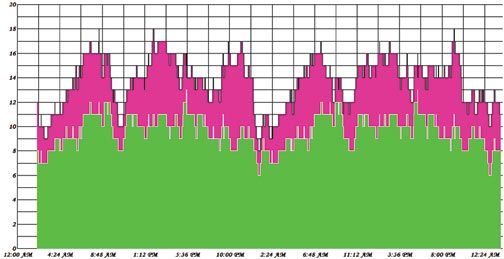
    FIGURE 1. GPS (green) and GLONASS (pink) constellation visibility in Tokyo for 48 hours. Note that GPS visibility picture repeat itself every 24 hours, and GLONASS visibility changes. It also illustrates why GLONASS satellite orbits are less affected by gravitational filed irregularities.
    FIGURE 1. GPS (green) and GLONASS (pink) constellation visibility in Tokyo for 48 hours.
    Note that GPS visibility picture repeat itself every 24 hours, and GLONASS visibility changes.
    It also illustrates why GLONASS satellite orbits are less affected by gravitational filed irregularities.

    Further, more systems mean more reliable service. Healthy competition will only benefit users. Compatibility of the systems had been be improved and will be improving further. Two systems will provide higher accuracy and higher integrity.

    The international GLONASS market can increase due to the fact that countries that do not own their satellite navigation system can provide some redundancy in their infrastructure if they implement GNSS from different owner/operators. This, however, becomes less important as other navigation satellite systems, such as Galileo, come to life. Also, more satellites will benefit users, who operate in urban or other obstructed environments.

    Accuracy. It has been generally accepted that the real-time accuracy of GLONASS is less than that of GPS. The main source of accuracy degradation comes from broadcast ephemeris and clock parameters. For many users, it is possible to use precise ephemeris, freely available on the Internet from, for example, the International GNSS Service (IGS), formerly the International GPS Service, a voluntary federation of more than 200 worldwide agencies that pool resources and permanent GPS and GLONASS station data to generate precise GPS and GLONASS products.

    We also have analytical centers similar to, and some within, the IGS. Four analytical centers wi
    thin the IGS are estimating GLONASS ephemerides, and two of them are estimating GLONASS clocks. The accuracy of precise GLONASS ephemeris are within 4 centimeters, 1 sigma.

    Using precise ephemeris, or differential service, a GLONASS user can mitigate the above-mentioned error sources and enjoy higher accuracy comparable with those of GPS. In the future, a global network, even a commercial one, can further benefit GLONASS in terms of higher real-time accuracy.

    Summarizing, we expect the GLONASS market worldwide to grow, though less rapidly than the internal market in Russia. We see our business in providing global solutions, which includes GLONASS, GPS, and Galileo, to the global market of GNSS users worldwide. The standard for navigation systems in the future will be multifrequency, multi-constellation user equipment, and we are well on the way to meeting this standard.


    VASILIY ENGELSBERG is president of NVS Technologies AG and co-founder of NAVIS.

    IVAN PETROVSKI is NVS director. Among his numerous responsibilities, he is in charge of research and development and the Asia-Pacific region.

    VALERY BABAKOV is co-founder and general manager of NAVIS. Babakov explains, “Our company is a center of the NAVIS group, which is the main supplier of GLONASS receivers in Russia. NAVIS itself is about a 300-person company. The main area of our activity is the creation of navigation and timing equipment, based on GLONASS/GPS signals.

    “We produce technologies and equipment that use GLONASS and GPS signals, including navigation equipment for marine and airborne applications, devices of time-and-frequency synchronization for communication systems, and GPS, GLONASS, satellite-based augmentation systems (SBAS), and Galileo simulators.Our current GPS/GLONASS receiver Navior seems to present interest to a wide range of customers worldwide. “Working in today’s market, we are covering all components of user service starting from conceptual engineering, to technical project development, delivery, assembling and launching of equipment, and finally providing users with training, technical support, and maintenance during exploitation.

    “As part of the process of integration of our technologies into the worldwide GNSS market, NVS Technologies had been established. NVS Technologies is a new company, which aims to bring a wide range of GNSS products to the market and is envisioned to combine the experience of Russian NAVIS and NAVIS Ukraine in GPS and GLONASS user equipment development with Swiss quality and expertise in international marketing.

    “Our company group now is not only engaged in the GLONASS business, but also looking forward contributing to Galileo equipment development. We are participating in the Galileo Integrated Receiver for Advanced Safety of Life Equipment (GIRASOLE) project together with Thales Avionics and Thales Aleniaspace. Our part in the GIRASOLE project is to provide the Galileo L1/E5 simulator. To facilitate simulator development, we have built a Galileo prototype receiver, which can acquire and track the GIOVE-A signal. Working with our SN3806 simulator, the receiver can also make a positioning. In November 2007 our engineers conducted a three-day tutorial on our GNSS simulator in Thales Avionics premises in Valence.”


  • Why are GLONASS satellites launched on Christmas Day?

    Why are GLONASS satellites launched on Christmas Day? Question posted on CANSPACE on December 10, 2006, by Kerry Matthews

    The latest triple-satellite GLONASS launch occurred on December 25th at 23:18 Moscow Time. This launch is the sixth GLONASS December launch in a row. In fact, all 9 launches since December 1995 have occurred in the last month of the year with the exception of the launch on October 13th, 2000 (see a list of GLONASS launches going back to 1990).

    Including this month’s launch, three of the recent launches have occurred on December 25th and one originally scheduled for the 25th, occurred on the 26th. Why the preponderance of December launches and launches on Christmas Day in particular?

    First of all, we should realize that for most people in the Russian Federation, there is nothing special about December 25th. Most Christians in Russia belong to the Russian Orthodox Church which celebrates Christmas according to the Julian calendar — on January 7th. And in modern Russia, January 7th is a state-wide holiday. So, GLONASS launches don’t occur around December 25th because it’s a special day on the Russian calendar. So why do they occur then?

    I posed this question to Col. (ret.) Nikolai Shienok, the former chief of the Information Department of the Coordination and Scientific Information Center of the Russian Ministry of Defense. After conferring with officials from Roscosmos (the Russian space agency) responsible for the GLONASS program, Col. Shienok confirmed that it is only for financial or organizational reasons that there is a preponderance of launches in December. “It is the last month of the year and it is impossible to postpone a planned launch further” Col. Shienok said.

    Nevertheless, there may be some operational calendar constraints on GLONASS satellite launches as there are for launches of other satellites. Satellite operators typically try to avoid launching satellites when the Sun-orbit-plane or beta angle for the intended orbit is unfavorable. The beta angle is the angle between the geocentric position vector to the Sun and the satellite’s orbital plane. This angle determines if and for how long a satellite will be in the Earth’s shadow during its orbit. For a given orbit (altitude, inclination, and initial right ascension of the ascending node), the beta angle will vary over the year. Operators try to avoid a launch date when the satellite would be in eclipse for a significant fraction of its orbit so that during the crucial satellite deployment and commissioning phase, the satellite’s solar panels receive as much sunlight as possible to keep the satellite’s batteries fully charged. The recent GLONASS launch put the satellites into Plane 2 which is actually in one of its eclipse seasons right now. However, the satellites will be out of eclipse by early January.

    Prof. Richard B. Langley

    Dept. Geodesy and Geomatics Engineering

    University of New Brunswick

  • Galileo, GLONASS, and GPS

    By Javad Ashjaee, President & CEO, Javad Navigation Systems

    The launch of the Galileo test satellite marks another very significant and exciting day in the history of navigation. Just as competition between GPS manufacturers rapidly enhanced technology and performance, the competition between the constellation providers should do the same.

    In 1984 a high-end GPS receiver weighed more than 100 pounds, performed poorly, was very difficult to operate, and came with a price tag of about $200,000. Thanks to competition, a high-end GPS receiver now weighs less than one pound, performs significantly better and with greater ease, and costs less than $5,000.

    The benefits of the competition Galileo will bring are already apparent. I believe that the Galileo project had a significant role in removing Selective Availability (SA) from the GPS signal, or at least expedited it. In fact, the removal of SA was announced at the first conference discussing Galileo. The Galileo project also proved to be a positive influence on the GPS modernization project and encouraged faster development of GLONASS satellites.

    Undoubtedly, competing with GPS was the main reason and force behind the creation of GLONASS. GLONASS, in turn, helped the removal of SA from GPS and encouraged the Galileo project. With Galileo, history may very well repeat itself.

    Galileo Advantages. Galileo has several advantages over its historical counterparts. Galileo benefits from more than 30 years of experience with GPS and 20 years with GLONASS. It should be, and most probably will be, more advanced than GPS and GLONASS from the get go. Galileo also has the luxury of international support in general and that of U.S. GPS officials in particular. In contrast, GLONASS was a project of the Cold War and was, at best, ignored by the West. I witnessed current U.S. support for GLONASS, however, a few months ago when coordinating the meeting between U.S. Department of Defense and Russian officials to discuss common GPS and GLONASS signals. With a solid support system and history on its side, Galileo has a promising future.

    That is not to say that Galileo goes unchallenged. GPS and GLONASS started mostly as military projects. The two recent wars clearly demonstrated the significance of such navigation systems as an essential military component, forcing military powerhouses to compete further and faster. Galileo’ motivation, however, is partly military, partly commercial, and partly pride. Satisfying the commercial motivation is a factor that, in my opinion, could hinder the timely progress and success of Galileo. The one-country support of GPS and GLONASS seems to have expedited the decision-making process. Galileo has scattered decision-making centers but seems to be resolving this disadvantage quickly.

    Galileo Opportunities. From the technical side, I do not see any fundamental problem for the interoperability of GPS, GLONASS, and Galileo. GPS and GLONASS signal structure differences are much more drastic than those of GPS and Galileo. Yet we were able to circumvent GPS-GLONASS technical issues relatively easily. The amazing opportunity is the fact that, with Galileo on the horizon, all existing receivers will be obsolete in a few years, and the challenge of competing to make the best user equipment is enormous. I am excited to begin this new round of competition as soon as technical issues and specifications are finalized.

    The competitive, historical, and technical aspects of Galileo help create the face of the future of navigation. GPS is already an established system. It will continue to improve and serve as the backbone of navigation systems for many years to come. GLONASS, too, is halfway there. Russia has strong motivation to complete and support it, and with the price of oil at the current level, it will prove to be a strong competitor sooner than we may think. The recent launch of three GLONASS satellites is a good signal. Galileo is starting solidly. Will China create a fourth navigation system? It has the need to support its military operation and markets and has the financial might to pay for it. I cannot imagine a fifth system, at least not in this century. Multiple navigation systems operating independently help increase public awareness and confidence and open and expand markets quickly.

    A key factor in the success of GPS was the cooperation between GPS authorities and manufacturers. Technical details were readily available to all GPS manufacturers worldwide. In 1983, during development of the first generation of GPS receivers at Trimble, I had daily phone conversations with then Captain Karl Kovach at the GPS Control Segment to ask questions and give him feedback on GPS satellite performances that I was observing. Availability of cost-effective high-quality receivers brings the fruits of the system to the world.

    A gentleman from a GLONASS-related institute recently described the status of GLONASS as “ constellation of 14 satellites and many thousands of Javad receivers.” Generously giving me credit for my past activities, he also pointed to the importance of open, unbiased cooperation within industry. I hope Galileo’ commercial structure and objectives allow all of us to compete to develop user equipments of the highest quality and lowest cost.

    For the recent launches of Galileo and three GLONASS satellites, congratulations to all of us civilian users!