Category: Mobile

  • ESNC winner Sensolus keeps Antarctic scientists safe

    Scientists will now wear safety trackers from a Belgium start-up company while working in Antarctica.

    Antarctica is the coldest, windiest and harshest location on Earth. Temperatures can reach –90°C during winter and go down to –20ºC during summer. Winds can reach 250 km/h and visibility can sink to almost zero during whiteouts. With the potential for rapid changes in weather, all outdoor activities must always be done with the greatest care.

    Carrying a SticknTrack location tracker in the pocket from Sensolus, a start-up company from ESA’s Business Incubation Centre in Flanders, will help to keep the researchers safe. The same sensors will also be used to track skidoos, sledges and other equipment used.

    StickNTrack’s developers took third place in the 2014 European Satellite Navigation Competition (ESNC), after taking first in the Flanders regional competition. It also won the European Space Agency’s Innovation Award. The product debuted in August 2015.

    The Belgian Polar Secretariat, Sigfox and Sensolus announced an agreement in January to connect the 2016 Belgian Antarctic Research Expedition to the global Sigfox Internet of Things network.

    “This partnership will allow us to test technology that could be useful for the safety of our operations in Antarctica,” said Rachid Touzani, director of the Belgian Polar Secretariat.

    The expedition includes specialists in glaciology, climatology and geomorphology in charge of various Belgian and international scientific projects. They are hosted at Belgium’s Princess Elisabeth Research Station, 200 kilometers inland in the 2.7 million square kilometers region of Antarctica known as Queen Maud Land.

    The station — designed, built and operated by the International Polar Foundation — is the first polar base that combines eco-friendly construction materials, clean and efficient energy use, optimization of the station’s energy consumption and clever waste management. It can support up to 40 people during the brief Antarctic summer of November to February.

    The team members will work within 40 kilometers of the base and, for the first, 45 GPS-based Sensolus trackers connected to the Sigfox network will allow realtime tracking of their movements, in the often-extreme weather conditions.

    Sigfox ultra-narrow-band communications will secure the link to two antennas at the base station. The information will also be sent to Belgium.

    “Having our extremely battery-efficient StickNTrack GPS trackers at the Princess Elisabeth station is very exciting,” said Sensolus CEO Kristoff van Rattinghe. “We strongly believe that sustaining missions like this is the kind of real innovation we can achieve with the Internet of Things. And this is only possible through strong collaborations like the one set up for this mission.”

    The first results on the contribution of the Sensolus and Sigfox technology to the expedition will be released in March.

  • Microsemi broadens grand master timing options for network edge deployments

    Microsemi Corporation, a provider of semiconductor solutions differentiated by power, security, reliability and performance, has added two products to its IGM (Integrated Grand Master) product portfolio, the IGM-1100o (outdoor version) and the IGM-1100x (support external antennas), as well as capacity enhancements to its IGM-1100i (indoor version).

    The offerings broaden outdoor and indoor deployment options for mobile network operators when a cost-effective, precise timing master is needed, including small cells and backhaul to eNodeBs for wireless service delivery at the LTE network edge.

    “Last year, our innovative IGM-1100i solved the problem of providing precise time indoors where GPS signals usually cannot be received,” said Sri Purisai, vice president and business unit manager at Microsemi. “Today, backhaul to macro eNodeBs is one of the biggest challenges for network operators. Our expanded IGM portfolio solves that challenge by bringing the timing source closer to the base station. Microsemi is committed to continued innovations to solve the most difficult issues facing operators.”

    The expanded IGM portfolio and technology flexibly addresses indoor and outdoor deployment models for mobile service providers increasing network edge capacity and coverage to deliver advanced wireless services in public hotspots, such as K-20 campuses, public transit and retail settings.

    • IGM-1100i (indoor version): With its integrated GPS antenna, IGM-1100i operates indoors without the need for a dedicated antenna, associated cabling and installation hurdles. With increased capacity now from eight PTP 1588 clients to 16 clients, the IGM-1100i now also includes support for Telecom 2008 and Default 1588 profiles and support for CLI over SSH.
    • IGM-1100o (outdoor version): Complementing the IGM-1100i in outdoor wireless deployment cases where extended temperature range and ruggedization are critical factors, the IGM-1100o integrates the PTP 1588 master and an outdoor GPS antenna in a single device. It can be installed at an outdoor location like a roof top or alongside other eNodeB antenna installations. The IGM-1100o Power-over-Ethernet (PoE) capability makes rooftop deployment much simpler than over coax.
    • IGM-1100x (external antenna support): Designed for scenarios with a pre-existing GPS antenna and associated cabling, or when an indoor installation is unrealistic, IGM-1100x provides very quick and low-cost deployment of a PTP 1588 master by connecting to the existing cable via a simple cable installation to a telecom cabinet or hut. The IGM-1100x is the ideal solution for IEEE 1588 deployments of up to 16 clients with existing GPS antennas, with the TimeProvider 2700 supporting up to 128 clients.

    The entire IGM portfolio leverages the same software, delivering consistent behavior and capabilities for each form factor.

    “With increased smartphone usage worldwide, operators must leverage their spectrum more efficiently to enable more network coverage and capacity,” said David Chambers, founder of ThinkSmallCell. “Although network strategies vary widely — ranging from small cells, distributed antenna systems (DASs), spectrum re-farming, cloud RAN, eNodeBs and carrier Wi-Fi  coordination and interference mitigation within these heterogeneous networks are key to enabling new services, and this implies precise timing. Microsemi has understood that a portfolio of flexible solutions is essential, so operators can deploy the right timing solutions for their specific network architectures. Microsemi’s expanded IGM product portfolio is good news for operators and for the mobile industry.”

    According to market research firm Infonetics, the first nine months of 2015 were marked by increasing small-cell rollouts all over the world and continue to point to double-digit growth. The firm expects the total small-cell market to hit $2.2 billion in 2019 at a compound annual growth rate (CAGR) of 20 percent.

    The IGM product portfolio is part of Microsemi’s broad portfolio for LTE Advanced deployment, which includes:

    • TimePictra,  a modular web-based synchronization management system that scales and evolves with operational requirements, monitoring the IGM family as well as other Microsemi IEEE 1588 Grand Masters;
    • Indoor managed PoE midspans, which allow upgrading the network to support PoE with virtually no downtime. The family includes products with port densities of up to 24 ports and 60 watts per port, to power small cells and the IGM-1100i; and
    • Outdoor PoE switches, hubs, midspans and surge protectors, a complete outdoor PoE portfolio, essential for the deployment of the IGM-1100o.
  • Water utility deploys iPad solution

    Like thousands of water utilities across the U.S., the City of Sebring, Fla., Utilities Department is tasked with providing a safe and reliable water supply, while managing all the dispersed assets of the water distribution and wastewater systems. This means regularly locating, mapping and inspecting assets to maintain service levels and operations.

    Source: GPS world staff
    This City of Sebring storm drain runs down the center of a street. (Photo: TerraGo)

    When Sebring evaluated this approach, the city received a quote for geographic information system (GIS) software that was more than $30,000 and bids for surveying services that were as high as $300,000, which didn’t include the mobile tools to collect the data or integration with the existing CAD system.

    “We could see the traditional GIS and GPS approach was going to eat us alive cost-wise,” said Mark Kretz, water plant operations, Sebring Utilities.

    Sebring Utilities then researched mobile products to see if other organizations had field success using iPads and iPhones to do the work. Sebring still needed to achieve survey-grade accuracy — sub-meter, centimeter-level in some cases. This is impossible with an iPhone or iPad out of the box, which delivers 5 meters at best.

    Source: GPS world staff
    Installation of a storm drain in Sebring. (Photo: TerraGo)

    Some tasks, such as mapping an underground valve, need sub-foot or better accuracy. Other tasks, such as locating an aboveground valve, could be seen within 3 to 5 meters, so just the iPad would work.

    Source: GPS world staff
    Mark Kretz, Water Plant Operations, City of Sebring, conducts water asset inspections and maintenance. (Photo: City of Sebring)

    CAD integration. Sebring also needed to be able to utilize computer-aided design (CAD) diagrams on its mobile devices to identify and locate valves and other assets in the field. In the past, the utility relied on printed CAD drawings, a cumbersome and costly solution. Plus, with time of the essence when containing a leak, workers wanted on-demand access on their mobile devices.

    With the multitude of assets from fire hydrants to valves to sewers, the data collection and maintenance work varied greatly. Sebring needed a way to create custom forms and workflow processes, and be able to modify them over time or create new ones when needed.

    In the end, the city opted to deploy TerraGo Edge on iPads. With TerraGo Edge, Sebring was able to integrate with GPS receivers that pair to iPads or iPhones via Bluetooth because the product is fully integrated at the software level with Apple-certified GPS receivers. This enabled the city to cut costs, bring surveys in-house and improve response times for repairs. TerraGo Edge also delivers custom forms, CAD diagrams and survey-grade accuracy.

    “On a day-to-day basis, the biggest benefit is that we get the ease of use of an iPad, and didn’t have to buy and use proprietary GPS handhelds, which are more complex and vastly more expensive,” Kretz said.


    CAD on iPhone with TerraGo Edge. (Image: TerraGo)
    CAD on iPhone with TerraGo Edge. (Image: TerraGo)

    Edge benefits

    • Cost savings of 90 percent over traditional GIS and GPS systems
    • Improved efficiency and response times
    • Streamlined operations and in-source surveying
    • Use of iPads and iPhones
    • Real-time, survey-grade accuracy with RTK
    • Customizable smart forms
  • Driverless future revealed at upcoming conference

    May flip transportation industry more than Henry Ford did

    The future rollout of the autonomous vehicle will disrupt transportation in way not seen since the automobile’s introduction. A new conference, Driverless, March 22-23 at the Crown Plaza Hotel-San Francisco Airport will explore future autonomous vehicle markets and policy; outline technological and cultural challenges; detail legal, cyber and privacy issues; and assess the investment opportunity in this potentially game-changing technology.

    Silicon Valley — not traditionally an automotive center — is the new autonomous driving hotspot, as computer and software firms rapidly develop solutions and prototypes. Teaming with established automakers, new ventures and established Silicon Valley giants alike are testing systems worldwide for both passenger cars and commercial fleets. The Driverless conference takes advantage of its proximity to the computing capital to draw influential speakers and knowledgeable, motivated attendees in a high-level gathering.

    Headshot: Alain Kornhauser
    Headshot: Alain Kornhauser

    In the future panel, titled “The Way Ahead: The Road to Autonomous Driving,” industry experts assess the technological challenges facing full-blown autonomous driving. Who leads the effort to reduce component prices? What is the single most important decision that will unleash for ubiquitous rollout?

    Panel members include: Adrian Pearmine, National Director for Smart Cities and Connected Vehicles, DKS Associates; Alain Kornhauser, Professor, Operations Research & Financial Engineering, Director, Transportation Program, Princeton University; Grant Mahler, Advanced Technology Engineer, BMW Group; Mike Jellen, President and COO, Velodyne; and Randall Iwasaki, Executive Director, Contra Costa Transportation Authority

    Headshot: Alain Kornhauser
    Headshot: Alain Kornhauser

    Kornhauser recently stated that autonomous vehicles will, like Ford’s Model T nearly a century ago, disrupt transportation. “Other disruptive technologies include intermodal container shipping, personal rapid transit, the rise of intelligent transportation systems and the Defense Advanced Research Projects Agency (DARPA) Challenge 10 years ago that flipped the industry from automated highways to the automated vehicle,” he said at the Transportation Research Board annual meeting. “It may flip the transportation industry more than Henry Ford did.”

    Headshot: Mike Jellen
    Headshot: Mike Jellen

    BMW, with its longstanding interest is assisted driving (see 2007 GPS World article, Pass/No Pass, is also a leader in autonomous driving. BMW Group, consisting of BMW, Rolls Royce, MINI and BMW Motorrad, recently powered the first self-driving car in China. Baidu, “the Chinese Google,” announced in December that its autonomous car successfully navigated a complicated route through Beijing. According to the company, the modified BMW 3-Series drove an 18.6-mile route around the capital city that included side streets as well as highways. The car made left, right, and u-turns, changed lanes, passed other cars, and merged onto and off the highway.

    A Mapping Panel at the Driverless conference will feature HERE and San Francisco-based Civil Maps. Maps will be integral to any company’s strategy to introduce autonomous vehicles to the roadway.

    Headshot: Randall Iwasaki
    Headshot: Randall Iwasaki

    HERE recently unveiled its HD Live Map, an advanced cloud-based map asset. Ready to be deployed in connected vehicles in North America and Western Europe, HD Live Map creates a highly detailed and dynamic representation of the road environment, enabling a vehicle to effectively “see around corners” beyond the reach of its on-board sensors.

    In 2015’s largest location-industry deal, three German luxury auto manufacturers, Audi, BMW and Daimler, purchased HERE for $2.8 billion from Nokia.

    Civil Maps launched its lidar to GIS online platform at last year’s Esri User Conference. The software extracts and classifies features from 3D laser scans for export to popular GIS software. By leveraging proprietary artificial intelligence graph search powered by a supercomputer, Civil Maps says that its approach reduces turnaround times by 75 percent and yields more accurate maps than human-based processing, providing a streamlined approach to asset management and planning.

    Other panels at the Driverless conference focus on:

    • Why Are Autonomous Vehicles Hot?
    • The Autonomous Vehicle Investment
    • Autonomous Vehicle Project Updates
    • Driverless Product Liability, Cyber Security and Privacy Issues

    Driverless Conference Schedule. The full-day program on Wednesday, March 23, will feature 30 speakers from BMW Group, Peloton, USAA, Farmers Insurance, Velodyne, HERE and many others. The conference begins with an early evening reception on March 22, and ends with a similar reception on the 23rd, featuring exhibits from top companies.

    Register here to attend. Driverless will be held at the Crown Plaza Hotel-San Francisco Airport, which has some of the lowest hotel rates in the Bay Area. Registration and hotel reservation rates go up March 9.

    Sponsorships and displays are still available. Contact Global Technology Communications, (303) 369-3230, or email [email protected].

  • Auto industry adopts GSMA embedded SIM specs for connected cars

    Automotive and transportation companies are supporting the GSMA Embedded SIM Specification to help accelerate the growth of the connected car market, according to the GSMA.

    Automakers. The interoperable specification has been backed by international brands including General Motors, Jaguar Land Rover, Renault Nissan, Scania and Volvo Cars, and will enable automakers to remotely provision connectivity over the air to vehicles with an operator of their choice.

    It will help to deliver a range of in-vehicle services such as real-time navigation, infotainment, insurance and breakdown services, as well as telematics and remote diagnostics. The use of the specification will also help to quickly connect vehicles with local operators, regardless of where the cars are manufactured.

    Mobile Operators. To date, 22 mobile operators worldwide have commercially launched solutions based on the GSMA Embedded SIM Specification. New operators to launch commercial solutions include AIS, América Móvil, KPN, MTN, Rogers Wireless, Swisscom, Taiwan Mobile, Telenor, TIM as well as members of the Bridge Alliance and the Global M2M Association.

    The adoption of an interoperable specification will reduce fragmentation and help the industry to take advantage of the Internet of Things, an addressable market estimated to be worth US$1.1 trillion by 2020 according to Machina Research4. Bell Canada, Deutsche Telekom, Etisalat, Indosat, NTT DOCOMO, Orange, Tele2, Telefónica Brasil, Telefónica Group, TeliaSonera and Vodafone have already made commercial solutions available to the market.

    “The GSMA Embedded SIM Specification has progressed from the first availability of commercial solutions to industry adoption in a very short space of time. The automotive sector is set for huge growth and it is clear that a common, global standard will help mobile operators to provide scalable, reliable and secure connectivity to vehicles regardless of location,” said Alex Sinclair, Chief Technology Officer, GSMA. “This approach will help car manufacturers offer any type of in-car connected service through a single SIM, which can be provisioned with the profile of a mobile operator once the car is shipped, as well as at the end of a contract, without the SIM needing to be changed.”

    The connected car market is set for exponential growth. Gartner Research has forecast that one in five vehicles will have some form of wireless network connection by 2020, equating to more than 250 million connected vehicles in service.

    Additionally, Machina Research estimates that the total number of connections in the connected car market will grow at a CAGR of 31 per cent from 182 million in 2015 to 693 million in 2020.

    Analyst house Berg Insight also notes that in-vehicle embedded telematics systems shipped 1.9 million units in 2014, a figure that is expected to reach 15 million by 20203.

    “Jaguar Land Rover is putting connectivity at the heart of its vehicles to deliver a range of safety, security, convenience and infotainment features for our customers. The GSMA Embedded SIM Specification allows Jaguar Land Rover to reduce manufacturing complexity, adapt to changing regulatory frameworks and work with the best mobile operators, on a country-specific or regional basis, improving the customer offering to deliver the next generation of connected services over the lifetime of our vehicles,” said Mike Bell, Global Connected Car Director, Jaguar Land Rover.

    “The GSMA Embedded SIM Specification solves a number of fundamental issues in auto manufacturing principally in-market localisation and lifecycle management that enable us to provide an efficient, robust and global product,” said Fredrik Callenryd, Senior Business Strategy Manager, Scania CV AB.

    “The Renault – Nissan Alliance is a global industry innovator for technology for mainstream and mass-market consumers. Supporting the GSMA Embedded SIM Specification will help sustain our innovations by enforcing a reliable and stabilized solution and enable us to offer more flexible and agile solutions. We will be able to offer our customers ease of use and a high quality of service which are Renault – Nissan’s main objectives,” commented Alexandre Corjon, Renault-Nissan Alliance Global VP, Electrics Electronics & Systems Engineering.

    GSMA Intelligence research highlights that 76 percent of global M2M connections are now serviced by mobile operators that are deploying or are committed to the GSMA solution, underscoring the momentum behind the specification.

    GSMA Connected Living Programme at Mobile World Congress 2016

    The GSMA’s Connected Living Programme will showcase the GSMA Embedded SIM Specification at Mobile World Congress, Feb. 22-25 in Barcelona. There will be a number of live demonstrations of the specification in the GSMA Innovation City located at Stands 3A11 and 3A31 in Hall 3, Fira Gran Via, including scenarios from Bridge Alliance and the Global M2M Association.

    There will also be a number of workshops, seminars and presentations highlighting the impact of the GSMA Embedded SIM Specification on the international market.

    The GSM Association (GSMA), formed in 1995, is an association of mobile operators and related companies devoted to supporting the standardizing, deployment and promotion of the GSM mobile telephone system. It represents the interests of mobile operators worldwide, uniting nearly 800 of the world’s operators with 250 companies in the broader mobile ecosystem.

  • InvenSense demonstrates MEMS sensor platform at MWC

    InvenSense Inc., a provider of micro-electrico-mechanical (MEMS) sensor platform solutions, is showcasing the company’s latest innovations in its Internet of Sensors platforms and solutions for mobile, smart home, wearable, industrial, and automotive segments in Hall 2 — stand 2C16MR — at the 2016 Mobile World Congress (MWC). MWC is being held in Barcelona, Spain, Feb. 22-25.

    InvenSense brings innovative human-like interfaces, including motion, audio and software solutions in both consumer and industrial devices. This year, InvenSense is progressing the idea that the Internet of Sensors is the next wave of intelligent sensor system-on-chip (SoC) solutions and that they connect any conceivable consumer electronic and industrial device and allow them to behave, react and think autonomously.

    InvenSense’s pioneering of Internet of Sensors motion, audio and software solutions are synergistic with consumer electronic devices and the Internet of Things (IoT) requisite to track behavior, enhance contextual awareness, and help sensor-driven decision analytics.

    InvenSense will showcase:

    • SensorStudio and the InvenSense FireFly development kit, a sensor prototyping and development platform for Internet of Things (IoT) applications.
    • Optical Image Stabilization (OIS) and Electronic Image Stabilization (EIS) solutions for drones, digital still cameras, smartphones and more.
    • Invensense’s TrustedSensor IoT Security Solution, showcased by Intrinsic-ID, a leader in the field of Cyber Physical Security Systems as a provider of “Physical Unclonable Functions” (PUF).
    • InvenSense’s continuous heart rate monitoring with vital sign monitoring system solution, delivering accurate Heart Rate Measurement (HRM) while walking, running, biking, and gym activities.
    • The new CoursaSports.com, a cloud-based sensor Software as a Service (SaaS) fitness tracking platform for smartphone and smartwatch health and fitness applications.
    • The new CoursaRetail.com, an infrastructure-free, indoor-location analytics for Bricks & Mortar, enabled from your mobile app on customers’ phones and capturing sales from missed conversions on previous visits.
  • Pole Star, MOCA provide MWC 2016 with geolocation

    Pole Star, with its end-to-end scalable indoor solution, and MOCA, with its location-based mobile engagement platform, are the official providers for the GSMA Mobile World Congress 2016, being held Feb. 22-25 in Barcelona, Spain.

    Pole Star’s technology integrated with the MOCA solution provides visitors, exhibitors and organizers with geolocation and context-aware marketing services. The joint solution is based on three service levels that combine users’ geolocation with other data to expand the value of contextualized messages.

    The combination guides visitors through the 240,000 square meters of the Mobile World Congress, providing personalized notifications based on proximity along with an intelligent recommendation system aimed at enhancing networking efficiency.

    Using geofencing, the exhibitors will be able to interact with attendees and attract them to theirs booths.

    Finally, indoor location analytics brings a powerful analysis tool to the event organizer, providing the necessary knowledge to understand the behavior and preferences of attendees.

    Pole Star is exhibiting in Hall 5, Stand 5B41, French Tech Pavillon. MOCA is exhibiting in Hall 8.1, stand B75.

  • CartoDB acquires Nutiteq to bring location intelligence to mobile devices

    CartoDB is acquiring Nutiteq, a mobile mapping software development company with more than 15 million unique installations of its software development kit (SDK).

    CartoDB is a location intelligence, data analysis and visualization company. Nutiteq’s clients include SeatGeek, LonelyPlanet, iRobot and Accenture, among others.

    The acquisition will allow CartoDB to offer a cross-platform mobile mapping SDK, with a core rendering engine that complements its geo-analytics capabilities. The offline mapping and routing capabilities, along with an ability to work with a number of different sources of data, will enable enterprise customers to implement core location intelligence apps from a one-stop solution.

    “We believe there is a big opportunity to rethink how we interact with location data on mobile devices. Most geospatial innovation has been pushed to the consumer space. Now enterprises will be able to make use of location intelligence on mobile devices with CartoDB,” said Javier de la Torre, CEO of CartoDB.

    Nutiteq’s current SDK offering, including on-device analytics and vector rendering, will be augmented with CartoDB’s cloud location analytics and self-service products. This will provide a complete solution for companies building external facing apps or productivity tools on mobile.

    “We’re thrilled for the potential to unlock massive value for location intelligence in virtually every industry,” said Jaak Laineste, CEO of Nutiteq. “It’s no surprise that people are moving from laptops to smartphones, and it’s safe to say that enterprises will be quick to follow.”

    Laineste will lead the mobile division for CartoDB. The entire Nutiteq team will join CartoDB, with an office opening in Estonia, where Nutiteq is currently headquartered.

  • New Garmin smartwatch combines GPS, heart-rate monitor

    Garmin will introduce a new GPS smartwatch at Mobile World Congress, being held Feb. 22-25 in Barcelona, Spain. The vívoactive HR includes Garmin Elevate wrist heart-rate technology.

    vivoactiveHR_HR-WThe vívoactive HR helps keep track of active moments throughout the day, counting steps and floors climbed, intensity minutes, monitoring sleep and featuring built-in GPS-enabled sports apps for walking, running, biking, swimming, golfing, paddle boarding, rowing, skiing and snowboarding.

    The smartwatch uses 24/7 wrist-based heart rate data to calculate calories burned information as well as the intensity of fitness activities, providing proper credit for users’ array of workouts. With the Connect IQ store, users can personalize their vívoactive HR with free apps, widgets, watch faces and data fields.

    The smartwatch will be showcased at the Garmin booth #CS 90.

    “The vívoactive HR builds on the incredible versatility and multi-functionality of its predecessor by adding wrist-based heart rate and a barometric altimeter — allowing it to track even more data essential to workouts and day-to-day activity,” said Dan Bartel, Garmin vice president of worldwide sales. “All your efforts to stay active are accounted for from taking the stairs at the office to going on a run or ride.”

    Featuring Elevate wrist heart rate technology1, the vívoactive HR provides 24/7 heart rate monitoring and eliminates the need for a chest strap. Using the heart rate data the vívoactive HR quantifies the intensity of fitness activities and allows users to monitor their progress against aerobic activity goals recommended by leading health organizations like the American Heart Association.

    The vívoactive HR’s always-on, touchscreen, sunlight-readable Garmin Chroma Display lets users track activity and stay connected anytime, anywhere. Its built-in GPS-enabled sports apps include:

    Running – Using a built-in accelerometer and GPS users can track runs either indoors or out. Additional features include Auto Lap, Auto Pause, and vibration alerts for heart rate, pace, run/walk intervals, and more. Post-run summaries include stats such as total mileage, calories, average pace and overall time.

    Cycling – The cycling app measures time, distance, speed and calories. It is compatible with speed and cadence sensors, and the Varia® lights and radar (sensors and radar are sold separately).

    Pool Swimming – In addition to tracking total and interval time, distance, pace, stroke count and stroke type, the swimming app also features easy pausing for rests, complete with rest timers, and can calculate swolf, a measure of swimming efficiency.

    Golfing – Users can view a simplified view of the green, measure shot distance and be pointed in the right direction with PinPointer while golfing on one of the 40,000 course maps worldwide available for download from the Garmin golf course database.

    Stand Up Paddleboarding and Rowing – Users can easily track and view pace, time, distance, stroke count, stroke rate and distance per stroke. When using an indoor rowing machine, users can track time, stroke count and stroke rate.

    Skiing and Snowboarding – The skiing and snowboarding app measures 3-D speed by calculating the speed and distance on an incline versus latitude and longitude. It also provides splits automatically and features Auto Pause, which freezes the timer automatically when users stop or ride the lift.

    The vívoactive HR also includes Garmin Move IQ, a new feature that continuously monitors for periods of sustained activity. With Move IQ, the vívoactive HR automatically recognizes walking, running, biking, swimming and elliptical training. Users can easily track their exercise throughout the day without needing to start a timed activity. Once synced with Garmin Connect, users can review their full day of activity in a convenient Timeline view.

    The vívoactive HR will begin shipping in Q2 for a suggested retail price of $249.99. It will be available in regular and extra-large fit black bands. Accessory bands will be available in black, white, force yellow and lava red for a suggested retail price of $29.99 each.

  • Garmin to acquire outdoor tracking company DeLorme

    
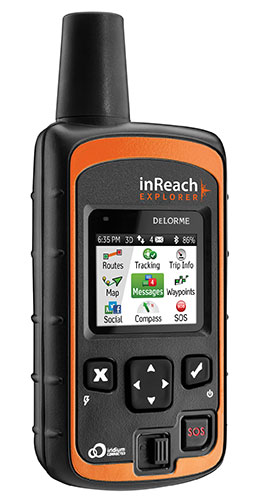
The DeLorme inReach Explorer.
    The DeLorme inReach Explorer.

    Garmin Ltd. has entered into an agreement to acquire substantially all of the assets of DeLorme, a privately held company that designs and markets consumer-based satellite tracking devices with two-way communication and navigational capabilities.

    The completion of the acquisition, which is subject to customary conditions, is expected to occur within 30 to 60 days.

    One of the most compelling products in the DeLorme portfolio is its inReach series of two-way satellite communication devices. These GPS-enabled devices allow the user to send and receive satellite text messages or trigger an SOS for emergency help, anywhere in the world. In addition to inReach, DeLorme has an extensive library of digital cartography and enterprise GIS software, as well as traditional mapping.

    “DeLorme is a respected brand with exciting products and technologies that are a natural fit in the Garmin portfolio,” said Cliff Pemble, Garmin’s president and CEO. “We look forward to completing the acquisition and welcoming them onto our team. We are looking forward to leveraging their expertise to further enhance the Garmin lineup of products.”

    Source: GPS world staff
    The DeLorme inReach Explorer is a two-way satellite communicator with built-in navigation.

    “Our inReach technology is invaluable to hikers, hunters, boaters and pilots who often find themselves in remote areas — Garmin’s core customers. We are looking forward to completing the acquisition and are excited to help leverage our expertise into enhancing their already outstanding products,” said Michael Heffron, CEO of DeLorme. “Garmin has extensive R&D capabilities and a global distribution network that will allow us to provide this technology to customers across many markets and around the world.”

    Garmin will retain most of the associates of DeLorme and will continue operations at its existing location in Yarmouth, Maine, following the completion of the acquisition. The Yarmouth facility will operate primarily as a research and development facility and will continue to develop two-way satellite communication devices and technologies. Financial terms of the purchase agreement and acquisition will not be released.

    For decades, Garmin has pioneered new GPS navigation and wireless devices and applications that are designed for people who live an active lifestyle. Garmin serves five primary business units, including automotive, aviation, fitness, marine and outdoor recreation.

  • Spirent and Oasis partner to accelerate IoT connected devices

    Spirent Communications and Oasis Smart SIM have created a strategic partnership to remove connectivity and network provisioning barriers for the rapid development of connected products and devices, such as cameras, smart vehicles, logistics and production goods.

    Spirent Communications is a provider of device intelligence solutions, and Oasis Smart SIM is a global Universal Subscriber Identity Module (USIM) connectivity and management provider.

    The partnership marks both firms’ entry into the connected Internet of Things (IoT) business, which analyst Gartner forecasts will result in 6.4 billion connected devices worldwide in 2016, reaching 20.8 billion by 2020.

    Beefore launching the new product, Spirent and Oasis undertook extensive research into the hurdles that original equipment manufacturers (OEMs) face in making diverse connected products, ranging from white goods in the kitchen to those used in animal management, suitable for sale in world markets. It became clear that old technologies and business models based on use of the traditional SIM were not suitable for IoT device activation and subscription provisioning on a global scale.

    The partnership between Spirent and Oasis will introduce a two-click software solution, including USIM functionality, that OEMs can embed into products for seamless cellular service activation in any of the world’s markets, as well as life-cycle management.

    The new product will be showcased on the stands of Spirent (Hall 6, Stand 6J37) and Oasis (Hall 2, Stand 2D13/15/19MR) at Mobile World Congress, in Barcelona (22-25 February, 2016).

    “Spirent and Oasis have teamed up to help manufacturers build better and smarter products for the connected world,” said Dennis Juul Poulsen, general manager of Spirent’s IoT Connectivity and Subscription Management business. “Be it a connected truck or a pair of smart running shoes, OEMs in whatever vertical market now have a solution that provides customers with seamless instant connectivity and the freedom to choose whatever cellular service provider they wish.”

    “Spirent’s unique automatic access point name (APN) setup and remote subscription management solution with Oasis’ embedded smart USIM functionality is a game changer in connected products and devices,” said Olivier Leroux, CEO of Oasis Smart SIM. “OEM vendors now have a leaner way to manufacture, distribute and maintain connected products compared to solutions centered on the traditional SIM.”

  • Driverless conference targets autonomous vehicles

    Driverless: The Business of Autonomous Vehicles” presents a one-day conference in the neighborhood of Silicon Valley, center of autonomous testing.

    The March 23 program at the Crowne Plaza Hotel, San Francisco Airport, focuses on a fast-changing landscape where automakers and Silicon Valley technology companies are crafting and beginning to roll out their strategies for the autonomous car. Keeping on top of the latest technology, early adoption trends, worldwide markets, liability factors and regulation will be critical in a sector previously known for long product design cycles.

    Key topics addressed: Advanced driver assistance systems (ADAS) and autonomous vehicle technologies; solving the high cost of rolling out autonomous systems; investment approaches; testing; innovative players; consumer expectations; market-sector differentiation and strategies to exploit them; the regulatory picture.

    Paul Drysch, global director, Connected Car for Jasper Wireless, is the conference chair. Panel moderators include Steve Wollenburg, co-founder and vice president, Business Development, Automatiks; Phil Magney, founder & principal, Vision Systems Intelligence; Derek Kerton, founder, The Kerton Group, Telecom Council, Autotech Council; Jan Hellaker, program director, DRIVE SWEDEN; and Adrian Pearmine, national director for smart cities and connected vehicles, DKS Associates.

    The conference also features a reception on the evening before, a hosted luncheon, and a post-program exhibit and reception.

    March 22-23, 2016, Crowne Plaza Hotel, San Francisco Airport. For more information, see www.driverlessmarket.com, [email protected]