Category: Mobile

  • Smartphone vs. Tablet vs. Desktop? It No Longer Matters

    Janice Partyka
    Janice Partyka

    The biggest mobile show, the Mobile World Congress, starts next week in Barcelona, Spain. It comes at an interesting time. Attendees will find it no longer makes sense to think about which device, or screen, is of primary importance to users. Google reports findings that 90 percent of users move sequentially between several screens (TV, phone, desktop computer and tablet) to accomplish tasks.

    Google, wanting to more fully exploit ad opportunities on all devices, has revamped AdWords to require that all ad campaigns include mobile. The GPS-based fitness watch market looks like it is on a steep curve upward, and feasible smartphone GPS watches are available. Rumor says Facebook is going to start tracking users’ locations at all times to be able to cull more ad revenue from individual’s preferences and geo life.

    Analytics firm Flurry tracked mobile app usage during the Super Bowl and found that overall app usage declined by less than 5 percent during the Super Bowl, compared to same time period on the prior Sunday. A large amount of consumers’ attention was spent in apps, even as they sat in front of their TVs on the biggest football day of the year. Surprisingly, app usage did not greatly differ between commercials and game play. Mobile app usage peaked during the game’s power outage and declined during Beyonce’s apparently riveting half-time show.

    Google Requires Mobile Advertising. Citing concerns that the shift from desktop to smartphones and tablets is damaging its bottom line, Google is revamping its AdWords advertising platform to integrate ad campaigns across all device screens. In fact, Google indicated that it will require all advertisers to pay for mobile ads even if they only wish to reach consumers on desktops. The revamp will allow customers to use contextual factors like location, time of day and device type to control integrated campaigns.

    Google provides an example of how a user’s location and device type could change the advertising message. “For example, a pizza restaurant probably wants to show one ad to someone searching for ‘pizza’ at 1 p.m. on their PC at work (perhaps a link to an online order form or menu), and a different ad to someone searching for ‘pizza’ at 8 p.m. on a smartphone a half-mile from the restaurant (perhaps a click-to-call phone number and restaurant locator),” reads Google’s blog.

    Will Apple Take Control of Your Wrist? Rumors continue that Apple will release a GPS-based fitness watch in 2013. Whether Apple enters the market or not, the GPS fitness market is huge and growing. The GPS fitness watch market is set to reach $1.07 billion in 2013, predicts ABI Research. Cellular connected GPS fitness watches like the I’m Watch may further speed this market. “There have already been unfounded rumors around Apple in 2013, so let’s wait and see. If an Apple watch did feature integrated GPS, it would no doubt significantly boost shipment forecasts in 2013,” asserts Dominique Bonte of ABI. Some start-ups in the GPS watch category have joined the action including Leikr, Pebble, Basis and others.

    Facebook Is Watching. Is it possible that the relationship between Facebook and Google can get even more tense? According to a Bloomberg article, Facebook is developing a smartphone application that will track the location of its users. The app is said to be scheduled for release by mid-March, and would run on handsets in the background even when the Facebook app or the phone isn’t open or in use. The location data would help Facebook capture more advertising revenue as ads can be more targeted with information about a user’s location and habits. The project is said to be headed by an ex-Googler and talent from Glancee and Gowalla, both of whom were purchased by Google.

    Privacy concerns with Facebook location tracking will undoubtedly be raised. Currently, Facebook records the GPS coordinates of users when they post status updates or photos from their phones, or check into a venue. Tracking users 24/7 is another thing. Facebook’s current location-sharing policy seems to cover them carte blanche. It allows the use of data “to serve you ads that might be more relevant,” and “to tell you and your friends about people or events nearby, or offer deals to you that you might be interested in.”

    Blackberry10-T_150x94Will Windows and BlackBerry Smartphones Succeed? Will there be a crack, even a tiny one, in the duopoly of iOS and Android? The biggest worry for Microsoft and BlackBerry is if initial sales of their smartphones are too small to excite developer interest. Without abundant applications, consumers won’t continue to buy these phones. ABI Research is predicting that the demand will be strong enough, and is forecasting a BlackBerry installed base of 20 million and Windows smartphone base of 45 million by year-end.

    Open Geospatial Consortium Location Standards for Next-Generation LBS.  The Open Geospatial Consortium (OGC) is having a free session and reception at the Mobile World Congress for mobile developers, location data providers, network operators and LBS service users. Attendees will learn the latest in open standards development. The event is being held on February 27, 2013 in Barcelona. Register for free.


  • Path Social Networking App Settles FTC Charges on Privacy Infringement

    The operator of the Path social networking app has agreed to settle Federal Trade Commission charges that it deceived users by collecting personal information from their mobile device address books without their knowledge and consent. The settlement requires Path, Inc. to establish a comprehensive privacy program and to obtain independent privacy assessments every other year for the next 20 years. The company also will pay $800,000 to settle charges that it illegally collected personal information from children without their parents’ consent.

    The settlement with Path is part of the FTC’s ongoing effort to make sure companies live up to the privacy promises they make to consumers, and that kids’ personal information isn’t collected or shared online without their parents’ consent.

    “Over the years the FTC has been vigilant in responding to a long list of threats to consumer privacy, whether it is mortgage applications thrown into open trash dumpsters, kids information culled by music fan websites, or unencrypted credit card information left vulnerable to hackers,” said FTC Chairman Jon Leibowitz. “This settlement with Path shows that no matter what new technologies emerge, the agency will continue to safeguard the privacy of Americans.”

    Path operates a social networking service that allows users to keep journals about moments in their life and to share that journal with a network of up to 150 friends. Through the Path app, users can upload, store, and share photos, written thoughts, the user’s location, and the names of songs to which the user is listening.

    In its complaint, the FTC charged that the user interface in Path’s iOS app was misleading and provided consumers no meaningful choice regarding the collection of their personal information. In version 2.0 of its app for iOS, Path offered an “Add Friends” feature to help users add new connections to their networks. The feature provided users with three options: “Find friends from your contacts;” “Find friends from Facebook;” or “Invite friends to join Path by email or SMS.” However, Path automatically collected and stored personal information from the user’s mobile device address book even if the user had not selected the “Find friends from your contacts” option. For each contact in the user’s mobile device address book, Path automatically collected and stored any available first and last names, addresses, phone numbers, email addresses, Facebook and Twitter usernames, and dates of birth.

    The FTC also alleged that Path’s privacy policy deceived consumers by claiming that it automatically collected only certain user information such as IP address, operating system, browser type, address of referring site, and site activity information. In fact, version 2.0 of the Path app for iOS automatically collected and stored personal information from the user’s mobile device address book when the user first launched version 2.0 of the app and each time the user signed back into the account.

    The agency also charged that Path, which collects birth date information during user registration, violated the Children’s Online Privacy Protection Act (COPPA) Rule by collecting personal information from approximately 3,000 children under the age of 13 without first getting parents’ consent. Through its apps for both iOS and Android, as well as its website, Path enabled children to create personal journals and upload, store and share photos, written thoughts, their precise location, and the names of songs to which the child was listening. Path version 2.0 also collected personal information from a child’s address book, including full names, addresses, phone numbers, email addresses, dates of birth and other information, where available.

    The COPPA Rule requires that operators of online sites or services directed to children, or operators that have actual knowledge of child users on their sites or services, notify parents and obtain their consent before they collect, use, or disclose personal information from children under 13. Operators covered by the Rule also have to post a privacy policy that is clear, understandable, and complete.

    The FTC charged that Path violated the COPPA Rule by:

    • not spelling out its collection, use and disclosure policy for children’s personal information;
    • not providing parents with direct notice of its collection, use and disclosure policy for children’s personal information; and
    • not obtaining verifiable parental consent before collecting children’s personal information.

    In addition to the $800,000 civil penalty, Path is prohibited from making any misrepresentations about the extent to which it maintains the privacy and confidentiality of consumers’ personal information. The proposed settlement also requires Path to delete information collected from children under age 13 and bars future violations of COPPA. Path has already deleted the address book information that it collected during the time period its deceptive practices were in place.

    The FTC has also introduced Mobile App Developers: Start with Security, a business guide that encourages developers to aim for reasonable data security, evaluate the app ecosystem before development, and includes tips such as making someone responsible for data security and taking stock of the data collected and maintained.

    The commission vote to authorize the staff to refer the complaint to the Department of Justice and to approve the proposed consent decree was 5-0. The DOJ filed the complaint on behalf of the Commission in U.S. District Court for the Northern District of California on January 31, 2013.  The proposed consent decree will be filed with the same U.S. District Court today and is subject to court approval.

  • Avenza Offers NatGeo Maps Off-Line, Yet Still GPS Interactive

    National Geographic Maps has joined with Avenza Systems to offer a new channel to access its map content. The alliance enhances Avenza’s digital map database by adding more than 500 maps from National Geographic and furthers National Geographic Maps’ established reach with mobile consumers.

    The Avenza PDF Maps app takes advantage of geospatial technology and allows users to view, acquire and interact with maps on their mobile devices, including iPhone and iPad, without needing a mobile data connection or being accessed international roaming charges. PDF Maps offers an in-app store to facilitate the transaction and delivery of the maps, consolidating, in a digital format, consumers’ access to hundreds of maps from multiple publishers.

    “In the last decade, advances in technology have shifted how consumers receive and use information, and we have responded by making our rich map content available on a variety of platforms,” said Charles Regan of National Geographic Maps. “Avenza’s PDF Maps app provides a unique way for consumers to access our content with an easy-to-use in-app map store and a set of robust features that will enhance the map user’s experience.”

    Hundreds of maps from National Geographic Maps’ extensive library are now available in Avenza’s PDF Maps system, including travel and destination titles covering five continents, historical and thematic maps, and educational and reference titles. The app provides constant access to geographic information and points of interest, with additional interactive tools such as measuring, place marking and location tagging. PDF Maps operates without the risk of lost reception, due to cell tower proximity, and does not rely on an Internet connection.

  • Broadcom Launches GNSS Chip with Geofence Capabilities

    Broadcom Corporation has introduced the BCM47521, a GNSS chip with architecture that enables geofence capabilities while preserving battery life. According to Broadcom, the new chip opens the door to always-on location-aware applications such as social networking, place-based mobile commerce and local merchant advertising.

    Broadcom will showcase its GNSS innovations at the upcoming Mobile World Congress show in Barcelona, February 25-28.

    A geographical region of interest (“geofence”) is being used by many new and innovative location-aware applications. The geofence feature enables the application to receive a notification when a user enters or exits a virtual perimeter. However, the implementation of this feature in traditional architectures is not viable, as the applications processor needs to run constantly, causing rapid drain to the device’s battery. Broadcom’s new BCM47521 overcomes this issue, making it possible to continuously monitor geofence areas while consuming 60x less battery power.

    “The astounding growth of mobile devices is driving new opportunities for inventive applications that deliver valuable location-aware information,” said Scott Pomerantz, Broadcom vice president and general manager, GPS. “With the BCM47521’s low-power geofence mode, Broadcom is driving the next wave of system power consumption innovation that will allow OEMs to incorporate features that differentiate their mobile offerings and make location-aware, always-on applications a reality.”

    The BCM47521 chip also provides multi-constellation support by simultaneously collecting data from GPS, GLONASS, QZSS and SBAS, and using the best received signals, resulting in faster searches and more accurate real-time navigation, Broadcom said. Broadcom’s multi-constellation technology, coupled with advanced signal processing, provides faster positioning performance for improved user experience, especially in challenging urban environments where buildings and obstructions can dramatically impact accuracy and time-to-first-fix.

    A key feature is the 60x better system power efficiency versus a host-based architecture. An advanced host-offload mode monitors geofences in the background and only activates the applications processor when there is a trigger event, and smart algorithms adapt in real-time as the user gets closer to a geofence boundary.

  • LOCiMobile Launches Enterprise Work Force Tracking App TMWF

    LOCiMOBILE, Inc., a wholly owned subsidiary of GTX Corp, has launched its first enterprise app for companies looking to effectively track and monitor their workforce in real time. Track My Work Force (“TMWF”) is available for download on iTunes, and based on its early success, is in development for release on the Android platform.

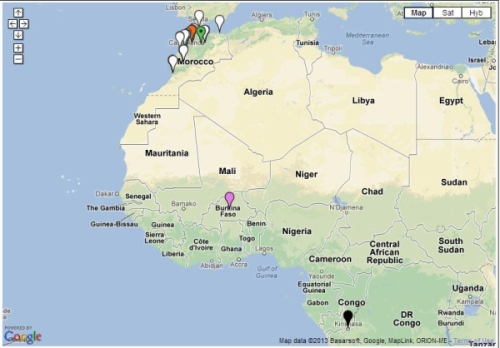
    Once downloaded on either an iPhone or iPad, the app works in the background and reports the whereabouts of that device back to the GTX Corp monitoring back-end. The app was designed for small- to medium-sized companies that have a mobile sales or service workforce and need to know the location of their reps in real time. Companies in the U.S., Canada, Czech Republic and Morocco, in industries including transportation, construction, plumbing, IT, medical and pharmaceutical, have already deployed the TMWF app and the GTX back-end monitoring platform.

    Morocco+All
    In January, a pharmaceutical company based out of Morocco that services 25,000 pharmacies across several North African countries deployed TMWF for 150 of its sales reps.

    “Our diamond delivery business relies heavily on our traveling sales representatives in order to maintain relations with existing customers as well as meeting new ones. GTX Corp’s Track My Work Force app was extensively tested during our system trial,” Jack Daynes of the Diamond Group said. “The results were such that we implemented the program immediately and haven’t regretted it in the slightest. Both the pricing and the service that we’ve received have exceeded our expectations.”

    Companies can easily deploy this technology by leveraging the mass adoption of smartphones and tablets in the workforce, said GTX Corp. In January, a pharmaceutical company based out of Morocco that services 25,000 pharmacies across several North African countries deployed the app for 150 of its sales reps.

    “We are very pleased with the initial feedback and potential of this app,” said Patrick Bertagna, GTX Corp CEO. “There are tens of thousands of companies all over the world that can benefit and increase customer service, productivity and security from two-way GPS technology and are now able to implement this technology with a simple download.”

    The TMWF app is an efficient and cost-effective way for business owners and managers to keep track of and manage their mobile work force, GTX Corp said. It’s faster and safer than text messaging and allows the worker to focus on the task at hand rather than spending valuable time calling HQ to check in and report, the company said. The app costs $9.99 initially, with an additional monthly monitoring service fee that costs around $5.00 per user per month.

    The company provides a free two-week evaluation for any business with more than five employees, and custom solutions along with a licensable white-label platform for larger companies.

  • How to Use GPS to Make a Valentine

    How to Use GPS to Make a Valentine

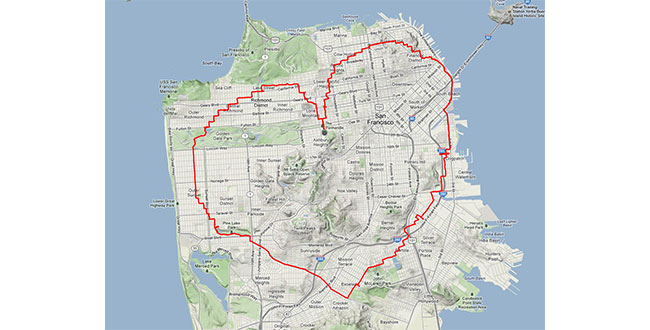
    Yes, there is a way. According to Krulwich Wonders, an NPR science blog, a man in San Francisco equipped with an iPhone and tracking app rode his bike 27 miles around the city. Two and a half hours later, Payam Rajabi had etched a heart shape onto a city map.

    large-heart-map
    Click to enlarge.

    In 2012, Rajabi had to leave his girlfriend behind in Toronto for a new job. To make sure Clare knew this was a labor of love, Payam included an elevation map of his ups and down in the hilly city.

    This year, Verizon is featuring Rajabi — who repeated the feat for cameras — in a television commercial:

  • Facebook to Roll out Location App

    Facebook to Roll out Location App

    Kevin Dennehy
    Kevin Dennehy

    There always is a lull in news between the Consumer Electronics Show and the Mobile World Congress, which is later this month in Barcelona. However, published reports that Facebook plans to launch a location application is big news. The social network giant, with more than 1 billion mobile users worldwide, could conceivably generate huge advertising revenue through the location-based friend-finder app. Facebook has a number of competitors, but with the sheer number of worldwide users, it has to make the industry take strong notice.

    Facebook to Roll Out Location Application for Mobile Users

    Facebook is attempting to grab a big piece of the mobile location market with a new app that will track users to perhaps boost mobile advertising sales.  The news, first reported by Bloomberg, indicates that Facebook is adding location features to perhaps take a chunk of profit from 1 billion mobile users who use the social network.

    The new feature, expected to be launched in March, will work with smartphones, even when the user is not using the application, according to the Bloomberg article.  This may raise some privacy hackles, as competing services have opt-in functions. In addition, some handset manufacturers and carriers require user opt-in as part of privacy agreements.

    Facebook already purchased two location companies in Glancee and Gowalla. Glancee is a location-tracking startup Facebook bought in May 2012. Gowalla, a location-based social network, was purchased in December 2011.

    Facebook Has Competitors in Location Market

    The new Facebook location app will be an answer to Google Latitude, which was launched in early 2009. Latitude, a feature for Google Maps, is an opt-in mobile app that allows users to see the location of friends and family, who also allow the service to track them. Google’s premise, four years ago when it launched Latitude, was that many users wonder where their friends and family are — and what they are doing.

    Because it is an opt-in service, Google said users could find out where a spouse was stuck in traffic on the way home from work, knowing when a loved one’s flight landed safely, or if a buddy was in town. Although it has been around for more than four years, Latitude was innovative with the concept that not only can you see friends on a map, but you can get in touch with them via SMS, Google Talk, gmail and  updating a status message.

    “While Google quietly improved its databases, tools and location services, most other players in the location industry were slipping further behind, apparently involved in a frenzy of disorganization prompted by a lack of skills in strategic planning,” said Mike Dobson, Telemapics president, in a recent interview.

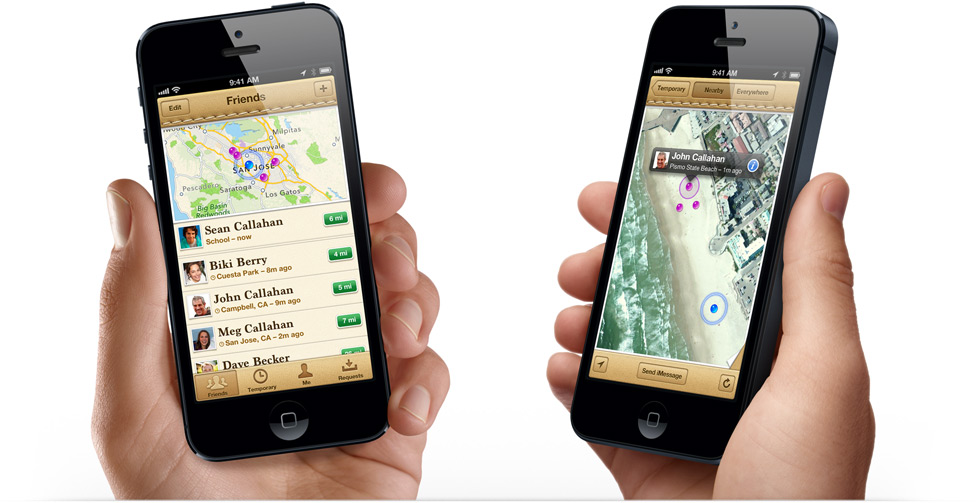
    Another similar service, Find My Friends from Apple, runs on the iOS 5 operating system.  It is another location share service that attempts to allow users to find friends in real time, according to published reports.

    Apple needs to hit a home run in the location and mapping market. Last year, the controversy surrounding Apple Maps caused a shake up at the company and industry because of faulty map data. The incident made manufacturers realize that digital maps are a very important feature for smartphones. It also made many of these giant companies, who believe that location isn’t that big of a deal, sober up to the fact it is hard to make quality maps.

    A number of other companies are offering friend and family finder apps, namely Location Labs, Life360 and Loopt.

    Still, while such companies as Facebook, Apple and Google give away maps and navigation for free, which destroyed smaller companies and caused a huge consolidation of the industry starting in 2008, some believe that maps are too hard to produce for free. Some analysts, Dobson included, think that “free” maps and navigation services may not stay that way as consumers and enterprise customers demand better accuracy.

    Tablet Owners Spend More than Smartphone Buyers

    In advance of the Consumer Electronics Show, analysts were saying not only that flatscreen TVs sales were dropping, but the champion of the previous shows, the tablet, also was to see a downward trend. Not so, says ABI Research, which estimates nearly 200 million tablets shipped worldwide since 2009, with an additional 1 billion tablets forecast to ship over the next 5 years.

    What’s interesting, or not, depending on your location company’s strategy, is that ABI says 22 percent of users spend $50 or more per month and 9 percent spend $100 or more on purchases ordered from their tablets. That’s higher amounts than from even smartphones, the company says.

    As we reported last fall, the next edition of Amazon’s Kindle Fire tablet introduced mapping services in partnership with Nokia, which snubbed technology from Google, which is funny because its mobile operating system powers the platform. But it was an indicator of how much promise companies are still seeing in adding location-based services capability to tablets.

    In other LBS news:

    • Sense Networks released the results of a location-based mobile advertising campaign for Denver-based fast food chain Quiznos. The campaign, conducted in Portland, Oregon, placed ads on mobile devices of people 18-34, who eat at competing, and similar, restaurants such as Subway. The company said Quiznos had a 20 percent gain in coupon redemptions.
    • TeleCommunication Systems, Inc. (TCS) is providing map, local search, location services and navigation applications for the new BlackBerry 10 smartphone. The TCS-based mapping application will ship with the new smartphones, which are scheduled to roll out in mid-March. TCS’ APIs are also available for Blackberry 10 developers. This leads many in the industry to believe that if this smartphone is a much-needed home run for Research in Motion, the TCS partnership could be a big deal.
    • Locaid plans to provide GTECH with secure mobile location, IP location and other LBS to include geofencing and location authentication. What’s cool about this deal is GTECH designs and sells lottery technology. Its service includes a geo-complaince engine that ensures a mobile or Internet-connected device is within state lines.

    If you have news, or tips, or gossip, please contact me at [email protected].  The Mobile World Congress in Barcelona is coming up this month, so get me your story ideas and product news.


  • Verve Mobile Ad Company Secures Funding from Nokia, Qualcomm

    Location-powered mobile advertising company Verve Mobile announced today it has closed its Series C financing led by Nokia Growth Partners, a global growth stage venture firm focused on mobile technology, services and media with participation from new investor Qualcomm Incorporated, acting through its venture investment group, Qualcomm Ventures (QCOM), and Series B lead investor BlueRun Ventures.

    The capital will be used to further develop and expand Verve’s proprietary mobile location-based advertising and publishing products and to grow its marketing and sales capabilities.

    “Verve’s focus is combining big data, location-based services (LBS) and ad technologies to make mobile advertising work better for advertisers and publishers,” said Tom MacIsaac, Verve Mobile CEO.  “Nokia and Qualcomm are global leaders in mobile technology innovation and have important insights, assets, initiatives and relationships that can help Verve maintain its lead in location powered mobile advertising.”

    John Gardner of Nokia Growth Partners has joined Verve’s Board in connection with the financing, and Quinn Li of Qualcomm Ventures has become a Board Observer.

    Verve Mobile’s customers are national-brand advertisers who want to engage consumers on their mobile devices with location-aware, data-driven and highly targeted marketing, the company said. Verve has offices in New York, Washington D.C. and San Diego, California.

  • Magellan Launches Switch Series GPS Fitness Watches in Europe

    Magellan Launches Switch Series GPS Fitness Watches in Europe

    Magellan today announced that it has expanded the worldwide availability of the Magellan Switch Series of crossover GPS watches to Europe for athletes who run, bike, swim or participate in a variety of outdoor activities. The Magellan Switch and Switch Up watches are available this month from select retailers and through Magellan’s European distribution network.

    To support its European users, Magellan has also expanded its Magellan Active website with additional languages including French, Spanish, German, Italian and Dutch as well as English. Magellan Active makes it convenient for multisport athletes who record their performance data on Magellan’s Switch Series to easily upload and track data online with intuitive charts, maps and metrics, from a single location, Magellan said.

    “Magellan is continuing to further enrich the lives of multi-sport athletes worldwide with best-in-class fitness watches and innovative tools to help them take control of their active lifestyles,” said Clark Weber, Senior Director of Fitness Products for Magellan. “The Switch Series is rapidly gaining popularity with fitness enthusiasts, and we are pleased to work with our European distribution partners to make our GPS watches available to consumers throughout Europe.”

    Both Switch watches include features such as an Activity Pacer that shows runners if they are on target with their goal, and provides specific targets to attain the desired result. The Switch GPS watch, designed primarily for runners, includes nine customizable sport profiles, high-resolution display, eight hours of battery life, a high-sensitivity GPS receiver, 50-meter water resistance, and compatibility with ANT+ sensors. The Switch Up GPS watch has the same features as the Switch GPS watch but includes a barometric altimeter for precise elevation data, a thermometer to monitor and capture outside temperature, vibration alerts for notification in louder environments, and a quick-release mounting system to transition between sports.

    The Magellan Switch Series is available from Magellan’s European distribution partners serving UK, France, Germany, Turkey, Spain, Italy, Austria, Switzerland and Benelux.

    Developer API Program. Magellan also is making available its Magellan Active Developer API program. Third-party websites and applications can now access activity data from Magellan Active and import data into their websites once customer permission has been granted. A Magellan Active Web Widget can be embedded in any website for uploading activities and gives users the ability to upload activities and perform device software updates from within a personal website or HTML Widget/Gadget.

  • Berg Insight: LBS Revenues in Europe to Reach €825M by 2017

    Berg Insight: LBS Revenues in Europe to Reach €825M by 2017

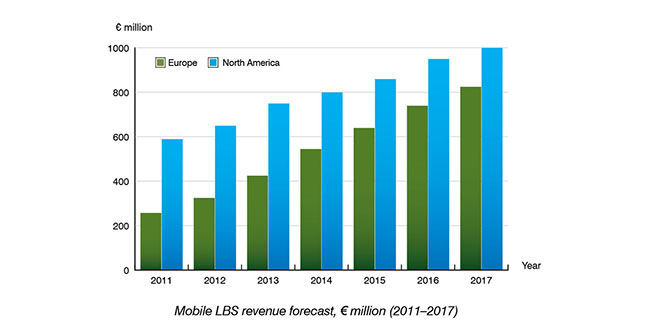
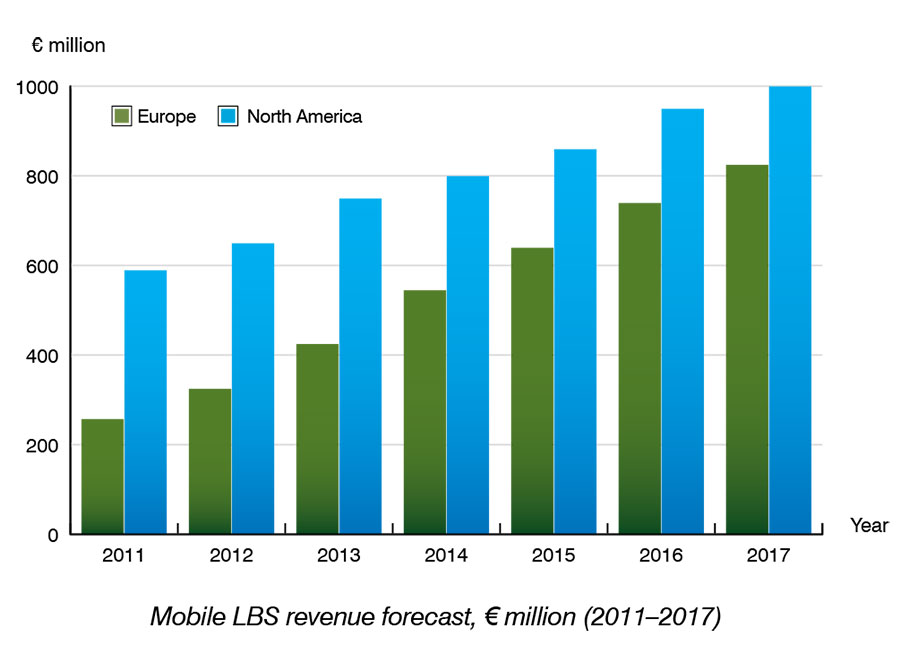
    According to a new research report by Berg Insight, mobile location-based service (LBS) revenues in Europe are forecast to grow from €325 million in 2012 at a compound annual growth rate (CAGR) of 20.5 percent to reach €825 million in 2017.

    The North American LBS market is forecast to grow at a CAGR of 9.2 percent from US $835 million in 2012 to reach US $1,295 million in 2017. Berg Insight estimates that 40 percent of all mobile subscribers in Europe use some kind of location-enhanced application on a regular basis. In North America, the larger installed base of GPS-enabled handsets and smartphones has enabled higher uptake of LBS.

    Berg Insight estimates that about 50 percent of all mobile subscribers in the region now access LBS at least monthly. Local search, social networking and navigation services are the top application categories in terms of number of active users. Mobile workforce management services that aim to improve operational efficiency for businesses are also gaining traction in new industry segments.Berg-LBS-report

    “Smartphones are the most important enabler for LBS adoption in general. The installed base of smartphones in Europe has now reached 45 percent of total handsets and already surpassed 55 percent in North America,” said André Malm, Senior Analyst, Berg Insight. He adds that besides differences in smartphone adoption, there are other regional differences. “Mobile operators still play a more central role in North America than in Europe, marketing branded services to both consumer and enterprise customers.”

    However, the operators’ central role in the LBS ecosystem is now being challenged by the smartphone ecosystems that bundle key LBS and give developers access to location data and distribution channels in the form of on-device app stores. Mobile operators are therefore showing renewed interest in offering network-based bulk location data for advertising and analytics, as well as new services such as secure authentication and fraud management.

    A brochure on the report can be downloaded here.

  • Bryton Enhances Sports Monitoring Equipment with u-blox GPS

    bryton

    Bryton Incorporated has chosen to integrate u-blox’ UBX-G6010 GPS single chip to give its sports electronics products location-aware features. Founded in 2009, Taiwan-based Bryton has established a brand of GPS-enabled sports monitoring devices dedicated to four main activities: cycling, fitness, outdoor adventure and athletic training.

    “At Bryton, we understand the mindset of sport enthusiasts, and know exactly what they are looking for when they shop for electronic equipment to enhance their exercise experience: it must be smart, small, attractive, accurate, dependable, and packed with interesting and useful features that make their workouts more fun and informative,” said Wolf Lin, President at Bryton Inc.

    “u-blox’ extremely small GPS chip solution requires very few external components, meaning we don’t need to allocate much space in our products to achieve state-of-the-art, extremely sensitive GPS positioning capability,” added Lin. “Another primary feature is long battery life. Thanks to u-blox’ low power chip design with sophisticated power saving modes, the GPS receiver, which must be active much of the time, requires only a small fraction of the device’s power.”

    Bryton evaluated leading vendors of GPS technology and selected u‑blox’ GPS single-chip based on four key product features: small size, high sensitivity, low-power consumption, and upgradability.

    Bryton markets its products under two main product categories:

    Rider. An extensive line of waterproof bike computers that provide navigation while monitoring location, distance, elevation, route history as well as heart rate and calories usage.

    Cardio. Smart sports watches for runners with integrated GPS that delivers accurate time, pace, distance, stride, lap information and much more.

  • GPS Module

    The Jupiter SE880 by Telit Wireless Solutions is a small, ultra sensitive 48-channel GPS module that features an advanced 3D technology that improves time to first fix and brings indoor location fix to reality with cold start and tracking sensitivity down to -148 dBm and -165 dBm. The turnkey solution enables the design of ultra-compact applications, requiring minimal external BOM and a footprint of less than 40 millimeters compared to conventional PCB technology.

    The Jupiter SE880 is designed for high-volume GNSS ultra-compact mobile / tracking devices as well as advanced consumer devices such as sport watches and cameras.