Category: Opinions

  • Expert Advice: Critical Offshore Applications of SBAS GNSS

    JDL-photo-II-W
    James D. Litton, President/CEO, Litton Consulting Group

    Precise positioning of many different kinds of vessels and other equipment depend upon satellite-based augmentation systems (SBAS) of GNSS, principally GPS and GLONASS at this time. The applications range from exploration to production and delivery of hydrocarbons to shore-based installations and navigation of very large crude carriers, or oil tankers. Decisions and recommendations are strongly needed to keep these services free from interference.

    It is fallacious to think that because LightSquared or similar use of out-of-band high-power terrestrial radiation would be confined to a continental region (physically impossible, in any case), that no harm would accrue to offshore navigation assets. The three principal suppliers of these offshore precise positioning services are Fugro’s Starfix services, C&C Technology’s C-Nav which utilizes John Deere/NavCom’s StarFire systems, and Subsea 7’s Veripos system.

    All of these systems depend upon GNSS reference receivers placed around the world in networks which depend upon corrections that are derived from regionally sited reference stations. The 10-centimeter level of precision now required for many of the most dangerous and valuable applications requires, in turn, centimeter-level accuracy in base stations in the United States and elsewhere in the world.

    Inmarsat frequencies allocated to these applications for delivery of the differential corrections generated by these reference stations have been in use for both the huge number of land applications (agriculture, infrastructure development, river and harbor navigation, seismic exploration, pipeline surveys, etc) and offshore applications. Changing these frequencies is feasible only at great cost to both Inmarsat and the many on- and offshore uses. Inmarsat may be compensated by LightSquared for its costs, but not so the many millions of dollars of expense to offshore and onshore operators in down time, redesign and reprogramming of receivers, and suspension of critical operations.

    The offshore applications outlined here are just a few of the more familiar. No attempt has been made to capture all of these applications in this short memorandum, but operators in this industry, represented by the National Ocean Industries Association (NOIA), have made their position clear in the attached letter to the FCC.

    Major Offshore Applications

    Exploration. Modern seismic exploration depends upon seismic streamers many kilometers long. Several such streamers (containing thousands of hydrophones for capturing reflections from deep beneath the ocean floor and determining the structure and composition of the strata which may contain hydrocarbons) are towed by each ship. The seismic profiles which result are depicted in three dimensions with great precision. Discovery and assessment of such strata depend sensitively upon the positioning accuracy of these streamers, which, in turn, depend sensitively on the position of the vessel with respect to the center of the earth, because the vessel’s trajectory is the reference for the relative positioning of the streamers by magnetic and inertial means, sometimes augmented by GNSS receivers integrated into the seismic streamers.

    Drilling. Increasingly, drill rigs and drill ships are placed and maintained in position by dynamic positioning systems that depend upon augmented GNSS systems for stabilizing the massive structures over the well head. In deep water (more than 5,000 feet), only dynamic positioning through the use of massive thrusters (such as those employed by the Deepwater Horizon vessel of Transocean in the Macondo well disaster, commonly referred to as the BP disaster) is feasible. With as much as 10,000 feet of riser attached to these drill ships between the well head and the ship, safe operation is critically dependent upon very precise positioning of the vessel. Further, down-hole positioning depends upon inertial and wireline systems, which are calibrated by the use of augmented GNSS systems.

    Production. Production platforms range from single sites over a single well to massive platforms with undersea pipelines and risers connecting them to manifolds on the sea floor, which in turn are connected to multiple well heads in an area. This infrastructure is placed, maintained, and monitored with the use of SBAS systems integrated with acoustic systems. Use of remotely operated vehicles and autonomous underwater vessels or vehicles, submarines equipped with sensors that can image and manipulate underwater structures, for these purposes is prevalent.

    Station Keeping. Supply vessels, crew vessels, special-purpose vessels, and helicopters are positioned relative to the drill rig, seismic vessel, production platform, and pipeline-laying vessel by SBAS systems fused with other sensors such as lasers and microwave distance-measuring equipment. A huge drill ship, for instance, moving about in response to ocean dynamics but centered on the well head, cannot be docked to a supply vessel solely with ropes and cables. Each vessel must be free to move but to move synchronously with each other. Because of the huge masses involved, the velocity of each relative to the other must be kept as near zero as possible. Centimeter-level precision is required for this purpose. In all of the applications listed above, at various stages, vessels require station keeping with other vessels to very precise relative distances and velocities.

    Containment and Recovery. When there is a requirement for a flotilla of vessels such as attended the Macondo blow-out event, there are as many as a hundred large and small vessels in a relatively small area, with the need for central control (by the U.S. Coast Gaurd in this case) and collision-avoidance systems. These systems also depend upon having precise GNSS, mostly using SBAS systems.

    Further application details and additional critical applications can be provided upon request.


    Jim Litton is the President of the Litton Consulting Group, Inc. (LCG).  His GPS-related experience includes being the Chief Engineer at Magnavox during the GPS phase I development, contributing to analysis of ionospheric effects and senior vice-president and general manager of the Magnavox Commercial GPS Division before forming the Litton Consulting Group in 1992. He co-founded NavCom Technology in 1994.  He holds the Hays award from the ION for 1996 and is co-inventor on a codeless GPS receiver patent.   

  • Expert Advice: Energy Production Concerns about LightSquared

    RandallLuthi_W
    Randall Luthi, President, National Ocean Industries Association

    By Randall Luthi, President, National Ocean Industries Association

    To: Mr. Julius Genachowski,
    Chairman, Federal Communications Commission
    Ref: LightSquared, Inc.,
    L-Band allocations impacting GPS FCC File No. SAT-MOD-20101 1 IS-00239

    Dear Chairman Genachowski:

    The National Ocean Industries Association (NOIA), which represents approximately 270 member companies involved in outer continental shelf (OCS) energy production throughout the United States, is gravely concerned over the pending allocation of Mobile Satellite Services (MSS) spectrum to LightSquared, Inc. for terrestrial high-powered transmissions. LightSquared’s proposed transmission structure will adversely impact GPS and Inmarsat signals along our coastlines, both of which are critical to marine operations. Specifically, NOIA is concerned that:

    1. Coastal and near shore GPS operations will be impacted even at (promised) reduced LightSquared power levels. While NOIA understands that LightSquared will be required to reduce its tower transmission power along the coastline, their reduced power transmissions will still be many orders of magnitude greater than GPS signals, virtually guaranteeing interference for users in coastal and near-shore areas.

    2. GPS receiver types used by NOIA members will be impacted substantially. NOIA members primarily use high-precision GPS receivers for their high-accuracy coastal and near shore work. High-accuracy GPS receivers require a wide-band front end, which will be seriously impacted by LightSquared transmissions.

    3. Inmarsat-linked DGPS corrections will have interference. Virtually all of the high-accuracy GPS work requires the use of differential GPS corrections transmitted by Inmarsat in “L” band. These corrections will be jammed by the LightSquared signal. Implications are, for example, dredging or excavation work in areas near buried high-pressure natural gas pipelines. This work will become much more dangerous due to inaccurate, intermittent, or unreliable GPS readings.

    4. Offshore oil and gas operations will be impacted because of interference on land. LightSquared interference from their 40,000 proposed transmission sites across the nation will interfere with dozens of high-accuracy DGPS reference stations used to generate differential corrections for offshore use and high-accuracy operations on shore. Because of this land-based interference with high-accuracy GPS reference stations, hundreds and possibly thousands of coastal users will be impacted. High-accuracy differential GPS corrections are used by a wide cross-section of marine users including dynamically positioned drilling rigs, pipeline construction vessels, rig supply vessels and others. Loss of GPS corrections or erroneous differential GPS corrections due to shore-based interference can cause a floating drilling rig to deviate from station resulting in catastrophic blowouts, environmental damage, and fatalities.

    5. LightSquared will cause interference with Inmarsat. NOIA understands that LightSquared has paid Inmarsat, and will continue to pay Inmarsat a fee, to “endure the pain” caused by the interference. However, Inmarsat’s customers, including virtually all NOIA members, will still be required to endure the pain. Isotropic Inmarsat antennas will be impacted the most. NOIA understands that Inmarsat plans to move user frequencies at their cost. However, NOIA cannot be assured that this solution is viable given the financial drivers LightSquared is offering Inmarsat; it is not reasonable to assume that Inmarsat can compensate thousands of users for the costs of making the changes, even if the equivalent frequencies and powers are available.

    6. NOIA is concerned that the FCC was premature in its decision to issue a waiver to LightSquared. Unlike the FCC’s historic test-then-approve, NOIA is concerned that the FCC has fast-tracked the effort and has improperly and unnecessarily implemented an approve-then-test procedure for this applicant. NOIA is concerned that the FCC may have directed findings of the professional staff in its decision making.

    7. NOIA believes that millions of land and airborne GPS and DGPS user groups will be severely impacted by LightSquared transmissions. In conclusion, NOIA and its 270 member companies are extremely concerned that high-end GPS, DGPS, and the associated GPS reference stations will be interfered by LightSquared transmissions in the band previously protected for the very low power signals typical of satellite communications. The real-time GPS positioning needs of NOIA member companies are critical to the safety and success of their operations, and although these operations are at-sea they are totally dependent on shore-based GPS reference receivers, therefore LightSquared’s land-based operations will affect the offshore regions as well. With the marine industry’s giant assets including very specialized 2 vessels of all types completely dependent on GPS, the safety and environmental implications of GPS interference is astronomical. NOIA is concerned that other specialized Inmarsat installation members will also be disrupted.

    Finally, NOIA believes that the FCC is moving too quickly and needs to step back and make its decisions based on sound science, understanding that national wireless coverage is being pursued with all deliberate speed by several knowledgeable industrial groups that have paid for the value received from their frequency allocations. It does not need this asymmetric and competition-reducing spectrum grab by a group without the years of experience and trust of those who are building the infrastructure to accomplish the very laudable outcome that is ostensibly LightSquared’s motivation.

  • LightSquared: High-Precision Receivers Are Collateral Damage

    Originally, the LightSquared/GPS Technical Working Group’s (TWG) report was due to the FCC on June 15, 2011. LightSquared requested from the FCC, and received, a two-week extension to submit their report. Three days later, LightSquared announced it found a solution to the GPS interference problem. Its new proposed solution is not good news for the high-precision GPS user community. Instead, it’s a threat directed squarely at high-precision GPS users like you and me. Do you recall what I wrote a month ago? It’s ringing true with the latest LightSquared proposal.

    “I’m going to keep this simple. You, the high-precision GPS user, are likely going to be considered collateral damage.


    The military is going to be accommodated in the name of national security. The aviation industry is going to be accommodated in the name of safety-of-life. The auto navigation industry is going to be accommodated because they are high-profile. The high-precision user is going to be thrown under the bus because we are the most difficult to accommodate (technically) and don’t have a high profile nor are perceived as significant enough to accommodate.”


    If you recall, the TWG consists of LightSquared and GPS industry representatives tasked with testing the effect that LightSquared’s proposed system may have on GPS. Four of the five sub-teams were ready to file their final report with the FCC on June 15. LightSquared’s sub-team, according to the Coalition to Save Our GPS webinar on Thursday June 16, was only sub-team not ready to file its report.

    Ok, so after the FCC granted LightSquared the two-week extension, I’m thinking we have a two-week hiatus from the LightSquared discussion as LightSquared compiles and prepares their July 1 submission.


    Nope, not a chance.

    On Monday, a mere three business days after they requested a two-week extension from the FCC,  LightSquared announced they’ve found a solution to the GPS interference problem and issued a statement titled “LightSquared Solution to GPS Issue Will Clear Way for Nationwide 4G Network.”

    LightSquared’s solution is to temporarily abandon the upper frequency they originally planned to roll out (1550-1555 MHz) and rollout its service using the lower spectrum I refer to as “modified” (1526-1536 MHz) in Figure 1.

    It’s important to remember that the lines separating frequency spectrums are not “brick walls.” There is signal “roll off” that results in a gray area between spectrums. That’s the reason the LightSquared upper frequency at 1550-1555 MHz was slamming GPS. Even though it is apparently separated from GPS L1, the sheer power of the LightSquared signal at 1,500 watts significantly bled into the red RNSS zone (1559-1610 MHz) in Figure 1.


                                                  Figure 1: FCC Spectrum Dashboard

    Using only the lower frequency spectrum (1526-1536 MHz), LightSquared claims that they are “largely free of interference issues with the exception of a limited number of high-precision GPS receivers that are specifically designed to rely on LightSquared’s spectrum.” LightSquared’s CEO said that this solution will accommodate 99.5% of the GPS receivers.

    Uh oh, guess who the remaining .5% are? Yes, your high-precision GPS receiver. One half of one percent is about the percentage of high-precision GPS receivers with respect to the total GPS market size in the U.S.

    I’m pretty confident that LightSquared isn’t weighting the receivers, so that means a $2 GPS chip inside a mobile phone carries the same weight as your $15,000 RTK receiver. But obviously the impact on our infrastructure and economy differs by orders of magnitude between the two.

    Remember last month when I wrote that high-precision GPS receivers might be thrown under the bus and considered collateral damage (LightSquared: It’s Worse than You Think)? The latest LightSquared proposal is what I was referring to. High-precision GPS receivers are the most difficult to accommodate, and LightSquared is thinking that if they tell the FCC (and the world) that they’ve taken care of 99.5% of the GPS receivers in the U.S., the other .5% can deal with it.

    It’s not yet clear how LightSquared broadcasting on 10L (1526-1536 MHz) will affect high-precision receivers. We should see some of those details at the end of the month when all reports are filed with the FCC.

    But either way, it’s clear that LightSquared broadcasting in the 1526-1536 Mhz spectrum would slam OmniSTAR and Deere & Co. Starfire users as you can see in Figure 1.

    Not so fast, say GNSS engineers. What about GLONASS, Galileo, and Compass?

    Russia’s GLONASS satellites are increasingly being used by high-precision receivers. In fact, it’s safe to say that all major manufacturers sell GPS/GLONASS receivers, which is an expensive option on most receivers. However, it’s relatively easy to justify the additional expense due to the productivity gains from the additional GLONASS satellites. Generally speaking, more satellites equals less down-time.

    The problem is that the U.S. government has no vested interest in protecting the GLONASS spectrum.

    The FAA doesn’t care about it. The U.S. military doesn’t care about it. The first-responders don’t care about it. Although GLONASS is starting to show up in consumer GPS chips, it’s not being used in those markets like it is in the high-precision markets such as surveying, engineering, construction, agriculture, GIS, and various machine control applications. Therefore, no GLONASS testing was performed at the Maryland test site (simulator not configured to output GLONASS) and little or no testing was done using GLONASS at the New Mexico or Las Vegas sites unless individual companies took it on themselves.

    Some say that GLONASS will get hammered by LightSquared mobile phones.

    To this point, most of the talk has been about GPS interference from LightSquared transmitters in the 1525-1559 MHz spectrum. We also need to be aware of LightSquared mobile phones, of which they intend to field 250 million — 100 million by the end of 2012. While LightSquared has control over the filtering on their transmitters, it have no control over the filtering used in mobile phones designed to use their system.

    I’ve heard there is some mention of LightSquared mobile phones in the reports that are to be filed with the FCC, but not made public yet. However, no LightSquared mobile phones exist today so it’s only possible to simulate them in a lab environment using a lot of design assumptions.

    The uplink frequency used by LightSquared mobile phones (to talk to the nearest tower) is in the range 1626.5-1660.5 MHz. That frequency is getting close to the top end of GPS and really close to GLONASS L1 which has a range of ~1598-1605.4MHz.

    According to one RF engineer I’ve spoken to, “We already know that Iridium (1616-1626.5 Mhz) and Inmarsat cannot co-exist in the upper band and seeing that the LightSquared handset transmit frequency is in that same spectrum, I think GLONASS in the U.S. is toast.”

    The future of GNSS receivers is definitely trending towards integrating GPS, GLONASS, Galileo, Compass, etc. signal
    s. A section of the NPEF report (mentioned above) succinctly describes the interference issue with GNSS receivers.

    Another approach examined involves limiting the LightSquared transmissions to the lower 5 or 10 MHz channel of their planned deployment. However, while this approach would protect a limited number of GPS applications other applications would still be susceptible to interference. Using this approach it may be possible to protect classes of GPS receivers, primarily those with greater receiver selectivity. However, some classes of GPS receivers would still not be protected under this mitigation technique. Receivers having wider RF front-end characteristics, such as those used for scientific and commercial uses requiring high-precision measurements, and some receivers capable of receiving multiple signals from different GNSS systems (e.g., GLONASS) would remain susceptible. Additionally, the use of only the lower LightSquared channel would provide only a temporary solution to the existing interference problems as 4G LTE levels of service may not be possible. Thus, even if allowed, the FCC’s objectives and service conditions on the LightSquared license would not be met.

    Finally and on a slightly different note, the future GPS L1C signal and L1 signals proposed by Galileo and Compass are a wider band than the current GPS L1 CA, which means they are likely more subject to interference from the LightSquared system.


    FCC Chairman Julius Genachowski: “As I have stated previously to Congress, the commission will not permit LightSquared to begin commercial service without first resolving the commission’s concerns about potential widespread harmful interference to GPS devices. Under no circumstances would I put at risk our nation’s national defense or public safety.”

    The FCC has stated on numerous occasions that LightSquared won’t be allowed to begin commercial service until GPS interference issues are resolved, but what does that really mean?

    Chairman Genachowski has also stated that “It should come as no surprise to anyone involved in the LightSquared matter that the company was planning for some time to deploy a major terrestrial network in the spectrum”. He’s implying that all parties involved should have prepared for this moment, and if the GPS industry didn’t, it should bear some of the burden. This is bad news indeed.

    Bottom line: The FCC is not looking out for your interests. The National Broadband Plan is heavy on their minds. I can clearly see the FCC thinking “in the interest of the bigger picture, the high-precision GPS user community can deal with it since its only .5% of the total GPS market.”

    We need to squash this new proposal by LightSquared in a hurry. It’s a threat directed squarely at the high-precision GPS user community.


    LightSquared Consultant claim: in the GPS industry’s “insatiable thirst for precision,” it made poor engineering decisions that made GPS receivers more vulnerable to interference from neighboring bands.

    Although it appears the statement is from an independent consulting firm, PRTM consultant Dan Hays is a Harbinger crony so don’t let it fool you into thinking it’s anything but another piece of LightSquared propaganda.

    But, let’s visit the subject for a minute to clarify because LightSquared has also claimed that high-precision GPS receivers are somehow at fault because they “are looking in our spectrum”.

    Jim Kirkland, VP and General Counsel for Trimble Navigation, said it well when I presented Mr. Hays’ statement during the Coalition to Save Our GPS webinar last Thursday. Mr. Kirkland responded:

    “… we’ve engineered our products to use services that are available for payment to LightSquared’s predecessors. That’s a critical point…these precision receivers are designed to receive MSS signals to make the services better and they pay for those services to Skyterra (owned by LightSquared) and Inmarsat (LightSquared vendor). So if that’s a bad design decision that we decided to design our receivers so that our customers could pay money to Skyterra (LightSquared), that’s one of the more absurd things I’ve heard in this whole debate.”


    What he’s talking about is that OmniSTAR pays SkyTerra (LightSquared) to lease bandwidth on their satellite to deliver corrections to high-precision GPS users on the ground. Yes, if you pay OmniSTAR for their VBS, HP, or XP service, then a portion of what you pay goes to LightSquared. The irony is as thick as molasses. Furthermore, Deere & Co/Navcom offer a similar service called Starfire in which they lease satellite bandwidth from Inmarsat. LightSquared and Inmarsat are connected. Based on an original agreement signed in December 2007 between LightSquared’s predecessor and Inmarsat, Inmarsat is to receive hundreds of millions of dollars from LightSquared towards “the re-banding and efficient reuse of L-band radio spectrum covering North America.”

    Essentially, what LightSquared is doing is selling the GPS industry their satellite-to-earth wireless services (a la OmniSTAR), but they are complaining that the GPS industry has designed GPS receivers to utilize services in which LightSquared gets paid. Is that a “poorly designed GPS receiver”?

    I’ve even heard, through the grapevine, that some legislators are regurgitating this nonsense of “poorly designed GPS receivers.” Maybe there’s no ill-intent, but it’s either that or a fair amount of ignorance.

    Logically, many of today’s high-precision GPS receivers have OmniSTAR/Starfire capability built into their antennas and RF front-ends to look into the 1525-1559 Mhz spectrum for the OmniSTAR/Starfire signals. They don’t focus on particular frequencies in that band because the frequencies change periodically as OmniSTAR users can attest. Also, even if you have the OmniSTAR/Starfire capability turned off in your receiver, the antenna is still designed to look into that band so there’s no way around it.

    Like I mentioned earlier, even if your receiver isn’t designed to utilize OmniSTAR/Starfire, no one knows yet if it might be affected by the LightSquared 5L/10L signal.


    Where do we go from here?

    There’s a lot more to talk about on this issue. It’s as critical as it’s ever been that you make you concerns known to your state senators and representatives as well as the FCC. Scroll to the bottom of this article for web links and contact information.


    Free Webinar – Thursday, June 23. LightSquared: What it means to the GPS Surveying/Mapping User Community

    Thursday, June 23, I will conduct a webinar to discuss the LightSquared issue as it relates specifically to the GPS Surveying/Mapping community (high-precision users). Joining me will be Dr. Mike Whitehead, VP of Technology at Hemisphere GPS. He’s a leading GNSS design engineer and can speak clearly about the technical ramifications of LightSquared interference on high-precision GPS receivers. Click here to sign up for the webinar. Sign up even if you can’t attend the live webinar on Thursday because you’ll be sent an email on how to view the archived presentation that you can listen/view at your convenience.


    Light
    Squared coverage at the Esri Survey Summit (July 7-12, San Diego, CA)

    Esri has coordinated comprehensive coverage of the LightSquared issue at this years Survey Summit. Remember, this year the Survey Summit is combined with the ACSM (American Congress on Surveying and Mapping) annual conference so the turnout should be very good.

    On Friday, July 8th @ 2pm at the Survey Summit, I’ll be giving a 60 minute presentation entitled “GPS/GNSS Technology Update” focused on covering the latest developments in GPS/GNSS. I will cover the latest LightSquared news as well as other recent GPS/GNSS technology developments.

    On Saturday, July 9th @ 3:30p and 4:00p respectively, Jeffrey Carlisle from LightSquared and Peter Large from Trimble Navigation will give 30 minute presentations on the GPS/LightSquared interference issue.

    On Sunday, July 10th @ 8:00a-10:00a there will be a GPS/LightSquared discussion panel consisting of myself, Peter Large, Jeff Carlisle, Curt Sumner (ACSM), John Matonich (NSPS), and Dr. Javad Ashjaee. The panel discussion will be moderated by Joe Paiva. This will be the first panel discussion in the industry focused on the high-precision GPS/LightSquared interference issue.

    Following the discussion panel, at 10:30am-Noon,  there will be a strategy session designed to plan actions that surveyors (high-precision users) can take to avoid becoming collateral damage.

    ———————–

    Take Action Now
    The Coalition to Save Our GPS has posted guidance on its website as to how to submit your comments. They are:
    Voice your concerns directly to Congressional Representatives
    To voice your concerns about GPS interference, you can send letters, emails, faxes, call or visit your Congressional representatives’ office in person to explain how you use GPS as a local business and what the impacts of interference would be to the local economy.
    Contact Your Local Senator
    Ask your Senator to support and co-sign the letter from Senators Roberts (R-KS), Nelson (D-NE) and nearly a third of the U.S. Senate: explain how you use GPS in your state and what impact interference or any compromise of the GPS service would have on you and the local economy.
    Write Your Representative
    The Washngton Wire reported this week that “A bipartisan group of 66 House members asked the FCC Tuesday to protect global positioning systems from interference from wireless broadband start-up LightSquared…”
    Please include: “Coalition to Save Our GPS and FCC File No. SAT-MOD-20101118-00239” in your correspondence.
    Send your comments directly to the Federal Communications Commission (FCC)
    Email the FCC: [email protected]
    For your ready reference, below are the actions the Coalition is seeking from the FCC:
    1. The FCC must make clear, and the NTIA must ensure, that LightSquared’s license modification is contingent on the outcome of the mandated study unequivocally demonstrating that there is no interference to GPS. The study must be comprehensive, objective, and based on correct assumptions about existing GPS uses rather than theoretical possibilities. Given the substantial pre-existing investment in GPS systems and infrastructure, and the critical nature of GPS applications, the results of studies must conclusively demonstrate that there is no risk of interference. If there is conflicting evidence, doubts must be resolved against the LightSquared terrestrial system. The views of LightSquared, as an interested party, are entitled to no special weight in this process.
    2. The FCC should make clear that LightSquared and its investors are proceeding at their own risk in advance of the FCC’s assessment of the working group’s analysis. While this is the FCC’s established policy, the Commission’s International Bureau failed to make this explicit in its order.
    3. Resolution of interference has to be the obligation of LightSquared, not the extensive GPS user community of millions of citizens. LightSquared must bear the costs of preventing interference emanating from their devices, and if there is no way to prevent interference, it should not be permitted to operate. GPS users or providers should not have to bear any of the consequences of LightSquared’s actions.
    4. This is a matter of critical national interest. There must be a reasonable opportunity for public comment of at least 45 days on the report produced by the working group and further FCC actions on the LightSquared modification order should take place with the approval of a majority of the commissioners, not at the bureau level.
    Thanks, and see you next time.
    Follow me on Twitter at http://twitter.com/GPSGIS_Eric
  • LightSquared Prospects; FCC Chair Wants Interference Cleared, Hits Back at GPS

    LightSquared Prospects Dimming. Concerns by government and the private sector about GPS interference from LightSquared’s proposed wholesale LTE service accelerates. Government experts just reported that interference with GPS occurred in high portions of LightSquared’s spectrum bands and little in the lower spectrum. The National Space-Based PNT Advisory Board’s tests showed that some GPS receivers lost signal strength while others were fully disabled by LightSquared’s signal. FCC Chairman Genachowski, under fire for granting LightSquared a conditional waiver, has reiterated that he will not permit LightSquared to begin commercial service without first resolving concerns about potential interference to GPS devices.

    Genachowski hit back at the GPS community in a letter to Sen. Charles Grassley, “It should be no surprise to anyone involved in the LightSquared matter that the company was planning for some time to deploy a major terrestrial network in the spectrum adjacent to GPS.” Members of the National Space-Based PNT Advisory Board have stated that they and the GPS community were not properly notified when the FCC removed the limit on the number of base stations deployed on this spectrum. And so it goes on. (See also LightSquared, FCC Rebuttals Distort Record.)

    Getting Intimate. Mobile phones are the most personal computing devices. How personal? iPass conducted a study of 3,700 mobile employees at 1,000 enterprises worldwide. Sixty-one percent of these mobile workers sleep with their smartphones and 43 percent of those within arm’s reach. It gets worse. 58 percent of those that sleep with their phones at least occasionally, check it during the night. Not surprisingly, almost a third of mobile workers say their relationship with their smartphone causes friction with their partner. I’d say.

    Frienemies. In a newly extended agreement, Google will continue to provide archrival Apple with map and search capabilities. This kills rampant rumors that Apple will have a home-grown mapping database ready in the near term. In March, AppleInsider discovered an Apple job listing for an iOS Maps Application Developer to “radically improve” Apple’s location-based services. Even for Apple, a mapping database will take time to develop.

    App Stores Aren’t the Holy Grail. App developers whose marketing strategy starts and ends with getting onto app store “shelves” need a reality check. With more than 200,000 apps on Google’s Android Market and 350,000 on the Apple store, it is hard to stand out. According to Distimo, 20 percent of free applications and 80 percent of all paid applications have been downloaded less than 100 times in the Google Android Market, worldwide. Ninety-six applications have been downloaded more than 5 million times, with Google Maps the winner, with more than 50 million downloads in the Android Market.

    Traffic Targeted. Navteq will begin delivering its traffic services in Transport Protocol Expert Group (TPEG) standard format to enable location-targeted traffic services with radius search capabilities and user authentication and session management. The format allows more targeted data to be delivered in smaller file sizes.

    Mobile Advertising Flying High. Many of the location content providers are counting on monetizing with mobile advertising, and things are looking good. AdMob is receiving more than 2.7 billion mobile ad requests daily, spanning more than 80,000 mobile applications and websites. Now they are introducing ads for tablet formats. Ad Mob was purchased by Google last year for $750 million.

    Snippets

    • Nokia is ending the confusion of its dual names by killing the Ovi brand. Ovi maps, Ovi e-mail, Ovi music, Ovi store, and other Ovi products will continue to operate under the Nokia brand name.
    • Industry-backed Future of Privacy Forum is launching a new ApplicationPrivacy.org website to help developers create their own privacy policies. Location privacy concerns have so far been focused on the big players like Apple and Google, but app providers have a critical role.
    • Firefox for Android now includes a “do not track” tool that signals all web pages, images and advertisers that the user doesn’t want to be tracked.
    • Taipei officials are ordering Apple and Google to offer free seven-day mobile app trials in alignment with Taiwan’s Consumer Protection Act.
    • Google is raking in more than 97 percent of U.S. mobile search spending. Yahoo and Microsoft’s Bing share the remainder.

    Monetizing with Nothing. The Inside Virtual Goods report estimates $1.6 billion dollars was spent by game players on virtual goods last year and is predicting a 40 percent increase in 2011. There is a gender factor. MocoSpace, mobile entertainment provider, reports that although the percent of male players (53 percent) is only slightly higher than female, men account for 90 percent of all virtual goods purchased in their games. Can you lend me your sword, sir?


  • LightSquared, FCC Rebuttals Distort Record

    A claim frequently made by LightSquared spokesperson Jeff Carlisle, and recently by FCC chairman Julius Genachowski, that the GPS industry knew long ago about LightSquared’s plan for powerful terrestrial transmitters, would be a telling point — if it were true. But it is not. The verifiable fact is that the GPS industry knew about and agreed to a plan by a previous version of the company, for a different purpose, with a different business concept, and employing a completely different technological approach, one that would not have harmed GPS transmissions and disabled GPS users the way the current plan does. Calling the 2010 LightSquared plan the same as the 2003 Motient plan is running a wolf in sheep’s clothing.

    The GPS industry worked cooperatively with previous incarnations of LightSquared, known variously as Motient, Mobile Satellite Ventures Subsidiary LLC, and SkyTerra, to facilitate the provision of ancillary terrestrial component (ATC) service: a terrestrial service authorized by the Federal Communications Commission (FCC) as an ancillary component of an integrated satellite offering.

    [Definition of ancillary: Providing necessary support to the primary activities or operation of an organization, institution, industry, or system.]

    The Record. Since at least 2003, the FCC has contemplated terrestrial operations as an ancillary supplement to a primarily satellite-based service. And since 2003, the GPS industry has been aware of this, and cooperated with it. The plan involved no foreseeable harm to the GPS signal or millions of GPS users. In fact, its very design to protect its own satellite signals also protected GPS signals from interference.

    LightSquared’s predecessors — Motient, MSV, and SkyTerra, in succession — presented a series of technical proposals in limited proceedings, and the FCC accepted a series of incremental modifications of its technical rules, all against the backdrop of the fundamental requirement: that the terrestrial operations would be ancillary to and fully integrated with a primary satellite service. The GPS community evaluated changes in the technical rules in this context and did its best to cooperate in technical modifications that would apply to terrestrial operations subject to these fundamental constraints.

    More to the point, those predecessor companies had to protect their own primary satellite operations from interference. The protection that their own satellite operations required was also sufficient — at that time — to protect GPS receivers. Because of these companies’ self-interest in protecting their own satellite signals in-band, the GPS industry focused its efforts on limiting out-of-band emissions from the anticipated ATC operations to GPS reception in the adjacent spectrum band, as evidenced by the agreements reached between the parties involved.

    Ring in the New. The present situation is completely different. The current owners of LightSquared — entities affiliated with the New York hedge fund Harbinger Capital Partners — took over SkyTerra in March 2010.  That’s when everything changed.  A new senior management team, a new business plan, and a new technological implementation: 40,000 powerful terrestrial transmitters adjacent to the L1 band in which GPS operates. Nothing previously seen by the FCC or the GPS industry even hinted at this approach.

    LightSquared now proposes an extensive deployment of terrestrial transmitters, operating independently of its satellite offering, which will create interference to GPS far beyond what was contemplated by prior FCC policy and applicable rules. GPS operators understood and agreed that satellite operators in the Mobile Satellite Service (MSS) band could deploy terrestrial service on an ancillary basis to complement satellite-based services in areas where satellite reception was weak. But there was never any agreement to, nor awareness of, the kind of dense and very powerful terrestrial network that LightSquared now seeks to install.

    LightSquared spokesperson Carlisle paints his organization as involved in prior communication to and negotiations with the GPS community in connection with the ATC rules. This disguises an essential point. That was a different organization, with a different ownership and leadership, a different business plan, and a different technology to back it up.

    Carlisle himself says so in a November, 2010 update letter to the FCC, which is when the rumbling really began.

    “In the six years since LightSquared’s [initial terrestrial] application was granted, control of the company has been transferred and its business plans have evolved.”

    FCC chairman Julius Genachowski picked up the ball in a recent letter replying to Senator Charles Grassley’s concerns about LightSquared interference. “It should be no surprise to anyone involved in the LightSquared matter that the company was planning for some time to deploy a major terrestrial network in the spectrum adjacent to GPS.”

    If an untruth is repeated enough times in enough different places, it begins to pass itself off as the truth.

    Two to Ponder. The evolution of LightSquared’s business model involves two key elements, both of them at odds with established FCC policy, not to mention GPS viability — and thus not reasonably anticipatable by anyone.

    First, LightSquared’s proposed terrestrial broadband operations cannot be described as ancillary to the primary purpose for which its predecessors, Motient, MSV, and SkyTerra, received their spectrum and licenses — that is, to provide a service that was primarily a mobile satellite service.

    Second, a requirement for the ATC service in the MSS band was that any terrestrial service be integrated with the satellite service. LightSquared’s new business model contemplates no meaningful integration of terrestrial service with satellite service.

    The deviations from established policy and rules required to accommodate LightSquared’s new business model were not mere technicalities. They represent a fundamental change to a complex and interrelated set of rules and policies that were carefully designed to protect GPS users from interference.

    On Its Head. The November 2010 Lightsquared letter to the FCC described a new business model that turns the original concept on its head. LightSquared for the first time revealed plans to build a “nationwide network of 40,000 terrestrial base stations,” and stated that “the capacity of its fully deployed terrestrial network across all base stations will be tens of thousands of times the capacity of either of [its] satellites.”

    Under the only combined satellite/terrestrial service plan described in the letter, an end user would be provided with basic usage (that is, usage before additional charges apply) of one gigabyte of terrestrial wireless broadband usage but only 500 kilobytes of satellite date usage, less than what is needed to send a single email in many cases.

    It appears that the purpose of Lightsquared’s satellite service is, now, to provide ancillary service in remote areas not covered by the ubiquitous primary terrestrial network, or in the event that the terrestrial network is destroyed — exactly the opposite of what the FCC authorized and the GPS industry had understood and agreed to.

    In 2003, the FCC stated that: “We will authorize MSS ATC subject to conditions that ensure that the added terrestrial component remains ancillary to the principal MSS offering. We do not intend, nor will we permit, the terrestrial component to become a stand-alone service.”

    LightSquared now claims, and at least one FCC commissioner wants Congress to believe, that the GPS industry should have anticipated that what was bedrock when the FCC adopted its ATC rules would become quicksand by 2011. But there is no language in prior Commission orders that might have put the GPS community on clear notice that the rules of the game were likely to be changed in such a fundamental way.

    The Distortion. LightSquared has mischaracterized the GPS community’s earlier cooperation as permission to extend the technical rules, without further consideration, to the fundamentally different, new and far more threatening mode of operation now proposed by its 2010 re-incarnation.

    When the FCC first authorized ATC, it made it clear that in the event that services in bands adjacent to ATC operations, like GPS, suffered harmful interference, it would be the responsibility of the ATC operator, not the GPS provider, to cure that interference. If LightSquared cannot demonstrate that it will not cause – or that it alone will ameliorate – harmful interference to GPS operations, it must not be permitted to initiate service.

    A cursory examination of Carlisle’s and Genachowski’s backgrounds reveals nothing pertaining to engineering or technical knowledge. Both are lawyers. Such professional experience has proven to go far in Washington D.C., of course. That and a line of talk.

    Interestingly, Carlisle served as deputy chief and then chief of the FCC’s Wireline Competition Bureau from 2001 to 2005 — the period during which the earlier, less harmful ATC agreement was reached.  Carlisle managed the development of FCC policies on broadband and competitive entry into the local exchange market, and was the architect of FCC policies on bankruptcy of common carriers.

    Genachowski has a long-term and reportedly close relationship with President Obama, who appointed him to the FCC chairmanship.  His background as a Supreme Court law clerk has led some to speculate that he may play a strong role in determining legal strategy on FCC court cases. His official bio states that “Prior to his FCC appointment, Genachowski spent more than a decade working in the technology and media industries as an executive, investor, and board member.”

    The GPS industry is amply on record as supporting the goal of ensuring that all Americans have access to broadband services, and President Obama’s goal to make more spectrum available for wireless broadband operations. However, pursuit of those goals cannot jeopardize the many critical functions performed by GPS in the national economy, security, or defense, and the overall U.S. infrastructure.

  • Special Operations – SOFIC 2011

    SOFIC 2011, the Special Operations Industry Conference held in Tampa, Florida, received a lot of attention this year for several reasons. First, the apprehension and death of Osama Bin Laden by the Navy SEALs was a national attention grabber. Second, as irregular warfare becomes the norm, there is a growing need for unconventional operations. As a result, the Special Operations community is seeing their budgets increase while other military activities are seeing cuts. SOFIC was extremely well attended with over a one-hour-long line for late on-site registration. Thankfullly I pre-registered early.

    The conference was what one would expect with all the major defense industry players showing off some of their latest technology. Boeing was highlighting its A160 Hummingbird Unmanned Aerial Vehicle, a helicopter that can reach high altitudes, hover for long periods of time, go great distances, and operate much more quietly than current helicopters. It features a unique optimum speed rotor technology that enables the Hummingbird to adjust the RPM of the rotor blades at different altitudes and cruise speeds. One of its proposed GIS-related missions is as an ISR platform.


    Lockheed Martin was demonstrating HULC, a sci-fi looking exoskeleton that was surprisingly unobtrusive and intuitive for the user. HULC (Human Universal Load Carrier) is hydraulic powered, permitting users to carry loads of up to 200 pounds for extended periods of time over all terrains. The design permits deep squats, crawls, and upper-body lifting. HULC senses what users want to do and augments their ability, strength, and endurance. See the following video which does a better job of explaining its features and capabilities. For those of you doing field GIS data collection in remote locations it may be of interest as a way of carrying heavy gear over rough terrain. Click on the image below to view the video.

    Also on display was information about the new line of dirigibles for persistent surveillance and ISR data collection such as this Northrop Grumman Long Endurance Multi Intelligence Vehicle (LEMV). These airships are a hybrid blimp and ridged aircraft that have aerodynamic lift, designed to hover at high altitudes for long periods of time, up to 21 days. They can be manned or unmanned. One would think that these large slow vehicles could be vulnerable to small arms fire but the high altitude combined with a semi-ridged tough skin and low helium pressure make them almost immune to ground attack.

    GIS-related exhibitors included ESRI, BAE with the new version Socket GXP for imagery analysis and exploitation, and TerraGo showing GeoPDF creation and add on tools. Although there was no direct information about geospatial participation in the Bin Laden raid, experience teaches us that GIS played a part in mapping and reconstructing the compound using aerial and ground-level imagery with GPS guidance throughout the operation. In conversations with some attendees, we guessed that the compound was reconstructed to the last detail including construction using the same types of building materials so the teams could practice how tough penetration would be and the level of protection walls would provide. But remember, even at this SOFIC conference, those who really know won’t talk and those who talk don’t really know.

    One guess I’m confident about is that they practiced every possible scenario over and over again. In my personal experience during my Navy career, I was the Weapons Officer of the USS Forrest Sherman DD-931 which was part of the Iranian hostage rescue attempt in 1980. In 1980 carriers and large combatants didn’t operate in the Persian Gulf because everyone thought the waters were too shallow and the Gulf too small for carrier ops. As a result, we were the only combatant in the Persian Gulf and our job was to act as a ”horse’s twitch” attracting the attention of the Iranians in the northern Gulf while the helicopters came in from the south. The key lesson learned from the helicopter crash and failed attempt was practice, practice, practice and plan for every contingency.

    At trade shows I always like to hit the small booths because that’s where the innovation shines. Several smaller vendors had items of interest to us GIS people. One example that may be of interest to GIS field operators, especially emergency response command centers, was a very portable satellite dish antenna that is a precision inflatable ball. GATR Technologies makes the four-pound antenna that can be carried in a backpack and set up in minutes to provide 1.2-meter high-bandwidth communications. The entire equipment package is less than 50 pounds and the inflated ball was surprisingly stable, even in heavy winds, according to the GATR rep.

    Another high-tech GIS based technology was a robot swarm capable of performing many hazardous tasks. The science-fiction-like swarm, built by Solstice, can operate autonomously or as directed by an operator. The individual robots use GPS and IMUs to move to target locations and report back their position and data collected in the field. The location of the bots can be displayed on a GIS along with the data attributes collected. One example of their use was rapid combat airfield inspection. Dozens or more robots are sent out to inspect a proposed landing site for potholes or FOD (debris that can pose a jet engine intake hazard). Then the bots can line up and provide approach and runway illumination.

    You probably have seen toy remote control helicopters sold in specialty gift stores. The Shadow and Dark Shadow are serious versions designed for surveillance and data collection. Built by BCB of the United Kingdom, the remotely piloted four rotor helos have a 2.5 lb. payload and a 70-minute flight duration on internal battery power. They can easily carry still or video cameras.

    The booth that tickled me the most was a young inventor’s new design for a lowly tent stake. When I saw it I wanted to do a Homer Simpson “D’oh, why didn’t I think of that?”  Eric Simonson, shown here, inventor and president of ToughStake, solved the annoying problem of tent stakes not working well in sand.

    He realized that the reason stakes pull out is that the load pulls the top of a traditional stake which pulls it over then out easily. Eric came up with a design that is genius in its simplicity. He built a flat metal shovel-like stake that has a steel cable and ring running from the bottom of the stake up to the load. Since the pressure is applied to the bottom the stake it is not pulled ove
    r but actually drives deeper. At his booth, Eric had a simple test box filled with dry sand so attendees could try it for themselves. I tried it and with the force of one arm I couldn’t budge it.

    His stake works equally well in normal soil, dry sand or snow. I could see this stake solving a lot of field installation problems such as setting up remote antennas towers, data collection gear, tents, and protective canopies. Well done to Eric for solving such a basic problem that has plagued many military field operations with such an elegant solution.

    And of course I have to end with a big “Bravo Zulu” (Navy talk for well done) to Navy SEAL Team Six.


  • Does Automobile as Ultimate Mobile Device Include LBS?

    As touchscreens get larger in vehicles, so does the thought that location-based services should be included. At the Telematics Detroit 2011 conference, while most industry observers say that some sort of advertising will soon be in every vehicle, not everyone is sold on having advertising flashed to drivers as they go by a business.


    NOVI, Mich. — While the automobile may become the ultimate mobile communication device, it remains to be seen how big a role location-based services will play in this new development, said an analyst here at the Telematics Detroit 2011 conference.

    “We have been looking into LBS for 10 years. The idea of driving by a store and getting a coupon is one that [consumers are] cool to. There is a big privacy issue that may backfire on companies,” said Thilo Koslowski, Gartner vice president. “In our studies, social networking still scores low for the average car consumer. The people who are buying cars are not thinking about Twitter while driving their cars — though the numbers are higher among younger drivers. Navigation is still the top feature that consumers want.”

    Because of larger screens going into many vehicles, LBS seems like a natural advertising fit, but Koslowski says it will be more along traditional display-type marketing models.

    Koslowsi said the biggest competition the auto industry has is the smartphone or other consumer mobile device. “We will see growth in vehicle application on the Android platform, while Apple will be leveling off. [Research in Motion] will have a lower share.”

    The risk for auto manufacturers is getting too many gadgets and applications into a car. “There is a lot of risk, and hype, when manufacturers try to get too much into a vehicle. Consumers will expect certain connectivity features in the future,” Koslowski said. “Many of these innovations will occur, for the premium brands, in 2013 — that’s just around the corner in automotive years.”

    Overall, Koslowski says telematics vendors and automakers should balance their priorities and opportunities. “They should seek new partnership models and strive for controlled openness [of systems], which means not complete control. The automobile will emerge as the ultimate mobile device,” he said. “There are several challenges about the connected vehicle. It is too expensive — not a must-have for consumers. Manufacturers have an unrealistic expectation.”

    One of the companies wanting to get its services into a vehicle, Verizon Wireless, showcased its “Rule the Road” initiative at the conference. Rule the Road, which leverages the 4G and LTE networks, features a suite of services such as Wi-Fi hotspots, vehicle diagnostics, navigation, and traffic and safety/security.

    “What you can and can’t do [in a vehicle] are important. Most navigation systems have long wait times to reroute; in the LTE world, traffic date and rerouting are immediate,” said Janet Schijns, Verizon Wireless vice president, business solutions group, who previously worked at Intel and Motorola’s enterprise group. “The car is the most powerful mobile device.”

    Schijns says the car will be a great mobile communications device because owners are more loyal to it than another consumer product. “The average person used to own a computer for five years — that time continues to be reduced. They are less loyal to their mobile devices,” she said. “But people are loyal to their cars. They are the longest-life mobile device.”

    Manufacturers continue to innovate and roll out products tailored to the automotive telematics market. CSR made several announcements, and exhibited, at Telematics Detroit.

    One of its products, the SiRFstarIV GPS engine (GSD4e 9500), features active jammer removal technology that precludes in-band interference in cars.

    “It’s the same receiver adopted by Samsung on their Galaxy mobile phones,” said Lars Boeryd, CSR director of automotive marketing.

    CSR also said that Renesas Electronics Corp. adopted its location and connectivity hardware for its automotive infotainment platform. The company also is tailoring its CSR6000 Wi-Linx to automotive manufacturers to turn cars into rolling Wi-Fi hotspots, which seemed to be a big deal during sessions here.

    M2M Constitutes Large Location Market

    One bright spot in the whole location market is the burgeoning machine-to-machine segment. Some of the numbers are big: 4.4 million MRM units deployed by 250,000 companies, said Clem Driscoll, CJ Driscoll & Associates founder, in his annual presentation at Telematics Detroit.

    Driscoll still believes that the Contran 245 Brazil law that requires every new vehicle in that country to have a GPS-enabled system will be huge for the industry. However, he concedes that the South American country has been slow to implement this law.

    Trucking fleet markets, which have been in the doldrums since a 2008-2009 slump, may be heading back toward profitability because of new government regulations that require electronic onboard monitoring recorders, or EOBRs, Driscoll said. “These simple EOBRs will be in the $300-$500 range,” he said.

    Kore Wireless Group, which exhibited at Telematics Detroit, said they bought Melbourne-based Mach Communications Pty Ltd., a wireless M2M network provider. “The growth in the Asia-Pacific market is going to triple. We wanted to have a solid presence in that area,” said Pete West, Kore Telematics business development manager.

    Kore, which partners with Vodaphone and Iridium, is looking at such future M2M markets as insurance and health-care diagnostic monitoring, West said.

    Another M2M company, Telenor Connexion, announced that it had partnered with Italy-based Octo Telematics, which specializes in telematics services and systems for the insurance and automotive market. “The company has seen aggressive growth, particularly in emerging countries in Eastern Europe. In Europe, the market is pay-as-you-drive. It’s a progressive way for building new customer segments that did not want restrictions in Europe,” said Per Lindberg, Telenor Connexion global business development executive.

    Telenor Connexion, which has a long-established relationship with Volvo Trucks and many other companies, now builds its own M2M platforms.

    In other conference news:

    • Overused conference word alert! The word “experience,” as in “driving experience,” or “consumer experience,” is way overused. Just like the 1990s’ “value-added” and ”best-of-breed” or “solution” (instead of product). A prominent wireless exec used the word “experience” more than a dozen times in her 40-minute presentation.
    • Telematics Detroit 2011 had a big crowd, which was not bad in a so-so economy in a remote location.
  • My 1967 Israeli GPS, Eyewitness to History

    The recent furor concerning President Obama telling Israel to withdraw to its 1967 pre-war boundaries brought back some vivid memories for me. I was there in Israel in 1967, coincidentally and thus unintentionally covering the Six-Day War for Radio Free Europe, along with several other genuinely surprised correspondents and journalists. We encountered many unusual situations and not a few difficulties, which I will relate shortly.

    In his Mideast statement, the President obviously misread his GPS (Geo-Political Situation) where Israel is concerned. He, along with his appointee at the Federal Communications Commission, also misreads the needs of this nation, and here I’m talking about the real GPS — the Global Positioning System.

    The two scenarios — Israel in 1967 and the United States today — are connected, and that connection has to do with GPS. I urge all my readers to take prompt action, as outlined at the end of this column. Believe me, it is in your own best interest.

    Navigation in 1967

    One of the difficulties my fellow journalists and I encountered in 1967 was navigating around Israel in the pre-GPS era. All we had then were paper maps, of course, and after six days everything had changed, and not in small ways, either. Plus, there were mined roads and mined pathways everywhere that were not marked accurately on any map, but were marked on the ground with white flags that approximated the area of the minefield.

    Think for a moment about navigating through minefields with simple paper maps as designators, and hopefully that will get your attention and give you some idea of the daunting navigation challenges we faced in 1967.

    If President Obama, the Federal Communications Commission, and LightSquared have their way, we may soon find ourselves navigating without GPS and reverting to paper maps here in the United States as well. I wonder if that is really the legacy for which the Obama administration wants to be remembered: destroying the efficacy of the greatest satellite constellation ever placed in orbit. More on the FCC and LightSquared later.

    Return Visits

    I have returned to Israel several times over the last 44 years on various military assignments, including one to the vastness of the Negev desert, which comprises half of Israel’s southern landmass, where there are few discernable landmarks. Navigating in the Negev can be a daunting task without GPS, because believe me when I say Israel is still a country surrounded by a host of enemies. This means that a wrong turn when you are navigating close to those borders can be disastrous, even fatal; for that reason among others, GPS units are very popular in Israel. Almost everyone I met had one or more units. Handheld units are extremely popular because you can get just as lost and in as much trouble walking around and making wrong turns as you can by driving, even in the Israeli capital of Jerusalem.

    Consequently there are several Israeli companies today that produce excellent GPS units, including ruggedized military units. In fact, an Israeli company makes one of the best military SAASM GPS units for warfighters manufactured today. But that is another story, for another time. For now let’s briefly travel in time back to 1967.

    There I was…

    For reasons probably left better to the imagination, I found myself in Israel just as the Six-Day War drew to a rapid close. At the time I was attending University Abroad in Munich, Germany, and working as a broadcaster for Radio Free Europe. Even though I had not planned it, I was able to cover the immediate aftermath of the Six-Day War on the scene for Radio Free Europe as a foreign correspondent. Great shades of Edward R. Murrow.

    It was an amazing, tension-filled, historical moment that I will never forget. As I mentioned, one of those memories involves how we managed to navigate around a country that had just won a war conducted throughout its own and neighboring territories. To say that navigation in post-war Israel in 1967 was sometimes a major issue is putting it mildly.

    For example, during a memorable journey from the port of Haifa to our quarters in Jerusalem and then on to our destination of Masada, near the Dead Sea, we used several different forms of transportation. We departed the busy port city in a tour bus to Jerusalem, and then continued by desert trucks toward Masada. Halfway there, we switched to horses, then to camels, and our final transports were tiny burros supposedly able to carry us up the ramps at the lofty 2,000-year-old natural stone fortress steeped in history.

    Granted, all these forms of transportation were not strictly necessary, but since we were in Israel for the experience, an unforgettable experience is what transpired — although a full-blown war and its exciting but very confusing aftermath were not exactly what we had envisioned. I might add that we were constantly accompanied by bodyguards and a security force for the entire duration of our visit, which was vaguely comforting and troubling at the same time. I will never forget our first meal at Masada when we were able to converse with our bodyguards and ask the proverbial question, “What did you do during the war, Jacob?” The answer was of course “If I told you I would have to …” Well, you know the rest.
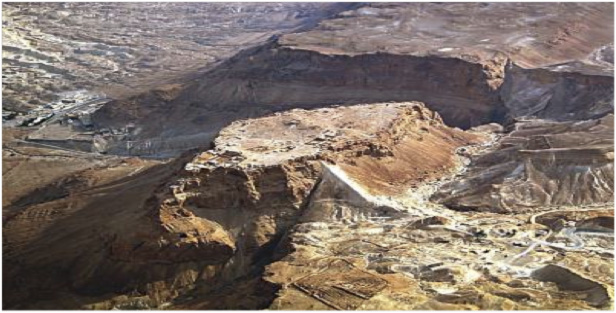
    Masada-1
    Aerial view of Masada and the remains of the camp of Roman besiegers built in 73 C.E.


    Considering all the forms of modern and ancient transportation we utilized during our visit, you might ask how we managed to navigate accurately, since the GPS was of course still eleven years away even from its initial launch, let alone operability.. The answer is, we navigated as accurately as possible and we did it the old-fashioned way, using the pre-1967 version of GPS: Global Navigation & Planning (GNC) maps, ancient street maps, and at times hand-drawn maps. The GPS abbreviation in 1967 stood not for Global Positioning System but for Going Places Slowly, while stopping every fifteen minutes to consult a paper map of dubious accuracy.

    Today

    Today, of course, the trip from Haifa to Jerusalem and then to the storied fortress of Masada can be made on a fancy European tour bus in air-conditioned comfort, and you can take a cablecar to the top of Masada. Once there, you might be able to just barely see the Dead Sea, which is much further away now than it was in 1967.  Yes, unfortunately the Dead Sea is shrinking drastically, due to the high demand for water in Israel today. It is barely visible from the top of Masada’s highest vantage point. You might find it interesting to know that all the young men and women in the Israeli armed forces today take their oaths of allegiance atop Masada. The reasons are historical and make interesting reading, check it out.

    Today, of course, everyone navigates accurately to all these wonderful historic venues with a handheld or vehicle-mounted GPS. And believe me, as I said, it seems that everyone in Israel has at least one. And no one in that country today, for personal and security reasons, wants to go back to the old days of navigating with paper maps, where one wrong turn can be catastrophic.

    Lessons Learned

    So anytime you find yourself being the least bit complacent about GPS and what it does for you, think about what it is like to live in Israel, where GPS has revolutionized the way an entire county navigates and literally serves as a lifesaving device every single day.

    Here is the United States, we tend to take our technology for granted — no surprise there — but when you find yourself in some place like Israel, Iraq, or Afghanistan, and your life
    literally depends on a satellite system 12,500+ miles up in space, believe me, you no longer take it for granted.

    An Enabler

    Always remember: GPS is a ubiquitous utility that is provided to the world free of charge, as a gift from the United States government. Countries around the globe, including Israel, use the positioning, navigation, and timing (PNT) capabilities enabled by GPS for critical national infrastructure, for military planning and execution, and yes, for everyday navigation. Plus, as I have stated many times, more than 90 percent of the 1 billion-plus people around the world who use GPS, use it for time and all the capabilities that time accurate to 1×10-E14 enables.

    Will It Be There?

    Please never take your GPS for granted. Part of not taking it for granted is ensuring that GPS is available and is protected from encroachment and jamming by companies like LightSquared. If LightSquared has its way, and its FCC terrestrial license is not revoked, then the company will be able to legally jam GPS and deny everyone in the United States from enjoying the innumerable activities that GPS enables around the globe.

    Does that make sense? The U.S. government provides the GPS service globally, but we in the United States cannot benefit from it because a private company has convinced the FCC that being able to Google or Twitter on a cell phone in the middle of Kansas is more important than all the industries and capabilities that GPS enables, not to mention the $100 Billion in revenue that the GPS industry generates every year?

    I ask again — does that make sense?

    Bottom Line

    Let’s hope we never have to fight another war on our homeland, because if we do and LightSquared and the FCC have their way, we will do it without GPS. We will find ourselves navigating by the seat of our pants, just as I did in Israel in 1967. Call your Congressman and complain loudly about LightSquared and the FCC. Help put an end to this insanity.

    Until next time, Happy Navigating.

    P.S.  Our 1967 group of war correspondents included the grandson of former British Prime Minister Sir Winston Churchill, who was named after his famous grandfather. Young Winston wrote an excellent book about the war shortly afterwards. If you want to know more about the Six Day War from an eyewitness then I highly recommend The Six Day War by Randolph S. Churchill and Winston S. Churchill. As I was there, I can verify that Winston’s book is forthright and factual. Winston tells it like it was with no dithering of the facts for political correctness.

  • Out in Front: Business Hand at the Helm

    I met Chris Litton (right) at my first European Navigation Conference in Sevilla, Spain, May 2001. I recall a long conversation over a dinner of Moorish and Andalusian dishes, attended by the staffs of NavCom Technology and GPS World, in the Mesón Don Raimundo.

    Over the years we met again and again at conferences hither and yon. “Great cities of the world!” became our greeting. As sales manager for NavCom, then for the NavCom division of John Deere & Co., from 1995 to 2007, Chris saw many more of those cities than I did. A GPS road warrior.

    I’m very happy to announce that we now play on the same team — to your ultimate benefit. Meet J. Christopher Litton, international account executive and ad manager for GPS World magazine, website, e-newsletters, webinars, and the whole enterprise.

    Add to his decade-plus at Navcom the subsequent years, up to present date, doing similar things for Septentrio Satellite Navigation, earlier experience as co-founder of Litton Consulting Group, where he helped establish NavCom, and deep background as U.S. Navy gunner’s mate missile system specialist.

    As a result, your business partner here knows more about GNSS markets and technology than the editor. That not only distinguishes us from the crowd — it’s got to be worth something. To you.

    For the 6.7 percent of our subscribers who are actual or potential advertising decision-makers, this is worth a great deal. Give him a ring or shoot him an e-mail query about reaching your business development goals. He’ll have something concrete, knowledgeable, and effective to suggest. He can implement your message, simultaneously and synergistically, across many platforms: print, electronic, social media, exhibits, and more. He’ll visit you for an in-depth skull session. A GNSS road warrior, traveling to all cities of the world, great and small.

    The balance of 93.3 percent — or really, all our readers — will benefit from Chris’ knowledge and marketplace vision, helping me shape and steer this vast starship across the far reaches of positioning, navigation, and timing.

  • Location Industry Hits Speed Bump

    Location privacy issues have the power to put the skids on our industry. When I stepped into the Where 2.0 show, little did I know I was about to see Apple publicly open its kimono, reveal its location collection practices, and further fuel public and government outrage on location privacy.  Apple doesn’t stand alone as Google also stores similar data on Android devices. And in a smaller breach, TomTom’s user location data was sold to the Netherland’s government, helping  to optimize the placement of speed traps. Congress responded by hauling Apple and Google into a Congressional subcommittee meeting. Senator Patrick Leahy captured the hearing’s mood when he said, “American consumers and businesses face threats to privacy like no time before.” He went on to say that he was “deeply concerned” about the reports that iPhones and Android devices were “collecting, storing, and tracking user location data without the user’s consent.”

    Apple’s recent revelation was that its iOS operating system stores user location data in a hidden file. The location was being provided to iTunes during back-ups, giving Apple a log of a user’s movements and activities, for up to a year. A new iOS version reduces the log to a week of data and ends the back up to iTunes. The cache can be eliminated by disabling the device’s location feature.

    Leak from Google Skyhook skirmish. Larry Page, now-CEO of Google, sent an e-mail last year to top executives with the news that Motorola had chosen to use Skyhook, and not Google, location services. According to e-mails leaked to the San Jose Mercury News, Google executives responded by emphasizing the importance of collecting location data from smartphones, and the value of the data.

    “I cannot stress enough how important Google’s Wi-Fi location database is to our Android and mobile product strategy,” Google location service product manager Steve Lee wrote. “We absolutely do care about this (decision by Motorola) because we need Wi-Fi data collection in order to maintain and improve our Wi-Fi location service.”

    At the beginning of 2010, because of public concerns, Google had stopped collecting Wi-Fi data from vehicles used to capture street images for Google Maps’ Street View feature. When the vehicles also scanned an area for Google’s location database, Google admitted that in doing so, it inadvertently collected personal data from unsecured wireless networks. Google had turned to collecting location data via Android phones and the Skyhook move was seen as a major threat.  Motorola later decided to resume using Google’s location services, and Skyhook Wireless sued Google for patent infringement and interfering in its business relationship with Motorola.

    Who’s there? Location veteran Duncan McCall unveiled PlaceIQ at Where 2.0. The company provides meaning to hyper locations, categorizing the types of people, places, social, and digital activity that occurs within a city block or 100 square meters. PlaceIQ doesn’t use personal information but tries to infer information about people situated at a location. For instance, a location might be a trail head at a popular hiking destination or a tourist spot like Fisherman’s Wharf in San Francisco. Place IQ can identify locations in which an advertiser’s target audience has a likelihood to be present.

    Let’s make a deal. Groupon purchased location-enabled social networking company Pelago (Whrrl).  Look for Groupon to take on foursquare, which has led in social networks and local check-in market.  Groupon will move beyond being a new customer acquisition tool to adding a social platform on which a location-enhanced social community will exchange recommendations and insights on deals. A loyalty program will be added to reward check-ins and usage.  Groupon will expand beyond its current local small businesses focus to include national brands and large retailers.

    Keep your hand on your pocket. eBay wants to be your mobile wallet. The company just purchased location-based services provider Where.  Previously called uLocate, Boston-based Where develops mobile advertising, search, recommendation and daily deals services. Where will be housed in eBay’s PayPal division and used to strengthen the company’s position in mobile and hyper local shopping and deals. This fits with eBay’s earlier acquisitions of local shopping start-up Milo, barcode scanning developer RedLaser, and online retailer GSI Commerce.

    Got mail. Last month’s column highlighted indoor location and generated unprecedented mail to my inbox. I mentioned a few companies providing apps that involve indoor mapping or locations, but as many pointed out, there are more. Others include Eakahau, Ehud, Fast Mall, Geodelic, Les Quatre Temps, Point Inside, and Spotlight Mobile. I’d like to clarify that Aisle411 maps offer routing and some interactive capabilities. Choices for indoor positioning include both handset and network solutions like Wi-Fi, GPS, Bluetooth, U-TDOA, Wi-Fi,  radio frequency pattern-matching, and geo-location sensors.

    Mapping for good. Ushahidi, a non-profit organization, developed open software and interactive mapping for “crowd voicing” to increase transparency and allow people to document their condition. After the Kenyan disputed election, 45,000 users contributed information about violence and peace activities throughout the country. The platform was also used after the Haiti earthquake. Ushahidi utilizes an elite team of volunteers for coding and other important jobs. Get involved.