Category: Opinions

  • LightSquared: It’s Worse than You Think

    Tired of hearing about LightSquared? Think it’s a bunch of panicking journalists hungry for something to write about? Listen, it usually takes a lot to get the hairs standing up on the back of my neck. On the LightSquared issue, they are at full attention.

    Why?

    The GPS receivers that would likely be affected the most aren’t military, automobile, aviation, mobile phones, etc. The GPS receivers that would be affected the most are the ones you use, the high-precision GPS receiver!

    This means any receiver designed to produce accuracies at meter-level or better (submeter, decimeter, centimeter receivers). This means surveying, engineering, construction, bridge/dam/structure/seismic monitoring, GIS, precision agriculture, mining, utilities/telecom, transportation, environmental, disaster management, and all sorts of machine control across a vast number of industries.

    Do the Math

    LightSquared is planning to construct 40,000 ground-based transmitters broadcasting 1,500W each across the U.S. These are targeted at metropolitan areas with high-density population. The will pop-up like mobile phone towers. What do you think a map looks like with 40,000 LightSquared transmitters overlaid on the current infrastructure of CORS (1,500+ GPS receivers in the U.S.) and RTK networks (100+ consisting of several thousands of receivers in the U.S.)?

    Do you use OPUS? Do you use CORS? Do you use an RTK network? Do you use WAAS corrections? Do you use OmniSTAR? Do you use StarFire? Do you operate your own high-precision base station (real-time or post-processing)? I do not know one high-precision user who does not use one of the aforementioned technologies in their GPS operations. All of the above technologies are in jeopardy.

    I’m going to keep this simple. You, the high-precision GPS user, are likely going to be considered collateral damage.

    The military is going to be accommodated in the name of national security. The aviation industry is going to be accommodated in the name of safety-of-life. The auto navigation industry is going to be accommodated because they are high-profile. The high-precision user is going to be thrown under the bus because we are the most difficult to accommodate (technically) and don’t have a high profile nor are perceived as significant enough to accommodate.

    In other words, the high-precision user will be told to “deal with it.”

    What Does “Deal with It” Mean?

    It’s not clear at this point, but without any hardware modification, your receiver performance will likely be degraded (weakened or lost signal) in metropolitan areas, and to a lesser extent in rural areas. That totally depends on where LightSquared decides to place its towers. Very soon, with the final Working Group report due to the FCC (June 15), we will see how serious the interference will be.

    GPS receiver manufacturers would likely offer some sort of hardware upgrade, if possible. You can bet that they won’t support upgrading older hardware and it’s possible some newer hardware won’t be retrofittable, so the upgrade turns into a “trade-in” with a hefty price tag. But beware that a hardware upgrade doesn’t mean it will solve the problem, but rather minimize it.

    In order to have a chance of not being forgotten or dismissed as collateral damage, you need to jump loudly and with resolution to raise awareness with your congressperson and the FCC about the importance of GPS to your operations. If you’re an international user, write the FCC.

    You can view the list of submissions made to the FCC by clicking here. Deere & Co. as well as Fugro and many others provided very clear and concise comments.

    The Coalition to Save Our GPS has posted guidance on its website as to how to submit your comments. They are:


    Voice your concerns directly to Congressional Representatives

    To voice your concerns about GPS interference, you can send letters, emails, faxes, call or visit your Congressional representatives’ office in person to explain how you use GPS as a local business and what the impacts of interference would be to the local economy.

    Contact Your Local Senator

    Ask your Senator to support and co-sign the attached letter from Senators Roberts (R-KS) and Nelson (D-NE): explain how you use GPS in your state and what impact interference or any compromise of the GPS service would have on you and the local economy.

    United States Senate Letter from Pat Roberts (R-KS) and Ben Nelson (D-NE)

    Find Your Local Senator

    Write Your Representative

    Find Your U.S. House of Representatives

    Please include: “Coalition to Save Our GPS and FCC File No. SAT-MOD-20101118-00239” in your correspondence.

    Send your comments directly to the Federal Communications Commission (FCC)

    Email the FCC: [email protected]

    For your ready reference, below are the actions the Coalition is seeking from the FCC:

    1. The FCC must make clear, and the NTIA must ensure, that LightSquared’s license modification is contingent on the outcome of the mandated study unequivocally demonstrating that there is no interference to GPS. The study must be comprehensive, objective, and based on correct assumptions about existing GPS uses rather than theoretical possibilities. Given the substantial pre-existing investment in GPS systems and infrastructure, and the critical nature of GPS applications, the results of studies must conclusively demonstrate that there is no risk of interference. If there is conflicting evidence, doubts must be resolved against the LightSquared terrestrial system. The views of LightSquared, as an interested party, are entitled to no special weight in this process.
    2. The FCC should make clear that LightSquared and its investors are proceeding at their own risk in advance of the FCC’s assessment of the working group’s analysis. While this is the FCC’s established policy, the Commission’s International Bureau failed to make this explicit in its order.
    3. Resolution of interference has to be the obligation of LightSquared, not the extensive GPS user community of millions of citizens. LightSquared must bear the costs of preventing interference emanating from their devices, and if there is no way to prevent interference, it should not be permitted to operate. GPS users or providers should not have to bear any of the consequences of LightSquared’s actions.
    4. This is a matter of critical national interest. There must be a reasonable opportunity for public comment of at least 45 days on the report produced by the working group and further FCC actions on the LightSquared modification order should take place with the approval of a majority of the commissioners, not at the bureau level.


    Lastly, following is the list of high-precision GPS receivers that the Working Group (consisting of US GPS Industry Council representatives and LightSquared representatives) have chosen to test:

    Hemisphere R320 (with A52 antenna)
    Hemisphere A320 (with Integral antenna)
    Deere iTC (with Integral antenna)
    Deere SF‐3000 (with Integral antenna)
    Deere SF‐3050 (with Aero antenn
    a)
    Trimble MS990
    Trimble MS992
    Trimble AgGPS 252
    Trimble AgGPS 262
    Trimble AgGPS 442
    Trimble AgGPS EZguide 500
    Trimble CFX 750
    Trimble FMX
    Trimble GeoExplorer 3000 series GeoXH
    Trimble GeoExplorer 3000 series GeoXT
    Trimble GeoExplorer 6000 series GeoXH
    Trimble GeoExplorer 6000 series GeoXT
    Trimble Juno SB
    Trimble NetR9 (with Zephyr 1 antenna)
    Trimble NetR9 (with Zephyr 2 antenna)
    Trimble R8 GNSS (with Integral antenna)
    Trimble 5800 (with Integral antenna)
    Trimble NetR5 (with Zephyr 1 antenna)
    Trimble NetR5 (with Zephyr 2 antenna)
    Leica SR530 (with AT502 antenna)
    Leica GX1200 Classic (with AX1202 antenna)
    Leica GX1230GG (with AX1202GG antenna)
    Leica GR10 (with AR10 antenna)
    Leica Uno (with GS05 antenna)
    Leica GS15 (with Intergral antenna)
    Topcon HiPer Ga
    Topcon HiPer II
    Topcon GR‐3 (with Integral (5/8) antenna)
    Topcon GR‐5 (with Integral (5/8) antenna)
    Topcon MC‐R3 (with MC‐A3/cabled (5/8) antenna)
    Topcon NET‐G3A (with CR‐G3/cabled (5/8) antenna)
    Topcon TruPath/AGI‐3 (with Integral (special mount) antenna)
    NovAtel PROPAK‐G2‐Plus (with GPS‐702/GPS‐701 antenna)
    NovAtel FLEXG2‐STAR (with GPS‐701GGL/GPS‐701 antenna)
    NovAtel FLEXPAK‐G2‐V1 (with GPS‐701GGL/GPS‐702 antenna)
    NovAtel FLEXPAK‐G2‐V2 (with GPS‐702GGL/GPS‐702 antenna)
    NovAtel PROPAK‐V3 (with GPS‐702GGL/GPS‐702 antenna)
    NovAtel DL‐V3
    NovAtel FLEXPAK6 (with GPS‐702GGL/GPS‐702 antenna)
    Septentri PolaRx3e (with PolaNt GG antenna)
    Septentrio AsteRx3 (with PolaNt G antenna)


    Thanks, and see you next time.

    Follow me on Twitter at http://twitter.com/GPSGIS_Eric


  • Space Symposium, Partnership Council Offer Valuable Information

    As it happens April, May, and June are watershed months for space and PNT geeks every year. In April I was honored to attend the National Space Foundation sponsored 27th annual National Space Symposium held at the incomparable five-star Broadmoor Resort in Colorado Springs, Colorado, and in May, just last week I attended the 10th annual GPS Partnership Council at SMC (Space and Missile Systems Center) in Los Angeles, California. Currently I am planning my strategy and greasing the chain on the mountain bike for the sixth annual Space and Cyberwarfare Symposium in the beautiful mountain village of Keystone, Colorado, which is followed later in June by the Joint Navigation Conference, also in Colorado Springs.  I know this is really an incredibly tough June schedule, but somehow I will manage.

    Seriously, my purpose in telling you about these wonderful events is two-fold: number one, they are important events and number two, they are events you should attend if you are the least bit interested in space and especially PNT or GPS. All the events this year had/will have maximum time built in for networking with colleagues and businesses you may not come into contact with any other time during the year. You know that Executive VP for Space you have been trying to see for months? He or she will probably be attending one of these events. Take a shot.

    National Space Symposium

    The 27th National Space Symposium (NSS) just gets better and better every year. Yes, I know I say that every year, but it is true. I have had the honor of attending 24 of the symposiums and have witnessed phenomenal growth. This year there were more than 9,000 participants and yet it never really seemed crowded because the event encompasses the entire Broadmoor resort. There is so much happening that I will have to say this year, for the first time, I did not make it to all the events I planned. But I was able to network, and for a journalist as well as a business executive that is key. I see people at the Space Symposium every year that I never see at any other event probably because there is no other event in the world quite like it. The National Space Symposium is truly unique in its scope and venue and frankly this year I thought, also for the first time, that it could have easily continued for one more day. Then maybe I just might have been able to take in everything, albeit on the run. When you consider that a great many of the attendees start and end their NSS journey with trips to the nearby Rocky Mountain ski slopes, attendees and businesses would not really experience any more downtime due to the symposium adding an extra day, but hitting the slopes is sure is a great and unique way to start and end a business conference.

    NSS Exhibits

    There were more exhibitors this year than ever before, and some of the exhibits, especially the static displays, were phenomenal. For example, as I mentioned in my NSS blog in GPS World, on the first morning I was able to see and actually touch (before I saw the “Please Do Not Touch” sign, of course) the X-37B, the U.S. Air Force autonomous space vehicle. The USAF says the X-37B Orbital Test Vehicle, or OTV, is a non-operational system (an adjective conveying minimal veracity in my opinion) that demonstrates a reliable, reusable, unmanned space test platform. Indeed, on March 5, just five weeks before the 27th NSS, the USAF launched the second X-37B from Cape Canaveral, Florida.x-37b-W

    The OTV-2 launch comes on the heels of the successful flight of OTV-1, which made an autonomous de-orbit and landing at Vandenberg Air Force Base, California, on December 3, 2010, after successfully logging 224 days in space, something for which the current NASA manned space shuttles were never designed  and are unable to accomplish. According to USAF officials, post-flight analysis of OTV-1 revealed OTV-2 needed no significant changes, and the second X-37B flight is aimed at helping Air Force scientists better evaluate and understand the vehicle’s performance characteristics and expand upon the tests from OTV-1.

    The spacecraft measures more than 29 feet long and nine-and-a-half feet tall. Its wingspan is 14 feet, 11 inches, and it weighs approximately 11,000 pounds at launch. The objectives of the OTV program include space experimentation, risk reduction, and a concept of operations development for reusable space-vehicle technologies.
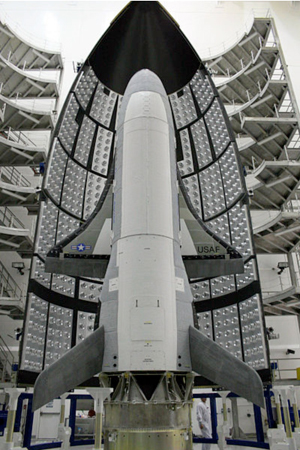
    x-37BThe X-37B OTV is America’s newest and most advanced re-entry spacecraft. Based on NASA’s X-37 design, the unmanned OTV is designed for vertical launch to low Earth orbit (LEO) altitudes where it can perform long-duration space technology experimentation and testing. Upon command from the ground, or as preprogrammed, the OTV autonomously re-enters the atmosphere, descends, and lands horizontally on a designated runway. The X-37B is the first vehicle since NASA’s Shuttle Orbiter with the ability to return experiments and surveillance sensors to Earth for further inspection and analysis.

    The X-37B OTV is a military autonomous space vehicle, and that is where the excitement resides. It brings back memories, from around 1959, of the promised but unfulfilled capabilities of the early Boeing Dyna-Soar or X-20 (yes, I spelled it correctly) space and atmospheric skipping vehicle and, well… just use your imagination. Early estimates are the X-37B OTVs could actually stay on orbit for more than a year if necessary. That sounds like a real time, persistent space surveillance platform/sensor to me, just to name one option among a list of many valuable military missions. I suspect we will be hearing about many more amazing feats and record flights concerning the X-37B or not; and because I attended the NSS I actually got to see the real article up close and personal…that alone was worth the price of admission.

    NSS Presentations

    Certainly the presentations at the NSS are not to be missed, but you have to plan your time carefully since there is so much to see and do. Just roaming the halls of the multiple exhibition areas (four this year) is an education in itself, and you just never know who you are going to run into. Former and current astronauts abound, and senior officers from all services will freely stop and chat with you about the various exhibits and their pet programs. Treat them to beautifully hand scooped ice cream at AGI or a hot Italian Cappuccino at the LMCO booth and who knows what you may learn.

    National Strategic Infrastructure versus LightSquared

    480px-Gen_William_L_SheltonAs I mentioned in my NSS blog, the whole event, both the Cyber and the Space Symposiums, were kicked off by my old friend and colleague General William L. Shelton, the commander of Air Force Space Command. General Shelton tends not to be long winded — in other words, his
    speeches are brief and to the point, and historically right on target. His presentations at the Cyber and Space symposiums were no exception.

    General Shelton took on the new and emerging cyber threats, the future of space with a flat or declining national security space budget, and of course the imminent national GPS threat from LightSquared. As the steward of GPS and as a warfighter himself, General Shelton is the only four-star officer from any service that has manned up, stood tall, and been counted on the LightSquared issue, which is an ominous harbinger (pun intended) of a possibly disastrous future for our warfighters and first responders (see PDF report) — actually, it poses a threat for all GPS users in the U.S. The LightSquared debacle is led by a Luddite administration where no one has the guts to tell the commander-in-chief he has no clothes, or a clue for that matter, when it comes to military or first-responder PNT related technology. Just ask Seal Team Six how important GPS and all the capabilities that GPS enables was to their successful mission taking out Bin Laden. But of course this administration has a history of denying critical PNT-related support to the national strategic infrastructure. Just think back to the eLORAN fiasco, and now there is the LightSquared debacle with the potential catastrophic denial of GPS signals across the United States, or you may wish to refer to it as FCC-sponsored nationwide GPS jamming as I have often heard it described.

    In my opinion, the whole LightSquared issue is ludicrous and borders on the criminal. If LightSquared and inept FCC commissioners, who can’t spell space, have their way, our warfighters and first responders will not be able to train the way they fight in the U.S. or for that matter “… defend the United States against all enemies foreign and domestic…” which, to the best of my recollection, they are sworn to do, and LightSquared would cripple that ability. And this is how the loss of GPS signals across the United States applies to you and me on a daily basis. When you are having a medical emergency, say a major coronary, the short-staffed paramedics will no longer be able to find your home in time to save your life, and the undermanned fire department won’t arrive until your home has burned down or the over-burdened police department won’t arrive until the burglars are long gone, because they will be too busy looking at outdated paper maps trying to determine where you live. And don’t get me started on undermanned FAA control towers, the potential loss of next-gen, GPS enroute navigation, approaches, departures, and sleepy overworked controllers. The entire future of the FAA and our air travel in the U.S. is based on satellite navigation and in the U.S. that means GPS. That is now at risk plus the millions of dollars and jobs that will be lost because of LightSquared. GPS is and always has been a recognized force multiplier and without it critical service providers across our nation will become even more short-handed. and he U.S. could loose over $100B in revenue annually. All so young people, who are mostly too young to vote Mr. President, can have a broadband signal to browse the Internet and play games in the middle of Kansas, or of course the all-important ability to download, read, and comment on those Congressional Bills awaiting the President’s signature…just another promise by candidate Obama that has never materialized. Don’t hold your breath. Write your congressman now.


    LightSquared Webinar Set for May 26, 10 a.m. PDT

    A panel of experts will discuss findings contained in the May 15 status report by the FCC Technical Working Group on LightSquared/GPS Interference Issue. The TWG’s third report is anticipated to include at least some testing results of GPS receivers under LightSquared conditions: terrestrial transmitters in the L-1 Band (1525 MHz–1559 MHz) immediately adjacent to the band (1559–1610 MHz) where GPS and other GNSSs operate. Webinar panelists will represent the high-precision sector, aviation, consumer handsets, and timing infrastructure. Register today.


    NSS Speakers

    Alas, I digress, so let’s step off the soapbox momentarily and move on to more positive happenings at the NSS, but you haven’t heard the last of LightSquared. If only we were so fortunate. Onto the outstanding agenda of presentations… There were almost 100 speakers at this year’s Space Symposium, and if you count the Cyber Space presentations there were well over 100 speakers, some with topics more interesting than others of course, but all the presentations I attended were professional and at a minimum engaging and focused on the future of the space enterprise. Unfortunately you could not go more than five minutes without a speaker expressing his or her opinion, or someone asking your opinion, about the LightSquared debacle. At least I can say that regardless of the opinions, they were certainly passionate.


    Bottom Line At The End: BLATE

    So the bottom line on the NSS is if your interests, personal or business related, are in the National Security Space arena, then the NSS is the place to be. A time-sensitive agenda with interesting and high-level presentations, exhibits from the world’s leading space companies, networking opportunities that are second to none, and all in a venue that King Arthur would love. Truly the Broadmoor accommodations, the courteous and professional staff, the excellent cuisine, and the breathtaking views are second to none. Plan now and see what all the fuss is about at the “Premier Gathering of the Global Space Community,” the 28th National Space Symposium, in the foothills of the Rocky Mountains, April 16-19, 2012.

    GPS Partnership Council

    Fast-forward a mere two weeks and now we are attending the AFCEA (Armed Forces Communications and Electronics Association) sponsored 10th Annual GPS Partnership Council at SMC, Space and Missile Systems Center, at Los Angeles Air Force Base in California. This event, which was successfully and artfully resurrected four years ago by the then GPS Wing Commander, Colonel David Madden, has carried on under the auspices of Colonel Bernie Gruber, the current director of the newly designated GPS Directorate. Managerially sponsored by the local AFCEA chapter with funding provided in the most part by numerous GPS primes and their sub-contractors, this is a first-class event you need to attend if you are a hard-core GPS groupie. The folks at AFCEA ably aided by Colonel J.B. Borris (USAF Reserves), the indomitable event chairman for four years running, and his team — especially this year’s narrator extraordinaire, Captain Tiffany “Tupperware” Ware, who fortunately had a great sense of humor, which certainly comes in handy with this crowd — put on another memorable council. Frankly, even though I fondly remember the old GPS Partnership Councils, pre-Madden, they do not hold a candle to the content and professional first-class events of the last four years. If you are a military, civil, or commercial GPS/PNT professional, or work in a GPS-related industry, then the GPS Partnership Council in Los Angeles is where you needed to be last week, and it is never too early to plan for next year’s event in May 2012. One old-timer I overheard explaining this event to a newcomer said it this way: “Think of this as a joint military, inter-agency, civil, and comm
    ercial get-together of GPS subject matter experts.” That works for me.

    While the venue is two hours west by fast jet and about 6100 feet lower in altitude than the NSS, the same professionalism still prevails. Of course this event is GPS centric and since GPS is so ubiquitous in our everyday lives, we should all take note of the news coming from this important event. While it is only 1/45 the size of the NSS, it is no less important to those who depend on GPS as their raison de vivre. This years’ theme was “Executing Modernization…Enabling New Paths and Beyond.” However, I enjoyed General Robert Rosenberg’s comment, during his rousing remarks relating to the way ahead in a fiscally restrained environment, that the theme might more appropriately be taken from one of Winston Churchill’s famous quotes during WWII, “Gentlemen, we have run out of money. Now we have to think.”

    The speakers at this years’ event, especially General Rosenberg, were on the whole outstanding from the introductory comments by Lt. Gen. Tom Sheridan (USAF), SMC/CC, who will be hanging up his military spurs later this month, encouraged us all to have a good time and left us with a quote from the International Academy of Astronautics, which has declared that to date “GPS is the space program that has proven the greatest human benefit in the history of space.”

    Just after General Rosenberg’s wonderful invigorating and thought provoking lecture, and yes he included the LighSquared debacle, a very senior and well-known member of the audience, who was speaking to me as a colleague and friend and not as a journalist, so I will respect his wish for anonymity, expressed his dismay that… “a private for-profit company should be allowed to wreak such havoc on our critical national infrastructure… it is simply criminal. Why doesn’t someone in the military speak up? What is wrong with this administration? Do you think the President is not aware of the potential devastation he has wrought? This whole LightSquared issue just makes me ill.” I could not have said it better.

    Warfighter Panel

    While it was great to hear about the proclamation by the International Academy of Astronautics, the awesome warfighter panel presentation on the last day of the GPS Partnership Council was in my opinion the highlight of the event. To see and hear how the panel of Army Rangers, Navy SEALs, USAF Special Operators, and USAF aviators and others actually use GPS not only to accomplish their missions but to save lives every day is exciting. The warfighter panel provided feedback on how warfighters’ lives depend on GPS, and as a former warfighter the moving presentations made my chest swell with pride and brought a tear to my eye. These young men and women are going in harm’s way and they deserve the best equipment and support we can provide. At the end of the day the warfighter panel received a much-deserved standing ovation and I was proud to be in the audience. I hope they caught it on video so you can all experience it someday. Emotions were running high to say the least.

    Extras + Networking

    Just as during the NSS, the networking opportunities at the GPS Partnership Council were abundant and rife with potential. Plus fun was had at the biggest networking opportunity of all, the annual golf tournament, where you get to rub shoulders and compare bogies, with a who’s who of the GPS community; plus the now traditional libation-fueled networking event at “Shade” was a fun time for all who attended as well.

    Exhibits

    Certainly the exhibits at this event are at a minimum, but the companies that do exhibit have a very interested, attentive, and GPS-educated audience. If I were running a GPS/PNT/GNSS centric company, I would definitely want to be there as an exhibitor, because 100% of the audience is greatly interested in what you do. While current exhibit space is somewhat limited, there does appear to be room for expansion if needed. The biggest challenge at this event is a common one in California and that is parking, but there was a plan and it worked well as far as I could determine. I did not hear any complaints.

    Boeing II-F Factory Tour

    Since you are attending a GPS event at the home of GPS acquisition, opportunities for additional information abound with the large prime contractors in the area that support GPS, and this year as in the years past we were able to take advantage of that circumstance. This year wearing a slightly different hat I, and several of my think tank colleagues, visited with Ken Torek, the vice president for Navigation and Communications Systems & Space and Intelligence Systems, and his staff, which included Jan Heide, the new Boeing GPS Program Director, at the new Boeing GPS II-F facility in El Segundo, California. We were given the VIP treatment and were able to see IIF satellite vehicles three through seven, all in various stages of completion on the innovative, labor, and cost savings Boeing Pulse Line. In this configuration the satellite comes to you in a fashion that would make Henry Ford proud. While on our tour we learned that SV IIF-2 has already been shipped to Cape Canaveral, Florida, for a launch scheduled sometime in July. We also learned this will most likely be the only II-F launch in 2011. Since there are 31 active satellites on orbit, with three residuals and one in standby mode, the launch schedule has been moved to the right with the lack of urgency resulting in one GPS launch per year for the foreseeable future. Barring a catastrophic event on orbit, this will most likely be the future of GPS launches for the life of the II-F program. As previously predicted we will most probably witness several IIIA launches (built by LMCO) before the II-F launches are complete. My hat is off to Boeing for a great afternoon of briefings and tours, plus here’s hoping for a successful IIF-2 launch in July.

    PRNs and Accuracy

    During the council the USAF and DOT announced that they would be removing the PRN-1 number from SVN-49 (the one with spurious signals that has been placed in standby mode) and releasing the test PRN for use with IIF-2, that when launched in July will utilize PRN-1 while it is being checked out. Once operational, another PRN will be assigned that will be especially helpful for precision users (surveyors and such). Since the ground command and control system cannot currently handle more than 31 PRN’s, for reasons not appropriate to this venue, (a problem that will supposedly be fixed by OCX in 2015) this means that SVN-49 will be placed in residual status for now and in all likelihood also means another SV will be placed in residual status as well, bringing that total number to five SVs in residual status. When I checked this move with other sources they were quick to assure me that this does not mean they have given up on SVN-49 and indeed they hope to find a way to make it a fully functioning member of the GPS constellation in the years to come. No timetable for that move obviously. But I was assured they are still working the issues.

    Since the single on orbit instance of the II-F SV is proving to have an extremely accurate clock, hopes are that IIF-2 will follow by broadcasting a more accurate timing signal, which translates to more accuracy on the ground. Remember from MEO one nanosecond of timing accuracy equates to one foot of position accuracy on the ground.


    Another Civil Focus Day?

    Colonel Gruber announced that General Shelton, the current AFSPC/CC will more than likely follow in the footsteps of General Kehler, the former AFSPC Commander, and announce a follow-on Civil Focus Day most likely to be held at Air Force Space Command sometime this year. The first resurrected event of it’s kind in about ten-years, it was a big success in 2010.

    <e
    m>GPS-IIIA: OCX Updates and the Gap

    Colonel Gruber provided us with an update on the GPS-IIIA program by Lockheed Martin, which is on track for the first GPS IIIA launch sometime in 2014, and an update on the Raytheon OCX program, or new GPS ground Command and Control system, due to be operational sometime in 2015. While Colonel Gruber is happy with the way both contracts are progressing, in my opinion we still have the famous “gap” that everyone goes out of their way to explain is not really a gap, but in new government speak as proclaimed by a pundit from the stage during the National Space Symposium, what we really have is “negative operational margin.” But seriously it is still a gap, no matter how you characterize or spin it and one that still needs to be closed. And yes I know all about the plan to fill the “gap that doesn’t exist” with the new LCS (Launch and Checkout System). While I don’t object to LCS per se, I do object to the way ahead as currently envisioned by SMC. There is in my opinion an extremely clear way ahead for LCS; why not use the same incredibly reliable, low risk, and very affordable independent LADO (Launch/Early Orbit, Anomaly Resolution, Disposal, and Operations (LADO) System, built by Braxton Technologies, that the USAF used for the IIA, IIR, IIRM, and IIF SVs and is the only technology that allows us to operate residual satellites today? Can you say past performance matters? Can you understand excellence and low risk are key performance parameters? Alas, on this issue the acquisition community for some reason beyond my ken cannot, and now the politicians and cost accountants are involved. Indeed, it has become the dreaded forest for the trees sort of issue. I’ll do my best to keep you updated. And I would very much like to say that surely reason, logic, and common sense will prevail, but then I inevitably think about the LightSquared debacle and I am not at all sanguine about filling the gap, excuse me, the negative operational margin, in a logical or timely fashion with the current plan in place. For the same reason I am not sanguine about the U.S maintaining GPS as the Gold Standard for the world. Can you spell insanity? L I G H T S Q U A R E D or just abbreviate it as F C C, take your pick.

    Constellation Update

    Colonel Gruber’s constellation update read like this (comments are mine):

    Status of the Enhanced 24 GPS Constellation

    • 35 total GPS satellites on orbit (Most ever on orbit)
    • 31 total GPS satellites set healthy (Max for AEP)
    • 3 residual GPS satellites (enabled by LADO)
    • 1 standby GPS satellite (SVN 49)
    • IIA – 11 GPS satellites on orbit (average life 16 years, oldest 20 years)
    • IIR – 12 GPS satellites
    • IIR (M) – 7 GPS satellites
    • IIF – 1 GPS satellite

    It was a very uplifting and “good news” presentation right up to the point where someone in authority hinted that the entire GPS Modernization effort being briefed by Colonel Gruber was in danger due to the LightSquared debacle. Do you sense an underlying theme?

    GPS Hall of Fame

    At the end of Colonel Gruber’s presentation we all had a nice surprise when he inducted the distinguished aerospace engineer  William (Bill) Feess from Aerospace Corporation into the GPS Hall of Fame. Bill has been a stable and guiding force at Aerospace for the last 48 years with many of those years spent in the GPS arena dating from the 621B era. A well-deserved honor for Bill and the Partnership Council was the perfect venue for the award.

    Rockwell Collins

    During one of the numerous networking breaks I ran into Trevor Overton the Principal Program Manager for Surface Navigation Programs and Government Systems at Rockwell Collins, the company that produces the DAGR or Defense Advanced GPS Receiver. Rockwell Collins had a large booth and display, as they do every year and they were well represented in the DAGR and micro-DAGR arena by Gina Krug who serves as the Principal Account Manager for Precision Navigation and Government Systems. Mr. Overton is the one that got my attention however because somehow his title translates into the engineer who is in charge of the embedded side of the GPS operations at Rockwell Collins and he let me know rather quickly and in no uncertain terms that he had nothing to do with the handheld DAGR but worked solely with embedded systems. Then he showed me the fruits of Rockwell’s latest endeavor, the MicroGRAM, a new embedded GPS with GPS SAASM (v3.7) chip that area wise is about the same size as an SD chip, 19 mm sq, but about three times as thick since it is built with 90 nanometer technology. It has solder points for embedding on a systems board by OEMs (original equipment manufacturers) and is 12-channel capable. However, it was the near SD size that intrigued me. While embedded works and I hope they sell a ton of them, being able to slide this GPS + SAASM chip capability into an SD slot on any device with an SD slot, an antenna and a display is very appealing and constitutes a capability the war fighters have been asking for and could benefit from today; but Rockwell tells me there would be significant security issues with this approach. More on this chip in a later article when I have had a chance to visit Rockwell Collins and see what the future holds. Iowa in the Spring sounds doable.

    GPS and Seismology

    There was a very interesting briefing on what is now known as the Tohoku earthquake and tsunami in Japan. Seismologist have apparently settled on a 9.0 rating on the Richter scale, which is the fourth largest earthquake on record since 1900, with enough power was generated to power the entire planet for 40 years if someone could figure out a way to harness all that raw power. The Tohoku earthquake and tsunami are catastrophic events that Japan and the world will long remember. Undoubtedly there will be lessons learned, especially in the nuclear power plant protection arena. In the briefing at the GPS Partnership Council, we learned that Japan had prepared as best they could from a geodetic warning point of view by building more than 1,000-networked GPS receiver sites known as GEONET. It was hoped that GEONET would provide warnings of cataclysmic seismic events, but the system experienced a real-time telemetry failure, as in it is hard to transmit when your antennas are under a hundred feet of seawater. However, now critical GPS data from the event are being retrieved and processed so there are still valuable lessons to be learned even in a post-processing environment. One of the most impressive graphs of the data shows that just prior to the tsunami the GPS monitoring stations around the Sendai area of Japan actually shifted to the east by four meters. I was shocked by that information. You might expect four centimeters or four inches of movement but four meters represents an event of catastrophic proportions in the seismology world, and indeed we have all seen the results on the nightly news. Obviously the GPS seismology data is crucial to future earthquake planning and even to earthquake-proof building codes around the globe. Consequently, in the future in Japan and in the Unites States we can expect to see GPS used co-seismically as a real-time monitoring and warning tool. The question is how do you make the seismology warning system survivable to a four-meter (~12 feet) physical displacement and able to survive a 125-foot wall of seawater moving at jet speeds?

    Garmin Has a Deal for You

    During another of the networking breaks I was introduced to Rick Evans, a former Marine, who serves as the business development manager for government and law enforcement at Garmin, in Olathe, Kansas. Since Garmin does not have a designated military division, this is as close as it gets. It is a
    well documented fact (we have a database of more than 8,000 responses to surveys and interviews) that a huge majority (>95%) of our warfighters use Garmin or other civilian, commercial equipment in theater because it works, meets their needs in a non-jamming environment, and has a very user-friendly interface. I plan to follow up with Rick and possibly visit Garmin, but I want to pass on a bit of interesting and valuable information to our warfighters and first responders. If you fit in either of those categories, there is a website just for you that allows you to order Garmin equipment at a considerable discount. But again it is only for warfighters and first responders/law enforcement, and you can find it at Strohman Enterprises. More on this at a later date. Let me know how this works for you if and when you order from this site.

    Future Events

    I’m running out of airspeed and space but I do want to mention two upcoming Colorado events I will be attending in June and you should attend if you are interested in GPS and the warfighter or from a first-responder perspective. The first event is the Space and Cyberwarfare Symposium in Keystone, Colorado, June 14-16. This will be the sixth year for this up-close-and-personal gathering of space and cyber experts. This year’s theme is Space and Cyberspace Innovation: Leveraging the Enterprise to Win the Joint Fight. And of course today it is all about the joint fight. Even the Seal Team Six raid in Pakistan was a joint endeavor. I’m sure we will hear more about that at the Symposium.

    My favorite parts of this symposium are the small size and the access you have to senior decision makers who are far away from their office and phones and able to relax in the Rocky Mountains. There are extended networking sessions between briefings that provide you with plenty of opportunities to connect. Plus, do you know how much farther a golf ball flies at 10,000 feet? It really makes a difference. So you can probably predict my next favorite features are the venue and the people involved. This professional and educational yet relaxed atmosphere event is very well put together and you will be happy you attended. Come join me as I ride my mountain bike alongside the roaring Snake River — with GPS attached of course. Hope to see you there.

    ION

    The next event is the annual ION (Institute of Navigation) and JSDE or Joint Services Data Exchange co-sponsored Joint Navigation Conference (JNC), which will be held in Colorado Springs, Colorado, this year and next. This year’s FOUO events take place June 27-30 at the Crown Plaza Hotel, while the classified session on June 30 takes place at the Elkhorn Conference Center located on Ft. Carson in south Colorado Springs. According to ION officials, this year’s JNC will be the largest U.S. military navigation conference of the year, with joint service and government participation. The event will focus on technical advances in positioning, navigation, and timing (PNT) with emphasis on joint development, test, and support of affordable PNT systems, logistics, and integration. From an operational perspective, the conference will also focus on advances in battlefield applications of GPS, critical strengths or weaknesses of fielded navigation devices, warfighter PNT requirements and solutions, to include navigation warfare. Plus the classified warfighter panel on June 30 at Ft. Carson (USA) should be enlightening because the warfighters are free to speak in a classified environment (SECRET) and relate details and experiences that would not be possible in a public forum. So go online and register today and don’t forget to have your security manager send your clearances and join us for the warfighter panel.

    So June looks like it is a busy month for PNT professionals. I hope to see you all in the Rocky Mountains. Until next time, happy navigating.


  • Location Privacy: Will It Derail Mass Market LBS?

    This column rarely covers privacy as a critical issue to build location-based services markets. Why? It was our contention that most LBS are opt-in — or opt out — at the discretion of the consumer, making privacy an important issue, but not a market stopper. Frankly, many privacy panels at location conferences either bordered on hysteria, or were not relevant to market growth. However, since the recent Where 2.0 conference, which revealed that some entities were storing location information without users’ permission, the privacy issue has the potential of suppressing products and markets before they even start. Some are dubbing this new privacy concern Locationgate.


    SATNA CLARA, CALIFORNIA — In a potential breach of public trust — and perhaps thwarting LBS market growth — it was revealed at the Where 2.0 conference here (April 19-21) that location data was secretly stored in all iOS 4 devices. Since the conference, where attendees learned that Apple was storing a file with location data in every iPhone or iPad with iOS 4, Sen. Al Franken (D-Minn.) asked Apple CEO Steve Jobs to address privacy concerns about the operating system, particularly for children, who make up 15 percent of users.

    In a letter to Jobs, Franken asked why Apple consumers were not informed of the collection and retention of their location data, how frequently is a user’s location recorded, why is this information not encrypted, with whom has the information been shared, and what is the purpose of collecting the location data.

    Apple contends that iOS devices are not logging the location of the user, but caching a database of Wi-Fi hotspots and cell tower locations around a user’s position. Some of these cell towers may be many miles away from the user.

    At our deadline, Franken, chairman of the Judiciary Subcommittee on Privacy, Technology and the Law, will this week be heading the subcommittee’s first hearing, titled “Protecting Mobile Privacy: Your Smartphones, Tablets, Cell Phones, and Your Privacy.”

    According to published reports, scheduled to testify at Franken’s hearing are Alan Davidson, Google’s U.S. director of public policy, and Bud Tribble, Apple’s vice president for software technology. Other hearing attendees include privacy experts and representatives from the Federal Trade Commission and the Department of Justice.

    Privacy is becoming an issue for consumers who are using Facebook Places, Foursquare, Gowalla, Twitter, and other social media more frequently. In fact, one company, Neer, which is a subsidiary of Qualcomm Services Labs, has an entire business plan based on privacy. Neer’s social media system allows users to determine where, when, and to whom their location information is sent.

    Location privacy is starting to be a big issue overseas. According to published reports, South Korea sent police into Google’s Seoul office this month to examine how the company’s AdMob platform and Android devices can collect private data about user’s location. Google purchased AdMob last year for $700 million.

    In France, companies with with GPS-enabled devices are required to turn the systems off during an employee’s personal break, said lawyer Francoise Gilbert, in a privacy session at Where 2.0. “There is a significant difference in laws [overseas]. One size doesn’t fit all,” she said. “It is a bad idea to talk to your lawyer the day before you plan a product or website launch.”

    In addition, at Where 2.0, the American Civil Liberties Union had a speaker and booth on site to educate developers on privacy issues. The ACLU was promoting its 2011 Privacy Challenge for developers of smartphones and other applications.

    Where 2.0 LBS Developer’s Dream?

    This year’s Where 2.0 was the largest ever. The crowd was overflowing with developers — and the companies that were happy to license products to them. Where 2.0 started out as an offshoot of the geographic information systems industry — and still has that GIS feel.

    Navteq, which said it now has 50,000 developers in its network, showed off its Destination Maps product which features pedestrian-friendly guidance, including showing how they “cut across” open areas. The company rolled out advanced mapping collection technology, including rotating LIDAR, that captures 3D data points.

    A number of significant announcements came during Where 2.0, but were not made at the conference. Boston-based Where was purchased by eBay for $135 million in as big a deal as any this year in the LBS industry. According to published reports, Where was considering an acquisition bid from Research in Motion.

    Where, formerly called uLocate, was founded in 2003 to provide location tracking for GPS-based cell phones. The company changed its name and refocused on LBS markets to include a location-based advertising network, location search, and recommendation applications. The company rapidly grew — from 30 employees to more than 120.

    In another deal made within a day or so of eBay’s, Groupon bought Seattle-based Pelago for an undisclosed amount. Pegalo CEO Jeff Holden, a former Amazon executive, will head Groupon’s product development. Pelago operated a check-in service called Whrrl.

    In other industry news:

    • ALK Technologies recently announced that industry veteran Barry Glick is joining the company as chief executive officer. Glick, who led GeoSystems and launched MapQuest, has been involved in high-profile company sales. GeoSystems, and MapQuest, was acquired by AOL/Time Warner. Glick later was at the helm of France-based Webraska Mobile Technologies, which was sold to Sanef. Glick moved on to Navteq, where he was vice president of mobile and media products. Glick’s hire and track record make those in the industry wonder if he plans to spearhead the future sale of ALK.
    • I have written about location technology markets for nearly 19 years. Call me a grumpy old man, but every time I pull out my reporter’s notebook to write something down that a young Google, eBay, or Facebook executive has to say at a location conference, they say zero about the market, or frankly, anything relevant. Sad thing is that people show up to see these big-name companies — only to be disappointed. Seems as if these younger execs say a lot, but say nothing. One seasoned industry executive in the crowd lamented, “This person runs (insert company)’s location efforts — and said zero about the location market and how they fit into it.”


  • Q&A from L5 and LightSquared Webinars

    In late March, I conducted a webinar titled “A Closer Look at L5: The Future of High-Precision GNSS,” in which I discussed the impact that the new GPS L5 signal/frequency may have on high-precision users. Then, in April I was part of a discussion panel-format webinar titled “LightSquared: Our Story So Far.” Many questions and comments arose from both webinars, and I’ll attempt to address those in this column.

    First of all, the day after the March 17 webinar, I published a summary with some links and illustrations. If you want to review it to refresh your memory or get a quick overview if you didn’t attend the webinar, click here.

    During the March 17 webinar, I conducted several polls. Following are the poll questions with accompanying pie charts to illustrate the results. I think polls are a great tool to gain a better understanding of what your colleagues are thinking.

    Poll #1: Does your organization use dual frequency GPS (L1/L2) receivers?

    Gakstatter comment: Nothing earth-shattering, but good to know most of the audience members polled are high-precision users.

    Poll #2: When do you plan on upgrading your GPS receivers to take advantage of the new L2C and L5 signals?

    Gakstatter comment: I think the large number of “I don’t know” answers is due to two major variables. #1 is the economy. If the economy was healthy, I think folks would be more inclined to take the risk upgrade to the latest technology. #2 is the unclear status of GPS and Galileo (and other GNSS). If there was a launch schedule that people knew they could count on and plan for, I think users would be more inclined to upgrade sooner rather than later.
    Poll #3: Do you believe that GPS and Galileo will meet their projected deployment dates of 2014/2015?
    Gakstatter comment: I understand the skepticism about GPS and Galileo staying on schedule. I don’t think the GPS schedule can push out too far because the FAA requires a full constellation of GPS satellites broadcasting L5 by 2019. The Galileo program is under a lot of pressure to deliver something to the user community. A very important milestone this year is the scheduled September launch of the first two operational Galileo satellites, followed by the launch of a second pair the first quarter of next year. This is an opportunity for the Galileo program to set a new tone and sense of urgency with the user community.
    Poll #4: How concerned are you that LightSquared’s initiative might interfere with your GPS operations?
    Gakstatter comment: Since the March 17 webinar, there’s been much more information released and published about LightSquared’s potential effect on GPS. In April, I participated in a webinar about LightSquared’s potential effect on GPS with my portion of the webinar specifically addressing high-precision users. I will discuss this later in this article. But, suffice to say that this is a serious issue for the U.S. high-precision GPS user community. LightSquared isn’t going to walk away from this without putting up a big fight, and they have enough of an argument that I could see the FCC (Federal Communications Commission) folding or trying to negotiate a compromise. However, any compromise is likely to have a negative effect on the high-precision GPS user community. Best case scenario, there would be a hit in signal strength. Worst case, you’ll need a hardware upgrade.
    As I normally do, a number of questions were raised during the webinar and I will address them here to the best of my ability. I’ll start with the L5 questions and then address some of the questions regarding LightSquared that were asked from both the March and April webinar.

    On to the Questions

    Question #1: What impact will L5 have on RTK networks?

    Gakstatter comment: Great question. There’s only upside in having another GPS frequency to work with. Since the premise behind RTK Networks relies heavily on atmospheric modeling, L5 is going to help. It’s further separated, with respect to frequency, from L1 than L2 and the signal is much stronger than L2. L5 will go a long way in mitigating the effects of the atmosphere on high-precision GPS positioning.

    They logistics of implementing L5, by the manufacturers, into RTK Networks may not be so easy. I’m not sure that L5 has been defined well enough in the RTCM specifications and even if it was, I’m not sure how fast manufacturers would implement it. Take, for example, L2C. Even though there are eight satellites broadcasting L2C, I’m not sure there are any RTK Networks taking advantage of it and transparency between different rover manufacturers. However, my gut tells me that manufacturers will be more willing to jump on the L5 bandwagon with a sense of urgency due to the potential significant increase in receiver performance.

    Question #2: What could be a better frequency combination in terms of acheiving higher sensitivities: L2C/L5 or L1/L5?

    Gakstatter comment: This is another great question. Technically speaking, I’m guessing that L2C/L5 would be a higher-performing combination due to the significantly-improved code structure of L2C (longer code and improved error-correcting methods), which allows
    the signal to be acquired and tracked better in tough GPS conditions such as under tree foliage.

    Question #3: If I toggle on L2C in my current Trimble GNSS; that would give me an extra 8 SV broadcasting

    Gakstatter comment: Good, creative thinking, but it doesn’t work that way. You are already using those eight satellites with L1 C/A and L2P. If you utilize L2C from those satellites, you’ll get some marginal gain in performance (assuming the reference station is broadcasting L2C info), but nothing like adding eight additional satellites.
    Question #4: What accuracy can be expected from single frequency L5?

    Gakstatter comment: It’s going to be better than L1 C/A due to the stronger signal strength (4 x more powerful than L2C) and much longer code structure (than even L2C). With SBAS corrections, we’re seeing about 60cm now with L1 C/A. It will probably be slightly better than that and definitely more robust positioning in marginal GPS conditions.

    Question #5: What sort of base line distances can we expect to get with L5?

    Gakstatter comment: Using L5 will definitely help with longer baselines, but baselines are already pretty long. Look at the distance between reference stations in RTK Networks today. Some are pushing 70-80km. Will they go longer than 100km? I’m not sure. That would be cool, lowering infrastructure costs of setting up and operating RTK Networks.

    Question #6: Using RTK corrections the bandwidth requirements will increase with all these extra satellites will there be more efficient correction broadcast techniques like CMRx?

    Gakstatter comment: I agree. I think there will need to be an efficient way of getting the data from reference network to rover. That either means using up more bandwidth on your mobile phone data plan (if you aren’t using UHF/VHF/Spread spectrum radios) or manufacturer’s inventing more efficient formats. 

    Questions Regarding LightSquared


    LS Question #1: LightSquared is going to filter their signal heavily until it will not interfere. They have too much invested to fail.

    Gakstatter comment: I agree that LightSquared is not going to walk away from their huge investment. But even if they heavily filter the base transmitters (40,000 of them), I still think there will be some interference. The nature of high-precision GNSS receivers is that they have a wideband RF front-end to take into account better code tracking and accomodate other signals such as OmniSTAR and Starfire. 
    Also, since LightSquared can’t control the design/production of the mobile phones that will use their system, each of the mobile phones can potentially be a “mobile GPS jammer”. It’s one thing to know the fixed location of each of the 40,000 transmitters, but how about the tens of thousand, hundreds of thousands or millions of mobile phones using the LightSquared infrastructure.

    LS Question #2: What do you see as the future for OmniSTAR?

    Gakstatter comment: Obviously, OmniSTAR and Starfire people must have major concerns since they are well within the LightSquared frequency spectrum. Ironically, OmniSTAR currently leases satellite bandwidth from LightSquared to broadcast their corrections.

    I’m sure they are working on a solution, but I’m not privy to what the options they are considering.

    Another option is another delivery method such as NTRIP over mobile phone networks.

    LS Question #3: If the signal effects high precision users, it will also effect casual users(hunters, fishermen, and also field technicians – forestry inventory and utility asset mapping – will w ALL need to change the GPS devises currently used today?

    Gakstatter comment: It won’t affect casual users as much as high-precision users due to the inherent design of the receivers. But, you’re right about forest inventory, utility mapping, etc. which typically use high-precision receivers. If LightSquared is allowed to continue on their desired path, it’s possible that each high-precision receiver would need to be upgraded (or traded in). That’s the worst-case scenario.

    LS Question #4: Would better filters on the GPS receiver front-ends improve the concerns?

    Gakstatter comment: Yes, but it’s not clear if high-precision receivers would perform as well with such filters designed into the receiver.


    LS Question #5: Is the transmitter the cell phone or Lightsquare base station?

    Gakstatter comment: This is a bit outside of my area, but both are transmitters. The LightSquared base stations are designed to broadcast at 1,500 watts while the mobile phone’s highest transmission power is probably 1-3 watts while it’s first connecting to the network. The base stations are transmitting at the band adjacent to GPS on the lower end while the mobile phones transmit in the adjacent band above the GPS. I look forward to reviewing the data in the next working group report to the FCC which includes interference testing from both base station transmitters as well as mobile phones.

    LS Quest
    ion #6: 
    How does LightSquared affect L2C, if at all?

    Gakstatter comment: From what I know and have read, I don’t think it would have any direct affect on L2 since L2 is at 1227MHz, far from LightSquared’s frequency spectrum of 1525MHz to 1559MHz. Indirectly, it would have an affect on L2P as L1/L2 receivers need L1 to utilize L2P. That’s not the case with L2C, but remember there are only eight satellites broadcasting L2C at this time.

    Obviously, there is more to discuss. I didn’t touch on the affect on GLONASS receivers (yes, there is a potential problem too). The feedback I received from the LightSquared webinar is that many of you would like to have a webinar that is focused on LightSquared as it relates to the high-precision user (surveying, mapping, engineering, GIS, etc.). I plan to conduct such a webinar in early June. Stayed tuned for the announcement. Hopefully, I’ll have some interesting new data to present from the report due to the FCC on May 15.

    Lastly, I attended NOAA’s Space Weather Workshop last week in Boulder, Colorado. I plan on a more comprehensive write-up, but in the mean-time you can check out my Geospatial Solutions Weekly newsletter with some info on my visit there. I’m still working on a GPS space weather notification system I wrote about last summer. I’m getting closer to having something for you.

    Thanks, and see you next time.

    Follow me on Twitter at http://twitter.com/GPSGIS_Eric

  • Expert Advice: GNSS Interference, Detection, and Mitigation

    ExpAdv_SallyBasker_C2101R12356
    Sally Basker

    Interference, detection, and mitigation — these have become topics of paramount importance to the GNSS community recently, surpassing at times even those old familiar standards accuracy, availability, and integrity.

    In March, a large expert audience attended a GNSS Interference, Detection, and Mitigation (IDM) conference at the United Kingdom’s National Physical Laboratory near London. My conclusions first, followed by reportage of the details. In brief, GNSS has revolutionized positioning, navigation, and timing (PNT), but clearly, GNSS vulnerability is real, the risk is ever increasing, and we need urgently to improve interference, detection, and mitigation.

    Many GNSS-related benefits that we enjoy today come from integrated systems, automation, and new, high-performance concepts of operation with fewer and less-skilled people. Reversion to older concepts of operation is not an option in many cases, and so we must build resilience into our systems.

    Resilience costs money. It can be accomplished piecemeal, where each sector does its own thing, but ubiquitous solutions — standards and backup systems, among others — that draw on economies of scale will be more cost-effective.

    I suspect that productive response will be hindered by a combination of ignorance, disbelief, over-confidence, technical complexity, and economic sensitivity. To wit:

    • ignorance of the role of GNSS in embedded systems;
    • disbelief that policy makers could have put all the eggs in one basket and burnt the other basket;
    • overconfidence because in-car navigators work so well;
    • the difficulty of explaining complex, technology causal loops and their impact at a business level;
    • the lack of desire to spend money at this point of the economic cycle.

    I hope I am proved wrong.

    Just prior to the conference, the UK’s Royal Academy of Engineering released its report warning of over-reliance on global navigation satellite systems. The balanced report makes key recommendations on raising awareness and analying impact, policy responses, and increasing resilience.

    Further presentations during the day addressed high-level policy issues in the UK and U.S., interference detection using terrestrial and space techniques, and mitigation based on improving receiver and antenna design, integration and eLoran. All this was underpinned by a number of themes based on the ever-increasing risks (reliance and threat) and the emerging detection and mitigation response.

    James Caverley (U.S. Department of Homeland Security, DHS) and Martyn Thomas (UK Royal Academy of Engineering) both addressed reliance. Caverley stressed the level of ignorance outside the GNSS community, particularly with embedded systems. He discussed a DHS timing study that found GPS timing was essential for 11 of 18 critical infrastructure and key resource sectors — although their leaders originally said GPS wasn’t needed!

    Thomas stated the UK and other developed countries are dangerously dependent on GPS as a source of PNT, and that nobody has a full picture of the dependencies or vulnerabilities. But the real cause for concern is that up to 7 percent of Europe’s gross domestic product is dependent on GNSS, and many of the backups are inadequate and not exercised.

    The increasing interference threat is based on capability and intent. Caverley noted the commercialization of GPS jammers, and that Canada has intercepted large numbers of jammers intended for the criminal market. The intent is varied: career criminals covering their tracks, lovesick swains wanting privacy, and the general public objecting to poor policy implementation (for example, road user charging) using GPS. Mentioning Lightsquared, Caverley stated that the DHS had been surprised by the FCC decision and that it was working hard to ensure that interference is not a problem.

    IDM is at the early stage of its product life-cycle, and so a number of different detection techniques are being considered. The main challenge is that it is very hard to detect mobile interferers. The UK Technology Strategy Board has funded several projects: Charles Curry (Chronos Technology) discussed the GAARDIAN and SENTINEL projects developing IDM probe networks. Stuart Eves (Surrey Satellite Technology) discussed space-based techniques. Washington Ochieng (Imperial College) gave a fascinating presentation on the use of integrity monitoring for detecting interference. Nigel Davies (Qinetiq) described a jamming and interference mitigation system funded by the EC.

    Mitigation is an even wider topic. Stephen Harding (Ofcom) outlined the UK’s regulatory options and discussions with the police of enhancing current laws. He revealed that Europe has been in discussions with LightSquared for two years. Peter Soar (Qinetiq) outlined how technical design and integration with inertial systems can mitigate jamming to some extent, but noted that best-practice is not discussed because companies want to protect their intellectual property.

    Thomas expressed strong support for eLoran as a backup, and George Shaw (General Lighthouse Authorities) described a business case where eLoran had the largest, positive economic return over the cost-benefit period; all other approaches were negative. Caverley stated that a nationally accessible backup for timing is important, but he is not sure whether the U.S. needs a ubiquitous system.


    Sally Basker, former director of research and radionavigation at the General Lighthouse Authorities of the UK and IReland, has opened Sally Basker Consulting: strategy, business, and technology advice with expertise in navigation services. See www.baskerconsulting.com.

  • Out in Front: Blinded by the Light

    To illustrate the fix we’re in, Logan Scott offered this analogy for out-of-band interference during the April webinar, “LightSquared and GPS: Our Story So Far.” We’re driving at night and come upon a bicylist with one of those little flashing lights. That’s the GPS signal. So far, so safe. We know the bicyclist’s position.

    Then around the bend comes a truck with its headlights on high-beam, in the adjacent lane, but brights set at our eye level. That’s the LightSquared signal.

    Where’s the bicyclist? Uh oh.

    That is not the only light off which we are fending. Some of it we generated ourselves — with help from neighbors and children and friends and employers and, well, just about anyone with a 
mobile online connection.

    Every time you:

    • download a map and driving directions to your cell phone or wireless-connected PND;
    • stream a movie to your cell phone (all right, so only youngersomethings of your acquaintance actually do this. They still have the eyesight for it);
    • while on the road, tap wirelessly into your company’s complex database of whatever kind that has been moved to “the cloud” in a cost-saving and efficiency-ramping measure;
    • download a Zen meditatation app to your mobile, one with scientifically designed binaural rhythms using embedded beats to induce a trance-like state through brainwave entrainment for ultimate relaxation, stress reduction, pain management, improved sleep quality, super learning, enhanced creativity, out-of-body experience, and lucid dreaming (I kid you not); or
    • get sports updates and video highlights direct to your phone —

    Every time you do any one of these or myriad other activities on your handy pocket communications device, you, sir or madam, are contibuting to the problem that the GNSS community now struggles with.

    Society has developed a ravenous appetite for huge volumes of virtual data, and we are not at all content to wait until getting home or to the office for a wired connection to access it. We want it now! On the road or sidewalk, in the coffeeshop, in the mall, in the stadium, along the running path, yea, even unto in the wilderness.

    This appetite will only grow. LightSquared — mark my words, it will have plenty of company following — wants wider bandwidth to help you access online data faster. Sooner than you can say “traffic congestion,” even more data will be on offer, with even greater demand for wider bandwidth.

    As one webinar attendee e-mailed (he wrote in all caps to emphasize his feelings, but they are downsized here),
    “Do y’all think this has anything to do with the fact that mobile phone companies can make significantly more money streaming TV to cell phones than with GPS applications?”

    Technology is never a single-edged sword.

  • Indoor Location on the Move

    It’s coming. Indoor location, which has been stymied by the limitations of GPS and lack of mapping, is finally getting some legs and is heading us towards seamless navigation. A shopper is guided from home to an empty parking space at the mall, and the navigation doesn’t miss a beat as he heads inside and gets directions to a particular store, and perhaps to a given shelf. Today, the location of a wireless device usually cannot be determined more precisely than the building it is within. In tall or sprawling venues like arenas, malls, dormitories, or apartments this is a critical problem for emergency personnel trying to locate a person who has dialed 911. Mobile marketing and social network applications have also been constrained by problems in obtaining indoor location.

    Finding Cherries. Aisle 411 is a shopping app with local search and navigation that helps users find a particular item within a store. The app navigates to the threshold of a store and then provides a diagram of the interior (essentially a paper map) with a drawn path to the desired item, for instance, a jar of maraschino cherries. Apps like this provide a good service, but are held back by the nascent state of indoor navigation. Geo-coded locations of indoor stores often aren’t available. Apps that are more granular and attempt to locate goods within a store face greater challengers. Inventory is moved around and geo-coding is infrequent, hence the diagrams of Aisle 411. Some applications like Aisle 411 utilize crowd-sourced maps, in addition to venue-provided maps.

    Height Counts. Products are being introduced to determine the elusive “z” plane, or in layman’s terms, height. Location systems work well at determining the “x” and “y” axis but can’t distinguish between a location on the first floor and one on the twentieth floor. Polaris is releasing an indoor location offering in the second half of this year. In addition to Polaris’ existing location technology, the solution also uses femtocell and distributed antennas without necessitating a client on the handset. Polaris can distinguish a position within a range of five floors. Infrastructure provider CommScope introduced GeoLENS Indoor, a solution that integrates with wireless indoor coverage systems including distributed antenna systems (DAS), repeaters, and other RF equipment.

    Inside Job. Micello, a small start-up, has been addressing the indoor mapping issue. The free Micello app contains the maps of the insides of large structures including shopping malls, airports, hospitals, and business campuses. So far, Micello has mapped 215,545 structures in 2,200 locations.

    3D Indoors. Navteq showed off Destination Maps’ indoor navigation system at the International CTIA Wireless 2011 show, held in Orlando March 22-24 . The maps are available in 200 U.S. shopping malls and provide detailed 3D guidance and information within indoor structures. The system will use transmitters within buildings that communicate via Bluetooth and Wi-Fi.

    Monster in the Room. Mobile users aren’t satisfied by industry privacy measures. “About half the people in a study of 1,500 consumers we interviewed are concerned about who knows their location, particularly businesses,” says Kristi Crum of Verizon. Subscribers want to understand how their data is being used, whether is it being aggregated, or if it is being shared personally or kept totally private. It will only take one or two high-profile events involving misuse of data before there is fallout on our industry, warns Crum.

    Monetize, Monetize, Monetize. Mobile payment systems will become ubiquitous. Google is collaborating with MasterCard and Citigroup to embed contactless near-field communication (NFC) payment technologies in Android. Financial service companies are becoming players in mobile advertising and will likely provide advertising networks like Google with consumer data that will enable more targeted advertising. Google is starting a pilot in New York and San Francisco and is paying for thousands of point-of-sales readers for stores in the regions. Google will go head-to-head against ISIS, a nationwide mobile commerce NFC venture that includes Verizon, AT&T, and T-Mobile. ISIS plans to introduce services within the next 18 months.

    GPS Interference Concerns Grow. The Department of Defense and the Department of Transportation have added their voices to concerns over LightSquared’s hybrid satellite-terrestrial LTE network, which they think may interfere with GPS systems. In a letter to FCC Chairman Julius Genachowski, the agencies state they were “not sufficiently included” in the development of LightSquared’s initial work plan to address potential GPS interference issues caused by its network. An FCC spokesman tried to ease concerns by indicating that LightSquared will not be permitted to go forward until potential GPS interference issues are addressed.

    At CTIA, LightSquared acted as though there were no hurdles in its way. CEO Sanjiv Ahuja asserted that the company will beat its build-out goals with a commitment to cover 100 million POPs by the end of 2012, 145 million by the end of 2013, and 260 million by the end of 2015. “We are not only committed to meeting these milestones, we are today positioned to exceed them,” Ahuja said.

    DoCoMo. There was a large empty space where Japan’s NTT DoCoMo’s CTIA booth would have stood. DoCoMo issued a statement that it was skipping CTIA to focus fully on delivery of mobile services for relief efforts. In the bare exhibit space, a solitary vase stood filled with cherry blossoms.

  • Mobile Epiphany – Round Two

    Don Jewell
    Headshot: Don Jewell

    Many of you may remember my one and only software review of a product called Touch Inspect back in December 2009, by a Denver, Colorado (Aurora)-based company called Mobile Epiphany. At the time this is how I began my initial brief review of the software program:

    “The software is called Touch Inspect, and it is essentially a computerized, geospatially aware, data-collection application with an amazing user interface. But having said that, just so you understand the basic intent of the program, I have to also say that it is so much more than a computerized data-collection application. Calling Touch Inspect a typical computerized data-collection application is like comparing a skateboard to a Ferrari.”

    At the time I promised an in-depth review the software “real soon.” Well, real soon has turned into 16 months, and not a single week has gone by that I have not received several e-mails wanting to know more about the software and asking when the next review would be published. So for all of you who have been waiting, this is the promised in-depth review of Touch Inspect version 2.0, which the company now promotes as customizable software tools under the more apt heading of “Mobile Business Process Software.” But the base program is still known as Touch Inspect.

    Bottom Line Up Front — BLUF

    When you brief senior military officers today, as I have occasion to do, it seems that they all want the first chart to be the BLUF chart. It is a version of the old military briefing idiom that goes like this: Tell me what you are going to tell me and then tell me and then at the end tell me what you told me. So I will start by saying that my original assessment of Touch Inspect has not changed, unless it is to have become even more enamored with this incredible software. I have an even broader vision of its uses, especially for warfighters, whether their primary function is combat, maintenance, inspection or logistics. This software applies to first responders as well. You be the judge.

    Versatility and Visions

    When I was first briefed on this unique software program back in 2009, my first thoughts were that this is indeed a great inspection software program, but I can think of so many more uses for it. My first thought was that it would be wonderfully useful as a mobile IED (Improvised Explosive Device) database, inspection, and information-gathering program. In fact, it was so obvious that I was off wool-gathering about IED databases during the briefing that the CEO of Mobile Epiphany, Dr. Glenn Kletzky, stopped his presentation until I rejoined the real world. But this is what hearing about this incredible software does to you. It makes you think of all the possibilities and capabilities it makes available to our warfighters and first responders. I was happy to hear from Glenn that my reaction, thinking that Touch Inspect is so much more than a top-notch mobile inspection tool, was to become a commonplace reaction amongst almost everyone who saw or heard about the software.


    Today, Touch Inspect, running under numerous pseudonyms, is being utilized by our government and others in ways we just can’t discuss in this venue. It is being tested and/or used in the construction industry, in oil and gas operations and exploration, in utility related industries, in the telecommunications industry, in human services and tracking, as well as in healthcare, just to name a few of the myriad user communities. There are other users that I am not allowed to list because this software really gives you an unfair advantage over those not utilizing its considerable and unique capabilities. Suffice it to say that almost everyone who views a demonstration of this extremely flexible asset and process/procedure-focused software thinks of something useful for it to accomplish, and sometimes it even involves inspecting something.

    My first thoughts of using Touch Inspect for activities surrounding IEDs has evolved considerably. Not only can the Mobile Epiphany software be used to house an interactive mobile database with all the knowledge we have gained about IEDs, but when the software is running on a rugged mobile device with GPS, communications, and cameras, as well as other sensors, it enables the user to:

    • Take a picture of the device and annotate that image
    • Look up other items in the database with automatic prompting of what the user should look for
    • Instruct the user how to interact with the IED (other than the obvious precaution of ‘run’ or proceed very carefully)
    • Assist users in identifying the type of IED and the associated dangers
    • Automatically gather data such as location to include GPS or specific grid coordinates, altitude, and heading and whether other IEDs have been found on the same site previously or in the surrounding area and can automatically identify those locations on an internal or externally obtained map
    • Record the time of the observation and the position of the observer, for review at a later date.

    If the IED is a common type or one seen previously by EOD or Explosive Ordnance Disposal personnel, the software can be configured to instruct the user on disarming the device, if he/she is crazy enough to do that, and if disarming is indeed an option; it does all this with preprogrammed software that ensures all the necessary data is collected. If the user is a novice, which can be automatically determined by the user’s login and granted permissions, the software can automatically prompt the user at every step, or in the case of an experienced user, the software can make use of an accelerated or “fast-flow” mode that eliminates many of the more basic steps or procedures and gets to the required data collection and instructional screens without delay.

    In short, the software is flexible in the extreme, to the point that I can make the statement that I see uses for it every day, especially for our warfighters and first responders, and I sincerely hope that it makes its way into the .mil applications store for the DoD soon. It is a software product and capability/advantage our warfighters desperately need.

    Platforms

    When I wrote my first review, the Touch Inspect software (version 1.0) ran only on handheld devices that used the Windows Mobile Operating System. Today, it runs on all versions of Windows Mobile (5, 6, 6.1 and 6.5) as well as running on all versions of the full Windows operating systems (XP, Vista, and W7). Furthermore, the full Windows version of Touch Inspect runs on all PC-based slates and tablets in either orientation (portrait or landscape) and can be resized from full screen to a minimal window size, thus sharing the screen with other applications.

    Today the software is also in the process of being ported to Android and Apple platforms. The Android operating system versions will be released in the third quarter of 2011 and the Apple versions will be released in the fourth quarter of 2011.

    Although Mobile Epiphany is growing by leaps and bounds, according to Dr. Kletzky, I predict that the company will really take off when the Android and Apple versions hit the street. If you can’t tell, I am as excited about this software as I am about my iPad and
    iPhone because it will take the usability of these highly desired and much utilized mobile platforms, especially for warfighters and first responders, to new heights. The software and hardware combined will present an awesome potential that will greatly enhance our warfighters’ and first responders’ productivity and safety. For example, since these are the most popular and prevalently used devices in theater, the U.S. Army is considering a plan to provide Android and Apple mobile devices to the warfighters. So why not provide the warfighters with the very best and most flexible software, along with its very friendly user interface as well? Provide the warfighter with devices and software that they will actually use and customize to their needs. The combination of top-of-the-line mobile devices and Mobile Epiphany software will save time, money, and lives. But, of course, Windows is already in very wide use today throughout our armed forces, and this software is ready right now to help those existing users.

    I’m convinced the combination will prove to be an invaluable tool for mission planning, data collection, intelligence gathering, and post mission debriefs, as well as a tool for the everyday tasks that must be conducted in a prescribed manner — such tasks as pre-flights, repair procedures, facility and equipment inspections, and anything else that requires a complex procedure or checklist today. I don’t want to dumb down this versatile product and call it an automated and/or interactive checklist, because that is just one of the more mundane but important uses of the software. And I don’t want you to forget the instructional capability of the software. You can have complex procedures where every step is accompanied by multiple reference high-definition media to ensure success at your task, like a parts blow-out or a wiring diagram, right on your mobile device. Whether you need to learn a new complicated business process or a new series of military procedures, the Mobile Epiphany software has the ability to take you through it step-by-step flawlessly, with seemingly endless potential branches in any scenario, until you are confident that you have mastered your task. Glenn Kletzky explained it this way: “Once you have procedures or processes of any sort established, and you have users who perform and confirm those steps on paper or on screens, it is then just another small step to convert those steps, complete with branching logic based on a user’s input, into Touch Inspect.”

    “Although it is critical to ensure quality data collection and disciplined procedural adherence to process, it is also a step ignored by most software programs,” Kletzky said. “Once these steps are rapidly configured into the Touch Inspect’s Business Process design tool in combination with the available branching logic capabilities, viola! you have a process that can be customized to the user’s needs.”

    The Algiz 7 running Touch Inspect.


    The Real Deal

    Never being one to totally trust marketing hype, I showed up at Mobile Epiphany’s facility a few weeks ago with three very different GPS-enabled mobile computers. I brought the latest Trimble NOMAD, being used by thousands of our warfighters today, a borrowed first-generation GD (General Dynamics) rugged MR-1 computer, which I reviewed for our readers two years ago in April 2009, and the most recent computer I reviewed, just last month in fact, the Handheld Algiz 7. I then challenged Glenn to load version 2.0 of the Touch Inspect software on all three machines and we would see how they fared.

    So while Glenn was giving me the latest updated briefing on and future plans for the Mobile Epiphany software, his technicians loaded the software and the results were amazing. The rugged GD computer was the oldest machine, being a very early version (Hint: there is a much more modern and totally waterproof version of the MR-1 available today from GD). My borrowed device is several years old and still operating with an antiquated version of the Microsoft XP operating system, with a small amount of RAM, compared to today’s latest machines. But once loaded, the Mobile Epiphany software screamed on the machine. Everything from zooming in on annotated images, slipping and zooming in on maps, rolling through flick lists of assets, etc., all animated smoothly. It ran as fast, once loaded, as the two newer machines, which sported much faster processors and double or triple the RAM. This just goes to prove that the software does adapt well to various platforms and operating systems. You don’t need to have the latest and greatest hardware and tons of RAM to run this software. That to me is a testament to the hard work the Mobile Epiphany software engineers have put into making this a truly adaptable mobile software tool, that really comes alive on a PNT-enabled device.


    The GD MR-1 running Touch Inspect.


    Adaptability

    For those of you who are saying, yeah, great, sure it is customizable, but I don’t have millions of dollars and months or years to customize the Touch Inspect software to make it do what I need it to do. Oh contraire, mon ami. On-the-fly process and workflow customization is another major strong suit of this software, and it differentiates it from any other software I have ever used.

    Dr. Glenn Kletzky is actually the CEO of two very successful IT companies, Mobile Epiphany and iBeta. iBeta is a 12-year-old software quality assurance and testing laboratory for software ranging from enterprise class applications for government all the way to the video game industry. And he and his team have been at this for some time, and they have experienced the agony of the software development life-cycle (SDLC). It is not uncommon for robust mobile applications which include geospatial and process capabilities to require no less than 18 months to design, develop, test, and fix prior to being ready for deployment. Additionally, the SDLC requires a team of skilled programmers and testers to meet those deadlines. And even that speed can only be achieved using tools known as Rapid Application Development or RAD tools. Glenn likes to say, we (Mobile Epiphany) took that process from 18 months to 18 hours, and the 18 hours requires no software developers. All that is required is a subject matter expert (SME) in the field for which you are customizing the software and a single person who knows how to configure the process using the technology’s easy-to-use configuration toolset. Yes, you heard me right: just 18 hours versus 18 months. Talk about time, cost savings, and flexibility.

    Mobile Epiphany accomplishes this feat through a process known as Rapid Application Configuration or RAC, and it is possible because of Mobile Epiphany’s new approach to rapid application creation and deployment. You do not have to go through the traditional lengthy process of designing the application itself and the screen appearances, or even the work flows. This is because the application and all the relevant workflows required for a geospatial, process-based application already exists. The software has already been designed, developed, and tested. The person in charge of configuration simply “configures” the application (easy to learn — no programming at all) with a rapid customization tool included in the
    configuration tool set, known as the “Business Process Designer.” And this configuration tool, along with others, can be learned by non-programmers in a matter of a few hours. This means our warfighters, who already customize and download specialized applications on their non-government mobile devices, can now totally customize Touch Inspect software via the RAC process, on the fly, in the field, in less than a day, to do exactly what they need it to do. And after one person configures the work flow or process required, it can be sent wirelessly or by wire to two or two thousands other users. I know this sounds impossible and too good to be true, but I have personally observed the process and then customized the software myself, and believe me if I can do it, anyone can. And the beauty is that the customization process and version control are seamless. They appear to the user to just be another part of the application because they are, and that is a large part of the appeal of the Mobile Epiphany software.

    What makes Mobile Epiphany Software So Different?

    When I asked Glenn how he had managed to develop software with such incredible and user-friendly capabilities, he simply said: “We listened to our customers and our users, and we figured out a way to simplify the process of giving them what they need. They asked for powerful and flexible software with a friendly user interface that could be customized in the field, on the fly and that’s what we gave them.” It should be noted that Glenn worked with video-game designers in his company, who are not programmers, to develop the entire interface.

    Now- anyone in the software business knows that in order for a powerful software program to accomplish useful work and still be simple to operate, there must be a tremendous amount of capability hidden inside an intuitive interface with a definable hierarchical process and this is what Mobile Epiphany software epitomizes.

    So indeed Mobile Epiphany has built a very useful business process software tool that incorporates:

    • Robust hierarchical lists with image and data lookup built-in. After all, images can be a big part of the procedural discipline and data collection and process.
    • A powerful and advanced branching logic engine: think Boolean logic and powerful and/or <> = rules and searches made easy.
    • Using math as a method to determine branching logic requirements, and making math easy and natural for the user.
    • Ensuring there is a hierarchical approach to everything (if you require it) with drill downs at every level to ensure you won’t get lost in the process.

    To add authenticity, intended use specificity, and ownership for the user, Mobile Epiphany spent hundreds of programming hours making it easy for the user to “skin” or customize his own application’s appearance. It is all Touch Inspect underneath, but it can make the interface appear to be user purpose specific, with art placed onto the interface not only as a user trademark, but also as an integral part of the buttons they press to complete their unique workflow and process. Indeed, with the Mobile Epiphany software, customer branding can be displayed in many ways, obvious or subtle, on every screen if necessary, and it can all be accomplished within the confines of the original software. As the saying goes today, there is a GUI (graphical user interface) and/or an app for that, and in this case they are built-in.

    For example, if a fire department is using the software, the program displays an almost endless variation of maps and/or floor plans plus a database of chemicals that have toxic fumes when exposed to heat. Both maps and encrypted data can be stored directly on the device (no network connection required in order to keep working) or it can be brought in through secured online connections (real-time) to map and data servers. The software readily accommodates PNT (position, navigation and timing) inputs, as well as geospatial information system data, from numerous sources, and seamlessly incorporates those inputs and displays the information as needed by the user, in more ways than you would imagine. The system’s server even has a complete set of web services and APIs (application programming interfaces) so that the data trapped in legacy systems and only accessible through fixed terminals can now be made mobile through integration to the Mobile Epiphany servers.

    If you want or need more diversity, then rapid customization on the fly is only a few hours away. You don’t need a separate development team or costly software development program. All the customization capabilities are built into the Mobile Epiphany software, and you can test the results of your changes as you go along. Remember, all that’s required are the subject-matter experts who have a process that needs to be made mobile. The software also features a powerful report-building and report-running tool, a business process design tool for rapid application configuration (RAC), an enterprise description and security administration tool so that you can decide who in the organization (or what group of people) can gain access to which data, as well as a data exploration tool for rapid look-up of data via an easy-to-use query engine.

    Reports

    All the customization and rapid configuration tools and capabilities sound great, but what about the reporting tools? What happens when you need to interface with the office IBM mainframe or a distributed military server network and then need to print or produce reports in a standard format with legacy reporting requirements? Not a problem; the Mobile Epiphany software can integrate to any legacy system on the company server or network seamlessly and produce reports in most all required formats.

    There are web services and APIs (application programming interface), which allow the software to be integrated to any other existing system or network. It is a combination push-and-pull process. While the software does not need any other back-end system to function (it is a full, end-to-end system), it can also function as powerful middleware for existing systems. The way Touch Inspect collects data and tracking geospatial metadata, it retains a rich layer of metadata on the assets and users in the system (as well as images and signatures that are also date, time, and geotagged) that most systems may not be designed to store and report on. Therefore, the integration of data from a legacy system into the Mobile Epiphany servers acts not only to mobilize the data, but to extend the capability of the legacy system, storing the geospatial metadata and other aspects of data that the legacy system was not designed to retain.

    Integration to other systems is certainly not a requirement to make use of the software. As stated previously, it is a full stand-alone, end-to-end system. But the Mobile Epiphany software works in such a unique way that customers can take advantage of the capability until their systems can be modified to store and forward the encrypted data as needed. Although Mobile Epiphany hosts their clients’ data in their servers in the cloud, the server technology need not be hosted by Mobile Epiphany. The Mobile Epiphany server technology is also available to customers who want to host and secure their own data behind their own firewalls. Like the new IBM commercial says, “We have to start thinking about data differently,” and once you experience the amount of rich metadata that the Touch Inspect software produces, you will understand why this is a popular capability.


    Bottom Line at the End – BLATE

    The Mobile Epiphany software is a valuable tool that our warfighters and fir
    st responders need to have in their arsenal now. The software by itself is a revelation, and when combined with real-time GPS data, it becomes a true force multiplier. The Mobile Epiphany software provides the warfighter and first responder with a capability that, once used, they will not want to be without.

    The Mobile Epiphany software is so easy to use and customize, and the user interface is so intuitive, that users are typically up and running and customizing the software in a matter of hours. When contrasted with the horrible user interface and proprietary software on the current MGUE (Mobile Government User Equipment) issued today, the Mobile Epiphany software is a simple no-brainer. Let’s make sure we provide our warfighters and first responders with the latest and greatest software and most friendly user interface available today; in my opinion, that is software from Mobile Epiphany. I will go so far as to say that if the current version of the handheld DAGR (Defense Advanced GPS Receiver) were running Mobile Epiphany software, it would be a valuable tool that warfighters would actually enjoy using, despite all its other shortcomings. I can say this because reportedly all the embedded DAGRs that are currently in use perform their tasks well, as long as the user does not actually have to interface directly with the device. What our warfighters actually say about the current DAGR user interface and operating system, we can’t print. But you can imagine. So it’s nice to know there could be a fix. Now I just need to get Rockwell Collins and Mobile Epiphany in the same room.

    But, hey. You don’t have to take my word for it. Just go to the Mobile Epiphany website and view the numerous video demos and tutorials. Or call the company and request a test drive. I am convinced you will agree with my assessment. Please click on the e-mail address below, and then drop us a line and let us know what you think at[email protected].

    This week (11-15 April 2011) I will be attending the 27th Annual National Space Symposium, the largest space symposium and exhibit in the world today, in Colorado Springs, Colorado, at the beautiful Broadmoor Resort. Tough duty, but somehow I will prevail. Be sure and check the GPS World website for my daily blogs, as I am sure the LightSquared debacle will be a focal point of many discussions. (For a list of all GPS World blogs, click here.)

    Until next time, happy navigating.


  • How Does the Potential AT&T Acquisition of T-Mobile Affect the Location Industry?

    Now that CTIA is over, and without a lot of location-based services news at the Orlando show, the time is ripe to examine the potential blockbuster AT&T acquisition of T-Mobile and how it affects the location industry. In the meantime, is Apple trying to get its mapping initiatives stronger to compete with other heavyweights? Does this include trying to be its own map database provider?


    The potential blockbuster acquisition of T-Mobile by AT&T raises some eyebrows in the location industry, not because of the consolidation of two major wireless carriers with navigation programs, but for spectrum availability issues. At least one analyst believes so.

    “I think AT&T has been very open in indicating that one of the major reasons for the acquisition of T-Mobile was a response to the spectrum crunch,” said Michael Dobson, TeleMapics president. “According to Ralph de la Vega, president and CEO of AT&T Mobility, their customers’ data usage has grown 8,000 percent over the last four years and is predicted to grow 8 to 10 times larger over the next five years. During the CEO Roundtable at CTIA, de la Vega indicated that the proposed deal will help to alleviate the spectrum crunch that both AT&T and T-Mobile are experiencing in key markets by allowing them to more efficiently use the allocated spectrum. I should note that details on how the spectrum would be used more efficiently as a result of the potential acquisition were not addressed at CTIA.”

    Dobson said Robert Roche of CTIA’s comment were illuminating. Roche indicated that data usage in 2010 grew by 110 percent compared to 2009 and totaled 388 billion megabytes of data. Note that this “data” total does not include the more than two trillion minutes of air-time generated by wireless users or the 2 trillion text messages sent by them during the same period, Dobson said.

    “In 2010 data accounted for approximately $50 billion of the total $160 billion, or services revenues realized by the wireless carriers. In 2000, data revenues for carriers were $211 million out of $55 billion in wireless service revenues,” he said. “In essence, data revenues have increased from less than one-percent of the revenue pie to almost one-third of present revenues over the last 10 years.”

    While it is impossible to ferret out the size of the data usage total that could be attributed to location services, Dobson says there is little reason to assume that it does not mirror the trend in data growth in general. “If AT&T can advantage itself by easing its spectrum crunch through the acquisition of T-Mobile, it could result in the company being more interested in navigation and LBS than in the past, especially if the action takes the heat off of them in the cellular call performance horse race with Verizon — for instance, fewer dropped calls,” he said.

    As an interesting side note, CTIA’s Roche indicated that texting has grown from an average of 14 million messages a month in 2000 to 187.7 billion messages during the 31 days of December 2010, Dobson said. “How many of these were related, in some manner, to location services or casual navigation — not a formal navigation service — remains unclear, but it is likely that many of these messages are about the user, where the user is, and where you can meet them,” he said. “Location and navigation are at the core of many social interactions, but finding the business strategy to unearth the value remains the problem for both the industry and the carriers.”

    Is Apple Trying to Improve Mapping?

    According to a number of recently published reports, Apple is starting to recognize that Google may have its stuff together on mapping technology and use. Recently, Apple had a job opening for an iOS Maps application developer — with rumors that it plans to redesign the iOS application — and even create its own maps database.

    “It is always difficult to know what Apple’s corporate strategy is in any area, much less one, like mapping, that is not in the limelight. While it is quite apparent that Apple will make some strategic move in mapping/location services, the nature of the strategy will likely be determined by Apple’s goals for its nascent advertising business aimed at mobile handsets,” Dobson said. “Those who use an iPhone have probably used the resident map app that is linked with a contact list. While the map data is provided by Google, the rest of the application was designed and developed by Apple. Clearly, they have experience in working with location data, as well as having augmented these skills through two modest acquisitions of companies who knew how to ‘munge’ data.”

    Dobson suspects that Apple will come out with some enhanced location software, featuring its usual slick interface and well-thought-out application. “However, the interesting question for the industry is whether or not Apple needs to be a map database provider in order to differentiate itself and its phones from the competition,” he said. “Android (Google) phones are powered by Google Maps, Nokia phones by Ovi Maps, and Windows phones by Bing Maps and soon by OVI Maps (Nokia) — although each of these is merely an instance of Navteq, which is, of course, owned by Nokia.”

    Dobson isn’t sure whether Apple needs to be a map supplier to be successful in the mobile advertising business. He said that the question, however, is whether or not Apple would be comfortable having a potentially substantial revenue streams dependent on the good will of a “foreign,” and possibly antagonistic, map supplier who is also a mobile competitor, or owned by one.

    “On the other hand, Apple is always upsetting the applecart. For example, I understand that one of the major traffic providers in the U.S. is developing a street-level database for the country’s top 20 urban areas,” he said. “When I first heard about this, it did not make much sense to me, since it is difficult to get into the navigation business with a piece of data here and a piece of data there. However, when I thought of this development as a strategy supporting an advertising play, it became a little more sensible. Unfortunately, there is no way of knowing what Apple intends until someone spills the beans, but it sure is fun speculating.”

    Is CTIA Becoming a Throw-away Show?

    Some industry observers have noticed the lack of real news at the CTIA conferences…and Dobson is one of those folks. “I have become disenchanted with CTIA and consider the show a throw-away. Anything interesting at CTIA must occur behind closed doors, because it certainly does not appear on the stage or on the exhibit floor,” he said. “On the other hand, perhaps I am too harsh; after all, these folks want to sell services and hardware and are not particularly interested in the details, as long as whatever it is, is hot,” he said. “My disdain for the lack of inquisitiveness at CTIA was sparked by a former Verizon President Denny Strigl, who has written a book about how to be a good manager.”

    At the conference Strigl said a manager needs to focus on four things — and only four things — to be successful as a manager. His recommendations: 1) grow your revenues, 2) add new customers, 3) retain old customers, and 4) cut costs. I realize that Mr. Strigl was generalizing, but it often seems that the CTIA audience sees data as a product to sell, but does not have a clear idea about the companies that provide quality data and the markets they serve, especially the location and navigation markets.

    “Please note that this is not sour grapes. Apparently unlike Mr. Strigl, I think that innovation in product development needs to be near the top of a manager’s to-do list. However,
    the innovation at CTIA seems to have come from Apple, Google, and others who decided how to take advantage of this weakness in the carriers’ philosophy,” Dobson said.

    In other LBS news:

    • I will be reporting at the O’Reilly Where 2.0 conference in Santa Clara, California, this month. If there are location topics you think I should know about and cover, please send me an e-mail.
  • Nano Hummingbird

    The concept demonstrator has a wingspan of 6.5 inches and weighs just 19 grams – a little less than an AA battery. The bot carries onboard a motor, video camera, network communications and a battery, and the whole thing is housed in a light weight plastic humming bird-esque disguise. Image Credit: AeroVironment, 2011
    The concept demonstrator has a wingspan of 6.5 inches and weighs just 19 grams – a little less than an AA battery. The bot carries onboard a motor, video camera, network communications and a battery, and the whole thing is housed in a light weight plastic humming bird-esque disguise.
    Image Credit: AeroVironment, 2011

    By Art Kalinski, GISP

    U.S. military archives hold 24 million minutes of video collected by Predators and other remotely piloted aircraft that have become an essential tool for commanders. But the library is largely useless because analysts often have no way of knowing exactly what they have, or any way to search for information that is particularly valuable.

    To help solve that problem, the Air Force and government spy satellite experts have begun working with industry experts to adapt the methods that enable the NFL and other broadcasters to quickly find and show replays, display on-field first-down markers and jot John Madden-style notations on the screen.

    “The NFL has the technology so you can pull an instant replay of any Brett Favre touchdown over his career,” said Carl Rhodes, a researcher with RAND Corp. “The idea is maybe the Air Force could use similar technology to look at what has happened at a particular corner in Afghanistan in the past week or past year.”

    Sports television broadcasters mark video with embedded text “tags” that later can be searched to find footage of a particular player or play. Such tags can help editors compile a highlight reel of the day’s most exciting home runs, or a retrospective of the year’s best dunks.

    The military is seeking to use similar technology to track possible insurgents in theaters thousands of miles away.

    Drones are used by the CIA to attack suspected insurgent sites in Pakistan’s tribal areas along the Afghan border. In Afghanistan and Iraq, they are operated by the military, and are used more for spying and observation.

    “We are used to having the cutting-edge technology: reconnaissance satellites and unmanned vehicles,” said Maj. Gen. James Poss, who helps oversee the Air Force’s reconnaissance programs. “And this is the first time industry is really way ahead of us.”

    Unmanned aircraft have been used for reconnaissance since the 1990s. The first armed drones were rushed to Afghanistan with a minimum of testing days after the Sept. 11, 2001, terrorist attacks.

    The military is still refining the aircraft, but more than 7,000 drones of all types are now in use over Afghanistan and Iraq. The Air Force is spending $3 billion a year to buy and operate the aircraft, and is training more pilots to fly unmanned than manned vehicles.

    Pilots can fly them remotely from bases in the U.S., with others in the theater of action handling takeoffs and landings. The pilots are assisted by camera operators — some of them technicians as young as 19 or 20 — and intelligence coordinators.

    They may be called upon to watch over a U.S. military vehicle stranded in the Afghan desert until help arrives, or launch a missile strike. Mistakes can be deadly. Results of a U.S. military investigation released last month criticized a drone crew based in Nevada and ground commanders in Afghanistan for misidentifying civilians as insurgents. Using their information, a helicopter airstrike was authorized. As many as 23 civilians were killed.

    The CIA does not publicly acknowledge the existence of its program in Pakistan, but officials say it received permission two years ago to launch attacks on the basis of “pattern of life” analysis — without knowing the names of its targets. Officials say that they may conduct surveillance for days before deciding they have enough evidence to launch an attack, and that they gather so much detail that they can watch for the routine arrival of particular vehicles or the characteristics of individual people.

    The military once stored Predator video in much the same way it handled photos from a U-2 spy plane or a satellite: It chopped the video into short clips and filed it by date and location.

    But new technologies developed by firms such as Harris and Lockheed Martin record the observations of analysts who monitor the video feeds, creating a database of terms and footage that can later be searched.

    For instance, every time a white truck appears on video, an analyst will type “white truck.” The observation automatically tags that portion of the video. Later, if someone wants to find all the white trucks that passed by a particular building, all they need to do is designate the area of interest and the time frame and search for “white truck.”

    The Air Force hopes that eventually, such emerging technology will automatically give people, places and vehicles more unique identifiers. Then the database will be able to search for specific white trucks, such as one with a dented fender or any other unique mark.

    In addition to improving archives, the new tools also may help analysts combine live video feeds with other sources of intelligence to better understand the situation on the ground.

    Analysts soon may be able to view Predator video feeds alongside intercepted phone calls from the area under surveillance. They also could view area maps or other information.

    “We are creating situational awareness in real time,” said John Delay, a director of strategy for Harris, a defense contractor that also equips broadcasters.

    The drive to change began in earnest four years ago, when Michael O’Neal, a civilian working for the Air Force, went to the National Association of Broadcasters symposium in Las Vegas, a trade show where companies that help the television industry manage video exhibit their products.

    Some businesses thought the military would be too small of a market. Harris, however, showed an interest, and O’Neal began working with the firm’s executives.

    Two years later, Harris had a working version of its technology, the Full-Motion Video Asset Management Engine, or FAME.

    An early version of the system, developed by Lockheed Martin and Harris, is being tested in Afghanistan on a limited number of smaller unmanned planes flown by the Army. The Air Force hopes to do its own tests with larger Predator and Reaper planes.

    It is not known whether the CIA is using the technology yet, but it is likely to eventually employ some version of it. The National Geospatial-Intelligence Agency has established standards for the new archiving technology so that all surveillance video can be easily searched.

    In addition to news and sports technologies, the Air Force has examined video applications used by reality TV. At the request of the Air Force, one RAND Corp. analyst spent time last fall on the set of a reality show to see what lessons the military might glean from its production techniques. The think tank is prohibited from disclosing which show it visited.

    Reality television is of limited usefulness because the setting is a “controlled environment,” said Poss, the Air Force major general. The range of expected actions on a reality show set is far more limited than that of possible insurgents in Afghanistan.

    But it is instructive: Instead of monitoring a single camera that captures a range of images, television editors can use a variety of cameras and angles to track a single subject.

    “In reality TV, there could be 20 cameras. Instead of each person watching a camera in each room, you have a camera following each individual around,” said Rhodes of the RAND Corp. “That doesn’t exactly translate to the Air Force’s job, but there are things they can learn.”

    Read more about it.


  • GPS Surveying/Mapping Current Events

    Trimble Navigation has made a fair number of strategic acquisitions in the past ten years. Spectra-Precision and Tripod Data Systems were acquired early last decade. Applanix, Seco Manufacturing are some you’ve heard of, but there’s been a fair number of companies that you’ve never heard of, typically ones that allow Trimble to entrench themselves deeper into their core vertical markets (engineering, construction, GIS, MRM, etc.). Trimble has always strived at providing a complete solution (hardware, software, sensors, etc.) and it’s one of the reasons they’ve been so successful.

    Within the past 30 days, they announced two acquisitions that are higher profile and you may have noticed.

    The first acquisition was Measurement Devices, a UK-based company specializing in laser rangefinders. The acquisition is not surprising as the ground-based (terrestrial) laser scanning business is growing. Actually, I should clarify, I’m not sure it was an acquisition or what kind of acquisition it was since there’s been no press announcement on it that I’ve seen, but it doesn’t matter. Obviously, something happened because this week Trimble announced the Trimble LaserAce 1000 handheld laser rangefinder, which is clearly based on MDL technology.

    Trimble LaserAce 1000

    The second acquisition was a bit more surprising to me and some of you, but probably a smart move on Trimble’s part. Trimble announced they acquired certain assets of OmniSTAR’s land applications business. OmniSTAR also has a significant offshore client base (oil & gas) so apparently that wasn’t included in the sale. The acquisition does include OmniSTAR’s land business for North/South America, Europe/North Africa/Middle East/India, Asia Pacific, and South Africa.

    The OmniSTAR acquisition is pretty smart, at least for the medium-term. Trimble has been quietly (until now) growing their GPS correction service business. Their VRS Now service, a subscription-based RTK Network, provides both RTK and decimeter corrections in many parts of the world already. OmniSTAR will only enhance Trimble’s subscription offering. In the short-term, they will have a strong portfolio in the real-time corrections business with Deere/Navcom being the only other major player offering satellite-based world-wide subscription services. However, the Deere/Navcom system (StarFire) is focus on agriculture and doesn’t have much support from receiver manufacturers/integrators outside of the agriculture market like OmniSTAR does. With Trimble’s acquisition of OmniSTAR’s land business, Deere/Navcom might look at the non-ag markets differently. It will be interesting to watch.

    The longer-term competition for real-time decimeter correction are the public (free) SBAS such as WAAS (North America), EGNOS(Western Europe/No Africa), MSAS (Japan), and GAGAN (India). They are all slated to implement the new civil L5 signal. Once that happens, albeit 5-10 years from now, decimeter accuracy will be at your fingertips, free of charge, if you’re using an L1/L5 capable receiver and in an SBAS coverage area.

    Speaking of Deere/Navcom, just this week they showed signs of non-agriculture life by taking a step to enter markets outside of agriculture with the introduction of their pole-mount SF-3040 GNSS receiver. Although somewhat of a “me too” product, it does include the capability of accessing their StarFire network, which makes it unique.

    Deere/Navcom’s SF-3040 Pole-Mount GNSS Receiver


    Seeing how OmniSTAR seems to be a popular subject this week, newcomer Geneq added another OmniSTAR receiver to their product like this week. Claiming to be the smallest GPS L1/L2 OmniSTAR receiver in the world, they introduced the SXBlue III-L GPS that’s able to use OmniSTAR’s HP and XP corrections services. If you recall, a few months ago, Mike Whitehead and I collected 24 hrs. of OmniSTAR HP-corrected data as part of some experimenting we did for the January webinar. I ran the data through a rigorous statistical software program that randomly tested the accuracy of the data. The horizontal accuracy (at the NSSDA 95% confidence level) was 9cm.

    Geneq SXBlue III-L GPS


    LightSquared Saga

    I feel I need to keep you up-to-date on what’s going on with LightSquared. As crazy as it sounds, I could see the FCC pushing this through unless the GPS community makes a lot of noise. Bear in mind, I don’t think it’s an ‘all or nothing” deal. LightSquared is not going to rollover. For sure, the testing will show it jams GPS to some extent. I’m confident of that. At the end of the day, I think they will push for some sort of compromise, a compromise that would likely mean that GPS functionality would be degraded, possibly signal strength degradation. The high-precision users (sub-meter and below) will take the hit because those receivers try to squeeze as much from GPS as possible, so a few dB of signal strength is very important.

    On April 21, we are hosting a free webinar entitled “LightSquared and GPS: Our Story So Far”. I’ll be on the webinar dicussion panel as well as some people who are a lot more intelligent than me. My role is to bring a high-precision user community perspective to the discussion. If you want to gear up on the LightSquared issue, the webinar is a good opportunity.

    To help visualize the issue, following is a graphic I lifted from the Federal Communications Commission (FCC) website. I’ve inserted the GPS center frequencies (L1, L2, L5) as well as frequencies that LightSquared wants to use. If radios worked with nice, clean lines, we’d be in good shape. LightSquared would stay below 1559 MHz and GPS would stay above 1559 MHz. But it doesn’t work that way. High-precision GPS receivers use a wide radio front-end for improved performance. It can be as much as 25 MHz wide. 1575 MHz (GPS L1 center frequency) minus 25 MHz = 1550 MHz. LightSquared base stations are broadcasting at 1,500 watts. A certain amount of noise is going to invade the 1559-1610 MHz range that GPS uses. Furthermore, mobile devices built to use LightSquared’s signal may also invade the 1559-1610 MHz range. The water starts to become muddy very quickly. Bear that in mind when viewing the chart below.


    Source: FCC


    Click here
    to view the latest article from GPS World on LigthtSquared and GPS.

    Lastly, it’s not too late to take action. Following is a response I received from Oregon U.S. Senator Jeff Merkley after contacting his office about my concerns.

    I haven’t heard anything more since I received this letter on March 25, 2011, but I trust Mr. Merkley’s staff is querying the FCC about this. The more attention we draw to the issue, the better.

    Thanks, and see you next time.

    Follow me on Twitter at http://twitter.com/GPSGIS_Eric