Category: Opinions

  • Mobile GIS Webinar Follow-up and the New Google Nexus 7 Tablet

    Thanks to those able to attend the June 21 webinar titled “Mobile GIS: What’s the New Normal? Windows, Android, iOS, Open Source?” If you weren’t able to attend and would like to listen to it, you can by registering here. It’s a fascinating discussion about the direction that mobile GIS devices are taking in the future. To top it off, two days after the webinar, Google announced its own tablet computer, the Nexus 7.

    I conducted three live audience polls during the webinar. One audience member noted that by asking the poll questions after presenting slides on the subject that I may have skewed the results. I guess it’s possible, but I think most audience members already had some idea of which direction they were going even before attending the webinar. However, I do agree that by presenting information the audience may not have been aware of (such as Microsoft’s commitment to support Windows Mobile until at least 2019), that this may have caused audience members to reconsider or change their answers based on new knowledge, but isn’t that what the webinar is supposed to do? Provide timely and current information for more informed decision-making?

    Followng are the poll results from the webinar.

    Poll #1: For Mobile GIS work, which type of device do you prefer?

    Poll1

    Gakstatter comment: The audience results don’t surprise me. Some might expect that smartphones would be higher, but as one audience member noted, “The screen is too small and who wants to risk using their phone?” Also, there are a very limited number of mobile GIS apps available for smartphones running Android or iOS. But, I think the fundamental issue is risk. Yes, for lightweight mobile GIS, a smartphone may be very useful, but if you’re tasked with an all-day intensive mapping project, would you really use a smartphone for this? It’s a valid question.

    Poll #2: Which Mobile device operating system do you foresee using in the future for Mobile GIS?

    Poll2

    Gakstatter comment: This is interesting, but not completely surprising. The dominance of Android makes sense because the vast number of Android-based devices being introduced, from smartphones to tablets. I expected the iOS number to be higher, but I think what’s hurting iOS is the lack of apps for mobile GIS and the inability of iPads/iPhones to interface (Bluetooth) with external sensors (such as GPS, lasers, cameras, etc.). Another interesting point is the high number of “Don’t Know yet” responses (27.4%). With the lack of powerful mobile GIS apps for Android and iOS and the user community’s uncertainty about Microsoft’s intentions with Windows Mobile, there’s a lot of “wait and see” going on. My gut tells me that Windows Handheld will garner the largest share of the “Don’t know yet” audience. It’s going to take quite some time before mobile GIS Android apps are developed, introduced, debugged, etc. Plus, there are so many versions and variations of Android that I think developers will have to target certain devices to support. It’s not a “one-size-fits-all” thing. An app developed for Android doesn’t mean it’s going to run properly on all Android devices.

    Poll #3: In the future, do you think your organization will be using cloud-based mobile GIS apps or standalone mobile GIS apps?

    Poll3

    Gakstatter comment: I have to say, this is the most confusing webinar question I’ve ever asked. During the webinar, I noted this and asked the audience to respond Yes for cloud-based apps and No for standalone apps. If you understood it that way and responded accordingly, the results seem reasonable. Either way, there’s no doubt about the huge interest in working with cloud-based apps. It’s going to be interesting to watch where the cloud-based apps go. It’s not like a small consulting company or local government agency can deploy cloud-based mobile GIS apps easily. They would need a whole level of back-end support (hardware and software) to do this. In that case, maybe there’s companies that will offer SaaS (Software as a Service) for these folks to use? That starts to make sense. But, where are they? Is ArcGIS for Android/iOS and Google for Android as good as it’s going to get? One segment where I have seen some traction is local governments offering mobile GIS SaaS from companies like Accela and CitySourced.

    If I haven’t said it enough, what’s hindering Android and iOS in mobile GIS is the lack of apps. Esri will never have ArcPad (arguably the world’s most popular mobile GIS software) rewritten to Android or iOS, that’s pretty clear. Esri’s successor for ArcPad is ArcGIS for Windows Mobile, in which they just released version 3.0. It’s a hybrid standalone/cloud app so you can use it when your not connected to the Internet, but it still doesn’t have some of the useful features that ArcPad (and others) have like supporting related tables and direct support for raster imagery, CAD, and shapefiles that don’t have to be “pre-processed” in ArcGIS. There’s really nothing similar for Android or iOS.

    Due to the lack of apps for Android and iOS apps, I’m not so quick to write off Windows Mobile devices as many people have. As poorly as Microsoft has communicated its intentions, they have committed to supporting Windows Embedded Handheld (essentially, the same as Windows Mobile) until at least 2019. That’s plenty of time to let Android mature and settle (or even some other operating system to emerge), which it needs to do in order to not drive software developers insane. Android ships in many flavors today, from version 2.3 to the new Google Nexus 7 tablet running version 4.1. Since Android is an open operating system, you can have so many variations and nuances that it will be nearly impossible for app software to run flawlessly across so many different hardware devices and operating system versions.

    On the flip side, Apple (iOS) has a highly-controlled app registration process, so other than varying screen sizes, apps will largely run across the iOS hardware platforms. The highly controlled environment seems to work well in ensuring smooth running apps. I’m told that Apple does this to ensure the “best user experience.” However, in some areas, notably Bluetooth connectivity, the proprietary nature of Apple rears its head in a not-so-flexible way. For example, for those of you waiting for the day you can use Bluetooth to connect your high-precision GPS, camera, or laser rangefinder to the iPad or iPhone, don’t hold your breath. If it wasn’t specifically made to Bluetooth to iOS, it’s not going to work. For example, following is a Bluetooth GPS receiver (XGPS150) that works with iPads/iPhones as well as other non-Apple Bluetooth hosts. Note the “Mode” toggle switch where the user must select between Apple and non-Apple products.

    Dual XGPS150 (Source: Dual)
    Dual XGPS150 (Source: Dual)

    The Dual XGPS150 is your typical consumer-grade GPS receiver. It has value for pilots, auto nav, and other apps where the users need to place the GPS antenna in a different location than the iPad/iPhone. However, none of the professional-grade Bluetooth GPS receiver manufacturers have designed “Apple Bluetooth” into their systems, so there’s no way to connect your iPad/iPhone to a high-precision GPS/GNSS receiver via Bluetooth, unless you jailbreak the Apple Bluetooth stack.

    With iOS devices “out” for the forseeable future, that leaves the battle between Android and Windows Mobile devices for the most flexible and powerful GIS data collection devices.

    Google’s New Nexus 7 Tablet Computer

    Just two days after Mobile GIS webinar, Google introduced its Nexus 7 tablet computer.

    Google Nexus 7
    Google Nexus 7

    Even though Google says it’s not meant to target the Apple iPad, it may be better suited for geospatial apps than the iPad. One of the apps it was built for is gaming, so it’s got a pretty strong processor, a 1.3GHz quad-core CPU backed by 1 GB of RAM. Given that, dealing with raster imagery efficiently may not be an issue, although storage might. The Nexus 7 comes in 8-GB and 16-GB versions, with no memory expansion slot. That’s a lot of storage, but we like our SD cards.

    Of course, the “7” in the Nexus 7 name matches the display size, 7 inches, with 1280 x 800 pixel resolution, which is higher-res than the first two iPads. The Nexus 7 weighs in at 12 ounces, which is ligher than a Kindle Fire and half the weight of an iPad (although the iPad has a larger 9.7″ display). It reportedly works fine in direct sunlight, which is a must for geospatial users.

    It’s 4300-mAh Li-Ion battery will run it 9+ hours and I’d probably buy the $20 protective case for it since it’s not built for outdoor use any more than a notebook computer is. Ruggedness is always the rub with using consumer electronics devices outdoors, and the Nexus 7 is no different.

    By the way, the Nexus 7 is actually an ASUS Transformer Prime tablet that Google has rebranded. This is a good thing because the hardware bugs have likely been flushed out. Gizmodo rated the ASUS unit its favorite Android-based tablet.

    The Nexus 7 is one step closer to bringing consumer tablet computer technology to professional geospatial users. Although it has a built-in GPS receiver and 1.2-megapixel cameras, we need better geospatial tools. If various Bluetooth geospatial devices like high-precision GPS receivers, cameras, laser rangefinders, etc. can be interfaced to the Nexus 7, it’s a better match for geospatial apps than the iPad.

    Running Android’s latest 4.1 operating system, it’s going to suffer from a lack of geospatial apps, for now. But maybe this is the sort of hardware that developers need to see to get them excited.

    Did I mention the price?

    $200 bucks. If you want to splurge, $250 for the 16-GB model.

    This is getting interesting, very interesting.

    Thanks, and see you next time.

    Follow me on Twitter here.
  • Expert Advice: Mobile Computing on the Rise

    This discussion of current trends in location-enabled mobile devices takes as its foundation the different operating systems (OSs) for those devices. Why? For GPS/GNSS hardware units to be useful, there have to be software applications — apps — also riding on those units. Apps are totally dependent on the operating system. An analogy is that the operating system is the foundation of a house and the app is the house itself. The type of foundation you have drives what type of house you can build.

    For example, no one is going to write an app today for Palm OS because that OS is essentially dead. While that’s an obvious one, a not-so-obvious one is Microsoft Windows Mobile. Most apps written for professional users are written in Windows Mobile, but Microsoft hasn’t done a good job of communicating its intentions regarding Windows Mobile, so users and developers think Microsoft may abandon it.

    On the other hand, Android is gaining so much momentum. Will developers rewrite their apps from Windows Mobile for Android? Or for Apple’s iOS? Can they afford to? Can they afford not to? If they don’t, that would mean that fewer professional apps will be available for Android and iOS users. Will that mean Windows Mobile will be the OS for professional GPS/GNSS users, and conversely, will Android/iOS be the OS for consumer-level GPS/GNSS users? Taking it to a practical conclusion, according to the type of mobile computing device that you purchase, what kind of location application will you be able to use?

    Photo: Apple
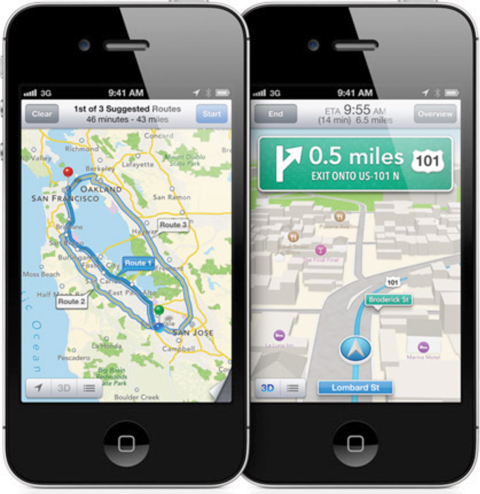
    Smartphones. Apple iOS’s new Maps app will likely be the largest scale crowd-sourced app ever introduced.


    PNDs Out-Smarted

    For the past decade, GPS personal navigation device (PND) sales have burned white-hot. In 2007, Garmin experienced double- and triple-digit growth, selling more than 10 million units. TomTom grew from zero to hero and sold more than 9.5 million units in that same year. During that brief golden era, every consumer electronics company who was anyone took a stab at introducing a PND to get a piece of the action. As unlikely as it seems, Garmin and TomTom stayed on top, fighting off consumer electronic giants like Sony, Panasonic, Hewlett-Packard, and Philips, all orders of magnitude larger. PNDs ruled the GPS world during that era.

    Credit: GPS World
    Download a PDF of our Mobile Computing Product Showcase.

    At the height of that period of explosive GPS PND growth, Apple introduced a new generation of smartphone, the iPhone, in January 2007. At that time, there were approximately 17 million smartphones on the market. Nokia with its Symbian operating system led the pack at 63 percent of worldwide market share, Blackberry was the rising smartphone of choice, while Microsoft Windows Mobile operating system captured 18 percent. Google’s Android operating system had not yet debuted.

    It’s amazing how a mass-market technology, so personal to us all, can change so quickly. Today, Google’s Android operating system dominates the smartphone market (roughly144.4 million smartphones were sold in Q1 alone of 2012, according to Gartner Research) with a 56.1 percent share. Apple’s iOS follows at 22.9 percent; Symbian (Nokia) has fallen from leader to bit player at 8.6 percent, and keeps company in the low rungs with RIM/BlackBerry (6.9 percent), Samsung’s Bada (2.7 percent), and Microsoft Windows (1.9 percent).

    The trend is clear. Android and iOS are cleaning up at the expense of all the others. Is it any coincidence that these two are the ones making the most of their maps and nav? More on this in a moment.

    By the way: every one of the 144.4 million smartphones that shipped in the first three months of 2012, no matter what operating system it ran on, carried a GPS receiver inside, typically a chipset from Broadcom, CSR/SiRF, u-blox, Qualcomm, or Texas Instruments. That spells trouble for Garmin and TomTom. Google and Apple are doing to Garmin and TomTom what Microsoft did to NetScape with Internet Explorer.

    Even with GPS PND prices at an all-time low, Google’s Navigator, with high-quality, PND-like turn-by-turn street navigation, is included on Android smartphones free of charge. Apple is following suit. Just last month, Apple introduced the Maps app for turn-by-turn street navigating as well as real-time traffic information. With more than 100 million iPhones behaving like traffic sensors, Apple’s Maps app will likely be the largest scale crowd-sourced app ever introduced.

    What does this mean to Garmin and TomTom? The numbers don’t lie. In February 2012, TomTom reported a 40 percent decrease in GPS PND sales for Q4 2011 compared to Q4 2010.


    Tablet Computers

    For another wild ride, take a look at the tablet-computer market. The tablet has been around for many years. I remember playing with them in the 1990s when they were horribly expensive ($3,000–$5,000). The price, a limited outdoor-viewable display, and power usage all combined to squash unit sales. Only a few manufacturers such as Fujitsu had the determination to stay. That all changed in 2010 when Apple introduced the iPad.

    Prior to the iPad rollout, tablet computer sales were limited primarily to business users. Healthcare provided a particular arena for Fujitsu and others to focus on, and there were a few other markets that were not very price-sensitive, and so receptive to the tablet. The iPad blew away that $3–5K price point (iPad 2, $629) and brought the tablet experience to the average consumer. The result? Roughly 67 million units sold since its introduction, far surpassing all tablet computer unit sales in history in just two years. Apple hit a sweet spot, for sure.

    The iPad catalyzed the tablet industry for two reasons:

    • It opened the eyes of the consumer to the applications of a tablet computer.
    • It drove the price-point expectation of all tablets down.

    Of course, the iPad has its limitations. It runs Apple’s proprietary operating system, iOS, so you are limited to the number of apps written for that platform. It also lacks horsepower to run more challenging programs that an Intel or AMD-based computer can breeze through. From a GPS/GNSS perspective, certain models of the iPad sport a GNSS chipset (from Broadcom) similar to mobile phones; however, because of the way the GPS functionality is designed into the system, accuracy is limited to a few meters at best. Power GPS/GNSS users would love it if Apple would implement serial port profile (SPP) in its Bluetooth software. Then, GPS/GNSS users could attach any Bluetooth-compliant GPS/GNSS receiver they like, even RTK-capable receivers for centimeter-level accuracy. But Apple doesn’t seem interested.

    As in the mobile-phone market, Google is making a strong tablet play with its Android operating system. Google’s device-agnostic operating system is attracting tablet hardware makers in droves with iPad-like tablet computers, notably Samsung Galaxy (with GPS) and Amazon Kindle Fire (no GPS). Also, there’s an interesting link between mobile phones and tablets. Gartner reports that 40 percent of user apps run on both mobile phones and a corresponding tablet computer. This is significant because the operating system may well drive the tablet purchase. For example, a person with an iPhone is more likely to buy an iPad than a Samsung Galaxy, which runs Google Android.

    However, Android has not achieved the dominance in the tablet computer space that it has in smartphones. iOS (iPad) held 67 percent market share in 2011, falling to 61 percent in 2012,but still retaining the pole position. Android is a strong second with 29 percent in 2011, rising to 32 percent in 2012, according to Gartner. No other operating system even comes close.

    Gartner forecasts show that Android will eventually approach iOS in market share, and my guess is that it will overtake iOS within five years. Apple’s proprietary system will catch up to it. While GPS/GNSS chipsets aren’t as widely integrated in tablets as they are in mobile phones, that will change as GPS/GNSS use becomes even more ubiquitous. Further, there are plenty of ways to add GPS to a non-GPS model via Bluetooth, PCMCIA, and USB.

    Android supports Bluetooth SPP, or a derivation of it, so you can connect any Bluetooth SPP-compliant GPS receiver that you like and not be limited to the receiver chipset the tablet engineer decided to design into the system.

    ]Although PDAs have an embedded receiver, they are lower-precision systems, in the 1- to 5-meter range, largely due to poor antennas. For higher precision requirements, these are used as field data collectors connected to an external antenna and/or a high-precision GPS/GNSS receiver.Handheld PDAs

    Handheld personal digital assistants (PDAs) were all the rage 10 years ago when Compaq Computer Corp. introduced the iPAQ H3100 running Microsoft’s PPC2000 (Pocket PC) operating system, the precursor to Microsoft’s Windows Mobile operating system. The iPAQ made a strong run through 2009, with the last models running Windows Mobile 6 before smartphones became powerful enough to negate the purpose of the PDA.

    While we probably will never see another introduction of a new iPAQ-branded PDA, it was a useful device and an inexpensive handheld for interfacing to GPS/GNSS receivers. Albeit a niche market, there’s still a demand for such handhelds for field data collection.

    According to the nature of capitalism, where there’s a demand, suppliers will show up. Since the iPAQ has faded, and smartphones aren’t yet well-suited as field data-collection devices, a new breed of semi-rugged and rugged PDAs has emerged in the past year from small, niche-oriented companies. Examples include the SXPad from Geneq, Juno 3 series from Trimble, and the Mesa/Rampage 6 from Juniper Systems/SDG Systems.

    These devices, with GPS/GNSS receivers embedded, are not built for the average consumer. Their prices are higher — but coming down — and they are more rugged; some are water-resistant, some waterproof.

    In a nutshell, PDAs went professional, targeting organizations that need maximum data-collection productivity from field personnel. Although they have an embedded receiver, they are lower-precision systems, in the 1- to 5-meter range, largely due to poor antennas. For higher precision requirements, these are used as field data collectors connected via Bluetooth to a high-precision GPS/GNSS receiver.

    Although the professional PDA market is not immune to the operating-system wars we’ve seen in mobile phones and tablet computers, it’s a bit stickier. Professional data-collection apps have been written almost exclusively around the Microsoft Windows Mobile operating system. These niche software programs are written for relatively small audiences (compared to the mass-market apps on smartphones), and it can be economically tough to justify porting the apps to iOS or Android. Therefore, the professional PDA market has been slower in adopting iOS and Android.

    Microsoft hasn’t helped the cause. It stopped certifying new products with the Windows Mobile operating system, creating confusion in the user community. Is Microsoft exiting the mobile device business? Not according to the company. It appears that it has split the mobile device business into two operating systems. Smartphones will run Windows Phone, and other mobile devices will run Windows Embedded Handheld, which is compatible with Windows Mobile.

    The problem, the confusion, and the frustration come from the fact that the Windows Phone operating system is not compatible with Windows Mobile (or Windows Embedded Handheld). Microsoft split the market between smartphones and other Microsoft-driven mobile devices. Given Gartner’s research that 40 percent of users’ smartphone apps also run on a tablet device, this means that Microsoft is going to either change that dynamic or suffer the consequences.

    No matter which direction mobile devices take, be it phone, handheld, or tablets running Android, iOS, Windows, or something we haven’t yet seen, embedded GPS/GNSS functionality will remain the centerpiece of location technology in all mobile devices. Even more exciting are the new GNSS signals and constellations in the next five years that will bring unprecedented accuracy to all mobile devices, driving the development of a tremendous number of new apps to exploit the improving accuracy.


    Eric Gakstatter is contributing editor for survey at GPS World magazine and the editor of Geospatial Solutions. He has spent the past 20 years in the GPS survey/mapping industry, using many brands of GPS equipment and software. He is a non-partisan advocate for the GPS user community, and a frequent speaker at user and technical conferences.

  • Out in Front: The Quick Quid

    Maybe we should take it as validation, an acknowledgment of the worth, maturity, and promise of the GNSS industry, that profiteers show up trying to make a fast buck. A prompt pound, a quick quid.

    Or perhaps we should be angry at this violation of international trust, this grasping effort to monetize the free and open exchange of scientific ideas, this contravention of the very spirit and tradition of global navigation satellite systems and signals.

    For no sooner have we dispatched the LightSquared wolves from our doorstep than others come knocking, saying they are entitled to a fee for something that everyone else has always given away.

    See this editorial from my GNSS Design & Test newsletter for details and background on this controversy.

    Not enough has been made, over the last two and a half decades, of what is arguably the United States’ greatest foreign aid project of all time, a free and open gift to the world: the continuous provision of PNT signals everywhere, at no charge whatsoever to users or to manufacturers incorporating the signals in their offerings. Other GNSS providers have followed suit in being openhanded and largely aboveboard, starting with GLONASS, continuing with a few stutter steps through Galileo, and probably concluding in like fashion with Compass, not to mention QZSS and other regional augmentations.

    But now the United Kingdom’s military and/or a commercial spin-off and/or two scientists funded by same want to fence off an area of the open sky and say “This is ours and you must pay to use it.” Whether the two individuals acted on their own initiative, or were driven to signal-rustling by a strapped military looking to profit from someone else’s investment, or were prodded into adventurism by an overweening veep of sales and IP, we do not know at this point. Keep in mind, this is the same establishment that gave us the Charge of the Light Brigade.

    Was there a man dismay’d ?
    Not tho’ the soldier knew
    Some one had blunder’d:
    Theirs not to make reply,
    Theirs not to reason why,
    Theirs but to do & die.

    One British scientist wrote an open email letter, excerpted here, to members of the international GNSS community:

    “I would like to make it absolutely clear that this patent application has nothing to do with me whatsoever. I was required to work with both of the individuals named on the patent on other projects. However, I have never ever worked on GNSS signal design and certainly do not endorse their patent application in any way. I personally agree with those that consider this patent to be against the spirit of international cooperation under which the interoperable GNSS signals that we all need have been developed.

    “I’m sorry to take up your time. However, my reputation is important to me.”

    Would that others had thought of their reputations, not to mention the effect on the industry that nurtured them, no less the shackling of benefits to all humankind, before taking this step.

  • Letter to the Editor: Automatic Gain Control, Spoofing

    Cover: GPS WorldJust for the record: what is reported in “Detecting False Signals With Automatic Gain Control” (April GPS World) is what we introduced a long time ago and is reflected in one of our videos, and implemented in all of our GNSS receivers. AGC information is one of the four ways, and the least significant way, that we show interferences. There is a big difference between showing something in the laboratory and in some receivers, compared with having technology in mass production that everyone can understand and use.
    — Javad Ashjaee
    JAVAD GNSS, San Jose, California

    Author Dennis Akos replies:
    I am sure JAVAD receivers work quite well to leverage AGC to flag RFI (it was not the survey-grade model I used for the paper, though). The original Nordnav R30 GPS receiver showed both AGC and the L1 frequency spectrum back in 2004. u-blox has an RFI flag in its receiver, which is based on AGC. Others likely do as well.

    In any event, AGC detection of RFI (and you could say spoofing) is not new. I coauthored an ION GPS paper with Bastide and others back in 2003 showing how powerful AGC could be to detect interference. In 1997 Per Enge had a student, Awele Ndili, working with the Plessey chipset, who did something similar, checking the AGC for signs of RFI.

    So when all the hubbub came up about spoofers a couple years back, I tried to flag the question — why be concerned about this? AGC can tell when more power is coming in the frequency band and thus flag RFI or spoofing is happening. So spoofing is no more of a threat than simple jamming, should one be concerned about it and make a relatively small effort to check for it.

    I was quite impressed with the spoofer design Humphreys/Psiaki/Ledvina came up with (“Straight Talk on Anti-Spoofing,” January 2011, and “Assessing the Spoofing Threat,” January 2009). Quite neat, needs very little additional energy with the lift and carry-off approach. But also very hard to leverage for any dynamic case where the victim receiver did not want to be spoofed (spoofing a dynamic receiver with the approach? Doable, but really hard, and would still inject more RF energy). So it left the threat, in my mind, to those who are being monitored and want to spoof their device: very small subset — the fisherman in illegal waters, the prisoner with ankle monitoring. This is the hardest detection case, but I am still fairly confident AGC can work here.

    Main motivation for the article: I was troubled that I did not see the need for folks to be up in arms any more about spoofing than plain old jamming.

    Again, my premise: in the great majority of cases spoofing is easily detected using technology already in a majority of receivers, making it no worse than jamming, and the harder cases should still be detectable with additional effort/sensors. But it is important for all to remain vigilant, as these AGC-based techniques do need to be implemented/leveraged to avert the spoofing threat — and Humphreys/Psiaki/Ledvina deserve credit for bringing this potential to light. Even with successful spoofing detection it will appear as much less sophisticated jamming, not allowing the receiver to obtain position/time information.

    So that is why I worked with the Swedes to try and show this and get that message out. It would have been great to test with one of the more sophisticated jammers (perhaps will have a chance to do so with an upcoming test), but I did not have one, so we just did simple repeater jamming.

    I am glad Javad is preaching the same message. It would be great to see him to more widely disseminate that message and put much of these concerns to rest.

    Regarding the video: Thanks, Javad. Really some nice features. I need to get a TRIUMPH-VS or two here at Colorado University to work with. Quite curious as to the sensitivity of the AGC. But the receiver has a great feature set!

    One quick comment. In the video where you tested the RX with the jammer — I might go back and qualify that indicated you did the test under controlled/allowed conditions. I recall we published an GPS RFI test back about 10 years ago, and we had some official inquires for more details on the testing and why we were broadcasting in the GPS band. No idea how/where you did your testing (assuming 746th Jamfest or similar), but unless you state otherwise, it might bring some unwelcome attention.

  • LightSquared and Another FCC Issue You Should Be Aware of

    Although the LightSquared issue seems to have waned, it’s like a virus in that it’s really difficult to erradicate it completely. However, Harbinger Capital Partners (LightSquared’s primary financial backer) and LightSquared are facing tougher problems than they have since they’ve started this adventure, not only from their technical foes but now from the U.S. Securities and Exchange Commission (SEC).

    Earlier this week, the SEC filed fraud charges against Phil Falcone and Harbinger. In particular, the SEC alleges that:

    • Falcone fraudulently obtained $113.2 million from a hedge fund that he advised and misappropriated the proceeds to pay his personal taxes;
    • Falcone and two Harbinger investment managers through which Falcone operated manipulated the price and availability of a series of distressed high-yield bonds by engaging in an illegal “short squeeze;”
    • Falcone and Harbinger secretly offered and granted favorable redemption and liquidity rights to certain strategically-important investors in exchange for those investors’ consent to restrict redemption rights of other fund investors, and concealed the arrangement from the fund’s directors and investors; and
    • Harbinger engaged in illegal trades in connection with the purchase of common stock in three public offerings after having sold the same securities short during a restricted period.

    “Not only are hedge fund managers expected to be savvy investors, they are supposed to serve the interests of their clients. Here, in addition to raiding a fund for personal benefit and cutting secret deals with favored investors, Falcone then lied to investors about what he had done,” said Bruce Karpati, Chief of the Asset Management Unit in the SEC’s Division of Enforcement.

    This follows a civil lawsuit filed on February 17, 2012 by Harbinger investors, claiming Breach of Fudiciary Duty, Gross Negligence, Breach of Contract, and Fraud.

    It also follows LightSquared filing Chapter 11 bankruptcy on May 14, 2012.

    Yes, it’s getting ugly. However, they aren’t giving up. I wouldn’t expect so after spending ~$4 billion on this project.

    LightSquared’s latest proposal to the Federal Communications Commission (FCC) is a spectrum swap. Read the details of their proposal here. In fact, LightSquared was able to convince a group of your legislators to lobby the FCC in support of the spectrum swap.

    “In the absence of a viable technical solution that would allow LightSquared to use its own licensed spectrum, we believe a spectrum swap is the most resourceful and efficient way to quickly expand broadband access nationwide,” wrote Reps. Jim Moran (D-Va.), Maurice Hinchey (D-N.Y.), Steve Rothman (D-N.J.), Rodney Alexander (R-La.) and Ander Crenshaw (R-Fla.), who all serve on the Appropriations Committee.

    Seriously? Our own U.S. legislators want to trade for spectrum worth almost nothing for spectrum worth billions of dollars? Who’s side are these people on? Clearly, not the taxpayer. However, there’s little or no chance a spectrum swap is going to happen. It’s a dream that they ran up the flagpole so see who would salute it. I doubt anyone did, at least anyone of significant influence, and now the legislators can say they fulfilled their obligations (in exchange for ??) and no harm done.

    Serious Technical Issues Still Exist

    Aside from the serious financial, legal, and political challenges LightSquared faces, they are no closer to solving the GPS interference problems disclosed a year ago.

    If you recall, the National Telcommunications and Information Administration (NTIA), a U.S. government agency tasked by the FCC to study the LightSquared/GPS interference issue, concluded:

    “The federal agencies and LightSquared have invested significant time and resources to identify and analyze proposed solutions to address the impact of LightSquared’s planmned network implementations. Based on the testing and analyses conducted to date, as well as numerous discussions with LightSquared, it is clear that LightSquared’s proposed implementation plans, including operations in the lower 10MHz would impact both general/personal navigation and certified aviation GPS receivers. We conclude at this time that there are no mitigation strategies that both solve the interference issues and provide LightSquared with an adequate commercial network deployment.”

    That pretty much says it all. While the “lower 10” the NTIA is likely a technically solvable problem, the cost of redesigning and redeploying GPS receivers across commercial, military, aviation, etc. markets to accomodate the lower 10 MHz is huge. It’s likely in the high tens of billions or even into the hundreds of billions.

    The upper 10 MHz of LightSquared’s spectrum, there is no practical technical solution that exists. If there was one, even one that was close, LightSquared would be talking about it all day long. You can bet that many engineers from many different companies and agencies have been working to solve this technical problem since early last year, but no one has come up with any reasonable solution yet. Also, remember that the upper 10 MHz hammered the vast majority of all GPS receivers in existence, not just high-precision receivers.

    The Way Forward

    Without a technical solution to their GPS interference problem, LightSquared is stuck trying to convince regulators that it deserves to be gifted alternative spectrum since they couldn’t make theirs work. As I wrote earlier, I think the possibility of a spectrum swap is low, but the conversation may linger.

    From now on, it’s clear that the technical discussion has disappeared. It’s turning into a pure political discussion. Even though the FCC received the NTIA’s recommendation to not allow LightSquared to proceed back in February, the FCC still hasn’t declared a ruling on anything regarding this matter. Some speculate that they won’t make a ruling before the U.S. presidential election this coming November in order to fly under the radar. For this reason, it would not be surprising to me if this issue hung in limbo for the rest of the year; dormant, but it’s still lurking, like a virus.

    Last Monday, June 25, 2012, I was a guest on America’s Web Radio’s ACSM Radio Hour discussing the current LightSquared situation. It’s a good discussion (60 minutes). The podcast is a standard audio recording you can play on your MP3 player or listen to on your computer. You can download it here.

    FCC Narrowbanding Rule

    While we’re on the subject of the FCC, you might have heard about the Narrowbanding rule the FCC established some years ago. It’s going to kick in January 1, 2013. If you’re an RTK user who uses UHF or VHF radios, you’re likely going to be affected and should be aware of it. Following is a summary statement from the FCC:

    “On January 1, 2013, all public safety and business industrial land mobile radio systems operating in the 150-512 MHz radio bands must cease operating using 25 kHz efficiency technology, and begin operating using at least 12.5 kHz efficiency technology. This deadline is the result of an FCC effort that began almost two decades ago to ensure more efficient use of the spectrum and greater spectrum access for public safety and non-public safety users. Migration to 12.5 kHz efficiency technology (once referred to as Refarming, but now referred to as Narrowbanding) will allow the creation of additional channel capacity within the same radio spectrum, and support more users.

    After January 1, 2013, licensees not operating at 12.5 KHz efficiency will be in violation of the Commission’s rules and could be subject to FCC enforcement action, which may include admonishment, monetary fines, or loss of license.”

    Essentially, the FCC is trying to increase the efficiency of the UHF and VHF radio spectrum so it can accomodate more users.

    If you use UHF or VHF radios for RTK, you’ll likely need to upgrade or replace your UHF/VHF radio hardware. Be aware that this could be quite expensive.

    Following are some relevant FCC documents on the matter:

    May 13, 2008 Fourth Memorandum Opinion and Order

    January 5, 2012 Reminder from FCC Regarding Narrowbanding Transition

    February 21, 2012 FCC Provides Supplemental Guidance For Licensees In The 150-174 MHz and 421-512 MHz Bands Seeking Waivers Of The Narrowbanding Deadline

    Following is a link to a page on Pacific Crest’s website regarding narrowbanding transition:

    The FCC’s Narrowbanding Regulations

    April 30, 2012 Pacific Crest Letter “Applying for a 25kHz FCC License”

    Look for more from me on this subject soon as the deadline is looming.

    Thanks, and see you next time.

    Follow me on Twitter

  • The Patent Brouhaha

    Two British technologists backed by the U.K. Ministry of Defense have filed patents on the future interoperable GPS and Galileo signal designs that severely disrupt modernization plans for both systems and suddenly, unexpectedly place receiver manufacturers in a highly uncertain and unfavorable situation. Some of the patents have been granted in the U.K. and in Europe, and applications are pending in U.S. patent court, with a ruling expected at any time.

    Companies in the United States and outside the country are being approached and asked to pay royalties, on the basis of the patent filings, for use of the European E1 Open Service signal and the modernized GPS L1C signal. Should such initiatives prevail, costs would presumably be passed along to end users of GPS and Galileo — the same taxpayers who have already paid once for the systems.

    The purveyor of the royalty solicitations is Jim Ashe, vice president for sales and intellectual property at Ploughshare Innovations Ltd., Hampshire, UK. The patents, if successfully used to collect fees from satellite manufacturers or receiver manufacturers, would have a chilling effect on the use of the new interoperable signals that all parties have labored so hard, for so long, to design. They could quite possibly lead to a return to a BOC(1,1) structure for these signals, losing the benefits of MBOC.

    “There’s quite an argument going on,” said one person familiar with the controversy. “Some of the methods of arguing have not been too kind.”

    The Background. A great deal of work was accomplished cooperatively between the United States and the European Union (EU) to develop the landmark 2004 signal agreement that emerged from the Galileo Signal Task Force, formalizing cooperation on satellite navigation between the United States and more than two dozen European countries, including the U.K. Part of that agreement concerned a common signal structure (spectrum) for the civilian signals for both the E1 Open Service (OS) signal — the Galileo equivalent of GPS L1 — and the new U.S. GPS L1C signal to be implemented on the GPS III satellites, coming as early as 2015.

    The EU said during that process, in effect, “Even though we have agreed on this, Europe wants to be able to optimize the E1 OS signal beyond the agreement on that civilian signal being a binary offset carrier BOC(1,1) signal.” Both international entities had agreed that would be the waveform or the spectrum of the new signal.

    The Europeans began to evaluate methods of optimizing their signal. They had some designs called composite binary coded symbols (CBCS), a mechanism of putting a higher frequency componenent into the signal structure, and also a version called CBCS*, meaning that they found there was a bias generated by that extra signal, and so they had to invert every other one of its repetitions.

    The signal structure that they were playing with was centered on a plus and a minus 5-MHz component. (Actually five times 1.023, because of the inherent clock of GPS, you can think of it as 1.023 MHz. Everyone in doing compatible or interoperable signals agreed upon that; when reference is made to 5 or 10 MHz, or an even 5 or an even 10, it means that number multiplied by 1.023).

    The Europeans were were putting an additional BOC signal on top of the BOC 1,1, and it would have plus or minus 5 MHz as the centers of those two BOC peaks, and then some kind of waveform to modulate that.

    The United States pushed back against that to some degree, and proposed adoption of the so-called MBOC waveform, in which case the U.S. signal was equally optimized with a concept called time-multiplexed BOC (TMBOC). The Europeans used the CBOC approach. So, very different ways of doing this. In the European way, they transmitted a continuous but very low-power BOC(6,1) term. The U.S approach transmits four BOC(6,1) chips out of every 33 chips of code (see “Future Wave” sidebar).

    A chip in this case means a part of the spreading code, so each signal has its spreading codes, just like the C/A code is a spreading code, meaning a pseudorandom code modulating the carrier. L1C and E1 OS have a pseudorandom spreading code.

    The U.S. approach does not put BOC(6,1) components onto the data; that’s what is commonly called MBOC. The U.S. approach is TMBOC, on the pilot carrier only, not on the data component. The European system is like two separate signals, the BOC(1,1) signal having both pilot and data, and a BOC(6,1) signal having both pilot and data. They’ve put the (6,1) into both data and pilot components.

    Cue the Antagonists. Part of the task force from Europe and the United States considering the future signals’ make-up were Tony Pratt and John Owen, who works for the U.K. Ministry of Defense and whose office sponsored Pratt’s work. The two participated heavily in all these signal discussions. They stated in early meetings they planned to file patents in some areas.

    “Frankly,” states one source, “people should have paid more attention when they said that, and asked ‘What do you mean, and how’s it going to work, etcetera?’ And secondly, there probably should have been a written agreement between parties that nobody will take advantage or patent any of these ideas that we are developing.”

    Pratt and Owen filed a number of patents domestically, in the U.K., and and in the European Union, in 2003 and in 2006, and in other places around the world, such as Japan, Canada, and in the United States as well. Some of the U.K. and European patents have been granted. The first of some of those U.S. patents may be issued in the near future.

    The original patent filings were later amended to include new claims. The new claims were much more specifically oriented toward TMBOC and CBOC, whereas the original claims were more generally oriented toward modulated methods. The claims have been modified over the years; this is fairly standard patent practice.

    As a result, the original 2003 patent doesn’t necessarily read on a particular signal, but its early filing date has precedence. The claims have been updated and modified, and if the patent office issues those, as a true patent, then the new claims apply. Plenty of big patent battles have been fought over just such issues.

    Once the patent is issued, a satellite or receiver  manufacturer must assume that it is valid, and has only two responses to make, other than acquiescing to royalty claims. The manufacturer can either say, if building a product, “No, my product does not infringe, and I will prove that it doesn’t.’” The other choice for manufacturers is to go back into the patent office and sue the patent filer (and grantee) in the patent courts and prove that the patent was invalid in the first place that the patentee should not have been granted it.

    The United States and others were taken off-guard when the U.K. company Ploughshare, which is owned and controlled by a part of the British MoD called Defense Science and Technology Laboratory (DSTL), started making claims on manufacturers. The DSTL is similar to the U.S. Defense Advance Research Products Agency (DARPA), which is credited with inventing the Internet. If taxpayer money goes into something new and interesting, it is considered in some circles legitimate to file patents on those and attempt to recover taxpayer money through royalties on that taxpayer investment. That concept is not being challenged. Questions as to whether the patents are legitimate are very much in discussion.

    Ploughshare has contacted companies, saying, “If you use these signals coming from either the European satellites or the U.S. satellites, we will go after companies using these signals.” There are different patents issued, one by the European Patent Office, applying to most of the EU countries, that applies directly to the TMBOC signal, the E1 OS signal, and possibly also to Europe’s E5 signal, which is E5a and E5b; and there is also a patent for GPS III, the L1C signal.

    The Devil. For details on the various patents, see Application 10594128 and Application 12305401. See also European patent specification EP 1 664 827 B1, and International Application WO2007/148081. These are examples; there are other applications as well. It is to be argued in some future court as to how those patents are to be interpreted.

    “If you take the patent that hits TMBOC, and you take the broadest possible interpretation of that patent against receiver companies, it says: if you bring into your antenna and process that signal, whether you use all parts of it or not, for instance if you use the BOC(1,1) and not the BOC(6,1) part — then you infringe the patent. Others argue that if you don’t use both components, you don’t infringe.

    “But the claim is written broadly enough that it would apply to any receiver receiving and processing the signal. Nobody says what processing means. The patent says if you receive and process the TMBOC signal, as defined in the prior claim, you infringe the patent.

    “There is confusion as to whether that will apply or not apply — some people expect that it doesn’t and some people think that it might. That’s up in the air.”

    George Is Getting Upset. Various factions in the United States are upset by and trying to figure out what to do about the impasse. From a government point of view, there are three paths that the U.S. government can follow:

    • Put pressure on the U.K. diplomatically. That would be up to the State Department to put pressure on the EU or the U.K. in particular. The EU and the continental Europeans are equally furious at the British for doing this, as far as parties in the U.S. understand. This can’t be stated as a fact but is widely understood and thought to be the case. The diplomatic approach has its limits, obviously.
    • Go into Europe and fight the patents in European patent court and try to prove them invalid, to invalidate the patents. Companies could do the same thing, go into various courts, whether they be U.S. or European or Japanese, and say: “Our receivers don’t infringe,” and then have to prove that to the court; or say “The whole patent should not have been allowed, and I’ll fight the legitimacy of the patent.”
    • Some believe — and there is controversy and anger on this point — that, just as Galileo’s IOV satellites have the capability to transmit without the BOC(6,1) component, the United States should be able to do that with the GPS III satellites as well. Because if the signal is not there, and if the receivers are therefore not designed to process the signals that are not there, then the patent no longer has any relevance.

    “If we are to turn off the BOC(6,1) term for a period of time until the legal or diplomatic or other approaches worked, then we would be able to turn the BOC(6,10) term back on again, and return to the original agreed MBOC and TMBOC signals. That requires some coordination between the United States and Europe, and it requires some work to make that possible in the GPS III satellites, putting a switch in the GPS III satellites to permit the operators to turn that (6,1)BOC on and off. This is being hotly debated.”

    Some parties object, stating that L1C is too important a signal to mess with, and this proposal runs the risk of slowing down the program, and/or making it more expensive. They believe strongly that the off/on switch is not the best or most far-sighted option: why should the United States be forced to change its signal design due to an illegitimate patent, and in the end wind up with a less capable system?

    It is not publicly known whether the Air Force is or is not looking into that option.

    During the week of June 25 there was Working Group-A meeting in Washington D.C. followed by a plenary meeting between the EU and United States. The patent controversy was presumably discussed in some fashion, but whether formally addressed or lurking in the background is unknown at this time.

    “There is some naivete around this,” said the magazine’s soure. “It’s a serious threat. People think maybe they’ll only go after the high-end receivers, and maybe the royalties won’t be so bad. Ploughshare is trying to lull people into a false sense of security. The impact of this will be great unless it is defeated.”


    Future Wave

    Excerpted from the “Future Wave” article on L1C, GPS World, April 2011:

    “The L1C waveform originally was to have been a pure BOC(1,1) (a 1.023 MHz square wave modulated by a 1.023 MHz spreading code). Negotiations between the U.S. and the European Union (EU) at that time resulted in an agreement that both GPS and Galileo would use a baseline BOC(1,1) signal. However, the EU reserved the right to further optimize their signal within certain bounds. Some of the optimization proposals were known as CBCS and CBCS*. However, in further EU/US discussions it was decided that L1C and the Galileo E1 open service signal should have identically the same spectrum. This was a significant challenge because of different baseline signal structures and existing designs.

    “The breakthrough came when [U.S. representative] John Betz proposed what is called MBOC. The MBOC waveform has 10/11th of its power in BOC(1,1) and 1/11th in BOC(6,1). However, L1C and E1 OS achieve this result in very different ways. The Galileo technique is called CBOC. The GPS technique is called TMBOC. Whereas Galileo has a 50/50 power split between pilot and data and includes the BOC(6,1) component in each, GPS includes the BOC(6,1) waveform only in the pilot component by modulating four of every 33 spreading code chips with a 6 MHz square wave and 31 chips with a 1 MHz square wave. With 75 percent of the power in the pilot, the result is 3/4 x 4/33 or 1/11, as required. It is likely the BOC(6,1) signal component will be ignored by consumer-grade GNSS receivers where a narrow RF bandwidth is preferred. Fortunately that is a loss of only 12 percent (0.56 dB) of the L1C pilot power. However, for commercial and professional grade receivers, the extra waveform transitions (wider Gabor bandwidth) can be used to improve code tracking signal-to-noise ratio, and with certain advanced techniques it should be possible to improve multipath mitigation. This final point depends on careful control or calibration of the transmitted code timing and symmetry.”

  • Mapping Upheavals, Indoor Location Headway, FCC on LBS Privacy

    Big changes. Apple finally ended its long time dependence on Google Maps. As part of its latest operating system upgrade to iOS 6, Apple is launching its own, home-grown mapping service. It is an impressive offering. In a very different move, Microsoft is replacing its own Bing maps in all Windows Phone devices. Nokia maps, previously Navteq, will replace Microsoft’s home-grown Bing Maps. Micello has a new indoor location trial that isn’t just indoor mapping. This month the FCC has something to say on the topic of privacy in LBS apps. ABI Research has high expectations for indoor location.

    Google maps will be demoted to just another app on iPhones and iPads, a blow to Google’s bottom line. iOS device owners account for 28 percent of Google Map users in the U.S., U.K., France, Germany, and Spain, reports Analysis Mason. This parting will create additional friction in the contentious relationship between Google and Apple. Many partners are helping Apple produce the offering, but TomTom is the only one acknowledged in the announcement. Apple reports TomTom is “powering Apple maps.” No explanation has been given.

    The new Apple in-house maps built for iOS 6 include 100 million business listings and Yelp recommendations, integrated with real-time, crowd-sourced traffic, navigation, and suggested travel routes. It all works with Siri, Apple’s voice-activated search software. Siri has its critics, including Apple co-founder Steve Wozniak who has been quoted with derisive, even crude, comments on Siri’s usability.

    Will Location Move Stock Price? Facebook says it’s working on a location-based mobile-advertising product that will allow advertisers to target users based on their real-time whereabouts. Facebook’s shares have dropped by almost 20 percent since the company’s initial public offering, fueled partly by concern that ad-revenue growth isn’t keeping up with a shift by users to mobile phones.

    LBS Is Being Monitored. Ever concerned with privacy, the FCC released a report on location-based services. The agency declined to adopt privacy regulations or best practices, but indicated it would monitor the industry for the following: ensuring privacy considerations are integral to product development, security of data from unauthorized access, timing and frequency of location privacy notices to consumers, and minimization of data collected and time period for which it is retained. The FCC warns it will take additional steps if not satisfied with privacy implementation for LBS.

    Indoor Fortunes. Indoor location is positioned to save retail brick and mortar, says ABI Research. I wouldn’t go that far, but it will certainly have a positive impact. Major U.S. retail brands will launch indoor location technologies in 2012 and 2013, says ABI. “Revenue will come from multiple sources, including advertising, infrastructure deployment/service fees, and application management,” says Patrick Connolly. The technology will enable advances in customer analytics, proximity advertising, store optimization, couponing, and CRM. Retailers will likely want to control store data, which will be an important consideration in picking partners.

    I Am Here. Micello, indoor mapping creator, has a trial for its new FindMe location application. Users can share their whereabouts in Singapore with anyone in their address book. The app allows users to send a text that includes a detailed map that shows the user’s indoor location. The company is expanding the app to Las Vegas and some college campuses.

    Grapevine. Rumors persist that Amazon is in talks to acquire Jumptap, one of the mobile advertising network leaders. Amazon plans to enlarge its Special Offers advertising platform to the Kindle Fire Tablet, a competitor to Apple’s pricier iPad, reports Ad Age. A Jumptap purchase would make sense. Amazon has a treasure trove of purchase information on individual users on hand that can be used to develop personalized and contextual mobile advertising.

    Timing Is Everything. In Apple’s forthcoming operating system update, all applications will require explicit user permission before accessing personal information, such as location information. Apple made the announcement just after developer Arun Thampi reported iOS social application Path was uploading users’ address books to its servers. A backlash from consumers and legislators followed. Path later acknowledged storing user data and updated its app to enable users to opt out of its contacts database.

    Sad News. Sorry to hear Nokia plans to cut 10,000 jobs by the end of 2013. Remember when Navteq had the mapping world in the palm of its hand? What a fall. Last year Nokia cut 14,000 jobs.

  • New Offerings and Retarded Growth

    NEW ORLEANS — CTIA was both about new offerings and the issues retarding industry growth. The hyper local mobile advertising contingency proclaimed 2012 as the year of its breakthrough. Indoor location companies hoped that 2012 would be their year. Although the car manufacturers didn’t exhibit, mobile apps for the connected vehicle were prominent. Mobile wallet and safety apps were hot. The connected home raised its hopeful head once again. Winning back consumers’ trust that their privacy would be safeguarded, including location information, was acknowledged as standing in the way of deeper, more personalized offerings. Carriers sounded alarms about running out of spectrum to support ballooning mobile data consumption.

    Industry leaders provided their perspectives on where our industry is headed:

    “The reputation of our industry has dropped to the lowest of any major industry. Even the cable and oil industries rate higher with consumers than we do. That’s a bummer.” Dan Hesse, Sprint Nextel

    “We are waiting for the Steve Jobs of automotive. We need a platform that lets apps run with zero friction. Jobs listened to consumers; we need that for connectivity to the vehicle.” Alon Atsmon, iOnRoad Technologies

    “In two years we will see more vehicle connectivity, indoor location, and mobile based advertising. We are not pursuing indoor location now, but it is on our radar. In the future we will see incremental map updates. Map updates are now done on a country or state basis. We can’t yet pull out a tile of the map and just update it.” Darianna Gessner, TomTom

    “There will be advances in location accuracy, reliability, ubiquity and indoor position. We will see a more connected infotainment system in the vehicle­. It will connect to the vehicle and make phone calls, provide safety and security, understand proximity, and give lane guidance.” Brian MacLeod, Trimble

    “Companies need to be concerned about monetization, distribution, and functionality. Some companies are putting money into developing apps when it doesn’t make sense, and they don’t need to be in an app store. The Financial Times pulled their app out of the app store, because they no longer wanted to share the revenue.” Todd Simpson, Mozilla

    How would you like to pay for that? The credit card companies, carriers, and Google are vigorously vying for best market position in the mobile payment industry. Has Ralph de la Vega of AT&T found a new reality plane? During a keynote, he predicted that mobile payments would replace the wallet by next year. With public concerns about privacy and security, a shift needs to occur in the U.S. before it will be widely adopted. Strong, simple, and convincing privacy controls that win consumers’ trust will the first step.

    Location Protects Location Labs is the provider of the Sprint “Safely Bundle,” which offers families a way to monitor or restrict their phone-carrying children through location checks and limits on texting, such as while driving or at school. “We are working on developing a way to offer geo-fencing,” says Tasso Roumeliotis of Location Labs. “The challenge is that continuous location checks drain a phone battery greatly.” The goal is always-on location. Geo-fencing has long been used for asset tracking in devices that draw power from the car battery.

    Eye on the Road. iOnRoad showed off its clever driver assistance app and came away with the show’s Mobile Application Automotive Driving and Transportation prize. A cell phone, placed in a dashboard mount, provides a forward collision warning by monitoring the distance to the vehicle ahead. It also provides a lane departure warning if the vehicle is traveling over 37 mph and the wheel touches a solid line (not dotted line). The product is being sold for $4.99, a one-time license fee.

    CTIA Reveals. TechnoCom has launched a new division dedicated to the LocationSmart platform, a location integration solution. “This cloud-based location and messaging service adds device location awareness to enterprise and consumer applications,” says Mario Proietti of TechnoCom. “It is a cross-carrier platform for location and messaging.” Asked for his perceptions of CTIA, Proietti summed it up as the year of the credit-card companies (mobile payment), mobile solutions for in-car experience, and swarms of booth babes. I would like to see new product reveals, not skin.”

    Lost? How far can Hertz NeverLost go without expanding its market beyond their rental cars?  Hertz was at CTIA showing off expanded city guides that will provide enhancements to their users. When asked if they had plans to enlarge their market beyond customers of their rental fleets, Linda Senigaglia of Hertz seemed surprised by the question, and asserted that their play is solely with Hertz customers. Ouch.

    Sprint Mobile Ad Policy. Sprint Nextel plans to introduce a new mobile advertising privacy policy that it will distribute to all new subscribers, allowing them to opt-out of services. Sprint reported that an independent third party would audit Sprint’s compliance. “We must ensure customers are fully informed of our data collection practices,” explained Dan Hesse of Sprint. “As an industry, we’ve got to work together to get this right.” Hesse has previously called for stricter guidelines on driving while using cell phones and for the use of renewable and reusable materials.

    Spectrum Shortage. Verizon Wireless and T-Mobile executives complained that the future of data use is at risk if more spectrum isn’t put to use. FCC Chairman Julius Genachowski defended the agency’s decision to block the AT&T T-Mobile deal with a rejoinder about spectrum shortage. “Some have argued that transactions — let’s be frank, one transaction — is somehow causing a shortage,” said Genachowski. “But the overall amount of spectrum hasn’t changed.” While this is true, spectrum is a concern. CTIA reports that U.S mobile data traffic surged 123 percent in 2011.

    Rumors. The grapevine is buzzing with rumors that Deutsche Telekom is in talks with MetroPCS about combining with T-Mobile. Sanford Bernstein’s Craig Moffett had a field day with the possibility, “Oh, my, what an ugly baby,” he writes. Bloomberg reports that MetroPCS is in discussion with other partners as well.

    At the movies. Have you seen the fabulous new Norwegian thriller Headhunters? Spoiler alert: the main character is tracked via nano-sized location devices smeared somewhere on his body.   See the movie to find out where.

  • Google Enhances 3D Maps: Is It Enough To Keep Competitors at Bay?

    Kevin Dennehy
    Kevin Dennehy

    Google’s recent announcement that it plans to enhance its 3D maps on the Android platform was seen as a preemptive strike against Apple, which is planning a similar announcement. In other recent news, some analysts and trade press are saying Verizon is paying way too much for Hughes Telematics. All of this is making for an interesting summer for the location industry.


    Google recently demonstrated new 3D capability for Google Earth, in a move that some say preempted a similar announcement by Apple, which will roll out its own product at our deadline during the Worldwide Developers Conference.

    While Apple is set to announce its own version of a mapping program for iOS that does not use Google Maps, some in the industry are wondering if the 3D capability is enough for developers to stay with Google, particularly with the fees the company is charging high-volume users. The big winner in the Apple announcement was TomTom, which has signed a global agreement with Apple for maps and related information. No further details of the agreement will be provided, the company said.

    In terms of upstaging Apple via 3D, one company executive thinks that is overblown. “I don’t think Google was trying to do that directly on just that feature. I think they are very concerned about the Apple announcement — not just because they will lose Apple as a customer, they will, but because they fear a ‘wow’ factor upstaging them despite all the great work [Google] has done to date,” said Kim Fennell, deCarta president and CEO. “Their press conference last week was more about reminding everyone how hard it is to do this stuff really well, and I think they wanted to remind Apple, and the market, it takes a lot do the complete mapping solution really well. I think their Google Earth capabilities with street views and their new 3D modeling is a major investment and they wanted to set the overall bar high for Apple.”

    DeCarta says half of its new developers are coming from Google Maps. The company says that, in the last 90 days, 488 new companies have signed up to its developer’s program.

    In a white paper, de Carta says:  “The timing of this surge confirms that Google is no longer seen as the ‘Benevolent Provider of Free Stuff’ that it once was. What is more surprising is that not all of the companies jumping ship are big guys…in fact some are not even close to the 25,000/day map threshold that Google uses to trigger the hounds.”

    The company contends that there is a common theme that developers want to work within clearly defined partnerships, how much they will need to pay, and whether or not they can execute their business model — especially if that involves advertising. “They want to create some differentiation and most of all, they want to know whether or not their partner will one day decide to compete with them,” the company white paper says. This restriction trickles down to real estate, travel, local search, and other sites, the company says.

    Fennell said deCarta started working with Google competitor OpenStreetMap in 2009 when it was early in the market and there were almost no takers.  “We were too early, the market wasn’t really looking for an alternative yet — and the map data quality wasn’t good enough. Three years later, it is looking much more interesting both from supply (map data availability) and demand (customer interest),” he said.

    Verizon’s Purchase of Hughes Telematics a Financial Reach?

    To strengthen its presence in the machine-to-machine and connected car market, Verizon Communications said it plans to buy Atlanta-based Hughes Telematics Inc. for $612 million, or $12 per share. The high price has some analysts scratching their heads — particularly because Hughes was trading at only $4.35 per share the day the deal was announced.

    Hughes Telematics, which competes with OnStar, began to provide LBS, connected safety and convenience services to Mercedes-Benz customers in 2009.

    “I was frankly surprised at the valuation considering HTI’s financial position. I assume Verizon sees a lot of value in the Mercedes account and potential value in HTI’s VW account — and at least one other OEM account which they are expected to get,” said Clem Driscoll, president of CJ Driscoll Associates.  “I think it is also clear that Verizon’s plans called for increasing its role in telematics through acquisition of a telematics service provider. A previous attempt at a TSP acquisition was unsuccessful. HTI clearly has some good technology, as evidenced by the Mercedes Mbrace solution.”

    Driscoll said that Hughes Telematics’ financial problems probably discouraged some auto OEMs from using them in the past, but those issues should now be resolved.

    The Verizon-Hughes Telematics acquisition is expected to close in the third quarter. Verizon plans to retain Hughes Telematics’ management, operate the company as a subsidiary of its Verizon Enterprise Solutions group, and keep the company headquartered in Atlanta.

    ITS America Holds Small Annual Meeting — Why?

    It isn’t big news that private companies still court government contracts and attend the ITS America Annual meeting in Washington to work on connected vehicle committees. However, this is the first time I’ve covered this conference, and I’ve attended off-and-on since 1993, to notice attendance has reached the point that only a few die-hard private sector companies are going to this government-focused meeting.

    Remember, the ITS America meeting was the only game in town in the 1990s and early 2000s, with two of the dominant players at that time, Navteq and Etak (later to be purchased by Tele Atlas) anchoring a growing navigation and location industry.

    Instead of ITS America dominating the entire connected vehicle conference market, most private companies choose to attend the pricier Telematics Update Detroit meeting. What made the meeting more disappointing is the fact that ITS America does attempt to focus on the connected vehicle. The U.S. Transportation Department invited delegates and the press to a connected vehicle demonstration with Ford, General Motors, and Toyota, among other team members. The demonstration highlights this summer’s testing of 3,000 vehicles, which will test crash-avoidance technologies in Ann Arbor, Michigan, in a year-long government program.

    Still, some companies attended such as Inrix, Beat the Traffic, and TomTom. The Virginia Transportation Department is partnering with TomTom to analyze where travelers entered and exited the I-95/I-64 corridor.

    Some companies are getting ITS grants, such as Xerox, which grabbed $15 million from the U.S. DOT for a pilot program incorporating real-time parking guidance systems, among other projects. These parking systems, using smartphone apps from Streetline, enable motorists to view spaces based on price, location, and real-time availability.

    Simulators Keeping LBS Companies on Target

    Spirent Communications, which is monitoring the popularity of LBS, said its new GNSS simulator supports simulation of signals from individual or combined GPS/SBAS, GLONASS, and Galileo constellations, with eight satellites per constellation.

    The company, which said it recognizes the increase in LBS’ momentum and the market need for improved positioning performance on mobile devices, has expanded its LBS LTE test product to support an LTE Positioning Protocol and Observed Time Difference of Arrival. The company says both are critical enablers for LBS adoption.

  • NIST and Metrology

    I must govern the clock, not be governed by it.
    — Golda Meir

    The Question

    A few months ago at a speaking engagement, I took questions from the audience after my presentation. The audience was made up of GPS enthusiasts, GPS equipment vendors, and evidently GPS neophytes as well, because the last question was asked by a young lady, from a large well known government user segment, who was intrigued by but obviously knew little about the inner workings of GPS. Her question so stunned me and the audience that it brought the questions to an abrupt end. Thank goodness no one actually laughed out loud, and frankly I was so incredulous that I almost gave an impertinent answer that would not have served any purpose other than to embarrass the young lady and expose some insensitivity on my part. No, fortunately, after recovering from the initial shock due to the naiveté of the question, I answered her with a straight face, because it seemed to be an honest and sincere question.

    Allow me to set the stage. My talk was on the Perfect Handheld GPS Transceiver and how the PHGPST could be aided by a Symmetricom Chip Scale Atomic Clock (CSAC).

    The young lady’s comment and eventual question was exactly as follows: “I came here this afternoon because I was intrigued by your columns in GPS World and I wanted to know more about the Perfect Handheld GPS Transceiver and possibly learn how I could even purchase one or more for my organization. However, most of your comments have been focused on the benefits of atomic clocks. Frankly, I am a bit disappointed. So where can I buy a PHGPST and what do atomic clocks have to do with GPS anyway?”

    Retrospective

    I have had a few months to think about that episode, and although all ended well, with no one being overly embarrassed, despite some good-natured ribbing, it was a little unsettling. It also takes me back to a previous theme in several of my columns concerning educating users about the Global Positioning System. Not just what GPS can do for you — certainly that is well covered in GPS World, other publications, and on the Internet. Indeed, just type the acronym “GPS” into any search engine and you will be rewarded with the rather daunting number of 1,670,000,000 hits — yes that’s 1 billion, 670 million hits.

    A Daunting Perspective

    Considering that the average person today, who has reached my advanced age, my will probably live to be approximately 80 years of age or more, the obvious question is does anyone actually have the time to peruse ~1.6B websites on GPS?

    You don’t have to be a professional metrologist or an expert mathematician to determine the logical answer, but if you are really concerned about time it might help. Consider the following answers — yes, plural — to the question posed, which assumes that a person would spend one minute or 60 seconds at each website — which begs the question, just how many minutes are there in an 80-year life span anyway? Of course, this answer assumes the hopefully unlikely event that one would come out of the womb Googling “GPS.”

    Calculations

    By the nominal quartz clock on the wall, and using the Gregorian calendar, and not considering leap years, 80 human years equates to 42,048,000 minutes.  If we utilize the Julian calendar and add leap years, it equates to 42,076,800 minutes. By a standard years definition it equates to 42,075,936 minutes. By SI, international system of units, or true metrology standards, 80 years equates to, 42,075,901.3 minutes. The differences have to do with metrology and atomic reference systems versus the nominal unaided quartz clock. And although we say GPS runs on atomic clocks, the true answer is GPS runs on highly stable (accuracy is not a relevant term to be used here) atomic reference systems — noble gases and all that.

    Now stay with me and allow me to explain the 80-years-in-seconds answers (and you naively thought there was only one answer) in terms a metrologist (the guys and gals who really care about time and frequency) at NIST, the National Institute of Standards and Technology in Boulder, Colorado, would use:

    80 Years by the Calendar and Clock

    For an entire block of 80 years, containing 20 leap years, the number of minutes would be the same as in 80 Julian calendar years of 365.25 days.

    The number of minutes as calculated by calendar and clock is 42,076,800 — 80 years x 365.25 days/year x 24 hours/day x 60 minutes/hour = 42,076,800.

    Or 80 times the number of minutes in a year, which is calculated as 525,960.

    SI or Leap Years

    Now, when we approach the question from an SI perspective, the answer is slightly but significantly different. The definition of a year is 31,556,926 standard seconds, while the standard leap year calculation is equal to 365 days, 5 hours, 49 minutes, and 12 seconds (31,556,952 seconds). Instead of 525,960 clock minutes, you have 525,949.2 (standard) minutes. For 80 years, the results equal 42,075,936 minutes.

    The variation between clock/calendar minutes and the measured length of the year only becomes important to those unfortunate enough to be born on the 29th of February. That’s when the two calculations and calendars diverge by enough to subtract an entire day from the normal leap year system, hence the varying length of February, on the Gregorian calendar, every four years. However, to metrologist and GPS experts, who define an SI second as the duration of 9,192,631,770 periods of the radiation corresponding to the transition between the two hyperfine levels of the ground state of the Caesium 133 atom, the differences are astronomical (pun intended).

    Caesium, Rubidium, Hydrogen…

    At this point many GPS/PNT cognoscenti are probably saying, wait a minute, there are also Rubidium and hydrogen maser clocks on orbit today, so why use the Caesium standard for the SI second?

    The Standard Tale

    The Caesium standard for the SI second was established in 1960 when it was decided that it was time to abandon the astronomical or ephemeris, revolution of the Earth around the Sun, basis for the second. Indeed Louis Essen from the National Physical Laboratory (NPL in Teddington, England) and William Markowitz of the United States Naval Observatory (USNO in Washington, D.C.) determined the relationship between the hyperfine transition frequency of the Caesium atom and the ephemeris second. Using a common-view measurement method based on the received signals from radio station WWV  (operated by NIST and broadcast continuously from Boulder, Colorado) they determined the orbital motion (ephemeris) of the Moon about the Earth. From this data they inferred the apparent motion of the Sun, in terms of time as measured by an atomic reference system, in this case Caesium. They determined a second of ephemeris time (ET) to be equal to 9,192,631,770 ± 20 cycles of the atomic Caesium frequency. Consequently, in 1967 the 13th General Conference on Weights and Measures formally defined a second of atomic time in the International System of Units as the duration of 9,192,631,770 periods of the radiation corresponding to the transition between the two hyperfine levels of the ground state of the Caesium-133 atom.

    So, since 1967 the Caesium atom has determined and supplied the atomic time reference for the globe. Caesium clocks have certainly undergone numerous refinements, and companies like Symmetricom in the U.S. still build Caesium reference systems that are used globally to determine the SI second and hence coordinate both International Atomic Time (IAT) and UTC or Coordinated Universal Time. And just how accurate is Caesium as a standard? The Swiss have built a continuous cold Caesium fountain atomic clock in Switzerland that started operating in 2004 at an uncertainty of one SI second in 30 million years.

    Numbers Can Be Deceiving

    Now while that sounds and is very impressive, the fact of the matter is one SI second is a long duration when it comes to atomic clocks — notice I avoided saying a “long time.” Indeed, today metrologists routinely speak in terms of 18 orders of magnitude less than an SI second. That is 18 places to the right of the decimal place, a very small number, destined to become even smaller.

    Unit

    Size

    Notes

    yoctosecond 10−24 s
    zeptosecond 10−21 s Future of optical reference systems
    attosecond 10−18 s Shortest time uncertaintyin present measurements
    femtosecond 10−15 s Pulse time of ultrafast lasers(100 as = 0.1 fs) – Hydrogen Maser
    picosecond 10−12 s
    nanosecond 10−9 s Time for molecules to fluoresce
    microsecond 10−6 s Think millionths of a second
    millisecond 0.001 s, 10E-3 Think thousandths of a second
    second 1.0 s SI base unit

    We are speaking of incredibly short measures of duration (time) and they keep getting smaller.

    So What?

    Now many of you may be thinking, this is all very well and good, possibly even interesting, but so what? OK, here is the “so what.” Asking what GPS and all the incredible technology it enables has to do with atomic clocks is like asking what gas or electricity, as the case may be, has to do with my automobile. Atomic clocks, and the increasingly minute measurements of time they define, fuel our global economy today. And if you doubt the veracity of that statement, think about all that GPS/PNT enables in around the globe. All of our critical national infrastructure depends on a coordinated time, and the primary distribution system for that time for the last 20+ years has been GPS.

    While there are academically numerous definitions of time and several so-called standards, primarily today the world runs on UTC (Universal Coordinated Time) distributed by GPS and other PNT systems with the requisite corrections.

    System

    Description

    UT1

    UTC

    TT

    TAI

    GPS

    UT1

    Mean Solar Time

    UT1

    UTC = UT1 – DUT1

    TT = UT1 + 32.184 s + LS – DUT1

    TAI = UT1 – DUT1 + LS

    GPS = UT1 – DUT1 + LS – 19 s

    UTC

    Civil Time

    UT1 = UTC + DUT1

    UTC

    TT = UTC + 32.184 s + LS

    TAI = UTC + LS

    GPS = UTC + LS – 19 s

    TT

    Terrestrial (Ephemeris) Time

    UT1 = TT – 32.184 s – LS + DUT1

    UTC = TT – 32.184 s – LS

    TT

    TAI = TT – 32.184 s

    GPS = TT – 51.184 s

    TAI

    Atomic Time

    UT1 = TAI + DUT1 – LS

    UTC = TAI – LS

    TT = TAI + 32.184 s

    TAI

    GPS = TAI – 19 s

    GPS

    GPS Time

    UT1 = GPS + DUT1 – LS + 19 s

    UTC = GPS – LS + 19 s

    TT = GPS + 51.184 s

    TAI = GPS + 19 s

    GP


    Note: In June 2012, GPS will add another leap second.


    NIST and Metrology

    What then is time? If no one asks me,
    I know what it is. If I wish to explain

    it to him who asks, I do not know.
    — Saint Augustine
    Now, just how do you learn about atomic time and frequency, GPS, UTC, clock errors, ephemeris errors, and all the other multitude of errors that affect the GPS time we all, meaning the world, depend on every day?

    Obviously there are many routes to that knowledge, but for me, and I have been involved with GPS since 1978, the best resource I have experienced to date was the annual week-long Time and Frequency Metrology Seminar that has been held at NIST in Boulder, Colorado, for the last 37 years.

    I was kindly invited by Dr. David Howe, the seminar chair and group leader of the Time and Frequency Metrology Physics Measurements Laboratory, Time and Frequency Division at NIST, to attend this year’s seminar, and it was an eye-opening experience. Not only for the knowledge gained, but for the people met and the networking opportunities as well.

    The Metrology Seminar

    The seminar is billed as a course on understanding clocks, oscillators, atomic frequency standards, RF (radio frequency) and optical synchronization, optical oscillators, quantum information, optical cooling and heating (think lasers); making precise frequency, time, phase-noise, and jitter measurements; and establishing measurement accuracy and traceability. I am convinced the four-day course is the most comprehensive available anywhere today.

    The June 2012 seminar included extremely informative presentations by Judah Levine, David Howe and David Allan (Ph.D.s all) — David Allan is the author of the Allan Variance — and 23 other presenters in subjects as diverse as direct-digital PM (phase modulation) noise measurements, how to specify frequency uncertainty, oscillator needs for new radars and surveillance systems, GPS vs. other global navigation satellite systems, photonic (laser-based) oscillators, chip-scale atomic clocks, femtosecond laser dividers, active PM-noise reduction techniques in oscillators, millimeter-wave applications and noise measurements, and ultra-low noise amplifier design techniques.

    As the seminar descriptor says it is comprehensive in nature and there is no wasted time. One day the presentations lasted from 8 a.m. until 9 p.m. that evening. So it is an intensive metrology seminar filled with incredible learning opportunities. This year’s activities included an enjoyable and educational evening with Symmetricom, a forward-looking company that I sincerely view as the last true major commercial atomic reference builder in the United States. Symmetricom produces Hydrogen, Cesium (the ubiquitous 5071A), and Rubidium atomic reference standards, as well as high-end quartz oscillators with superior spectral purity and short-term frequency stability that support more military communications, satellite ground stations, and test and measurement applications than any other precision frequency references in the world today. Plus the incredible Symmetricom Chip-Scale Atomic Clock (CSAC), the world’s smallest atomic reference, has achieved historic breakthroughs in size, weight and power consumption — you can and I have balanced a CSAC on the end of my little finger. It is tiny yet powerful, and supports reference requirements as small as 1x10E-12 for specified periods of time. Indeed, this is the device that has the potential to revolutionize the Perfect Handheld GPS Transciever (PHGPST), but that is the subject for another column. As are the interviews I conducted with Judah Levine, who I refer to as “Father Time,” a Fellow at NIST, and David Allan, the originator of the Allan Variance and Allan Deviation, which allows the GPS Kalman Filter to work wonders and assures a GPS position accuracy of less than 1 meter possible for us all, with the right equipment of course.

    The Right Equipment

    Which leads me to my closing comments for this month’s column. While it is true that you can now routinely utilize GPS for real-time centimeter accuracy, since GPS does have the best atomic reference systems of any PNT system in orbit today, without monitoring systems and excellent GPS receivers you can’t depend on those parameters — the integrity is just not guaranteed without adequate signal monitoring, corrections, and augmentations.

    Consequently, to ensure the best possible results, the receivers in the GPS global monitoring stations, of which there are hundreds more than those sanctioned by the U.S. government, tend to be high end and of stellar quality. And a majority of those receivers, according to my sources are, NovAtel receivers. Certainly NIST has a good number of NovAtel reference receivers, even though they are not allowed to specify or recommend a reference-grade receiver. I have also noticed large numbers of NovAtel receivers at FAA facilities around the U.S., and NovAtel’s reference receivers are at the core of national aviation ground networks around the world.

    Recently NovAtel announced the development of a new receiver card known as the OEM625S Selective Availability Anti-Spoofing Module (SAASM) Global Navigation Satellite System (GNSS) receiver, which is actually a collaborative effort between NovAtel and L-3 Interstate Electronics Corporation (IEC). Since this is designated an OEM card, it is primarily for system integrators. However, since many users worldwide have come to rely on the centimeter-level positioning accuracy of real-time kinematic (RTK) GPS receivers, this may be a card you want to specify in your next high-end GPS receiver purchase or upgrade.

    PPS Accuracy

    Since defense users routinely rely on access to the Precise Positioning Service (PPS) for single-point positioning and this is certainly available with the OEM625S, it should be of special interest to those users. The card combines a commercial dual-frequency NovAtel GNSS receiver with an L-3 IEC XFACTOR SAASM in a single card solution, reducing overall size and power requirements for user applications. The new card maintains the OEMV-2 form factor, meaning it should be a drop-in replacement with backward compatibility for existing users.

    NovAtel has promised to ship me a card to review in depth at the end of the third quarter of this year, so more on the new NovAtel/L3 card at that time. It promises real-time centimeter level accuracy and I can’t wait to see how it performs.

    Make Your Reservation

    Meanwhile, give Dr. David Howe a call at NIST and sign-up for the 38th Annual Time and Frequency Metrology Seminar — you will be glad you did.

    I hope to see you all at ION JNC (Institute of Navigation – Joint Navigation Conference) in Colorado Springs, June 12-15, 2012! The classified Warrior Panel promises to be the hit of the show. Don’t miss it!

    Until next time, Happy navigating.


  • Out in Front: State of the Industry

    It’s not been done before, so we’re going to do it now.

    In the September issue of this magazine will appear the very first State of the Industry report. On the GNSS industry, of course. It will cover such topics as:

    The Global Economy and how it affects business in your sector. Customers’ availability of capital to invest is top-of-mind for most industry professionals, whether designers, manufacturers, integrators, suppliers/dealers, or end users.

    Industry Confidence in the road ahead. Is the prolonged recession over and are we on the road to recovery, or is it best to remain cautious and conservative? Just reading the stock market reports and the latest from the U.S. Bureau of Economic Analysis or the G8 Summit doesn’t give the level of specific detail to GNSS that sound business navigation requires.

    Investment for Return. How are savvy marketers implementing their business outlook? Are they ramping up advertising, web presence, search-engine optimization, exhibits and shows, deep cultivation of existing or past customer base — any or all of these? Something new?

    Issues of Concern. To what extent do industry leaders take into account the following as well as further factors, and has their respective weightings of these changed since this time last year?

    • Pricing and competitive issues;
    • GNSS jamming, spoofing, other RF interference;
    • (Lack of) compatibility or interoperability of GNSSs: GPS, GLONASS, Compass, Galileo;
    • (Lack of) sufficient government funding for satellite system development or modernization;
    • (Lack of) R&D funding, whether government or private, driving application development for downstream markets, to encourage GNSS adoption.

    Watch for It. On July 1, the State of the Industry survey form will go live at env-gpsworld-integration.kinsta.cloud. We’ll collect input for about three weeks, and send ample notifications during that period. These will prominently feature the incentives for participating in the survey: entry into drawings for fab gear, likely to include one or more of the latest electronic wizard gizmos, a pair of tickets to GPS World’s Leadership Dinner in Nashville during ION-GNSS, a let’s-make-a-deal surprise, and the odd coffee-shop gift card.

    Participation in the survey is naturally open to all who participate in the GNSS industry, whether as givers or takers, suppliers or end users. A subscription to this magazine is not required — though a free subscription to the Digital Edition, if you do not already have one, will be encouraged at the end of the survey.

    Read It and Profit. The survey, complete with helpful infographics, will appear in the September issue and receive wide distribution at ION-GNSS, InterGeo, and other outlets.