Category: Opinions

  • CES Turning into Big Tech Auto Show

    Navigating your way through thousands of booths and 140,000 attendees is a challenge in itself at the 2012 Consumer Electronics Show. While there was a huge amount of location-based services news, the big deal was the presence of just about every automobile manufacturer. Such off-site meetings as the Consumer Telematics Show, Showstoppers and AT&T Developer’s Conference also highlighted the connected car.

    images

    LAS VEGAS — It took several years, but most major automobile manufacturers are onboard with the idea that a vehicle needs to be connected. Most automobile manufacturers came to the Consumer Electronics Show here to show off their connected devices and explain where they think the market is going.

    “The connected vehicle has arrived, though it is not a smart phone on wheels. This the year we are seeing a lot of growth — and I have been doing this a long time,” said Thilo Koslowski, Gartner vice president. “From 2008 to 2012, the majority of car manufacturers have installed connected vehicles. From 2013 to 2016, we will see really major market adoption. A mature market expects connected vehicles — and that’s right around the corner.”

    Koslowski says that automakers shouldn’t be locked into one specific market strategy. “They aren’t going to make it if they do.  Technology and business approaches evolve in parallel,” he said. “The traditional value and supply chains may not be the best way to market these systems…and you will see some consolidation.”

    The aftermarket will take over the connected marketplace if the car makers won’t adjust their strategies, Koslowski said. He said in 2004, the CRM opportunity seemed to be more important to auto makers, but now it’s somewhere in the middle of importance. “We are primarily in the product differentiation phase now,” he said. “It is an open playing field right now, but it will be a challenge for companies who think they have it all figured out.”

    Gartner’s research has found that consumers want wireless map updates, real-time weather and traffic, remote software updates and parking availability. What they don’t like are family and friend location information, creating and reading e-mail in a car, anon-demand music book, and such social networks as Twitter in the vehicle.

    TomTom Signs Deal With Samsung

    One of the bigger announcements in the location space at CES, and maybe the one with the most LBS tie in, was TomTom’s deal with Samsung. TomTom’s maps and location content will power Samsung’s Wave 3 smartphone. The deal basically allows the phone to have LBS, said Charles Cautley, TomTom managing director, automotive licensing.

    The business-to-business market has been a strong one for TomTom, which estimated that around 40 percent of its earnings came from that segment, said Cautley, who spent considerable time at General Electric in the commercial vehicle market before coming to TomTom three years ago.

    To cap off a big week, TomTom rolled out three portable navigation devices, Start, Via and Go Live. It also signed a licensing agreement with high-end automaker Fisker Automotive. Through a three-year-deal, TomTom will provide map and location data for the Fisker Karma electric sedan. “We absolutely think the electric vehicle market is going to grow,” Cautley said.

    TomTom competitor Magellan also rolled out some new PNDs, including the RoadMate 9055-LM and back-up camera. “Overall, the PND is becoming less a novelty and more a utility,” said Magellan’s Stig Pedersen, senior director of marketing strategy. “We are moving more towards safety features in the next year.”

    Auto Companies Announce Offerings At CES

    Some in the automobile industry are now saying that CES is the place where car makers are rolling out the new technology, not at the concurrent Detroit Auto Show, which is used to roll out new cars.

    Chrysler Group’s Uconnect now has a website that allows its users to get in-car updates for their in-vehicle system through a mobile phone, said Joni Christensen, Uconnect head of marketing.

    After the initial cost of Uconnect, all that a car owner needs to pay for, after a year’s free service, is the Sirius radio, Christensen said. The navigation system, like Ford’s Sync, is tied to one system — and like Cadillac’s Cue, can be switched from one screen to a view that is incorporated into a car’s speed gauge.

    OnStar will give “selected” developers access to a proprietary application program interface (API) to create mobile apps designed with OnStar’s suite of services, the company said. The first partner to use OnStar’s API will be RelayRides, a peer-to-peer car sharing marketplace.

    In other company news, OnStar and Verizon Wireless are working on a second-generation connected research vehicle. The Chevrolet Volt research will receive streaming content from the Cloud enabled by the Verizon 4G LTE network and building on OnStar’s Advanced Telematics Operating System (ATOMS).

    Audi said it is also offering a 4G LTE capability for its Audi Connect services. The company will continue to use Google Earth maps and will show a driver their destination in 3D imagery.

    Telenav launched a new product called Scout at CES that can work with Ford’s SYNC connected unit. Scout provides customized navigation, entertainment, and convenience features for connectivity between a smart phone, vehicle, or a computer.  Scout Key features turn-by-turn directions, real-time traffic, and estimated drive times to specific destinations at different hours of the day. Scout also provides personal local search based on a user’s preferences for entertainment, restaurants, and other points of interest once they arrive at a destination.

    “It’s free on iTunes right now, but we plan to launch it on other platforms,” said Sooner Heath, Telenav customer solutions manager.

    Indoor Positioning Looking to Get Bigger

    Soon all malls, shopping centers, airports, sporting venues and other businesses will feature indoor maps, which could be the boost LBS needs, particularly if big businesses come on board and advertise. At CES, CSR said it is working with Micello, Google and Nokia Location and Commerce on indoor positioning, that combines Wi-Fi and GPS.

    Some of the capabilities include being able to see what floor in the building you are walking in, pedestrian dead reckoning, and turn-by-turn walking directions, said Blake Bullock, CSR product manager.

    Fernando Villasol, Nokia Location and Commerce director of content, says the advent of indoor positioning will soon open up new market opportunities for developers.

    In other CES news:

    • Kenwood says its marketing agreements with Garmin continue to produce great aftermarket sales. The company rolled out its $1,500 DNX7180 Navigation/Multimedia Receiver, which features navigation from Garmin, including Lane Assist with Junction View. A built-in free feature is the Navteq Live Traffic for the life of the product.
    • Location Labs’ new Safely line of services include phone controls to allow parents to lock kids’ phones, a family locator, a teen phone lock during drives that is available on Sprint and T-Mobile phones, and a social monitor for Facebook.
    • Like TomTom’s discontinuation of the Tele Atlas name, Nokia has basically done away with the Navteq company name, though many in the industry still say “Navteq” when talking about the mapping side of the business.
    • There was an LBS and Safety Zone at CES that was in a terrible area in the back of North Hall. While there was a lot of foot traffic, looks like smaller and international companies were thrown in the back — not near the bigger auto players which would have generated more attention to the booths/companies. Overall, CES is more of a connected vehicle show than LBS…a change that has been happening for two years.


  • Should GPS Users Accept New ‘Fees’?

    This week, I’m pleased to present to you an essay written by Gavin Schrock, a licensed land surveyor (Washington), technology writer and administrator of the Washington State Reference Network (WSRN), which operates 103 GNSS reference stations that comprise the statewide RTK Network. He has written about surveying, mapping, GNSS, civil engineering, GIS, and data management for industry and association publications. He is usually not as cynical as he is when facing potential forced upgrades/replacements/production losses for his profession and the GNSS community.

    With plenty of announcements, posturing and news, expect another newsletter shortly from me recapping the LightSquared events of December and January.

    Eric Gakstatter


    Should GPS Users Accept New “Fees”?

    “Eat your spinach, you no good’ infink [infant]’. Eat it. EAT IT. Eat it.!” – Poopdeck Pappy [from Popeye]

    By Gavin Schrock, LS

    GPS is free of charge; period. Apart from any costs you incur in securing your own equipment to utilize the signals from the GPS constellation, or to subscribe to some augmentation service, there are no direct user fees. This is codified in our nation’s laws; GPS is free of user fees and this policy has remained consistent throughout the history of the U.S. Global Positioning System. End users, industry, public safety, and some international agreements, are based on or rely upon this fundamental, ubiquitous, irrefutable, concept of free!

    Not that a fee would not be a great revenue generator; it has often humorously commented on within the Position Navigation and Timing (PNT) circles of the government that if one penny could be charged every time a GPS-based position is generated that there would be no debt. But this is not a serious consideration, and for the very reason we have GPS in the first place: we’ve already paid for it. GPS is essentially a military program, a weapons system “friend with benefits”. Taxpayers own this system. It was funded for and is operated (in an exemplary manner) by the military for specific purposes, but is almost exclusively unique as a military program in that it provides almost unprecedented direct economic and public safety benefits to the civilian world as well. In other words; we really get our money’s worth out of this investment.

    The military can keep it free because they reap enough internal benefits to justify the expenditures; like valuable encrypted services for their own national security purposes. Many fear that the military might lose a substantial portion of this justification if such things as P-Code encryption were turned off, as some have suggest (without the newer “M-Code” being fully deployed first) and that bean counters might start looking at fees. Fees are universally so unpopular for dual-use GNSS systems that no other constellation provider does, nor plans to do so, with the possible exception of the European Galileo system; and there is still great internal debate and dysfunction within the EU and the Galileo program on the design of a franchise model for user fees. Some have also tried to characterize expenditures for developing, deploying, operating and modernizing the GPS constellation as “subsidies” for GPS manufacturers and users. Many more view it as: we paid for it, we own it, and it ain’t a subsidy. Are lighthouses and highways considered subsidies?

    You can freely look for and receive GPS signals anywhere they may roam, worldwide and in any band they may wander, not just the GPS Band. There are absolutely no restrictions on receiving GPS signals. The FCC regulates transmissions, not reception. You are not breaking any laws or “squatting” if you look for GPS signals in the next band or the one beyond that. You can try to look into an FM band with your VHF radio if you want. It may not make any sense, but there are no restrictions. What one does with received signals can run afoul of the law though (like eavesdropping on private conversations or decoding encrypted national security transmissions), but when it comes to GPS, there are no current restrictions on what you listen to.

    That the FCC only regulates transmissions and not reception discounts calls by some (guess who), for the FCC to develop and enforce standards for GPS receivers. The FCC is generally only concerned with what things emit or transmit. A receiver does neither as it is transmissions and emissions that harm other users. There may be no legal standing for the FCC to regulate receivers. The same kind of selective indignation is heard the characterization of GPS units as being “unlicensed” (got a license for your FM car radio?). This is another attempt to deflect from the immediate issue at hand by implying that your GPS gear is somehow breaking some rules, is deficient, or that the manufacturers have been negligent. More storms in teacups?

    No Steps Backward, Only Steps Forward

    To this date, the gracious hosts of the GPS constellation (USAF) has not implemented any fundamental design changes that would force you to have to change your GPS uses, or incur any additional costs in doing so. Quite the opposite, there have been many improvements along the way which would make one consider a voluntary upgrade. An example of changes for the better include Selective Availability (deliberate degradation of GPS signal) being turned off in 2000. That action was made permanent in 2007 and such actions acknowledge the tremendous lateral benefits of civilian uses. It will not be until December of 2020 (at the earliest) that there will be any major change in the GPS signal (or spectrum) that will render any method or solution for utilizing the GPS solutions unusable or substantially compromised. The planned change is an option that the constellation provider may exercise at that time to no longer support selected elements of the GPS L1 P(Y) and L2 P(Y) signal characteristics. The U.S. Government acknowledges global use of GPS codeless and semi-codeless techniques is committed to maintaining as such for a whole decade for transition. That is an important distinction; a whole decade… there are no “gotchas” (nor should there be) when it comes to such a valuable amenity. This decade for transition primarily provides time for other constellation upgrades to reach fruition, providing alternatives and mitigating for the possible loss of codeless and semi-codeless functionality. That is another important distinction and concept; do no harm to one capability until there are alternatives completely in place to mitigate for the harm/loss.

    Don’t Fee on Me…

    If the U.S. government was to try to start charging some end users fees directly or via some other means like a surcharge on GPS gear, that would be met with such opposition as to drag the debate out in process and possibly the courts for far more than a decade. Such an action would also be breaching some hard wrought international agreements. Implementation of direct fees would be as improbable as being struck by a falling GPS satellite.

    Now, if the constellation host (USAF, or if forced by another agency) were to make a design change that enabled a specific private entity or group of entities to be able to charge for use of the system (i.e. like an encryption, or spectral change that might cause you to have to buy some proprietary gear) then that would be a fee and that scenario would surely cause an even bigger storm!

    But what if a U.S. government regulatory action rendered your current gear to become obsolete in some way? That you would have to incur expenditures to continue to use the very system you paid for, and through no fault or action of your own – would this in affect be a “fee”? (You probably know where I’m going with this). Some say this is moot, because (in their eyes and marketing dreams) your gear is already “obsolete”, and you should buy their gear right away.

    Obsolete?

    One would not expect the definition of a word like “obsolete” to be highly debatable, but one would have never expected a word like “ancillary”, or Ancillary Terrestrial Component to be up for debate either.

    From the FCC:  (“We clarify that ‘integrated service’ as used in this proceeding and required by 47 C.F.R. § 25.149(b)(4) forbids MSS/ATC operators from offering ATC-only subscriptions. We reiterate our intention not to allow ATC to become a stand-alone system. . . . We will not permit MSS/ATC operators to offer ATC-only subscriptions, because ATC systems would then be terrestrial mobile systems separate from their MSS systems.”).

    Sorry, got sidetracked there. Obsolete. Now look at your high precision GPS gear, the gear that you maybe even purchased within the past year. If you were to use that gear today, you would have a reasonable expectation of a certain level of precision and reliability from that gear. There are no planned constellation/signal changes before the end of 2020 that would otherwise negatively impact the expected precision and reliability of your gear. Barring events or conditions completely out of your control, or that of the constellation hosts (natural or manmade disasters, invasions of GPS eating zombies, etc) your gear will not be in any way “obsolete” (with regards to current functionality) before 2020 at the earliest (and may still function long after that).

    Your smart phone might be deemed “obsolete” by some of your technophile buddies because a new one came out, but yours still works. On the other hand some have opined “just because a company builds an electric car does not mean we should shut down all gas stations”. Comparing consumer level devices to expensive and sophisticated high precision GNSS gear is like comparing grapes and watermelons. Folks do not take too kindly to others telling them their gear is obsolete, or poorly designed – quibble about the details, but they don’t take too kindly just the same.

    But what could make your gear obsolete? Apart from the previous scenarios (and no insult to folks who believe in GPS eating zombies) there are things out there that could potentially compromise your ability to use your current gear, but none, other than things like space weather and malicious jammers (that deliberately set out to mess with current GPS capabilities), are not within your realm of control, or for the most part the control of the constellation providers. However, there is that controversial broadband plan under review that sets out to introduce a new source of interference (that does not currently exist in the specific form, strength, and coverage) being so heavily debated during this past year.

    If this perpetually-revised broadband plan is to be given the go ahead, then a new source of interference will require an upgrade or replacement of many high precision and general navigation and aviation GPS units, and if the costs of upgrades and production interruptions fall on the end users, this will, in effect, be a “fee” (or at least smell like one). Likening these costs to a fee is not any crazier or out of line than the barrage of claims and counter-claims brought about by this recent GPS-Broadband “mad as a box of frogs” debate. There are all kinds of arguments, or rationalizations of unpopular positions, that run the gamut from specific technical considerations, politics, deflection, projection, test result rejection, lobbyist injection,  to “we already have full rights to do this, GPS must accept the interference.” If that were the case, then why did there have to be a waiver? – and a waiver with strict conditions attached at that?

    The broadband applicant and the GPS industry have sparred mightily. Have the conditions of the waiver been met? Who’s fault was it? Bad receiver designs or flawed and rushed broadband plan? [Insert your own favorite rhetoric or talking point here]. Leaving all that aside for a moment, a big overlooked question is, what about the innocent bystanders that will take the heat if it is approved? The end users subject to a new “fee” of sorts. While there is fleeting mention of the “who pays?” in the deliberations (that only seems to go as deep as “the other guys should pay”), no party has set forward a practical plan to cover those costs other than the end user eating them. The highest probability is that the end user will have to eat this “fee” and that will be quite a blow to many people.

    Is the fix in, for the fix that is in?

    There has been a lot of alchemy going on over the past year with regards to this matter; attempts to turn straw into gold; like the effort to turn low-cost satellite spectrum into golden terrestrial spectrum, and more recent efforts to try to spin what will amount involuntary upgrades (“fees”) as some kind of “gift”.  Involuntary expenditures end users will have to incur, to continue to use their perfectly fine GPS gear and perfectly fine spectrum and perfectly fine constellation, as they were designed for and as they are accustomed to, are a defacto fee! To try to spin something so unsavory into a gift, gem, or blessing in disguise, is being viewed widely viewed as self serving and somewhat disingenuous. There is a reason why alchemy went out of style centuries ago by the way.

    One way to help someone swallow something unsavory is to sugar coat it, convince someone that it does not taste too bad and won’t make them sick, or wrap it in something that appeals to them. It is very likely that all manufacturers will see fit (if the plan is indeed forced on us) to sweeten the deal to soften the blow, offer incentives, and throw in cool features. No matter how cool the deal is, and what amazing features “you’d be a fool to pass up” are, there is still an element of being forced to pay to be able to continue to use GPS as you are accustomed.

    Setting aside this controversy for a moment, there are several schools of thought about upgrades. Like any product, developers (even sometimes with the purest of intentions) work very hard to develop new features and hope we see those as valuable enough to spark an upgrade or replacement purchase. This can be wonderful and with healthy competition we benefit from options for both “nice to have” new features to groundbreaking “must have” features. High precision GPS gear is not consumer GPS gear, and most folks do not buy every new unit that comes out. Do you buy a new car every year? Most need to get several years of use out of the gear to realize cost-benefit, but for others a constant upgrade can pencil out. The growing popularity among heavy users (especially construction) of leasing gear ensures all of newest features, configuration, and firmware (remember that every support call starts with “what firmware version are you on?”). This does not work for everyone and so far as there has not been a forced upgrade or other planned obsolescence, users have reasonably expected many years of reliable use out of their current gear.

    Selling (and opposing) the controversial broadband plan that sparked this flurry of debate, has been a well-funded and ongoing effort. No one disagrees that more wireless would benefit a lot of people and even laterally the very end users that will have to pay the “fees” to make it a success. We’ve been told that this plan heralds a new chapter/era/breakthrough in wireless. But it is not like there is some amazing new technology in play that could not be served by other plans, existing or in the works, that do not hurt GPS, and then we find out that the plan might not be as ubiquitous as we might think.

    We’ve been told that this is an epic battle between and “obstructionist GPS community and the very future of broadband!” Not quite; LTE is already here, growing, and there are quite a few other initiatives under way, including several hybrid satellite-terrestrial proposals that do not pose immediate threats to GPS. Opposition to this plan does not impact the entire future of all broadband. Plus there is a substantial amount of spectrum being “sat on”, and numerous tests show seriously underutilized spectrum. This has more to do with operational, marketing, and poorly functioning systems that just needs good management and policies. Of course more spectrum needs be sought over time, but why are some of the more recent (and vocal) advocates (even from within the GPS community) for this specific plan so hung up on the supposed “criticality” of this one specific plan. Wouldn’t it be better for both the expansion of broadband and the GPS community to advocate for better management of existing spectrum? Or is it better to zero in on one piece of spectrum that represents a hazard to current GNSS? How about working on underutilized spectrum and give sufficient time to work out solutions for the MSS/GPS bands? This haste and laser focus on this GPS-unfriendly option raises a lot of questions and hackles as we have seen.

    We’ve been told variations over time how the interference can “all be fixed with a ten cent filter” to “some components only cost $6″, to $300, to $800, to $5,000, to a thousand bucks a year, to… (lets drop that for a moment). We’ve also been pitched that the plan will bring forth a new cut-rate nationwide RTK network (which may not be as practical or nationwide as some might think). Though there would be benefits of more wireless choices, and a great many investors would benefit as well; does one segment of the population have to take the bullet for this success?

    New features added to sweeten the deal might be well worth the cost when separately considered as a voluntary purchase (or not), but if someone wants to eschew the sweeteners, can they get upgraded for free?

    A spoon, or shovel full of sugar helps the medicine go down…

    Manufacturers have always admirably striven to create new and amazing features, and then the sales and marketing folks have to turn those into “must have” features. This latest move with the “GPS upgrade fee sweeteners” is not an exception. Some sweeteners that will likely be added to the “GPS upgrade fee” might be “must have” to some, but might include features that are not quite ready for prime time in the view of some, or do not solve “make or break” issues for other end users. End users are savvy enough to decide what to buy and when, and if not forced to do so will buy based on business needs and cost benefits. Folks do not take too kindly to salesmen implying that they are “fools for not taking advantage of this deal”.

    For example, a forced upgrade might be offered with modifications to get access to more constellations and signals (for the limited numbers of receivers that can take that kind of upgrade). A lot of folks already have with their current gear, L5, Galileo, and other signals capability (or at least placeholders and will be waiting years before those come to fruition). Others wait until a constellation or signal is fully deployed before making a big purchase or commitment. It was announced December 27th, 2011 that the Beidou/Compass constellation has been declared operational, but how many years before that will make any difference to you in the field? Trying to sell something that is not yet ready for prime time can have mixed results. Do you remember the dark times of the old Glonass constellation? Unlike today when it has been successfully modernized and is at full deployment, there were past precision issues reported when using Glonass.  I asked a few manufacturers why a decade ago they did not heavily market their early Glonass capable gear, one response was “we did not want a customer to go out there and get [poor] results and then blame us for pushing Glonass on [them]”. Many users may be wise wait until these new constellations and signals have matured.

    A noble ambition/feature is to solve the filtering for not only this pending issue but for all forms of interference, and this has been tacitly offered as up another sweetener. With the timeline too short to pull this off before approval of this broadband plan hanging over our heads aside, are end users currently really being crippled by existing sources of interference? Not to deny the potential harm of various types of interference, but is the timing of this “awareness heightening” by some supporters of the broadband plan a case of (to paraphrase L. Frank “Oz” Baum) “pay no attention to the [broadband plan] behind the curtain”?

    The U.S. GPS Interference Detection and Mitigation Program (IDM) is a serious undertaking. There are reporting elements like the Patriot Watch portal (closed to the general public) and support/notification services (for not only interference but constellation updates and other alerts) from a “GPS Triad” formed by the USAF (military issues), the FAA (airspace issues), and U.S. Coast Guard (surface issues) already in place. I’ve queried these entities, as well as a number of RTK network operators and have not come up with a huge number of verified examples of interference that would significantly affect high precision users. I’m not saying that “the Orc we fear is worse than the Orc we hear”, but like any other element of risk assessment there should be serious analysis of incident data and testing before we rush off on a potentially costly course of action based in part on anecdotes and compound assumptions about interference.

    There have been several (but few) well publicized cases of interference that do present cause for concern, in particular the accidental military source disruption in San Diego in 2007, and the cheap “trucker jammer” that affected an airport in New Jersey. But for non-jamming or military sources (that are not typically turned on in populated areas) the other more commonly suspected sources of interference are often recognized and avoided (e.g. certain types of power lines, some sat-phone handsets, and some high power distribution substations). There are also users successfully working in areas one would highly suspect for interference, but are not necessarily a hazard; like in and around airports, military installations, and even on hilltop antenna farms, without loss of precision.

    That is not to say that interference is not a threat nor that jamming might not harm operations. Jammers are highly illegal and of course some folks will use them. You put the idea in a users head, and then the otherwise systematic debugging of field operations issues can take on a whole new element of paranoia. We’ve even fielded support calls this past year with frustrated field users asking “could this be interference from LightSquared?”, a system that has not even been turned on yet. Efforts to build affordable detection devices is a noble cause. There have been some great strides in analyzing this issue and developing new tools. The problem with serving up these things as a sweetener added to a forced upgrade, or as a tool to deflect attention away from the immediate broadband-plan issue, is that many view this in some way disingenuous.  Right or wrong, the timing and nature of how this has been spun may serve to taint the otherwise worthy issue of a broader interference.

    More at stake than your GPS unit

    Sweetening the deal and softening the blow for one limited segment of GPS users, like the surveying profession, or other specific type of GPS equipment, completely ignores other issues that can be viewed as much more compelling than that of the individual.

    Aviation: Can the same model of cheap, quickie upgrades (and sweeteners) be applied to aviation? Some of the most compelling concerns have come from the aviation community and FAA Advisory report. To assert that one could go up to a plane on the tarmac, crack open the GPS unit, put in a few cheap components and then send a hurtling can of people into the sky sounds more than reckless or insulting. Developing, acquiring, testing, certifying, installing and then testing again of aviation components is time consuming and expensive, and cannot be taken lightly.

    Public safety rightly seems to trump all in this debate, it was no surprise that the December 2011 report of recent limited FCC ordered testing was met with such shock, and that mainly over the aviation element risks.

    The same solutions for limiting interference in cell phones may not be applicable to other types of gear, and may be completely ludicrous for others. In the case of cell phones, these are narrow band (only using about 6%, or 2MHz of the 32MHz of GPS signal) as they are not concerned with precision, and many utilize Assisted GPS (AGPS); an augmentation to improve the slim pickings from such a narrow band view. High precision units, and most general navigation GPS, plus aviation, and most military are “wide band”. There is a huge difference between a cell phone being tested in a purely pass/fail mode; more for “conformance”, than for “performance” and a high precision unit that uses (perfectly legitimately) as much signal as possible to achieve such high precisions as many rely upon.

    No one would disagree that there are engineers that have been rolling up their sleeves and working on new and improved filtering options, but at this point in time, there is a sort of “spectral gun” being aimed at the end users. The view is quite a bit different from down here at the business end of said gun than from the point of view of those who are so cavalier about this subject on the trigger end. In this charged atmosphere of the current controversy, we may really need a “hype filter”. Is it too much to ask that such grand filtering ideas be backed up with solutions that have been developed and tested for every type of GPS unit well in advance of anyone monkeying with the spectrum? Sure one can assume that anything can be fixed with enough time and money; seems to be no shortage of money, but how about time? Back down the throttle a little and let this plane come in for a safe landing.

    Hold the Cheeseburger

    Wrap up something unsavory in a double-patty-pickles-onions-cheese-on-a-sesame-seed-bun and we are still being forced to consume something unsavory or disgusting– and don’t expect us to think folks are heroes for selling us a toothbrush.

    Opposition to the plan has not been limited to the GPS manufacturers or satellite communications providers who would stand to lose something in this matter. The U.S. military, aviation, agriculture, and public safety are among the others who have arguably had more say in the matter. There have been some accusations that all opposition is contrived, or based solely on conflicted interests – don’t insult us. Yes, the end user may be only looking at the costs of upgrade/replacement/production interruption but what of those who stand to gain either financially or in stature from this if approved?

    Why would parties from even within the GPS industry and community (some call “turncoats”) advocate for introduction of this new specific form of interference and inflicted forced upgrades/replacements on their own industry and end user community, and then try to spin that as some kind of gift, or path to a “better world”? Some would suspect profit, or there may be pure intentions involved, though the latter might make one think about those old spy/action movies where some group is planning to disrupt the world so that they can rebuild a more perfect world according to their plans or beliefs. Good intentions, but…

    If this broadband plan is given the green light (and even if it looks like it might not fly), or not, it may serve as a harbinger of things to come. If it fails, it is not the end of broadband or the world as we know it, and perhaps a good long term plan to manage spectrum and constellation could come of this. It would be a fantastic goal/role for joint PNT/FCC cooperation, but these things cannot and should not be rushed. Wow, managing something effectively, am I dreaming?

    If approved though, all of the manufacturers will have to offer some kind of deals to soften the blow. The end user may have no choice but to upgrade or replace, but they will have a choice in how they do this and who they patronize. Some sweetener peddlers have jumped the gun and have touted cost-benefit computations of the upgrades (based in part on some aforementioned arguable assumptions) that (they say) may only cost you the price of a burger a day; couple of bucks a day (or 50 Rubles, or whatever currency equivalent as many might turn to cheap GPS gear from overseas if forced into this). Many have expressed how insulted they feel about this attempt to minimize their concerns.

    People will not easily forget those who blatantly advocated for what many consider to be a rushed-reckless spectral disruption. Many end users have indicated that they will seek to pay (if forced to) these “fees” to other companies who did not support the potential harmful broadband plan, exercising what little choice or influence they have in this matter. Or at least if the GPS eating zombies do attack, they might be tempted to trip some of those turncoats.


    Thanks, and see you next week.

    Follow me on Twitter at http://twitter.com/GPSGIS_Eric


  • Where Am I?

    I have long advocated that our warfighters and first responders deserve the best equipment available so they can answer the basic question, “Where Am I?” quickly and with complete certainty. Or, “Where am I now and how do I get to someplace of relative safety quickly?” Unfortunately, government-furnished equipment (GFE), in this case the GPS handheld equipment we supply our warfighters, does not do a good or even adequate job of answering that question.

    At this time of year, while everyone else is busy making New Year’s resolutions and breaking them, I tend to wax nostalgic. About 45 years ago when I was a college newspaper editor — yes my fascination for the written word has been going on for at least that long — I had the opportunity to interview a wonderful elderly professor who taught a combined psychology and philosophy course on the human condition. I am absolutely sanguine he gently pontificated marvelous, life-changing platitudes, many of which are unfortunately long forgotten, but I do remember his famous Daniel Boone quote related to being lost, and I present to you the slightly modified version. When Daniel Boone, the famous wilderness scout, became a legislator later in life, he was asked by a senator if he had ever been lost while he was roaming around in the wilderness. Daniel Boone thought for a moment and replied, “No, I have never been lost, but since my compass was government furnished equipment supplied by the lowest bidder, I was mighty bewildered once for about three weeks.” This kindly professor also encouraged his graduate students to constantly ask themselves, metaphorically of course, “Where Am I?”.

    It is a philosophy that we should all adopt, one I have followed through the years. It has served me well, certainly much more so than the plaintive words from the 7th Cavalry General Custer query, where we hear the oft-cited and mournfully questioning lyric, What Am I Doing Here? Recently, the troubling aspects of the “Where am I?” and “What am I doing here?” questions have come home to roost. Of course, I am speaking of when and where I am physically, as in time and place, not metaphorically. While the answer seems straightforward and simple for most of us, emails I have received over the last ten years from our warfighters indicate this may not always be the case for everyone. Many of us, and in fact I hope, all of us, at one time or another, ask that question: Where in the heck am I anyway? When you and I ask that question and we are momentarily disoriented or just trying to find the location of our next appointment, it can be mildly frustrating, but when our warfighters ask that question in the heat of battle, it can be a life or death interrogative.

    In this column from day one, I have strongly advocated that our warfighters and first responders deserve the best equipment available that enables them to answer that basic question — Where am I? — quickly and with complete certainty, no ambiguity. Where am I now and how do I get to someplace of relative safety quickly? Unfortunately the GFE or government furnished equipment, in this case the GPS handheld equipment we supply our warfighters, does not do a good or even adequate job of answering that question. Let’s face it — the government furnished equipment fails miserably at what should by now be a simple task.

    Our warfighters may eventually be able to determine where they are located with the help of a paper map, but the handheld versions of GPS GFE do a lousy job providing situational awareness and indicating the route to a safe haven. If there are still doubters, one need only remember the Jessica Lynch story as you contemplate the disasters resulting from disorientation, being lost, or making a wrong turn in combat conditions. That one infamous wrong turn will affect Jessica Lynch and her comrades for the rest of their lives as well as the families of those who died because of a simple and basic navigational error.

    Since that very public scenario played out almost eight years ago, our GFE GPS equipment has unfortunately not changed one iota for the better. Our warfighters are still using . . . let’s be precise, are still issued the same outdated, overweight, battery limited, lousy handheld equipment, with a monochrome screen, that they actually rarely use as a stand-alone device. The current GPS GFE functions almost adequately when it is embedded in another piece of equipment and our warfighters do not have to deal with the sorely antiquated and frustrating user interface. When bullets are flying and our warfighters are enmeshed in the fog of war is not the time to deal with an infuriating user interface.

    The bottom line is thousands of our warfighters — if their cards, letters, telephone calls and public testimonials are any indication — consider the GFE GPS they are issued to be vastly inferior PNT equipment.

    iphone-5-black-and-white
    Apple iPhone 4S

    As a natural consequence, many warfighters have turned to commercial equipment for their PNT (Position, Navigation and Timing) needs. Familiar commercial GPS providers such as Garmin, TomTom, Trimble, and Apple have seen their devices proliferate in theater. Service providers such as Verizon have seen a ten-fold increase in commercial spectrum since the conflicts began more than eight years ago. Face it: When your life is on the line, you are going to quickly determine what you really need to survive, purchase it, and learn how to use it. This is why in my previous column I mentioned that the new Apple iPhone 4S may prove to be the most useful and versatile PNT device on the market today. This is true especially for our warfighters and first responders, who have stated categorically in more than 8,000 letters and emails to me that availability of PNT signals is the critical metric for judging the efficacy of a handheld/portable PNT device in war time and emergencies.

    Consider the following iPhone attributes:

    1. Receives 30+ GPS satellites.
    2. Receives 24+ GLONASS satellites.
    3. Receives WASS and EGNOS GEO satellite transmissions where available. Note that a GEO (geosynchronous Earth orbit) PNT satellite may be the geometric equivalent of more than three MEO (medium Earth orbit) satellites. As I have said many times, where PNT is concerned geometry matters.
    4. Receives Wi-Fi signals and un-encoded GPS signals processed by Skyhook wireless software, which providing a TTFF (time to first fix) of only four seconds.
    5. Receives 3G and 4G signals from cellular towers and provides a position when all other signals are obscured or otherwise unavailable. Note: While the Apple iPhone GPS chip is sensitive enough to work indoors, even when that fails due to electrical interference or dense shielding, the Wi-Fi signals and cellular signals usually penetrate. Warfighters tell me even in Afghanistan it is rare not to have an accurate position and time displayed on an Apple iPhone, iTouch or iPad.
    6. The iPhone user has access to 30+ PNT programs with highly accurate color terrain maps and satellite views that the GFE GPS does not provide.
    7. The Apple iPhone fully incorporates the multi-sourced PNT derived position with other applications on the iPhone and makes the most of situational awareness, which is critical to a warfighter and first responder.
    8. The Apple iPhone fully incorporates the PNT position with the communications capabilities of the iPhone to include cellular, Wi-Fi and SMS or texting for the younger generation.
    9. The iPhone allows users to take photos of their surroundings and encode the photos with PNT information, alerting others to their situation. It provides situational awareness for the users and those communicating with the users.
    10. The embedded and integrated communication capabilities of the iPhone allow the user to talk with mission planners, taskers and superiors while simultaneously reporting findings or accepting mission changes, all on the same device.
    11. If the iPhone is lost, its position can be determined with another iPhone or Apple computer. If it has fallen into enemy hands, it can be tracked and found, or if that is not feasible all the information on the Apple device can be deleted and the device rendered inert.

    While this is quite a list of capabilities, it is far from a complete or exhaustive list. The really tragic part of this true story is that with just a little imagination and subject-matter expertise combined with some planning, the GFE GPS could have incorporated the same capabilities, and more; who knows, The iPhone could be the future GFE for PNT. As it is of the eleven PNT and related capabilities listed for the Apple iPhone, only one can be accomplished by the current GFE handheld GPS — a tragic state of affairs!

    To make matters worse, officially our warfighters cannot use the iPhone and its abundant situational awareness capabilities, or devices like it, for official mission or mission-related activities. To the U.S Army’s credit, it is attempting to change this inane and life-threatening policy. Until that happens or new GFE PNT equipment is developed, U.S. military personnel are forced to use the worst handheld equipment available, from a size, weight and power perspective (SWAP) that provides the least amount of information possible. This makes current DoD policy concerning PNT hardware, software and frequencies about 20+ years out of date and consequently, or should I say thankfully and to their credit, our warfighters have basically totally ignored this antiquated policy.

    To be perfectly clear, I cannot and would never advocate ignoring official government policy or denigrate those who do. The current GFE GPS serves a purpose, or so I am told, and even though it is marginal, the equipment should be utilized where officially mandated. However, the smart warfighter will incorporate numerous GPS/PNT backups and utilize them judiciously — or as one clearly frustrated warfighter wrote, “…I use the GFE GPS and Viper combination, which is very unwieldy and cumbersome, to call in or direct fire because I can be prosecuted by the military if I don’t, but I use my iPhone [PNT capabilities] for everything else including communicating with and getting my comrades and I back to our unit at the end of our patrol. Why can’t the military furnish me with something like the iPhone that works, is a tenth the size and weight, and costs only one fifth what the current GFE GPS costs? It already exists, just authorize my teammates and me to use it. How hard can that be?”

    You can literally feel the warfighter’s confusion in that statement. Let’s hope the U.S. military is successful in mandating desperately needed changes. We will keep track of those efforts and let you know. Meanwhile, buy your favorite warfighter a backup PNT device such as a Trimble, Garmin or iPhone — anything so they can answer the age-old question of “Where am I?” and then find their way safely home.

    Until next time, with full apologies to CWO5 William Dagenhart (USMC) and to the men and women of the 7th Cavalry, happy navigating.


  • Ecobuild America: GIS, CAD, BIM and More

    By Art Kalinksi, GISP

    In December I attended the “EcoBuild America” conference organized by the National Institute of Building Sciences. Ecobuild America and its co-located events provided education and resources to build smarter and improve our built environment. Specific areas of interest included: building information modeling (BIM), geographic information systems (GIS), green technology, high-performance building, sustainable design, energy efficiency, and security and smart buildings. My key interest was to understand how the playing field was evolving with regard to CAD, GIS and BIM.  Most of you already know that BIM technology is a merging of GIS and CAD into topological 3D models. If you aren’t familiar with BIM technology, see my 2008 article that explains the basics (“BIM, Son of CAD” August 12, 2008).

    There was early optimism that BIM technology would supercede both CAD and GIS, but time has shown that the realities of the technologies are re-painting a different picture. What users have determined is that even though BIM models are topological feature linked databases, there are many operations that are better handled by a traditional GIS. The best analogy I’ve heard uses Microsoft Office. Even though you could use PowerPoint to compose and print a letter who wouldn’t prefer to use Word for word processing. Likewise you could use Word to create slides but PowerPoint is designed to do that task better.

    ESRI / Woolpert

    I talked about the BIM – GIS play with the staff at the ESRI booth, including John Przybyla, senior vice president of Woolpert, who is an ESRI industry partner. Part of the problem is that the concept of a BIM is the entire life cycle management of facilities from construction to ultimate demolition. BIM models can become extremely complex, especially if every detail of the facility is included. Adding details of every window or every piece of hardware can result in databases that are huge. Although that extreme level of detail is necessary during construction, carrying that overhead detail can be cumbersome in doing traditional geospatial analysis.

    John gave me an overview and insight that brought clarity to this complex environment stating that:

    “BIM and GIS are really complementary technologies, each focused on the information management needs of specific life cycle phases of real property. With today’s GIS products, organizations can create full 3D models of their facilities or entire campuses that include all features above the ground (think airspace for airports), on the ground (transportation, landscape, etc.), under the ground (buried utilities), and inside the buildings — and it can all be stored in a single relational database.

    “This opens the door to a world of capabilities — proximity/adjacency analysis, space and tenant management, asset management, way finding, routing, and tracing contaminants, to name just a few — that are no longer constrained by artificial boundaries in our data. The benefits that result from such capabilities are huge and often greater than anticipated.

    “Organizations today typically manage multiple separate versions of their infrastructure data — some in scanned drawings, some in CAD, some in GIS, some in proprietary databases. There are huge inefficiencies that typically occur when data is managed in multiple locations — duplication of data, incomplete data, and old or inaccurate data. The operational savings from integrating all the data into a comprehensive GIS often justify the cost of implementing a singular infrastructure database.

    “But the real cost to an organization is that storing spatial data in multiple environments makes it impossible to achieve integration with other information systems. This is where GIS excels — because of its open architecture, its underlying relational database structure, and its server-based nature. For most organizations that manage real property, the real power of GIS is in its ability to spatially enable information from other (nonspatial) information systems to be integrated to achieve a result that was never possible in any other way.

    “You may be thinking, ‘If this is such a great idea, then why hasn’t it happened before?’

    “This is where BIM comes in. The cost and effort to create a 3D database of a facility from scratch has been so prohibitive that it has not been practical up to this time. But with new facilities being designed in BIM (and, because of the power of BIM, being built as designed), a building owner now receives a complete 3D model of every new building. Recent developments in 3D laser scanning have made it possible to create a 3D BIM-like model of an existing building at an affordable cost. Laser scanning is now becoming a commonly accepted practice to document as-is conditions prior to renovations. Over time, more BIM models will become available, and at some point it will make sense for organizations to use laser scanning to build models of their remaining stock.

    “For some organizations, this scenario may be some time in coming. In the meantime, scanned and CAD drawings can be converted into 2D GIS datasets and, in most cases, extruded to form passable 3D GIS models that will provide the foundation for all the benefits described above. Once all your infrastructure data is in a single repository, the options are unlimited.”


    BIMPAGE

    Two growing problems that many BIM users are experiencing is storage and easy access to BIM models for collaboration and follow on use. BIM models can get very large, but much of the detail is not used very often once the building is constructed. A potential solution is the patented BIMPAGE and online BIM storage and cataloging system. I spoke with patent holder David Ways who has developed the system that stores BIM models, with varying degrees of detail, combined with real estate data, GIS layers and imagery all easily accessible online.

    IMG_1950

    BIM Storm

    Speaking of collaboration, an Expo area was devoted to BIM Storm. BIM Storm is a very robust virtual online collaboration environment that takes full advantage of the visual nature of BIMs. Participants in remote locations were able to participate in the common BIM model and instantly see changes to the project as they are suggested. There was a team of people on laptops in the Expo area as well as other participants in other parts of the country as well as overseas.

    IMG_1951

    Lights and Roofs

    Although BIM-centric, many booths in the Expo were related to the overarching theme of building smartly. Several lighting firms showed the latest in LED lighting. I believe that LEDs are the silent revolution that may save our rear ends with regard to energy usage. Although the feds are pushing compact fluorescents, LEDs are sneaking up as a safer and more efficient light source. LEDs have been extremely expensive, but thanks to free-market pressures, prices continue to drop while light output continues to rise. Many local governments have changed traffic lights to LEDs and the trend is continuing even with street lights.

    IMG_1948

    Another trend that seems to have evolved is using turf as a roof covering. Turf roofs promised significant energy savings and longer roof life but early attempts fell short. Companies like LiveRoof have solved many of the problems by selecting a mixture of vegetation that is tailored to the local geography and growing seasons. The patented modular growing trays make for easy installation and low water use. You can even select areas of edible plants so you can eat your roof during hard times.

    IMG_1949

    Photos: Art Kalinski

  • Out in Front: Big Bang Cheery

    By Alan Cameron

    A supersize bunch of pent-up GNSS just bust out all over. GLONASS is fully operational for the first time in more than 15 years. At least one Galileo in-orbit validation satellite broadcasts the new E1 and E5 signals, maybe both satellites by the time you read this. Compass has completed its regional navigation constellation. The first GPS III satellite testbed arrived at its integration and testing site in Colorado. The Russian SBAS is climbing back onto the air again. And QZSS has been quietly making progress, almost unnoticed.

    For the first column since last February, I can write about something besides LightSquared.

    Oops, I did it again.

    But what a breath of sweet, fresh air.

    Maybe now we can get back to the real business of this community: building systems, integrating sensors, exploring applications, and making the world a better place.

    Can’t resist one last note about those creative financiers, now under Securities Exchange Commission investigation, over at LightSquared. A little bird overheard a certain someone say in mid-December, “I was at the FCC on Monday. The discussion was only about what happens after the LS bankruptcy. They are done with LS. This is all about positioning for litigation right now.”

    Of course it’s not all over yet but the kicking and screaming. Companies have powerful lawyers and white houses have long tentacles into federal agencies.

    Be that as it may, I promised to talk about GNSS, the whole GNSS, and nothing but the GNSS.

    We, and by that I mean you, on three continents, are just kicking the milestones over. I’ve never seen a month in which so much progress was made on all fronts: GPS, GLONASS, Galileo, Compass, and QZSS. It has been my experience that a step forward for one system is often matched by a step back or at least sideways for another. It is after all a system of systems, and complex systems are by nature fraught with potential for temporary setback.

    Knock on wood, interoperability moved further toward our grasp in the period November 28 to December 16, 2011, than during any other comparable span. We sometimes talk about a coming Golden Age of GNSS. We just witnessed the Golden Growth Spurt.

    A brief note: With this issue, I assume the responsibilities of publisher of this magazine, as well as editor-in-chief. With colleagues Chris Litton (associate publisher, international account manager), the invaluable Tracy Cozzens (managing editor), and Charles Park (art director), we are collectively worth slightly south of three digits of GNSS experience. Count on us to keep a steady stream of business and technical news coming your way, and to keep this forum open for your views and opinons.

    Got something to say?

    Tell me about it.

  • Expert Advice: Give Us This Day Our Daily Bread

    Headshot: David Last and Sally Basker
    Headshot: David Last and Sally Basker

    David Last and Sally Basker

    Across transportation, agriculture, industry, commerce, and finance, GPS has replaced earlier technologies, opened up innovative applications, and led to new ways of doing old things. GPS now plays a key role in the critical infrastructures of all industrialized nations, from the most sophisticated telecommunications system to the production of a simple loaf of bread.

    Wheat is the world’s second staple food, and bread its main product. Bakers have been around for 30,000 years. GPS, among its manifold other duties, now also helps bring us our breakfast toast and midday sandwich.

    British farmers sow 2 million hectares (5 million acres) of wheat per year, harvest 8 tonnes per hectare (3.6 U.S. tons per acre) and sell it at £150 a tonne ($214 per U.S. ton), making their harvest worth £2.5 billion ($3.9 billion). Nearly a billion pounds-worth ($1.6 billion) goes to make bread.

    We use Britain as an example because we are British, but this same truth holds, at much grander scale, when you consider the United States, Russia, and many other European nations.

    A vital value chain wends its way from farm to mill to bakery to store to home: in the UK, 99 percent of households buy bread, 99 percent of which is made in this country, 80 percent of it from domestic flour. This relatively closed value chain lets us see how GPS is used, and that its loss would increase the price of a loaf and translate into inflation.

    GPS serves as the basis of the precision agriculture, cutting fuel costs and enabling selective and variable rate optimized application of fertilizers. It lets farmers use less manpower, reduces soil compaction, and even minimizes operator fatigue. Farmers now spend much more time on yield monitoring and within-paddock zone management than leaning on gates chewing straws. Though the capital cost of precision agriculture is high, the annual benefits are comparable with the investment. Losing GPS-based precision agriculture would increase the price of bread by at least 2 percent.

    Transport logistics is the glue that joins our value chain together. GPS in fleet management optimizes routings, accelerates dispatching, prevents theft, improves driver behavior, and delivers fuel efficiencies. Loss of GPS in the transport links in our chain would increase fuel costs alone by 13 percent.

    On top of all this, GPS is the ultimate source of precision timing supporting telecommunications links at every stage of the value chain, from wheat futures trading and banking transactions to voice, data, and Internet traffic.

    The sudden loss of GPS in farming, transportation, communications, business management, and retail distribution, would substantially raise the price of bread, hit every household, and impact the national economy.

    What applies to a traditional  and at first glance low-technology product like bread applies across the board. The recent report on GNSS vulnerabilities by the Royal Academy of Engineering says that GPS and other satellite navigation services have applications so pervasive that there is now a real threat to global security if the systems should fail — or be interfered with. The signals are used by almost every industry: rail, road, aviation, space, maritime, agriculture, energy, surveying, construction, law enforcement and communications.

    Dependence on GNSS connects many otherwise independent services into a so-called accidental system — with a single point of failure, the satellite signal. And a satellite signal, says the report, is a weak foundation for important services, since it can fail in dozens of ways.

    GPS is no longer the only GNSS, of course, as many nations, recognizing its political and economic value, have developed their own systems, and augmentations to enhance accuracy and integrity. Over the next few years, the number of navigation satellites may approach 150. This will help reduce vulnerability to the loss of GPS and so will be a benefit in the short term.

    But the long term is a very different matter. All these systems now use, or shortly will use, essentially the same technology. And, crucially, the same radio frequency bands.

    In those frequency bands, GNSS is threatened by rising levels of radio interference. This threat has several strands that are being recognized separately and handled individually, but which taken together will determine the future of GNSS.

    We face a Triple Whammy!

    The First Threat

    The first component of the Triple Whammy comes from the new satellite systems themselves. Each satellite transmitting in the GPS frequency band increases the noise level there. Satellite navigation receivers must find and lock onto the extremely weak signal that reaches the Earth, digging it out from the background noise of the cosmos. And the other GPS satellites add to the noise level.

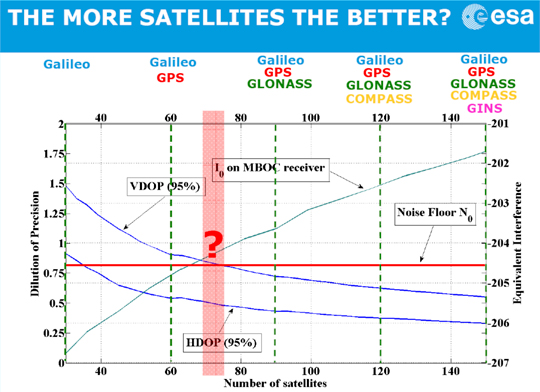
    Günther Hein of the European Space Agency shows this remarkable diagram (Figure 1): as the number of systems increases and the number of satellites heads for that 150, up rises the noise they make, the blue-green line. More than about 70 of them, and satellite noise exceeds the cosmic noise floor in red and becomes the main source of noise. The more satellites, the worse the reception as GNSS interferes with itself. Too many satellites, and you’d pick up none at all! The first threat of the triple whammy is self-inflicted.

    Chart: David Last and Sally Basker
    Chart: David Last and Sally Basker

    Figure 1. The first threat of the Triple Whammy: new satellite systems. Source: Günther Hein.

    The Second Threat

    Conflicts between nations as their new GNSSs compete for radio spectrum also threaten GNSS viability.

    The frequency bands available to satellite navigation are essentially L2, L5, and the principal one we use currently, L1. On L1, the European Galileo system and the Chinese Compass system occupy the same areas. Now, that’s very desirable if the two systems are to share receivers. But they also compete for that spectrum, and there is conflict between Compass and Galileo.

    This battle for spectrum is a highly complex engineering problem. But chiefly, the spectrum wars are political, even emotional.

    Chinese satellites fly across American skies broadcasting signals that interfere with European receivers. Spectrum wars have everything to do with relationships between nations and little to do with battles between engineers. They are developing into a classic tragedy of the commons: a situation in which self-interest determines how a limited resource — here the radio spectrum — is to be shared in a regime in which regulation is weak. The International Telecommunication Union sets standards and registers claims. The UN Office for Outer Space Affairs seeks to mediate. But neither is a policeman; sovereign governments may sometimes be penniless, but they are very powerful.

    The second threat of the Triple Whammy is also self-inflicted.

    The Third Threat

    Communications systems compete with GNSS for spectrum: witness the current LightSquared case of a powerful new broadband system. For existing receivers, including those in government systems and aviation, it seems there is no fix for its devastating interference. LightSquared is driven by rich and powerful commercial forces; it could well win this fight.

    Communication technologies will continue to press upon the satellite navigation spectrum. LightSquared will likely erode spectrum gaps between communications and navigation services, the so-called guard bands.

    Satellite navigation has become highly political. The intense use of GNSS across our economies makes them vulnerable. GNSS is threatened by a Triple Whammy, by jamming, and by spoofing. These increase the risks to our security and our economies, both in probability and impact. The solution of detecting jammers and making ownership illegal will help with local problems in local areas. But the Triple Whammy threats are not local; they are national and international, world-wide.

    Today’s spectrum wars affect us all. That the loss of GPS would increase the price of a loaf — the very trigger for the French Revolution — brings this down to earth.

    These are not technical issues, they determine the price of our food! They constitute a real and present danger to our societies — down to the mundane yet very real level of our daily bread.


    David Last is a past-president of the Royal Institute of Navigation, a consultant and expert witness on radio-navigation and communications systems to companies, governmental and international organizations, and criminal investigators.

    Sally Basker, former director of research and radionavigation at the General Lighthouse Authorities of the UK and Ireland, has opened Traxis Ltd: management, business, and technology advice with expertise in navigation service provision. See www.traxis.co.uk.


    This article is adapted from a presentation at the European Navigation Conference, London, November 2011. A longer version of the talk appears in the Royal institute of Navigation News.

  • Freemium Model for in-Vehicle LBS

    Cloud-based infotainment, more tightly integrated apps, and more personalized offerings will change the in-vehicle mobile experience. Interfaces will morph towards combinations of heads-up displays and voice. These were some of the conclusions from my December 1 webinar “Car as a Mobile LBS Device,” with panelists from Ford, OnStar, Pioneer and TomTom.  How in-vehicle apps will be monetized is an open question. When polled, almost half of the webinar audience believed a “freemium” model will prevail. Freemium models work by offering a product or service free of charge while charging a premium for advanced features.

    Close to a third of the webinar participants believed that LBS apps will come as “standard equipment” on new vehicles. Many see mobile advertising as adding a significant revenue stream if the advertising is truly contextual and continues to serve up offerings that are useful to a consumer. Obtaining contextual marketing data about consumers must be done with prudence, but more about that later. The carriers and service providers such as Facebook and Google stand to make the most money from in-vehicle apps.

    Carrier Low IQ. Mobile contextual advertising needs consumer behavior data to work. The behavior data are highly sought because of their value to advertisers. If you haven’t been paying attention, Carrier IQ allegedly has been illegally and secretly recording individual cell-phone user behavior, including location data, across more than 140 million handsets. Carrier IQ maintains that its services count and measure operational information and do not record keystrokes or provide tracking tools.

    Who raised their hands? AT&T, Sprint and T-Mobile admitted to using Carrier IQ. Apple said it stopped using Carrier IQ in the latest version of its operating system, iOS 5. Across the board, the companies insist that they only used information to track operational and network performance issues. Security researcher Trevor Eckhart has released a report detailing how Carrier IQ’s software could be used by carriers and device makers to track user activity, actual keystrokes and location data. Now comes renewed scrutiny of the industry by Congress, federal agencies and consumers.

    Checked-out? Facebook consumed Gowalla in an acquisition of the location-enabled mobile social network. Gowalla’s users check in at specific places to share their location with friends. Unable to compete with Foursquare, the Gowalla service will be shuttered by Facebook; however, employees will be kept on, presumably to work on the new Facebook Timeline chronological interface. JWire, a media company, reported results of a survey that sheds light on the category. Consumers are split on their feelings towards location-enabled mobile social networks. A little over a third of respondents indicated positive feelings toward it. Just as many had a poor opinion of it, with the rest ambivalent. Males are more likely to use the service and the most popular check-in categories are restaurants, hotels, bars and health clubs.

    Let There Be Light? Resolution of the LightSquared GPS interference issue eludes. The LTE provider has moved quickly to make added concessions following new reports of GPS interference based on LightSquared’s already previously revised deployment plans. LightSquared’s newest concessions include limiting or delaying transmission power increase. This comes on the heels of reports from a key government committee that LightSquared’s network affects a “majority” of general-purpose GPS receivers and technology used to land planes, but doesn’t appear to have a significant impact on cell phones. “LightSquared signals caused harmful interference to the majority of other tested general-purpose GPS receivers,” said Anthony Russo, director of the National Coordination Office for Space-Based Positioning, Navigation and Timing (PNT) in a statement last week. The federal advisory committee examined tests of LightSquared’s revised deployment plan, which moved transmissions into airwaves located farther away from GPS bands. LightSquared had asserted this would solve the majority of issues with GPS interference, but that isn’t supported by early tests. The final analysis of the tests by the PNT committee is still underway.

  • Interview: 2nd Space Operations Squadron Commander, Lt. Col. Jennifer Grant

    December is typically the month when writers of regularly featured columns wax nostalgic and engage in a certain amount of prognostication. This year I enlisted the help of Lt. Col. Jennifer Grant, the 2SOPS/CC at Schriever AFB, the home of GPS, to help us with our year-end review and crystal-ball gazing as we look ahead to the GPS horizon. Lt. Col. Grant reminisces about her first 16 months as 2SOPS/CC, reviews numerous major accomplishments, and updates us on the status of the GPS constellation as well as the often overlooked, ever contentious and always seemingly in flux critical Command and Control (C2) segment.


    By way of introduction, I first met Lt. Col. Grant when she was assigned to the Command Suite at Headquarters Air Force Space Command at Peterson AFB in Colorado Springs, Colorado, and served under the four-star commander General Robert Kehler, who is now the commander of USSTRATCOM (United States Strategic Command). At the time she impressed me as being intelligent and insightful. Her professional reputation as a perfectionist certainly supported that assessment. The next time I met Jennifer, we were both wearing different hats and serving in different roles.

    Several of us on the GPS Independent Review Team (GPS-IRT) were sent by General Kehler to Schriever AFB to check in with the new 2SOPS/CC and see if we could offer her any assistance. This is a role we, the IRT, have played many times in the past, and just like the old saw concerning Inspector General (IG) visits, our mantra was and is “…we are only here to help…that’s our story and we are sticking to it.” Regardless of the perception or even trepidation over our visit, Jennifer and her staff were extremely supportive and it was abundantly clear that Lt. Col. Grant was drinking from a fire hose and doing more than surviving. She actually seemed to be handling it well and possibly even enjoying herself. While she was not new to Space Command, she was new to the GPS.

    More than a year later, I and another IRT member paid Lt. Col. Grant another official visit and the transformation was nothing short of amazing. Did I fail to mention that she is also known as a quick study? In 16 months’ time Jennifer went from the new kid on the block in GPS operations to a sophisticated, erudite, extremely knowledgeable and passionate advocate and supporter of the GPS and all aspects of 2SOPS operations.

    Recently she stood toe-to-toe in a meeting with the same GPS-IRT members that visited her 16 months ago and proved without a doubt that she has matured as a commander and GPS operator beyond our wildest imaginations. To her credit she is not intimidated by titles, rank or history. She knows her job. She walks the talk and will not hesitate to challenge anyone, although very politely and with a smile, who is not totally accurate and fair in his or her assessment of GPS operations yesterday, today and tomorrow.

    Like any good commander, she is totally and relentlessly supportive of her command and her people. However, she is pragmatic enough to know that changes, and big ones, are on the horizon. At the same time she realizes that she commands not only the largest and most well-known military space constellation on orbit today, but also one that supports the entire planet’s critical infrastructures with crucial timing, frequency, position and navigation information. GPS has become the de facto time and time frequency distribution system for the world we live in today. There are more than two billion known users worldwide, and that conservatively equates to more than 5 billion GPS receivers. Indeed, given the number of stealth GPS receivers in almost every appliance we use today, that number could easily grow to more than 10 billion. No stress there!

    When I called Lt. Col. Grant about a follow-up IRT visit and mentioned that an interview might also be in order, she replied that she would get right on that as soon as she spent Thanksgiving with her family. Imagine that, she actually took a day off. In the real world she seems to balance being a wife, mother and commander of the world’s most visible satellite constellation with a maturity beyond her years.

    Now that we have peeled back the curtain just a bit, let’s see what Lt. Col. Jennifer Grant has to say about the Global Positioning System and PNT in general.


    DJ: Don Jewell, GPS World Defense Editor
    JG: Lt. Col. Jennifer Grant, 2SOPS Commander 


    DJ: What can you tell us about your first year as the 2SOPS/CC?  What makes you happy about your command job and GPS specifically?

    JG: Don, my time as the new 2SOPS/CC has really passed quickly! Commanding the largest DoD satellite constellation is both humbling and invigorating. It is amazing to look back over the past year and recount our accomplishments as a team: I accepted satellite control authority of the first two GPS IIF satellites; we completed the largest satellite repositioning in history with expandable-24; we successfully completed two major test exercises involving demonstrations of flex power and SA/ASM (Selective Availability and Anti-Spoofing Module), respectfully; we successfully completed the largest major software sustainment installation, AEP 5.7.0 [ed. Architecture Evolution Plan]; we flawlessly executed two operation mission transfers to our back-up (Command & Control) location; we’ve completed dozens of station-keeping maneuvers; we’ve resolved on-orbit anomalies and sustained the constellation of satellites which have outlived their estimated design life — and celebrated the 21st birthday of SVN-23, our oldest IIA satellite on orbit. We’ve also disposed of SVN-24 and are preparing for the disposal of SVN-30. Our GPS Operations Center (GPSOC) has provided 75,000+ products to our mission planners and warfighters down range, and we have seen the implementation of our GPS Google Earth tool.

    On the personnel front, we were part of the team, along with 19SOPS and SMC — Space and Missile Systems Center, awarded the USAF Chief of Staff Team Excellence Award (CSTEA) in Washington, D.C., for the GPS IIF Launch; and we were part of the past and present GPS team of personnel earning the International Aerospace Federation’s 60th Anniversary Award for excellence in aerospace. General Shelton accepted this award in Johannesburg, South Africa, on behalf of the U.S. Air Force contributions to the GPS. We have also achieved the most accurate signal-in-space in our history, far surpassing the office of the Secretary of Defense, Standard Positioning Service Performance Standard requirement of seven meters!

    2SOPS, with assistance from our reserve mission partner, 19SOPS, supports more than two billion position, navigation and timing (PNT) users worldwide. The work we do every day and the mission we execute supports critical infrastructure, life-saving missions and worldwide operations.

    100820-F-1631A-028 . Headshot: Lt. Col. Jennifer Grant
    Lt. Col. Grant speaks at the change of command ceremony in August 2010,
    when she took over command of 2SOPS.

    In short, Don, I love my job — and I have the sharpest, best and brightest team of personnel employed to execute these tasks. I am amazed every day at the level of proficiency and professionalism demonstrated by our Total Force team of active duty, reservists, aerospace engineers, contractors and government personnel. Our team has managed and maintained the position, navigation and timing gold standard and will continue to do so.

    Making a difference in the lives of people gives me a great deal of personal and professional satisfaction. We are not doing our jobs right if we are not making the world a better place…one contact at a time, be it people or payloads.

    DJ: Can you give us a status of GPS as a system of systems, to include ground control, monitoring and the on-orbit constellation? Give us, if you will, a status brief of where GPS stands today, including SVN-49. And, since you are known for being precise when you speak about GPS matters, can you please answer using the nomenclature we should all use when we refer to the various segments of the GPS?

    JG: Absolutely, Don! The GPS constellation is the most robust and capable system in the history of space.  We currently have 30 actively engaged operational satellites on orbit (9 GPS IIAs, 12 GPS IIRs, 7 GPS IIR-Ms and 2 GPS IIFs). We maintain a program baseline minimum 24-satellite constellation consisting of six orbital planes each containing four primary satellite slots. Our four dedicated ground antennas and six monitoring stations are working as intended, and our MCS (Master Control Station) at Schriever AFB as well as our AMCS (Alternate Master Control Station) at Vandenberg AFB are both fully functional.

    On 15 June 2011, we completed expansion of a total of three primary slots, which added 3 satellites into our current baseline and enables us to optimize GPS assets to improve operational effectiveness for global users and warfighters in terrain-challenged areas.

    Currently, there are 30 satellites set healthy to users, and a 31st satellite, a GPS IIA, will be set healthy on 16 December 2011. We have one satellite awaiting disposal and three remaining satellites in residual status. Each of the three remaining residual satellites are in LADO, which is our unique Launch/Early Orbit, Anomaly Resolution, Disposal, and Operations system. One of the residual satellites is SVN-49, and they will all be tested and checked out for determination of future use and viability as a long-term operational decision.

    DJ: Those of us who have been Squadron Commanders know there are persistent problems in any organization that just won’t go away, be they programmatic, operational or personnel issues. What is it that keeps you up at night?

    JG: Thankfully, Don, I am a sound sleeper with peace of mind, so not much!  But really, one of the main responsibilities we manage is maintenance and sustainment of the GPS constellation, and the older the satellites in the constellation get, the more care and feeding they require. Right now, about a third of our constellation has exceeded its satellite design life by 100% — satellites designed to last 7.5 years are between 15 and 21 years old. So we have invested a great deal of time into contingency planning in the event of component failures, multiple vehicle anomalies, etc. We are doing everything we can to continue to extend the lives of our satellites, and it is a tribute to engineering, design and the satellite builders as well as the expert sustainment operations and engineering that they have lasted as long as they have.

    We need to ensure our replenishment launches for the current generation IIF vehicles stay on schedule and a priority.

    DJ: Would you give us your view and hopefully the MAJCOMs view of the way ahead for GPS as it supports military, civil and commercial users around the globe? Look forward to the future for us — how do you see GPS operations evolving in the years ahead?

    JG: Don, the Air Force is constantly being asked to do more with less — resources, manpower and time.  In this fiscally constrained environment we are being challenged to find effective and efficient ways to accomplish our mission. We have come a long way from the legacy systems in improving our operations, and I think we will see even more improvements in increased automation, faster satellite contact times, and increased downlink capabilities, as well as streamlined operations.

    We will also, I believe, see an increased need for interaction and interoperability with our international position, navigation and timing providers and consumers. GPS, though still the largest PNT provider, is no longer the only game in town.

    Although the GPS satellite constellation is procured and operated by the US Air Force, we understand we support a much broader user community in the civil, commercial and military sectors. We take pride in providing extremely accurate PNT services to billions of users worldwide.

    And we are spending considerable resources to modernize the GPS constellation to provide even better service in the future. The continued fielding of new GPS IIF satellites and GPS control segment software updates are key to current modernization efforts. GPS III satellites and the Next Generation Control System (OCX) will further enhance GPS capabilities. Fully compliant user equipment is essential as modernization efforts continue.

    We’ll continue to improve our constellation with the launches of new satellites; the next GPS IIF is scheduled to launch in September of 2012 and the first GPS III should be available for launch in FY 2014. And OCX remains on-track for a Ready-To-Operate (RTO) date in 2015.

    DJ: And finally, if you were Queen for a Day, what would you like to see changed?

    JG: For operators, there is always an interest in and a desire for greater capability, faster processing…and for us it is in pushing the envelope for even greater accuracy with precision timing, position and navigation.

    There is also an interest in expanding application of our NAVWAR (Navigation Warfare) knowledge, application and operations — having an even greater number of people trained and embedded with warfighters as NAVWAR experts. This is where I think we will see some real growth in the future.

    DJ: Colonel Grant, I know you are incredibly busy and I can’t thank you enough for your time, your expertise and the look ahead to the future of GPS. Best of luck in all your future endeavors.


    Editor’s Note: I have visited the 2SOPS more than 20 times in the past five years, and I have known and visited every 2SOPS commander since that organization began to include then Lt. Col. and now General William Shelton, the four-star AFSPC/CC. I have never seen a more motivated GPS crew force than the one I saw during my last visit with Lt. Col. Grant. Squadrons tend to reflect the work ethic, mores and integrity of their commander, and my hat is off to Lt. Col. Jennifer Grant because her crews are obviously very motivated to support the warfighter, and they seem very happy in their jobs. The atmosphere in 2SOPS these days is positive, upbeat and very customer (that’s you and me) oriented. Plus, many of the crewmembers are just back from tours in Afghanistan and Iraq, so they know the needs of the warfighter and they are working hard to fulfill them.
    Till next time, happy holidays and happy navigating.

  • 2011 Showed Better LBS Market Gains, But Was It All About Google?

    2011 was a decent year for the location-based services industry. It was an even better year if your company was lucky enough to get bought out by an ebay, Google or Intel. While acquisitions stood out as the key LBS news in 2011, privacy stood out as an ugly issue that threatened consumer acceptance. In addition, automobile manufacturers are viewing social media as a new profitable technology for vehicles and were trying to convince consumers that the connected vehicle is the way of the future.


    This year featured a slew of location-based company acquisitions and consolidation — far more than in 2010. The acquisitions of such established location companies as Where and Telmap by eBay and Intel, respectively, at least show that bigger companies want that capability in their online offerings.

    Google made many moves into the location business in the last two years — and really went crazy in 2011 with acquisitions. Google is trying to grab a large share of the European traffic market by offering real-time services in 13 European companies. Google shook up the navigation market with free navigation service for Android phones in 2009.

    To top off a big year for Google, the company is taking its mapping technology indoors with the launch of Google Maps 6.0. Indoor mapping and positioning received big headway in 2011, and it was reasonable to assume that the 800-pound LBS gorilla, Google, would be a big player to entice big retail companies to come on board for location technology to allow customers to find products.

    According to published reports, some of the big-box retail stores such as IKEA, Macy’s, Home Depot and Bloomingdales have been mapped. However, a lot of the bigger malls, and Target and Wal-Mart, have not been mapped.

    The cool thing about the product is that it also tells customers what floor they are on in a building. The uncool thing about the product is that Google Maps 6.0 is only available for Android.

    Google’s indoor mapping partners include 18 U.S. airports, which will open up more partners and LBS relationships in the future.

    A look at all of Google’s location market moves, and analysis, in 2011:

    • Google’s major partners, who have more than 25,000 Google Maps application uses per day, will be charged starting next year. Some say it won’t hurt small companies much—and may even help companies who compete with Google. Either way, some say the decision was inevitable for companies making a profit–and using Google’s resources for free.
    • The recent $12.5-billion Google acquisition of Motorola Mobility has some industry experts saying that the location market piece of pie is getting smaller every time the search giant makes a deal. Many industry experts have said that the main makers of Google Android smart phones should feel challenged as well as the company has seemingly gone into business against them. Google is once more trying to corner more of the social shopping market by buying The Dealmap, a 15-month-old company that offers its own location-based daily deal service.
    • Google purchased Menlo Park, Calif.-based The Dealmap, a company that collects data from hundreds of sources and arranges deals by location, on its website and a smartphone application. The start-up, founded last year, has 15 employees and 2 million users, according to published reports. Google tried to buy Groupon for as much as $6 billion last year, and decided to launch its own service, Google Offers, in Portland. Google’s service has since expanded to New York and the San Francisco Bay Area.

    More transition is happening in the LBS market this year — even at our deadline. As GPS World reported, LBS company Gowalla looks like it is shutting down by the end of January 2012, according to the company’s blog. Company president Josh Williams said he and his staff are now going to work for Facebook.

    While some LBS analysts said this year that GPS technology, and its offshoot niche navigation capability, are just embedded widgets in the overall location market, others say they still are the driver to consumer awareness and acceptance.

    “In my opinion, one of the biggest trends in 2011 included market acceptance — and demand — of GPS technologies. We are now seeing end-users demand GPS technologies in the workplace,” said Jonathan Hubbard, SpeedGuage CEO and co-founder. “In fact, truck drivers now say if you don’t have GPS-enabled automated logging of my work hours, or what we in the transportation sector call hours of service monitoring, then I won’t work for you. That’s a significant change in how GPS-enabled technologies were formerly viewed — more or less — for solely tracking purposes, and we see this trend only continuing and gaining momentum in the coming year.”

    Other Markets and Issues Made Big Splash In 2011                                                                 

    In vehicle technology also made headlines in 2011 when automakers said they would be increasing social media and other capabilities for new car models. Because of larger screens going into many vehicles, LBS seems like a natural advertising fit, but Thilo Koslowski, Gartner vice president, said that car companies will developing market strategies along traditional display-type marketing models.

    Koslowsi said the biggest competition the auto industry has is the smartphone or other consumer mobile device. “We will see growth in vehicle application on the Android platform, while Apple will be leveling off. [Research in Motion] will have a lower share,” he said.

    The other big “issue” confronting the LBS industry is privacy, which became big news in May when it was revealed that location data was secretly stored in all iOS 4 devices. It was learned that Apple was storing a file with location data in every iPhone or iPad with iOS 4.    These discoveries prompted Sen. Al Franken (D-Minn.), who was concerned that as many as 15 percent of users are children, to ask now-deceased Apple boss Steve Jobs about the operating system. In a letter to Jobs, Franken, who presided over hearings on location technology and privacy, asked why Apple consumers were not informed of the collection and retention of their location data, how frequently is a user’s location recorded, why is this information not encrypted, with whom has the information been shared, and what is the purpose of collecting the location data.

    Apple contended that iOS devices are not logging the location of the user, but caching a database of Wi-Fi hotspots and cell tower locations around a user’s position. Some of these cell towers may be many miles away from the user.

    In other LBS Insider news:

    • Veteran telematics vendor Cross Country Automotive Services and its subsidiary, ATX Group, which is a provider to BMW, Hyundai, Infiniti, Lexus, Rolls-Royce Motor Cars and Toyota, announced their new corporate brand name, Agero. Cross Country, which purchased ATX in 2008, says Agero will create products for auto manufacturers, insurance carriers and aftermarket providers.
    • GPS World Magazine is GPS-Wireless 2012’s official media partner. GPS-Wireless 2012 will be March 21-22 at the Hyatt Regency—San Francisco Airport.
    • LBS Insider will be covering the Consumer Electronics Show in Las Vegas next month. Please send me your news tips and releases.
  • A Nationwide RTK Network: A Great Idea, But…

    Gavin Schrock, LS, is a licensed surveyor, technology writer, and administrator of the Washington State Reference Network, a regional cooperative GPS network (RTN) in the Pacific Northwest. He has worked in surveying, mapping, data management, and GIS for over three decades in the civil, utility, and mapping disciplines. He has published in these fields and has taught these subjects at local, state, national, and international conferences.


    Some folks are proposing that a nationwide RTK Network (RTN) be piggy-backed on the controversial LightSquared communications network. That could be cool, if it can be done. No one is saying that it can’t be done, but there are reservations on whether it would be worth the massive investments needed to pull it off, and that there might be little gain at all over the existing presence of RTN in the U.S.

    RTN are arrays of continuously operating GNSS reference stations that can provide correctors for high precision positioning. Centimeter positions instantaneously; imagine what could be done with a capability like that. People have not only imagined such things, but have implemented over 100 of these in the U.S. and over 350 worldwide serving industries such as surveying, mapping, construction, precision agriculture, science, machine control, public safety, precise navigation. If you feel you have heard all of this before, you probably have, and chances are you might have heard this from an RTN junkie like me.

    I am a strong supporter, even a rabid supporter and promoter of the expansion of RTN and the many benefits that can be realized where RTN exist. I have bored many people to tears with my idealistic ramblings about RTN, and have seized opportunities to jump on any bandwagon that promotes more widespread or even nationwide RTN (e.g. On-Grid Goal, GPS World 2006). There are many countries that already have nationwide RTN like Japan, Germany, Denmark, Greece, and many others; but under completely different circumstances, and none piggybacked on communication network towers. So why haven’t we seen a nationwide RTN in the U.S.? There are a lot of good practical reasons why this has not happened, and likely won’t. It is not a matter of a single design or business model issue standing in the way, and likewise the solving of a single issue will not bring the entire dream to reality. There are far too many moving parts to an RTN; hurdles that would have to be overcome to realize a nationwide RTN. Examining those hurdles might bring us closer to visualizing the dream, but perhaps instead we should focus on what is realistically possible and provide the best possible amalgam of many well run RTN to provide the same utility.

    The Nationwide RTN Carrot. In the course of the past year, and the LightSquared broadband plan interference controversy, RTN have been mentioned in the context of both a reason to oppose the broadband plan in question, and by others as a reason to support the broadband plan. Some have suggested that the LightSquared plan in question would be the catalyst for a nationwide RTN, as it could possible fulfill the crucial communications element of an RTN, and have touted this as a carrot for approval of the entire broadband plan. The idea of piggybacking an RTN on a communications network towers is not a new idea, and it has been studied seriously by many folks, including myself. There have been GNSS manufacturers and mobile phone service providers who have looked at this idea; but none that have acted on the idea; for good reasons.

    I would really like to see a nationwide RTN, but this particular carrot is not backed up yet by a credible plan that has been formally proposed and presented for scrutiny, it does look mighty tasty at first glance. Are there too many compound assumptions being made with regards to this particular carrot? Or is there real potential for a grand RTN? The controversial broadband plan asks a lot of people to sacrifice a lot in direct costs and lost productivity during transition; so the various carrots being touted should be scrutinized very carefully. The first glance look at the assertion that a nationwide RTN could be piggybacked on the proposed LightSquared LTE build-out does appear to provide two key RTN elements: secure station sites (perhaps as many as 40,000 to choose from) with power and low-latency communications for both stations and rovers. But are tower sites really suitable? And can it be done with the tower sites alone? Can it be done in a manner that would greatly improve the coverage of RTN and at a dramatically lower cost? Let’s takes a closer look at what it would take to stake a nationwide RTN on an array of wireless communication towers before we jump to any conclusions.

    Secure sites with power. Yes, the proposed tower sites are essentially cellular tower sites with fences and reliable AC power. But the assumption that one can simply rely on tower sites only applies to the limited area of the country that will be covered by the terrestrial component, the rest would need new stand-alone CORS sites to be presumably served by the satellite component of the plan (not a good idea and adds more infrastructure costs).

    Tower mounts. A communications tower is subject to movement, and therefore not a good candidate for mounting a high-precision GNSS CORS antenna. Even as little as one centimeter of incidental movement (and much more in high winds) is not only not a good practice for an RTN station, it would compromise the relative integrity between RTN stations and the resultant real-time solutions. If you expect your rovers to achieve centimeter positions, the RTN stations must be stable to a few millimeters. But don’t cell towers already have GPS antennas on them? Yes, but these are typically tiny little single frequency units used to time the communications systems where positional precision is not a consideration.

    Co-Location at Tower Sites. You will not find very many RTN stations co-located at wireless communications tower sites, and those that are have been placed on stable ground mount far from tower (south side preferred for maximum constellation) to mitigate as much multipath from the tower as possible. Most tower sites are not big enough to accommodate this. It may take a separate lease of a fenced area far away from the tower. This greatly reduces the number of potential sites.

    Leases. Wireless communications  tower sites are mostly leased from local land owners, and the towers themselves are often owned by third parties from whom communications companies lease space on the towers. The LightSquared plan is not calling for wholly-owned and leased sites; other parties and leases will be required. For instance, Sprint has been proposed as a LightSquared partner for providing tower infrastructure. Site and tower owners want to make money from their property. Towers = more ongoing costs.

    Site Geology. Potential RTN station sites are carefully vetted for sources of incidental geological movement. For example, alluvial fans or slumping slopes are not good candidate sites. An RTN serves as the active control component of a geodetic reference framework; and strict criteria are followed. Tower sites are not necessarily vetted on the same criteria. The potential site list becomes even more narrow.

    Interference. While sources of interference from other radio frequency appurtenances on the towers might not be an issue, then there is the question (ironically) of the possible LightSquared interference as these stations would be at ground zero. Assuming that there are solutions for what is referred to as the lower 10MHz plan interference, what of the upper 10Mhz plan? Recent lower 10MHz filtering tests aside, the upper 10 MHz band plan has still not been taken off the table. No one has demonstrated any credible filtering plan (even LightSquared admits this is still theoretical or at least years away) for the upper 10MHz. Would the RTN stations be immune to such interference? Depending on how the upper band issue plays out, this idea (and viability of every other every other RTN, not to mention all high precision GPS in the U.S.) might be dead in the water.

    Geometry and Coverage. RTN stations are spaced as close as 30km or as far apart as 100km depending on what type of solution is being sought, terrain and elevation differences, tropospheric trends, redundancy considerations, and site suitability/availability as outlined above. With the LightSquared plan proposing as many as 40,000 possible tower sites it would otherwise  be possible to find enough in densely populated areas of the country to have decent geometry and coverage, but only if all of the other design criteria can be met. The point may be moot as tower sites overall are not good candidate sites and won’t cover the majority of the country without adding satellite communication-served sites.

    Geodesy. If the relative positional integrity of an RTN is not maintained, and elements like plate tectonics and ocean tide loading are not taken into account, the resultant solutions suffer. Poor geodesy renders an RTN useless for high precision positioning. There are amazing tools for monitoring, maintaining, and updating the geodesy of an RTN available in some of the commercial RTN operations software suites, but this proposal would be taking on an unprecedented huge and expensive geodetic burden – even if a fraction of the 40,000 sites are included. The National Geodetic Survey maintains system of 1,800 CORS maintained by over 200 different partnering organizations. Even with the most advanced tools and some of the finest geodetic minds in the world, maintaining the geodesy of these sites is straining the NGS resources. The threshold for update on NGS CORS is when its network integrity exceeds two centimeter horizontal by for centimeter vertical; completely unacceptable for the relative integrity that RTN requires. RTN operators maintain registration to the National Spatial Reference System via constraining to a minimum number of CORS, but then have to maintain a further level of relative integrity locally for the RTN to run. A nationwide RTN would need to be run as an array of sub-networks for independent geodetic regions; some RTN have to do this even within a single state to accommodate regions of varied tectonic velocity. A small army of geodesists would be needed to oversee a nationwide RTN resulting in another significant cost.

    Ubiquitous Communications. The term “ubiquitous” gets thrown around a lot with regards to the current plan. Go online and look at a population density map and then look at any of your favorite cellular coverage maps. Now look at a terrestrial component deployment map (Source: TMF Associates) for the proposed network from October 2010. It does not cover huge areas of the country; instead the satellite component of the proposed plan would need to be used. RTN CORS do not need a lot of bandwidth, but they do need low latency communications. Satellite communications links are rarely used for RTN. An RTN might get away with a few isolated high-latency satcomm served sites, but too many clustered together in a network solution do not work. Also notice the population map and the coverage map of some common cell/broadband providers look very similar; the profitable areas are targeted. Many companies are steadily deploying LTE broadband (LTE was not invented in the past year). While the plan calls for providing services to an admirable goal of 260 million potential subscribers, the remaining 50 million plus in rural areas will be left out as they have been by other carriers, or simply served by slower satellite communications.

    Nationwide does not really mean nationwide in the commercial communications business, and that would be the same for RTN. Communications networks get built where the potential subscriber base can support the investments. The same can be said for RTN. You will find RTN covering the same densely populated areas, or over areas where precision agriculture is being implemented. There are actually RTN and arrays of single-base RTK stations in places that are not covered well by broadband and would not likely be covered by this plan or the others. In these areas radio and satellite-based augmentation systems are the cost effective alternative. Even though the communications component of the plan (that might arguably be more bandwidth and possibly faster or cheaper) will not be much more ubiquitous in terms of RTN functionality than what is available now, there would still be big holes in a “nationwide” RTN.

    Wholesale. LightSquared plans to offer wholesale bandwidth. This might equate to any number of retail providers offering the bandwidth through proprietary or open source communications devices. LightSquared is promoting this as “the dumbest of pipes”; essentially a great big pipe of bandwidth, which is a cool idea and prime for a wholesale model. More options for communications through these retailers might arguably be a good thing for RTN users, but not necessarily for any entity trying to put together a nationwide RTN unless there was some kind of exclusive deal attached. Competition can lead to lower costs overall, but subscriptions are typically what the market can bear and that might not be stupendously lower than what we pay now because everyone in between needs to take a cut. One strong point of the model was supposed to be unified communications for RTN, but instead we may be looking at a fractured element. The potential RTN operator would have to deal with as many, if not more, wireless communications providers than currently exist.

    But in another potential model, if the RTN provider were also a LightSquared broadband retail “reseller”, that might be a key to streamlining the model. However, if every end user was to buy the same units or brand with built in broadband receivers from one of the preferred retailers (wishful thinking), that would streamline the model even more. There are too many existing RTN (some free or at nominal cost), and too much legacy equipment out there to expect users to accept and rapidly execute dramatic upgrades, replacements, or carrier changes unless the full LightSquared plan is approved and they are forced to upgrade.

    The Elastic and the Brittle. I hate to rain on anyone’s parade, but RTN are not the dramatic cash cow one might imagine. The worldwide experience of RTN is very similar in that there is a limited market for network corrections. Even if one was to count on signing up all of the current RTN users in the U.S., plus all of the precision agriculture market (and a mighty hard sell that would be as they have made some huge investments in their own systems), it is still unlikely that there would be enough revenue to fund the initial and ongoing infrastructure investments, and to sustain the ongoing costs of operations, geodesy, leasing, maintenance contracts, and account management. If anyone is entertaining thoughts of consumers paying extra for higher precision on their cell phones and car navigation devices they might be greatly mistaken. The consumer seems quite happy with accuracy on the order of a few meters, and multiple constellations and  modernization will be providing higher fidelity to them soon enough. One wireless service provider even experimented with delivering corrections to mobile phone users from the national RTN where they are based and found consumers in their test group to be indifferent and even thinking it was a silly idea.

    Private RTN have spread across areas of the U.S., somewhat organically as opportunities arise, partners are secured, and where the market can support them. Public and cooperative RTN have spread in areas where the sponsoring entities can realize cost-benefits from their investments like a state department of transportation for their own projects. Public RTN have often filled regions where a private network may not have otherwise been cost effective. Together public and private RTN have covered a substantial area of the U.S. The nature of RTN in the U.S. is a healthy elasticity which fits the market and needs. With RTN being narrow-margin enterprises, this is a good thing. Developing a huge single entity RTN on narrow margins leaves the entire enterprise quite brittle. Investors might view areas that have a low or negative return as not worth retaining or even building out in the first place. The cards are really stacked against a ubiquitous nationwide RTN, unless as some assert there were elements of overriding public interest to justify some level of public investment or partnering.

    RTN Coverage of the U.S. as a percentage of Total Area

    Infrastructure Investment. Typical RTN stations have cost between $10,000 and $50,000 each to establish and sites requiring satellite communications start at a minimum of $20,000. Let’s say for arguments sake that only 10,000 of the tower sites were utilized, with perhaps just as many in satellite communications-served sites also needed. That might not even exceed the coverage of existing RTN. Even so, at $10,000 each, that is $100,000,000 up front; not to mention the satellite communications-served sites on top of that. Some may question those costs, so let’s break them down. A RTN receiver has to be dual-frequency, multi-constellation, geodetic-grade, enable remote operations, and be paired with a geodetic-grade antenna. Sure, used receiver/antenna pairs can be had for as little as $2,000-$6,000. Let’s say for arguments sake a manufacturer was able to build and sell (or essentially give away) a new unit for the unlikely price of $2,000, there is still the cost of a stable ground mount, conduit, enclosures, labor, site selection, engineering, fuel, logistics, and contract management. These would very likely add up to $10,000. But let’s say for arguments sake this could be done for $8,000. It would still cost $80,000,000 up front, and maybe triple that to add enough satellite communications-served sites. One would have to question the robustness and viability of an RTN built so cheaply. Realistically, it would be more like $100,000,000 to $360,000,000 to build out.

    Ongoing Costs. Break even operations costs for an RTN average around $1,000-$4,000 per station annually. This includes hardware replacement, software contracts, operations staff, geodesy, training, support, billing, leases, power, communications, data processing, and more. Again, for arguments sake let’s say on a grand scale that cost could be brought down to $1,000 per station per year, that sill represents $8,000,000 to $10,000,000 per year, but more realistically like $15,000,000 to $20,000,000 annually with double or triple to that cost for satellite communications-served sites.

    Pricing Model. The carrot has been touted with assertions that the services would be provided at dramatically reduced costs for both communications and corrections. No one involved would be expected to give anything away. A fair price for all elements would be exacted like it would for any other enterprise. For existing RTN, price is not typically what holds back potential customers. The RTN’s in the U.S. charge very reasonable prices, and much lower than some RTN in other countries. The limitation is the existing and potential pool of users as a function of geographic area. To operate an RTN at greatly reduced prices does not work because many public RTN that initially offered free services are exploring at least nominal fees for the future. It does cost money to run an RTN. Even if a new cut-rate nationwide RTN were to assume it could assimilate all current RTN users, plus a substantial segment of agriculture users, it is likely that the revenues would not be able to justify covering more area of the country than existing RTN already do.

    What do we make of this carrot?

    I completely welcome this idea for consideration, but it needs to be examined seriously before any speculative cost benefits can be added to the value equations folks are presenting as rationale for approving the LightSquared plan. There are a lot of unknowns about what folks have in mind when they tout this piggyback-on-LightSquared-nationwide-RTN carrot.

    Too many unknowns encircle this carrot. If a credible plan were offered up for scrutiny and proposed coverage were shown, all of the design and business model issues I’ve outlined were addressed, the FCC approves the LightSquared LTE plan and there were investors who were willing to see modest returns at best, then I would be among the first to jump on the bandwagon, sing praises, and actively promote the idea.

    However, in light of the tremendous uncertainty we face not only in considering this carrot, but the fate of the broadband proposal it serves to sweeten, touting of this particular nationwide RTN proposal must be viewed at best with a not insignificant amount of skepticism and perhaps at worst be viewed as somewhat disingenuous. The seed for this carrot has not yet even been sown.

  • Directions 2012: A Look Ahead

    At the end of every year, I title this column Directions, in which I discuss significant developments, trends, technologies, companies, etc. in the GNSS industry. This year, two entities have captured my attention and I think have the potential to significantly transform the GNSS industry.

    The two entities I’m referring to are the U.S. Federal Communications Commission (LightSquared) and Europe’s GNSS Agency (Galileo).

    What conversation about GNSS today can we have without LightSquared being at its center? LightSquared, or rather the FCC’s looming decision about LightSquared’s proposal, has the potential to bring significant changes to the high-precision GNSS industry in 2012 and beyond.

    An FCC decision in favor of LightSquared can cause a paradigm shift in the GNSS competitive landscape in the North American market. By that, I mean significant market-share changes. The high-precision GNSS market is currently dominated by three key players: Trimble, Leica, Topcon. What if the FCC approves LightSquared’s plan, and thousands upon thousands of users need to upgrade their equipment? Will they purchase the same brand they currently own?

    The answer, in my opinion, really depends on how much of an upgrade is required. Since each GPS receiver model is designed differently, the extent of the upgrade can vary greatly among GPS receiver models. Some receivers may not require anything; some may require a new antenna design; and still others may require a new antenna design and new GPS receiver circuitry design.

    Since LightSquared’s plan has changed considerably over the past few months, and testing based on its latest plan isn’t complete (or even started in some cases) yet, it’s too early to say how particular receivers are going to be affected.  I’m sure each manufacturer has a good idea about each of their receiver models, but they aren’t talking yet.

    The current focus of testing is on the effects of the 10L (low) spectrum (10Mhz of spectrum at 1526-1536MHz), which is furthest from GPS L1 (centered at 1575.42MHz). If you recall, LightSquared’s initial plan was to roll out their service using the 10H (high) spectrum (1545-1555MHz), but that idea was abandoned in June 2011 when the Technical Working Group (TWG) testing clearly showed that GPS receivers, of all kinds, were jammed due to the 10H frequency being so close to GPS L1 and the signal being so strong compared to GPS, more than a billion times stronger.

    Since the original TWG testing was focused on 10H (with some 10L testing), the affect of rolling out LightSquared’s system on 10L is not fully known. Therefore, in September 2011 the FCC (via NTIA) ordered new testing focused solely on 10L. The testing for consumer-grade GPS (mobile phones, general navigation) was to be completed and analyzed by November 30, 2011. The NTIA has not released any information regarding the test results. My guess is that the testing will show that mobile phones and general navigation devices will be free of interference since those GPS receivers don’t need to use the entire GPS band (only 2MHz) like high-precision GPS receivers do (20+MHz), and aren’t designed to use GPS correction services broadcast in the MSS spectrum (such as OmniSTAR and Starfire).

    Separately, the DoD (Department of Defense) is conducting their own classified tests to understand the affect of 10L on military GPS receivers. We may hear bits and pieces of the results, but I’m guessing the DoD test results will largely remain classified and therefore not be made known to the general public. Interestingly enough, the DoD holds the most powerful LightSquared trump card, although we’ll likely never know if it was played.

    Besides the national security trump card the DoD could play, the Federal Aviation Adminstration (FAA) holds the slightly less powerful safety-of-life card that could trump LightSquared. The FAA is super-conservative (no one wants to be responsible for crashing an airliner) and their processes/procedures can take forever. A few weeks ago, I saw an FAA presentation with the following information:

    Next Steps:

    Preparing of NPEF Test report for NCO, EXCOM and NTIA/FCC

    Scope Next LightSquared Test Phase(s)

    – High Precision and Timing Receivers (different timelines)

    • Awaiting LSQ-provided High Precision and Timing Filters (November and March 2012 respectively), antennas and handsets.

    -Schedule

    • Tentatively, Spring of 2012
    • Test Test Types – Lab; Chamber; Live Sky; Aggregate Effects
    • Test Agency/Location – TBD

    -Funding – Cost Estimate; Source TBD


    LightSquared is fighting the time clock.

    Industry analyst Tim Farrar projects that LightSquared could run out of cash as early as April 2012. Wall Street isn’t helping, as the value of LightSquared’s debt has declined as much as 50 percent or more. Obviously, the company is scrambling. Last month, it told the FCC that the agency should ignore the opinions of other Federal agencies when evaluating their GPS-jamming problem.

    Another time crunch problem it has is its deal with Sprint. LightSquared isn’t “building towers,” at least for the bulk of their infrastructure. It is relying on an agreement with Sprint in which it will pay Sprint $9 billion over an 11-year period to use Sprint’s infrastructure, paying some $290 million up front.

    Sprint CFO Joseph Euteneuer, during Sprint’s 2Q 2011 Earnings Call, said “we’ve gotten the $290 million.” Furthermore, Euteneuer stated “…we will be getting pre-funding of any work that we would be doing for LightSquared.”

    Regarding the GPS-jamming problem, Euteneuer said “…we need clear GPS spectrum before we go forward. So we can get started with a lot of the planning and those things, but we need to get clearance on the spectrum before we start any heavy construction.”

    Sprint has the right to terminate the deal with LightSquared if LightSquared doesn’t receive FCC approval on the 20MHz (10L and 10H) of MSS spectrum by the end of this month. Clearly, that isn’t going to happen. Maybe Sprint will grant an extension to LightSquared, but it has to know the only thing LightSquared might bring to the table at this point is 10L sometime next year, and even that is a crap shoot given the huge cost that the Fed/state/local government agencies would incur in addition to private corporations, not to mention the DoD and FAA discussion above. Finally, Sprint has to know that there’s no chance for the 10H spectrum to be approved in the foreseeable future. The June 2011 Technical Working Group (TWG) test report clearly showed that 10H jams virtually all GPS receivers.

    That leaves LightSquared in a really tough spot, and is the reason its public relations campaign machine has really cranked up these past few months.

    Today (Wednesday, Dec. 7), LightSquared announced that “testing conducted by an independent laboratory has confirmed that several major high-precision receivers, including those developed by GPS pioneer, Javad GNSS, are 100 percent compatible with LightSquared’s network. These results show that LightSquared is well on its way to demonstrating that GPS interference issues have been resolved.” The message lacks specifics, and there has as yet been no verification of the unnamed independent lab’s results.

    LightSquared is taking the message this week to Capitol Hill trying to convince uninformed legislators and other public officials that the end is in sight. The problem is…it’s not true.

    Here’s why:
    1. LightSquared’s preliminary “independent testing” indicates that some receivers are tested to be 50 percent compatible with LightSquared’s network. Remember, we are only talking about 10L at this point, which is only half of LightSquared’s spectrum. Since LightSquared has not abandoned the 10H spectrum, it’s not true to say “100 percent compatible with LightSquared’s network.”
    2. These are newly-developed receivers, which means hundreds of thousands of high-precision receivers would be obsolete. Who will pay for replacing/upgrading them?
    3. LightSquared’s “independent testing” doesn’t include FAA (aviation) or DoD (military) testing.
    4. LightSquared’s “independent testing” doesn’t include LightSquared mobile devices (they don’t exist yet). As I’ve written before, they are potential portable GPS jammers.
    5. LightSquared’s “independent testing” announcement provides no details on GPS performance. A performance hit of 2 or 3 db of signal strength can make a significant difference when tracking in marginal GPS conditions.
    If you’d like to read a further (and more detailed) list of concerns, you might want to read Richard Keegan’s December 1, 2011 GPS World article.
    At the end of the day, LightSquared’s “independent testing” doesn’t address any of the outstanding issues. It’s just more public relations noise.


    Galileo – Europe’s satellite navigation system

    Unfortunately, the ongoing LightSquared debate has overshadowed one of the most important events in the history of GNSS, the launch of the first two operational Galileo satellites in October 2011.

    For more than a decade, Galileo has been discussed and debated, to the point that few believed it would ever come to fruition. Even today, some folks still don’t believe Galileo is real. Given the history and the current state of the European economy, I don’t blame them.

    However, the chips are down, and the stack is high. Europe is “all in.” As the Galileo folks head further down the road, it becomes much more difficult to pull back. The next launch of two Galileo sats is slated for next summer. The four are dedicated for In-Orbit Validation (IOV), but unlike the two Galileo test satellites that have been in orbit for several years (GIOVE-A, GIOVE-B), the latest IOV satellites will become part of the operational Galileo constellation of 30.

    Whereas I’m bullish on Galileo, the schedule is a bit more unpredictable. The European GNSS Agency (GSA) estimates that the first 18 Galileo satellites will be in orbit in the 2014/2015 timeframe. If they stick to it, it would have a profound effect on the GNSS industry fairly soon. As I’ve written before, Galileo supports the new L5 signal along with GPS; this means that L1/L5 dual-frequency, dual-constellation GNSS receivers will be low-cost and very accurate. Regardless if Galileo sticks to its schedule or not (not to mention  GPS sticking to its own schedule), when Galileo does finally have 18 satellites operating in orbit, it will change GNSS positioning forever.


    Webinar  – December 8, 2011

    I’m pleased to participate in a webinar  featuring Dr. Javad Ashjaee who is presenting his solution for the LightSquared interference problem. If you’re unable to attend, please register anyway and you will be emailed instructions on how to view the webinar at your convenience. It will be available for download within a few days of the live presentation.


    Thanks, and see you next time.

    Follow me on Twitter at http://twitter.com/GPSGIS_Eric
  • Preparing for the Next Generation: The Multi-GNSS Asia Demonstration Campaign

    Rizos_HiRes
    Headshot: Chris Rizos

    By Chris Rizos, Co-chair, Steering Committee of Multi-GNSS Asia

    A dramatic increase over the next five years to roughly 100 GNSS satellites in the skies over Asia and Oceania makes that region the fastest growing area in GNSS. The Multi-GNSS Asia (MGA) initiative, a cooperative international demonstration campaign, seeks to take full advantage of this scientific and technical windfall, gaining early experience with the new signals and services of multi-constellation GNSS.

    The MGA organization is sponsored by Japan’s Aerospace Exploration Agency (JAXA), and seeks to promote the region as the “showcase of the new GNSS era” through this demonstration campaign. See an animation of the burgeoning satellite availability over the coming decade. The MGA demonstration campaign consists of a series of activities from 2010 to 2015.

    Figure 1. First frame of the satellite-availability animation at www.multignss.asia/campaign.html.
    Figure 1. First frame of the satellite-availability animation at www.multignss.asia/campaign.html.

    Infrastructure Deployment. JAXA is currently deploying a multi-GNSS monitoring (MGM) network, consisting of continuously operating reference stations equipped with multi-GNSS receivers, that will support the production of precise orbit and satellite clock offset information for the multiple constellations. The MGM-net will be deployed in two stages. The first 20 receivers supplied by JAXA will go to hosting countries and organizations in the Asia-Oceania region by early 2012, with an additional 40 available for deployment globally in 2013. The MGM-net is a component of the tracking network of the International GNSS Service (IGS) global multi-GNSS experiment (M-GEX, igs.org). Both MGM-net and M-GEX will include data and analysis centers and faciltate the sharing of information and resources among participating organizations.

The multi-GNSS tracking data will be available to everyone in the form of RINEX files.

    Projects. Joint experiments involving new or extended multi-GNSS applications, such as disaster management, intelligent transportation systems, precise positioning, and location-based services will be promoted among GNSS providers, receiver manufacturers, local service providers, government organizations, and universities in the Asia-Oceania region.

 Some of these will take advantage of the special characteristics of the first QZSS satellite, Michibiki. Several project proposals have been submitted over the last year; one of particular interest is a call by JAXA for a “Multi-GNSS Joint Experiment.” Such experiments could include using the broadcast augmentation message known as the L-band Experimental (LEX) signal, modulated on the L6/E6 frequency at 1278.75MHz, to support precise positioning. China has recently proposed a “BeiDou Application Demonstration & Experience Campaign” (BADEC) as an MGA project activity.

    Regional Workshops. An important MGA activity is the organization of an annual workshop to report on joint experiments and results and to promote new joint projects. The First Asia Oceania Regional Workshop on GNSS (AORWG), held in January 2010 in Bangkok, Thailand, drew 195 participants from 18 countries.

    The second AORWG took place that November in Melbourne, Australia, and drew 101 participants from 11 countries.

    The most recent AORWG was held November 1–3 this year on Jeju Island, South Korea, attracting 86 participants. Five demonstration projects were proposed by researchers from Japan, South Korea, Taiwan, Australia, and Malaysia, and were all endorsed by the MGA Steering Committee.

    They are:

    • Evaluation of Multi-GNSS for Precision Agriculture in Korea; Chungnam National University, Korea
    • Sustainable Resource Utilization by Precision Farming of Oil Palm Plantation; RTK-Auto Guided Oil Palm Planter; On-the-Go Soil ECa Mapping; University Putra Malaysia , Malaysia
    • Automated rice transplanter guided by using Multi-GNSS including QZSS; Agricultural Research Center, National Agriculture Research Organization , JAPAN
    • Joint QZSS/GPS positioning using L1/L5 band signals; National Cheng Kung University, Taiwan
    • Multi-GNSS Experiment; Royal Melbourne Institute of Technology University, Australia.

    The status of the MGM-net deployment and the results of the demonstration projects will be presented at the fourth AORWG scheduled for November 2012 in Kuala Lumpur, Malaysia.

    China’s BADEC. At the third AORGW, Dr. X. R. Dong, an expert from the International Cooperation Research Center of  China Satellite Navigation Office (CSNO), introduced plans for several long-term project activities under the banner of the BeiDou/GNSS Application Demonstration & Experience Campaign (BADEC). This is another important proposal from China, following the International GNSS Monitoring and Assessment Service (iGMAS) that has drawn attention and support from GNSS providers, users, and international organizations.

    A subgroup dealing with iGMAS is approved and setup by ICG-6; the sub-group is co-chaired by Dr. X. R. Dong, IGS and Satoshi Kogure from Japan. Besides continuing to advocate for iGMAS, the goals of BADEC include seeking to make the Asia-Oceania region a showcase of the new GNSS era, and including BeiDou-specific goals such as “welcome the introduction and utilization of BeiDou services,” “let users experience the Multi-GNSS including BeiDou,” and “encourage GNSS provider and users to carry out experiment and demonstration jointly.”

    Both IGMAS and BADEC will contribute to promote the GNSS open-service performance, compatibility, and interoperability, to be implemented through extensive international cooperation, especially with the IGS’s M-GEX and MGM-net.


    Chris Rizos is professor and head of the School of Surveying & Spatial Information Systems, University of New South Wales, Sydney, Australia. He is president of the International Association of Geodesy, serving from now into 2015.