Category: Opinions

  • GIS Meets March Madness: Using Spatial Data to Analyze Basketball Team and Player Performance

    Even if you aren’t a basketball fan, you’ve likely heard the term “March Madness” over the years. It refers to a time when the best U.S. college basketball teams compete for the championship title. Demonstrating the diversity of GIS, a Harvard University professor has introduced an interesting method of analyzing basketball team and player performance using GIS spatial analysis techniques.

    At the MIT (Massachussets Insitute of Technology) Sloan Sports Analytics Conference 2012 (March 2-3, 2012), Harvard Professor Dr. Kirk Goldsberry presented Court Vision, “a new esemble of analytical techniques designed to quantify, visualize, and communicate spatial aspects of NBA performance and unprecedented precision and clarity.”

    Dr. Goldsberry argues that conventional performance metrics, such as shooting percentage, ignore spatial information. This is odd, Dr. Goldsberry explains, because basketball is a spatial sport. For example, the NBA players with the top shooting percentages are all forwards or centers, who typically shoot from shorter distances than players in the guard position. Without analyzing the spatial shooting tendencies, key scoring phenenom remain misunderstood and coaches and players are missing out on an opportunity to accurately analyze and refine their strategies.

    Who’s the Best NBA Shooter?

    “Data: Using game data sets for every NBA game played between 2006 and 2011, we compiled a spatial field goal database that included Cartesian coordinates (x,y) for every field goal attempted in this 5-year period. This data set includes player name, shot location, and shot outcome for over 700,000 field goal attempts. We mapped the shot data atop a base map of a NBA basketball court (Figure 1). Although a regulation NBA court is 4,700 ft2, (50ft x 94ft), almost all (>98%) field goal attempts occur within a 1,284 ft2 area in between the baseline and a relatively thin buffer around the 3-point arc; we call this area the “scoring area.” We divided the scoring area into a grid consisting of 1,284 unique “shooting cells,” each 1 ft2 (Figure 1). To quantify shooting range, we applied spatial analyses to evaluate shooting performance across the grid and within each shooting cell.”

    NBA field goal attempts 2006-2011 (Source: Dr. Kirk Goldsberry).
    NBA field goal attempts 2006-2011 (Source: Dr. Kirk Goldsberry).
    NBA field goal attempts (Source: Dr. Kirk Goldsberry)
    NBA field goal attempts (Source: Dr. Kirk Goldsberry)

    “Our composite shot maps from 2006-2011 NBA game data. The first map summarizes the density of all field goal attempts during the study period. The second map reveals league-wide tendencies in both shot attempts and points per attempt. Larger squares indicate areas where many field goals were attempted; smaller squares indicate fewer attempts. The color of the squares is determined by a spectral color scheme and indicates the average points per attempt for each location. Orange areas indicate areas where more points result from an average attempt, and blue areas indicate fewer points per attempt.”

    “We derived metrics that described spatial aspects of shooting performance throughout the scoring area. The most basic metric is called “Spread,” which is simply a count of the unique shooting cells in which a player has attempted at least one field goal. The raw result is a number between 0 and 1,284 and summarizes the spatial diversity of a player’s shooting attempts. By dividing this count by 1,284 and multiplying by 100, we generated Spread%, which indicates the percentage of the scoring area in which a player has attempted at least one field goal.”

    “Spread describes the overall size of a player’s shooting territory. League leaders in FG% generally have a small Spread value since they tend to only shoot near the basket. For example, since centers generally thrive in limited areas near the hoop they tend to have lower Spread values than shooting guards. Kobe Bryant has the highest spread value in the NBA (table 1); Bryant’s value of 1,071 indicates he has attempted field goals in 1,071 of the 1,284 shooting cells or 83.4% of the scoring area. In contrast, Dwight Howard has attempted field goals in only 23.8% of the shooting cells. Although Spread% favors players who simply shoot frequently, it also reveals that some players like Dwight Howard who do shoot a lot, only do so in limited court spaces. For example, Al Jefferson attempted 400 more field goals than Ray Allen during the study period, yet his Spread value is only 595 (46.3%), while Ray Allen’s is 952 (74.1%). Visual depictions of the spread variable expose the stark differences in individual players’ spatial shooting behaviors. Via the graduated symbol cartographic technique, figure 2 reveals the spatial structure of Al Jefferson and Ray Allen’s field goal attempts during the study period. Jefferson is highly active in the central areas near the basket, and clearly favors posting up defenders on the right side of the court. Meanwhile, Ray Allen is highly active behind the 3-point arc; he attempts many 3-point field goals, but is relatively inactive from mid-range areas.”

    Spread variable for Al Jefferson (Source: Dr. Kirk Goldsberry)
    Spread variable for Al Jefferson (Source: Dr. Kirk Goldsberry)
    Spread variable for Ray Allen (Source: Dr. Kirk Goldsberry)
    Spread variable for Ray Allen (Source: Dr. Kirk Goldsberry)

    “These Spread visualizations reveal a player’s basic shooting tendencies, but tell us nothing about potency. Shooting skill requires more than just attempts; the best shooters in the league are able to make baskets at effective rates from many court locations. To describe the spatial potency of players we created a metric called “Range,” which is a count of the number of unique shooting cells in which a player averages at least 1 point per attempt (PPA). PPA varies considerably around the court. As anyone who has ever shot a basketball knows, the probability of a shot attempt resulting in a made basket is spatially dependent; some shots are easier than others, and some players are unable to shot effectively from most court locations. Range accounts for spatial influences on shooting effectiveness. It is essentially a count of the number of shooting cells in which a player averages more than 1 PPA; we chose PPA over FG% because it inherently accounts for the differences between 2-point and 3-point field goal attempts.”

    “By dividing this count by 1,284 and multiplying by 100, we generated Range%, which indicates the percentage of the scoring area in which a player averages more than 1 PPA. Steve Nash is ranked first. He has a Range value of 406, indicating that he averages over 1 PPA from 406 unique shooting cells, or 31.6% of the scoring area. Ray Allen was ranked second (30.1%), Kobe Bryant (29.8%) was third, and Dirk Nowitzki (29.0%) was fourth (table 2). Figure 3 visualizes the shooting range of these four players.”

    “Steve Nash has the highest Range% in our case study, but does this mean he is the best shooter in the NBA? That obviously remains debatable; however it is certain that over the last few NBA seasons, Nash and Ray Allen are the most effective shooters from the most diverse court locations. The average shooter in the NBA has a Range% of 18.5, meaning they score efficiently from 18.5% of the scoring area. Nash and Allen are the only two players in the league whose Range% values exceed 30%; only a handful of players in the league average more than 1 PPA from at least 25% of the scoring zone (table 2), and unsurprisingly, despite being among the leaders in FG%, Dwight Howard (Range% = 6.5) and Nene Hilario (Range% = 3.7) are not on that list. Whether the Range% metric is the best way of quantifying shooting range or not, it seems to capture pure shooting ability better than FG% or eFG%.”

    The following images depict the shooting ranges of Steve Nash, Ray Allen, Dirk Nowitzki, and Kobe Bryant. According to Dr. Goldsbery, “these four players had the highest range values, but these graphics reveal that they achieve them in much different ways. For example, when compared to the three others, Dirk Nowitzki shoots relatively few 3-point shots and performs much better in the mid-range areas on the left side of the court, while Ray Allen excels in the corners of the court where Steve Nash rarely shoots.”

    Steve Nash shooting range (Source: Dr. Kirk Goldsberry)
    Steve Nash shooting range (Source: Dr. Kirk Goldsberry)
    Ray Allen shooting range (Source: Dr. Kirk Goldsberry)
    Ray Allen shooting range (Source: Dr. Kirk Goldsberry)
    Dirk Nowitzky shooting range (Source: Dr. Kirk Goldsberry)
    Dirk Nowitzky shooting range (Source: Dr. Kirk Goldsberry)
    Kobe Bryant shooting range (Source: Dr. Kirk Goldsberry)
    Kobe Bryant shooting range (Source: Dr. Kirk Goldsberry)

    “Steve Nash has the highest Range% in our case study, but does this mean he is the best shooter in the NBA? That obviously remains debatable; however it is certain that over the last few NBA seasons, Nash and Ray Allen are the most effective shooters from the most diverse court locations. The average shooter in the NBA has a Range% of 18.5, meaning they score efficiently from 18.5% of the scoring area. Nash and Allen are the only two players in the league whose Range% values exceed 30%; only a handful of players in the league average more than 1 PPA from at least 25% of the scoring zone (table 2), and unsurprisingly, despite being among the leaders in FG%, Dwight Howard (Range% = 6.5) and Nene Hilario (Range% = 3.7) are not on that list. Whether the Range% metric is the best way of quantifying shooting range or not, it seems to capture pure shooting ability better than FG% or eFG%.”

    To view Dr. Goldsberry’s complete paper, click here.

    Thanks, and see you next week.

    Follow me on Twitter at http://twitter.com/GPSGIS_Eric

  • eLoran and UrsaNav: Timing Is Everything

    The first part of the recent UrsaNav press release says it best:

    This week for the first time since August 2010 advanced low frequency (LF) signals, including a new eLORAN, are on the air in North America! As a result of a Cooperative Research and Development Agreement (CRADA) between the United States Coast Guard (USCG) and UrsaNav, Inc. live testing of a wide-area precise timing solution has begun. These initial tests include a comprehensive pallet of signals, including eLoran, that are being evaluated for their ability to provide a robust, wide-area, wireless precise timing alternative that can operate cooperatively with GPS, or during periods of GPS unavailability.

    Why eLORAN

    Global government, industry, and academic experts recognize that advanced LF signals, of which eLORAN is just one example, can provide alternative timing — either as a stand-a-lone service, or as a component of an existing PNT service. The high power, virtually jam proof and spoof proof LF signals operate independently of GPS and GNSS, and provide a Universal Coordinated Time (UTC) time reference in the order of tens of nanoseconds. The recognition of the criticality of time to many aspects of our national critical infrastructure has led to establishment of the CRADA to evaluate the benefits of an LF wide-area timing system.

    UrsaNav on-air eLORAN tests continue at various sites throughout the United States (CONUS and Alaska). Broadcast demonstrations will test several different frequencies, waveforms, and modulation techniques using evolutionary state-of-the-art technology.

    Reception demonstrations of the eLORAN broadcasts are planned at both on- and offshore locations, and will include advanced LF data delivery techniques. Trial results will be presented at national and international conferences. Anyone interested in any part of the testing or interested in making their own measurements are invited to contact UrsaNav.


    UrsaNav eLORAN system. Arthur Helwig (UrsaNav) and
    Aaron Grant (Nautel) prepare the LF transmitter for the next
    set of on-air tests.

    Partnered with Symmetricom and Nautel, UrsaNav says it has the world’s most advanced LF alternate PNT and data solutions to include the world’s best high-performance eLORAN timing receivers. UrsaNav has partnered with two of the best in the business for timing and transmitters, and this alliance of expertise provides the foundation technology for the best wide-area terrestrial-based alternative to GNSS such as GPS, GLONASS, and Galileo.

    That being said, I would add that you should not only consider the UrsaNav LF system as an alternative, but during normal GPS operations as a complimentary and/or augmentation to GPS, and then as a back-up and integrity system when the situation warrants.

    As one of my professional colleagues, who is a retired USCG officer and once ran the USCG Navigation Center, stated, “This is a big deal! It is in fact the first and biggest piece of good news about a true PNT (position, navigation, and timing) backup for GPS since Loran-C was killed in the FY2010 budget.

    “Not only is this an independent timing backup, but the LF signals can also be used as pseudoranges mixed in with GPS, or if enough transmitters are available, as a fully independent PNT network. In other words, a true backup PNT capability for safety-of-life navigation, for dispatching first responders, and for supporting critical national infrastructures.”

    This is a pretty enthusiastic response, even from a LORAN aficionado, and it is indicative of the responses I received whenever I reached out for comments from knowledgeable PNT SMEs (subject matter experts) around the globe.

    The response nationally and internationally has been extremely positive as well — especially in light of the recent LightSquared debacle and the now better-understood vulnerabilities of the very low-power GPS signals.

    I hoped I would never have to type or have you read that word again, as a noun or a verb, but the whole LightSquared scenario did serve to point out a dire need and shortcoming in the U.S. PNT infrastructure. Fortunately, the proposed UrsaNav eLORAN system appears to be on track to fill that need perfectly.

    For the first 32 years that GPS signals were broadcast, LORAN-C served as a critical backup for timing and a less accurate but viable alternative for navigation. In fact, Loran-C, along with GPS and cesium clocks synchronized to UTC, were the only accepted Stratum 1 frequency sources at the time (Stratum 1 frequency sources provide a minimum frequency stability of 1 x 10-11 per day.). Then in 2010 the current U.S. administration was looking for government programs to cut and for some unknown reason they latched onto LORAN-C, which was in a critical state of transition at the time.

    LORAN-C has been around since World War II. I among many other aviators used it extensively in Vietnam, and frankly for many countries and users today it is still a totally adequate service. With USCG expertise and support for 52 years, LORAN-C provided unparalleled timing and navigation services around the United States and Canada until the pretender known as GPS came along and dethroned the aging monarch.

    Now, that may sound like a natural sequence of events, except that LORAN-C was in metamorphosis, 80% of the way through the process actually, of morphing into a new digital (1990s era technology) LORAN know as eLORAN or enhanced LORAN with better, more reliable transmitters, smaller receivers, and a virtually jam-proof signal structure. Many likened the legacy eLORAN to a strong ground-based GPS with coded signals for security. All that was in place and 80% complete when the whole process was killed by an administration with a strong Luddite orientation and subsequently the bean counters pulled the plug in 2010, despite recommendations to complete eLoran from both the Department of Transportation’s Positioning and Navigation (PosNav) Committee and the Department of Homeland Security Geospatial Committee and the strong personal support of the DOT Undersecretary for Policy and the DHS Deputy Undersecretary for Preparedness and National Protection and Programs. My sources tell me the Office of Management and Budget (OMB) was determined to do away with Loran-C and facilitated its ultimate demise. An unfortunate theme we have seen played out much too often: Non-technical people forcing ill-advised technical decisions. In a country whose greatness has always been its technical acumen, willingness to take risks, and self-assurance, OMB stands as a chilling element of focus today…but, that’s a subject for a future article.

    Since that time the U.S. Coast Guard spent more money dismantling the legacy LORAN-C infrastructure and antennas than it would have taken to complete the 20% upgrade for a full transition to eLORAN. Taking down the Port Clarence, Alaska, tower, the video of which was a YouTube favorite for many weeks, cost an estimated $8 million. The destruction of the towers in Attu (right), Shoal Cove and St. Paul were probably on average $5 million each. With the tower removal in Baudette, Minnesota, the cost of removing Loran towers to date cost close to $25 million. One could argue that the administration created some jobs in these “shovel-ready” tower tear downs, but I have no doubt that a better use of the funding would have been to deliver a robust positioning, navigation, and timing backup for the nation. But alas that is ancient history in the technology world, a whole 18 months to be exact.

    Then along comes the Lone Rang… I mean Chuck Schue, the CEO and president of UrsaNav, which is a small company originally founded by Charles “Chuck” Schue, because frankly he has always been interested in navigation. Chuck is a former ION (Institute of Navigation) Washington, D.C., Section Chair and is a current member of the ION Council. Chuck is also a retired USCG officer and his last job in the USCG was as Commanding Officer of the Loran Support Unit, providing direct support to a large portion of the functions supported by the USCG Navigation Center (NAVCEN). So it is no accident that Chuck and UrsaNav saw the gaping hole for GPS support that was created when LORAN-C and the legacy eLORAN programs were unceremoniously put on the chopping block. Now UrsaNav with their new 2012 version of eLORAN and the help of the USCG, through a CRADA, have stepped in to fill a very real need.

    In my opinion (pun intended) their timing could not have been better. LightSquared is hopefully behind us along with the threat of losing GPS capabilities and all GPS P&T (positioning and timing) enables without a viable backup. This is definitely not a scenario any sane person wants to see happen again and fortunately UrsaNav LF timing and eLORAN can provide a critical back-up, augmentation and integrity check while simultaneously providing the USG with a security blanket, as Linus would say.

    The USCG-UrsaNav CRADA

    Before considering reactions from other USG agencies and then international reactions to the UrsaNav program, maybe it would be best, in case any of you are wondering, to describe the function of the subject CRADA since it has been mentioned several times.

    In February 2012 the U.S. Coast Guard Research & Development Center (R&DCEN) announced it had entered into a Cooperative Research and Development Agreement (CRADA) with UrsaNav to research, evaluate, and document at least one alternative to the Global Positioning System (GPS) as a means of providing precise time. The alternative under consideration is a wireless technical approach for providing precise time using U.S. government facilities and frequency authorizations.

    While this is a very general statement and does not give much away, it is meant to be that way since it is, after all, an R&D effort and general statements give you the most leeway when considering options and trade space.

    CRADAs are authorized by the Federal Technology Transfer Act to promote the transfer of technology to the private sector for commercial use as well as specified research and/or development efforts that are consistent with the mission of the federal parties to the CRADA. The federal party or parties (USCG) agree with one or more non-federal parties (UrsaNav) to share research resources, but the federal party does not contribute funding.

    This means that the USCG and UrsaNav are sharing R&D efforts, data, and even non-monetary resources, but the USG is not providing any funding to UrsaNav for the project. So UrsaNav is footing the bill; at the same time, it has access to USG data and resources, to include buildings and transmitting towers, for example, and UrsaNav knows it has at least generated interest among government and commercial users for LF timing signals.

    DOT/FAA Reactions

    When I first saw the UrsaNav announcement, I immediately thought of the DOT and FAA, since they have been trying to think of ways to provide a common, non-GNSS, distributed timing backup for all their facilities and customers as part of their efforts to develop an alternate PNT (APNT) capability. One of the APNT alternatives is considering distributing time to air traffic control facilities and aircraft through their ground-based DME (distance measuring equipment) facilities. For the non-aviators among you, DME signals allow aircraft to determine their distance from a DME location. Properly equipped aircraft (primarily commercial and high-end general aviation) can use ranging from multiple DMEs to actually determine their position and follow area navigation (RNAV) procedures for more effective routing and flexibility. In order to utilize the DMEs as a ground-based, high-power (1000 W) equivalent of a satellite constellation will require each DME facility to be synchronized in time to around 30 nanoseconds or better. Now, with the possibility of an eLORAN time standard with a huge booming, virtually jam-proof and spoof-proof signal, across the CONUS and Alaska, this FAA alternative solution could be greatly facilitated. While the FAA also has the option to use GPS time, or time from its own WAAS ground-based clock ensemble, or WAAS retransmitted time combined with GPS time for remote locations and to back it all up and provide an integrity check, the availability of an eLoran alternative is certainly worthy of FAA APNT consideration. The FAA’s distribution problems would be solved, and since both GPS and eLORAN have the capability for encoded signals, the integrity (information assurance) and security problems are solved as well. Comparison of the vulnerable GNSS signal with the robust eLoran timing signal could alert an operator to possible spoofing or even a less sinister loss of integrity event. So this is a win/win for the FAA and several other critical national agencies and infrastructures that must remain nameless for security purposes.

    International Partners

    What makes the UrsaNav solution so promising and frankly exciting is that they are not conducting these experiments and demonstrations in isolation. For the past few months UrsaNav has been working with the Lighthouse Authorities of the United Kingdom and Northern Ireland as well as Chronos Technology, a world leader in GNSS jamming and interference detection, in Great Britain. To determine how the UrsaNav eLORAN program is progressing internationally, who are you going to call? Personally, if it concerns GPS, time, and the UK, there are two people who immediately come to mind: Dr. David Last and Martin Bransby.

    Professor David Last is a consultant engineer and internationally renowned expert witness specializing in radio navigation and communications systems. David is a Professor Emeritus (that means he is at least as old as I am) at the University of Bangor, Wales, and Past-President of the Royal Institute of Navigation (RIN), the equivalent of the U.S. ION, but RIN has only been around since 1947. David acts as a consultant on radionavigation and communications to companies and to governmental and international organizations worldwide and is active as an expert witness, especially in forensic matters concerning GPS.

    Both David and Martin are highly qualified SMEs and BLUF, or bottom line up front; their praise for the UrsaNav initiative could not be higher.

    According to Professor Last, “…a ‘sky-free’ timing service like the one UrsaNav will hopefully soon be radiating in the United States is already available across the British Isles and adjacent parts of Europe. The eLORAN system uses the GLAs’ prototype eLoran system plus GPS/eLoran timing receivers from UrsaNav and Chronos Technology.

    “The prototype eLoran service has been running 24/7 since January 2008, serving the eastern half of Britain and the North Sea. It now delivers 10-meter (~30 feet) navigation accuracy in the approaches to Harwich and Felixstowe, the UK’s major container ports, where a prototype full differential service has been in place since mid-2010.

    “In addition, the UK transmissions support a prototype robust, nationwide data channel that will benefit in future from the techniques currently being developed by UrsaNav to expand the data capacity of eLoran-compatible LF transmissions.

    “This is all part of the resurgence of terrestrial LF services in response to the vulnerability of GPS and all other GNSS (read LightSquared). The GLAs are leading this movement to adopt eLoran as the terrestrial complement at sea and supporting the use of the new eLoran transmissions for sky-free complementary navigation, timing, data, and tracking of land vehicles. And the neat thing about LF timing and data is that a single station serves a large area. So the UK station delivers data across the UK and timing even more widely. This appeals to all sorts of folks who aren’t interested in navigation. But once enough timing and data stations are on the air, you get back navigation!”

    Now, Martin Bransby is the R&RNAV (Research and Radionavigation) manager for the General Lighthouse Authorities (GLAs) of the UK & Ireland. Which simply means he is a senior engineering manager and program manager with extensive experience in R&D of highly technical assets, such as maritime aids to navigation, radar, C4ISTAR, and tactical data links, and he is the official GLA POC working the eLORAN program in the UK and Ireland, which he indicates is progressing extremely well. So well, in fact, the GLAs awarded a 15-year contract to provide a state-of-the-art eLORAN service to improve the safety of mariners in the UK and Western Europe. The service contract includes R&D work and the operation of an eLORAN service through 2022.

    Support: The Good News

    Back on this side of the pond, my sources at the USNO (U.S. Naval Observatory) our resource for Coordinated Universal Time or UTC are supportive of the UrsaNav eLORAN effort. A senior source, who prefers to remain anonymous, stated that the USNO will support any USG terrestrial time distribution system that may emerge from the UrsaNav eLORAN effort by providing the underlying timing reference “UTC (USNO).” However, to achieve true GPS independence, my source would like to see either fiber-optic or two-way satellite time transfer (TWSTT) utilized to sync the eLORAN ground transmitters. And in the end higher power, GPS independence, and good indoor reception are probably the greatest advantages. My source is looking forward to the results of this initial demonstration by UrsaNav and the USCG.

    According to Chuck Schue, UrsaNav, anticipated this USNO preference and is working with Symmetricom on a TWSTT while also developing a TWLFTT, or two-way low-frequency time transfer capability, which allows for time transfer from a UTC source such as USNO or NIST that is completely sky-free.

    The Bad News

    We’ve all heard the Biblical phrase that originated in Matthew concerning “the right hand not knowing what the left hand is doing.” In this instance, where eLORAN is concerned, the USCG may have adopted that as a program motto.

    Note: The real motto of course is Semper Paratus, and the brave men and women of the USCG live up to it everyday.

    Originally in the Unites States, CONUS, and Alaska, there were 24 LORAN-C transmitters with towers between 600 and 1350 feet tall; add the towers supporting the Joint U.S.-Canadian LORAN-C system plus the LORAN-C Support Unit tower, and there were a total of 30 huge LORAN-C towers with all the accompanying support structures for the transmitters, support crews, etc. Today, there are only 25 towers remaining — as the USCG engineers are in the process of dismantling the LORAN-C infrastructure — five towers in the last 18 months.

    As often happens in a large distributed organization, though Headquarters (CG-5) supports the eLORAN CRADA with UrsaNav and fully realizes that future eLORAN deployment depends on reuse of existing infrastructure, the civil engineering support organization gets its money and develops its project lists separately. Consequently the antenna towers at Attu (located at the end of the Aleutian chain) and Port Clarence (situated well north of Nome) have come down, as have the towers in St. Paul (in the Pribilof Islands, northern Bering Sea) and Shoal Cove (located in SE Alaska, near Ketchikan). Only two towers remain in Alaska; one in Kodiak (adjacent to the USAF-Alaska launch facility) and one at Tok Junction (on the ALCAN Highway, southeast of Fairbanks). Within CONUS, the USCG engineers are in the process of dismantling the facilities in Baudette — which is just about as isolated as some of the sites in Alaska.

    Operational Issues

    The operational problem is that while the much more powerful and economical energy-scavenging transmitters from UrsaNav’s partner Nautel, and new wave forms being produced by UrsaNav, probably only need to utilize 8-10 towers — the system is that much better and more powerful — no one knows where they need to be located until more tests are conducted. So how do the USCG engineers know which ones to dismantle? Obviously they don’t and there’s the rub, plus if the system is really successful and the data portion is a success, there could be a need for even more towers. Solution — the R&D guys (RH) need to coordinate with the engineering crews (LH) and put a hiatus on dismantling LORAN-C towers and the associated infrastructure, unless they pose a safety hazard, until the outcome of the CRADA and subsequent acquisition decisions have been made.

    Seriously, the USCG and UrsaNav are heroes for initiating the CRADA, and my hat is off to them for realizing the critical need for eLORAN, but seriously, somebody pick up a phone and call the engineers, call the Commandant, call somebody that can put the tower demolitions on hold.

    The bottom line is UrsaNav and the USCG are to be congratulated for their foresight and planning. Let’s hope the eLORAN demonstrations continue to be successful and that a contract is forthcoming quickly before we, and the powers that be, forget the LightSquared lessons learned…like we would ever let that happen.

    All in all, this is a win/win proposition for the USCG, the USG, and for GPS users everywhere. Stay tuned for more on this topic.

    While you are reading this I will be attending the Munich Satellite Summit in Germany, so guess what my topic will be next month?

    Until next time, happy navigating.

  • Continued Growth of Connected Vehicle and M2M Highlighted at MWC

    The Mobile World Congress in Barcelona is getting bigger every year — so much that it’s almost a mini CES that is hard to navigate and find companies…much less big location-based services news. While there were no big jaw-dropping mergers and acquisitions, big product roll-outs and partnerships, this conference will continue to be the main showcase for location companies wishing to establish a presence in Europe.


    BARCELONA — It was tough to find out what might be the big deal for the location industry here at the Mobile World Congress, among 67,000 attendees and more than 1,500 exhibitors. Two areas continued to stand out, as they had at the January Consumer Electronics Show: the rise of the connected vehicle and machine-to-machine connections.

    An MWC keynote was given by Ford Motor Co.’s chairman Bill Ford (right), who gave long-term strategies for the company, which includes big connected car components. Ford’s Sync, which is already on 4 million cars in the United States since it was launched in 2007, now is available in Europe. The company hopes to have 13 million cars equipped with the connected service by 2015 — 3.5 million of those in Europe.

    One of the more significant deals at MWC was Sprint Nextel’s announcement that it will be the strategic wireless partner for Chrysler Group’s Uconnect voice-activated vehicle communications system.

    In keeping with the connected theme, GSMA’s Connected House featured such companies as AT&T and Airbiquity that showcased the transfer of connected lifestyle from car to house. Airbiquity demonstrated its products for cloud-based services, mobile phones and application integration into vehicles. The company launched its Application Developer Program at MWC.

    TCS Offers Family Locator to Auto Makers for Connected Car Initiatives

    TeleCommunication Systems announced at the MWC that it’s incorporating the TCS Family Locator into connected vehicles and is offering it on the iPhone and Android platforms. TCS Family Locator allows users to locate family members’ vehicles through aerial photos or maps to monitor when they arrive or leave specific areas.

    TCS was a pioneer in enhanced 911 roll outs, which was the basis of today’s location-based services, said Jay Whitehurst, TCS senior vice president, commercial software group.

    The cloud-based Family Locator product is being offered to vehicle manufacturers, telematics service providers, and wireless carriers for connected car initiatives, the company said.

    Currently, Family Locator supports BlackBerry and other phones.

    For the enterprise market, TCS said its Workforce Locator mobile resource management product now has extended coverage to data cards and any device with a SIM card, which includes mobile Wi-Fi hotspots and tablets.

    Also at MWC, TomTom said it partnered with HTC to provide the maps, points of interest, and turn-by-turn directions for a line of HTC smartphones in India. TomTom views India as a growing market, citing a study that forecasts more than 5.2 million smartphones will ship to the country this year.

    The HTC deal is TomTom’s first major partnership in India, said Nuno Campos, the company’s vice president of sales and marketing for its licensing division. Campos said that Jocelyn Vigreux, formerly president of TomTom USA, has been consolidating all business units in India to steward the company’s HTC partnership there.


    TomTom also announced a partnership with NDrive to deliver maps and other content to its location-based applications. The three-year deal is big for TomTom as NDrive has millions of users worldwide, Campos said.

    When asked how TomTom is competing against the Googles of the world, Campos said that the market is big enough to run a profitable mapping business. His only crack at Google was that “they are finding that making maps isn’t easy.”

    TomTom, through its joint venture partner AutoNavi Holdings Limited, also announced a seven-year agreement with Qoros Auto, an international automotive corporation. TomTom and AutoNavi will deliver HD Traffic, marking the first real-time traffic customer for the newly expanded joint venture. In 2013 the first cars — aimed at young metropolitan users — will hit the streets in China equipped with HD Traffic, providing drivers with the most accurate, comprehensive, and up-to-date traffic information available.

    In other Mobile World Congress news:

    • Urban Airship said its new Unique Opt-In Report allows users to gain insight in to the numbers of distinct users opting in or out of push notifications. This enables companies to hone mobile messaging strategy based on users’ behavior.
    • Locaaid rolled out its Global Cell-ID at MWC. This new feature, accessible via Locaid’s Location-as-a-Service (LaaS) platform, allows enterprise mobile developers to acquire carrier-certified, permission-based location on their devices in more than 165 countries around the globe.
    • American Roamer changed its name to Mosaik Solutions at MWC. Through its partnership with Europa, the company’s Global Coverage Analyzer and CellMaps are marketed in Europe. Mosaik Solutions’ customers include AT&T International, OnStar, and Comcast.
    • ALK Technologies Inc., which previously charged for its navigation applications, now said its CoPilot GPS is a free app for iPhone, iPad, and Android devices. The company contends that CoPilot is a lot more than Google’s free map service and allows users to search millions of pre-installed points of interest for nearby restaurants, hotels, and gas stations. The company had a booth at MWC and exhibited at Showstoppers, as did Poynt.

    Indoor positioning continued to be a big topic to enable LBS markets at the Mobile World Congress. Richard Najarian, Broadcom senior director, business development, said that market is shaping up. The company also showed off its Bluetooth Low Energy modules that enable indoor location positioning.


    Some other MWC observations:

    1. Qualcomm had an off-site reception for its indoor positioning partners that included Cisco and others.
    2. The Android room at MWC was huge…with such companies as Glympse participating.
    3. Telmap, now owned by Intel, which has recently said it will invest millions into connected vehicle initiatives, has a strong presence in Europe with many LBS applications.

    The company says it’s the No. 1 local content aggregator in Europe, according to Motti Kushner, Telmap’s chief marketing officer.

    Neustar, which is partnering with TELUS and other major operators in North America to create mobile services, had a large presence at MWC. The company’s intelligent cloud helps operators to integrate location and messaging, said Gary Zimmerman, Neustar’s director of product marketing.

    Some of these applications include geofence, which Neustar works with partner ZOS, to create opt-in mobile campaigns that send offers to subscribers based on their location. The company also offers enhanced location that shows how a brand can personalize location information once a consumer gives consent to participate.

    GPS World Partnering with GPS-Wireless

    GPS World is the GPS-Wireless (www.gps-wireless.com) conference’s exclusive media partner. GPS World’s Chris Litton will be on site at GPS-Wireless 2012, which is March 21-22 at the Hyatt Regency San Francisco Airport, to discuss why location companies should advertise in the magazine and LBS Insider, which has more than 10,000 worldwide subscribers.

  • How GLONASS, Galileo, and Compass Will Affect High-Precision Users

    Join GPS World’s Survey and GIS Editor Eric Gakstatter March 15 for the webinar, “Everything Else but GPS: How GLONASS, Galileo, and Compass Will Affect High-Precision Users.” The webinar will be held at 10 a.m. Pacific (1 p.m. ET/6 pm. GMT); registration is free.
    “In a rapidly changing world — which is the world of GPS and GNSS — those who invest significant amounts of their operating capital in hardware must plan carefully for the future,” said Gakstatter, who serves as moderator of the webinar. “Will your survey receiver remain relevant and up to date long enough for you to recoup your investment? How could taking advantage of newly operational constellations improve your efficiency and competitiveness? GLONASS is operational now. Compass has put forward a very aggressive schedule for regional and then global operations. Galileo is moving steadily forward.”

    Gakstatter closely follows all these systems, and can relate their capabilities — current and future — directly to surveyors’ needs. His guest speakers will add to the insight. This webinar is required listening for anyone planning to stay on survey’s leading edge.

  • LightSquared: CEO, Executive VP Over and Out

    The LightSquared machine continues to implode as CEO Sanjiv Ahuja and Executive Vice President Martin Harriman resigned last week in the wake of the NTIA recommendations against LightSquared rolling out their system. This week, Bloomberg reported that Sprint will end its infrastructure sharing deal with LightSquared. Meanwhile, the FCC is accepting public comments on the NTIA’s recommendations.

    On February 28, 2012, LightSquared announced that CEO Sanjiv Ahuja and Executive VP Martin Harriman resigned. Forbes reported that Ahuja will remain as LightSquared board chairman. LightSquared announced that Harbinger Capital Partners CEO Phil Falcone was appointed to the LightSquared board of directors. Chief Network Officer Doug Smith and Chief Financial Officer Marc Montagner will serve as interim co-chief operating officers while the search for a new CEO is underway. Amid the announcement, Falcone remained steadfast that LightSquared is focused on finding a solution.

    “We are, furthermore, committed to working with the appropriate entities to find a solution to the recent regulatory issues. We, of course, agree that it is critical to ensure that national security, aviation and the GPS communities are protected. I am confident that working together, we can solve this problem…,” said Falcone.

    In the week prior, on February 20, Reuters reported that LightSquared missed a $56.25M payment due to satellite partner Inmarsat. While LightSquared stated that Imarsat hadn’t completed it’s obligations, Inmarsat said it was negotiating with LightSquared but didn’t know if or when a payment would be made. Inmarsat issued a notice of default, starting the 60-day clock in which LightSquared has to resolve the issue. Inmarsat is a vital partner as LightSquared needs rights to certain MSS spectrum that Inmarsat has rights to. LightSquared has paid Inmarsat a total of $420M under their agreement, of which $260M was paid in 2011.

    Inmarsat isn’t the only vital partner not happy with LightSquared. Yesterday (March 6), Bloomberg reported that Sprint will opt out of its infrastructure sharing agreement with LightSquared. LightSquared had planned to use 31,000 Sprint towers, in addition to contributing 3,400 of its own towers, to roll out their system. Building its own towers from scratch would be prohibitively expensive and would not allow LightSquared to meet the roll out schedule detailed in the January 26, 2011, FCC order.

    The LightSquared-Sprint agreement is contingent on LightSquared gaining FCC approval. The original agreement expired December 31, 2011. Sprint agreed to grant a 30-day extension, some speculating for ~$20M. At the end of January, Sprint granted another extension, this time for 45 days, to March 15. Rumors are circulating that Sprint is done granting extensions. To date, LightSquared has paid Sprint $310M in prepayment for work. Sprint’s SEC filing last month stated that if LightSquared doesn’t achieve FCC approval by the agreed date (now March 15), Sprint is allowed to keep all but $74M of LightSquared’s deposit. MSS industry expert Tim Farrar called the $236M  “the most expensive press release in the world” stating that Sprint had done “basically nothing in terms of deployment apart from some initial network planning.”

    If Sprint pulls out, LightSquared is in a really tough spot. Although LightSquared owns its satellites for satellite-to-earth communications services,  they are relying heavily on Sprint’s infrastructure for its terrestrial service.

    Investor Lawsuit

    Obviously, LightSquared investors aren’t happy about how their money was squandered. On February 17, 2012, a LightSquared investor filed a lawsuit against Harbinger Capital Partners and Phil Falcone. Investor Lili Schad, daughter of the inventor of the snowmobile and noted film director, says she invested $4M in Harbinger and that they “implemented a very different investment strategy, which bore little or no resemblance to the investment strategy described in the Offering Materials.”

    Furthmore, the lawsuit states “By going all in on LightSquared, Defendents materially deviated from the Offering Material’s representations that the Fund would seek to achieve attractive returns by investing in distressing debt, special situation equities, and private loans and notes. The risks, rewards and time horizon implicit in the LightSquared investment were not those attendant upon an investment in a hedge fund with the objectives and investment strategy described in Harbinger’s Offering Materials.”

    FCC Seeking Comments on NTIA Recommendations

    The more than year-long battle between wireless start-up LightSquared and the GPS industry peaked on February 14, 2012 when the National Telecommunications and Information Administration (NTIA), tasked by the Federal Communications Commission (FCC) to study the potential interference problem between LightSquared’s mobile wireless proposal and GPS receivers, issued a statement and report with the following conclusion:

    “The federal agencies and LightSquared have invested significant time and resources to identify and analyze proposed solutions to address the impact of LightSquared’s planned network implementations. Based on the testing and analyses conducted to date, as well as numerous discussions with LightSquared, it is clear that LightSquared’s proposed implementation plans, including operations in the lower 10MHz would impact both general/personal navigation and certified aviation GPS receivers. We conclude at this time that there are no mitigation strategies that both solve the interference issues and provide LightSquared with an adequate commercial network deployment.”

    Read the entire letter from the NTIA to the FCC here (pdf).

    Read the NTIA technical report here (pdf). 

    The FCC subsequently issued a statement including the following paragraph:

    “NTIA, the federal agency that coordinates spectrum uses for the military and other federal government entities, has now concluded that there is no practical way to mitigate potential interference at this time. Consequently, the Commission will not lift the prohibition on LightSquared. The International Bureau of the Commission is proposing to (1) vacate the Conditional Waiver Order, and (2) suspend indefinitely LightSquared’s Ancillary Terrestrial Component authority to an extent consistent with the NTIA letter. A Public Notice seeking comment on NTIA’s conclusions and on these proposals will be released tomorrow.”

    As promised, the FCC subsequently opened a Public Notice seeking comments based on NTIA’s report and conclusions. View the Public Notice here. Public comments close on March 16, 2012. If you have invested in GPS technology, you should enter your comments to protect your investment.

    Submitting your comments to the FCC only takes five minutes. You don’t need to write an essay. Just state that you support the NTIA’s conclusion.

    You can compose your comments in a text editor like Notepad, then save the file and attach it. Once you go to the FCC comment submission website, it will make sense. If you have any problems, email me.

    1. Go to the FCC comment submission website by clicking here.
    2. Type in the following information:
    • Proceeding Number: 11-109
    • Name of Filer: Enter your name
    • Address Line 1: Enter your address
    • City: Enter your city
    • State: Enter your state
    • Zip: Enter your zipe code
    • Attach your comments

    That’s it. Five minutes and you’re done.

    You might have heard about another Public Notice that the FCC issued regarding LightSquared. It is in response to LightSquared’s petition to rule that GPS receivers are not entitled to interference protection. I wrote about it last week. You can read my article here. At that time, I was planning to submit my comments, but that was before the NTIA released its report and conclusions this week. I wouldn’t suggest you not enter a comment to the earlier Public Notice, but certainly I’d focus on entering comments on the latest Public Notice in support of NTIA’s report and recommendations.

    March 15 Webinar: “Everything Else but GPS: How GLONASS, Galileo, and Compass Will Affect High-Precision Users”

    In a rapidly changing world — which is the world of GPS and GNSS — those who invest significant amounts of their operating capital in hardware must plan carefully for the future,” said Gakstatter, who serves as moderator of the webinar. “Will your survey receiver remain relevant and up to date long enough for you to recoup your investment? How could taking advantage of newly operational constellations improve your efficiency and competitiveness? GLONASS is operational now. Compass has put forward a very aggressive schedule for regional and then global operations. Galileo is moving steadily forward.

    The webinar will be held at 10 a.m. Pacific (1 p.m. ET/6 p.m. GMT); registration is free.

    Thanks, and see you next time.

    Follow me on Twitter at http://twitter.com/GPSGIS_Eric

  • Letters to the Editor: Antennas and the Human Body

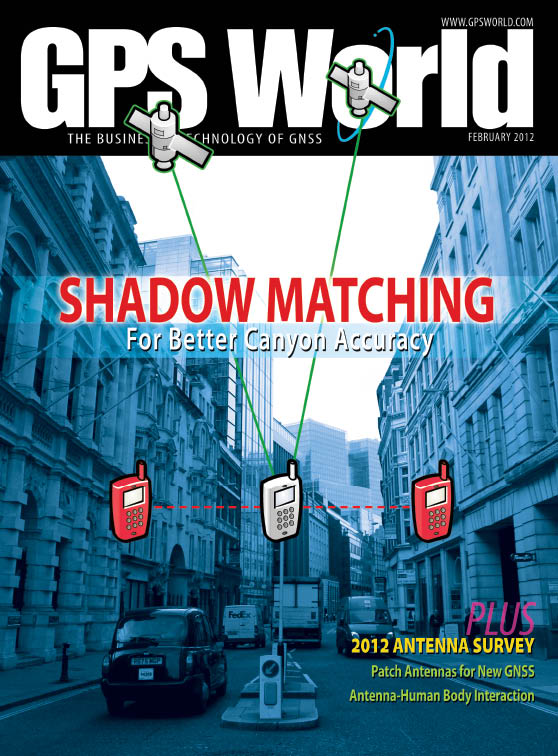
    GPS0212_01_Cover_lowres  Cover: GPS WorldAntennas and the Human Body

    We have been reading with much interest the Innovation column, “GNSS Antennas and Humans” (Innovation, February issue). As the interaction with the human body is something many companies designing GPS into their products do not consider, it is great to see this topic being given some recent attention. We do feel, however, that we should comment on some issues we see in the article, especially as one of our antennas has been used as part of the testing.

    As rightly mentioned in the article, many of the products using GPS where performance close to the body is potentially an issue are consumer products. These typically are of small size or at very least have major space constraints placed on those designing them. As such it is very unlikely that they would use either a large active patch antenna or in fact an active antenna from Sarantel. In the vast majority of consumer applications, either smaller patch antennas (12 × 12 millimeters, maximum) will be used with smaller ground planes or even small chip or planar inverted-F antenna (PIFA) style antennas.

    From a Sarantel perspective, we would recommend our smallest antenna, the passive SL1300, for these types of applications. In terms of how this would then affect the results of the test described in the article, our extensive testing of various antennas would suggest that with smaller patch antennas and linear antennas like chip and PIFA types, the impact of the body on antenna performance is greater than you would typically see with a large patch with a large ground plane. In addition, one of the reasons we would recommend our smaller antenna for this kind of application is because the ceramic material used has a much higher dielectric value than our larger products and as such is affected much less by the body or other interfering aspects of a product design.

    As I mentioned, we have done extensive testing of various antennas, much of which is available through the Application Centre section of our website. Further information can be shared if it would be of interest to your readers.

    — Chris Muir
    Director of Sales, Sarantel Limited

    Spectrum Swap

    I read with interest your article today (Latest News, February 1) concerning LightSquared looking at a possible spectrum swap in the current Aeronautical Mobile Telemetry band, used heavily by both the DOD and commercial side, primarily for aircraft and missile testing. I found it more interesting that the DOD MIDLANT Area Frequency Coordinator had been contacted concerning the same.

    First let me say that both the DOD and civil aviation and defense industries guard these bands quite strongly as individual users and via the Aerospace Flight Test Radio Coordinating Council (AFTRCC). AFTRCC is also the recognized non-government coordinator for these bands and resists any encroachment in these bands, while additionally allowing some temporary sharing when feasible.

    Secondly, I would add the the DOD has seven total Area Frequency Coordinators geographically spread across the United States, so contacting one would serve little purpose. Additionally, the coordinators are members of the DOD Frequency Management Group who one would say is the DOD equivalent of AFTRCC and believe me, both organizations are on the same sheet of music when it comes to defending AMT for flight-test purposes and even meet jointly twice a year to do just that. Combined with the DOD and if one looks at the member companies of AFTRCC any attempt to wrest any portion ATM spectrum away from the aerospace industry and DOD would be an expensive and lengthy process.

    This email does not constitute a response from either DOD or AFTRCC but that of a private citizen.

    — Wayne Morris
    Greenville, Texas

    Privacy Matters

    Good editorial (“When the Gavel Comes Down,” February issue). The three or four bases for the unanimous ruling in the instant case show a diversion of philosophy on this matter that is dangerous for resolution only through case and constitutional law.

    You are dead right, legislation is needed at the federal level before a hodgepodge of states and other jurisdictions make up their own policies for a global utility with manifold applications affecting privacy and personal and intellectual property, for good and for evil; morally neutral technology, as always….not just GNSS but as in most instances, GNSS enhanced.

    It would not be popular with the federal legislature, but I think some European Union deliberations on these subjects would be instructive for the U.S. Congress to heed in writing legislation. I wish that the White House and an interagency group like EXCOM could first take a non-political look at the trades and lead Congress, but that is unlikely to happen. Look at what nearly happened with the Software Owners Protection Act (SOPA) because of the lobbying power of media interests.

    Truly we live in interesting times, also from the stress on our constitutional concepts which often use tortured analogies to keep the law inside the four corners of the constitution.

    — James D. Litton
    President/CEO, Litton Consulting Group, Inc.

  • Out in Front: The Fire Next Time

    By Alan Cameron

    We have turned back the LightSquared effort to establish a threatening beachhead adjacent to GPS spectrum bands. Having expended many millions, we can now return to our business, secure in having demonstrated both our rights and our rightness.

    No. We cannot afford to do that.

    Radio spectrum is today’s natural resource, vital to current ventures and even more essential to future business and national growth of all kinds. It is far too valuable to be taken for granted, and far too vulnerable to be left protected simply by the Plan A recently executed.

    We will see attempt upon attempt upon attempt to use closely neighboring frequencies in disturbing ways — and, I daresay, to dislodge GNSS from the bands it now holds, by redistributing, re-allocating, and/or redefining spectra.

    Digging in deeper will not answer. It is questionable even now whether the numbers of GPS installed user base or the dollars they represent were sufficient to turn back the LightSquared initiative. It may have been, purely and simply, the Pentagon and the FAA.

    At any rate, the millions of installed GPS users and billions of dollars in industry and infrastructure may soon be dwarfed by billions of potential users and gazillions in economic benefit that broadband or any other spectrum-driven enterprise may muster. The future is wide open, as they say. It moves fast.

    Two courses of action show promise; there may be more.

    • Participate actively, pro-actively, even aggressively — and certainly with no time to waste — in the effort to define receiver standards. The NTIA and PNT EXCOM will devise “standards for the development and procurement of GPS receivers to support their various mission requirements.” NTIA recognized “the importance that receiver standards could play as part of a forward-looking model for spectrum management even beyond the immediate issue of GPS.”

    Get on board, bring productive ideas, work them through the process as efficiently and cooperatively as possible. Then design new products accordingly. Regulatory agencies, national and international, will have little patience with broadened use of other bands, no matter how long high-precision receivers have been doing it. We have been put on notice.

    • Aid, encourage, design products for interoperable GNSS, not to mention modernized GPS, particularly L5. Seek touchpoints with Galileo, GLONASS, and Compass developers, operators, and manufacturers. The broader, more wide-laned the base, the more frequencies that users and equipment can draw on, the more stable will be their operations, and the less vulnerable to encroachment, interference, or downright exclusion.

    Perhaps you have thought of other ways to ensure GNSS viability in a future of increasing demands for spectrum. I would love to hear them, and share them with our readers.

  • Expert Advice: Thank Your Lucky Stars

    Eric Gakstatter
    Eric Gakstatter

    In my 20-plus years of involvement in the GPS/GNSS industry, nothing has come close to the LightSquared debate for technical and political complexity, nor for potential effects on nearly every high-precision GPS/GNSS user in the United States. The industry’s destiny is somewhat controlled by a federal agency that is not very knowledgeable about how, when, and where GPS is used — although I’m sure they’ve learned a lot in the last 14 months.

    While receiver manufacturers have a firm grip on the technical complications of what LightSquared proposed, they have jockeyed for market position, as information released to the public is filtered through their marketing heads. Finally, media coverage is all over the place, from “LightSquared is doomed” to “this will happen.”

    On January 13, as we all know, the U.S. deputy secretaries for defense and transportation wrote, on letterhead of the Space-Based Positioning Navigation & Timing National Executive Committee (PNT EXCOM), to the head of the National Telecommunications Information Administration (NTIA), declaring that “there appear to be no practical solutions or mitigations that would permit the LightSquared broadband service, as proposed, to operate in the next few months or years without significantly interfering with GPS.”

    On February 14, the NTIA director wrote to the Federal Communications Commission (FCC) chairman in a similar vein with nearly the same language. That same day, the FCC stated its intent to “not lift the prohibition on LightSquared,” and to “vacate the Conditional Waiver Order, and suspend indefinitely LighSquared’s Ancillary Terrestrial Component authority.”

    It just so happens that LightSquared cannot accomodate military GPS users nor aviation GPS users. Those of you who use high-precision GPS can thank your lucky stars that the military and aviation folks are standing in your corner. Otherwise, as I warned back in May of last year, high-precision users would have been thrown under the onrushing bus of national broadband.

    In testimony to a House of Respresentatives subcommittee meeting on GPS and aviation in early February, the Transportation deputy secretary revealed that the Federal Aviation Administration (FAA) spent more than $2 million of taxpayer dollars with two different independent labs to conclude that LightSquared proposals were not compatible with several GPS-dependent air safety-of-flight systems.

    Don’t expect the Department of Defense (DoD) ever to provide similar testimony. The Pentagon played its veto card off-air and out of the public eye.

    LightSquared has continued to complain about GPS receivers “looking into our spectrum” as the reason for the interference GPS receivers are suffering. If you missed Richard Keegan’s December 2011 article in GPS World, you should take a look. He succinctly addresses this issue, as I did in my November 2011 Survey Scene column.

    As LightSquared has clearly lost the engineering argument, it has taken a very creative approach in an attempt to convince the FCC that this isn’t an engineering problem, but rather all about the FCC rules. LightSquared petitioned the FCC to confirm that “GPS devices are not entitled to protection from interference.”

    Crazy statement? If you think so, see if you recall reading this statement on equipment such as GPS receivers. It is on almost every electronic device that relies on radio signals.

    “This device complies with Part 15 of the FCC Rules. Operation is subject to the following two conditions:

    “(1) This device may not cause harmful interference, and (2) this device must accept any interference received, including interference that may cause undesired operation.”

    What if LightSquared can convince the FCC that GPS receivers do, indeed, fall within the confines of Part 15 of the FCC rules and aren’t entitled to interference protection? That’s what the company is trying to do, and that’s why this fight ain’t quite done.

    Don’t underestimate the power of the White House pushing the National Broadband Plan, or of commercial interests — of which there are myriad — seeking to turn a buck on the hunger, whether real or only perceived, for limitless broadband. Even the transportation depsec allowed in his testimony as how “in the Obama administration, we believe deeply in what LightSquared is attempting to do, which is to make the Internet more accessible to more people all across the country. This is an urgent national priority.”

    Communications for My RTK

    Some people in the GPS industry who believe that the LightSquared service will do wonders for RTK operations, somehow replacing the communications methods we currently use (UHF/VHF, 900MHz, GSM/GPRS, CDMA, Wifi/Mifi, etc.). I disagree.

    LightSquared was relying on Sprint’s infrastructure (~31,000 towers) for its terrestrial operations, supplementing them with ~3,400 LightSquared towers at some point. I’ve used Sprint’s mobile phone service for about 12 years and I used Sprint’s data card service for several years (not any longer). I pretty much know that Sprint is good for metro areas and poor for rural areas. Like other wireless providers (AT&T, Verizon, T-Mobile, etc.), Sprint is strong in some geographic areas, and weak in others. Since LightSquared is focused on serving people (densely populated areas) rather than geographic areas (e.g., farmlands), their terrestrial service is not going to be even close to being nationwide. LightSquared’s solution for areas not covered by their terrestrial service is to use satellite communications for Internet connectivity.

    If you think you would enjoy ubiquitous coverage with satellite communications for your RTK operations, consider OmniSTAR’s service, which is in the same spectrum as what LightSquared proposed. OmniSTAR works great when there’s a clear view of the sky to one of OmniSTAR’s satellites (ironically, operated by LightSquared) such as in the agriculture industry. But I’ve used it a bit and — just like GPS — it doesn’t work in buildings, in vehicles, under trees, or in other obstructed-sky locations.

    Can you imagine using a LightSquared mobile phone that doesn’t work in buildings, in cars, or under trees? You wouldn’t. Anyone who’s ever used RTK knows that spotty base/rover communications is the quickest way to spoil an RTK party. With GPS/GLONASS receivers allowing us to use RTK in places where we’ve rarely ventured before, the limitation wouldn’t be the number of navigation satellites in view, but rather if the LightSquared satellite was in view.

    For those of you who heard that LightSquared might have been a good idea in order to make wireless mobile Internet access more affordable, I seriously doubt that statement as well. Documents in a huge Freedom of Information Act release by the FCC reveal what LightSquared was planning to charge its wholesale customers (not retail) when they were out of range of the terrestrial system and forced to use LightSquared’s satellite for wireless broadband. The wholesale cost of their satellite broadband service was to be $10 per megabyte (not gigabyte), an astonishingly high price for a company that’s been touting affordable, nationwide wireless broadband Internet service.

    Upgrade Costs

    A cool $2.4 billion was the official estimate given for aviation industry upgrades, should LightSquared have gone forward. I think that’s conservative because I doubt it covers the infrastructure upgrade cost (WAAS, GBAS, and so on) or the cost of NextGen program delays.

    How about something closer to home? I queried the administrator of a statewide RTK network of 103 GNSS reference stations, and used his estimates to extrapolate national costs in that regard: 7,000 CORS receivers across the United States. They look like this: optimistic scenario, $64 million; likely,$92 million; worst-case scenario, $120 million.

    Keep in mind that this is only the high-precision GPS/GNSS infrastructure in the United States. There are still hundreds of thousands of high-precision GPS/GNSS receivers owned by users across the country that would have to be upgraded. For many GPS receivers (think handheld), there will be no upgrade solution, so the manufacturer might offer trade-in credit for a new GPS receiver.

    After spending time to understand the actual costs of accomodating LightSquared, one state legislator who initially voiced his support for LightSquared said “we can’t afford it.”

    New Beginnings

    Included in the NTIA report was a recommendation that, with time, GPS receivers could be redesigned in order to accomodate LightSquared’s 10L signal.

    NTIA also reported that during the January 13 EXCOM meeting, it was agreed that “federal agencies will move forward this year to develop and establish new GPS spectrum interference standards that will help inform future proposals for non-space commercial uses in the bands adjacent to the GPS signals and ensure that any such proposals are implemented without affecting existing and evolving uses of space-based PNT services vital to economic, public safety, scientific, and national security needs.”

    In summary, GPS/GNSS receiver designs will change in the coming years and move towards more efficient use of spectrum. To me, a critical statement in the NTIA letter to the FCC is “without affecting existing and evolving” — meaning that not only should GPS be considered, but also GPS-like systems from other countries such as Russia’s GLONASS, Europe’s Galileo, and other developing satellite navigation systems and applications.


    ERIC GAKSTATTER is contributing editor for survey of GPS World, and editor of Geospatial Solutions.

  • Brave New World of Data via the Cloud

    The frightening thing about the Mobile World Congress in Barcelona, the bloody awful frightening thing is the sheer amount of data talked about, enthusiastically envisioned, planned for. Planned for in the sense of throwing up business cases and wheeling and dealing new products and services for millions and billions of users that will pump vast amounts of data, countless numbers of gigabytes, terabytes, petabytes, exabytes per second through the cloud.

    Not planned for in the sense of actually making provision for.  Seeing if there’s enough resource on hand. Calculating if the ecosystem will handle it.

    No, wireless carriers and everyone else involved in this industry make money on data. So let’s make, make, make, more, more, more.

    Did anyone happen to estimate the amount of bandwidth needed to upload and download all this data? Has anyone thought about what pressure it might bring on other spectrum users such as, perhaps, GNSS?

    My guess is no, and no, and we don’t care. Because we are creating the future, don’t you see?!!?

    From this brave new world sprang LightSquared, born of the ravenous need for more wireless data. It doesn’t take much time at the Mobile World Congress to see that venture as just the first very tentative probe. Armies are massed at our borders.

    I didn’t get to location as a blue-chip commodity, as promised yesterday. That will have to come tomorrow.

  • Our Man in Barcelona

    Smartphones are taking over the world, and not just modern industrialized societies. A Broadcom executive predicted today at the Mobile World Congress in Barcelona that, with costs going down for less expensive models, smartphones will not only be the first phone of any kind for many people in India and other developing nations, it will constitute their first Internet experience.

    There’s a whole lot of change coming for North America and European users, too, and much of that is being envisioned, enthusiastically promulgated, and occasionally even demonstrated at this global village of 60,000 modcom movers and shakers that congregate here every year.  Just a few examples:

    • granting access to one’s location data for only a set period, from 15 minutes to 4 hours, via Glympse.
    • location-based display advertising, not just coupons, but glossy little ads on your screen, called up by proximity to the advertiser, via Sofialys.
    • centimeter-accurate indoor navigation, to the product on the shelf and not to its competitor product next to it on the same shelf, via Wi-Fi and near-field communication (NFC), Broadcom again but others including LocAid are talking about it too.
    • An alarm clock function on your phone that will wake you (or let you sleep) at exactly the right time for that morning, based on real-time traffic and weather conditions on your commute route, from Airbiquity.

    All this with either a few deft touches of the smartphone screen, or automatically enabled.

    And this is just the location aspect of smartphones, which represents maybe 5 percent of what’s being talked about here.  Tons of other apps for health and entertainment and more.

    Tomorrow: location as a blue-chip commodity.

  • Never Again? Oh, Again and Again.

    When the last English inhabitant of Virginia’s Lost Colony succumbed to hunger or swamp fever or local assimilation in 1588, Chesapeake chief Powhatan may have turned to his council and said, “Well, that’s the last of that. No more will we be troubled by outsiders infringing on our territory. Let’s get back to doing what we do best.”

    That would have been a monumental mistake, of course. Wave upon wave upon wave of outsiders followed, building over course of time the entity we now know as the United States and leaving precious little for the land’s original inhabitants.

    Let us now contemplate ourselves as the original holders, by right, of spectrum bands at 1176.45 MHz (L5), 1227.60 MHz (L2), 1381.05 MHz (L3), and 1575.42 MHz (L1). We have repelled the LightSquared encroachers, who sought to appropriate, well, not exactly our bands, but bands close enough to cause trouble. Having expended many millions in the effort, we can now return to our various businesses, secure in having demonstrated both our rights and our rightness.

    No, we cannot afford to do that.

    Radio spectrum is today’s natural resource, vital to current ventures and even more essential to future business and national growth of all kinds. It is far too valuable to be taken for granted, and far too vulnerable to be left protected simply by the Plan A recently demonstrated.

    We will see attempt upon attempt upon attempt to use closely neighboring spectra in disturbing ways — and, I daresay, even to dislodge GNSS from the bands it now holds. Petitions to redistribute, reallocate, and/or redefine spectra. Treaties, if you will. Students of history know how that goes.

    Digging in deeper will not answer. It is questionable even now whether the numbers of GPS installed user base or the dollars they represent were sufficient to turn back the LightSquared initiative. It may have been, purely and simply, the Pentagon and the FAA.

    At any rate, the millions of installed GPS users and billions of dollars in industry and infrastructure may soon be dwarfed by billions of potential users and gazillions in economic benefit that broadband or any other spectrum-driven enterprise may muster. Just as the numbers of Native Americans were quickly and vastly overcome by Europe’s teeming masses.

    Two courses lie immediately open to the GPS community, and there may be more.

    1. Participate actively, pro-actively, even aggressively — and certainly with no time to waste — in the effort to define receiver standards. The NTIA and PNT EXCOM will devise “standards for the development and procurement of GPS receivers to support their various mission requirements.” NTIA recognized “the importance that receiver standards could play as part of a forward-looking model for spectrum management even beyond the immediate issue of GPS.”
      Get on board, bring productive ideas, work them through the process as efficiently and cooperatively as possible. Then design new products accordingly. Regulatory agencies, national and international, will have little patience with broadened use of other bands, no matter how long high-precision receivers have been doing it. We have been put on notice.
    2. Aid, encourage, design products for interoperable GNSS, not to mention modernized GPS, particularly L5. Seek touchpoints with Galileo, GLONASS, and Compass developers, operators, and manufacturers. The broader, more wide-laned the base, the more frequencies that users and equipment can draw on, the more stable will be their operations, and the less vulnerable to encroachment, interference, or downright exclusion.

    Perhaps you have thought of other ways to ensure GNSS viability in a future of increasing demands for spectrum. I would love to hear them, and share them with our readers.

  • LightSquared Snuffed by NITA, FCC

    The more than year-long battle between wireless start-up LightSquared and the GPS industry peaked earlier this week when the National Telecommunications and Information Administration (NTIA), tasked by the Federal Communications Commission (FCC) to study the potential interference problem between LightSquared’s mobile wireless proposal and GPS receivers, issued a statement and report with the following conclusion:

    “The federal agencies and LightSquared have invested significant time and resources to identify and analyze proposed solutions to address the impact of LightSquared’s planned network implementations. Based on the testing and analyses conducted to date, as well as numerous discussions with LightSquared, it is clear that LightSquared’s proposed implementation plans, including operations in the lower 10MHz would impact both general/personal navigation and certified aviation GPS receivers. We conclude at this time that there are no mitigation strategies that both solve the interference issues and provide LightSquared with an adequate commercial network deployment.”

    Read the entire letter from the NTIA to the FCC here (pdf).

    Read the NTIA technical report here (pdf). 

    The FCC subsequently issued a statement including the following paragraph:

    “NTIA, the federal agency that coordinates spectrum uses for the military and other federal government entities, has now concluded that there is no practical way to mitigate potential interference at this time. Consequently, the Commission will not lift the prohibition on LightSquared. The International Bureau of the Commission is proposing to (1) vacate the Conditional Waiver Order, and (2) suspend indefinitely LightSquared’s Ancillary Terrestrial Component authority to an extent consistent with the NTIA letter. A Public Notice seeking comment on NTIA’s conclusions and on these proposals will be released tomorrow.”

    As promised, the FCC subsequently opened a Public Notice seeking comments based on NTIA’s report and conclusions. View the Public Notice here. Public comments close on March 1, 2012. If you have invested in GPS technology, you should enter your comments to protect your investment.

    Submitting your comments to the FCC only takes five minutes. You don’t need to write an essay. Just state that you support the NTIA’s conclusion.

    You can compose your comments in a text editor like Notepad, then save the file and attach it. Once you go to the FCC comment submission website, it will make sense. If you have any problems, email me.

    1. Go to the FCC comment submission website by clicking here.
    2. Type in the following information:
    • Proceeding Number: 11-109
    • Name of Filer: Enter your name
    • Address Line 1: Enter your address
    • City: Enter your city
    • State: Enter your state
    • Zip: Enter your zipe code
    • Attach your comments

    That’s it. Five minutes and you’re done.

    You might have heard about another Public Notice that the FCC issued regarding LightSquared. It is in response to LightSquared’s petition to rule that GPS receivers are not entitled to interference protection. I wrote about it last week. You can read my article here. At that time, I was planning to submit my comments, but that was before the NTIA released its report and conclusions this week. I wouldn’t suggest you not enter a comment to the earlier Public Notice, but certainly I’d focus on entering comments on the latest Public Notice in support of NTIA’s report and recommendations.

    For those of you who heard that LightSquared might have been a good idea in order to make wireless mobile Internet access more affordable, I have serious doubts about that statement. Here’s why…

    Borrowing from my article last week, LightSquared is relying on Sprint’s infrastructure (~31,000 towers) for its terrestrial operations, and supplementing them with ~3,400 LightSquared towers at some point. I’ve used Sprint’s mobile phone service for about 12 years, and I used Sprint’s data card service for several years (not any longer). I pretty much know that Sprint is good for metro areas and poor for rural areas. Like other wireless providers (AT&T, Verizon, T-Mobile, etc.), Sprint is strong in some geographic areas, and weak in others. Since LightSquared is focused on serving people (densely populated areas) rather than geographic areas (e.g., farmlands), their terrestrial service is not going to be even close to being nationwide. LightSquared’s solution for areas not covered by their terrestrial service is to use satellite communications for internet connectivity. If you want to know more about this, read Tim Farrar’s blog on the subject, which includes a map of LightSquared’s terrestrial coverage. I’ve asked LightSquared for the most current deployment map, but received no response. I’ve been unable to find it even in their FCC filings (maybe you can), but I have to believe that if it was something to be proud of, they would be showing it to everyone.

    Furthermore, in a huge FOIA (Freedom of Information Act) document release last week by the FCC, documents reveal what LightSquared was planning to charge their wholesale customers (not retail) when customers were out of range of their terrestrial system and forced to use LightSquared’s satellite for wireless broadband. The wholesale cost of their satellite broadband service was to be $10 per megabyte (not gigabyte), an astonishingly high price for a company that’s been touting affordable, nationwide wireless broadband Internet service. If you want to read for yourself, click here. You can read about LightSquared’s objections to the FOIA document release here.

    LightSquared bankruptcy looming?

    Of course, after the NTIA issued its report and conclusions this week, there were many rumors that LightSquared would soon declare bankruptcy. In response, LightSquared financier Phil Falcone told Reuters “It is clearly not on our table” and that “There are other ways around this.”

    Other rumors include a proposed spectrum swap that GPS World reported two weeks ago. Although it’s tough to rule out anything, this would be quite a stretch, especially for the spectrum mentioned in the GPS World article (1515-1525 MHz) since it’s still close enough to LightSquared’s 10L signal (1526-1536 MHz) that failed to pass the NTIA’s interference testing that it would likely require another round of GPS interference testing. Furthermore, one of the NTIA’s sticking points was the potential interference from LightSquared’s mobile devices, which operate (uplink) in the 1626.5-1660.5 Mhz range, so that would need to be addressed as well.

    The beginning of a new era of GPS/GNSS technology.

    Included in the NTIA report was a recommendation that, with time, GPS receivers could be redesigned in order to accomodate LightSquared’s 10L signal.

    NTIA also reported that during the January 13 Excom (Position, Navigation, Timing Executive Committee) meeting, it was agreed that “federal agencies will move forward this year to develop and establish new GPS spectrum interference standards that will help inform future proposals for non-space commercial uses in the bands adjacent to the GPS signals and ensure that any such proposals are implemented without affecting existing and evolving uses of space-based PNT services vital to economic, public safety, scientific, and national security needs.”

    In summary, GPS/GNSS receiver designs will change in the coming years and move towards more efficient use of spectrum. To me, a critical statement in the NTIA letter to the FCC is “without affecting existing and evolving,” meaning that not only should GPS be considered but also GPS-like systems from other countries such as Russia’s GLONASS, Europe’s Galileo, and other evolving satellite navigation systems and applications.

    For the latest news, join me next Monday on the ACSM Radio Hour (Monday, February 20)

    The LightSquared situation is still very fluid. There seems to be a new twist almost daily.

    This past Monday, I was a guest on ACSM’s (American Congress on Surveying and Mapping) Radio Hour with Gavin Schrock and Laurence Socci, hosted by ACSM’s Curt Sumner. You can listen to a recording of the show here.

    Due to the significant events that occured this week, I’m returning as a guest either next Monday or the following along with Gavin Schrock to discuss the latest developments. You can join us here at 8 a.m. Pacific/11 a.m. Eastern U.S. time on either day, or the show will be recorded and available for you to listen to at a later date.

    Thanks, and see you next week.

    Follow me on Twitter at http://twitter.com/GPSGIS_Eric