Category: Survey

  • Discussing the new North American-Pacific Geopotential Datum of 2022 — Part 1

    Discussing the new North American-Pacific Geopotential Datum of 2022 — Part 1

    On April 24-25, 2017, the National Geodetic Survey (NGS) hosted the 2017 Geospatial Summit in Silver Spring, Maryland, to discuss its plans for replacing the North American Datum of 1983 (NAD 83) and the North American Vertical Datum of 1988 (NAVD 88) in 2022.

    The summit was a day and a half long and provided an opportunity for NGS to share updates and discuss the progress of projects related to National Spatial Reference System (NSRS) Modernization. Stakeholders across the federal, public and private sectors also provided feedback and impacts of New Datums on their products and services.

    The absolute differences between the new vertical reference frame, North American-Pacific Geopotential Datum of 2022 (NAPGD2022), and NAVD 88 are going to be large but, in most regions of the country, the relative differences over small areal extents will be small.

    NGS is developing geodetic routines and tools to transform heights from NAVD 88 to NAPGD2022, and to facilitate the incorporation of geodetic leveling data into NAPGD2022 to establish NAPGD2022 heights. To prepare for the new datums and develop implementation plans, stakeholders should obtain an understanding of the differences between NAPGD2022 and NAVD 88.

    My previous columns provided figures that demonstrated the approximate differences between NAPGD2022 and NAVD 88 heights at a national level. (See figure 1.) This column will provide feedback from stakeholders that participated in the Geospatial Summit and, using NGS’ GPS on BMs dataset, a discussion on the differences between NAPGD2022 and NAVD 88 (and NGVD 29) at a local level.
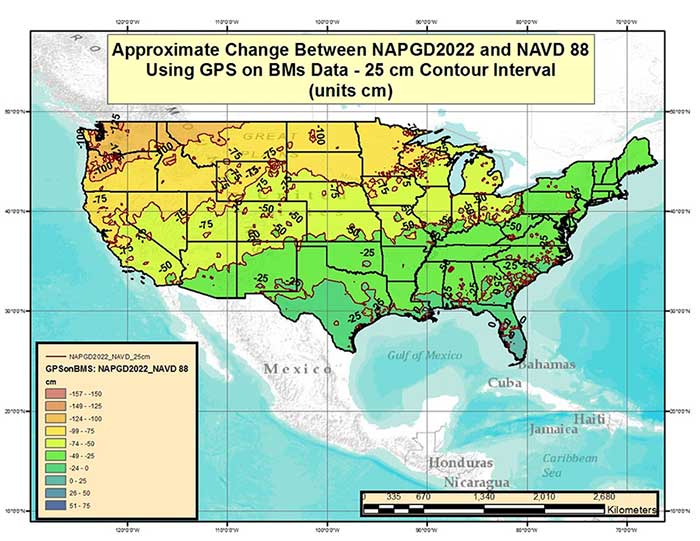
    Figure 1 – Approximate Change Between NAPGD2022 and NAVD 88 Using GPS on BMs Data (units = cm). (Image: National Geodetic Survey)
    Figure 1 – Approximate Change Between NAPGD2022 and NAVD 88 Using GPS on BMs Data (units = cm). (Image: National Geodetic Survey)

    Information about the summit and Summit Documents can be downloaded here.

    Read an excerpt from website here.

    If you check on the tab titled “Summit Documents” you can download the agenda and documents provided to participates. Read excerpts from the summit here.

    The first day consisted of presentations by NGS leadership and personnel providing updates and discussing the progress of projects related to the NSRS modernization. The presentations by NGS employees can be downloaded from NGS’ presentations library at this web link. View an excerpt from NGS’ presentations library here.

    The afternoon of day 2 were presentations by partners and stakeholders. (See box titled “Excerpt from NGS 2017 Geospatial Summit Agenda – Afternoon of Day 2.”)

    Excerpt from NGS 2017 Geospatial Summit Agenda – Afternoon of Day 2
    Day 2 Afternoon Agenda from NGS’ 2017 Geospatial Summit
    Day 2: Tuesday, April 25, 20171:30 – 3:05 Impacts of New Datums on Programs and Partners (Part 1)
    Coastal Mapping Program and VDatum: Mike Aslaksen and Stephen White, NOAA/NGS
    Federal Emergency Management Agency (FEMA): Kimberly Pettit, FEMA
    U.S. Geological Survey (USGS): Kari Craun, USGS
    U.S. Army Corps of Engineers (USACE): Jim Garster, USACE
    National Geospatial-Intelligence Agency (NGA): Stephen Malys, NGA
    3:05 – 3:25 Break
    3:25 – 4:55 Impacts of New Datums on Programs and Partners (Part 2)
    Geospatial and Remote Sensing Customers: Amar Nayegandhi, Dewberry
    Geographic Information System (GIS) Customers: Kevin Kelly, Esri
    Global Navigation Satellite System (GNSS) Equipment Customers: Hamid Mahmoudabadi, Trimble Kyle Snow, Topcon
    State Government Partners: Gary Thompson, N.C. Department of Public Safety
    Local Government Partners: Vickie Anglin, Fairfax County Government, Virginia; Patrick Simon, Baltimore County Land Survey, Maryland
    4:55 – 5:00 Wrap-up and closing

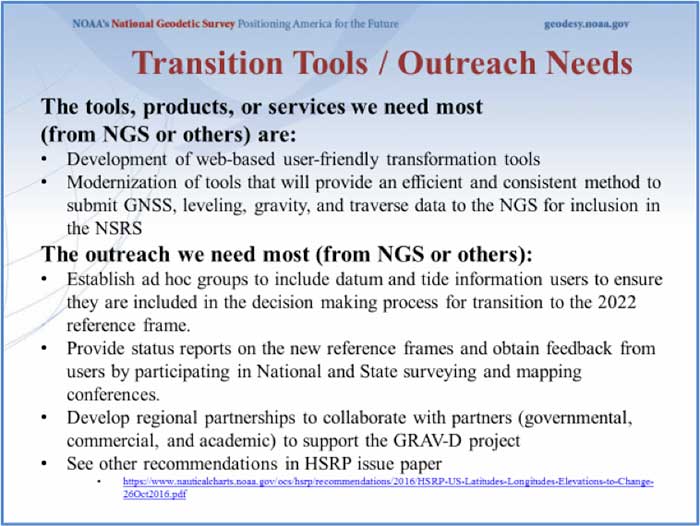
    In order for consistency, NGS provided guidance and a set of template slides for guest presenters to use. Guest presenters were allotted 10 minutes to present and limited to four slides. The presentation by the guest presenters are not on NGS’ Presentations Library but I’ve been told that they will be available on the Summit website later this year. Gary Thompson, Chief of the North Carolina Geodetic Survey (NCGS), provided me a copy of his slides and gave me permission to include them in this column. (See box titled “Power point Slides Presented by Gary Thompson, Chief of NCGS, at the NGS 2017 Geospatial Summit.”) North Carolina has been very proactive in addressing the impacts of the new datums on NC products and services. North Carolina Geodetic Survey has established a North Carolina Geodetic Survey Advisory Committee that reviews NCGS products and services, and they have established the North Carolina 2022 Reference Frame Working Group to prepare for the new datums.

    Slide: National Geodetic Survey
    Slide: National Geodetic Survey

    Powerpoint slides presented by Gary Thompson, chief of NCGS, at the NGS 2017 Geospatial Summit

    All of the presentations by the invited guest speakers were interesting, and everyone followed NGS’ guidance which helped to focus the Summit on the main issues associated with a datum change. As expected, each stakeholder had their own set of issues and concerns about transitioning to a datum. The following are some common themes that I heard from the participants:

    (1) There are a lot of products and services that will be effected by a datum change,
    (2) An official transformation model between the old and new datum(s) published by NGS is critical for a successful transition to a new datum,
    (3) Guidance documents that are “easily” understood by “non-geodesists” is required for a smooth implementation of a new datum, and
    (4) More frequent geospatial summits and webinars are needed to provide updates on the status of the projects associated with NSRS modernization and to ensure user involvement in the process.

    I contacted a couple of the guest presenters to discuss their feedback on the New Datums. As NAVD 88 Program Manager, I collaborated with many of them during the development and implementation of the NAVD 88. As in the transition from NGVD 29 to NAVD 88, it’s not the conversion of coordinates that’s a problem; a good transformation tool should meet that requirement. Saying that, it was stated that many users rely on commercial and open source software to convert their data, so they would like NGS to collaborate with others to ensure that these software suppliers are using the appropriate algorithms/information in their products. The integration with legacy data referenced to older datums may be complicated for some products and services; therefore, the process of transforming each product and service will need to be addressed individually. If all data are in digital form with the appropriate metadata, then the transformation should be relatively easy to accomplish and maps with new contour lines or new base flood elevations referenced to the new datum could be generated. However, how these new maps are integrated with old maps is a different issue. I will address some of these potential issues in future columns.

    To prepare implementation plans, users must obtain a working knowledge of the differences between the old and new datums. As previous mentioned, the absolute differences between the new vertical reference frame, NAPGD2022, and NAVD 88 are going to be large but, in most regions of the country, the relative differences over small areal extents will be small. To evaluate the relative differences at the local level, the differences between NAPGD2022 and NAVD 88 (and NGVD 29) were computed for bench marks in the NGS’ GPS on BMs dataset. The NAD 83 (2011) latitude, longitude, and ellipsoid height of each station was transformed to the IGS08 reference frame using NGS’ HTDP web tool, and then the GNSS-derived orthometric height was computed using the following formula:

    Approximate NAPGD2022 GNSS-Derived Orthometric Height
    Equals
    IGS08 Ellipsoid Height minus xGeoid16b Geoid Height (referenced to IGS08).

    Figure 1 is a plot of the difference between the approximate NAPGD2022 height and the published NAVD 88 height for bench marks that are part of the GPS on BMs dataset and have the published attribute of “Adjusted.” It should be noted that these are only estimated changes because the final NAPGD2022 reference frame will not be exactly the same as the current IGS08 reference frame, but these estimates should serve the purpose of providing approximate changes for users to develop transition plans.

    Since some users are still converting NGVD 29 heights to NAVD 88 heights, the approximate change between NAPGD2022 and NGVD 29 is provided in figure 2. VERTCON values were used to convert the NAVD 88 published heights to NGVD 29 heights, and then the difference between the approximate NAPGD2022 orthometric height and the NGVD 29 orthometric height was computed.
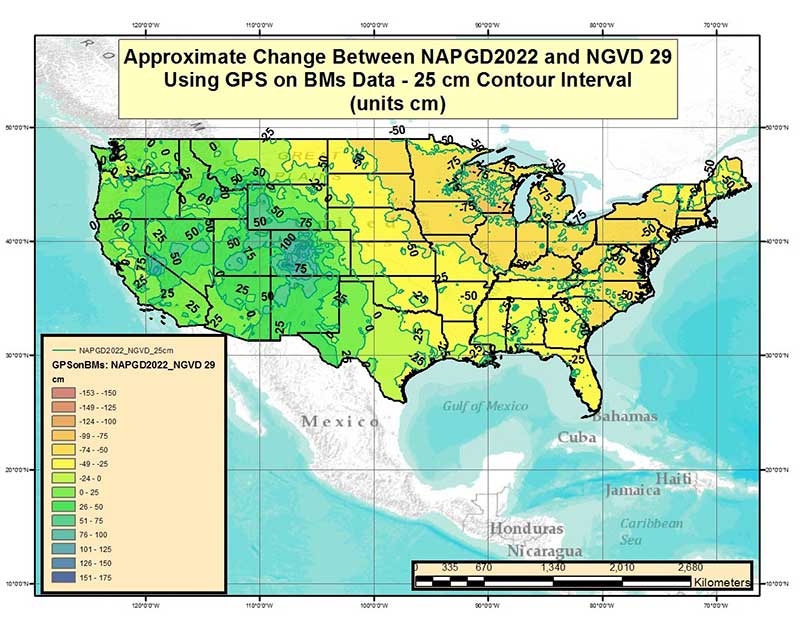
    Figure 2 – Approximate Change Between NAPGD2022 and NGVD 29 Using GPS on BMs Data (units = cm). (Image: National Geodetic Survey)
    Figure 2 – Approximate Change Between NAPGD2022 and NGVD 29 Using GPS on BMs Data (units = cm). (Image: National Geodetic Survey)

    As shown in figure 2, the absolute differences between the new vertical reference frame, NAPGD2022, and NGVD 29 are also going to be large but, once again, in most regions of the country, the relative differences over small areal extents will be small.

    What does this look like in a local area? Figure 3 is a plot of the approximate change between NAPGD2022 and NAVD 88 in North Carolina and surrounding states, and figure 4 is plot of the approximate change between NAPGD2022 and NGVD 29 in North Carolina and surrounding states.
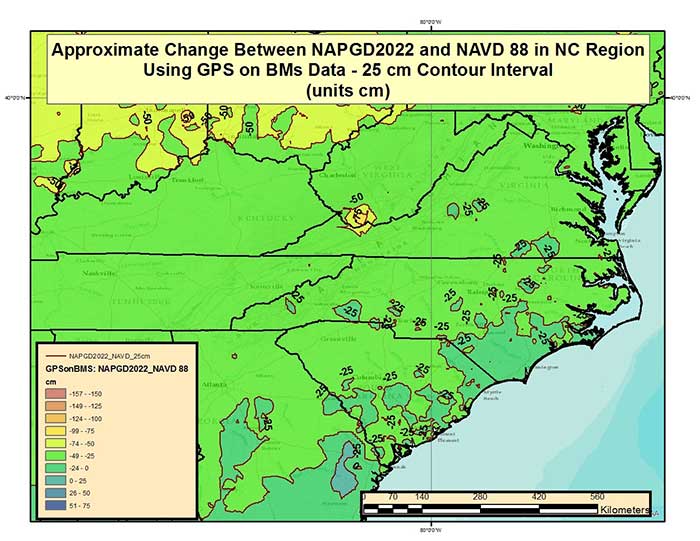
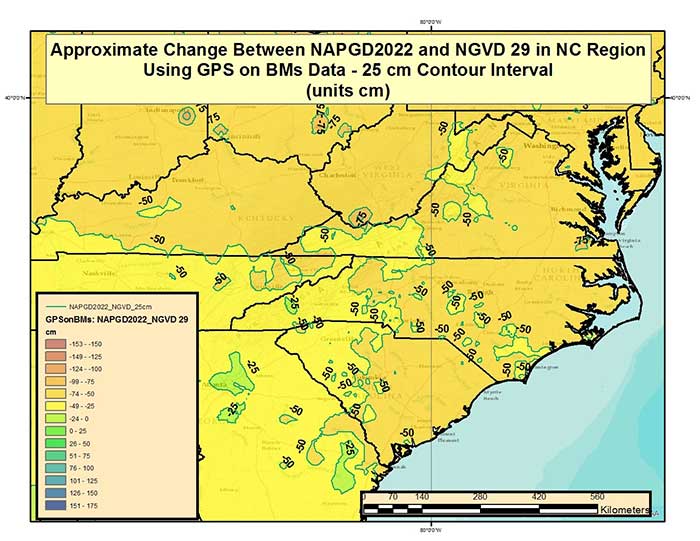
    Figure 3 – Approximate Change Between NAPGD2022 and NAVD 88 in North Carolina and Surrounding States Using GPS on BMs Data (units = cm). (Image: National Geodetic Survey)
    Figure 3 – Approximate Change Between NAPGD2022 and NAVD 88 in North Carolina and Surrounding States Using GPS on BMs Data (units = cm). (Image: National Geodetic Survey)
    Figure 4 – Approximate Change Between NAPGD2022 and NGVD 29 in North Carolina and Surrounding States Using GPS on BMs Data (units = cm). (Image: National Geodetic Survey)
    Figure 4 – Approximate Change Between NAPGD2022 and NGVD 29 in North Carolina and Surrounding States Using GPS on BMs Data (units = cm). (Image: National Geodetic Survey)

    Figure 5 provides a more detailed depiction of the change between NAPGD2022 and NAVD 88 along the North Carolina Atlantic Coast. The differences appear to vary by several centimeters but some of these differences are due to errors in published heights (both ellipsoid and orthometric). These differences can be used to develop a transformation model but the user will need to know the accuracy of the model, globally and locally.
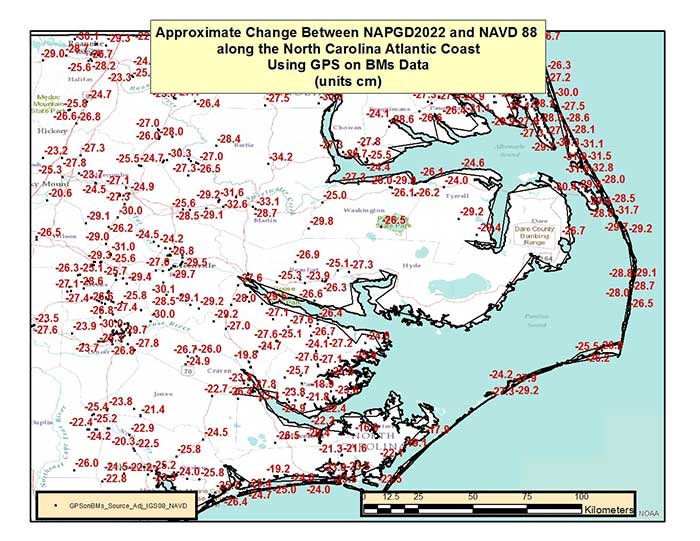
    Figure 5 – Approximate Change Between NAPGD2022 and NAVD 88 along North Carolina Atlantic Coast Using GPS on BMs Data (units = cm). (Image: National Geodetic Survey)
    Figure 5 – Approximate Change Between NAPGD2022 and NAVD 88 along North Carolina Atlantic Coast Using GPS on BMs Data (units = cm). (Image: National Geodetic Survey)

    Figure 6 is a detailed depiction of the change between NAPGD2022 and NGVD 29 in the same area as shown in figure 5. Comparing figures 5 and 6, the reader should notice that the differences between NAPGD2022 and NGVD 29 are about 30 cm larger (more negative) than the differences between NAPGD2022 and NAVD 88.
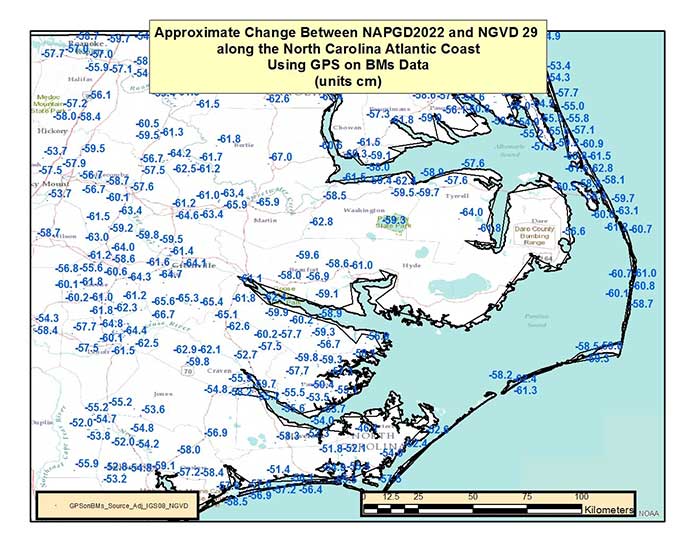
    Figure 6 – Approximate Change Between NAPGD2022 and NAVD 29 along North Carolina Atlantic Coast Using GPS on BMs Data (units = cm). (Image: National Geodetic Survey)
    Figure 6 – Approximate Change Between NAPGD2022 and NAVD 29 along North Carolina Atlantic Coast Using GPS on BMs Data (units = cm). (Image: National Geodetic Survey)

    Figure 7 is the difference between NAPGD2022 and NAVD 88 in western North Carolina. The local difference in the NC mountains is around -35 cm which is about 10 cm different from the NC Atlantic Coast. Questions that users need to address include: What is the accuracy of the transformation model? And What is the accuracy of the product or service being transformed? The transformation model will not replace the original survey results but may be useful for transforming some products and services.
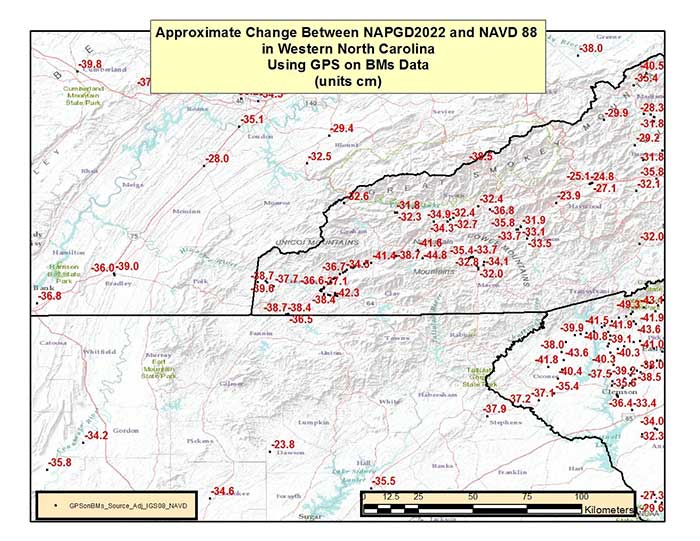
    Figure 7 – Approximate Change Between NAPGD2022 and NAVD 88 in the Western North Carolina Using GPS on BMs Data (units = cm). (Image: National Geodetic Survey)
    Figure 7 – Approximate Change Between NAPGD2022 and NAVD 88 in the Western North Carolina Using GPS on BMs Data (units = cm). (Image: National Geodetic Survey)

    Table 1 provides the average difference between NAPGD2022 and NAVD 88 (and NGVD 29) by State using the GPS on BMs dataset. This table shows that there are large differences between NAPGD2022 and both NGVD 29 and NAVD 88. No matter which datum the product or service is referenced to, it will probably need to be transformed to NAPGD2022.
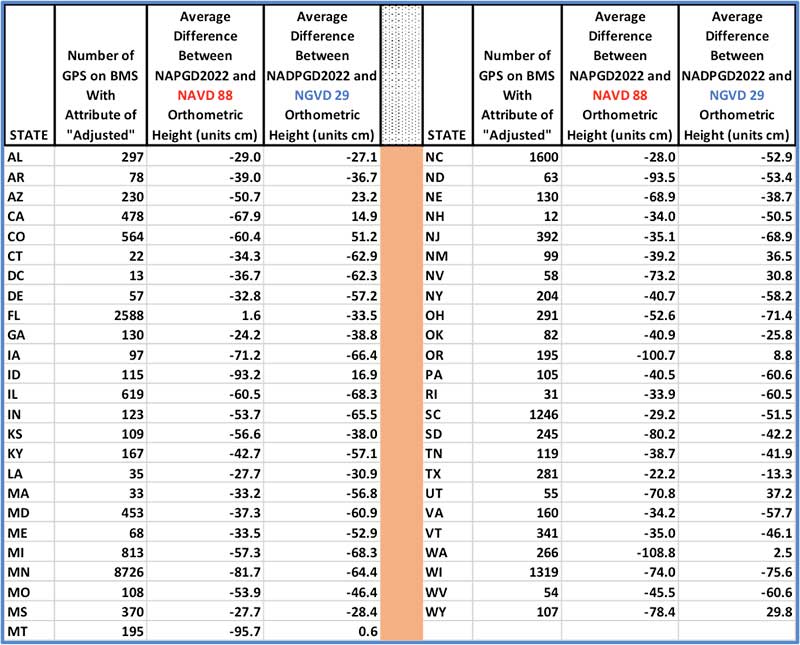
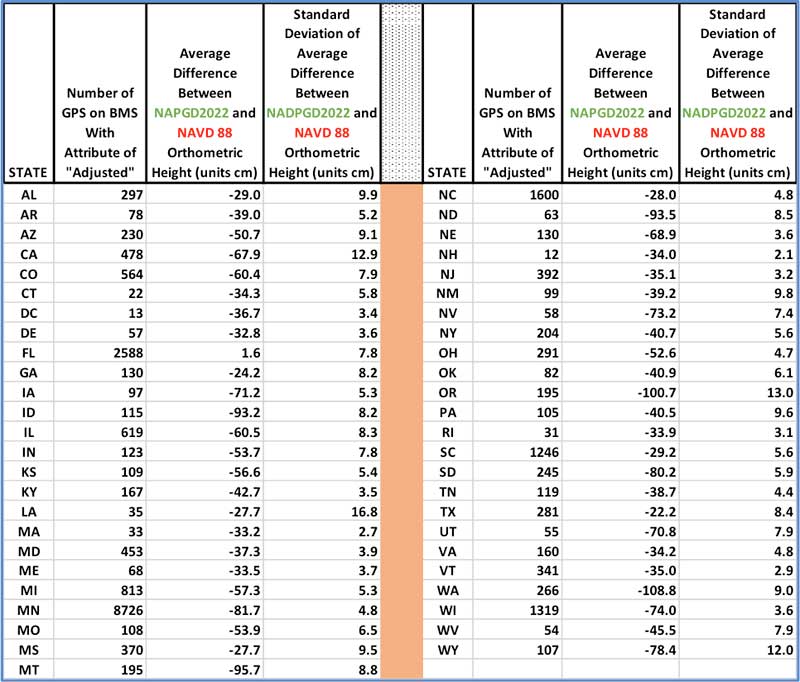
    Table 1 – Average Difference Between NAPGD2022 and NAVD 88 (and NGVD 29) by State Using GPS on BMs Dataset (units = cm). Click to enlarge. (Date: National Geodetic Survey)
    Table 1 – Average Difference Between NAPGD2022 and NAVD 88 (and NGVD 29) by State Using GPS on BMs Dataset (units = cm). Click to enlarge. (Date: National Geodetic Survey)
    Average Difference Between NAPGD2022 and NAVD 88 by State Using GPS on BMs Dataset (units = cm). Click to enlarge. (Date: National Geodetic Survey)
    Average Difference Between NAPGD2022 and NAVD 88 by State Using GPS on BMs Dataset (units = cm). Click to enlarge. (Date: National Geodetic Survey)

    Table 2 provides the standard deviation of the average difference between NAPGD2022 and NAVD 88 by State. For example, North Carolina has a sample size of 1600 stations and its average difference is -28 cm with a standard deviation of 4.8 cm. Looking at figures 5 and 7, there appears to be a difference of 10 cm across the State. The States in the northwestern region of the United States have a larger difference between NAPGD2022 and NAVD 88 as well as a larger standard deviation. Oregon has a sample size of 195 stations and its average difference is -100.7 cm with a standard deviation of 13.0 cm, and Washington has a sample size of 266 stations and its average difference is -108.8 cm with a standard deviation of 9.0 cm. Figure 8 is a plot of the approximate change between NAPGD2022 and NAVD 88 in the northwest region of the United States.

    As mentioned previously, these differences will vary from station to station because of a bias and trend between the two datums and due to remaining errors in published heights (both ellipsoid and orthometric). As I have noted in previous columns, many of the large relative differences between stations in a local area could be due to an invalid NAVD 88 published height because the bench mark moved since the last time the height of the bench mark was adjusted and published, and/or an undetected error in an ellipsoid height due to a weak GNSS project design. Either way, in my opinion, most of these stations with large relative differences don’t accurately represent the current NAVD 88. NGS’ modernization of the NSRS will provide a more accurate and consistent reference frame, and improve the user’s ability to obtain a current and accurate orthometric height.
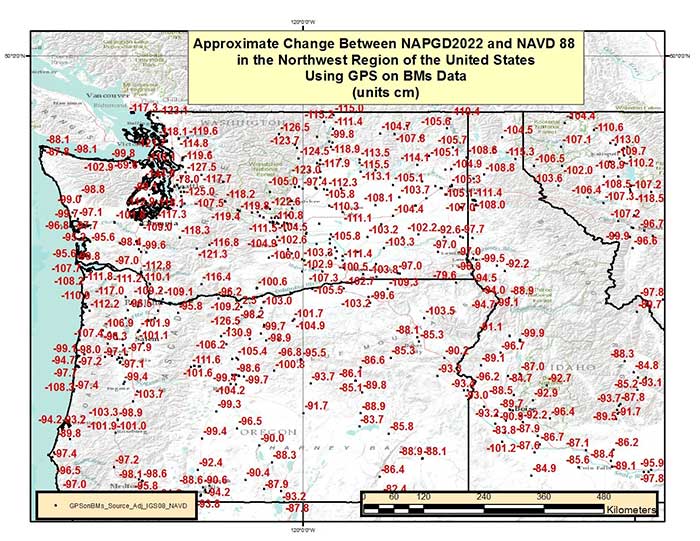
    Figure 8 – Approximate Change Between NAPGD2022 and NAVD 88 in the Northwest Region of the United States Using GPS on BMs Data (units = cm). (Image: National Geodetic Survey)
    Figure 8 – Approximate Change Between NAPGD2022 and NAVD 88 in the Northwest Region of the United States Using GPS on BMs Data (units = cm). (Image: National Geodetic Survey)

    This column highlighted some of the feedback provided by guest presenters at the NGS’ 2017 Geospatial Summit held on April 24-25, 2017, in Silver Spring, Maryland. The column also provided a discussion on the approximate differences between NAPGD2022 and NAVD 88 (and NGVD 29) at a national and local level. To prepare for the new datums and develop implementation plans, users should obtain an understanding of the differences between NAPGD2022 and NAVD 88. This column is the first in a new series of columns addressing topics associated with transitioning to the new North American -Pacific Geopotential Datum of 2022 (NAPGD2022).

  • NASA tests next phase of UAS traffic management system

    NASA tests next phase of UAS traffic management system

    NASA’s UAS Traffic Management System was tested May 25 at the Nevada UAS Test Site. (Credit: Drone America)

    On May 25, the Federal Aviation Administration (FAA)-designated Nevada UAS Test Site and its NASA partners flew five different unmanned aerial vehicles (UAVs) to test NASA’s Unmanned Aircraft System Traffic Management (UTM).

    The flights demonstrated multiple operational scenarios, including parachute-initiated emergency supply deliveries and aerial survey operations.

    The UAVs were flown beyond the pilot’s visual line of sight using strategically placed visual observers and sophisticated command and control, communication and detect-and-avoid technologies.

    The test is part of a three-week national campaign, which NASA is leading in close collaboration with the FAA and industry partners on a more complex version of its UTM technologies at six different UAS Test Sites around the nation.

    The Technology Capability Level 2 (TCL2) National Campaign began May 9 with the Nevada UAS Test Site as the first of six UAS Test Site to begin UTM operations this year.

    The partners not only demonstrated drone flight capability, but also tested UAS traffic mapping, sensor and radar technology, all of which were connected through a NASA UAS service supplier network to NASA Ames Research Laboratory.

    Six FAA UAS Test sites and industry partners integrate their technologies with NASA’s UTM research platform and test the UTM concept in a range of conditions representative of those in the U.S. Airspace, explaind Tom Prevot, UTM project manager.

    “For the Nevada NASA Team, we flew the longest multi-faceted NASA UTM flights to date in Nevada,” Prevot said. “The beyond-line-of-sight missions we completed over a distance of 13 miles north of Reno, Nevada, and the multiple aerial parachute package-delivery missions performed were a first in the National Airspace System under the NASA UTM.”

    Current testing of the UTM TCL2 Test marks the second year in a row NASA has taken its UTM technologies on the road to further assess and refine their capabilities. During April 2016, NASA and its partners tested TCL1, which involved line-of-sight operations, and then began the first phase of TCL2 demonstrations in October 2016.

    Two more phases, TCL3 and TCL4, each progressively more complex and involving flying drones with specific tasks over increasingly populated areas, are scheduled for 2018 and beyond.

    The aerial parachute package-delivery missions performed were a first in the National Airspace System under the NASA UTM. (Credit: Drone America)

    “Our Nevada NASA partners did an amazing job in extending the body of airspace management and sense-and-avoid knowledge under the UTM and across the UAS Industry,” said Chris Walach, director of the Nevada UAS Test Site. “The National Campaign data provided to NASA from our two-week operation will go a long way toward advancing the UTM for the FAA and the UAS Industry.”

    “At AirMap, we consider UTM to be a critical ingredient for a thriving drone ecosystem,” said Steve Willer, business development manager for AirMap. “The TCL 2 trials demonstrate that technologies for geofencing, data exchange, and more can enable safe and sophisticated drone operations, even beyond line of sight. Along with NASA, the FAA, and NIAS we’re excited to show how UTM can chart a safe course for the drone ecosystem.”

    Drone America is a proud participant in a Nevada Institute for Autonomous Systems (NIAS) led NASA Unmanned Traffic Management (UTM) program at the Reno Stead Airport,” said Mike Richards, president and CEO of Drone America. “The safe integration of Unmanned Aerial Systems (UAS) into the National Airspace System (NAS) is critical to the future of this industry. Drone America is fortunate to call Nevada our home. Working in a state that is very supportive and business friendly makes a tremendous difference to our future sustainability. Our partnership with NIAS and NASA will not only contribute to successful testing, this partnership will pave the way for future generations to experience the true value of autonomous systems.”

    Carbon Autonomous Systems of Reno, in conjunction with their partner SmartPlanes of Skellefteå, Sweden, successfully took part in the planning, coordination, and flying in the most recent TCL2 NASA / NIAS UAS/UTM exercises conducted at the Reno Stead Airport UAS Test Range of the Nevada FAA UAS statewide test complex,” said John Hammond, chief pilot for Carbon Autonomous.

    NIAS was also supported by Delair-Tech and SensoFusion who provided UAS and drone detection UAS technologies, which were also tested during this NASA UTM TCL 2 Test.

    “We have been designing, manufacturing, and operating UAVs in the civilian airspace for almost 10 years in 100 countries,” said Benjamin Benharrosh, co-founder and head of Delair Tech North America. “This landmark agreement with NIAS, and the associated data collected for the UTM system designed by NASA at the Reno UAS Test Site will push our traffic management technology to a new level of precision and insight. We are thrilled to collaborate with NIAS on solutions that represent a new era for the commercial UAV market and a better presence of Delair-Tech in the U.S.”

    “We’re excited to be shaping the future of air traffic management as an official partner of the NIAS by providing our counter-UAS solution, AIRFENCE, in the ongoing NASA UTM project. AIRFENCE is playing an active role in detecting, locating, and tracking UAS as part of the project, providing rich data to NASA as they develop their UTM system,” said Kaveh H. Mahdavi, Sensofusion VP of operations.

    “NASA is one of Nevada’s most valuable partners. We appreciate the opportunity to support NASA’s UTM development. It is truly cutting-edge technology and will be instrumental in integrating UAS into the national airspace,” said Tom Wilczek, Aerospace & Defense Industry Representative for the Nevada Governor’s Office of Economic Development.

  • Exhibitors at GEOINT to launch range of new products

    Exhibitors at GEOINT to launch range of new products

    A number of geospatial intelligence companies are exhibiting at the GEOINT 2017 Symposium, which is taking place June 4-7 at the Henry B. Gonzalez Convention Center in San Antonio, Texas.

    Hosted and produced by the United States Geospatial Intelligence Foundation (USGIF), the annual GEOINT Symposium is the nation’s largest gathering of industry, academia, and government to include defense, intelligence and homeland security communities as well as commercial, federal, civil, state and local geospatial intelligence stakeholders.

    The event annually attracts more than 4,000 attendees from all over the world, with more than 250 exhibiting organizations and more than 50 hours of training sessions for attendees.

    The theme for GEOINT 2017 is “Advancing Capabilities to Meet Emerging Threats.”

    Companies planning to exhibit:

    TerraGo will be demonstrating its R3 mobile app, customized for the missions of reconnaissance, response and recovery and built entirely using TerraGo Magic, a zero-code platform that enables customers to build apps tailored to their unique operations with web services, custom map products, imagery, forms and workflows.

    TerraGo’s exhibition will be located at Booth 1567. Attendees can schedule a live demonstration.

    Red Hen Systems will showcase its surveillance technology. The company’s Digital Mapping Reconnaissance Toolkit Exportable (DMRT-EX) and MediaMapper Mobile Android app have been used by law enforcement military and civilian members around the world for anti-narcotics operations, vegetation management and other surveillance missions.

    Visit Booth 333 at GEOINT to see the company’s equipment in action.

    Descartes Labs Inc., a cloud-based geospatial analytics company, will unveil its global-scale machine learning platform. The platform powers geographic and temporal analysis of remote-sensing data to identify objects, forecast change and deliver high-performance intelligence solutions.

    GEOINT attendees can learn more about Descartes Labs at booth #1325 in the GEOINT Exhibit Hall. Descartes will also present a Lightning Talk at GEOINT Forward on Sunday, June 4, and a training workshop on Tuesday, June 6.

    The Polaris TLS by Teledyne Optech

    Teledyne Optech will showcase the advanced capabilities of the award-winning ALTM Galaxy T1000, now featuring a 1-MHz laser PRF, PulseTRAK and SwathTRAK technologies for a universal sensor that surpasses larger systems with consistent, ultra-dense data and measurement precision and accuracy.

    In addition, visitors will see the new Polaris Terrestrial Laser Scanner (TLS) for ground-based survey applications. With an integrated high-resolution camera, inclinometers, compass, GPS receiver, and weather-proof housing, the Polaris can be deployed in many environments and orientations.

    Visit Booth 1767, where sustaining USGIF Member Teledyne Optech will be joined by Teledyne DALSA, Teledyne Imaging Sensors, and Teledyne Brown Engineering to represent a broader range of Teledyne’s capabilities and solutions for GEOINT/ISR applications, including lidar, EO, IR and hyperspectral imaging.

    Esri will be showcasing mission-focused enhancements using the ArcGIS platform for defense, intelligence and national security workflows.

    ArcGIS provides high-performance 2D and 3D analysis for defense, intelligence, and national security. It is a complete and open platform for managing, analyzing, and sharing data and data products. ArcGIS leverages big data, web technologies, and integrated apps to make location-based data easy to use, more accessible, and collaborative.

    “GEOINT and geographic information system [GIS] technologies have never been more important to the intelligence community,” said Ben Conklin, Esri head of industry, defense, and intelligence. “We are looking forward to the annual GEOINT Symposium, since it gives us a great opportunity to demonstrate the latest advances in GIS technology. The event also gives analysts access to tools that provide quick, responsive, and interactive experiences for increased productivity and support of decision-making and operations at every level.”

    Esri will offer the following demonstrations at Booth 615:

    • Advancing The Science of Where
    • Reveal Deeper Insight through Analytics
    • Unlock Your Data with Apps
    • Open Platform for Intelligence

    The Esri Presentation “Geospatial Intelligence Using a Web-Enabled GIS” takes place Tuesday, June 6, 2 p.m., 007C River Level.

    East View Geospatial (EVG), a provider of content-rich cartographic products, continues to enhance the accuracy of automated feature identification using its newly developed training data sets in supervised machine learning applications. The early results pertained to automated recognition of building structures in an ongoing pilot project in Papua New Guinea (PNG).

    “Our goal is to create a state-of-the-art process that produces the highest quality training data available for the users and developers of supervised machine learning technology,” said Rod Buhrsmith, business eevelopment at EVG. “In just a few months, we have made significant progress and expect to push the accuracy even higher.”

    EVG will be available to discuss the PNG pilot in private meetings at GEOINT (contact Rod Buhrsmith at [email protected] or Mark Knapp at [email protected] or call 1-952-252-1205.)

    Sample data sets are being offered at no charge.

  • Galileo boosts GNSS corrections services

    Trimble’s RTX-based correction services now support the Galileo constellation. As a true five-constellation technology that uses GPS, GLONASS, BeiDou, QZSS and now Galileo satellites, Trimble RTX delivers improved real-time positioning performance to its users worldwide.

    With accessibility to the Galileo constellation, users now have visibility to more satellites, which can be advantageous for extreme latitudinal positions or in environments where line-of-sight may be limited.

    Surveyors, farmers, mapping and GIS professionals now have a more versatile and robust correction solution wherever they may work, even in the most challenging terrain locales.

    Benefits of adding Galileo to Trimble RTX correction services includes:

    • Increasing the number of in-view satellites, improving the accuracy and reliability of corrections
    • Improving positioning integrity using observations from additional satellites to better mitigate errors
    • Operating at higher cut-off angles, delivering better performance in urban canyons and other less than optimal environments
    • Minimizing multipath and interference through the addition of available satellite signals

    “Trimble is continually investing in its correction service technology to remain at the forefront of the industry,” said Mark Richter, marketing director for Trimble’s Networks and Services business. “Our focus is to ensure that the latest GNSS developments are leveraged to continue to deliver productivity improvements for our customers across the globe.”

  • TerraGo Edge version 4 uses iOS, Android flexibility

    TerraGo Edge version 4 uses iOS, Android flexibility

    The profession of land surveying has taken advantage of many technological location and measuring advancements, yet most of the data collectors used today are still based upon aging proprietary data collectors and even older operating system platforms.

    A common tool for most surveyors is the smartphone or tablet, so TerraGo developed an application that takes advantage of the nimble programming of iOS and Android.

    The TerraGo Edge 4 mapping application utilizes all the best features of today’s mobile technology, according to TerraGo. Besides an intuitive interface, Edge 4 allows users to customize how their data is collected and presented, including overlays on Google and Apple maps.

    Depending on the user’s needs, Edge 4 can use the device’s Bluetooth connection to an external GNSS receiver for greater accuracy.

    Sharing is also easy with publishing and ArcGIS exporting plug-ins, all in a mobile environment most users are familiar with using every day, the company said.

    GPS and GIS features include:

    • Sub-meter and centimeter precision
    • Real-time GPS monitor
    • Full NMEA GPS metadata display and capture
    • GPS accuracy settings
    • RTK support
    • Dynamic BT device list
    • Auto-record GPS Lines and Polygons
    • Import and export Esri file geodatabase, Shapefile, KML, CSV, JSON
    • OGC GeoPackage (SQLite) vector and raster

    Learn more on the TerraGo Edge features page.

    TerraGo Edge version 4.0 offers a completely redesigned app based on customer feedback, field user observations and task-centered design cycles, as well as a host of new features including the addition of Google and Apple basemaps.

    “The new interface is so much more than just a ‘look and feel’ change; it will allow us to more efficiently execute projects and improve data quality in less taps and less time, which is a force multiplier when you’re talking about thousands of data points per day,” said Scott Riccardella, director of oil and gas business development at Structural Integrity Associates. “Having the right tool is essential to getting any job done right, and TerraGo is ahead of the game when it comes to giving my field teams the best possible tool for the fastest, most accurate and highest-quality asset inspections.”

    “We have completely rebuilt the mobile user interface from the ground up to improve all aspects of the app’s performance, and while users will notice the stunning graphics and aesthetics, the real value is that the feature or data you need is always just one tap away,” said Dave Basil, vice president of product development at TerraGo. “By incorporating the latest native design elements like tabbed navigation, responsive split screens and adaptive list views, we found ways to improve the speed and efficiency of the work our customers do every day.”

    TerraGo Edge’s latest features include:

    • Reimagined user experience: Rebuild of the Edge mobile user interface incorporating both years of user feedback from the field and interactive design cycles with live users.
    • Google and Apple maps: Standard, satellite and hybrid maps are available for data collection and are paired with new precise location pin icons for a cutting edge data collection experience.
    • Tabbed app navigation: With the new, easier to reach tabbed navigation, it’s easier to collect data in the field.
    • Quick capture button: Allows users to create notes, complete forms, take photos, drop points and draw lines/polygons from virtually anywhere in the app, with only one tap.
    • Unlimited attachments: Now users can attach as many forms, photos or videos as you would like to a single note.
    • Responsive split screen view: When holding a tablet or larger mobile device in landscape mode, new split screens will automatically allow userse to view lists/maps or lists/details on one screen.
    • Detailed list view: The new detailed list view shows more of the important note data making it easier to find notes, and enables one-tap actions directly from the list.
    • One-tap forms and maps lists: Now users can view all the form templates, and instantly create notes using them, or view all your offline maps and directly access them, from one master list.
    • Precise location: Users can capture a more accurate location when creating notes by using the center crosshair target and coordinate level accuracy for dropping points and drawing lines/polygons.
    • Filter by map extent: This new feature keeps the notes on a map and in a list dynamically in sync.
    • Quick basemap preview: Preview online and offline basemaps in real-time from the selection screen to choose a map with one tap and no toggling back and forth.
    • Arc2Edge plug-in: ArcGIS Desktop users can directly share maps and features with mobile users, allowing them to roundtrip updates and new features from the field back to ArcGIS.
  • Hydrographic surveys to improve maritime safety in Papua New Guinea

    Papua New Guinea

    Fugro has been awarded six contracts by the National Maritime Safety Authority (NMSA) of Papua New Guinea. The hydrographic survey packages are expected to contribute to capacity development in the country, which has more than 5,000 kilometers of coastline.

    The surveys will be conducted using a combination of Fugro’s Airborne Lidar Bathymetry (ALB) and multi-beam echo sounder (MBES) sensors, and a seamless dataset will be delivered to the NMSA.

    “As a pioneer of ALB development, Fugro has a solid track record in applying this advanced technology for mapping shallow water environments safely and cost- effectively,” said Paul Seaton, Fugro’s regional business development manager for Asia Pacific.

    The surveys in deeper waters will be performed by vessel, and Fugro will also conduct a comprehensive tides campaign throughout the survey area.

    The contracts are part of the Asian Development Bank-funded Maritime Waterways Safety Project that aims to improve the safety and efficiency of the country’s international and national shipping in coastal areas and waterways. By improving the maritime environment and making coastal shipping safer, the project will facilitate travel, trade and tourism for rural communities.

    Fugro has also begun a hydrographic survey encompassing an area of Norwegian waters of 15,000 square kilometers. The contract was awarded by the Norwegian Hydrographic Service and has a value of 34.5 million NOK (approximately €3.8 million).

    The survey is part of the MAREANO program, for which Fugro has successfully completed a number of surveys since 2006. The Norwegian program maps depth and topography, sediment composition, contaminants, biotopes and habitats. It takes place in the Barents Sea with various areas located above the 78th parallel and typical water depths ranging from 80 to 3,500 meters.

  • MapSmart app hits the field

    Laser Technology’s MapSmart app for Android is a tool for expert field data collection without complicated equipment, the company said.

    The software is designed for quick and accurate mapping of anything, including stockpile volumes, with or without GPS coordinates for every data point.

    The survey-quality mapping app, using the smart device’s internal GPS or the user’s own external GPS, integrates with LTI TruPulse lasers and enables users to establish an origin and begin capturing field data in minutes.

    MapSmart:

    • offers four mapping methods to accommodate user preferences
    • provides an intuitive interface with icons and buttons
    • organizes and classifies data to ease the process of decrypting field measurements in the office
    • enables real-time addition of height and missing line values to mapped features
    • delivers advanced image capabilities, including tablet photo association with data points and TruPoint 300 image integration
    • supports a variety of report formats and wireless data transfer.

    The smart features and remote-fire capabilities are especially useful for stockpiles, where users can measure and calculate the volume and tonnage of any material from a safe location.

  • Satlab announces SLX-1 multi-application receiver mobile upgrade

    Satlab announces SLX-1 multi-application receiver mobile upgrade

    Swedish-based survey and GIS equipment maker Satlab Geosolutions has upgraded its multi-purpose multi-frequency GNSS receiver.

    SLX-1 receiver by Satlab.

    The SLX-1 was initially released as a CORS receiver but is now able to function as a mobile sensor suitable for any application where a rugged multi-application GNSS receiver is required.

    Based on embedded Linux operating system, the SLX-1 is a true multi-user and multi-tasking solution. The CORS design is ideal for long unattended and continuous operation and its mil-spec construction makes it ideal for mobile operations in the most rugged environments.

    The receiver tracks GPS, GLONASS, BDS, GALILEO, QZSS and SBAS constellations and can maximize the tracking to observe all visible GNSS satellite signals, thereby providing maximum performance for accuracy.

    With in-built Ethernet, 3.5G wireless, WiFi, Bluetooth and multiple serial communications for data transmission and/or reception, as well as a 64GB (expandable) internal memory, the receiver can simultaneously transmit/receive corrections while recording raw data in multiple sessions.

    The SLX-1 supports real-time TCP/IP, Satlab internet RTK and NTRIP in both server and client modes, as well as external radio Tx/Rx, making it compatible with most modern GNSS receivers on the market.

    With high performance precision GNSS measurement techniques, direct-millimeter accuracy with the highest levels of quality assurance is obtained. CMR, CMR+, sCMRx, RTCM2.x, RTCM3.x, RTCM32 and Binex differential formats, as well as Rinex and Raw data logging/output, are all supported so the receiver can be easily integrated into existing CORS networks, SatLab’s VRS NRTIP Caster Software or SatLab’s proprietary intRTK Cloud service. Equally, in Rover mode, it can easily connect any existing correction network or single-base source using any of its inbuilt communication modes.

    Control of the receiver is easily achieved by logging into the internal Web server either remotely or direct connection using Ethernet port or the inbuilt Wi-Fi hotspot. In Rover mode, real-time NMEA messages can be sent via any of two RS232 or single RS485 ports or via Bluetooth. It also has an external clock interface, event marker and PPS output.

    With a rugged anodized aluminum alloy metal case, internal lithium battery for up to 24 hours independent operation, two lane external voltage inputs with range 7-36VDC and PoE, the SLX-1 is designed to stay on regardless of environmental factors. If power is lost, once restored the receiver will reboot using the last settings and continue working normally.

    “This is an exciting upgrade to our popular SLX-1 CORS receiver, and now adds true multi-functional performance for both base and mobile operations to our increasing range of GNSS mobile products,” said Bjorn Agardh, CEO of Satlab. “The simplicity yet sophisticated capabilities of the SLX-1 combined with our free internet RTK global server services makes provision of correction data seamless and simple.”

    The mobile upgrade for the SLX-1 receiver is available now with a simple firmware upgrade that is available for free download and continues the promise that, there are no hidden costs of ownership with any Satlab product.

  • GSA launches 2017 GNSS Market Report

    GSA launches 2017 GNSS Market Report

    GNSSMarketReport2017-coverWith an in-depth look at market opportunities and trends across eight market segments, the European GNSS Agency’s (GSA’s) annual GNSS Market Report serves as a key resource for navigating the fast-evolving world of satellite navigation technology and GNSS applications.

    The fifth edition, the 2017 GNSS Market Report, was released May 10 by Carlo des Dorides, executive director for the GSA, at the European Navigation Conference held in Lausanne Switzerland.

    According to the new report, the growing demand for precise location information, in combination with the ongoing evolution of GNSS technology, means that today’s GNSS market is bigger than ever.

    According to the 5th edition of the GSA’s popular GNSS Market Report:

    • The global GNSS market is expected to grow from 5.8 billion devices in use in 2017 to an estimated 8 billion by 2020.
    • The GNSS downstream market is expected to produce over € 70 billion in revenue annually in 2025. When the revenue created by added-value services is included, this number could more than double.
    • The global GNSS downstream market is forecast to grow by more than 6 % annually between 2015 and 2020. Following the declaration of Galileo Initial Services in 2016, chipset and receiver manufacturers and application developers are leveraging Galileo signals, and a number of Galileo-ready devices are already on the market.
    • By 2025, the installed base of GNSS devices in drones will reach 70 mln, more than twice the sum of other professional market segments combined.

    Regularly referenced by policy-makers and business leaders around the world, the GNSS Market Report serves as the go-to resource for an in-depth look at GNSS market opportunities and trends across an array of essential market segments.

    “Providing in-depth information on today’s GNSS market opportunities and a data-driven forecast of its evolution through to 2025, this edition is a must-read for anyone looking to successfully navigate this promising market,” des Dorides said.

    The GNSS Market Report takes a comprehensive look at the global GNSS market, providing a thorough analysis per market segment (Location-Based Services, Road Transportation, Aviation, Maritime, Rail, Agriculture, Surveying and Timing & Synchronisation), region and application type, including information on shipments, revenues and installed device base.

    The 2017 edition includes such new features as:

    • An expanded section on macro-trends like the Internet of Things (IoT), Smart Cities and Big Data.
    • Segment-specific user perspectives, with an emphasis on the increasingly stringent demands of today’s GNSS users.
    • The unique added-value that European GNSS (EGNOS and Galileo) brings to each segment and how Galileo is already enhancing the functioning of many applications.
    • A special feature on the important role that GNSS plays in the growing market of drones (i.e., UAVs/Remotely Piloted Aircraft Systems).

    The full 100-page report is available for download free of charge.

    Methodology

    The GSA GNSS Market Report is compiled by the GSA and the European Commission and was produced using the GSA’s systematic Marketing Monitoring and Forecasting Process.

    The underlying market model uses advanced forecasting techniques applied to a wide range of input data, assumptions, and scenarios to forecast the size of the GNSS market in terms of shipments, revenue, and installed base of receivers.

    Historical values are anchored to actual data in order to ensure a high level of accuracy. Assumptions are confronted with expert opinions in each market segment and application and model results are cross-checked against the most recent market research reports from independent sources before being validated through an iterative consultation process involving pertinent sector experts and stakeholders.

  • Hemisphere GNSS launches latest Vector Eclipse board, the H328

    Hemisphere GNSS launches latest Vector Eclipse board, the H328

    Hemisphere GNSS has released the Vector Eclipse H328, the next offering in its line of refreshed, low-power, high-precision, positioning and heading original equipment manufacturer (OEM) boards.

    The H328 is designed for robotics, autonomous vehicles, antenna pointing, marine survey, machine control and any application where high-accuracy positioning and heading is required.

    Hemisphere-H328The multi-frequency, multi-GNSS H328 is an all signals receiver board that includes Hemisphere’s new and innovative hardware platform and integrates Atlas GNSS Global Correction Service.

    Designed with this new hardware platform, the overall cost, size, weight and power consumption of the H328 are reduced. It offers scalability with centimeter-level accuracy in either single-frequency mode or full performance multi-frequency, multi-GNSS, Atlas-capable mode that supports fast real-time kinematic (RTK) initialization times over long distances, Hemisphere GNSS said.

    The H328 offers fast accuracy heading of better than 0.17 degrees at 0.5 m antenna separation and aiding gyroscope and tilt sensors for temporary GNSS outages. The 60 mm x 100 mm module with 24-pin and 16-pin headers is a drop-in upgrade for existing designs using this industry standard form factor.

    The latest technology platform enables simultaneous tracking of all satellite signals including GPS, GLONASS P-code, BeiDou, Galileo, and QZSS making it robust and reliable. The updated power management system efficiently governs the processor, memory, and ASIC making it ideal for multiple integration applications. The H328 offers flexible and reliable connectivity by supporting Serial, USB (On-The-Go with future firmware upgrade), CAN, Ethernet and SPI for ease of use and integration. Optional output rates of up to 50 Hz are also supported.

    Powered by the Athena GNSS engine, the H328 provides centimeter-level RTK. Athena excels in virtually every environment where high-accuracy GNSS receivers can be used, Hemisphere GNSS said. Together with SureFix, Hemisphere’s advanced processor, the H328 delivers high-fidelity RTK quality information that results in guaranteed precision with virtually 100-percent reliability.

    Integrated L-band adds support for Atlas GNSS global corrections for meter to sub decimeter-level accuracy while Tracer technology helps maintain position during correction signal outages. The H328 also uses Hemisphere’s aRTK technology, powered by Atlas. This feature allows the H328 to operate with RTK accuracies when RTK corrections fail. If the H328 is Atlas-subscribed, it will continue to operate at the subscribed service level until RTK is restored.

  • Panasonic collaborates with u-blox on RTK GNSS tablet

    Panasonic collaborates with u-blox on RTK GNSS tablet

    Panasonic Corporation, in collaboration with u-blox, has launched a tablet-using centimeter-level RTK GNSS technology.

    Toughpad, the newly born version of Panasonic’s professional grade notebooks family, is specifically designed for precision agriculture, machine control and robotic guidance applications in harsh environments and conditions. Embedded in the tablet is a u-blox NEO-M8 GNSS receiver module delivering high integrity and precision in demanding applications world-wide.

    The Toughpad FZ uses a u-blox NEO-M8 GNSS receiver module.
    The Toughpad FZ uses a u-blox NEO-M8 GNSS receiver module. Photo: Panasonic

    First successfully tested for collecting snow in Hokkaido, the Toughpad tablet uses Panasonic’s own satellite positioning technology combining a satellite radio receiver module, wireless WAN, and a single band real-time kinematic (RTK) GNSS receiver connected to an external antenna. The system enables high-precision positioning down to centimeter level in open sky conditions.

    “We needed a high quality, reliable and robust GNSS module for this tablet designed to be used in rugged environments,”  said Tetsuya Sakamoto, general manager, mobile solutions business division, development center at Panasonic Corporation. “The NEO-M8 from u-blox was therefore the right choice.”

    “It was very exciting to collaborate with a market leader such as Panasonic in developing a product that would guarantee precise positioning for a wide range of professional applications,” said Tesshu Naka, country manager at u-blox Japan. “This implementation will support the global expansion of the high precision market where u-blox is a key player.”

    Toughpad was first launched in Japan.

  • TerraGo Magic enables design of custom applications without coding

    TerraGo Magic enables design of custom applications without coding

    Magic-Create-Note-Android-TerraGo-WWhile change is constant, one thing that has become standard is the use of handheld mobile devices. Smartphones and tablets are used by almost everyone and the professional surveying community is no different. The process of data collection for specific purposes often needs to be tailored to each project type, yet traditional surveying methods are not flexible in allowing customization easily.

    TerraGo Magic, a custom app designed for both iOS and Android platforms, simplifies the process of designing a custom application for specific clients and needs.

    Surveying firms can install this tool in their mobile device to enable the specific collection and sharing of important data that can vary as needed. This data can overlay Google and Apple Maps and allow attachments of images and video. Overall, the app avoids the time-consuming coding process, and could significantly improve workflow for many firms.

    Distribution for the customized app is through the App Store for iOS and Play Store for Android.

    A free webinar on Thursday, May 25 covers the TerraGo Magic App Platform-as-a-Service, which enables anyone to rapidly build private-label, custom Trimble apps without the expense of traditional app development and without writing any code. Users don’t need hours of training or professional development skills to do it. Using a zero-code enterprise app platform, users can create, build and deploy custom mobile app for any industry or workflow in minutes.

    The webinar covers:

    • creating custom mobile apps with branding and selected features using a click app studio
    • integrating custom mobile apps with Trimble GNSS and many other enterprise platforms
    • publishing to the AppStore, Google Play and the cloud with
    • deploying cloud-based or private-hosted enterprise servers
    • reducing development costs