3DroneMapping completed a project under tight time and space constraints — surveying a tiny tropical island without disturbing guests.
The 15-hectare island three kilometers from the Zanzibar coast is isolated from the rest of the world. Surrounded by coral reefs and sandbars, the island is home to an exclusive resort, but its limited space is threatened by erosion from changing currents.
Developers are concerned that proposed structures will be washed out to sea in a few years. Because no plans or maps of the island have ever been drawn or surveyed, they felt it was important to provide scale and dimension to architects for a master plan.
Images courtesy of Luke Wijnberg.
The survey needed to include existing structures, pathways, major trees, visible services, high-tide marks, levels and contours. It needed to be done in a tight timespan, before the island closed for renovations in three months. Also, the survey could not disturb any guests.
Using a custom-built multi-rotor drone with a high-resolution camera allowed 3DroneMapping to obtain images with good detail but taken far enough from guests to not bother them. Control points were located strategically, in places not visible to the public.
Images courtesy of Luke Wijnberg.
Luke Wijnberg, CEO of 3DroneMapping, conducted the survey with the L1 Reach by Emlid. “Such a survey could not have been possible without drones and Reach kit,” Wijnberg wrote in a blog. “Using this technology kept the pricing low for the customer, kept time on the ground and disturbance to guests to a minimum and provided a very quick turnabout time.”
Images courtesy of Luke Wijnberg.
After fieldwork was completed, the photogrammetric process was a fairly simple affair with 600 images collected and control added to the model. A high over and sidelap was required to obtain ground strikes between the vegetation.
The ground strikes were then extracted from the dense point cloud using specialized 3D point cloud editing and classification software. Other features were exported to a CAD program.
All files were handed to the client via an online GIS platform with AutoCAD files for the master planners.
What is the biggest challenge facing the UAV industry? Go to gpsworld.com/17marpoll to give us your opinion by March 22 and you’ll also be entered in a drawing to receive a $50 gift card.
Here are the possibilities on offer, plus an “other” category for you to specify something bigger if you think we’ve omitted anything.
Better quality images and video
Better, smaller, more lightweight sensors (inertial, Lidar, infrared, spectral, etc.)
Integration of other sensors with GPS/GNSS
Applications and command-control on mobile devices: smartphones and tablets
Virtual and augmented reality
Competition from satellite and aircraft imagery/mapping/other
Air traffic control and the FAA regulatory environment
Other (please specify)
=
Watch this space for continuing coverage of developments in UAV navigation and related issues, with in-depth reporting from the upcoming AUVSI Xponential conference in May.
The Udee backpack was designed to be comfortable as well as utilitarian. Photo: Udee
A new backpack could be the perfect answer for field workers, remote workers and people who travel with expensive equipment.
The Udee backpack has 19 features, and was made possible through an IndieGoGo Kickstarter campaign. The versatile and user-friendly design is equipped with 19 features designed specifically for serious travelers and outdoor workers who need to stay connected and protect valuable equipment while belongings remain readily accessible.
The designers of the Udee backpack integrated functions that make it adaptable to any situation. Functions include a portable cooler, a USB port for charging electronic devices, and an earphone pocket that allows users to keep their earphones in their backpack while listening to audio.
Udee also has an anti-theft feature, important for anyone with a laptop or GNSS receiver. It has a port for a battery pack as well.
The backpack, introduced this month, has already received an award from Forbes, and one from PC Advisor, which named it one of the top 14 laptop bags.
The backpack is made of high-end padding and waterproof fabric, and has sturdy, roomy compartments. This reporter was able to carry inside her DSLR camera and 13-inch Macbook Pro (on which this review was written), as well as plenty of other material.
The inside of the Udee backpack has padded sections to protect a laptop, camera, smartphone and other electronics.
Here is the full list of 19 features:
Charging port
Earphone port
Lightweight build
Anti-theft combination lock
Safety LED light
Portable cooler
Photography bag
Waterproof material
Phone pocket
Power bank pocket
Notebook pocket
Pen pocket
Passport/cards holder
Carabiner
Safety reflective stripes
Security pocket
Luggage belt
Large volume, 25-liter capacity
Expandable volume
To learn more about the backpack or place an order, visit the Udee backpack page.
Monitor, manage and evaluate monitoring data, optionally trigger alarms
The Delta Solutions deformation monitoring system uses several software and hardware components — Delta Link, Delta Log, Delta Watch, Delta Sat and the Topcon MS AXII total station — to provide accurate and reliable monitoring measurements and associated reporting for asset protection. Delta Watch delivers accurate and reliable data in a variety of reporting formats to fit a project’s needs. Data from the total station, GNSS receivers, leveling devices and sensors can be processed and analyzed individually or as a network-adjusted solution. Delta Watch’s optional Delta Sat GNSS processing module allows for stand-alone GNSS monitoring or combined GNSS and total-station network adjustments. Delta Link provides hardware support communication for autonomous operation in the field, managing each power source to maximize system availability, while Delta Log provides an intuitive interface to manage observations, target types and measurement scheduling.
GPS data collector for utilities, mining, forestry, agriculture
The SXPad 1000P is an affordable, rugged handheld GPS data collector specifically designed for mobile GIS users in applications such as water, electric and gas utilities, transportation, mining, agriculture and forestry. The high-performance 1000-MHz device is designed to give professionals the power needed to work with maps and large data sets in the field. It has an IP67 waterproof seal and can survive 5-foot (1.5-meter) drops to concrete. Its 3.7-inch color touchscreen (full VGA) is sharp and is sunlight readable. Standard features include a battery life of more than 10 hours on a charge, 8-GB internal storage, and slots for MicroSD cards and SIM cards as well as Windows Mobile 6.5. The SXPad 1000P also offers a 3.5G cellular modem, Wi-Fi, Bluetooth, video capture and a 5-megapixel camera. It is optimized for GPS/GIS field data collection using its 1-to-3-meter accuracy internal GPS receiver or one of Geneq’s high-performance SXBlue GPS receivers for sub-meter and centimeter-level accuracy.
Glean and share insight from big data, internet of things
Esri ArcGIS 10.5 offers next-generation analytics technology by helping organizations glean insight from enterprise data, big data and the Internet of Things (IoT) and share that insight in intuitive ways. It includes improved capabilities for handling large-scale analytics and big data; a drag-and-drop interface that streamlines the creation of spatial analysis through maps, charts and graphs; and collaboration features to connect and analyze information across the enterprise. The new release is powered by Esri ArcGIS Enterprise, a significant evolution of the technology formerly known as ArcGIS for Server. ArcGIS Enterprise has been updated with improved power to process and analyze large, disparate datasets.
Entry-level device for construction, public safety
The Faro FocusM 70 is an entry-level laser scanner for construction building information modeling (BIM) and public safety forensics. Features include an IP54 rating for use in high particulate and wet weather, high-dynamic-range imaging, an acquisition speed of almost 500,000 points per second and extended temperature range. Data captured can be used with various third-party software packages. The Faro FocusM 70 is specifically designed for both indoor and outdoor applications that require scanning up to 70 meters and at an accuracy of +/– 3 millimeters.
The adaptation of GPS for civilian use is the single greatest step taken by the land surveyor, more specifically the advance to real-time kinematic networks. Now unmanned aerial vehicles enable data collection in places thought impossible previously, and laser/LiDAR scanners are on the horizon as the next game-changer. But how did we get here? An understanding of our history can be help us prepare for the future.
The land surveyor has been practicing this occupation since man first claimed rights to physical property. In similar fashion with almost all other professions and trades, forward progress in knowledge and technology has increased educational requirements for even the most mundane of surveying tasks. An environment in which a simple survey is completed by manual measurements and depicted on a hand-drawn plat still exists but will continue to decrease as technological acceptance and governmental requirements become increased. The challenge will be a continual advancement to educate the surveying community as a whole.
Today, the average age of the professional land surveyor approaches that of a sexagenarian (no worries, it’s just a fancy word for being in your sixties). Here’s a rundown of how we got there:
Boots on the Ground
In a previous article, I wrote of my journey to becoming a professional land surveyor (GPS World November 2015) and how it was possible for a high school graduate to be introduced to this wonderful profession with little to no formal training. Even though my introduction into land surveying started in the early 1980’s, it was still during what I refer to the early “high tech” surveying era. While electronics were evolving the surveying industry from the late 1960’s to my beginning days, it didn’t change the career path for the surveyor.
At the time of my surveying opportunity, an entry level employee didn’t require the knowledge of higher level math, science and geodesy to gain a position as a chainman on a three-man survey crew. At a minimum, the employee was instructed to hold the measuring tape (known as the “chain”) at specific locations as directed by the survey party chief. The employee also was utilized as a pack mule to carry equipment and staking materials, so physical conditioning and stamina were much more important characteristics that knowledge of the profession.
Over time (and usually through employee attrition), the chainman could learn to run the surveying equipment, which included transits, levels, and theodolites. Total stations with integrated electronic distance meters (EDM) were just becoming mainstream during my early days as an instrument person but little additional knowledge was necessary other than on-the-job training. The benefit of the EDM allowed the survey crew to measure further and faster than previous manual methods.
An additional benefit of the total station was the digital readout of the horizontal and vertical angles and the elimination of the time-consuming need of reading the angular verniers. These electronic advancements were great but didn’t affect the procedures for calculating survey figures and boundary analysis; they only increased the productivity of the field crew.
Once an instrument man became more knowledgeable in the math and processes of land surveys, it was possible to advance further as a party chief. This path included many days on construction sites, hand calculating staking points and alignments, squaring up buildings and running traverses under the direction of a party chief, who in many cases, had become a professional land surveyor by these methods as well.
Most of the knowledge obtained for career advancement was still on-the-job, but now also included some office tasks to compute boundary calculations and staking calculations through simple geometry/trigonometry means. Not rocket science but still required a good head for math and problem solving; this step also provided a potential career roadblock. This meant an occupational ceiling for some and advancement for others.
Most of those who continued to advance were the ones with the stronger mathematical aptitude and capability to evolve with the knowledge they were gaining during their experiences as an apprentice land surveyor. The success of these future professional land surveyors depended greatly on successful mentoring capabilities of his/her previous supervisors. For those fortunate enough to learn under a great mentor, many more facets of the profession were introduced to them to gather experience. They were provided with time and care to explain and demonstrate proper methods and procedures for many surveying tasks, along with an example of how paying it forward helps everyone in the process.
There are those, however, that received limited personal and professional training from their supervisors. These supervisors/managers possessed little experience in formal education or training methods. While these superiors excelled well enough to pass the licensing requirements at the time, the fast-paced movement of the surveying profession has left them in the dust. It is also these individuals who lack the necessary knowledge to successfully train and mentor the next generation of professional land surveyors.
Old School versus New School
The point here is that all of this was possible for the “old world” way of surveying. Several of my professional land surveyor contemporaries came up through this pathway of apprenticeship and mentoring with little to no formal education or training, yet have succeeded in business very well for themselves. But I caution you; they are not the norm. This minority of forward thinking professional land surveyors are the ones who remain visible in our business environment and continue to push themselves toward improvement for personal and professional gain.
Where does this leave everyone else? Like so many other professions that have existed for centuries, the system of learning the craft of land surveying is based upon being self-serving. A historical look at the profession will reveal a long list of generational lines of land surveyors (yours truly included…) and have passed down the occupation somewhat like a family crest. But like so many vocations that get passed down like a family heirloom, if the means and methods of the occupation don’t progress with the times, it will eventually falter.
The earlier example of the career of the land surveyor was possible until the early 1990’s; that’s when the electronic modernization of our profession picked up steam and the survey equipment manufacturers began revolutionizing our measuring and data collection methods. Couple the hardware enhancements with the boost in drafting capabilities of several drafting packages and that starts us down the road of needing staff with more educational requirements. Because of the advancements in both the field and office tasks of land surveying, we must look at each to understand how technology must be embraced to succeed as a profession.
Not Your Father’s Transit & Chain (or Theodolite or Total Station…)
I believe the field portion of the land surveying revolution started in the mid-1990’s with the rapid change in technology. Geodimeter led the conventional instrument innovation with servo-driven theodolites and robotic total stations that increased field productivity along with reducing errors. Along with the advancement of data collectors, these improvements greatly modernized a manual method of locating information. It also gave surveying firms an opportunity to reduce the number of staff members necessary on a field crew and spread their work out to more customers.
The continuing improvement of the software on the data collector also made it more user friendly but also providing a “dumbing down” of the way the information is collected. While the data collection is now more efficient, the overall calculation process hasn’t changed much. But when this information is incorporated into various datums and coordinate systems, it gets much more complicated. We’ll cover this area more later.
As stated in my previous articles, it is my opinion that the adaptation of the global positioning system created by the United Stated Department of Defense for civilian use is the single greatest improvement for the land surveyor (GPS World May 2016), more specifically the advancement to the real-time kinematic network. Couple this now with the exploding market of the unmanned aerial vehicle (UAV) with GNSS location capability, the surveying community now can collect data in places though impossible previously.
The use of GNSS is a big part of that equation (no pun intended) and having the right balance of education and experience with its use will be key to our profession’s success. The continued to use of all facets of GNSS by surveyors worldwide will require the need for more responsible field staff. They will need to have the proper education and experience to comprehend the technology and calculations behind the data.
I would be remiss if I didn’t mention laser/LiDAR scanners as tools for surveyors. There are companies who utilize these devices on a regular basis but they haven’t become the game changer like other technologies. These will come more into play as technology makes them smaller and the price point for entry into potential purchase is more affordable. The learning curve for processing the field data in point clouds is long and tedious but will evolve like everything else.
It’s Always Warm and Dry in the Office
Equally as important requiring proper training, education and mentoring are the land surveying tasks completed by office staff. As I stated in the opening paragraph, the norm used to be hand-drafted maps and plats depicting the results of field surveys from the notes of the party chief. Many drafters came through high school vocational programs and were hired directly after graduation. Simple angles, distances and direct measurements between entities were easy to portray and didn’t take much training. The introduction of the personal computer in the late 1970’s/early 1980’s also brought various platforms of computer-aided drafting (CAD) so another level of training was now necessary to learn both the software and the computer. Early versions were simplistic and mostly line-based but as technology increased the capability, it become more clear that a high school graduate didn’t have enough formal training to keep up with it.
In addition to the drafting packages, computation software has become increasingly complex. These systems have developed into incredibly capable programs with a multitude of surveying solutions. This category includes aerial photography rectifying systems, point cloud manipulation and control network planning/computation systems that were only available previously on mainframe computers. While they are user friendly, they are well above the general education level of the high school graduate. The requirement to stay pertinent in the surveying environment must be centered around education.
This Is Supposed to Be about GPS; How Do All These Things Fit In?
I wrote in my last column regarding geolocation and how relied upon it has become in our society, (GPS World January 2017), and the land surveying community is no exception. The story here becomes about how quickly we can train the entire surveying profession to recognize the importance of location in our vocation or get left in the dust.
It used to be location only mattered to explorers and mappers. Even with the creation of the latitude/longitude system, it was embraced more for the those who were traveling and giving directions to those planning to do so. Early surveys only related to surrounding properties and didn’t give much mind to specifically where it was located on the face of the earth. The surveys and related legal descriptions relied on physical monuments and avoiding hindrances versus actual measurements. That’s one reason why in the surveyor’s Rule of Construction that monuments carry significantly more weight that distance or direction in a legal description. The early settlers of the American Colonies relied on this system for conveyance of properties.
It was only when the United States wanted to sell the lands gained from the Revolutionary War and Louisiana Purchase did they come up with a system for dividing the land. The Land Ordinance of 1785 was the beginning of the Public Land Survey System (PLSS) with the Surveyor General sending his staff westward to begin the task of establishing the sectional system.
Fast forward to the 20th century and the rapid expansion of civilization worldwide. In the post-WW2 timeframe, our world was going places. Highway systems were increasing and the need to map it all was becoming more important on much larger scales. These entities charged with this mapping needed a much bigger method of planning and charting to depict where information was being located. The implementation of state plane coordinate systems was utilized to help with this task but involved high-order surveying along with brain-numbing geodesy. Very few individuals and firms were capable of doing this work but it provided a needed baseline for future endeavors.
Fast forward to the past 20 years and think of the technological explosion of geolocation in the surveying and engineering fields. What used to be simple plat and plans has become a georeferenced dataset relied upon by clients, contractors, governing bodies and our firms. There are many geographical information systems in place now (from cities/counties/states down to rural utility companies) that all rely on geolocation. It would be easy to sit back and state I’m just a surveyor and this geolocation thing doesn’t come across my radar, but I would be greatly mistaken. Geolocation is an important factor of my profession and must be considered for almost all of my work going forward.
Education Is the Key
The professional land surveyor is uniquely qualified to provide accurate measurement for platting and mapping purposes. Our main focus throughout history has been to provide guidance and knowledge on boundary matters worldwide. Our background, knowledge and experience is not only in the physical location of the boundary but of the legal precedent and standing within the court system. Only the professional land surveyor can provide the legal opinion of where a boundary line lies; a judge or jury are not permitted to do that under law. The judge can rule whether to accept your opinion as fact but cannot make the determination themselves. We have an incredible duty and responsibility to the public; now we have the opportunity to instill more trust from them regarding geolocation.
These statements are not intending to water down the importance of any of the Rules of Construction for surveys. It is intended to bring it in a brighter light so that surveyors see they have another role to fill, and that is the role of providing locations for the world in a spatial context. All of those tasks we provide can now be referenced in another view; data location in relation to the world.
The professional land surveyor and their use of GNSS provides the basis of all real and potential mapping. Our inherent background in geodesy, technology and analysis of survey data leads the way as promoting our capability as the geolocation experts. While I still believe that conventional instruments will be utilized for a significant portion of our work, it will be the GNSS portion that will further define us as the experts in geolocation.
All surveyors, both existing and future ones, need to get on board and embrace the future. This means additional education for us old timers along with planting the seeds in the junior high and high school age students who don’t know what a surveyor is or does. It means supporting the programs that train future surveyors; from the Boy Scouts through the collegiate level.
Here is where the big difference in land surveying from past generations to now lies: education. I was fortunate enough to have started during a generation that allowed me to gain the necessary on-the-job education and training to become a professional land surveyor. I will also be the first to tell you that path is not the proper one for today’s surveying environment. Higher level math, science, and surveying training topics along with specific knowledge of geodesy, GNSS concepts, and environmental conditions are among the necessary tools for becoming a successful professional land surveyor in today’s world.
Because of the family and financial barriers to formal schooling, there is a movement to roll back the educational requirements for professional land surveyors. I’m here to state for the record that surveying is much harder than when I began my career, so I can’t imagine trying to break into the profession now without the proper formal training. Just as many other occupations have need to adapt to stay current, the surveying profession need to do the same. There is too much at risk to not properly train our staffs to not just operate the equipment and software but to understand the concepts and results that are gained by it.
While I became interested in land surveying for different reasons, my focus on geolocation as a subset of my boundary knowledge has me more energized for our profession. It is this enthusiasm that I ask that you help me spread to the world but also help provide the education and guidance that will be necessary for these young future professionals. In the end, the professional land surveyor through the use of GNSS can lead the charge with geolocation. All it takes is the proper education, training and guidance; after that, everything is easy.
GNSS Survey & Engineering, a 238-page primer for the professional user, has just been published by Geomares. Four opening chapters deal with the general layout of GNSS, its errors and its practical use. Geared to the everyday professional GNSS user, this section does not give in-depth theoretical background. The second group of four chapters discusses topics such as geodesy, satellite signals and positioning theory. Filling in the background of subjects in the first part, this section is aimed at the more specialized professional user or student who needs an in-depth knowledge of GNSS positioning.
This is the second edition of the book by Huibert-Jan Lekkerkerk. The book is based on lectures the author has written for Skilltrade, an online training site, as well as a series of articles on satellite navigation systems. Lekkerk has bachelor’s degrees in hydrographic surveying and maritime electronics and a Master’s degree in geographic information management. He works in hydrography and on the standardization, analysis, processing and dissemination of geographic data for the Dutch government.
TerraGo has entered a partnership with Duncan-Parnell, a provider of geospatial solutions to the surveying, construction and other infrastructure industries in Delaware, Washington, D.C., Georgia, Maryland, North Carolina, South Carolina, Tennessee, Virginia and West Virginia.
“Our customers depend on Duncan-Parnell to provide innovative, reliable solutions for their geospatial and infrastructure management needs,” said York Grow, MGIS Solutions Manager at Duncan-Parnell. “Because TerraGo apps provide direct integration with Trimble receivers, they can help us deliver the best of both worlds for customers with an easy-to-use field app and proven Trimble accuracy.”
“Duncan-Parnell provides the expertise and level of service that complements our mobile technology to help our customers complete projects on time and on budget,” said John Timar, vice president, Worldwide Sales, TerraGo. “The latest Trimble GPS and positioning technology combined with our user-customizable apps means they get their field work done faster and cheaper, with the precision they already know and trust.”
Duncan-Parnell specializes in providing high quality hardware, innovative software, and invaluable services to make projects successful. With 13 locations to serve customers, Duncan-Parnell is an authorized reseller of TerraGo Edge and TerraGo Magic products in addition to Trimble, Esri and other leading geospatial technologies.
The companies are hosting a webinar at 12 p.m. ET on Tuesday, March 14 that includes a live demonstration of mobile GIS and GPS solutions available from TerraGo and Duncan-Parnell.
The GPSdome anti-jammer was developed for civilian applications. It aims to curb situations in which civilian vehicles are stuck “off the grid.” It combats electromagnetic warfare by using null steering, a method of spatial signal processing through which a transmitter can nullify communication jamming. In particular, the product was developed to address the requirements of autonomous cars, drones and unmanned aerial vehicles, all of which depend heavily on GPS to function. Several carmakers have expressed interest in integrating the anti-jammer in their autonomous cars, including Daimler-Mercedes, Ford, Toyota, Hondand BMW and others.
The Aaronia GPS Logger is a six-parameter datalogger designed for recording the position and orientation of RF antennas (such as the Aaronia HyperLOG X, HyperLOG EMI and Magnotracker series) during field investigations. It also is useful for a wide range of non-RF applications where position and movement logging is required. It has sensors in a very small form factor, with a fast data-capture rate of up to 35 logs/second. The logger with built-in battery is 4 x 1.7 x 0.9 inches and weighs 3 oz. The logger starts up in about 30 seconds and features a 66-channel GPS sensor with built-in antenna, offering a position accuracy of six feet, maximum velocity measurements of up to 350 mph and altitude up to 60,000 feet, with a signal sensitivity of –165 dBm. The logger can be used to create an RF heat map including frequency, direction and strength of an RF source with a 360-degree view. All sensor data can be captured at up to 35 readings per second on to a microSD card or via USB streaming. The real-time indication of data makes the Aaronia GPS logger useful for instantly assessing position-variable information.
For consumer GPS processing and smartphone indoor positioning
Photo: Focal Point Positioning
S-GPS is a smartphone-based sensor fusion, machine learning and signal processing suite designed to provide satellite positioning capabilities in urban environments and indoors. With its multipath-mitigation process, S-GPS improves the performance of existing radio-based positioning systems. The fully software-defined solution is aimed at system-on-chip silicon architecture and smartphone receiver front ends. A software upgrade for existing receivers, it requires no extra hardware, dongles or infrastructure to operate. The computational load of S-GPS is comparable to that of existing GNSS processing. The higher sensitivity of S-GPS allows signal tracking to be maintained in traditionally difficult environments, such as deep indoors, where standard devices would fail. This reduces the time spent in acquisition mode in urban areas, leading to significant improvements in battery life in like-for-like tests with standard A-GPS technologies.
The u-blox LARA-R3121 is a single-mode LTE Category 1 modem and a GNSS positioning engine. It is designed for Internet of Thigns (IoT) applications including smart utility metering, connected health and patient monitoring, smart buildings, security and video surveillance, smart payment and point-of-sale systems, as well as wearable devices, such as action cameras. It comes in a land grid array (LGA) package for easy manufacturing, and offers easy migration from u‑blox LTE, UMTS, CDMA and GSM/GPRS modules.
NTS units can detect difference between real and spoofed signals
Photo: OnTime Networks
OnTime Networks has added advanced anti-spoofing technology to its Blueberry and Cloudberry CM-1600 network time server (NTS) product lines. OnTime Networks’ proprietary anti-spoofing algorithms and technology provide not only an alert that GPS is been spoofed, but also the protection that the GPS timing signal is moved over to a highly stable free-running clock, as long as the detected GPS spoofing attack is in progress. Power grids are particularly vulnerable to spoofing, and are increasingly implementing GPS technology to more accurately meter allocations of electricity across the grid. Being even 10 microseconds off could cause power generators to shut down or get damaged.
The GNSS tracking engine of the K708 OEM board with 496 channels is capable of tracking all working and future constellations. Compared with the K5 series OEM boards, the K708 uses an application-specific integrated circuit (ASIC) chip that improves data quality and reduces power consumption. It is designed with strong compatibility and built-in functions, including high-accuracy position, velocity and time (PVT) output, long baseline RTK and reserved webserver service. The K708 is designed for CORS, deformation monitoring systems and related high-accuracy GNSS positioning applications. Signals received include GPS L1 C/A, L2C, L2P, L5; BeiDou B1/B2/B3; GLONASS L1C/A, L1P, L2C/A, L2P; Galileo; and QZSS.
Monitor, manage and evaluate monitoring data, optionally trigger alarms
Photo: Topcon Positioning
The Delta Solutions deformation monitoring system uses several software and hardware components — Delta Link, Delta Log, Delta Watch, Delta Sat and the Topcon MS AXII total station — to provide accurate and reliable monitoring measurements and associated reporting for asset protection. Delta Watch delivers accurate and reliable data in a variety of reporting formats to fit a project’s needs. Data from the total station, GNSS receivers, leveling devices and sensors can be processed and analyzed individually or as a network-adjusted solution. Delta Watch’s optional Delta Sat GNSS processing module allows for stand-alone GNSS monitoring or combined GNSS and total-station network adjustments. Delta Link provides hardware support communication for autonomous operation in the field, managing each power source to maximize system availability, while Delta Log provides an intuitive interface to manage observations, target types and measurement scheduling.
GPS data collector for utilities, mining, forestry, agriculture
Photo: Geneq
The SXPad 1000P is an affordable, rugged handheld GPS data collector specifically designed for mobile GIS users in applications such as water, electric and gas utilities, transportation, mining, agriculture and forestry. The high-performance 1000-MHz device is designed to give professionals the power needed to work with maps and large data sets in the field. It has an IP67 waterproof seal and can survive 5-foot (1.5-meter) drops to concrete. Its 3.7-inch color touchscreen (full VGA) is sharp and is sunlight readable. Standard features include a battery life of more than 10 hours on a charge, 8-GB internal storage, and slots for MicroSD cards and SIM cards as well as Windows Mobile 6.5. The SXPad 1000P also offers a 3.5G cellular modem, Wi-Fi, Bluetooth, video capture and a 5-megapixel camera. It is optimized for GPS/GIS field data collection using its 1-to-3-meter accuracy internal GPS receiver or one of Geneq’s high-performance SXBlue GPS receivers for sub-meter and centimeter-level accuracy.
Glean and share insight from big data, internet of things
Esri ArcGIS 10.5 offers next-generation analytics technology by helping organizations glean insight from enterprise data, big data and the Internet of Things (IoT) and share that insight in intuitive ways. It includes improved capabilities for handling large-scale analytics and big data; a drag-and-drop interface that streamlines the creation of spatial analysis through maps, charts and graphs; and collaboration features to connect and analyze information across the enterprise. The new release is powered by Esri ArcGIS Enterprise, a significant evolution of the technology formerly known as ArcGIS for Server. ArcGIS Enterprise has been updated with improved power to process and analyze large, disparate datasets.
Entry-level device for construction, public safety
Photo: Faro
The Faro FocusM 70 is an entry-level laser scanner for construction building information modeling (BIM) and public safety forensics. Features include an IP54 rating for use in high particulate and wet weather, high-dynamic-range imaging, an acquisition speed of almost 500,000 points per second and extended temperature range. Data captured can be used with various third-party software packages. The Faro FocusM 70 is specifically designed for both indoor and outdoor applications that require scanning up to 70 meters and at an accuracy of +/– 3 millimeters.
PingNav ADS-B OUT GNSS navigation unit. Photo: uAvionics
PingNAV is a small, light ADS-B OUT compliant navigation source. ADS-B (Automatic Dependent Surveillance – Broadcast) helps aircraft operators sense and avoid possible collisions. ADS-B is mandated by the FAA for all aircraft in the U.S. National Airspace by 2020. PingNAV supports GPS, GLONASS, Galileo and QZSS, and has a battery backup for quicker position initialization. Dual static ports forpressure altimeter readings and integrated security and integrity technologies include receiver autonomous integrity monitoring (RAIM) and satellite-based augmentation system (SBAS) to detect and correct errors improving accuracy, reliability and availability.
The Ping200S is a small, light, FCC-approved full range mode C and mode SAutomatic Dependent Surveillance-Broadcast (ADS-B) transponder. At 50 grams, power consumption is low enough to be powered by battery pack for 2 hours, yet is powerful enough to provide visibility to other aircraft and UAVs up to 200 miles away, at which point it implements sense and avoid for drone operations in the national airspace. The ping200S is designed to meet the requirements of TSO-C199 as a Class A Traffic Awareness Beacon System.
Defense-proven to disrupt and neutralize hostile UAVS
Photo: Liteye Systems, Tribalco
The AUDS counter-UAS defense systemhas been field proven to detect, track and defeat malicious and errant unmanned aircraft systems (UAS) or drones. The fully integrated system has achieved TRL-9 status following the successful mission deployment of the AUDS system with the U.S. military. TRL-9 is the highest technology readiness level that a technology system can attain. The AUDS system — developed by Blighter Surveillance Systems, Chess Dynamics and Enterprise Control Systems — can detect a drone six miles (10 kilometers) away using electronic scanning radar. It tracks the UAV using precision infrared and daylight cameras and advanced video tracking software before disrupting the flight using a non-kinetic inhibitor to block the radio signals that control it. The detect, track and defeat process typically takes 8–15 seconds. Using AUDS, the operator can effectively take control of a drone and force a safe landing. The AUDS system works in all weather, day or night, and the disruption is flexible, proportional and operator controlled.
For UAV manufacturers to add flight time, extend battery life
Photo: Texas Instruments Sample build.
Two circuit-based subsystem reference designs can help manufacturers add flight time and extend battery life to quadcopters and other non-military consumer and industrial drones used to deliver packages, provide surveillance or communicate and assist at long distances. The 2S1P Battery Management System (BMS) reference design transforms a drone’s battery pack into a smart diagnostic black box recorder that accurately monitors remaining capacity and protects the Li-Ion battery throughout its entire lifetime. Designers can use the drone BMS reference design to add gauging, protection, balancing and charging capabilities to any existing drone design and improve flight time. A second reference design helps manufacturers create drones with longer flight times and smoother performance. It helps electronic speed controllers achieve the highest possible efficiency with performance for speeds more than 12,000 rpm (> 1.2 kHz electrical) including fast-speed reversal capability for more stable roll movement.
The CMA-5024 GPS landing system sensor meets the requirements for an instrument-flight-rules civil-certified GNSS. The European Geostationary Navigation Overlay Service (EGNOS) augments GPS to provide an extremely accurate navigation solution that will support all flight operations from en route through localizer performance with vertical guidance (LPV) CAT-l equivalent approach. The CMA-5024 is compliant with and completely supports EGNOS/SBAS, from departure, en-route navigation and all EGNOS/SBAS LPV precision approaches, and complies with published Communication Navigation Surveillance/Air Traffic Management (CNS/ATM) navigational mandates.
A new variant of Qualcomm’s connected car reference platform uses its gigabit-class Snapdragon X16 LTE modem to help car manufacturers deliver high-speed, high-quality and reliable connectivity for advanced telematics and connected vehicle services. It supports peak download speeds up to 1 Gbps. The reference platform allows carmakers to integrate additional wireless and networking technologies, including Wi-Fi, Bluetooth, Bluetooth Low Energy and GNSS, with optional support for dedicated short-range communication (DSRC) and cellular-V2X. The platform includes a module reference design for the Snapdragon X16 LTE modem to help automotive suppliers accelerate development. The reference platform integrates quad-constellation GNSS and 3D dead-reckoning location solutions, and is designed to manage concurrent operation of multiple wireless technologies using the same spectrum frequencies.
RAK equipment records video and tracks GPS coordinates of distressed roads. Photo: RAK
Red Hen Systems Inc. is offering a way to accurately categorize road conditions and linear miles.
The Road Assessment Kit (RAK) can be installed and operated for assessing roads, bridges, curbs, sidewalks, signs and more.
The all-in-one system uses real-time video geotagging with Red Hen’s patented video mapping system, the VMS-333. The VMS-333 connects to a GPS receiver and camera or video recorder to automatically geotag photos, videos and audio notes with GPS coordinates.
The data can then be analyzed in Google Earth with isWhere, Red Hen’s geospatial media mapping software, which provides a track log of the route traversed. Data can also be mapped in Esri ArcMap.
A screenshot of isWhere. Photo: RAK
The survey hardware can be moved from one vehicle to another in 30 minutes or less and is suitable for routine vehicle operation in between annual road surveys.
Using GoPro cameras, the kit can capture up to four views with GPS data points in a single data collect.
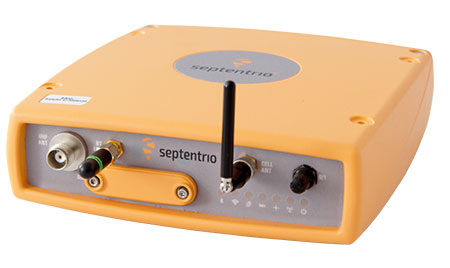
The Belgian dredging, environmental and engineering group DEME relies on the accuracy and reliability of the AsteRx family of precise GNSS positioning solutions from Septentrio.
DEME is using Septentrio’s AsteRx GNSS receivers to obtain centimeter-level accuracy for all its dredging and marine construction operations worldwide. These receivers are specifically designed to operate in difficult conditions, from dredging a few meters from the coastline to constructing wind turbines kilometers out at sea.
AsteRx-U dual-antenna receiver.
DEME began using Septentrio’s solutions more than 10 years ago. While dredging in the Belgian town of Oostende, DEME was unable to obtain a reliable RTK position from their GNSS equipment because of interfering radio signals from a local radio tower.
Septentrio worked with DEME to identify the source of the interference and modified a standard RTK receiver with special firmware to address the jamming problem. This case, along with others faced by Septentrio’s customers in the field, encouraged the development of a dedicated interference mitigation technology called AIM+, which is now standard in Septentrio’s GNSS solutions.
Septentrio’s AsteRx GNSS receivers have been deployed on DEME’s ships around the world. They have been vital to DEME for the success of projects such as the creation of Gateway Port in London, U.K.; the construction of Deurganckdok in Antwerp, Belgium; the Pearl Qatar City; the Thornton Bank Offshore Windfarm in Belgium; the extension of the Suez Canal in Egypt; and many more.
“’Creating land for the future’ is the slogan here at DEME and this is thanks, in part, to the accuracy and robustness of the solutions offered by Septentrio,” says Lorentz Lievens, head of the survey department.
“Jamming is a concern which DEME has seen more and more all over the world,” Lievens says. “Septentrio’s receivers are unique in that they continue to provide an accurate solution even in areas of high radio and ionospheric interference allowing DEME to deliver projects on time and on budget. Septentrio’s precise positioning solutions will remain vital for DEME to deliver quality and cost-effective operations around the world for many years to come.”
GeoMax has updated the firmware on its Zenith35 Pro GNSS receiver, which was introduced in November 2016.
The update is for NovAtel’s OEM7 Measurement Engine built into the receivers. Update OM7MR0102SN0005 addresses a real-time kinematic (RTK)-network connection issue preventing reception of corrections when connecting to selected NTRIP networks in some countries.
Note that the receiver’s onboard firmware version remains unchanged at 2.01.
The compact and fully ruggedized Zenith35 Pro has 555 channels. Its multi-constellation and multi-frequency capability supports all satellite systems today and in the future.
The Zenith35 Pro incorporates “Tilt&Go” functionality that allows users to measure inaccessible points. This significantly increases efficiency in the field, since leveling time is eliminated. Tilt and compass values for each measurement are stored for quality control and documentation purposes.
The unit is IP68-rated for water and dust, and is shock protected.
The Oregon Department of Transportation (ODOT) is embracing the growing trend in highway construction to go “stakeless” and push to full 3D design.
With more contractors using automated machine guidance applications, ODOT’s construction personnel are being asked to inspect projects with fewer stakes and visual indicators for line and grade. Employees are seeking to use the same data and information to determine line and grade when building or fixing stretches of road.
ODOT inspectors Jorge Jimenez and Mike Stennett at Multnomah Falls, preparing for a night-time paving operation. (Photo: Chris Pucci)
To address this need, rugged tablet maker DT Research worked closely with ODOT to design purpose-built Inspector Positioning Tablets that run GPS locating and 3D modeling applications, and take advantage of the Oregon Real-Time GNSS Network.
“MicroSurvey Field Genius surveying software is used to read XML files directly, allowing the inspector to work with the same files that the contractors received from the roadway designers,” said Chris Pucci, ODOT Construction Automation Surveyor.
The tablets enable ODOT to fully use its knowledge of the Oregon Real-Time GNSS Network and expertise in survey-grade RTK GNSS to achieve accuracies of +/0.05 feet.
The model DT391GS tablets have 9-inch touchscreens. The tablets can be used as handhelds or with an external antenna and pole. ODOT purchased one of four GNSS options offered by DT Research for the DT391GS tablets. The options enable inspectors and construction crews to employ a combination of GPS locating and 3D modeling to guide construction workers.
The goal is to allow the inspectors to make the same checks they would have made if there had been traditional construction staking on a project, not to make inspectors into surveyors, Pucci noted.
A one-day training is provided to train construction personnel before they are issued a tablet. “The tablets have been very well received by our construction inspection personnel,” he said.
The tablet project is now in the pilot phase with 20 tablets deployed to eight construction offices and more than 70 construction personnel having been trained. “We also just placed an order for 22 more tablets for the upcoming 2017 construction season,” Pucci said.