Category: Survey

  • Asteri Navigation launches X-series of wearable GNSS receivers

    Asteri Navigation launches X-series of wearable GNSS receivers

    Asteri Navigation will introduce a new line of rugged, compact and fully integrated GNSS receivers on Nov. 15 at the 2016 Autodesk University in Las Vegas, Nevada.

    Photo: Asteri NavigationSuitable for geospatial field data collection and inspection applications that require high accuracy positioning, the Asteri X-Series receivers are light enough to be mounted to external sensors or worn on the body or arm.

    Asteri Navigation will debut the affordable X-1 and X-2 receivers in booth No. 1783 at Autodesk University, which runs from Nov. 15-17 at The Venetian in Las Vegas. The X-3 is scheduled for release in December.

    The compact Asteri receivers were designed with safety and ease of use in mind. Each device weighs just 11.3 ounces with the 12-hour lithium battery. Their 2.8-inch by 5.4-inch size allows them to fit safely in shoulder or arm pouches.

    The internal single-frequency antenna enables users to capture accuracies of well under 10 centimeters with RTK/VRS corrections. This integrated design allows users to work in difficult terrain without worrying about equipment and antennas getting snagged or broken.

    Engineered to provide centimeter-level accuracy with Real-Time Kinematic (RTK) or Virtual Reference Station (CRS) correction when connected to an external antenna, the Asteri GNSS receivers support a generic NMEA 0183 GNSS data protocol. This makes them compatible with data collection and field mapping applications supporting the same protocol and ideal for users who want to develop their own software applications for inspection and GIS data capture activities.

    The new receivers can communicate via Bluetooth or cable with most popular devices used for field data collection, including utility line locators, ground penetrating radar, data loggers, laser rangefinders, smartphones, and tablets.

    Asteri expects the X-Series will be used extensively in mapping and survey applications related to asset management, pipeline operation, utility construction, forestry, electric staking, and underground utility location.

    For users needing higher accuracy, an external multi-frequency antenna can be added to the provided port on the receiver. In addition, the Asteri X-3 will be compatible with Atlas GNSS satellite-based real-time correction services worldwide.

    The three products in the X-Series provide varying levels of accuracy:

    • X-1 provides sub-meter accuracy out of the box.
    • X-2 offers accuracy of 1 meter down to 1 centimeter with RTK/VRS.
    • X-3 will achieve 1 centimeter with RTK/VRS, 30 centimeters with Atlas H30, 4-10 centimeters with Atlas H10.
  • Trimble and Hilti deliver integrated solutions for construction professionals

    Trimble and Hilti deliver integrated solutions for construction professionals

    Trimble  and the Hilti Group announced today that they are collaborating to deliver new software integration and data exchange solutions. These new integrated solutions provide a connected and improved digital experience for building construction professionals.

    The announcement was made at Trimble Dimensions.

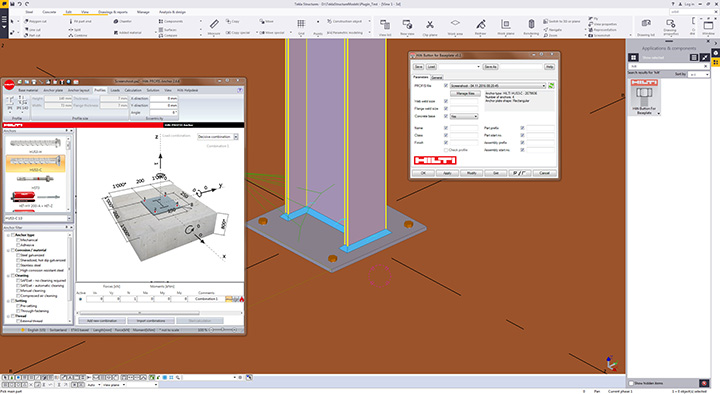
    The Hilti PROFIS Plugin for Trimbe's Tekla Structures.
    The Hilti PROFIS Plugin for Trimbe’s Tekla Structures.

    New software and data exchange solutions include:

    • Sharing design information between software applications — Hilti PROFIS Plugin for Tekla Structures allows engineers and detailers to apply PROFIS design information directly in a Tekla Structures model through the Trimble Connect collaboration platform.
    • Easy access to data in the cloud — Hilti’s total stations POS 150/180 and PROFIS Layout Office solutions, and PROFIS detection solutions are now integrated with the Trimble Connect collaboration platform, enabling data to be easily exchanged and shared with others.
    • More design content, specification information and pricing at a user’s fingertips — Hilti has significantly increased its design content in the Tekla Warehouse to include anchors and cast-in solutions as well as providing more than 7,000 items through Trimble’s TRA-SER and LuckinsLive pricing services.

    Since 2010, Trimble and Hilti’s relationship has been built upon shared values that focus on a deep understanding of customer needs and harnessing innovation to develop value-added solutions that increase customer productivity.

    Hilti Corporation supplies the worldwide construction industry with technological products, systems, software and services.


  • Trimble offers management services for real-time networks

    Trimble offers management services for real-time networks

    Trimble is offering a new suite of services benefiting owners and operators of real-time networks (RTN): Trimble Network Management. The initial offering consists of three levels of service, ranging from simple backup to fully outsourced network operations.

    Trimble Network Management is performed by Trimble’s global network operations team, comprised of network engineering, geodetic and IT professionals, already performing around-the- clock operations and maintenance in support of Trimble?s local and global networks.


    The announcement was made at Trimble Dimensions.

    Trimble Network Management is comprised of three levels of service, each one scalable and customizable to meet the requirements of the individual network owner.

    trimble-network-management-rtn-w

    Trimble Backup ensures users receive the highest possible level of uptime, maximizing productivity in the field. Trimble maintains a redundant network processor and server with 24/7 monitoring and support, and seamlessly maintains corrections to rovers in the event of a primary server failure.

    Trimble Network Hosting brings RTN into the cloud using a fully redundant, decentralized data center. Network hosting can minimize the limitations of traditional IT solutions such as accessibility, server configuration and reliability.

    Trimble Network Operations provides the expertise of the same Trimble network operations team trusted to maintain the Trimble RTX and VRS Now networks. Geodetic experts across the globe will monitor and maintain a RTN network 24/7.

    Trimble Network Operations offers additional flexibility with resourcing, allowing RTN owners/operators to focus on their core competencies, or even expand into new horizons.

    “Trimble Network Management is designed to reduce operating costs for the owner/operator,” said Patricia Boothe, general manager of Trimble Advanced Positioning. “And by leveraging Trimble’s team of network operations professionals as well as our scalable infrastructure, we can enable the private network owner to deliver improved network performance resulting in an enhanced end-user experience.”

    Trimble Network Management is available today for RTN owner/operators using Trimble Pivot Platform network software.

    trimble-network-management-services-2-w

  • Trimble unveils software GNSS receiver for high-accuracy in mobile devices

    Trimble has introduced Catalyst, a software-defined GNSS receiver that works with select Android mobile handhelds, smartphones and tablets. When combined with a small, lightweight, plug-and-play digital antenna and subscription to the Catalyst service, the receiver provides on-demand GNSS, geo-location capabilities to transform consumer devices into high-accuracy mobile data collection systems.

    The announcement of the new product, designed for GIS professionals, was made at Trimble Dimensions.

    Through smartphone and tablet developments accelerated by the bring your own device (BYOD) to work movement, field workers and consumers increasingly have access to positioning technologies for geospatial data use and collection. The Catalyst software receiver collects data and inspects or manages assets using smart devices. The software-defined GNSS receiver is designed to be integrated into a wide range of applications—providing a dual-frequency, multi-constellation receiver. The mobile device receives dual-frequency signals from the plug-and-play Trimble DA1 digital antenna. The small size and light weight of the antenna makes it possible to store in a car glove box or backpack, available for use on demand. By adding a Trimble Catalyst subscription, users can choose the level of accuracy to suit their application needs from meter level to centimeters.

    Trimble calls its Catalyst service Positioning-as-a-Service. It is available on-demand. Users download applications to suit their business needs, purchase the low-cost DA1 digital antenna and subscribe to the level of service required for the application. For GNSS corrections, the solution automatically selects the best available correction service based on the user’s location and subscription level. Corrections powered by Trimble RTX technology and the Trimble VRS Now networks are supported. Trimble RTX corrections can be received either via IP/cellular connection or L-band satellite. The subscription cost is based on usage, allowing users to scale up/down for projects with minimal capital expense.

    “The addition of Trimble Catalyst expands our portfolio to address the needs of organizations that have adopted a workplace Bring Your Own Device (BYOD) strategy for their businesses and individuals who periodically need accurate positioning to support various work activities,” said Ron Bisio, vice president of Trimble’s Geospatial Division.

    TerraFlex Geospatial Data Collection. The first available application for the Trimble Catalyst service is the Trimble TerraFlex cloud-based mapping and GIS field software, enabling users to achieve up to centimeter-level accuracy. TerraFlex is a scalable cloud-based solution addressing a  variety of field requirements including attribute-rich GIS data collection on consumer devices. With an intuitive interface and streamlined toolset for creating custom digital form templates, TerraFlex keeps the data flow standardized and streamlined from the field to the office.

    TerraFlex provides a common interface for users across a range of common mobile and smart devices to provide robust, high-accuracy GNSS positioning and detailed asset attribution collection. The Catalyst service for TerraFlex provides a new option for a higher level of accuracy for users’ workflows without the upfront investment of traditional hardware GNSS receivers. It enables scaling up to meet specific project demands and allows a workforce to collect high-accuracy location in conjunction with other work tasks.

    Availability. Catalyst service subscriptions and Catalyst DA1 antenna are expected to be available in the first quarter of 2017. In addition, a Software Development Kit (SDK) is expected to be available in the fourth quarter of 2016 for developers who are interested in developing new applications that use the Trimble Catalyst positioning on-demand service. Information and updates.

    TerraFlex is available now.

  • Launchpad: Timing receiver, AR smart glasses

    Launchpad: Timing receiver, AR smart glasses

    OEM

    GNSS receiver

    High precision for the mass market

    piksi_multi_rear-w-200x150The Piksi Multi is a multi-band, multi-constellation receiver for the mass market. Autonomous devices require precision navigation, especially those that perform critical functions. The receiver uses real-time kinematics (RTK) technology, providing location solutions 100 times more accurate than traditional GPS. Piksi Multi supports GPS L1/L2 and is hardware-ready for GLONASS G1/G2, BeiDou B1/B2, Galileo E1/E5b, QZSS L1/L2 and SBAS. The Piksi Multi Evaluation Kit also has been upgraded with all-new components. The new kit contains two Piksi Multi GNSS modules, two integrator-friendly evaluation boards, two GNSS survey-grade antennas and two high-performance radios, so that it can deliver reliability and range — well over 10 kilometers — and all of the accessories required for rapid prototyping and integration.

    Swift Navigation, www.swiftnav.com

    Timing receiver

    For dedicated time and frequency transfer applications

    The Septentrio PolaRX5TR.
    The Septentrio PolaRX5TR.

    The PolaRx5TR has 544 hardware channels and supports all major satellite constellations including GPS, GLONASS, Galileo, BeiDou, QZSS and IRNSS. A calibration circuit is incorporated to measure and compensate for internal delay, removing the need for calibration using external equipment and ensuring measurement latching is always accurately synchronized with the PPS input. The PolaRx5TR is compliant with the new-format CGGTTS version V2E of Consultative Committee for Time and Frequency (CCTF) recommendations. Also included as standard is Septentrio’s Advanced Interference Mitigation (AIM+) technology, giving outstanding interference robustness in difficult radio environments. Up to eight independent logging sessions can be configured logging to either the 16-GB internal memory or to an externally connected device.

    Septentrio, www.septentrio.com

    GNSS simulator

    Designed for a wide range of testing

    ion-titan-simulator-200x150The NCS Titan GNSS simulator has up to 256 channels (and 1024 multipath channels) and up to 4 RF outputs per chassis, providing flexibility and outstanding performance . The extra complexity and cost of using multiple signal generators is avoided, improving reliability without compromising on functionality. Its innovative design allows users configure channels for any GNSS signals and allocate those channels to any of the RF outputs fitted. This flexibility enables the same simulator hardware to be used for an extensive range of tests, for all types of GNSS applications. The NCS TITAN GNSS Simulator was developed in cooperation with WORK Microwave GmbH, Germany.

    IFEN, www.ifen.com

    Interference detector

    Analyzes RF interference of GPS signals

    Spirent's GSS200D interference detector.
    Spirent’s GSS200D interference detector.

    The GSS200D Interference Detection and Analysis solution, developed with Nottingham Scientific Limited, comprises field-based hardware and a secure data server for automatic capture and analysis of GNSS radio-frequency interference. Deployments of GSS200D probes provide users with a thorough understanding of the RF interference environment at sites of interest. Spirent has already detected thousands of disruptive GPS L1 interference events with its global network of GSS100D detectors. By adding support of additional frequencies and constellations, as well as improving the analysis and reporting, the GSS200D responds to the demand of critical infrastructure and civil aviation customers.

    Spirent, www.spirent.com


    SURVEY & MAPPING

    Multi-band receiver

    For surveyors, contractors, builders and engineers

    PositionIT-Carlson-620x620-e1464842339861-200x150The Carlson BRx6 is a multi-GNSS, multi-frequency receiver. It has a multi-band 372-channel GNSS receiver, Athena RTK technology and an integrated Atlas L-band receiver. The BRx6 also contains electronic sensors that measure tilt, direction (electronic compass) and acceleration, supporting Carlson SurvCE’s advanced features such as LDL (live digital level or e-bubble), leveling tolerance, auto by level, tilted-pole correction and advanced stakeout features. SurvCE contains sophisticated checks for compass and acceleration anomalies to ensure accuracy. The BRx6 delivers affordable, high-positional accuracy. Manufactured to Carlson’s exacting specifications by Hemisphere GNSS, the BRx6 can be used as a precise base station or lightweight rover. RTK corrections can be received over UHF radio, cell modem, Wi-Fi, Bluetooth or serial connection.

    Carlson Software, www.carlsonsw.com

    Subscription service

    Provides RTK correction data during outages

    resizedimage120120-correct-rtk-iconRTK Assist is a subscription-based service that provides users with satellite-delivered correction data to seamlessly continue centimeter-level accuracy during real-time kinematic (RTK) correction outages caused by communication disruptions. Users are able to maintain RTK-level performance for up to 20 minutes, reducing any associated downtime and optimizing solution productivity. The RTK positioning with correction data is delivered directly to the receiver via satellite, allowing for a continuous centimeter-level solution that is globally available 24/7. RTK Assist is best suited for applications where there are potential obstructions, dead spots or baseline limitations that would cause RTK network correction losses for short periods of time.

    NovAtel, www.novatel.com

    Mobile mapping

    GNSS-aided georeferencing

    applanix-announces-pospac-mms-8-for-high-accuracy-mobile-mappingThe POSPac MMS 8 is GNSS-aided inertial post-processing software for georeferencing data collected from cameras, lidars, multi-beam sonars and other sensors on mobile platforms. POSPac MMS 8 uses the Trimble CenterPoint RTX subscription service to deliver these benefits for mobile mapping from land, air, marine and UAV platforms. With an internet connection, users can achieve centimeter-level accuracy within one hour after data collection — there is no need to wait for delivery of public-domain ephemeris data. Users can map inaccessible regions that have no existing Continuously Operation Reference Stations (CORS) without the cost of deploying local base stations. With Trimble’s private network, users can attain consistent and reliable uptime.

    Applanix, www.applanix.com

    Geospatial data PDFs

    Extends geospatial data sets to all stakeholders

    geopdf-workflow-wTerraGo GeoPDF software suite version 7 offers new features to enable open, cross-platform, cloud and mobile access to advanced maps, engineering drawings, high-resolution imagery and other types of spatial data assets. Version 7 has tools for publishing GeoPDFs, including TerraGo Publisher for ArcGIS, TerraGo Publisher for ArcGIS Server, TerraGo Composer, TerraGo GeoPDF Platform Toolkit, TerraGo Publisher for Raster and TerraGo Toolbar. Features include PubPy, which extends and enhances integration into ArcGIS ArcPy to enable on-demand web services and GIS portals; and OpenGeoPDF, which adds Open Geospatial Consortium GeoPackage to GeoPDF documents to enable GIS-Lite applications using TerraGo Toolbar 7.0. Other features include mobile-workflow support, advanced layer control and remote desktop.

    TerraGo, www.terragotech.com


    UAV

    Ground-control points

    Solar-powered and portable

    Aeropoints are desgined for for companies across the industrial sector — including mining, construction, quarries and landfills.
    Aeropoints are desgined for for companies across the industrial sector — including mining, construction, quarries and landfills.

    AeroPoints are smart ground-control points designed to make it easy to capture survey–accurate mapping using drones. The portable ground-control markers are visible from the air and capable of quickly capturing their own positions down to 2-centimeter absolute accuracy. AeroPoints work with any camera or drone, and integrate seamlessly with Propeller’s cloud–based data platform and processing engine. They’re solar–powered, durable and weather- resistant, and they don’t require any on-site connection. To use AeroPoints, customers simply lay them down, fly their drone, and then pick them up again. They automatically connect to a wireless or mobile hotspot when back in range to upload captured positional data.

    Propeller Aero, www.propelleraero.com

    UAV lidar sensor

    Entry-level device for limited-weight drones

    mini-vux1-uav_riegl-lidar-wThe miniVUX-1UAV is a compact miniaturized 360-degree field-of-view lidar sensor weighing 1.6 kilograms. It is developed for the implementation of emerging survey solutions by small UAS, UAV and Remotely Piloted Aircraft Systems (RPAS). The sensor offers multi-target capability and accuracy using echo digitization and online waveform processing for data acquisition. It is capable of 100,000 measurements per second and offers an operating altitude of 100+ meters. Its small size and low weight make it suitable for mounting under limited weight and space conditions, allowing UAV-based acquisition of survey-grade measurement data for agriculture and forestry fieldwork, archaeology and cultural heritage documentation, glacier and snowfield mapping, and landslide monitoring.

    Riegl, www.riegl.com

    UAV awareness software

    Notifies pilots when drones draw near

    safertogether-wSafer Together is designed to reduce the risk of mid-air collision between aircraft and UAVs. Developed by senseFly and the Air Navigation Pro app makers, it is designed to make the skies a safer place by providing general aviation (GA) pilots and drone operators with awareness of each other’s airborne activities, giving them the knowledge they need to take any actions necessary to avoid mid-air incidents around 200–400 feet above ground level, where most light-weight drones fly. SenseFly added GA functionality to its eMotion flight-planning software, enabling operators to create a special advisory when activating automated drone flights. eMotion transmits the advisory to Air Navigation Pro’s server, which will push the information to all smart devices of connected app users. In turn, senseFly drone operators will be able to view the Air Navigation users’ flights in real time.

    Safer Together, www.safertogether.aero 

    SAASM inertial navigation

    Includes GPS antenna and cables

    geodetics-saasm-imu-wThe Geo-iNAV 1000 SAASM is a low-cost, rugged SAASM GPS-aided inertial navigation system. It tightly couples a SAASM GPS sensor with a high-stability Quartz micro-electro-mechanical system (MEMS) inertial measurement unit (IMU) to provide a high-performance navigation solution in challenging environments. Features include simple integration, SAASM GPS with path to M-code, internal high-accuracy quartz MEMS IMU, tight-coupling with Geodetics’ Extended Kalman Filter, in-motion dynamic alignment, and RS-232, RS422 and Ethernet (TCP/UDP) interfaces.

    Geodetics, www.geodetics.com

    Drone camera

    Hovers while taking photos and videos

    hover-camera-passport-wThe Hover Camera Passport hovers in place to allow users to quickly and easily take photographs. The self-flying camera is aimed at consumers, flying without the restraints of controllers. Once the camera is unfolded and powered on, the passport can take 13-megapixel photos and 4,000-pixel (4K) video using proprietary embedded artificial intelligence technology. The Hover Camera Passport introduces a new design into the flying camera field, with its propellers and motors encased in a strong, light carbon-fiber structure that ensures fingers can’t slip through during normal use. Features include auto-follow with face and body tracking, 360 spin; orbit; and self-positioning using a combination of sonar, its downward viewing camera and artificial intelligence.

    Zero Zero Robotics, gethover.com

    Camera drone

    Designed to fit in a backpack

    gopro-karma-drone-wThe Karma drone, designed to accompany a GoPro camera, features a compact, fits-in-a-small-backpack design and includes an image-stabilization grip that can be handheld or mounted to vehicles, gear and more. Karma is designed to capture smooth, stabilized video during almost any activity. Compact and foldable, the entire system fits into the included backpack that’s so comfortable to wear during any activity, users will forget they’ve got it on. The game-style controller features an integrated touch display, making it easy to fly without the need for a separate phone or tablet. The three-axis camera stabilizer can be removed from the drone and attached to the included Karma Grip for capturing ultra-smooth handheld and gear-mounted footage.

    GoPro, gopro.com

    Augmented reality smart glasses

    Enable UAV pilots to maintain line of sight

    epson-uav-smartglasses-wThe Epson Moverio BT-300 augmented reality (AR) smart glasses are light, binocular and transparent with an organic light-emitting diode (OLED) display. Combining silicon-based OLED digital display technology and Android OS 5.1, the Moverio BT-300 enables transparent mobile augmented reality (AR) experiences, including while flying drones. With the DJI GO app and the Moverio glasses, drone pilots are able to see clear, transparent first-person views from the drone camera while simultaneously maintaining their line of sight with their aircraft. The DJI GO app works with the DJI Phantom, Inspire and Matrice series flying platforms as well as the Osmo handheld gimbal and camera.

    Epson, www.epson.comDJI, www.dji.com


    TRANSPORTATION

    GNSS antennas

    Equipped with Inmarsat filter for marine vessels

    NovAtel-ATEX-antennaThe GPS-713-GGG-N and GPS-713-GGGL-N ATEX-qualified triple-frequency GNSS antennas come with Inmarsat rejection filters. Hazardous environments — those found on oil platforms, tankers and refineries — require compliance with the European 94/9EC ATEX directive. Based on the company’s Pinwheel technology, both antennas maximize performance with multi-constellation reception of L1, L2, L5 GPS; L1, L2, L3 GLONASS; B1, B2 BeiDou; and E1, E5a/b Galileo frequencies, the company said. The GPS-713-GGGL-N also supports L-band from 1525 to 1560 MHz. Customers can use the same antenna for GPS only, or up to quad-constellation applications, resulting in increased flexibility and reduced equipment costs. The two antennas deliver choke-ring-level antenna performance, but without the size and weight. Both provide enhanced Inmarsat interference rejection, which allows tracking of GNSS signals in the presence of high-powered Inmarsat transmitters typically found on marine vessels.

    NovAtel, www.novatel.com

    Auto navigation receiver

    Dead-reckoning enabled

    Furuno's GV-86.
    Furuno’s GV-86.

    The GV-86 is a high-sensitivity GPS receiver module supporting dead reckoning, which enables positioning in environments where no GNSS signals can be received, such as tunnels, underground car parking and deep urban canyons. The receiver concurrently receives GPS, SBAS and QZSS satellite signals. The dead-reckoning function is realized by integrating the information from a gyro sensor and a velocity sensor. It has fast time to first fix, and highly improved noise tolerance, and a configurable position output update rate up to 10 Hz (10 times per second.)

    Furuno, www.furuno.com

  • SmartNet North America assumes operation of East Coast RTK network

    SmartNet North America assumes operation of East Coast RTK network

    SmartNet North America, a high-precision, high-availability network RTK correction service, is assuming operations and incorporating all of the Maine Technical Source (MTS) RTK Network into SmartNet. The merger brings professionals along the East Coast access to a broader coverage area, better geometry and optimized performance.

    The MTS RTK Network has two national CORS base stations and 27 base stations covering most of New England. The incorporation of the MTS Network into SmartNet strengthens the network by giving users access to a range of additional tools, including full network quality monitoring and a comprehensive user portal with live status maps and rover management.

    The MTS RTK Network has two national CORS base stations and 27 base stations covering most of New England.
    The MTS RTK Network has two national CORS base stations and 27 base stations covering most of New England.

    Users will also be able to take advantage of immediate enhancements and investments SmartNet is currently making in the New England region. The network will continue to be supported by Maine Technical Source, the authorized sales and support organization for SmartNet solutions on the East Coast.

    SmartNet North America is fully open to all makes and models of GNSS equipment and is designed to provide the highest reliability and accuracy 24/7. A variety of different subscription plans are available at the state, regional and national level for any application requiring precision GNSS corrections. The latest expansion brings the total number of SmartNet North America stations to over 1,200 in 40 states and 8 provinces, strengthening SmartNet’s position as the most extensive network coverage of any network service provider on the continent.

    “Our commitment to excellence drives us to keep expanding to serve the needs of our customers,” said Wendy Watson, director of reference station operations — GNSS reference networks for SmartNet North America. “Whether it is through enriching our toolsets, adding new stations or incorporating existing networks with the assistance of valuable partners like Maine Technical Source, we will continue to make investments that provide users with the best possible service.”

    “The MTS RTK Network was already built on reliable, high-performance Leica Geosystems GPS technology,” said Jim Bosworth of Maine Technical Source. “Now users will have the added benefit of being supported by the industry-leading SmartNet service. The incorporation of the MTS RTK Network into SmartNet is a logical next step in supporting our GPS and GNSS customers in the region.”


  • Data collection of WGS 84 information — or is it?

    Location, location, location. It’s not just the tagline for real estate and sales; it’s about all of us, all of the time.

    Thanks to technology, everything revolves around location these days. It is in our cars, smartphones, exercise trackers, and even our packages. GPS has revolutionized so many things in our lives, but most people do not know how it truly works. They get the general idea of satellites beaming radio signals to Earth and translated into a position on the Earth, but that’s as far as it gets for most.

    Understanding the location relationship by points on the face of the Earth is something much more involved and gets quite complicated. Thanks to sophisticated computers and programming power, this complex bundle of formulas and computations are solved behind the scenes with little effort. All we know is that when our location shows up on our phone, we can share it with friends and family, search for the closest coffee shop, or have it tell us how long until we get home.

    This also affects professional surveyors more than many of them truly understand. The introduction of GPS has allowed many to produce work products with greater efficiency, but without understanding the true geodesy, math and positional accuracies behind the technology.

    Let’s take a look back in time to understand where we have come, to better understand why knowing the basis of datums is so important:

    IN THE BEGINNING

    Until the early 1900s, surveyors only measured what they could see and didn’t allow for any curvature of the Earth, (it is round, by the way…). Only after the introduction of long-baseline survey projects was there any consideration for adjustment to survey measurements.

    Extensive surveying observations were performed nationwide to establish a network of standardized horizontal positions throughout the land. Using least-square adjustment methods originally developed by Carl Friedrich Gauss to help with estimation of orbital movement of the planets, this network was developed using the Clarke Ellipsoid of 1866 with a base point of Meade’s Ranch, Kansas.

    The observed location of the initial point was determined at 39°13’26.686” North latitude, 98°32’30.506” West longitude; from here, all latitudes and longitudes are measured using the Clarke Ellipsoid for reference.

    This datum, called the North American Datum of 1927 (NAD27), was used extensively by government surveyors and geodesists for many decades, but because of the highly involved mathematics involved in the computations, very few private surveyors were trained to work within the datum.

    More than 26,000 survey stations were used in the computation of NAD27, all being manually observed and measured. The electronic distance meter and long-range theodolite help proliferate more reference points over time, but still required heavy-duty computation to determine results for the new positions.

    THE COMPUTER AGE

    The implementation of computers, both mainframe and personal computers, allowed for further development of programming that analyzed survey data faster and more accurately than humanly possible. This technology allowed geodesists to compute positions with more reliable results, but still lacked significant involvement by professional surveyors.

    As I’ve covered in previous articles, the development of a global positioning system by the Department of Defense created the ability to establish locations nearly anywhere. Their work started in the late 1950s with the development of an inter-continental geodetic system (World Geodetic System 1960 or WGS 60) to work with other nations. Continued refinement in the WGS data allowed for the development of a new geodetic datum that would be Earth-centered rather than the fixed-station method used by NAD27.

    In addition to the measuring method, there was also a much larger number of monuments now available for implementing into the new system. Approximately 250,000 points were included in the initial database for the new datum along with additional terrestrial and Doppler satellite data to create the North American Datum of 1983 (NAD83). Improvements with NAD83 over NAD27 included the correction and improvement of data distortion from earlier observations through the increased densification of information.

    A big difference from the previous datum was the use of the Geodetic Reference System of 1980 (GRS80) instead of the previously implemented Clarke Ellipsoid. It also offered global projection rather than localized realization of data. Because of these large differences based on projection methods, use of a larger ellipsoid and basis of coordinate values, it is somewhat easy to distinguish the difference between the two datums. But like life itself, everything is subject to change.

    BUT CHANGE IS INEVITABLE

    nga-logoThe National Geospatial-Intelligence Agency (NGA) published a Standardization Document in July 2014 outlining WGS 84, its parameters and history, along with the intended relationship with local geodetic systems.

    The standards covered in the document included:

    • Coordinate Systems
    • The use of GPS in the development of the WGS84 Reference Frame
    • Ellipsoid and its defining parameters
    • Ellipsoidal Gravity formula
    • Earth Gravitational Model 2008 (EGM2008)
    • EGM2008 Geoid Model
    • The World Magnetic Model (WMM)
    • WGS 84 relationships with other Geodetic Systems
    • Accuracy of WGS 84 and its models
    • Implementation Guidelines

    NGA continues to improve and refine the WGS 84 reference frame in order to standardize all future GNSS measurement. Let’s take a look at a few more specific characteristics of our current reference frames.

    WGS 84 BASICS

    The WGS 84 Coordinate System is a Conventional Terrestrial Reference System (CTRS). It has a right-handed, Earth-fixed orthogonal coordinate format. The system origin also serves as the geometric center of the WGS 84 ellipsoid, and the Z-axis serves as the rotational axis of this ellipsoid of revolution.

    It was established in 1987 with the intent of aligning with the Bureau International de l’Heure (BIH) Terrestrial System, also known as the BTS reference frame. Initial accuracies of the reference frame were 1-2 meters; ongoing refinement was important to the NGA team and development continued.

    The WGS 84 Reference Frame has been updated six times, with revisions taking place in 1994, 1997, 2002, 2012 and 2013. These updates are intended to incorporate international conventions and to align with the International Terrestrial Reference Frame 2008 (ITRF2008).

    Environmental changes in updated models and methods have begun to make discrepancies in the relationship between the reference frames, so improvements have been made to cause these periodic changes to the WGS 84 frame. The intent and result of each revision has been to improve its accuracy and precision, so applying constraints to WGS 84 in order to align it with ITRF results in maintaining continuity with other GNSS worldwide.

    With this latest revision to the WGS 84 reference frame, WGS 84 (G1762), the transformation differences with the International GNSS Service (IGb08) is essentially zero. This means users of the latest version of WGS 84 can use the data in its original state to translate to international measurements when necessary.

    ITRF2008 was recently updated to ITRF2014, but maintains its consistent relationship with WGS 84 (G1762) with centimeter-level accuracy.

    The original WGS 84 reference frame is still used by most consumer-grade GPS devices (smartphones, vehicle navigation, etc.). It has retained the original major-axis value to eliminate the need for various updates and modifications for these devices and mapping software. This allows existing collections of geospatial data to retain its values and not be subject to transformation or additional computation.

    NAD83 BASICS

    The NAD83 coordinate reference system is a horizontal adjustment of existing data from previous surveys, Doppler and Very Long Baseline Interferometry (VLBI) data. The geocentric datum is earth-centered/Earth-fixed, utilizes the GRS80 ellipsoid, and is intended to be identical to the original WGS 84 reference frame with the origin at the center of the mass of the Earth.

    The implementation of GPS-based data collection uncovered a discrepancy with the originally calculated center of the reference frame of up to 2 meters. This revelation rendered the reference frame flawed under its original configuration with positional errors up to 1-2 meters being commonplace.

    By 1997, additional observation data was introduced along with application of high-accuracy reference network (HARN) information to greatly increase horizontal accuracy. This was followed by the addition of continuously operating reference station (CORS) data through 2002, and then by the implementation of the National Spatial Reference System (NSRS) in 2007. The last major re-adjustment occurred in 2011 with more observation and CORS data.

    It is from this framework that the State Plane Coordinate (SPC) systems were developed for localized use. Transformation parameters were created to allow smaller coordinate values for easier use in all types for mapping and data collection. This is also where most surveyors were introduced to a simplified form of geodesy, but without the complicated formulas generally associated with its use.

    Hardware and software enhancements have made the implementation of SPC systems much easier than past computations. The continued refinement of the NAD83 system through significant adjustments and equipment upgrades has given the surveyor a lot of confidence in this system, but I still caution our profession to promote QA/QC programs to verify the information being collected. GPS data acquisition techniques are not infallible and appropriate caution during use is still required.

    SYSTEM COMPARISON

    The concept of a world geodetic system is to provide a globally dedicated reference system and to minimize or eliminate the need for local systems. The usual reason for a local coordinate system was to meet the needs for an area before the implementation of a larger system was possible. So often, the worst part of having and maintaining a horizontal system separate from a world system is the means and methods of transformation/translation of data.

    In the meantime, here are a few of the main differences between WGS 84 and NAD83:

    • While both use a similar ellipsoid, they differ slightly and thus create different results.
    • The coordinate system for WGS 84 is geographic, and the NAD83 system is projected.
    • WGS 84 values are points in space, while NAD83 coordinates are physical locations on the Earth.
    • WGS 84 is based upon the NAVSTAR satellite system, and the NAD83 system is based upon a network of ground points, observation data and CORS.
    • WGS 84 ellipsoid is defined as a geocentric, equipotential frame, whereas NAD83 considers GRAV-D data collection and tectonic plate velocities.
    • While the original WGS 84 system aligns with the NAD83 (1986) adjustment, further refinement of WGS 84 has been completed to maintain similarity to ITRF realizations.


    Until there is a redevelopment of the GPS system (including hardware), we must realize the limitation of each system and work together to make sure the relationship is understood by all who work with it.

    DATA COLLECTION NOTES

    With the advances in GNSS receivers, data collectors and RTK network opportunities, GPS data has proliferated greatly in the past 20+ years. What began as simple data collection with complex computing necessary to determine positional values has now turned into a plethora of available systems at your fingertips. Surveyors are now considered an “expert” in geodesy overnight, with very little education or knowledge of what they are truly measuring and publishing for coordinate and geodetic values.


    A majority of GPS data collection happens in a real-time network (RTN) scenario: (1) with a base station on a published coordinate point or OPUS-derived value, or (2) with a cellular-based RTN. Both situations are typically constrained by built-in NAD83 parameters within the data collector software to produce localized or state plane coordinate values. For projects that rely on these coordinates, these methods are perfectly acceptable.

    google-earthWhere the fork in the road appears is when geodetic values are required for data collection of geographic information system (GIS) database creation. Many GIS users understand the difference between WGS 84 and NAD83 data, whereas the typical professional surveyor does not. The data required for GIS use (such as Esri, Google Earth and Microsoft Virtual Earth) is typically defaulted to WGS 84 because most mapping is done for use by those with the simplest needs: the consumer. Consumers are using GPS in many personal devices, and keeping the programming and mapping requirements simple is key to their success. Excessive accuracy is not necessary when it comes to these devices, so a meter or two variations is perfectly acceptable. That is why the original WGS 84 reference frame is programmed into these devices and is still utilized for most large-scale mapping needs. But what happens when the mapping needs to be more precise?

    The need for precise data collection gets us back to the surveying community. Information collected by most surveyors is assumed to be in WGS 84 because “That’s what my data collector told me it was.” Ideally, the best way to gather actual WGS 84 values is to occupy the required locations and collect satellite data using a stationary, dual-frequency GPS receiver and noting the correct epoch and associated fixed-station GPS coordinate data used. Locations derived from data collected in local coordinate systems and transformed to WGS 84 values will be subject to characteristics and distortions potentially affecting the local system. This leads your subject data down an uncertainty path that may not be acceptable to your delivered product.

    Typically, data collected in NAD83 (2011) is in the 1- to 2-meter accuracy range from WGS 84 as previous discussed. These accuracies are not usually acceptable in the surveying world and hopefully not in most GIS base-layer situations either.

    One of the best solutions for high-accuracy data collection that will be more compatible with GIS database needs is to start your data collection with ITRF-based points, if possible. This method keeps your data consistent with current WGS 84 reference frame parameters and will fit seamlessly into most systems as required. Most hardware and software systems allow for its implementation as a coordinate system option and is just as easy to use as our normal NAD83 based systems. This helps provide less headache with data correlation to the client’s requirements and keeps the playing field closer to level.

    For surveyors, here’s the bottom line: our responsibility is to provide the client data in the most accurate and precise condition possible. Our profession needs to re-educate ourselves to better understand what the data collector is truly producing rather than relying on a wing and prayer that it meets the client’s needs.

    Think back to your early math class days; we spent many hours learning trigonometry functions by hand before we were turned loose with a calculator with sin, cos, and tan buttons. Learning longhand what was being produced helped us to understand how those complex calculations were completed.

    We need to think of this GPS data collection process in the same manner, and not just hope the “ghost in the machine” spits out the right numbers for the project. The worst thing you can tell a client is that you “think” the data is correct because you’re just not sure…

    BUT THERE IS GOOD NEWS…

    The good news for geographic data users in the United States is that the National Geodetic Survey (NGS) is working on a new datum that will incorporate radical new changes in combining horizontal and vertical datums. Visit the NGS website for more information. The initial framework sounds very robust and user-friendly, so keep your eyes and ears open for more details as they develop. I’m looking forward to the new system and so should surveyors everywhere.

    The problem sometimes with technology is that it moves forward so quickly  that good innovations get passed over due to previous acceptance and reluctance to upgrade (such as Sony Betamax, Microsoft Zune, etc.). This has been true with geodetic datums and the introduction of GPS for mainstream use. It will be an age-old issue, but I look forward to better and brighter days ahead.

    Now, where did I leave my trusty Junior Geodesist Secret Decoder Ring?

  • DJI joins Propeller Aero on turnkey solutions

    DJI joins Propeller Aero on turnkey solutions

    See also Propeller Aero’s ground-control points aim for UAV accuracy.


    Drone-maker DJI has partnered with UAV software company Propeller Aero to launch an integrated solution to reduce costs, improve safety and drive operational efficiency in the construction and mining industries.

    The partnership integrates DJI’s commercial-grade aerial platform, the Matrice 100, with Propeller’s cloud-based software specifically designed for surveying and inspection.

    The solution provides enterprises and commercial UAV operators a simplified, quick and efficient way to automate operations and access data. It will enable businesses to accurately perform site measurements and volumetrics and share data seamlessly with just a few clicks, the companies said.

    Rory San Miguel (left) and Francis Vierboom, co-founders and CEOs of Propeller Aero, display the new Aeropoints product. (Photo: Propeller Aero)
    Rory San Miguel (left) and Francis Vierboom, co-founders and CEOs of Propeller Aero, display the new Aeropoints product. (Photo: Propeller Aero)

    Sydney Start-Up. Propeller Aero was founded in 2013 in Sydney, Australia, when Rory San Miguel and Francis Vierboom first got hooked on drone technology. They wanted to bring drones to industries like mining and construction, where they thought the technology was really going to “grow up.”

    They set about joining Australia’s regulated drone industry by applying for their drone pilot licenses. While waiting for the paperwork, they created an online app to share data from their trial flights.

    Figuring out the best ways to process, visualize and use UAV data ended up being more exciting to San Miguel and Vierboom than actually flying the drone.

    Propeller Aero provides cloud-based software that streamlines data processing and simplifies the way data is used and shared. The software package provides web-based geospatial data processing, analytics and instant volumetric calculations for a range of professional applications. It has been adopted by commercial drone operators and enterprise clients in 60 countries.

    Deploying UAVs for surveying and inspection can reduce costs, minimize workplace hazards and improve operations, especially for businesses that operate in quarries, construction sites and asset infrastructure.
    “Being from Australia, Propeller Aero has had the considerable advantage of developing alongside the industries that have been using commercial UAVs since 2002,” said Michael Perry, DJI’s director of strategic partnerships.

    DJI’s Matrice 100. The Matrice 100 platform has DJI’s technology built in, including GPS, the flight controller, the propulsion system, DJI Lightbridge, a dedicated remote controller and a rechargeable battery. The system automatically manages complex tasks required for flight.

  • Propeller Aero’s ground-control points aim for UAV accuracy

    Propeller Aero’s ground-control points aim for UAV accuracy

    Aeropoints are desgined for for companies across the industrial sector — including mining, construction, quarries and landfills.
    Aeropoints are desgined for for companies across the industrial sector — including mining, construction, quarries and landfills.

    Propeller Aero has introduced AeroPoints — smart ground-control points designed to make it easy to capture survey­accurate mapping using drones.

    The patent-­pending technology provides a simple solution to a major roadblock to widespread commercial drone adoption: accuracy.

    Typical ground control requires establishing precise geolocation position using surveying equipment, and then securing a visible ground marker exactly on the pre­-marked GPS point.

    AeroPoints are portable ground-control markers, visible from the air and capable of quickly capturing their own positions down to 2-centimeter absolute accuracy.

    AeroPoints work with any camera or drone, and integrate seamlessly with Propeller’s cloud­-based data platform and processing engine (see above story). They’re solar­-powered, durable and weather­ resistant, and they don’t require any on­site connection.

    To use AeroPoints, customers simply lay them down, fly their drone, and then pick them up again. They automatically connect to a wireless or mobile hotspot when back in range to upload captured positional data — and precision georeferencing is done.

    See also DJI joins Propeller Aero on turnkey solutions.

  • NovAtel’s RTK Assist provides 20 minutes of accuracy

    NovAtel introduced its RTK Assist service at the Intergeo show, held this week in Hamburg, Germany.

    RTK Asssit is a subscription-based service that provides users with satellite-delivered correction data to seamlessly continue centimeter-level accuracy during real-time kinematic (RTK) correction outages caused by communication disruptions. Users are able to maintain RTK level performance for up to 20 minutes, reducing any associated downtime and optimizing solution productivity.

    RTK is a well-established method of achieving cm-level accuracy with GNSS. However, if the RTK correction data link to the receiver is interrupted, performance degrades quickly. RTK ASSIST subscribers are able to maintain the accuracy of their positioning solution during these interruptions, avoiding any down-time. RTK ASSIST is best suited for applications where there are potential obstructions, dead spots or baseline limitations that would cause RTK network correction losses for short periods of time.

    Neil Gerein, Portfolio Manager for NovAtel stated, “Combining NovAtel’s long history of expertise in RTK positioning with correction data delivered directly to the receiver via satellite allows for a continuous centimeter-level solution that is globally available 24/7.”

  • DJI and Datumate partner on site survey solution

    DJI and Datumate partner on site survey solution

    DJI and Datumate have begun offering a drone, software and app package that fully automates and expedites site surveys.

    Tailored for professional surveying jobs, the DJI-Datumate Site Survey Solution simplifies the surveying and mapping processes, while maintaining superior accuracy. Shenzhen-based DJI is the world’s top aerial-imaging company. Israel based Datumate is a leader in automated “field-to-plan” surveying solutions.

    dji-datumate-surveysolution-wThe DJI-Datumate Site Survey Solution is a comprehensive and professional package of imagery and mapping tools that help surveying, construction, inspection and infrastructure companies quickly generate a working model, site visualization, analytics and plan.

    The solution includes “Triple D” bundles of DJI Drone, DatuFly tablet app for an automated and expeditious aerial photography, as well as DatuGram 3D photogrammetry software that converts aerial and ground images to high-precision, geo-referenced 2D maps and 3D models.

    “New drone regulations expedite the adoption of drones in a wide range of surveying related applications,” said Paul Xu, DJI’s director of enterprise solutions. “We believe that DJI-Datumate Site Survey Solutions offer a professional and cost-effective end-to-end solution for the surveying, infrastructure-mapping and inspection markets.”

    DatuFly software generates a flight and image-taking plan for the DJI Drone, based on the best practice requirements of DatuGram 3D photogrammetry, ensuring survey-grade accuracy, high quality and quick results.

    “We are excited to partner with DJI to automate and digitize the entire field-to-plan process. Our mutual solution brings site visualization and analytics quickly to the office, keeping field and office work effortless and safe,” said Datumate CEO Tal Meirzon. “DJI-Datumate Site Survey Solutions are an important step forward in professional surveying, construction infrastructure-mapping and assets inspection.”

    DJI-Datumate Site Survey Solutions are available globally from the DJI online store, as well as through DJI and Datumate dealers.

  • TerraGo Edge and GeoPDF demonstrated at Intergeo

    TerraGo demonstrated at Intergeo the latest capabilities of its line of GeoPDF products as well as survey-grade, mobile GPS and GIS data collection with its TerraGo Edge and TerraGo Magic platforms geospatial collaboration and mobility software.

    GeoPDF products enable free, lightweight GIS applications, helping organizations get more value from their current investments in GIS and imagery platforms.

    TerraGo Edge and TerraGo Magic are GPS data collection devices combining high-accuracy, survey-grade GPS with advanced mapping and mobile collaboration on Android and iOS devices. With TerraGo Magic, customers and partners can build their own mobile apps, fully customized with their branding and features, without coding.

    TerraGo Edge v3.9.6 includes sample code for all REST API end points, automated note name options, enhanced cloud-based publishing of maps and forms and high-volume imagery and map to mobile processing. It includes:

    • New tools to support ArcGIS and enterprise integration: ArcGIS and enterprise integration using the TerraGo Edge REST API with the addition of sample code for every Edge REST endpoint via Postman API utility.
    • Automated note names with custom form fields: Configure the one-click QuickNote in any notebook to name notes by a specific form field, enabling  speed in the field and user-friendly data management and searching.
    • Attach maps and forms to multiple notebooks simultaneously.
    • Import multiple GeoPDFs and GeoTIFFs at the same time: Select or drag & drop many GeoPDFs/GeoTIFFs at the same time for user-friendly, high-volume parallel processing of  aerial imagery or offline basemaps.
    • New media filenames to help associate media to projects, includingnotebook name, note name, and a time and date stamp, to identify, search and sort  media files.

    GeoPDF. The latest Version 7 of TerraGo GeoPDF includes tools for publishing GeoPDF, including TerraGo Publisher for ArcGIS, TerraGo Publisher for ArcGIS Server, TerraGo Composer, TerraGo GeoPDF Platform Toolkit, TerraGo Publisher for Raster and TerraGo Toolbar.

    Features in this release include:

    • PubPy: Extends and enhances integration into ArcGIS ArcPy to enable on-demand web services and GIS portals.
    • OpenGeoPDF: Adds Open Geospatial Consortium (OGC) GeoPackage to GeoPDF documents to enable GIS-Lite applications using TerraGo Toolbar Version 7.0.
    • Mobile: Extends and enhances its support of TerraGo Edge and private-label apps created from TerraGo Magic with capabilities to create notebooks, maps, and applications for mobile workflows.
    • Advanced Layer Control: Implements of a number of features to improve flexibility and ease of use in production contexts.
    • Remote Desktop: Enables end users to access TerraGo Publisher and TerraGo Composer on their desktop from remote location.
    • Compatibility: Supports the latest versions of ArcGIS including the recently released ArcGIS 10.4.1.
    • Licensing: Implements a new license management system to  reduce the complexity and burden of license management, especially in enterprise software management.