Tag: Airbus Defence and Space

  • Airbus, Orbital Insight partner on OneAtlas analytics platform

    Europe-based Airbus Defence and Space has entered into a partnership with Orbital Insight, a U.S.-based geospatial analytics company, to build a suite of geospatial analytics services and tools.

    The agreement will provide Orbital Insight with access to Pleiades and SPOT satellite imagery at scale, and provide Airbus with analytics services, making Orbital Insight the first analytics partner for the Airbus Digital Platform OneAtlas.

    The OneAtlas Platform is a collaborative environment enabling users to easily access constantly updated satellite imagery, perform large-scale image processing, extract industry-specific insights, and benefit from Airbus assets to develop tailored solutions for a wide range of markets in both commercial and government sectors, the company said.

    “Under this agreement, we will offer premium analytics capabilities to a large range of users, powered by Orbital Insight’s services and tools,” said François Lombard, director of the Intelligence Business at Airbus Defence and Space. “The OneAtlas Platform is definitively the cornerstone to leverage both Airbus and partner assets to support our customers’ business development and growth.”

    “We’re proud to be Airbus’ first geospatial analytics partner on the OneAtlas Platform,” said James Crawford, Orbital Insight’s CEO and founder. “Along with our new satellite imagery agreement, this partnership drives customer value for those looking to better understand what’s happening on and to Earth.”
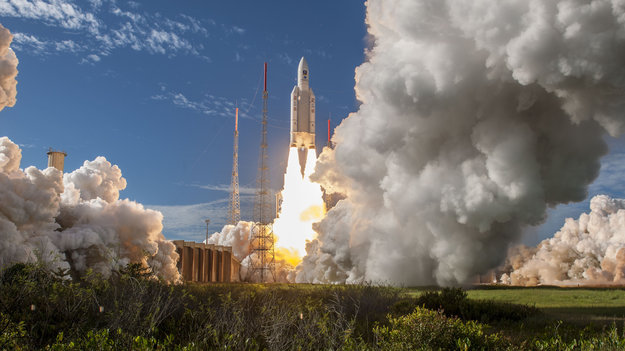
  • Latest satellite launch extends Galileo’s global reach

    Latest satellite launch extends Galileo’s global reach

    News from the European Space Agency

    Four more Galileo satellites were launched July 25 by an Ariane 5. Their arrival in orbit brings the Galileo constellation to 26 satellites, extending the global coverage of the constellation.

    Ariane 5 flight VA244, operated by Arianespace under contract to ESA, lifted off from Europe’s Spaceport in Kourou, French Guiana, at 11:25 GMT (13:25 CEST, 08:25 local time), carrying Galileo satellites 23–26. The first pair of 715 kg satellites was released almost 3 hours 36 minutes after liftoff, while the second pair separated 20 minutes later.

    They were released into their target 22 922 km-altitude orbit by the dispenser atop the Ariane 5 upper stage.

    In the coming days, this quartet will be steered into their final working orbits by the French space agency CNES, under contract to the Galileo operator SpaceOpal for the European Global Navigation Satellite System Agency (GSA).

    There, they will begin around six months of tests by SpaceOpal to verify their operational readiness so they can join the working Galileo constellation.

    “Galileo is ESA’s largest ever satellite constellation, built up to its present size in rapid time, with 22 Full Operational Capability satellites added within just the last four years,” remarked Jan Wörner, ESA’s director general.

    “We must thank our industrial partners OHB (DE) and SSTL (GB) for the satellites, as well as Thales Alenia Space (FR/IT) and Airbus Defence and Space (GB/FR) for the ground segment and all their subcontractors throughout Europe for their continued support to the programme. Together with ESA, the entire industrial team has worked hard for the point at which we now are and this cooperation have proven to be very successful, as we can show in the excellent performance of Galileo.”

    Paul Verhoef, ESA’s director of navigation, added, “Galileo has been providing Initial Services on a worldwide basis since 15 December 2016, and today has more than 100 million users, and rapidly increasing. Today’s satellites will increase the global coverage of Galileo with a performance that is widely recognized as excellent.

    “This is the end of the current phase of Galileo deployment, but our pace is not slacking. A further 12 Galileo ‘Batch 3’ satellites are in preparation as in-orbit spares and as replacements for the oldest Galileo satellites, first launched in 2011, in order to keep the system working seamlessly into the future.


    Photo: ESA

  • Esri joins with Airbus on global intelligence enterprise agreement

    Esri has entered into an enterprise agreement with the intelligence program line of Airbus Defence and Space. With this new agreement in place, the core GIS will be expanded to meet Airbus’s pivotal mission of using creativity and innovation to address the massive economic, social, and environmental challenges our planet faces.

    The enterprise agreement is global in nature and includes all Airbus Defence and Space intelligence affiliates. The agreement also includes several addendums to cover the complete use of Esri’s ArcGIS platform by Airbus Defence and Space.

    Airbus Defence and Space has used Esri technology as part of its GIS for 26 years.

    “The potential of this agreement can be expected to reach far beyond today’s use of the Airbus Defence and Space core geographic information systems,” says Greg Buckman, head of Airbus Defence and Space’s intelligence business activities in North America. “Enterprise-wide access to the ArcGIS platform will provide new and faster spatial analytical functionality through web services to support key Airbus initiatives. This bears the potential for significant cost savings and speed to market while enhancing crucial cross-domain functionality on a global basis.”

    “Esri shares in this vision and looks forward to supporting Airbus Defence and Space through the deployment of ArcGIS Enterprise,” said Lawrie Jordan, Esri’s director of imagery and remote sensing. “Having a complete GIS platform is vital to organizations such as Airbus Defence and Space that operate on a global scale and for whom geographic awareness is crucial.”

    To learn more about how Esri helps the intelligence community make the most of location data with The Science of Where, visit go.esri.com/arcgis-intel.

  • Active digital map for French armed forces will provide decisive mission advantage

    La Direction générale de l’armement (DGA), the French Defence Procurement Agency, has entrusted the firm tranche of the 10-year SYSENV contract to Airbus Defence and Space and its four partners, for the production of the SI GEODE4D information system for the French Armed Forces.

    This system is an essential component of the GEODE4D programme (geography, hydrography, oceanography and meteorology for defence) and will be available via a single and secure portal.

    It will allow all Ministry of Defence actors to access and share the same geophysical environment data and select and present them in a coherent way, according to the “one card for all” principle.

    “This programme shows the confidence of the DGA in Airbus and its partners for the construction of this information system for the French Armed Forces,” said François Lombard, Head of the Intelligence Business Cluster at Airbus Defence and Space. “One of the major challenges for the SI GEODE4D, which can truly be qualified as the active digital map of the 21st century, is also to assist our armed forces with their digital transformation.”

    It is vital to reinforce the ability to manage information and intelligence for early threat detection and identification. To provide an appropriate response to these varied and constantly changing threats, an accurate understanding of the geophysical environment is crucial for deployed forces.

    In future, the SI GEODE4D system, consisting of various services and applications, will provide the armed forces with an interoperable, coherent and shared vision of the geophysical environment, consistent with the NATO REP concept (Recognised Environmental Picture).

    The consortium is headed by Airbus Defence and Space and built around four innovative and specialised partner companies: Magellium for geography; Météo France International for meteorology, hydrography and oceanography; Bertin for the tool providing decision-making aids; and Deloitte for change management.

    The contract also includes the refurbishment of the geographical and meteorological–oceanographic data production centres in Creil, Haguenau and Toulouse. In particular, this refurbishment is designed to meet the need for the increased volume and transmission rates involved in the visualisation of all the environmental data on the future GEODE4D portal.

  • Airbus selects Google Cloud for One Atlas basemap

    Airbus Defence and Space has launched One Atlas, a new basemap streaming service delivering access to its satellite imagery over the world, fully refreshed within a 12-month period. It is powered by Google Cloud Platform.

    This service is a major leap forward for enabling access to satellite imagery for customers by leveraging the power of Google Cloud Platform and Airbus Defence and Space technologies, Airbus Defence said.

    A new approach in data storage, hosting and dissemination has been implemented using Google Cloud Platform to ingest the several hundred Terabytes of data annually required by One Atlas. This will bring value to clients for a wide range of applications such as infrastructure preparatory studies, land management, agricultural lands and crop-species mapping or even tree cover change detection in regions prone to deforestation.

    “Our team at Google Cloud is dedicated to helping businesses find success with public cloud and innovative technologies, such as cloud machine learning. We’re excited to collaborate with Airbus Defence and Space to create new products and transform existing business models through the power of Google Cloud Platform,” said Carl Schachter, vice president of Google Cloud Platform.

    Image from TerraSAR-X, a radar Earth observation satellite. (IMAGE: Airbus Defense and Space)
    Image from TerraSAR-X, a radar Earth observation satellite, of Barra da Tujica, Rio de Janeiro, Brazil. (IMAGE: Airbus Defense and Space)

    Google Cloud Platform was selected from seven public cloud providers because of its high-end technology, security resilience and strategic fit with Airbus Defence and Space’s business and development roadmap.

    “All satellite data collected each day are automatically processed and made readily-accessible in a global imagery library that is stored in Google Cloud Platform,” said Bernhard Brenner, head of the Intelligence Business Cluster at Airbus Defense and Space. “Google Cloud Platform’s global scale, low latency and infrastructure capacities in Europe give us the required performance, flexibility and scalability for current and future data volumes, ensuring a high level of service for our customers.”

    Additional investigations into the use of Google Cloud Platform and other Google tools are ongoing at Airbus Defence and Space, such as the integration of other datasets like TerraSAR-X radar data and WorldDEM into One Atlas, or the development of analytics services such as change detection and automatic object extraction. Very promising results have already been obtained from using Tensor Flow, an open source library for machine learning, and Cloud Machine Learning for automatic cloud detection.

  • Four-satellite Galileo Ariane 5 dispenser in place

    Four-satellite Galileo Ariane 5 dispenser in place

    News from the European Space Agency (ESA)

    A four-satellite dispenser for Galileo's Ariane 5 is shown during shaker testing at Airbus Defence and Space near Bordeaux, France. The dispenser has had four Galileo engineering models attached to it for test purposes. Copyright: ESA
    A four-satellite dispenser for Galileo’s Ariane 5 is shown during shaker testing at Airbus Defence and Space near Bordeaux, France. The dispenser has had four Galileo engineering models attached to it for test purposes.
    Copyright: ESA

    Following rigorous testing in France and Germany, a new type of dispenser designed to carry four navigation satellites into orbit at once is now in French Guiana, in place for Galileo’s first Ariane 5 launch later this year.

    The dispenser is an essential element of launch success, with a double role to play. It first must hold the quartet of satellites securely in place during the stresses of liftoff, and then the nearly four-hour long flight to medium-Earth orbit.

    Then, once the Ariane 5 EPS upper stage reaches its target altitude of 23,222 kilometers , the dispenser will release the four Galileo satellites using a pyrotechnic release system triggered by separate igniters, each one firing half a second after the other.

    The separated satellites are then pushed away from the dispenser in separate directions using a spring-based distancing system.

    The 447-kilogram dispenser, designed by Airbus Defence and Space, must support a satellite mass of 738 kilograms each – nearly three tons total.

    Made from a combination of metal and composite materials for maximum stiffness, the dispenser has undergone very comprehensive testing at Airbus Defence and Space near Bordeaux, France, and the IABG testing centre in Ottobrunn, Germany – using both Galileo engineering models and an actual flight satellite, including fit, shock and separation testing.

    A four-satellite dispenser for Ariane 5 Galileo launches with engineering models attached for test purposes. Copyright: CNES/ESA
    A four-satellite dispenser for Ariane 5 Galileo launches with engineering models attached for test purposes.
    Copyright: CNES/ESA

    The test campaign met all objectives, reports the ESA, confirming the behavior performs as predicted, after which the dispenser was shipped to Europe’s Spaceport in French Guiana.

    This fall, four Galileo satellites will be launched together for the very first time on a specially customized launcher — the Ariane 5 ES Galileo.

    In development since 2012, the new launcher variant has evolved from the Ariane 5 ES (Evolution Storable), used to place ESA’s 20,000-kilogram ATV supply vehicle into low-Earth orbit.

    This launder has to carry a lower mass payload – four fully fuelled 738-kilogram Galileo satellites plus their supporting dispenser – but needs to take it up to the much higher altitude of medium-Earth orbit, approximately 23,222 kilometers up.

    The target orbit is actually 300 kilometers below the Galileo constellation’s final working altitude, which leaves the Ariane’s EPS upper stage in a stable “graveyard orbit,” while the quartet of Galileos maneuver themselves up to their final set height.

    Once the Ariane 5 ES Galileo flight is complete, there should be 18 Galileo satellites in orbit.

  • Airbus to provide solar cells for MicroLink Zephyr UAV

    Airbus to provide solar cells for MicroLink Zephyr UAV

    Airbus Defence and Space has issued a production contract for MicroLink Devices’ solar sheets for use on the new Zephyr S platform.

    The Zephyr platform is a new class of unmanned air vehicle that operates as a high-altitude pseudo-satellite (HAPS) enabling affordable, persistent, local satellite-like services. The aircraft runs exclusively on solar power, and the Zephyr aircraft is at the forefront of the HAPS arena, holding world records with regards to absolute endurance (more than 14 days) and altitude (more than 70,000 feet).

    The next generation of Zephyr HAPS — depicted flying in formation in the stratosphere — will be powered by MicroLink solar sheets. (Art: MicroLink Devices)
    The next generation of Zephyr HAPS — depicted flying in formation in the stratosphere — will be powered by MicroLink solar sheets. (Art: MicroLink Devices)

    The British Ministry of Defence currently has ordered two Zephyr S from Airbus Defence and Space. The Zephyr S has a wingspan of 25 meters, is 30 percent lighter and can carry 50 percent more batteries than its predecessor — the 22.5-meter wingspan Zephyr 7. This enables the Zephyr S to carry heavier payloads for surveillance and communications roles.

    The Zephyr S is designed to fly continuously for over a month before having to land. The vehicle can then be refurbished and redeployed.

    The MicroLink Devices solar sheet is lightweight, flexible and highly efficient. It was designed as an enabling technology for electrically powered, area- and weight-constrained applications such as unmanned air vehicles, which run on renewable energy.

    The combination of high-efficiency and low mass enabled by the epitaxial liftoff (ELO)-based solar cells provides superior performance. The ELO solar cells are a perfect match for the HAPS platform. The resulting solar sheets have specific powers in excess of 1,000 W/kg and areal powers greater than 250 W/m2.

    MicroLink’s ELO technology was sponsored by numerous U.S. agencies including NASA, DARPA, the Air Force Research Laboratory, the Office of Naval Research, NAVAIR, Army Research Office, Army REF, CERDEC and the Department of Energy.

    MicroLink Devices solar sheets are lightweight and flexible with high specific and aeral powers enabling significant mobile power generation. (Photo: PRNewsFoto/MicroLink Devices)
    MicroLink Devices solar sheets are lightweight and flexible with high specific and aeral powers enabling significant mobile power generation. (Photo: PRNewsFoto/MicroLink Devices)

    “We are extremely pleased to have developed a relationship with the Zephyr team four years ago and to transition our high-performance solar sheet development efforts into a production program,” said Noren Pan, president and CEO of MicroLink Devices. “We are also thankful to Airbus for their purchase order and the confidence they have in MicroLink’s solar sheet technology and manufacturing ability. We know of no other flexible solar sheet that offers a comparable performance in terms of power and weight and reliability under a wide temperature range.”

    “Our collaboration with MicroLink Devices in the development stages and in the current production program has enabled the latest generation of Zephyr HAPS, which is a critical addition to our extensive portfolio of space and defense products,” said Steve Whitby, head of HAPS Business Development. “MicroLink Devices is a world leader in the epitaxial liftoff of compound semiconductors providing outstanding performance for many semiconductor devices. Combining Airbus and MicroLink Devices engineering expertise has proven to be a successful platform for our on-going success.”

  • Proteus Strengthens Satellite Imagery Procurement Service

    Proteus, a provider of satellite derived mapping, bathymetry and geospatial products, said it has strengthened its Professional Satellite Imagery Procurement Service by signing up as a reseller with international satellite imagery provider Airbus Defence and Space. Proteus is now an official reseller of Airbus’s satellite imagery data and value-added products.

    “We are very excited to formalise our relationship with Airbus Defence and Space,” said Proteus CEO David Critchley. “We are currently providing our clients with a successful Satellite Imagery Procurement Service, adding the large product portfolio of Airbus Defence and Space to our current catalogue of data provides our customers with even more choice of high quality product and satellite tasking services.”

    Proteus has been delivering geospatial solutions for mapping and classification projects using multispectral satellite imagery since 2011 and their experienced staff have all been working in the geospatial industry for over 15 years. Proteus’s satellite imagery projects have been delivered for environmental consultancies, oil and gas, engineering and other coastal zone applications in Europe, USA, the Middle East and Caribbean.

  • Esri Maps Reveal Impacts from Nepal Earthquakes

    Esri has added a pair of new maps to its Nepal Earthquake Maps gallery

    Nepal Earthquake Swipe Map

    Compare pre- and post-earthquake imagery from Airbus Defence & Space to explore damage around Nepal. This map includes several bookmarks to help users navigate around key points of interest and landmarks that were damaged or destroyed.

    Esri-Nepal-Swipe-W

    Nepal Earthquake Impact Summary Map

    Users can interactively explore demographic information about the people affected by the earthquake. The map fuses demographic data with the Shakemap from USGS to provide estimates about the population in each shake zone. Click a zone on the map to see how many people live in that area.

    Esri-Nepal-Summary-W

  • Esri Maps Reveal Impacts from Nepal Earthquakes

    Esri has added a pair of new maps to its Nepal Earthquake Maps gallery

    Nepal Earthquake Swipe Map

    Compare pre- and post-earthquake imagery from Airbus Defence & Space to explore damage around Nepal. This map includes several bookmarks to help users navigate around key points of interest and landmarks that were damaged or destroyed.

    Esri-Nepal-Swipe-W

    Nepal Earthquake Impact Summary Map

    Users can interactively explore demographic information about the people affected by the earthquake. The map fuses demographic data with the Shakemap from USGS to provide estimates about the population in each shake zone. Click a zone on the map to see how many people live in that area.

    Esri-Nepal-Summary-W

  • Airbus Releases Satellite Imagery of Nepal Earthquake

    Following Nepal’s devastating magnitude 7.8 earthquake on Saturday, Airbus Defence and Space has acquired Pléiades satellites imagery to support the International Charter and Copernicus Emergency Management Service. The data acquired will assist in assessing the damage and help rescue organizations in the delivery of humanitarian aid.

    The before and after Pléiades images over Kathmandu (full image can be downloaded here) show the devastation caused by the earthquake. The below “before” Pléiades image was acquired on Nov. 29, 2014, and the “after” Pléiades image was acquired on April 27, 2015, two days after the earthquake.

    Kathmandu, viewed by Pléiades satellites, before and after the earthquake. (Image: Airbus Defence & Space)
    Kathmandu, viewed by Pléiades satellites, before and after the earthquake. (Image: Airbus Defence and Space)

    The Airbus Pléiades 1A and Pléiades 1B satellites operate as a constellation in the same orbit, phased 180 degrees apart. The identical twin satellites deliver high-resolution optical data products and can revisit any point on the globe, according to Airbus.

    UPDATE:

    Esri has created a Nepal Earthquake Swipe Map, which allows users to compare the pre- and post-earthquake images from Airbus Defence & Space to explore damage around Nepal. This map includes several bookmarks to help users navigate around key points of interest and landmarks that were damaged or destroyed.

    Esri-Nepal-Swipe-W

  • Airbus Imagery to Help Vanuatu in Wake of Cyclone

    Port Vila, the capital of Vanuatu, viewed by Pléiades satellites, before Cyclone Pam.
    Port Vila, the capital of Vanuatu, viewed by Pléiades satellites, before Cyclone Pam.
    Port Vila, the capital of Vanuatu, viewed by Pléiades satellites after the passage of Cyclone Pam.
    Port Vila, the capital of Vanuatu, viewed by Pléiades satellites after the passage of Cyclone Pam.

    Following Cyclone Pam, Airbus Defence and Space has acquired Pléiades and SPOT 6 and 7 imagery over the island nation of Vanuatu to support the International Charter and Copernicus Emergency Management Service.

    The data acquired will assist in assessing the damage and help rescue organizations in the delivery of humanitarian aid.

    The before and after Pléiades images over Port Vila, that can be downloaded here, show the devastation caused by the cyclone. The “before” Pléiades image was acquired on April 9, 2014, and the “after” Pléiades image was acquired on March 16, three days after the Cyclone hit Port Vila.