Tag: Applanix

  • Phase One launches 280-megapixel camera with Applanix GNSS

    Phase One launches 280-megapixel camera with Applanix GNSS

    Photo: Phase One Industrial
    Photo: Phase One Industrial

    Phase One Industrial has launched a 280-megapixel aerial photogrammetric system, with an image coverage width of more than 20,000 pixels.

    The large format enables unprecedented high-quality aerial survey productivity, the company said. Compact and lightweight, the new aerial mapping solution can reduce operating costs and produce better returns on investment than today’s traditional large format systems.

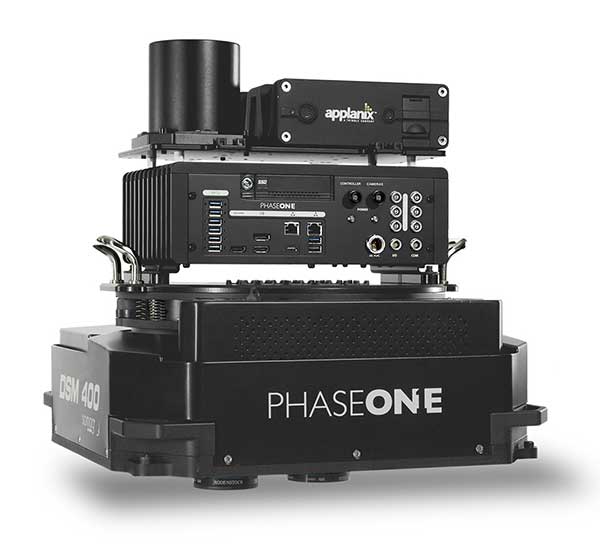
    The Phase One Industrial 280MP Aerial Solution consists of an iXM-RS 280F large format camera, Applanix GNSS/IMU receiver (POS AV series), Somag gyro-stabilized mount (DSM 400), Phase One iX Controller and iX Flight Management software.

    The system is a large format camera system that easily integrates with the DSM400 gyro-stabilized mount, creating a compact and lightweight system for use in a wide range of aircraft.

    At the system’s heart is the iXM-RS 280F, a dual-lens metric camera with 90mm lenses for capturing RGB information, providing precision imaging. Adding a near infrared (NIR) camera generates a 4-band configuration, most useful in agriculture, forestry and pipeline monitoring.

    The iXM-RS 280F camera generates a central projection image from two 150MP nadir images with equal ground resolution. The cameras’ backside illuminated CMOS sensor supports very high dynamic range at 83dB. Its high light sensitivity provides superb image quality in challenging low light conditions, enabling operators to take advantage of more flight hours per day and more flight days per year.

    “Our 280MP Aerial Solution is a bold and innovative approach to solving customers’ demands for affordable and reliable aerial mapping performance,” said Dov Kalinski, general manager, Phase One Industrial. “Previously, opportunities in the aerial mapping business were restricted due to high cost of equipment and limited aircraft options. While pioneering superior image quality, Phase One Industrial is creating more profitable possibilities in this exciting and important market.”

  • Latest YellowScan lidar system designed for UAV surveys

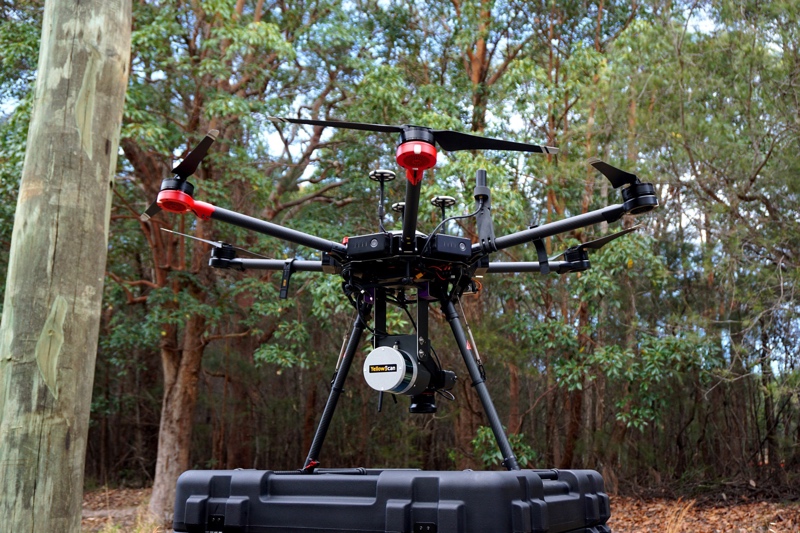
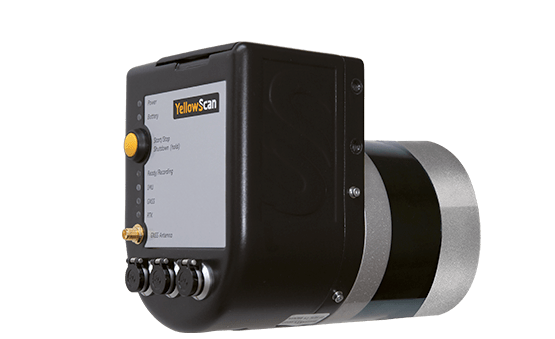
    YellowScan has launched a new lidar system, the Surveyor Ultra. It integrates the Velodyne VLP-32C scanner and the Applanix APX-15 GNSS/inertial measurement unit (IMU).

    With high density (600,000 shots per second), the system is suitable for high-speed UAVs and long-range needs (maximum range: 100 meters). Its light weight (1.7 kg) makes it easy to mount on any drone, including vertical takeoff and landing (VTOL) UAVs.

    As for all YellowScan lidar systems, the Surveyor Ultra is a turn-key system fitted for under vegetation 3D modeling and fast data processing, the company said.

    Applications such as forestry, archeology and environmental research will benefit from Surveyor Ultra, as they require long-endurance flights high above trees or over rocky mountains and rugged terrain.

    “The Surveyor Ultra shows great potential to safely and efficiently operate lidar on lightweight fixed-wing UAVs,” said Tristan Allouis, YellowScan CTO. “The Surveyor Ultra completes our product line, including the successful Surveyor Lidar System (integration of the VLP-16 scanner from Velodyne).”

  • Applanix offers Autonomy Development Platform for autonomous vehicles

    Applanix offers Autonomy Development Platform for autonomous vehicles

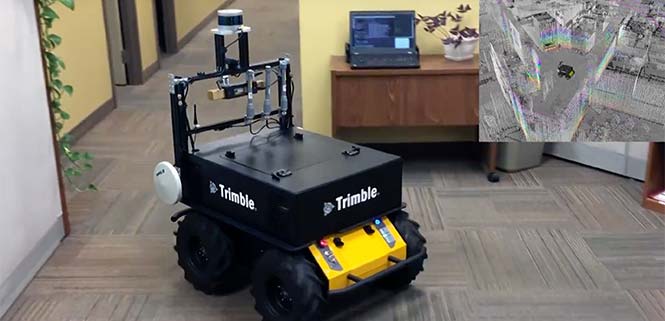
    Applanix, a Trimble Company, has introduced its Autonomy Development Platform to provide automakers, truck makers and Tier 1 vehicle suppliers the hardware, software, engineering and integration services they need to accelerate their development programs for on-road and off-road autonomous vehicles.

    By combining customized integration and engineering services along with Applanix’ GNSS-inertial positioning technologies, the Autonomy Development Platform advances driverless vehicle development projects at every stage of development and commercialization.

    “With the introduction of our Autonomy Development Platform, Applanix now offers on-road and off-road vehicle manufacturers the tools and engineering expertise necessary to support and augment their driverless vehicle development programs,” said Louis Nastro, director of Land Products at Applanix.

    “The platform delivers a navigation solution that is fully customizable and includes integration and engineering services, field-tested hardware and proprietary software for highly accurate positioning,” continued Nastro. “The navigation solution is capable of working with all sensors, including multiple cameras, lidar, radar and ultrasonic sensors, and with all vehicle types at all stages in the development and commercialization cycle.

    “The Applanix technology enables highly accurate assessments of the full 360-degree environment around a vehicle to produce a robust representation, including static and dynamic objects, critical for successful vehicle autonomy.”

    “Applanix has been committed to meeting the needs of autonomous vehicle manufacturers for more than a decade, going back to our success at the DARPA Challenges. In addition, our expertise in autonomous technologies is part of an extensive portfolio of Trimble solutions for automation and vehicle autonomy, which began more than three decades ago,” said Steve Woolven, president of Applanix. “Our refined positioning algorithms and expertise with sensor fusion and mobile robotic technologies enable us to provide a development platform that delivers the required performance and reliability for manufacturers to develop and produce self-driving vehicles for all environments and tasks.”

    The Applanix Autonomy Development Platform is available now through the Applanix worldwide sales channel.

    https://youtu.be/hF53U3MF_AE

  • Think 3D, Applanix combine on UAV-based airborne lidar mapping

    The Think 3D Stormbee multicopter integrated with Trimble’s AP15 provides efficiency, accuracy and performance for lidar surveys from unmanned vehicles.

    Historically, lidar-based aerial surveys were impractical for all but the largest unmanned systems. Because of Applanix’ development of small, lightweight and low-powered direct georeferencing solutions, airborne lidar scans from small drones are now practical, cost-effective, highly accurate and excellent options for lidar surveys, according to the company.

    The Stormbee is a directly georeferenced UAV lidar solution for 3D industrial mapping applications, designed to collect survey grade spatial data in a significantly more cost effective and efficient way than static lidar.

    Think3D-Stormee-UAV-lidar-O
    The Stormbee, a Faro Focus 130 laser scanner, and the AP15.

    Stormbee’s 3D mapping technologies include Faro’s Focus 130 laser scanner, Trimble’s AP15 high performance GNSS/inertial receiver, Applanix’s POSPac UAV GNSS/inertial post-processing software and Stormbee’s proprietary Beeflex software for lidar point cloud generation.

    Industrial applications (GNSS-denied environments) pose unique challenges for laser scanning using traditional static systems, due to obstructions and poor signal environments. These issues lead to increased costs and operational time.

    By using the high-performance Trimble AP15 with two antenna and the Applanix post-processing software (POSPac MMS) for georeferencing the lidar data, Stormbee provides an accurate real-time and post-mission solution for all motion variables.

    Applanix has brought together its decades of experience in multi-frequency, multi-constellation Differential GNSS and inertial based positioning and orientation with the best in small-form factor hardware and powerful software, to produce a DG solution for professional aerial mapping on UAVs.

    With a system delivering better than 5-cm accuracy (real mean squared) and high resolution, Stormbee and Applanix offer 3D detail from a platform moving at speeds up to 15 meters per second. The Stormbee leverages Applanix’s decades of experience in direct georeferencing of lidar systems to collect the most accurate 3D data.

    Benefits of the system:

    • compact, easy-to-operate and cost-effective
    • centimeter-level mobile positioning accuracy for 3D mapping products
    • improved productivity, with optimized workflow from data capture to georeferenced point cloud generation
    • superior visualization: Lidar scanners provide more accurate information of structures than camera technologies

    Think 3D, a Belgian company, is a 3D scanning company for many industrial applications including those in the beverage, steel, pharmaceuticals, chemicals and tank terminals industries. Think3D helps companies make changes to their installations by providing a full 3D CAD model of their installation.

    Stormbee to date has proven to be effective in many industries including mining, engineering, dredging, forensics, universities and survey.

  • Trimble offers direct georeferencing GNSS/inertial for UAVs

    Trimble offers direct georeferencing GNSS/inertial for UAVs

    Trimble is offering three new GNSS-inertial systems for direct georeferencing on unmanned aerial vehicles (UAVs): the Trimble APX-15-EI UAV, Trimble APX-18 UAV and Trimble APX-20 UAV.

    Direct georeferencing with the systems allows the location of image elements collected by lidar and hyperspectral sensors to be accurately computed without extensive networks of ground control points, reducing costs while maintaining accuracy to produce maps.

    The APX products use state-of-the-art low noise, multi-frequency Trimble Maxwell GNSS technology, and track all current satellite signals including GPS L1/L2/L2C/L5 and GLONASS L1/L2, QZSS, BeiDou, IRNSS and Galileo, supporting SBAS, RTK and Trimble CenterPoint RTX positioning modes.

    The APX-15-EI UAV features dual inertial measurement units (IMU); one embedded onto the GNSS-inertial board that is mounted on the UAV airframe with the GNSS antenna, and one that is mounted on an external sensor contained in a gimballed mount.

    With this feature, the APX-15-EI UAV can compute two sets of orientations — the UAV airframe and the gimballed mount —  enabling automatic, precise positioning of the sensor without requiring an external interface to the gimballed mount or autopilot.

    The APX-20 GNSS-inertial board by Applanix.

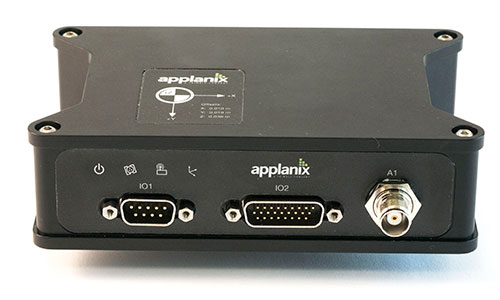
    The APX-18 UAV is a single-board GNSS-inertial solution that supports two-antenna heading for the highest accuracy in low-speed multi-rotor survey applications such as building facade scanning. Measuring  10 x 6 centimeters and weighing 62 grams, the APX-18 UAV uses on-board inertial sensors calibrated with the Applanix SmartCal software compensation technology for superior performance in a small, compact form for UAVs.

    To meet the higher accuracy demands driven by the allowance of higher altitude, beyond visual line of sight (BVLOS) UAV flights and the introduction of higher resolution, larger format imaging sensors, Trimble has developed the APX-20 UAV.

    Also featuring dual IMUs for automatic gimballed mount support, the APX-20 UAV uses a new, MEMS-based lightweight external IMU with unparalleled performance. With a total weight of less than 425 grams, the APX-20 UAV provides high performance without sacrificing flight time.

    “We are very pleased to announce these new additions to our portfolio of products for Direct Georeferencing on UAVs,” said Joe Hutton, director of inertial technology and airborne products at Applanix, a Trimble Company. “We have listened to our customers and worked very hard to come up with solutions that meet their needs, both from a technical and cost perspective.”

    All APX products include the Applanix POSPac UAV post-processing software for generation of high-accuracy carrier-phase differential GNSS-inertial position and orientation for highest accuracy map products.

    POSPac UAV supports single GNSS base-station processing with automatic coordinate survey using Trimble CenterPoint RTX, multi-single base station processing, and Applanix SmartBase Virtual Reference Station processing (optional), as well as the Trimble CenterPoint RTX post-processing trajectory generation available as a subscription.

  • GNSS Smart Target Base Station simplifies map production from UAVs

    Trimble has released the Trimble GNSS Smart Target Base Station for high-accuracy mapping from unmanned aerial vehicles (UAVs).

    The announcement was made at Intergeo 2017, the world’s largest conference on geodesy, geoinformatics and land management.

    Comprised of a survey grade, multi-frequency, multi-constellation GNSS reference station complete with a foam Ground Control Target with integrated carrying case, the Smart Target Base Station logs the raw GNSS observables required to perform centimeter level post-processed Differential GNSS positioning of UAVs, and acts as a photo-identifiable Ground Control Point (GCP) for quality control.

    Cost effective, simple to operate, and supported by both the Applanix POSPac UAV GNSS-inertial post-processing software for direct georeferencing on UAVs and Trimble UASMaster photogrammetric software, the Smart Target Base Station makes aerial mapping from UAVs easier, according to Trimble.

    Users can place the foam target with its receiver in the project area and stake it down. With the included smartphone app or web user interface, users can remotely begin logging the raw GNSS observables data collected by the target that is required for post processing.

    At the end of the mission, the user retrieves the target and downloads the raw GNSS data along with the data collected from the Trimble APX UAV GNSS-inertial system installed in the UAV.

    Global coordinates of the reference station are computed automatically using the Trimble Centerpoint RTX post-processing service in POSPac UAV or, if local coordinates are desired, the foam target can be centered over an existing reference point.

    “Efficient mapping from UAVs using cameras, lidar and other sensors requires the right solutions that need to be simple and easy to use,” said Joe Hutton, director of inertial technology and airborne products at Applanix, a Trimble Company. “The Smart Target Base Station is a result of listening to our customers’ needs for a GNSS reference station to support direct georeferencing on UAVs that is cost-effective, easy to deploy in all terrains, and does not require special knowledge to operate. Aerial surveyors can quickly realize greater value and significant cost savings with this system, while obtaining high accuracy.”

    The Trimble GNSS Smart Target Base Station operates autonomously for up to four hours with its embedded lithium ion battery. Extended operation can be achieved with a user-supplied external USB battery.

  • Phase One Industrial introduces 190MP aerial system

    Phase One Industrial introduces 190MP aerial system

    Phase One Industrial has launched the 190MP Aerial System, built on dual CMOS sensors and the dual-lens iXU-RS1900 camera, which is capable of capturing images at 190 megapixels, according to the company.

    An alternative to traditionally expensive large-format cameras, the system was designed with input from engineers and experts in photogrammetry to address challenging aerial applications such as remote sensing, monitoring, inspection and disaster management.

    The system is equipped with an Applanix’ POS AV system, enabling direct geo-referencing of aerial images. It is also compatible with other GNSS/IMU systems. By integrating precision GNSS with inertial technology, POS AV enables precise determination of position and attitude, as well as the completion of geospatial projects in a more efficient and cost-effective manner.

    The system’s accurate large image coverage, light weight and low power consumption make it compatible with most light aviation vehicles, including those that previously could not manage a large format system.


    The iXU-RS1900 camera and 190MP aerial camera system will be presented at Intergeo 2017, to be held in Berlin, Germany, from Sept. 26-28. Phase One Industrial’s booth is in Hall 4.1, stand B4.002. Applanix is exhibiting in Hall 4.1, stand C4.050.


    At the system’s heart is the IXU-RS1900 camera. It features two CMOS sensors and two 90mm lenses for capturing RGB information. Key imaging attributes include:

    • a small pixel size (4.6 µ)
    • large image area (16,470 x 11,540)
    • high image-capture rate of 0.6 second and exposure time of up to 1/2000 second.

    An optional four-band configuration, adding a 50-mm lens for capturing near infrared (NIR) information, provides four-band (RGB, NIR) or color-infrared (CIR) imagery.

    Integrated iX Capture software automatically generates distortion-free images and automatically performs an accurate matching of the NIR and RGB images.

    The iXU-RS1900 can also be a  standalone camera for photogrammetric work, as a component for lidar systems, or as part of a multiple camera array, such as a nadir camera for oblique systems.

    “Introducing the Phase One 190MP aerial system demonstrates our continuing commitment to the aerial photography market,” said Dov Kalinski, general manager of Phase One Industrial. “The cooperation with leading partners in mount design, GNSS, and Flight Managements Systems enables Phase One to offer an innovative system at affordable pricing, and enables our customers to execute projects faster and at lower cost.”

    190MP Aerial System Features

    The entire system comprises many elements including:

    iX Controller MK III: This is the central hub of the system. It controls the camera, the gyro-stabilizing mount and the GNSS/IMU system, and runs the capture application and the flight management system. The iX Controller supports dual monitors, so both the pilot and the operator are able to monitor and observe different views of the setup in parallel.

    iX Capture: iX Capture is an aerial capture, control and image processing software with an intuitive interface that displays key information such as exposure settings, histogram, GPS data and frame count. It provides the operator with real-time feedback and ensures confidence that each image has been captured correctly.

    Gyro Stabilized Camera Mount – Somag DSM400: Designed specifically for Phase One 190MP Aerial System, this mount has a low weight of 14 kg and high payload of 35 kg. It provides optimal stabilization of the system pod and allows highly efficient and precise image capturing under most flight conditions.

    GNSS/IMU system: The Phase One 190MP Aerial System is equipped with an Applanix’ POS AV system, enabling direct geo-referencing of aerial images. It is also compatible with other GNSS/IMU systems. By integrating precision GNSS with inertial technology, POS AV enables precise determination of position and attitude, as well as the completion of geospatial projects in a more efficient and cost effective manner.

    Flight Management System: Controlled and operated with ease, TopoFlight flight management system, integrated into the Phase One 190MP Aerial Camera System, enables the planning, positioning and sensors’ management – reducing aerial survey operational costs and increasing productivity. The 190MP Aerial System is also compatible with other flight management systems.

    Availability and Pricing: The iXU-RS1900 camera and 190MP Aerial Systems are available now from Phase One Industrial partners worldwide. The iXU-RS1900 camera pricing starts at US$150,000; the 190MP Phase One Aerial System pricing starts at U.S. $280,000; and the190MP Four-Band Aerial System pricing starts at US$365,000.
  • Applanix, Waterloo U collaborate on autonomous vehicle tech

    Applanix, Waterloo U collaborate on autonomous vehicle tech

    Applanix is collaborating on advanced research for autonomous vehicle guidance and control systems with the University of Waterloo Centre for Automotive Research (WatCAR) in Ontario, Canada. Applanix is a Trimble company.

    Applanix will provide WatCAR with its positioning and orientation system for testing autonomous guidance and control systems in real-world conditions. Applanix will also provide the Trimble GNSS-inertial board set for integration with car systems and sensors to enable precise positioning.

    The Applanix POS LV is a robust, reliable and repeatable positioning solution for on- and off-road vehicles. Applanix technology will be used by WatCAR to assess the performance of the guidance and control systems on board their autonomous vehicles.

    The testing will take place in challenging weather conditions and environments including on roads under repair, with lane reductions and closures, are wet or covered in snow, and where there is poor visibility.

    An SUV in an anechoic chamber at WatCAR.

    Applanix will also provide WatCAR with Trimble on-board GNSS-inertial board set designed for high-performance, high-volume original equipment manufacturer applications. These products, currently used in a variety of autonomous vehicle programs, include the Trimble AP GNSS-inertial board set that includes a high-precision inertial measurement unit.

    Small, rugged and low powered, the AP board sets provide the precise positioning needed for autonomous vehicle applications as they navigate their environment. Designed for use on all sizes and types of vehicles, the AP boards feature Trimble’s high-performance precision GNSS receivers and Applanix’ IN-Fusion GNSS-inertial integrated technology that produces uninterrupted position, roll, pitch and true heading measurements of moving platforms. Integrating easily with vehicle sensors, the AP board sets provide precise vehicle control when interacting with a constantly changing environment.

    The relationship with WatCAR will aid in improving the core technologies that deliver high-end systems capabilities for a variety of Trimble markets.

    The Waterloo Centre for Automotive Research in Canada conducts advanced research to further automotive innovation and competitiveness. From active safety to automated driving through lightweighting and advanced powertrains, 130 faculty researchers comprise the largest university-based automotive activity in the country. Leading-edge studies for industry partners around the world enhance vehicles, components and their materials with new approaches and integration of innovative technologies.

    “We are excited to collaborate with the University of Waterloo and WatCAR on this leading research in autonomous vehicle technology,” said Louis Nastro, director of land products at Applanix. “Applanix has been committed to meeting the needs of autonomous vehicle manufacturers for more than a decade, as first demonstrated in the early days of the DARPA Grand Challenge. And today, we are also part of many autonomous vehicle programs deployed worldwide in commercial applications.”

    “The Trimble AP products, first introduced in 2009, are designed for use in small, mass market vehicles where size, weight and cost factors are important,” Nastro said. “They have also been designed to easily integrate with the industry’s leading sensors, making them an ideal solution for autonomous vehicle navigation systems and sub-systems.”

    “We welcome the opportunity to work with Applanix, a leader in reference systems. Their technology identifies, with very high accuracy, the exact location of our vehicle at all times,” said Ross McKenzie, managing director at WatCAR. “Applanix is a valued industry partner and their team is great to work with. Going forward we anticipate a solution that will enable autonomous vehicles to traverse the real world reliably and safely.”

  • New TIMMS 2 a Maneuverable Indoor Mapper

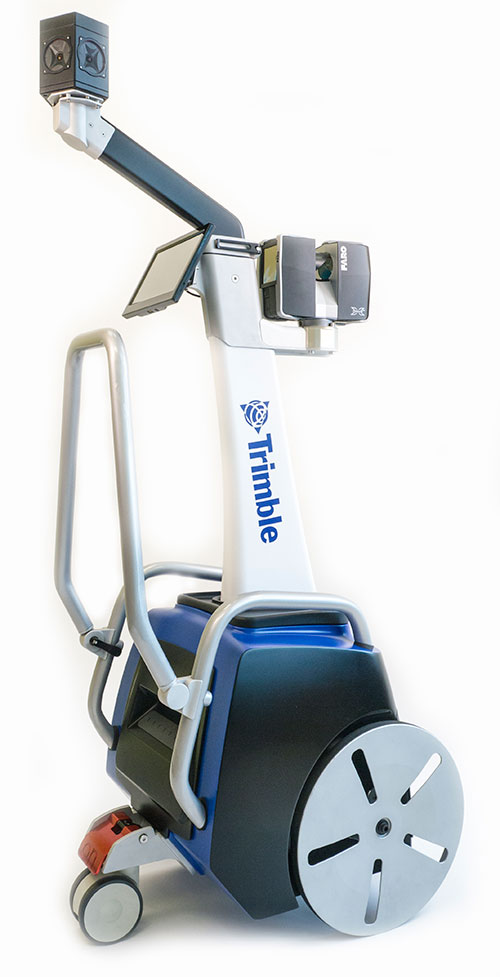
    Timms-From-the-angle-WTrimble has introduced its next-generation Trimble Indoor Mobile Mapping Solution (TIMMS) that produces fast and accurate maps of difficult-to-navigate indoor spaces and translates them directly into 2D and 3D models of structured interiors.

    TIMMS 2 is a fusion of technologies for capturing spatial data of indoor and other GNSS denied areas, the company said. It provides both lidar and spherical video, enabling the creation of accurate, real-life representations of interior spaces and all of their contents. The maps are geo-located, meaning that the real world positions of each area of the building and its contents are known and can be easily placed and oriented in a wide area model.

    TIMMS 2 is smaller, lighter and more easily maneuverable than its predecessor. It can negotiate tight corners, closets and catwalks, and can be carried up and down staircases where no elevator is available for travel between building levels.

    “The new Trimble Indoor Mobile Mapping Solution has been designed with greater emphasis on ease of use. It is very easy to maneuver, lift, ship and operate,” said Louis Nastro, director of Land Products at Applanix, a Trimble Company. “Our extensive experience with a broad range of projects with the previous generation TIMMS has led to a number of enhancements in data collection, processing and workflow management — making an indoor mapping project a seamless experience for users both pre- and post-mission. Whatever the building type and shape, TIMMS 2 can deliver exceptional results, both in accuracy and ease-of-use.”

    Building on the success of the first-generation solution, TIMMS 2 also provides improved software workflow to manage the complete process from collection through post-processing to model production. Fully compatible with POSPac MMS, Applanix’ post-processing suite, TIMMS data can be presented in a variety of ways, including integration into Trimble Business Center and other infrastructure management or CAD packages.

    Because of its increased efficiency, speed and ease-of-use, TIMMS 2 is an effective and high-productivity indoor mapping solution for buildings and facilities of all shapes and sizes, according to Trimble, including large or small areas, multi-level, industrial or commercial spaces. Users can obtain holistic 3D indoor geospatial views of all kinds of infrastructure including public buildings (government offices, schools, hospitals); industrial facilities (factories, warehouses); transportation hubs (airports, train stations); retail spaces (malls, concourses); entertainment venues (theatres, auditoriums, sound stages); and residential property (especially multi-occupancy high-rise buildings).

    Maps and models of these spaces can be used for activities including revenue management and space planning; emergency preparedness and disaster planning; and historical building conservation and preservation. In addition, the base map provides a platform on which building owners and managers can serve location-based services.

    Manufactured and sold by Applanix, TIMMS 2 indoor mobile mapping solution is available in the first quarter of 2016.

    Below, Eric Liberty of Applanix, a Trimble company, gives an overview of Applanix’s POS AV, POS AVX 210 and TIMMS indoor mobile mapping system at INTERGEO 2015, which was held Sept. 15-17 in Stuttgart, Germany.

  • Trimble’s TIMMS 2 Provides Maneuverable Indoor Mapping Solution

    Trimble’s TIMMS 2 Provides Maneuverable Indoor Mapping Solution

    Photo: TrimbleTrimble has introduced its next-generation Trimble Indoor Mobile Mapping Solution (TIMMS) that produces fast and accurate maps of difficult-to-navigate indoor spaces and translates them directly into 2D and 3D models of structured interiors.

    TIMMS 2 is a fusion of technologies for capturing spatial data of indoor and other GNSS denied areas, the company said. It provides both lidar and spherical video, enabling the creation of accurate, real-life representations of interior spaces and all of their contents. The maps are geo-located, meaning that the real world positions of each area of the building and its contents are known and can be easily placed and oriented in a wide area model.

    TIMMS 2 is smaller, lighter and more easily maneuverable than its predecessor. It can negotiate tight corners, closets and catwalks, and can be carried up and down staircases where no elevator is available for travel between building levels.

    “The new Trimble Indoor Mobile Mapping Solution has been designed with greater emphasis on ease of use. It is very easy to maneuver, lift, ship and operate,” said Louis Nastro, director of Land Products at Applanix, a Trimble Company. “Our extensive experience with a broad range of projects with the previous generation TIMMS has led to a number of enhancements in data collection, processing and workflow management — making an indoor mapping project a seamless experience for users both pre- and post-mission. Whatever the building type and shape, TIMMS 2 can deliver exceptional results, both in accuracy and ease-of-use.”

    Building on the success of the first-generation solution, TIMMS 2 also provides improved software workflow to manage the complete process from collection through post-processing to model production. Fully compatible with POSPac MMS, Applanix’ post-processing suite, TIMMS data can be presented in a variety of ways, including integration into Trimble Business Center and other infrastructure management or CAD packages.

    Because of its increased efficiency, speed and ease-of-use, TIMMS 2 is an effective and high-productivity indoor mapping solution for buildings and facilities of all shapes and sizes, according to Trimble, including large or small areas, multi-level, industrial or commercial spaces. Users can obtain holistic 3D indoor geospatial views of all kinds of infrastructure including public buildings (government offices, schools, hospitals); industrial facilities (factories, warehouses); transportation hubs (airports, train stations); retail spaces (malls, concourses); entertainment venues (theatres, auditoriums, sound stages); and residential property (especially multi-occupancy high-rise buildings).

    Maps and models of these spaces can be used for activities including revenue management and space planning; emergency preparedness and disaster planning; and historical building conservation and preservation. In addition, the base map provides a platform on which building owners and managers can serve location-based services.

    Manufactured and sold by Applanix, TIMMS 2 indoor mobile mapping solution is available in the first quarter of 2016.

  • INTERGEO 2015: Applanix Features Mobile Mapping and Positioning Products

    Eric Liberty of Applanix, a Trimble company, gives an overview of Applanix’s POS AV, POS AVX 210 and TIMMS indoor mobile mapping system at INTERGEO 2015, which was held Sept. 15-17 in Stuttgart, Germany.

    POS AV is a hardware and software system specifically designed for direct georeferencing of airborne sensor data.

    The POS AVX 210 is a GNSS-inertial solution designed for mapping with small and medium format cameras. The positioning components are now smaller and integrate MEMS technology.

    TIMMS (Trimble’s Indoor Mobile Mapping System) captures spatial data of indoor and other GNSS-denied areas of all sizes and locations, according to Trimble. It provides both LiDAR and spherical video of a facility, enabling the creation of accurate, real-life maps or models of interior spaces.

  • Applanix Offers Entry-Level Georeferencing Solution for Airborne Mapping

    Applanix Offers Entry-Level Georeferencing Solution for Airborne Mapping

    POS-LVX_AVX_2-W
    The POS-AVX 210 by Applanix.

    Applanix Corporation has announced the POS AVX 210, the latest addition to its airborne position and orientation portfolio for direct georeferencing of airborne mapping sensors. Using Applanix’ GNSS and inertial technology, the POS AVX 210 enables airborne surveyors to achieve gains in accuracy, efficiency and productivity for low-altitude or small form factor sensors, when compared to GNSS-only point-matching or aerial triangulation techniques.

    The announcement was made at the INTERGEO 2015 conference and exhibition in Stuttgart, where Applanix is exhibiting in Hall 8, Booth C8.047.

    For photogrammetric applications, the POS AVX 210 delivers highly accurate exterior orientation solutions — reducing the requirement for ground control in assisted aerial triangulation of digital single lens reflex (DSLR) or medium-format photogrammetric imagery. For low-altitude lidar applications, the POS AVX 210 provides the required precision and accuracy of direct georeferencing to enable users to generate point clouds for further refinement in adjustment software.

    The POS AVX 210 is fully compatible with, and supported by, POSPac MMS, Applanix’ post-mission software for direct georeferencing of airborne mapping sensors. It is also features a seamless integration with the NanoTrack system from Track’Air, a leading commercial flight management system designed for highly efficient survey flight operations. Aircraft equipped with the POS AVX 210 and NanoTrack will be able to fly missions with reduced sidelap between flightlines, and a greatly reduced requirement for ground control points. These benefits can reduce costs and improve the efficiency of both data collection and the production of finished data sets for end users.

    “With POS AVX 210, Applanix has answered a need in the marketplace for a small, compact system that enables efficient data gathering from low-cost yet highly effective sensors. These include DSLR and Medium format cameras, low-altitude lidar systems, and other systems,” said Joe Hutton, director of Inertial Technology and Airborne Products at Applanix.

    POS AVX 210 consists of a single rugged enclosure containing a precision GNSS receiver and micro-electro-mechanical-system (MEMS) inertial sensors calibrated with the Applanix SmartCal technology, coupled with on-board data logging capability and interfaces for mapping sensors and flight management systems. POSPac MMS, available as an option with POS AVX 210, is a powerful GNSS-inertial processing software package that includes proprietary advanced capabilities such as the Applanix SmartBase virtual reference station, Applanix InFusion algorithms for increased productivity, and CalQC, a suite of data optimization and quality management tools.

    “POS AVX 210 builds on the technological foundation of our established POS AV portfolio for large format sensors, and brings into play the innovations developed for our unmanned solutions. This combination of experience and innovation enables us to deliver a package that strikes the optimal balance between price and performance for this segment,” Hutton said.

    POS AVX 210 is expected to be available in the first quarter of 2016 through Applanix’ airborne sales channels.