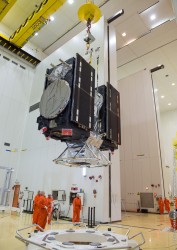
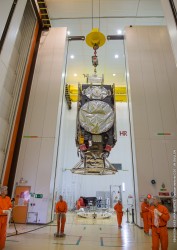
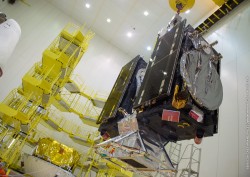
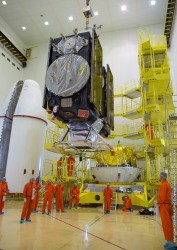
The first Ariane 5 launcher to orbit Galileo navigation satellites has completed its initial build-up in French Guiana, continuing preparations for Arianespace’s Nov. 17 mission from the spaceport to deploy four more Galileo satellites, according to launch contractor.
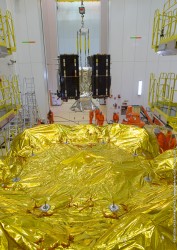
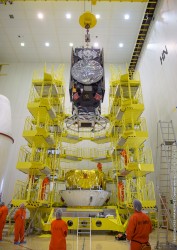
The Ariane 5 vehicle equipment bay is shown being lowered into position on the main cryogenic stage in preparation for Flight VA233, the launch of four Galileo satellites. (Photo: Arianespace)
During activity in the Spaceport’s Launcher Integration Building, the heavy-lift vehicle for Arianespace Flight VA233 underwent the assembly process that began by mating Ariane 5’s two solid propellant strap-on boosters with the main cryogenic stage.
The next step was integration of the launcher’s vehicle equipment bay as well as the installation of Ariane 5’s EPS storable propellant stage.
From launcher integration to final assembly
After completion of verifications and systems checkout by production prime contractor Airbus Safran Launchers, the Ariane 5 will be moved to the Spaceport’s Final Assembly Building — where Arianespace takes authority for payload integration and launch.
Ariane 5’s vehicle equipment bay is hoisted for integration in the Spaceport’s Launcher Integration Building, in preparation for Flight VA233, the launch of four Galileo satellites. (Photo: Arianespace)
The EPS storable propellant upper stage is powered by a re-ignitable engine that operates with MMH and N2O4 propellants. It differentiates Flight VA233’s launcher from the Ariane 5 ECA versions, which have a cryogenic upper stage and are typically used on Arianespace missions to geostationary transfer orbits with telecommunications satellites.
For Flight VA233, the Ariane 5 ES will carry the quartet of Galileo satellites (weighing 738 kg. each) and their 447-kg. dispenser system to medium-Earth orbit, for deployment at an altitude of approximately 23,222 km.
The upcoming Ariane 5 launch will mark the initial utilization of Ariane 5 in deploying Galileo constellation satellites. Flight VA233 will continue Arianespace’s support of the global positioning satellite system, following seven missions performed with the company’s medium-lift Soyuz that carries a pair of Galileo spacecraft on each flight. Seven Soyuz missions have delivered a total of 14 navigation satellites into orbit since 2011.
Galileo is a key effort for Europe, offering highly accurate positioning with great precision and reliability via a civil global satellite navigation system. The program is funded and owned by the European Union, with overall responsibility for management and implementation held by the European Commission. Design and development of the new generation of systems and infrastructure has been assigned to the European Space Agency.
The spacecraft to be launched on Flight VA233 were built by OHB System in Bremen, Germany, with their navigation payloads provided by Surrey Satellite Technology in the United Kingdom. Airbus Defence and Space developed the dispenser system that will carry and deploy the satellites from Ariane 5.
A four-satellite dispenser for Galileo’s Ariane 5 is shown during shaker testing at Airbus Defence and Space near Bordeaux, France. The dispenser has had four Galileo engineering models attached to it for test purposes. Copyright: ESA
Following rigorous testing in France and Germany, a new type of dispenser designed to carry four navigation satellites into orbit at once is now in French Guiana, in place for Galileo’s first Ariane 5 launch later this year.
The dispenser is an essential element of launch success, with a double role to play. It first must hold the quartet of satellites securely in place during the stresses of liftoff, and then the nearly four-hour long flight to medium-Earth orbit.
Then, once the Ariane 5 EPS upper stage reaches its target altitude of 23,222 kilometers , the dispenser will release the four Galileo satellites using a pyrotechnic release system triggered by separate igniters, each one firing half a second after the other.
The separated satellites are then pushed away from the dispenser in separate directions using a spring-based distancing system.
The 447-kilogram dispenser, designed by Airbus Defence and Space, must support a satellite mass of 738 kilograms each – nearly three tons total.
Made from a combination of metal and composite materials for maximum stiffness, the dispenser has undergone very comprehensive testing at Airbus Defence and Space near Bordeaux, France, and the IABG testing centre in Ottobrunn, Germany – using both Galileo engineering models and an actual flight satellite, including fit, shock and separation testing.
A four-satellite dispenser for Ariane 5 Galileo launches with engineering models attached for test purposes. Copyright: CNES/ESA
The test campaign met all objectives, reports the ESA, confirming the behavior performs as predicted, after which the dispenser was shipped to Europe’s Spaceport in French Guiana.
This fall, four Galileo satellites will be launched together for the very first time on a specially customized launcher — the Ariane 5 ES Galileo.
In development since 2012, the new launcher variant has evolved from the Ariane 5 ES (Evolution Storable), used to place ESA’s 20,000-kilogram ATV supply vehicle into low-Earth orbit.
This launder has to carry a lower mass payload – four fully fuelled 738-kilogram Galileo satellites plus their supporting dispenser – but needs to take it up to the much higher altitude of medium-Earth orbit, approximately 23,222 kilometers up.
The target orbit is actually 300 kilometers below the Galileo constellation’s final working altitude, which leaves the Ariane’s EPS upper stage in a stable “graveyard orbit,” while the quartet of Galileos maneuver themselves up to their final set height.
Once the Ariane 5 ES Galileo flight is complete, there should be 18 Galileo satellites in orbit.
Galileos 13 and 14 are scheduled to lift off at 08:48:43 GMT (05:48:43 local time, 10:48:43 CEST) on May 24 from Europe’s Spaceport in French Guiana atop a Soyuz launcher.
The first three stages of the Soyuz rocket take the Galileo satellites and their Fregat upper stage into low orbit nine minutes after liftoff. Then the reignitable Fregat, as much a spacecraft as a rocket stage, takes over the task of hauling the satellites higher through a pair of burns.
The satellites will be released in opposite directions by their dispenser once they reach their target 22,522-kilometer-altitude orbit 3 hours and 48 minutes after launch.
On Wednesday, May 18, Europe’s latest Galileo satellites were placed atop their upper stage then enclosed within their protective rocket fairing. The encapsulation took place inside the Spaceport’s cleanroom, as a two-piece Soyuz fairing was closed around the satellites, attached to their carrier atop the Fregat upper stage.
Europe’s 13th and 14th Galileo satellites being encapsulated inside their launcher fairing. (Photo: ESA)
The satellites had been installed on Fregat the previous day. This versatile upper stage will haul them the bulk of the way to their target 23,500-kilometer-altitude orbit.
The sealed satellites, dispenser and upper stage are collectively known as the “upper composite.” Today, the plan is to roll out the first three stages of Galileo’s Soyuz to the launchpad, ready for mating with this upper composite.
This will be the seventh Galileo launch, set to bring the number of satellites in space up to 14. Four more Galileos are planned to take flight in the autumn, launched for the first time on a customized Ariane 5 to bring the total number of satellites in the constellation to 18.
Watch the launch live here. Streaming begins at 08:28 GMT (10:28 CEST) on 24 May for the liftoff, then resumes at 12:23 GMT (14:23 CEST) to cover the satellites’ separation.
For other upcoming GNSS satellite launches, see this page.
Early Operations Phase. According to the European Space Agency (ESA), a combined team of specialists is conducting final training at ESA’s ESOC mission control centre to prepare for the launch.
The team comprises over 40 experts drawn from ESA and from France’s CNES space agency, supported by additional specialists at both agencies in areas such as flight dynamics and ground stations.
Within the combined flight control team, each position is paired with its counterpart from the other agency and mixed CNESOC shifts will rotate to conduct operations around the clock.
The same team conducts all the Galileo early operations alternately from ESOC and from the CNES control centre in Toulouse, France.
By launch day, the teams will have completed a demanding series of joint simulation training sessions at ESOC, complemented by more specific training conducted separately at each control centre. Joint sessions are especially important to develop team bonds “on-console” — so individuals get to know who will be working beside them and can foster one-on-one teamwork and mutual support.
Three Flight Operations Directors and three Spacecraft Operations Managers will work together with their teams in each of three shifts during the nine-day early operations phase. From left: Hélène Cottet (CNES), Remi Lapeyre (CNES), Liviu Stefanov (ESA), Christelle Crozat (ESA), Thomas Cowell (ESA) and Hervé Côme (ESA).
Another pair of Galileo navigation satellites is scheduled for launch by a Soyuz rocket on May 24 from Europe’s Spaceport in French Guiana, bringing the Galileo system a step closer to operational use.
This video gives an overview of Galileo and shows Galileo 13 and 14 in preparation in Kourou. It includes an interview with Paul Verhoef, ESA director of the Galileo Programme and navigation-related activities.
The European Commission asked the European Space Agency (ESA) to speed up the deployment of the constellation and to increase it’s robustness for delivering initial services, according to ESA.
A total of 12 satellites has been deployed into orbit during the last four years — six in the last year alone.
The first of two Galileo navigation satellites to be orbited on Arianespace’s May 24 Soyuz flight has been integrated on its payload dispenser system, marking a key step as preparations advance for this medium-lift mission from French Guiana.
Named “Danielė,” the Galileo 13 spacecraft was installed this week during activity inside the Spaceport’s S3B payload preparation facility. It is to be joined on the dispenser system by the mission’s other passenger, “Alizée” or Galileo 14, whose own installation is forthcoming, in a side-by-side arrangement.
The pair — each named after children who won a European Commission-organized painting competition in 2011 — are then to be mated atop Soyuz’ Fregat upper stage and encapsulated in the protective payload fairing. Prime contractor OHB System in Bremen, Germany produced the satellites, and their onboard payloads are supplied by UK-based Surrey Satellite Technology Limited (SSTL) – which is 99-percent owned by Airbus Defence and Space.
The Galileo FOC satellite “Danielė” is moved into position, then integrated on its payload dispenser at the Spaceport’s S3B payload preparation facility. (Photo: Arianespace)
“Danielė” and “Alizée” will become the 13th and 14th FOC (Full Operational Capability) spacecraft to join Europe’s Galileo navigation system, which was conceived to provide high-quality positioning, navigation and timing services under civilian control. Its FOC phase is managed and funded by the European Commission, with the European Space Agency (ESA) delegated as the design and procurement agent on the Commission’s behalf.
The May 24 flight is designated Flight VS15, and will be performed from the purpose-built ELS launch complex at Europe’s Spaceport. Arianespace’s Soyuz will carry out a nearly 3-hour, 48-minute mission to place its Galileo passengers into a targeted circular orbit at an altitude of 23,522 kilometers, inclined 57.394 degrees to the equator. Total payload lift performance is estimated at 1,599 kg.
Preparations for Arianespace’s upcoming mission have moved into the fueling phase for the next two Galileo navigation satellites, Galileo 13 and 14. The satellites will be sent into orbit by a medium-lift Soyuz on May 24 from the Spaceport in French Guiana.
Galileo 13 is fueled at the Spaceport for Arianespace’s May 24 mission with Soyuz.
As part of the process, the 13th in the series of Full Operational Capability (FOC) Galileo platforms (Galileo-FOC FM10) has been “topped off” in the Spaceport’s S3B payload preparation facility.
Galileo 13 is named for Lithuanian student Danielė — continuing the practice of designating Galileo spacecraft after youngsters who created space and aeronautics-related drawings that were selected by national juries in European Union member states.
Galileo’s FOC phase is funded and managed by the European Commission, which has designated the European Space Agency as the system’s design and procurement agent. Prime contractor OHB System in Bremen, Germany, produces the Galileo FOC satellites.
This month’s dual Galileo payload mission is designated Flight VS15 in Arianespace’s launcher family numbering system. It will be the 15th liftoff of the workhorse launcher from French Guiana since Soyuz’ introduction at the Spaceport in 2011.
Flight VS15 is one of up to 12 Arianespace missions targeted for 2016 with the company’s launcher family of the medium-lift Soyuz, heavy-lift Ariane 5 and lightweight Vega. So far this year, Arianespace has performed three launches: two with Ariane 5, and one utilizing Soyuz.
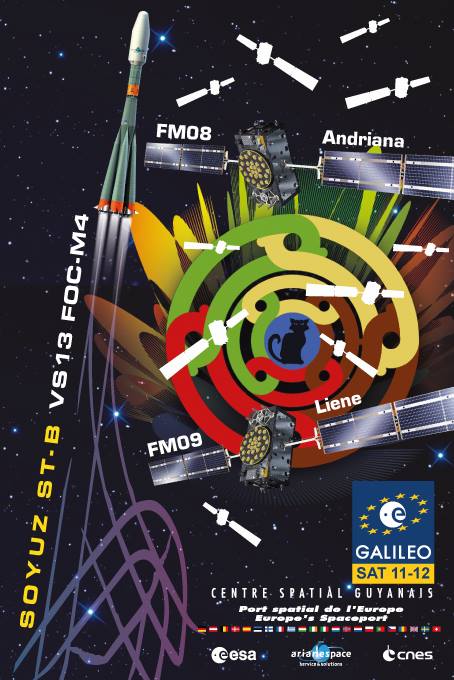
Launch poster for the upcoming launch of Adriana and Liene, also known as Galileo 11 and 12.
The two spacecraft for Arianespace’s latest Soyuz launch at the service of Europe’s Galileo satellite-based navigation system — and the company’s record 12th mission overall in 2015 — have been integrated at the French Guiana Spaceport in preparation for their Dec. 17 liftoff.
The launch of Galileo satellites 11 and 12 — dubbed Adriana and Liene — will conclude a year when the number of Galileo satellites in orbit will have doubled.
With this launch, ten years after the launch of GIOVE A, on Dec. 28, 2005, the Galileo constellation will become a reality.
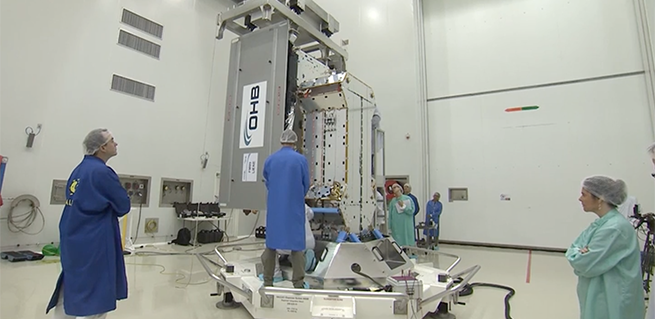
During activity in the Spaceport’s S3B clean-room facility, the spacecraft pair was mated with their dispenser, which will deploy the satellites by firing a pyrotechnic system for separation in opposite directions at the orbital insertion point.
The satellite/dispenser combination is ready for integration on Soyuz launcher’s Fregat upper stage, followed by the payload fairing encapsulation. This will create the “upper composite,” which is to be installed atop Soyuz once the vehicle has been moved to its Spaceport launch site.
Arianespace’s Dec. 17 mission, designated Flight VS13 in the company’s launcher family numbering system, will orbit two Galileo FOC (Full Operational Capability) satellites, further augmenting the European constellation of navigation spacecraft. The satellites are built by prime contractor OHB System in Bremen, Germany, with their onboard payloads supplied by UK-based Surrey Satellite Technology Ltd (SSTL), which is 99 percent owned by Airbus Defence & Space.
Galileo 11 and 12 are prepared for launch in the clean room. (Video capture: ESA)
The Galileo system is designed to provide high-quality positioning, navigation and timing services under civilian control. Its Full Operational Capability phase is managed and funded by the European Commission, with the European Space Agency (ESA) delegated as the design and procurement agent on the Commission’s behalf.
Flight VS13 will close out a busy year — complementing the 11 previous missions in 2015, which were composed of two other launches with the medium-lift Soyuz, three using the light-lift Vega and six with the heavy-lift Ariane 5.
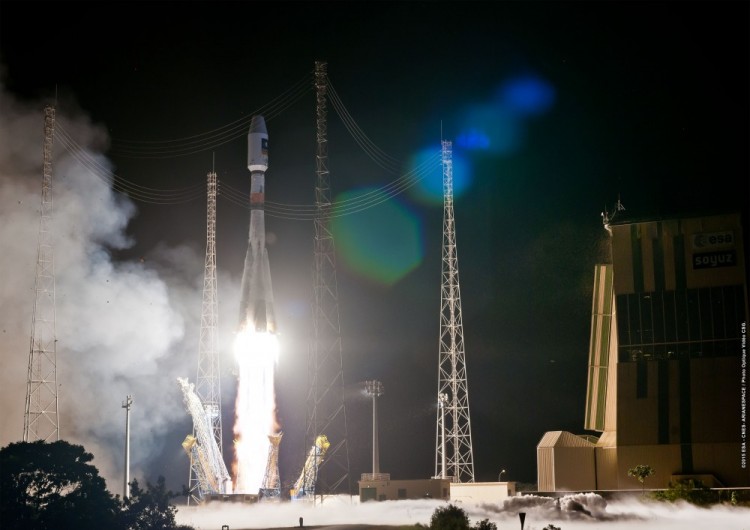
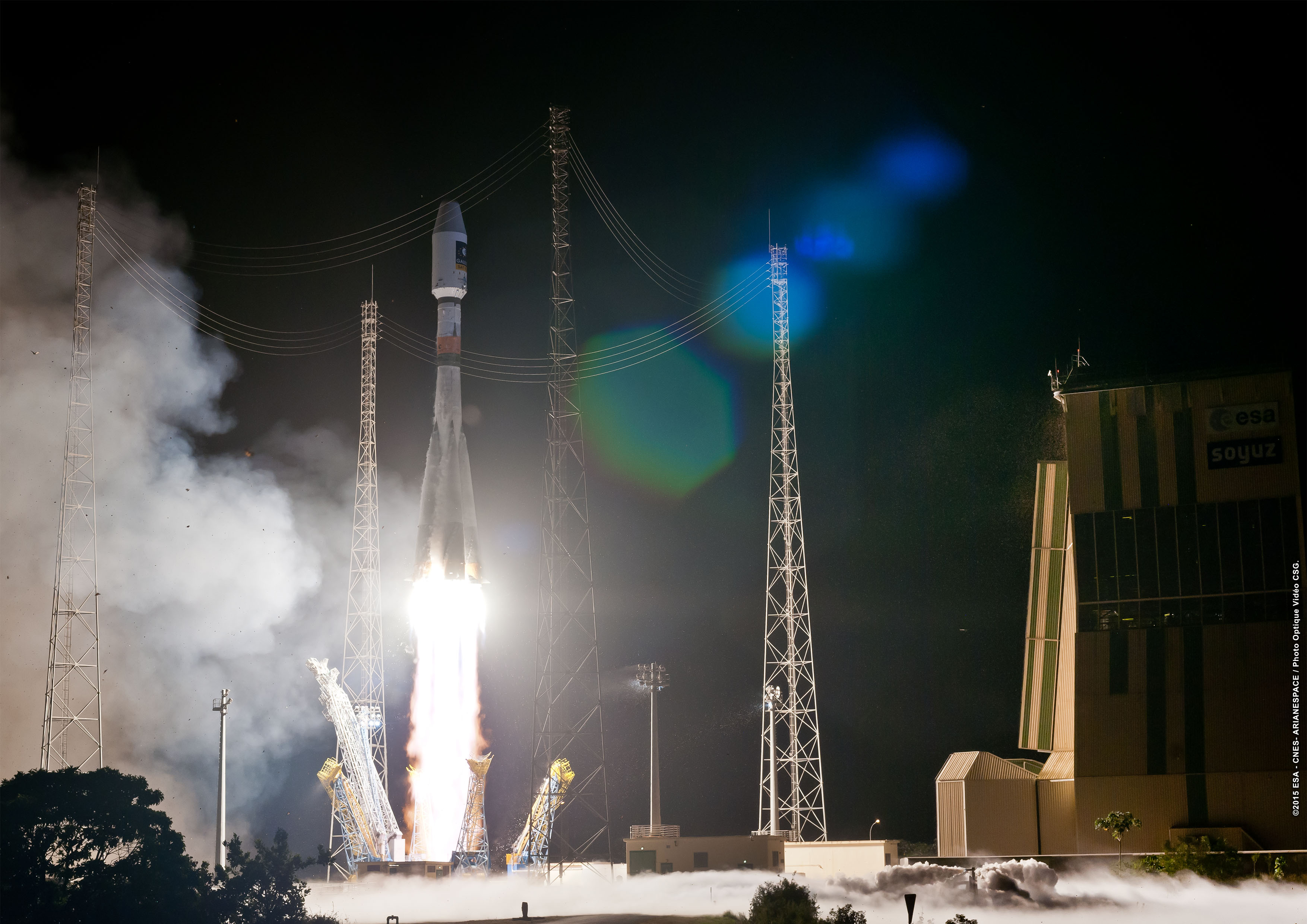
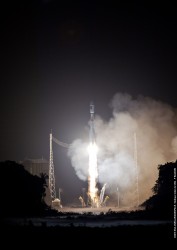
Soyuz launches Galileo 9 and 10 into orbit on Sept.10. (Credit: Arianespace)
Arianespace’s 12th Soyuz flight from the Spaceport in French Guiana orbited two more spacecraft for Europe’s Galileo satellite navigation system on Sept. 10.
2015 is an important year for Arianespace at the service of European institutions, with 11 payloads to be orbited utilizing the company’s family of Soyuz, the heavy-lift Ariane 5 and lightweight Vega, Arianespace Chairman and CEO Stéphane Israël said after the liftoff.
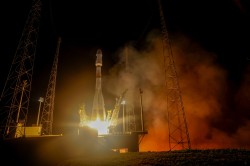
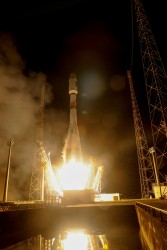
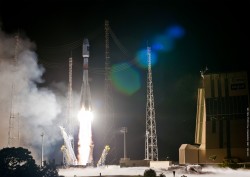
Departing the Spaceport’s ELS launch complex near the city of Sinnamary at the planned exact liftoff time of 11:08:10 p.m. (local time in French Guiana), Soyuz deployed its two latest Galileo passengers after a flight of just under three hours and 47 minutes. This included the propulsion of Soyuz’ first three stages and two burns of its Fregat upper stage.
Israël noted these are the ninth and tenth Galileo spacecraft orbited by Arianespace, joining a constellation that ultimately will consist of 30 satellites. The satellites, named Alba and Oriana, are the latest FOC (Full Operational Capability) satellites, which are to operate in Galileo’s Orbital Plane A — one of three orbital planes being populated by the European navigation spacecraft.
The European Commission is managing and funding Galileo’s FOC phase, during which the network’s complete operational and ground infrastructure is being deployed. Design and procurement agent responsibilities have been delegated to the European Space Agency (ESA) on the Commission’s behalf.
Arianespace is set to launch two more satellites with Soyuz by year-end, before handing this task over to Ariane 5 beginning in 2016 with a launch carrying four satellites. One more Soyuz and two more Ariane 5s will continue the activity in 2017-2018.
“Galileo keeps us busy, and Arianespace is very proud to be the reference partner of this European flagship space program,” Israël said.
After expressing his appreciation to the European Commission and ESA for their confidence, he noted that 2015 is an important year for Arianespace at the service of European institutions, with 11 payloads to be orbited utilizing the company’s family of Soyuz, the heavy-lift Ariane 5 and lightweight Vega.
“These satellites address all space applications: navigation, Earth observation, science and technology, meteorology and secured communications,” Israël explained. “Thanks to our launcher family, we are fully capable of addressing all needs of European institutions.”
Soyuz’ flight with Galileo’s Alba and Oriana satellites occurred during the eighth of 12 Arianespace missions planned for 2015 — which will be a new record for the company’s launcher family. Its preparations at the Spaceport included the first use of the new FCube fueling facility, which is part of improvements in French Guiana to increase launch capacity, flexibility and schedule robustness.
Israël acknowledged those who contributed to this latest Arianespace success, including the Russian federal space agency, Roscosmos, and the country’s industrial partners; along with the European support companies; the French CNES space agency, and Arianespace own teams.
Galileo 9 and 10 lift off. (Credit: ESA)
Galileo 9 and 10 lift off.(Credit: ESA)
Soyuz launches Galileo 9 and 10 into orbit on Sept.10. (Credit: Arianespace)
Soyuz launches Galileo 9 and 10 into orbit on Sept.10. (Credit: Arianespace)
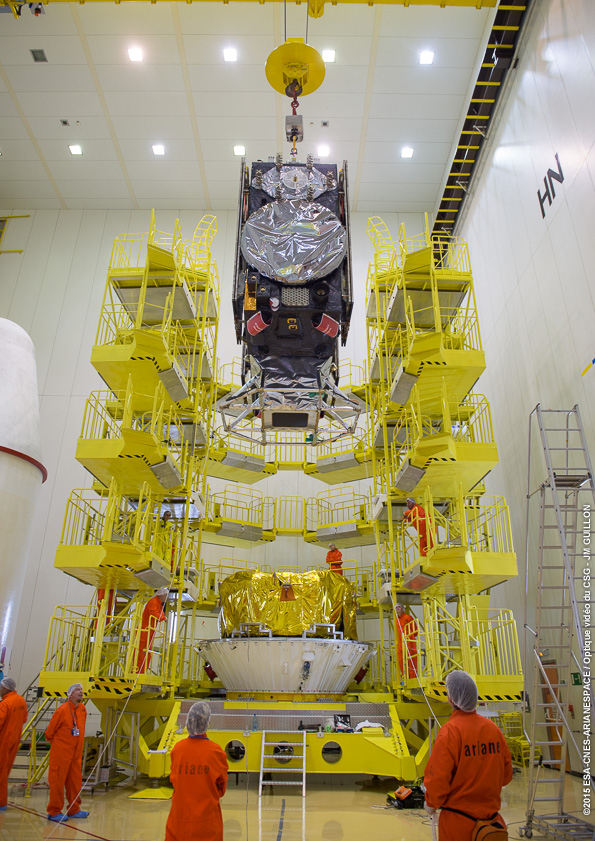
Galileos 9 and 10 are lowered onto the Fregat upper stage.
Galileo 9 and 10 are ready for launch atop a Soyuz rocket at 23:08 local time on Sept. 10 (02:08 GMT and 04:08 CEST on Sept. 11) from Europe’s Spaceport in French Guiana.
After being attached to their carrier last week, the pair of fully fueled satellites was carefully lowered onto the Fregat upper stage on Wednesday, Sept. 2, in the 3SB preparation building of the Guiana Space Centre. The following day was devoted to functional checks and inspections, preparing the Galileos plus Fregat to be encapsulated within the halves of their Soyuz rocket fairing, which took place on Sept. 4. This complete “upper composite” was then transported to the launch site and attached vertically to the first three stages of the Soyuz ST-B, the 12th Soyuz to be operated from the spaceport.
As much a spacecraft as a launcher stage, the re-ignitable Fregat will take the Galileos the bulk of the way to their designated medium-altitude orbit once the first three stages achieve low orbit, 9 minutes and 24 seconds after launch. A pair of Fregat firings will be separated by a 3-hour, 13-minute coast up to their target 23,222 km orbital altitude and 57.394° inclination.
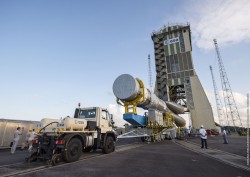
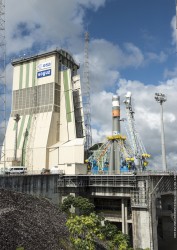
Soyuz in Launch Zone. The basic three-stage vehicle for Arianespace’s Sept. 10 Flight VS12 rolled out from its MiK integration building in the Spaceport’s northwestern sector this morning, and was transferred horizontally to the ELS launch zone by a transporter/erector rail car.
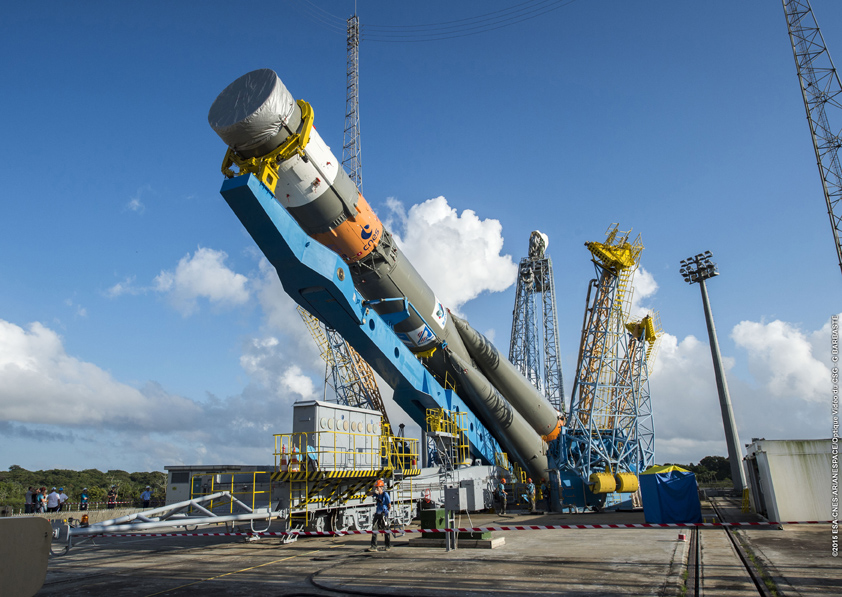
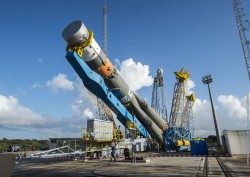
The Soyuz rocket is moved to the launch pad and lifted into a vertical position.
The Soyuz was then erected in a vertical position and suspended over the launch pad, held in place by four large support arms. This was followed by the 53-meter-tall mobile gantry’s move-in to protect the launcher, providing a safe environment for installation of the “upper composite” containing the Galileo satellites.
Galileo 9 and 10 are the fifth and sixth Galileo FOC (full operational capability) spacecraft, and have been designated “Alba” and “Oriana” — continuing the naming process after children who won a painting competition organized by the European Commission in 2011. The satellites were built by OHB System, with Surrey Satellite Technology Ltd. supplying their navigation payloads.
The European Commission is managing and funding Galileo’s FOC phase — during which the network’s complete operational and ground infrastructure is being deployed. The European Space Agency has been delegated as the design and procurement agent on the Commission’s behalf.
Two More this Year. Two further satellites are scheduled for launch by the end of this year. One is under test at ESA’s ESTEC technical centre in Noordwijk, the Netherlands, while the other has already completed its checks and is awaiting transportation to Kourou in the second half of October. In addition, the first satellite of the following batch (Galileo 13) has arrived at ESTEC and is undergoing its thermal-vacuum test. The next will arrive by mid-September.
Follow Arianespace’s launch activity on its website.
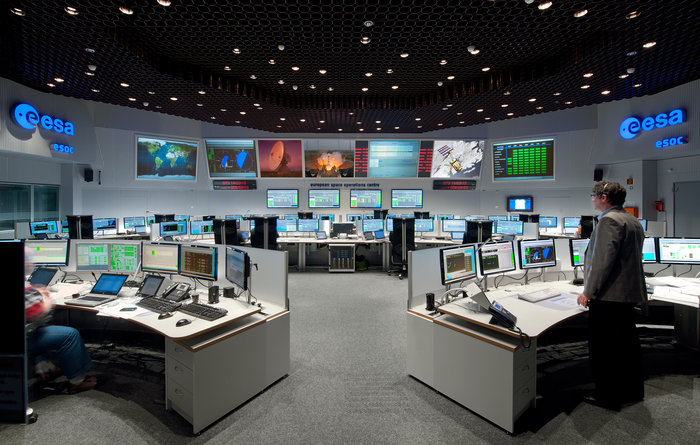
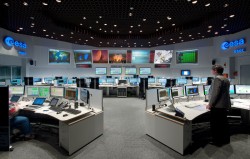
ESOC serves as the Operations Control Centre for ESA missions and hosts ESA’s Main Control Room (shown here), combined Dedicated Control Rooms for specific missions and the ESTRACK Control Centre, which manages ESA’s worldwide ground tracking stations.
Mission Control’s Mission. When the next pair of Galileo satellites is boosted into orbit on Friday, a team of mission control experts in Darmstadt, Germany, will spring into action, working around the clock to bring the duo through their critical first days in space. The fiery ascent to space will last just over nine minutes, after which the Fregat upper stage will fire twice to place the satellites into their release orbit.
Separation from Fregat, about 3 hours and 48 minutes into flight, marks the start of the critical early orbits for the team at ESA’s European Space Operation Centre in Darmstadt. Within the combined flight control team from ESA and France’s CNES space agency, each position is paired with its counterpart from the other agency and mixed “CNESOC” shifts will rotate to conduct operations around the clock. The same team conducts all the Galileo early operations alternately from ESOC and from the CNES control centre in Toulouse, France.
“Upon separation, the team will be very focused, and we’ll be watching for a number of critical events on the satellites to happen automatically at the right time and in the right order,” said ESA’s Liviu Stefanov, lead flight director for this phase. “The satellite must switch on, go into a basic flight configuration, deploy its solar wings for power, orient them towards the Sun and acquire Sun-pointing attitude. “As soon as we get communications, we’ll check its health and start sending commands to configure the satellite after completion of the automatic sequence and prepare it for the next major activity: pointing Galileo towards Earth.”
The intense activity will begin the 10-day early operations phase, during which the joint team will work 24 hours/day to oversee steps to prepare the satellites for handover to the Galileo Control Centre in Oberpfaffenhofen, for routine operations, and ESA’s Redu Centre in Belgium, for detailed payload testing.
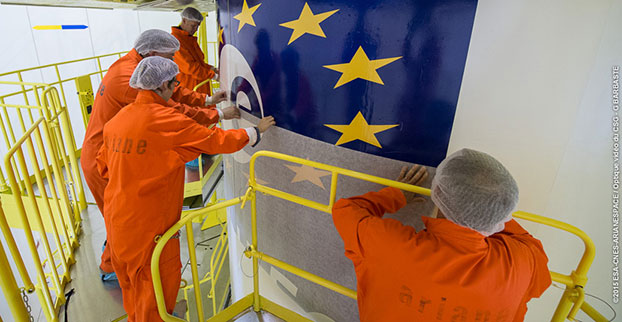
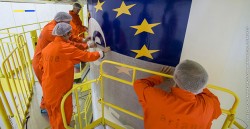
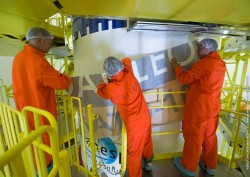
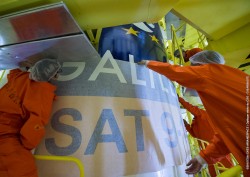
The logos of the two new satellites in the Galileo constellation are placed on the launcher fairing.
Photo Gallery
Galileos 9 and 10 are lowered onto the Fregat upper stage. (Credit: CNES/ESA)
Galileos 9 and 10 are lowered onto the Fregat upper stage.(Credit: CNES/ESA)
Galileo 9 and 10 on their dispenser being lifted towards the gold-insulation-covered Fregat upper stage. (Credit: CNES/ESA)
Galileos 9 and 10 are lowered onto the Fregat upper stage.(Credit: CNES/ESA)
Galileos 9 and 10 are lowered onto the Fregat upper stage. (Credit: CNES/ESA)
Galileos 9 and 10 are lowered onto the Fregat upper stage. (Credit: CNES/ESA)
The Soyuz launcher is transferred to the launch pad. (Credit: Arianespace)
The Soyuz rocket is moved to the launch pad and lifted into a vertical position. (Credit: Arianespace)
The Soyuz launcher is transferred to the launch pad. (Credit: Arianespace)
The logos of the two new satellites in the Galileo constellation are placed on the launcher fairing. (Credit: CNES)
The logos of the two new satellites in the Galileo constellation are placed on the launcher fairing. (Credit: CNES)
The logos of the two new satellites in the Galileo constellation are placed on the launcher fairing. (Credit: CNES)
The logos of the two new satellites in the Galileo constellation are placed on the launcher fairing. (Credit: CNES)
ESOC serves as the Operations Control Centre for ESA missions and hosts ESA’sMain Control Room (shown here), combined Dedicated Control Rooms for specificmissions and the ESTRACK Control Centre, which manages ESA’s worldwide groundtracking stations. (Credit: ESA)
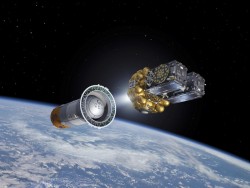
Artist’s view of Galileo satellites attached to their dispenser atop their Fregat upper stage separating from the Soyuz upper stage. The Fregat then flies them the rest of the way up to medium-Earth orbit. (Credit: ESA)
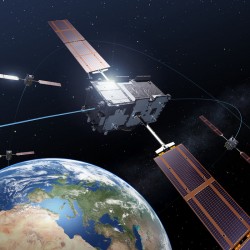
The Galileo GNSS. (artist’s rendering, courtesy ESA)
UPDATED 08/28/15 with information from the European Space Agency.
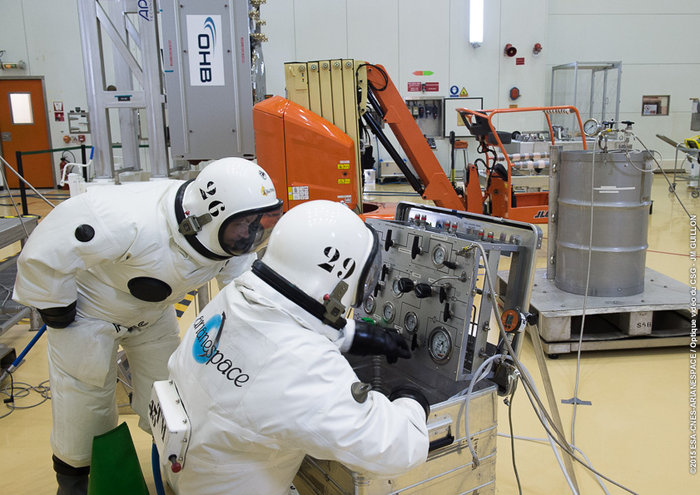
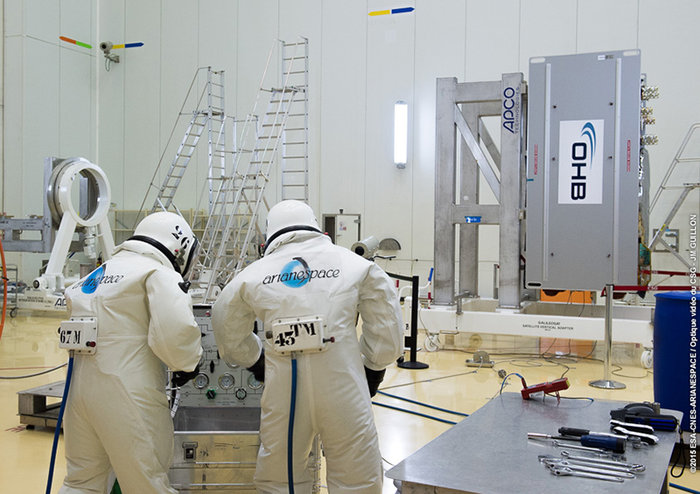
Europe’s ninth and tenth Galileo satellites were fueled Aug. 24 by technicians in protective SCAPE suits within the Guiana Space Centre’s 3SB preparation building. This left the satellites ready to be attached to their launcher upper stage in preparation for launch. (Photo:ESA)
The two European Galileo navigation satellites for Arianespace’s next mission from French Guiana have been fueled at the Spaceport, readying them for integration with their Soyuz launcher.
Galileo full operational capability (FOC) satellites 9 and 10 were “topped off” during activity this week at the Spaceport’s S3B payload preparation facility, further advancing preparations for the Sept. 10 mission — which is designated Flight VS12 in Arianespace’s launcher family numbering system, signifying the 12th liftoff of the medium-lift Soyuz vehicle from French Guiana. Lift-off is scheduled for 02:08:10 p.m. UTC.
Flight VS12’s satellites are the fifth and sixth in Galileo’s FOC phase. They were produced by OHB System, with Surrey Satellite Technology Ltd. supplying their navigation payloads that will generate precise positioning measurements and services around the world.
The Sept. 10 mission will be the fifth Soyuz flight with Galileo satellites performed by Arianespace from French Guiana — a series that began with the Russian-built launcher’s inaugural liftoff at the Spaceport in Oct. 2011.
At full deployment, the Galileo program will consist of 30 satellites — comprising operational spacecraft and reserves — situated on three circular medium Earth orbits at some 23,200 km. altitude inclined 56 degrees to the equator. The constellation — and associated ground infrastructure — will provide high-quality positioning, navigation and timing services under civilian control, and be interoperable with GPS and the Russian GLONASS.
Galileo’s FOC phase is managed and funded by the European Commission, with the European Space Agency delegated as the design and procurement agent on the commission’s behalf.
Arianespace Flight VS12 will be the company’s eighth mission this year, following the successful launches in 2015 of four heavy-lift Ariane 5s, two lightweight Vega vehicles, and one Soyuz.
Technicians donned spacesuit-like SCAPE (Self Contained Atmospheric Protective Ensemble) suits to fill each satellite with sufficient hydrazine fuel for their planned 12 years of operations in space, the European Space Agency describes in a news release. This fuel is needed for fine-tuning of their orbital paths following their launch, followed by routine orbital and attitude control over the course of their working lives.
Each Galileo satellite needs to keep its navigation antenna trained on Earth’s disc at all times, employing dedicated infrared Earth and Sun sensors for this purpose. This marked the first time Galileo had been fuelled within the Guiana Space Centre’s 3SB preparation building. Previously, the S5 fuelling building was dedicated to this purpose, but upgrades by Arianespace mean fuelling can now take place at the same location where they will subsequently be attached to their Fregat upper stage, streamlining the satellite preparation process. Completion of fuelling means the two satellites are essentially ready for launch — what needs to be accomplished now is to first attach the Galileos to their launch dispenser, then to fix this in turn to their Fregat.
The satellites plus Fregat will then be encapsulated within the launcher fairing, after which this ‘upper composite’ can then be attached to the other three stages of the Soyuz ST-B launcher. The latest Galileo launch campaign commenced at the end of July, with the arrival of the satellites in French Guiana on July 24. A “fit check” followed, to confirm the satellites as delivered in Kourou did indeed fit onto the dispenser that will first secure them in place during launch and then pyrotechnically eject them into their orbits once their target 23 222 km altitude medium-Earth orbit has been reached. This was followed by in-depth system checks and final settings of onboard navigation and data handling software parameters.
Two further Galileo satellites are still scheduled for launch by end of this year. One of these satellites is completing testing at ESA’s ESTEC technical centre in Noordwijk, the Netherlands, while the other one has already completed its testing and is awaiting transportation to Kourou in the second half of October.
In addition the first satellite of the following batch has arrived at ESTEC and is currently undergoing its thermal vacuum test. Another flight model will arrive at ESTEC by mid-September.
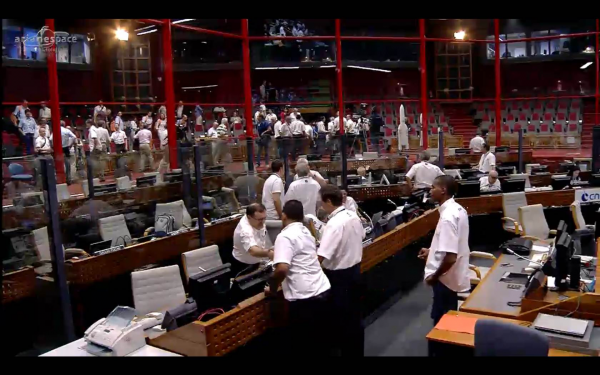
The Galileo launch team celebrates after a successful launch. (Screenshot of ESA/Arianespace live stream of lift-off.)
The two newest Galileo satellites — dubbed Adam and Anastasia — launched Friday are now being checked out by the European Space Agency (ESA) and France’s CNES space agency from the CNES Toulouse centre.
Following these initial checks, the two satellites will be handed over to the Galileo Control Centre in Oberpfaffenhofen, Germany, and the Galileo in-orbit testing facility in Redu, Belgium, for testing before they are commissioned for operational service. This is expected by mid-year.
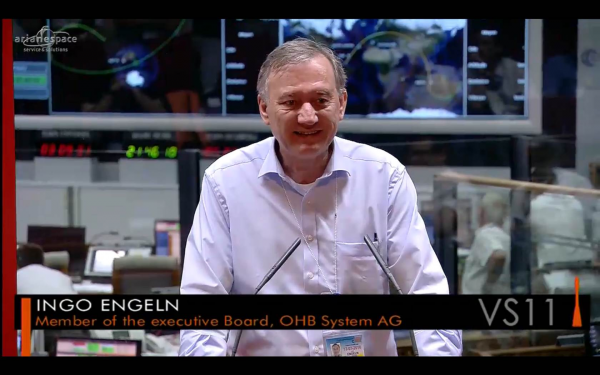
Screenshot of ESA/Arianespace live stream following lift-off.
Adam and Anastasia are the third and fourth Full Operational Capability (FOC) spacecraft for Europe’s Galileo global navigation satellite system.
After an initial powered phase of Soyuz’ three lower stages, the launch included two burns of the Fregat upper stage — separated by a three-hour-plus ballistic phase — to place the two 700-kg.-class satellites at their targeted deployment point, according to launch contractor Arianespace. Total payload lift performance for the flight was estimated at 1,597 kg. on a mission to a circular medium-Earth orbit.
During post-launch comments from the Spaceport, Arianespace Chairman and CEO Stéphane Israël thanked and congratulated everyone involved with the Soyuz mission — designated VS11 in the company’s numbering system — but added that there is still much work to be done for the Galileo program moving forward.
He said there are six more Galileo launches to come following tonight’s success: three missions on Soyuz with six additional FOC satellites, and three launches on Ariane 5, with 12 more units.
Screenshot of ESA/Arianespace live stream following lift-off.
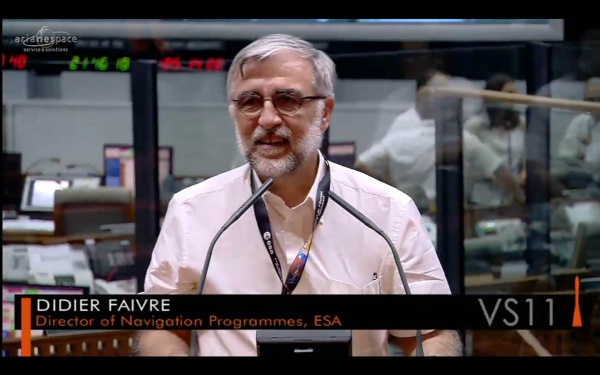
“The satellites are doing fine and are in good hands, managed by the Toulouse CNES [French space agency] operational center,” added Didier Faivre, director of Navigation Programs for ESA. “Let’s rejoice with this very good news. We will be back as soon as possible to continue deploying our satellites.”
The on-target Soyuz launch of Adam and Anastasia followed by one day the 35th anniversary of Arianespace’s creation in 1980. Adam and Anastasia were built by OHB System, with Surrey Satellite Technology Ltd. supplying their navigation payloads.
Galileo’s FOC phase — during which the network’s complete operational and ground infrastructure will be deployed — is being managed and funded by the European Commission, with ESA delegated as the design and procurement agent on the commission’s behalf.
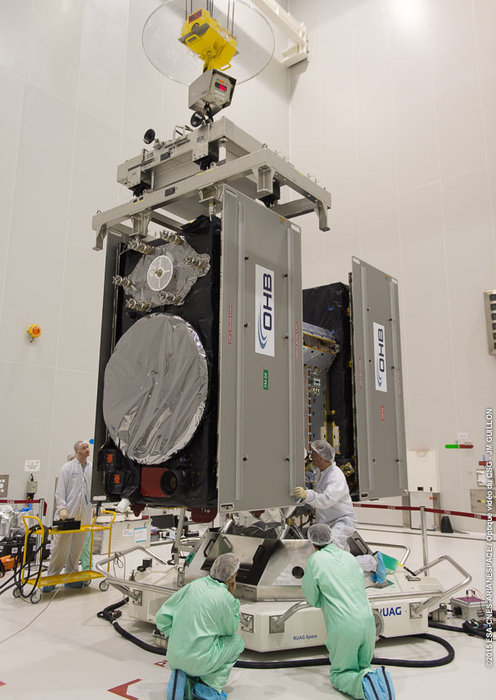
The seventh and eighth Galileo satellites being fitted together onto the dispenser, March 16-17. (Photo courtesy of ESA)
The Soyuz for Arianespace’s next medium-lift mission is in the launch zone at French Guiana, where it stands ready to receive the two spacecraft passengers that will join Europe’s Galileo global navigation satellite system.
Applying procedures that have been followed since the workhorse Soyuz launcher inaugurated the Space Age, the basic three-stage vehicle for Arianespace’s March 27 flight emerged today from its MIK integration building in the Spaceport’s northwestern sector.
Riding horizontally on a transporter/erector rail car, Soyuz was transferred to the ELS launch zone — which was followed by its erection to the vertical orientation and positioning over the launch pad, suspended in place by four large support arms.
With this step completed, all was ready for the purpose-built 53-meter-tall mobile gantry to be moved into position around the launcher — a phase of the processing in French Guiana that differs from Soyuz operations at Baikonur Cosmodrome in Kazakhstan and Plesetsk Cosmodrome in Russia. The gantry provides a protected environment for installation of the “upper composite,” which consists of the two Galileo spacecraft, the Soyuz’ Fregat upper stage and a two-piece protective payload fairing.
The March 27 launch — designed VS11 in Arianespace’s numbering system — is scheduled to lift off at precisely 6:46:18 p.m. local time in French Guiana, with its Galileo satellite passengers to be deployed during a flight lasting approximately 3 hrs., 47 min. Total payload lift performance is estimated at 1,597 kg., which includes a combined mass of some 1,428 kg. for the two spacecraft.
Flight VS11’s passengers — built by OHB System, with Surrey Satellite Technology Ltd. supplying their navigation payloads — are the third and fourth Full Operational Capability (FOC) satellites in the Galileo program, which is creating a European-operated space-based navigation system.
The European Commission is managing and funding Galileo’s FOC phase, during which the network’s complete operational and ground infrastructure will be deployed. The European Space Agency has been delegated as the design and procurement agent on the Commission’s behalf.