Tag: Arianespace

  • Arianespace Soyuz Begins Integration for March 27 Galileo Launch

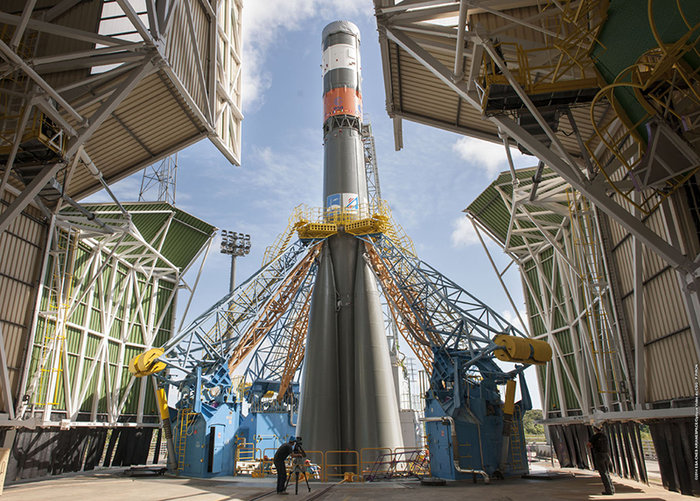
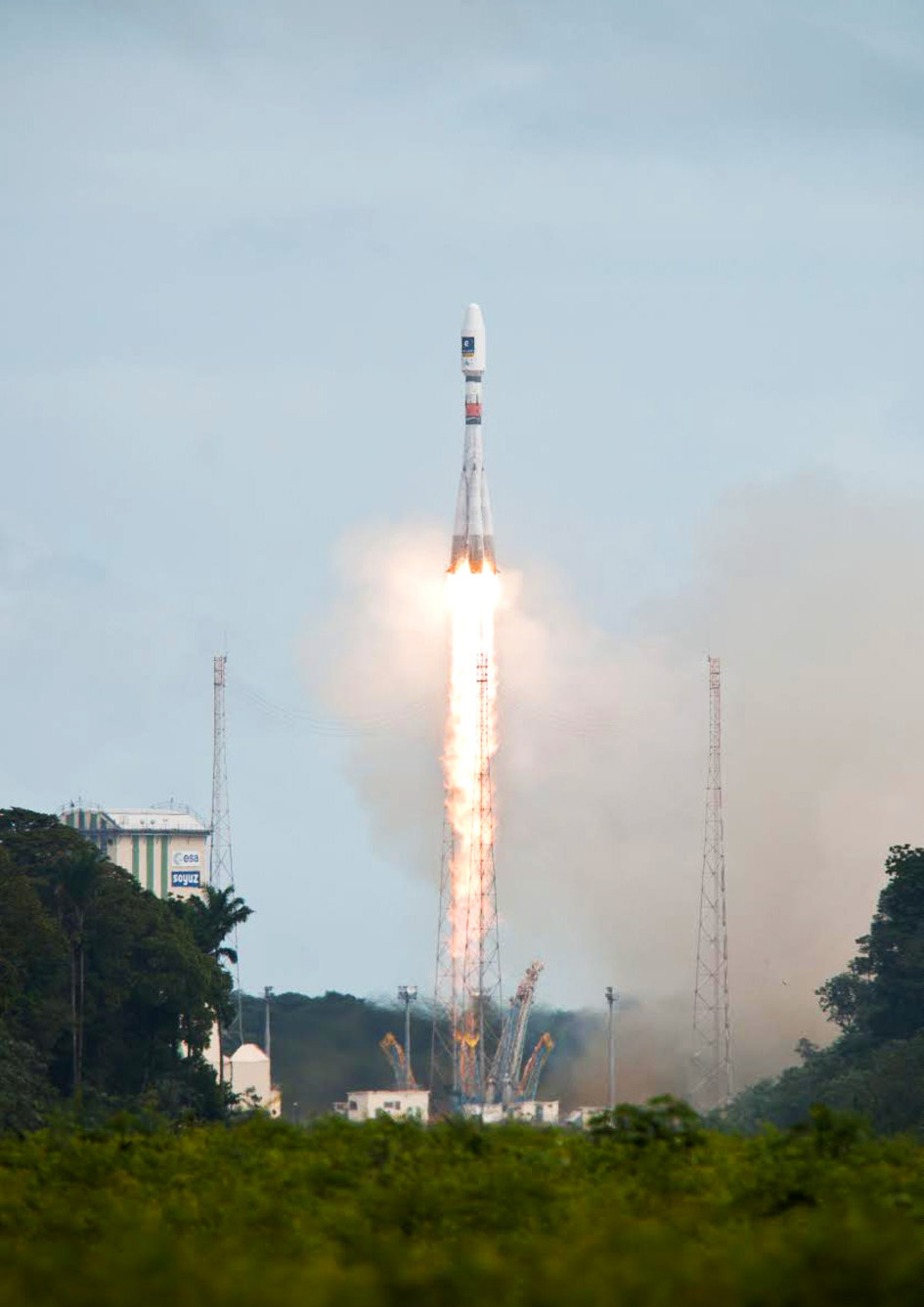
    The Soyuz launcher for Arianespace’s upcoming mission with two European Galileo navigation satellites is taking shape at the Spaceport for a March 27 liftoff from French Guiana.

    “During activity in the Spaceport’s Soyuz Launcher Integration Building, the medium-lift workhorse began to assume its iconic form with integration of the four first-stage strap-on boosters to the Block A core second stage,” Arianespace wrote in an statement.

    “The next step will be the mating of Soyuz’ Block I third stage to the launcher’s core, completing the basic build-up, and readying the vehicle for its rollout to the launch pad — where the payload will be mated.”

    The March 27 flight will be the 11th Soyuz flight from French Guiana since the launcher’s introduction at the Spaceport in October 2011. It is designated Flight VS11 in Arianespace’s numbering system for its launcher family, which also includes the heavy-lift Soyuz and lightweight Vega.

    For the upcoming Soyuz mission, Arianespace will loft Galileo’s third and fourth Galileo Full Operational Capability (FOC) satellites to further expand the constellation. Flight VS11’s two satellites were built by OHB System, with Surrey Satellite Technology Ltd. supplying their navigation payloads.

    Galileo’s complete operational network and its ground infrastructure will be deployed during the program’s Full Operational Capability phase, which is managed and funded by the European Commission. The European Space Agency has been delegated as the design and procurement agent on the Commission’s behalf.

  • Third, Fourth Galileo FOC Satellites Confirmed Fit for Soyuz Launch

    Source: GPS world staff
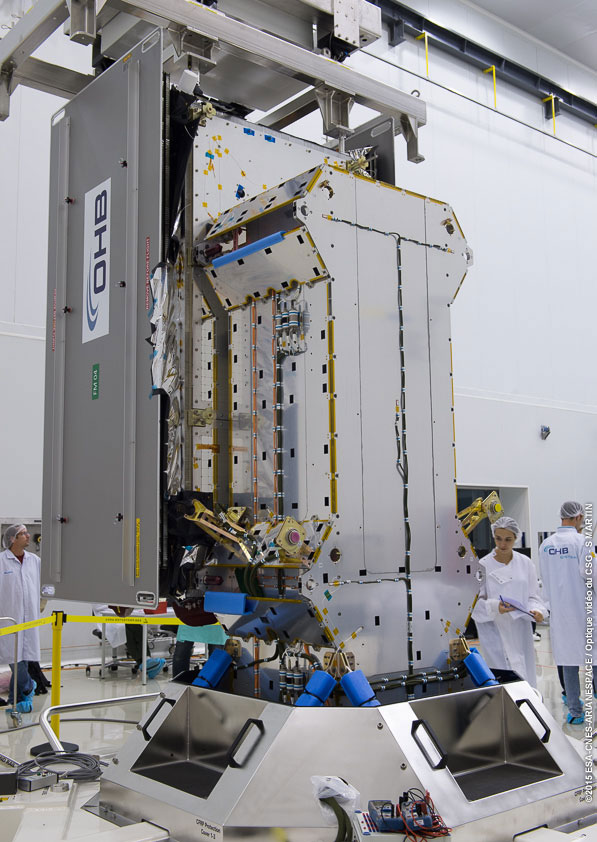
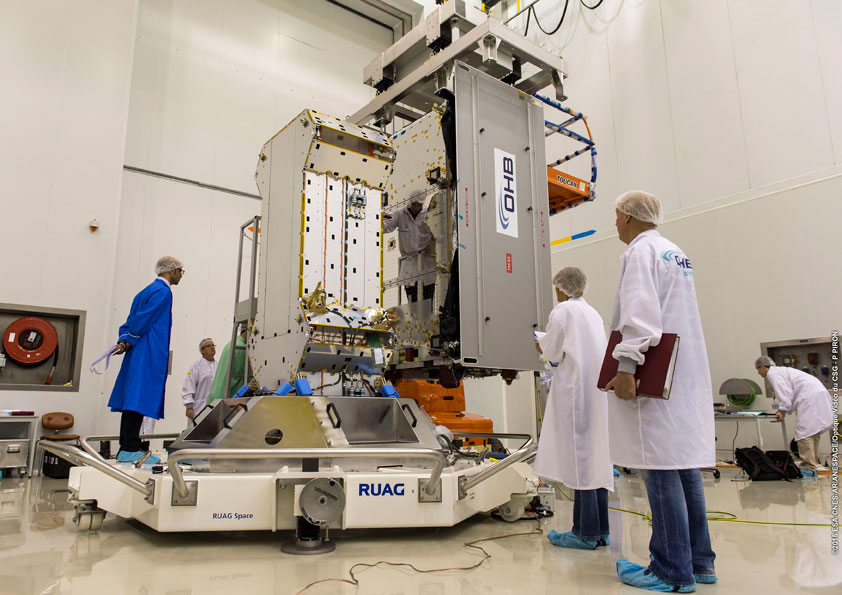
    The Flight Model #3 (FM3) spacecraft is moved for positioning on the payload dispenser. (Photo credit: Arianspace)

    The third and fourth Galileo Full Operational Capability (FOC) satellites are a confirmed “fit” for their Arianespace Soyuz launch March 27, having made initial contact with the mission’s dual-payload dispenser in French Guiana, according to Arianespace.

    The fit check was completed over a two-day period inside the Spaceport’s S1A payload preparation building. The two satellites were installed separately, with the Flight Model #3 (FM3) spacecraft integrated on — and subsequently removed from — the dispenser on Feb. 9. Flight Model #4 (FM4) underwent the same process the following day.

    The payload dispenser for Galileo was developed by RUAG Space Sweden for Arianespace, and carries one satellite on each side. It will deploy the spacecraft during the Soyuz launch by firing a pyrotechnic separation system to release them in opposite directions at the orbital insertion point.

    Source: GPS world staff
    Flight Model #4 (FM4) after its integration. (Photo credit: Arianspace)

    Final integration on the dispenser is to be performed during upcoming processing at the spaceport, and will be followed by the completed unit’s installation on Soyuz.

    The March 27 mission — designated Flight VS11 in Arianespace’s numbering system — will be the company’s fourth launch carrying spacecraft for the Galileo constellation. FM3 and FM4 were built by OHB System, with Surrey Satellite Technology Ltd. supplying their navigation payloads.

    The Galileo network’s complete operational and ground infrastructure will be deployed during the Full Operational Capability phase, which is managed and funded by the European Commission. The European Space Agency has been delegated as the design and procurement agent on the commission’s behalf.

  • 2, 4, 6, 8 — Who Do We Appreciate?

    Galileo, that’s who! For dogged determination and persistent pushing-forwardness in the face of adversity, obstacles, and the occasional technical difficulty. That there may be occasional confusion, as well, or mixed messages as to just what the future may bring, is certainly understandable. In fact, it is to be expected, given the circumstances.

    Let’s review the math.

    Two

    Two for the two launch vehicles that Galileo may use in the near future, Soyuz Fregat and Ariane 5. The Soyuz rocket can lift two satellites of the Galileo punching weight. The Ariane 5 rocket can carry four into space.

    Soyuz Fregat has a losing record so far with Galileo, being responsible for the August 2014 loosening of the first two full-operational capability (FOC) satellites into the dangerous Van Allen Belt. The first of these satellites has been successfully repositioned by the European Space Agency (ESA) into a mostly-but-not-totally useable orbit, and the second is currently en route to a similar spot.

    We do not wish to say we told you so, but we will. Back on March 26, 2014, we wrote on these virtual pages, “ESA’s year-end plan calls for two more dual-satellite launches in October and December on Russian Soyuz rockets — new partners to the Galileo dance, bringing perhaps new technical connectivity issues.”

    “Rockets are tricky,” said Tesla/SpaceX CEO Elon Musk, after his Falcon 9 Reusable rocket exploded over Texas at roughly the same time that Soyuz Fregat mis-delivered two Galileo satellites into wrong orbits.

    Musk meant tricky in actual operation, but we may also add, tricky in scheduling, in getting a cargo aboard a spacebound vehicle. Arianespace’s calendar is particularly filled with telecomm satellites impatient to be put aloft, with Ariane 5 being the preferred launcher of many. Soyuz availability, understandably, is somewhat more open.

    Four

    Four for the total of four Galileo satellites now orbiting and broadcasting useable signals at all times for all users. These four come from the in-orbit validation (IOV) generation.
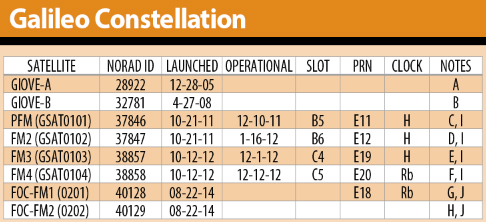
    Galileo-chart-Jan2015

    The two added FOC satellites, no longer in a bad orbit, now in a sort-of-pretty-good orbit, should be useable at some times, for some purposes, by some people. Peter Steigenberger and André Hauschild, researchers at the German Aerospace Center (DLR) / German Space Operations Center, wrote in this magazine in January that:

    “Despite the orbit injection error, the new Galileo FOC satellite has now been successfully activated and added to the Galileo constellation. Unfortunately, the current orbit is incompatible with the standard Galileo almanac format, which may cause restrictions for some commercial receiver types.

    “Nevertheless, the satellite can already be tracked by a wide range of geodetic receivers with existing firmware versions and it will, in fact, be possible to use the new satellite for diverse applications in surveying, precise positioning, and geodesy, as well as in general multi-GNSS studies. We now look forward to the activation of the second FOC satellite, which can be expected in early 2015 and will, for the first time, offer multi-frequency signals from a total of five Galileo satellites.”

    If you have four fully useable satellites and two partially useable satellites, what do you have? Does six = five functionally in this case? Or perhaps 5.5?

    Six

    Six for the oncoming new Galileo FOC satellites to be launched in 2015, according to some schedules and some official announcements.

    On a year-opening preview of operations given on Jan. 19, Thomas Reiter, Head of the European Space Operations Centre (ESOC) in Darmstadt, Germany, outlined the launch schedule for Galileo in 2015. Six new FOC satellites in total:

    • Galileo L4 with two on March 26
    • Galileo L5 with two in September
    • Galileo L6 with two in December.


    Now, six satellites divided by three launch dates gives two satellites per launch. Seeming to indicate a Soyuz rocket for all three dates. Reiter did not mention any rocket by name, but this would be the inference.

    That’s putting a brave face on the situation. Back in May, Russia suffered its fifth rocket launch crash in the past four years, raising serious concerns about the reliability of Russian rockets and launch procedures. Subsequently, the August Galileo launch that went so wrong was controlled by Arianespace, but it did use the Russian equipment.

    It strains credulity that an omission or oversight in the system thermal analysis  during stage design of a million-dollar rocket, designed to carry million-plus-dollar satellites in a 21st-century endeavor, could permit the creation of a thermal bridge between two feed lines, causing one of them to freeze during a crucial phase of space operations — but that is what apparently happened at some point at NPO Lavochkin in Russia, and that is what ultimately caused Galileo such misfortune. All parties concerned swear that this problem has been corrected in every other Soyuz Fregat, but who knows what other anomalies lie undiscovered therein?

    So putting all your 2015 money aboard Soyuzes is really rolling the marbles. Even if, as Elżbieta Bienkowska, Member of the EC in charge of Internal Market, Industry, Entrepreneurship and SMEs stated at this week’s 7th European Space Conference: EU Space Policy Confronted With the Rising Demand for Services and Applications, “We agreed to contract insurance for the next launches.”

    Eight

    Eight for the oncoming new Galileo FOC satellites to be launched in 2015, according to other schedules and other official announcements.

    “2015 will be a crucial year for the European space industry. We have big plans,” said Maros Sefcoviv, vice-president of the EC in charge of Energy Union, earlier at the very same 7th European Space conference, EU Space Policy Confronted With the Rising Demand for Services and Applications.

    “On the biggest one, we are planning five launches, which will bring up to space 10 satellites: eight for our Galileo constellation, and two for Copernicus. This is something that will put these programs over, I would say, over the edge, in a way, to be able to offer early services from Galileo, and to develop the program of Copernicus. It would prove the resilience and competitiveness of the European space industry, and its ability to serve the businesses, and what I think is most important, to offer new kinds of services to the citizens.”

    “For our flagship programs like Galileo and EGNOS, our priority must be to deliver services as soon as possible. That is why the satellites have to be delivered and operations must be ready as soon as possible.”

    Now, if you have eight satellites to go up in three launches, that would mean one of them has to go with four aboard. Thus, an Ariane 5 Galileo launch this year after all? Or possibly four Soyuz launches, although one more launch date could just just as hard to come by as a launch vehicle.

    Hard to tell. Very hard to tell. Extremely hard to tell, from the outside.

    Those who do not study history are condemned to repeat it, goes the dictum. Those who do study GNSS history, in this case, are likely only to repeat past pronouncements without any perceptible advance in clarity.

    Way, way back in March 2013, an EC program manager told GPS World, “Then, in 2014 [after four FOC satellites were to rise in 2013, which did not happen] we will see three Soyuz launches of two satellites each. We do not have the precise launch dates yet, but they are likely to be in April, June, and September. In December 2014, we expect to have the first launch using the Ariane 5 launcher, which is capable of deploying four satellites in one go. This means that by the end of 2014 Galileo will have deployed 18 satellites in orbit.”

    Now, the target has moved several times since then, and the schedule has slid accordingly.

    “In 2015, there will be two Ariane 5 launches, one in the middle of the year, one at the end, each carrying four satellites.”

    Six or Eight?

    Either number this year, we would surely appreciate. To return to Ms. Bienkowska, she left a little fudge room in her presentation: “We aim to launch at least six satellites this year.”

    Well, at least we are all moving forward. Resolutely.

    ——————————–

    I am indebted to Tim Reynolds, GPS World’s Brussels-based European correspondent, and to Peter de Selding, Paris bureau chief of SpaceNews, for their assistance in gathering diverse intelligence on this topic. Tim Reynolds will have an up-to-date view of this and other Galileo developments when we publish the next issue of the EAGER* newsletter at the end of March. Subscribe for free.

    * The European GNSS and Earth Observation Report
  • Galileo FOC Anomaly Traced to Design Ambiguity, Says Inquiry Board

    The root cause of the anomaly that sent two Galileo satellites into the wrong orbit is a shortcoming in the system thermal analysis performed during stage design, and not an operator error during stage assembly, according to findings by an independent inquiry board.

    The Independent Inquiry Board was formed to analyze the causes of the anomaly occurring during the orbital injection of satellites in the Galileo constellation by a Soyuz rocket launched from the Guiana Space Center on August 22. The board announced its definitive conclusions on Tuesday following a meeting at Arianespace headquarters in Evry, near Paris.

    The board was created on August 25 by Arianespace, in conjunction with the European Space Agency and the European Commission. It is chaired by Peter Dubock, former inspector-general of ESA. Its conclusions draw on data supplied by Russian partners in the program, and are consistent with the final conclusions of the inquiry board appointed by the Russian space agency Roscosmos.

    The anomaly occurred during the flight of the launcher’s fourth stage, Fregat, designed and produced by NPO Lavochkin. It occurred about 35 minutes after liftoff, at the beginning of the ballistic phase preceding the second ignition of this stage.

    The board’s conclusions confirm that the first part of the mission proceeded nominally, which means that the three-stage Soyuz launcher was not at fault. The Inquiry Board also eliminated the hypothesis that the anomaly could have been caused by the abnormal behavior of the Galileo satellites.

    The scenario that led to an anomaly in the orbital injection of the satellites was precisely reconstructed, as follows:

    • The orbital error resulted from an error in the thrust orientation of the main engine on the Fregat stage during its second powered phase.
    • This orientation error was the result of the loss of inertial reference for the stage.
    • This loss occurred when the stage’s inertial system operated outside its authorized operating envelope, an excursion that was caused by the failure of two of Fregat’s attitude control thrusters during the preceding ballistic phase.
    • This failure was due to a temporary interruption of the joint hydrazine propellant supply to these thrusters. The interruption in the flow was caused by freezing of the hydrazine.
    • The freezing resulted from the proximity of hydrazine and cold helium feed lines, these lines being connected by the same support structure, which acted as a thermal bridge.
    • Ambiguities in the design documents allowed the installation of this type of thermal “bridge” between the two lines. In fact, such bridges have also been seen on other Fregat stages now under production at NPO Lavochkin.
    • The design ambiguity is the result of not taking into account the relevant thermal transfers during the thermal analyses of the stage system design.

    The system thermal analyses have been reexamined in depth to identify all areas concerned by this issue. Given this identified and perfectly understood design fault, the board has chosen the following corrective actions for the return to flight.

    • Revamp of the system thermal analysis.
    • Associated corrections in the design documents.
    • Modification of the documents for the manufacture, assembly, integration and inspection procedures of the supply lines.

    Arianespace said these measures can easily and immediately be applied by NPO Lavochkin to the stages already produced, meaning that the Soyuz launcher could be available for its next mission from the Guiana Space Center as from December 2014.

    Beyond theses corrective actions, sufficient for return to flight, NPO Lavotchkin will provide Arianespace with all useful information regarding Fregat’s design robustness, which is proven by 45 successful consecutive missions before this anomaly.

    Following the announcement of the Independent Inquiry Board’s conclusions, Stéphane Israël, chairman and CEO of Arianespace, said: “I would first like to thank Peter Dubock,  who chaired the board. Their work, with the support of Russian partners, enabled the rapid identification of the root cause of the anomaly and the corrective measures to be applied. Since the corrective measures are easy to deploy by NPO Lavochkin, we are looking at the resumption of Soyuz launches from the Guiana Space Center, as early as December 2014. The resolution of this anomaly will enable a consolidation of the reliability of Fregat, which had experienced 45 consecutive successes until this mission.”

  • Improper Fuel Line Installation Led to Incorrect Galileo Orbit

    The cause of two Galileo satellites being released into the wrong orbit August 22 can be traced to improper installation of a hydrazine fuel line, according to Space News and the GalileoGNSS blog.

    The hydrazine fuel line was installed too close to a supercold helium line on the Fregat upper stage, which caused the hydrazine to freeze long enough to upset the Fregat stage’s orientation and cause the two satellites’ release into an orbit that is both too low and in the wrong inclination, officials said as reported on the websites.

    No official report has been issued; the board of inquiry is expected to release its findings this week. 

    The Euro-Russian inquiry board looking into the cause of the failure has discovered that one in four Fregat upper stages at prime contractor NPO Lavochkin in Moscow had the same fuel-line installation, according to the reports. “We have to assume that this was a practice that had gone on in perhaps a quarter of the Fregat stages produced in the past decade, but that it had not affected our launches up to now because of mission-specific aspects like coast time between burns, the number of burns and so on, which can influence the effect of the helium on the hydrazine,” one official is quoted as saying. “In any case, we’d like Arianespace, which currently has almost no inspection rights on the Soyuz, to be given more say in quality assurance.”

    In the stages without the installation issue, the hydrazine and helium lines were separated so that the supercold helium could not freeze the hydrazine. The design did not foresee any problem in putting the lines together, but in fact that is a problem for some missions.

    European Union government and officials are debating how to proceed, the reports said. The options are to continue, as scheduled, with the December launch of two more Galileo satellites aboard a Soyuz Fregat rocket, or to wait until next spring or summer and launch four Galileo satellites on a heavy-lift Ariane 5 vehicle.

    As for the two wayward satellites, in a presentation to the 65th International Astronautical Congress in Toronto September 30, OHB’s Galileo deputy program manager, Kristian Pauly, said he was optimistic that once the satellites’ perigee is raised and their orbit made less eccentric, they can be fitted at least partially into the Galileo program and perform a navigation function, Space News reported. OHB System is the prime contractor for the full operational capability (FOC) satellites.

    The first priority, Pauly said, is to take the two satellites out of regular contact with the Van Allen belts and adjust their Earth sensors to their new, unplanned view of Earth — which is much closer given the lower altitude.

    Pauly did not speculate on what the Galileo launch schedule would be. He said that OHB’s delivery schedule will not change much. “We have a delivery schedule that is extremely challenging and we will keep to it,” he said.

  • Slung Low, Sweet Satellites: Galileo Anomaly Update

    Slung Low, Sweet Satellites: Galileo Anomaly Update

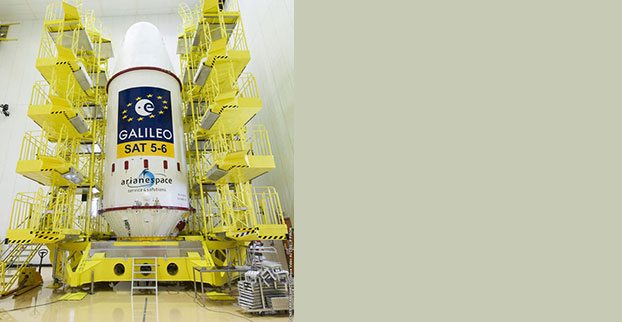
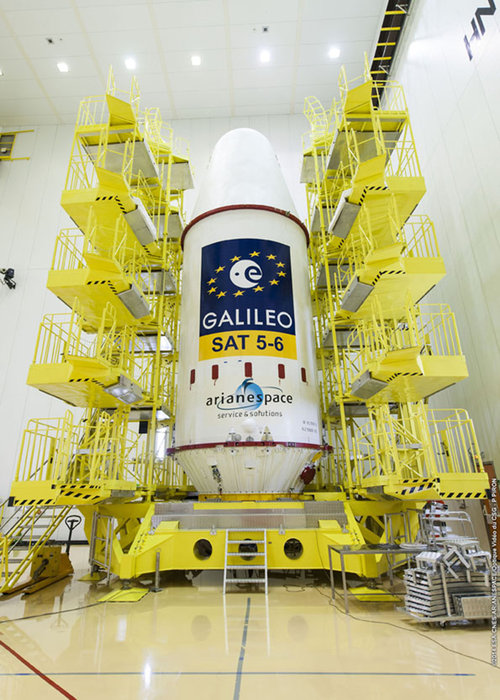
    Galileo mission logos have been applied to the payload fairing, which encapsulates the two-satellite payload and their dispenser system.
    The satellite payload fairing pre-launch.

    The wording is terse, the intent clear.

    “Following the failure on Friday August 22nd to inject Galileo satellites 5 and 6 into the correct orbit, the European Commission has requested Arianespace and the European Space Agency (ESA) to provide full details of the incident, together with a schedule and an action plan to rectify the problem.”

    This is the only official face showing, but extremely high levels of activity take place behind the curtain, studying what might have caused several million Euros of hardware to end up much lower above the Earth than desired. Meanwhile, active speculation in the satnav blogosphere provides glimpses of possible outcomes from the latest satellite disaster — not exclusive to Galileo, by any means — created in all likelihood by a malfunction aboard its Soyuz launcher and/or the Fregat upper stage thereof.

    The full official EC announcement is available here.

    The satellites are under the control of the European Space Operations Centre (ESOC), ESA’s main mission control center in Darmstadt, Germany. But they are far out off position — more than 3,500 kilometers of space away, so far as to make their eventual use as part of the Galileo constellation very unlikely. Discussions continue with ESA and Arianespace regarding whether or not the satellites are likely to be of use, but odds are against it.

    Their onboard fuel is not enough to compensate for the launch shortfall to reach higher orbits under their own power. ESA scientists are studying how they might still possibly  be used, far from their optimum position,s within the Galileo constellation.

    According to an Arianespace press release on August 23, the target orbit was circular, inclined at 55 degrees with a semi-major axis of 29,900 kilometers, but what they got was an elliptical orbit, eccentricity of 0.23, semi-major axis of 26,200 kilometers and inclined at 49.8 degrees.

    On August 28, the Russian newspaper Izvestia reported that “The failure of the European Union’s Galileo satellites to reach their intended orbital position was likely caused by software errors in the Fregat-MT rocket’s upper-stage.”

    “The nonstandard operation of the integrated management system was likely caused by an error in the embedded software. As a result, the upper stage received an incorrect flight assignment, and, operating in full accordance with the embedded software, it has delivered the units to the wrong destination,” an unnamed source from Russian space Agency Roscosmos was quoted as saying by the newspaper.

    An independent inquiry panel has been set up by Ariane. It is headed by former ESA Inspector General Peter Dubock. It starts work on August 28. The panel includes a couple of academics and a majority of ESA and EC figures.

    Ferdinando Nelli Feroci, the new EC Commissioner for Industry and Entrepreneurship.
    Ferdinando Nelli Feroci,
    the new EC Commissioner for Industry and Entrepreneurship.

    The new EC commissioner in this area, Ferdinando Nelli Feroci has invited ESA and Arianespace to his study during the first week of September to present the initial results of the inquiry.

    The commissioner commented, “The problem with the launch of the two Galileo satellites is very unfortunate. The European Commission will participate in an inquiry with ESA to understand the causes of the incident and to verify the extent to which the two satellites could be used for the Galileo programme. I remain convinced of the strategic importance of Galileo and I am confident that the deployment of the constellation of satellites will continue as planned.”

    The commissioner expects that the Galileo constellation will be fully deployed by the end of this decade. This may qualify as optimism because system planners had envisioned for six spares – and three are already blown.

    Ariane and ESA did not insure the satellites.

    According to back-of-the-envelope calculations, system operators are now one short of the minimum 24 needed for full 24/7 global coverage, as they have 4 IOVs up (1 broken) and 22 FOCs on order (2 launched and now in what could be called a junk orbit) which makes a potential maximum 23 sats that have actually been ordered – one short of the target.

    The Satellites Are Alright

    Satellite manufacturer OHB Systems of Bremen, Germany, issued a release stating that “Controllers at ESA’s ESOC control centre in Darmstadt, Germany, confirm the good health and the nominal behaviour of both satellites. They are in a safe configuration, are thermally stable, have stable pointing to the sun and sufficient power production. All platform subsystems have been checked and they work properly. Also the procedures to deploy the solar arrays are successfully performed and all solar arrays are properly unfolded.”

    Further, “The orbit anomaly has no impact on the production and delivery of the in total further 20 satellites. Two FOC*-satellites are currently at ESTEC test facilities in Noordwijk, the remaining are in various status of integration. ”

    Blogging the Boondoggle

    The chairman of the Executive Board of the German Aerospace Center, Johann-Dietrich ‘Jan’ Wörner, writes an interesting blog. The current installment opens with a quote from Elon Musk: “Rockets are tricky.”

    Wörner goes on to say, “The Soyuz launcher lifted off from the European Spaceport in French Guiana. Initially, all of the measurements suggested a perfect mission; the launcher took off at the scheduled time, followed the prescribed trajectory, and the stage separation was carried out correctly. However, the first problem became apparent when the two satellites proved unable to deploy their solar arrays as intended. A more detailed analysis then revealed that the eccentricity, the altitude and the inclination of the satellites’ orbits with respect to Earth’s equator did not meet the specifications. The upper stage had also evidently failed to induce the planned rotation around the longitudinal axis of the spacecraft (known as ‘barbeque’ mode, designed to maintain favourable thermal conditions during exposure to the Sun).”

    Further discussion of the possible causes of the anomaly can be found on a Russian site, which focuses on the Fregat stage thrusters and indicates that the Russians think the barbeque maneuver was completed, and thus not the problem.

    The other big issue is how the telemetry didn’t pick up the issue straight away.

    There is avid speculation and a number of interesting theories being aired on the Canadian Space Geodesy Forum. For subscriptions to this vital listserv, visit here.

  • Inquiry Commission Appointed Following Galileo Anomaly

    Inquiry Commission Appointed Following Galileo Anomaly

    Following the major anomaly that occurred on August 22 during the Soyuz ST mission carrying two satellites in the Galileo constellation, Arianespace announced today, in conjunction with the European Space Agency (ESA) and the European Commission, the appointment of an independent inquiry commission.

    The commission is chaired by Peter Dubock, former ESA Inspector General. Its mandate is to establish the circumstances of the anomaly, to identify the root causes and associated aggravating factors, and make recommendations to correct the identified defect and to allow for a safe return to flight for all Soyuz launches from the Guiana Space Center (CSG).

    The commission will start its work on August 28 and submit its initial conclusions as early as September 8.

    The inquiry commission comprises the following members:

    • Peter Dubock, former ESA Inspector General, Chairman;
    • Professor Guido Colasurdo, University of Roma “Sapienza”, full professor of flight mechanics;
    • Michel Courtois, former ESA Technical Director;
    • Paul Flament, European Commission, Head of Unit, Galileo and Egnos Programmes Management, DG for Entreprise and Industry;
    • Giuliano Gatti, ESA, Galileo Program Technical Officer;
    • Professor Wolfgang Kubbat, former head of the Institute of Flight Systems and Automatic Control at the Technical University of Darmstadt;
    • Isabelle Rongier, CNES Inspector General;
    • Toni Tolker Nielsen, ESA Deputy Inspector General.

    To maintain links with the Russian partners in the Soyuz at CSG program, the head of the Russian space agency Roscosmos, on request from the head of Arianespace, has designated Alexander Daniliuk, Deputy Director General of TsNIImash, as board liaison.

    Arianespace Chairman and CEO Stéphane Israël said: “I would like to thank Peter Dubock for having accepted the chairmanship of this commission, which was appointed in conjunction with ESA and the European Commission and with the support of the space agencies from France (CNES), Germany (DLR) and Italy (ASI), along with a team of high-level European experts. The commission will now be able to carry out its work independently, operating under a very tight schedule. We sincerely hope that the commission’s recommendations will lead to a rapid resumption of missions, while ensuring the high reliability expected of our Soyuz launches from CSG.”

  • Galileo Satellites Not in Expected Orbit

    Galileo Satellites Not in Expected Orbit

    After the separation of the two Galileo satellites launched August 22, ongoing analysis of the data provided by the telemetry stations operated by the European Space Agency (ESA) and the French space agency CNES showed that the satellites were not in the expected orbit.
    According to the initial analyses, an anomaly is thought to have occurred during the flight phase involving the Fregat upper stage, causing the satellites to be injected into a noncompliant orbit.


    UPDATE: Inquiry Commission Appointed Following Galileo Anomaly


    The liftoff and first part of the mission proceeded nominally, reports Arianespace, leading to release of the satellites according to the planned timetable, and reception of signals from the satellites. However, the targeted orbit was circular, inclined at 55 degrees with a semi major axis of 29,900 kilometers. The satellites are now in an elliptical orbit, with excentricity of 0.23, a semi major axis of 26,200 km and inclined at 49.8 degrees.

    Both the Fregat upper stage and the two satellites are in a stable condition and position that entails no risk for people on the ground. The residual propellants on the Fregat stage have been purged and the stage was depressurized normally.

    Studies and data analyses are continuing in Kourou, French Guiana, and at Arianespace headquarters in Evry, near Paris, under the direction of Stéphane Israël, Chairman and CEO of Arianespace, in conjunction with the Russian partners in the Soyuz in French Guiana program (Russian space agency Roscomos and the manufacturers RKTs-Progress and NPO Lavotchkine), as well as Arianespace’s customer ESA and its industrial partners, to determine the scope of the anomaly and its impact on the mission.

    Following the announcement made by Arianespace on the anomalies of the orbit injection of the Galileo satellites, ESA said that the teams of industries and agencies involved in the early operations of the satellites are investigating the potential implications on the mission.

    Both satellites have been acquired and are safely controlled and operated from ESOC, ESA’s Operations Centre in Darmstadt, Germany. Further information on the status of the satellites will be made available after the preliminary analysis of the situation.

    “Our aim is of course to fully understand this anomaly,” said Stéphane Israël, Chairman and CEO of Arianespace. “Everybody at Arianespace is totally focused on meeting this objective. Starting Monday, Arianespace, in association with ESA and the European Commission, will designate an independent inquiry board to determine the exact causes of this anomaly and to draw conclusions and develop corrective actions that will allow us to resume launches of Soyuz from the Guiana Space Center (CSG) in complete safety and as quickly as possible. The board will coordinate its work with Russian partners in the Soyuz at CSG program. Arianespace is determined to help meet the European Union’s goals for the Galileo program without undue delay. We would like to thank ESA, the European Commission and CNES for the very productive discussions since becoming aware of the occurrence of the anomaly. While it is too early to determine the exact causes, we would like to offer our sincere excuses to ESA and the European Commission for this orbital injection that did not meet expectations.”

    New NORAD element sets from Sunday confirm that the satellites and the Fregat upper stage are in the wrong orbits:

    TBA – TO BE ASSIGNED

    1 40128U 14050A   14235.29903612 -.00000029  00000-0  00000+0 0    62

    2 40128 049.6865 087.6132 2327926 024.5112 345.1155 02.04736595    14

    TBA – TO BE ASSIGNED

    1 40129U 14050B   14235.68621972 -.00000026  00000-0  00000+0 0    36

    2 40129 049.6897 087.5935 2330669 024.6823 271.0168 02.04928670    16

    TBA – TO BE ASSIGNED

    1 40130U 14050C   14235.29836211 -.00000029  00000-0  00000+0 0    43

    2 40130 049.7055 087.6017 2323101 024.6200 345.0221 02.05021368    10

  • Arianespace, ESA Sign Contract for New Galileo Launches

    Arianespace, ESA Sign Contract for New Galileo Launches

    Arianespace and the European Space Agency (ESA), acting on behalf of the European Commission, have signed a contract for three launch services with Ariane 5 ES to step up deployment of Galileo satellites.

    With this new launch contract and thanks to the performance of Ariane 5 ES, a total of 12 Galileo FOC (Full Operational Capability) satellites will be launched using three dedicated Ariane 5 ES launch vehicles, each carrying four satellites. The Ariane 5 ES launches will take place from 2015 onwards.

    Arianespace will be responsible for ensuring all of the 22 FOC satellites manufactured by the German group OHB System alongside the British company Surrey Satellite Technology Ltd. are taken into circular orbit at an altitude of 23,522 km using a combination of five Soyuz launch vehicles (two satellites per launch) and three Ariane 5 ES launch vehicles (four satellites per launch). The 22 operational satellites will join the four IOV satellites launched successfully by Arianespace from the Guiana Space Center in 2011 and 2012.

    Arianespace and its subsidiary Starsem were responsible for launching in 2005 and 2008 from the Baikonur Cosmodrome the initial satellites in the Galileo constellation, GIOVE-A and GIOVE-B, which were able to secure the frequencies allocated to the constellation.

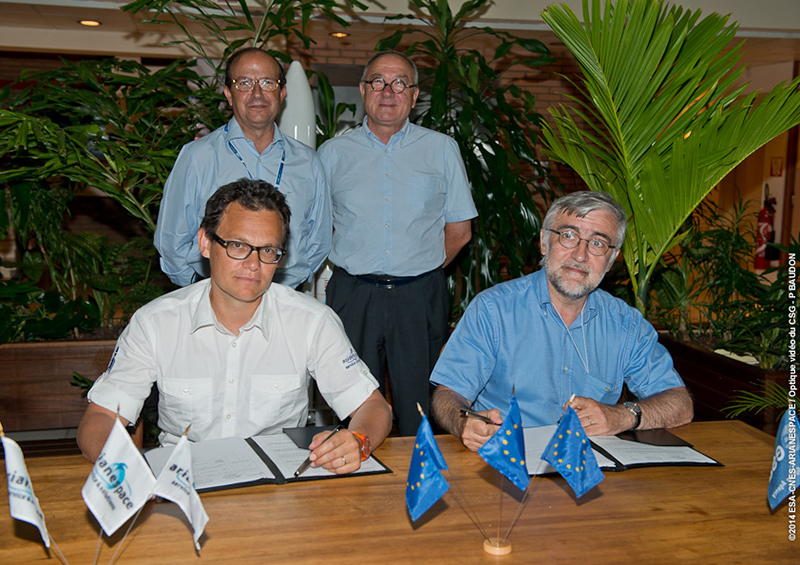
    The contract for Arianespace’s three Ariane 5 launches to orbit a total of 12 Galileo FOC satellites was signed at the Guiana Space Center by Chairman and CEO Stéphane Israël (seated, at left) and Didier Faivre, ESA director of the Galileo Program and Navigation-related Activities. Joining them were ESA Director General Jean-Jacques Dordain and Daniel Calleja Crespo, director general for Enterprise and Industry, European Commission.
    The contract for Arianespace’s three Ariane 5 launches to orbit a total of 12 Galileo FOC satellites was signed at the Guiana Space Center by Chairman and CEO Stéphane Israël (seated, at left) and Didier Faivre, ESA director of the Galileo Program and Navigation-related Activities. Joining them were ESA Director General Jean-Jacques Dordain and Daniel Calleja Crespo, director general for Enterprise and Industry, European Commission.

    Once the contract had been signed, Stéphane Israël, chairman and CEO of Arianespace, made the following statement: “With its Ariane 5 ES heavy-lift launch-vehicle, Arianespace is able to provide the most appropriate solution for stepping up the deployment of the entire Galileo constellation. Ariane has once again demonstrated its excellence as it lends its expertise to Europe’s ambitions in space. With the three Ariane, Vega and Soyuz launch-vehicles operated from the Guiana Space Center, European spaceport, Arianespace is giving Europe guaranteed access to space and suitable solutions to meet its wide-ranging needs. I would like to extend my heartfelt thanks to the European Commission and European Space Agency (ESA) for their continued trust. Being the launch operator of the Galileo program is an immense source of pride for Arianespace, its employees and its partners.”

  • Squeeze at the Launchpad for Galileo

    With the first two full-operational-capability (FOC) Galileo satellites successfully through their thermal-vacuum tests, the program’s next hurdle is securing a firm launch date in June aboard a Europeanized Russian Soyuz rocket, operated from Europe’s spaceport on the northeast coast of South America.

    It will not be a walk in the park. Competing with the two Galileo FOC satellites for the same June Soyuz launch are four commercial broadband communications spacecraft owned by O3b Networks of Britain’s Channel Islands, a start-up that promises, if all goes well, to launch as many as 100 satellites.

    O3b and Galileo managers as of late March were rushing to complete final tests to be able to be first to ship their craft to the spaceport and thereby lay claim to priority rights aboard the June Soyuz. Both say they can be on a plane to the Guiana Space Center launch base in April. Should they arrive within days of each other, the already nightmarish dilemma confronting the Arianespace commercial launch consortium will only grow more complicated.

    Here’s the matchup.

    Powerful Backer. O3b, in addition to its plans to launch dozens of satellites if the business model proves out, is backed by SES of Luxembourg, the world’s second-largest satellite fleet operator and as such a big Arianespace customer.

    SES has already shown itself disinclined to maintain its loyalty to the heavy-lift Ariane 5 rocket operated by Arianespace by booking three less-expensive launches, one already completed, aboard the new Falcon 9 rocket operated by SpaceX of the United States. Arianespace can ill-afford to alienate SES, whose 50-satellite fleet requires 3-4 launches per year just to maintain its existing capacity.

    The four first O3b satellites in orbit all have a defect that could cause one or more of them to stop functioning at any time. Without at least four satellites — and preferably six — O3b does not have a business and its future is put into question.

    It would be, to say the least, a public relations calamity for the company if its initial commercial operations, which began in March, were to be suspended in the wake of a satellite failure while waiting for a second batch of four spacecraft. This explains the extraordinary pressure that SES is placing on Arianespace on behalf of a June Soyuz launch for O3b.

    Does it really matter, O3b backers say, if Galileo waits until the next Soyuz launch slot, tentatively set for August?

    Emphatic Politician. It matters to the European Commission, which owns Galileo. Commission Vice President Antonio Tajani has all but pounded the table, insisting that the European Space Agency, hired to oversee Galileo’s technical development, ensure three Galileo launches on Soyuz rockets in 2014.

    Four initial-operating-capability Galileo satellites are in orbit. Indications are that their performance exceeds specifications. Three Soyuz launches carrying two satellites at a time would bring the constellation to 10 spacecraft, enough to offer initial commercial services, according to the Commission.

    Tajani has made clear how much he wants that feather in his cap as he prepares to leave the EC this year, probably headed for a political career in Italy. Make no mistake: as is the case with many wounded animals, Tajani’s status as a lame duck has made him all the more fierce in his insistence that Galileo meet its three-launch schedule in 2014.

    Tajani has put very public pressure on the European Space Agency, which in turn is pressuring Arianespace, for Galileo launches.

    Ariane’s Quandary. Arianespace is already facing an exceptionally crowded launch manifest in 2014 as it coordinates the schedules of three vehicles: the small Vega rocket in addition to the medium-lift Soyuz and the heavy-lift Ariane 5. Because both O3b and Galileo are late, neither has an obvious claim of priority status at Arianespace, which is clearly hoping that the problem will solve itself when either O3b or Galileo arrives at least several weeks ahead of the other.

    At press time, the next Soyuz launch was scheduled for April 3, carrying a European Commission environment-monitoring satellite. Commission officials will attend the launch and no doubt use the occasion to press their case for Galileo.

    There is no telling how this will turn out. Satellites have been known to face last-minute problems even after arrival at the spaceport. This happened to O3b in 2013, as the in-orbit defect did not surface until just before its scheduled Soyuz launch.

    But if one were to hazard a guess, here is the most likely scenario: O3b arrives ready for launch several weeks ahead of Galileo and secures the June launch. Galileo moves to August and is promised a second launch in the autumn. O3b’s planned second launch in 2014 is moved to early 2015, as is the planned third launch of Galileo.

    The effect of these schedule slips on the cost of the Galileo program, which is about a year late — cost overruns that Tajani has vowed will not be paid by the Commission — is a subject for another day.

  • GSAT-10 with GAGAN Spreads Its Wings in Test Before Ariane 5 Launch

    India’s GSAT-10 telecommunications satellite — one of two passengers for Arianespace’s upcoming Ariane 5 mission in September — has been put through its paces during pre-flight preparations at the Spaceport in French Guiana, including a solar panel deployment test, according to Arianespace.

    Also aboard GSAT-10 is the GAGAN (GPS and GEO augmented navigation) payload, which will support the Indian government’s implementation of a satellite-based regional capability to assist aircraft navigation over Indian airspace and in adjoining areas. The initial GAGAN payload was carried aboard the GSAT-8 spacecraft, orbited by Arianespace on an Ariane 5 mission in May 2011.

    The solar panel checkout involved the extension of its multi-segment solar panels, validating the proper operation before they are definitively stowed against the satellite in the final lift-off configuration. The test uses an overhead latticework that helps support the solar panel’s weight — simulating zero gravity conditions of space as the panel opens to its full length.

    Performed under the control of GSAT-10 satellite team members, the extension validation was conducted in the S5C high bay area of the Spaceport’s S5 payload preparation center — the largest individual hall in this facility.

    GSAT-10 was developed by the Indian Space Research Organisation (ISRO), and will meet the growing need for Ku- and C-band transponder capacity.  It is to become part of the Indian National Satellite (INSAT) system of geostationary spacecraft — representing one of the largest domestic communications satellite networks in the Asia-Pacific region.

    Configured with 12 Ku-band, 12 C-band and 12 extended C-band transponders, GSAT-10 utilizes the I-3K satellite bus developed by ISRO, with a power capability of some six kilowatts and a liftoff mass estimated at 3,400 kg.

    The upcoming Ariane 5 flight with GSAT-10 and the Astra 2F satellite as its co-passenger is set for September 21 from the Spaceport’s ELA-3 launch
    complex. This will be Arianespace’s fifth mission from French Guiana in 2012 with the heavy-lift workhorse.

    Below, one of GSAT-10’s two solar panels is extended during deployment verifications performed in the Spaceport’s S5 payload preparation center.

    940-1

    940-2

    940-3


  • Update on EGNOS and GAGAN SBAS Satellites

    Source: GPS
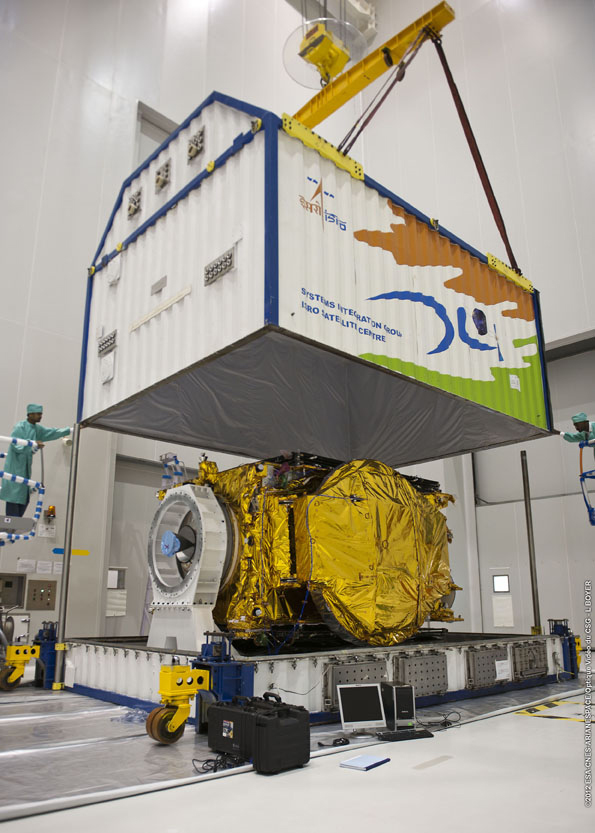
    The shipping container that protected GSAT-10 during its travels from India to French Guiana is removed inside the Spaceport’s S5 payload preparation facility, revealing the spacecraft.


    News courtesy of CANSPACE Listserv.

    UPDATE: According to an Arianespace press release issued Thursday, the launch of the GSAT-10 and Astra 2F satellites is now scheduled for September 21.
    SES-5. The SES-5 geostationary communications satellite (also known as Sirius 5 and Astra 4B), which was launched on July 9, 2012, arrived at its orbital slot of 5 degrees east longitude on or about July 19. The current position is actually about 5.2 degrees.

    The satellite carries L1 and L5 transponders for the European Geostationary Navigation Overlay Service (EGNOS) satellite-based augmentation system. According to a spokesperson from the Space and Missile Systems Center, the Global Positioning Systems Directorate has assigned C/A PRN code 136 and L5 PRN code 136 for use by the satellite.

    GSAT-10. The Indian Space Research Organisation’s GSAT-10 geostationary communications satellite has arrived at the European spaceport in Kourou, French Guiana. The satellite carries a transponder for the GPS and GEO Augmented Navigation (GAGAN) satellite-based augmentation system.

    GSAT-10 will be launched together with the Astro 2F satellite by an Ariane 5 rocket on September 21. GSAT-10 is expected to be positioned at 83 degrees east longitude and use PRN code 128. It will join the first GAGAN-equipped satellite, GSAT-8, which is at 55 degrees east longitude and is transmitting test signals on the L1 frequency using C/A PRN code 127.

    Although GSAT-8 reportedly carries a dual-frequency transponder, no L5 signals from this satellite have yet been detected by International GNSS Service tracking stations.