Tag: Bangladesh

  • Seen & Heard: FAA updates interference resources, measuring Bangladesh’s highest peak and more

    Seen & Heard: FAA updates interference resources, measuring Bangladesh’s highest peak and more

    Interference clocked by the FAA

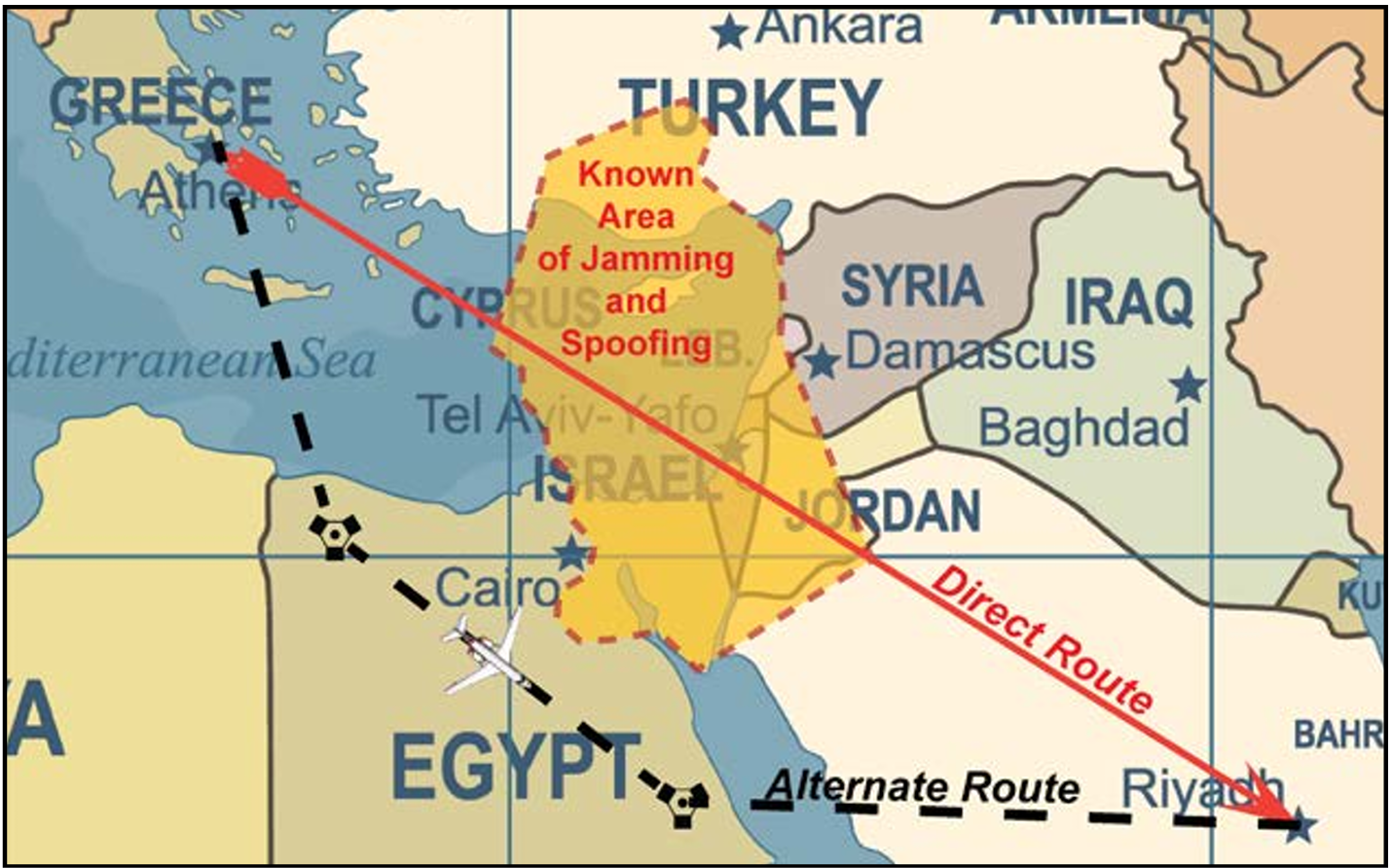
    The U.S. Federal Aviation Administration (FAA) has updated its “GNSS Interference Resource Guide.” The FAA’s Flight Technologies and Procedures Division (AFS-400) developed the guide to provide operators and pilots with current information on GPS/GNSS jamming and spoofing. According to the guide, “As the threat of GNSS jamming and spoofing is constantly changing, the FAA will update this resource guide to provide the best guidance in the rapidly changing environments.”

    Download the guide here.

    UK scientists unite to uncover coastline mysteries

    The research vessel Cefas Endeavour at dock in Lowestoft.(Credit: Cefas)
    The research vessel Cefas Endeavour at dock in Lowestoft.(Credit: Cefas)

    The UK Centre for Seabed Mapping (UK CSM) conducted a survey to explore and map the seabed along the United Kingdom’s southwest coastline. For four weeks, a team of 26 maritime scientists collected hydrographic, geological and environmental data. According to UK CSM, the survey represents an unprecedented level of collaboration within the maritime sector. The team aimed to collect and share high-quality marine data and make advances in how the seabed is mapped, understood and managed. The findings will support a wide range of applications including offshore energy and infrastructure, marine ecosystem science, safety at sea, marine policy, and defense.

    Bangladesh at the top
    Credit: MD Maruf Hassan/E+/Getty Images
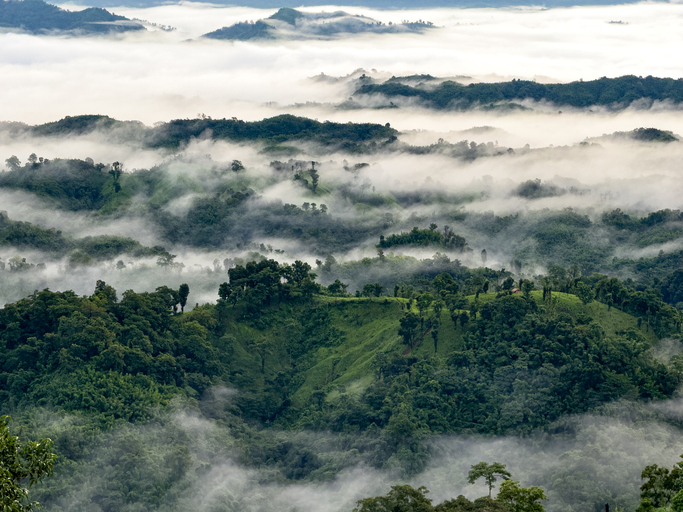
    Credit: MD Maruf Hassan/E+/Getty Images

    In April, field teams for the Survey department under the Ministry of Defense
    conducted field work in the remote hill areas of Bangladesh to determine the
    highest peak. Surveyors used modern geodetic methods and advanced GNSS
    technology in the Bandarban district, and followed international standards to
    determine the height of the country’s highest peak above mean sea level (MSL)
    with centimeter-level accuracy, including latitude, longitude and elevation.

    Turbulence shrinks Antartica’s Ross Ice Shelf
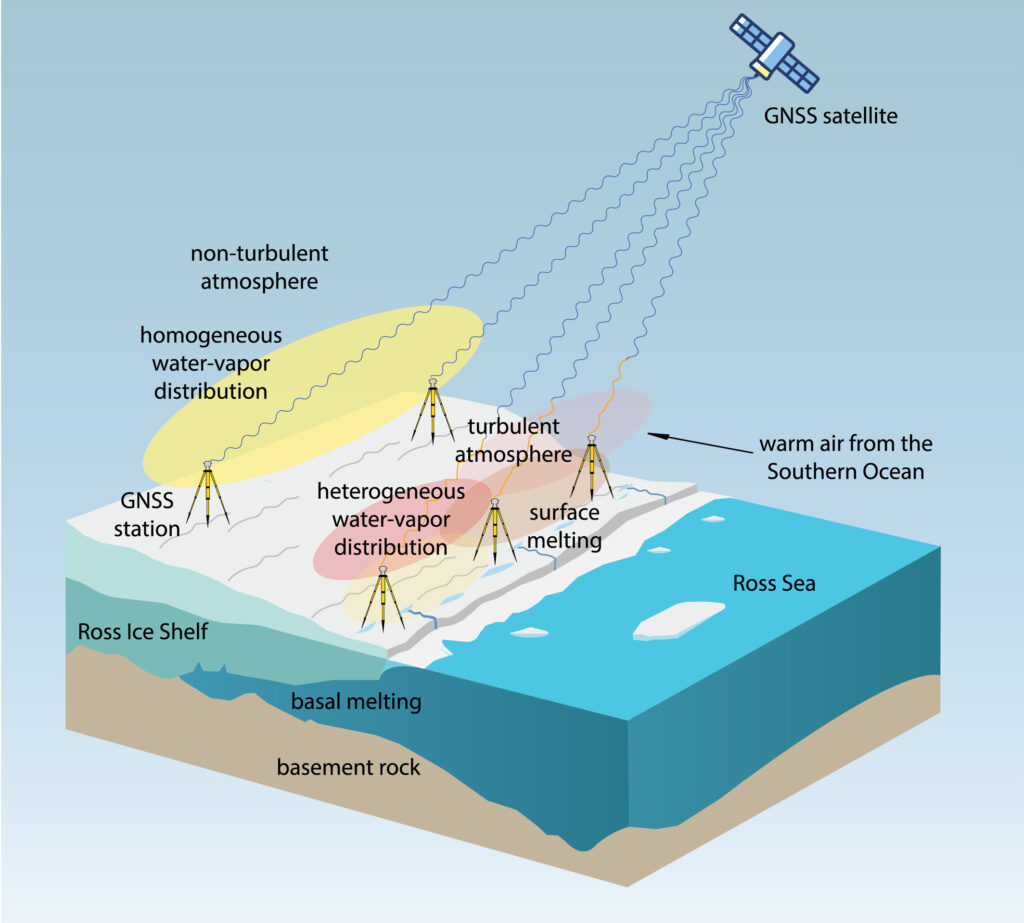
    Sketch (not to scale) of GNSS sensitivity to atmospheric turbulence in Antarctica. GNSS stations can probe the spatiotemporal distribution of water vapor in the lower atmosphere because water vapor induces a measurable signal propagation delay. Water-vapor distribution is spatially homogeneous for a non-turbulent atmosphere and heterogeneous when the atmosphere is turbulent. (Credit: MIT)
    Sketch (not to scale) of GNSS sensitivity to atmospheric turbulence in Antarctica (Credit: MIT)

    GNSS observations suggest a major melting event at Antarctica’s Ross Ice Shelf was
    linked to atmospheric turbulence. While the shelf typically melts underneath from warm ocean water, an unusual surface melting episode occurred in January 2016. Researchers from MIT Haystack Observatory used data from existing GNSS stations, with 13 stations installed on the shelf, to examine atmospheric turbulence. Wind, water vapor and temperature variations drawn in by warm and humid air caused the surface to melt, with turbulence four times greater than usual.
  • Survey to determine highest mountain peak in Bangladesh

    Survey to determine highest mountain peak in Bangladesh

    A government-sponsored survey has set out to find the highest peak in Bangladesh. Field teams for the Survey department under the Ministry of Defense have begun field work in the remote hill areas of Ruma and Thanchi upazilas in Bandarban district.

    The survey, taking place April 4-12, will use modern geodetic methods and advanced GNSS technology. The surveyors will follow international standards to determine the height of the country’s highest peak above mean sea level (MSL) with centimeter-level accuracy, including latitude, longitude, and elevation.

    Through the use of a newly developed geoid model, it will be possible to accurately convert ellipsoid heights obtained from GNSS receivers into mean sea level (MSL) elevations of the mountain peaks, according to the government.

    The survey is expected to resolve the long-standing debate over whether Tajingdong, Keokradong or Saka Haphong is the country’s highest mountain peak.

  • Researcher recounts adventure updating GNSS stations in Bangladesh

    Researcher recounts adventure updating GNSS stations in Bangladesh

    The challenge of repairing GNSS stations in Bangladesh is recounted in a Nov. 6 article by Mike Steckler, a researcher with Columbia Climate School.

    Steckler has been conducting research in the country for 25 years. He previously installed a continuously operating reference station (CORS) network in the southern region of the country.

    Data from the network has enabled study of the tectonic motions of the Earth leading up to earthquakes. It also revealed the sinking of the land in the world’s largest delta to less than 1 mm/y.

    “I still find that amazing compared to the days before GNSS became routine,” he writes. “I’ve been at sea where the crew had to use sextants to estimate our position to within 10 miles.”

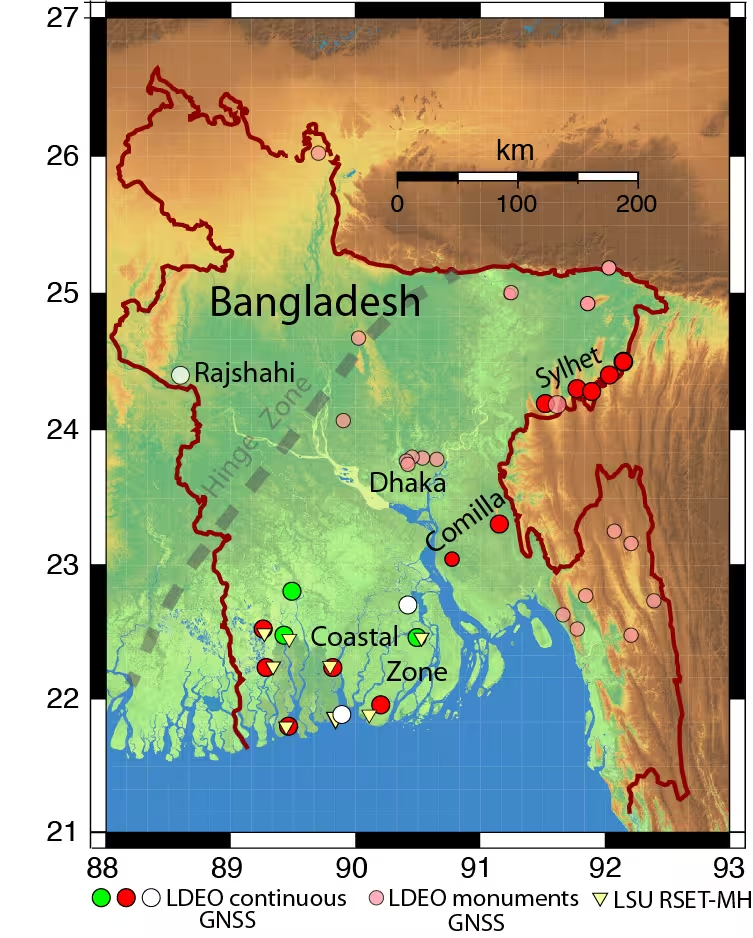
    Of 16 stations running in the country, only three (green) were transmitting data back to the U.S. “I have returned here once again with others to get them working again and add three new stations (white),” Steckler writes.

    Steckler was joined by a team from Dhaka University to visit the sites, make repairs and install new equipment.

    Read his full article at the Columbia Climate School website.

    Map of Bangladesh showing the locations of Steckler's GNSS sites and regions he is visiting. The green circles are working systems, the red ones need repair, and the white ones are new. The pink circles are monuments with no active system. (Image: Mike Steckler)
    Map of Bangladesh showing the locations of Steckler’s GNSS sites and regions he is visiting. The green circles are working systems, the red ones need repair, and the white ones are new. The pink circles are monuments with no active system. (Image: Mike Steckler)