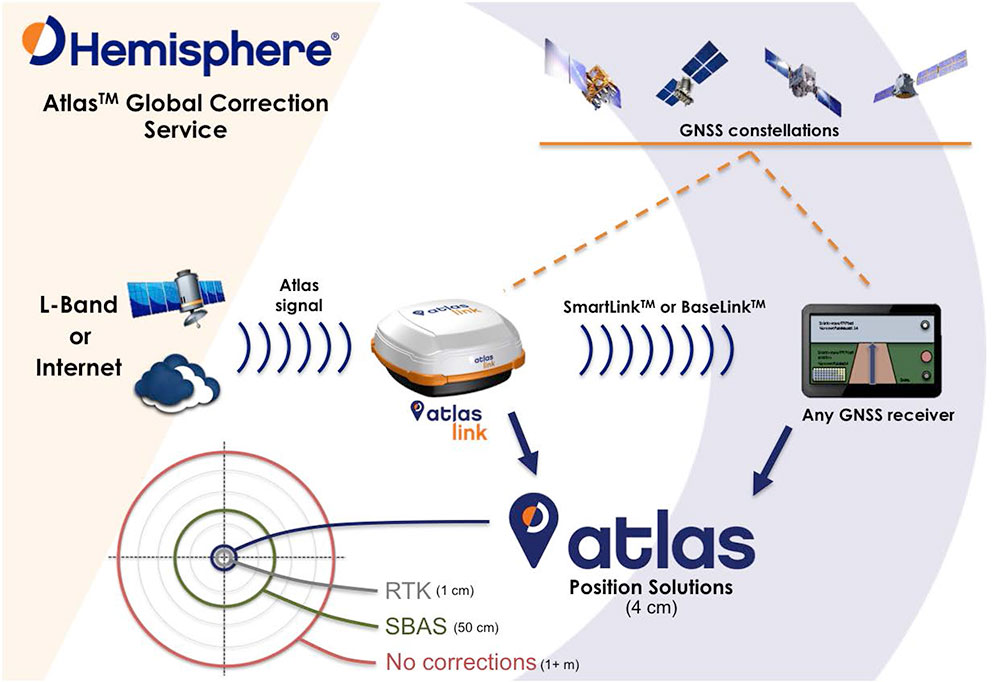
Hemisphere has released Atlas, its new entrant into the GNSS global correction services market. Atlas is delivered via L-Band or the Internet at accuracy levels ranging from meter level to sub-decimeter level. Atlas support is being introduced across a wide range of hardware, including Hemisphere’s new AtlasLink smart antenna, also launched.
“Atlas comes out of a change of culture and focus,” Hemisphere CEO Chuck Joseph told GPS World in an extensive interview that also included Rodrigo Leandro, Hemisphere’s director of engineering, GNSS Positioning Systems. For the full interview, see the second half of this news story.
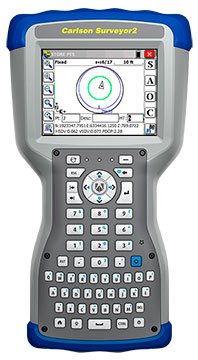
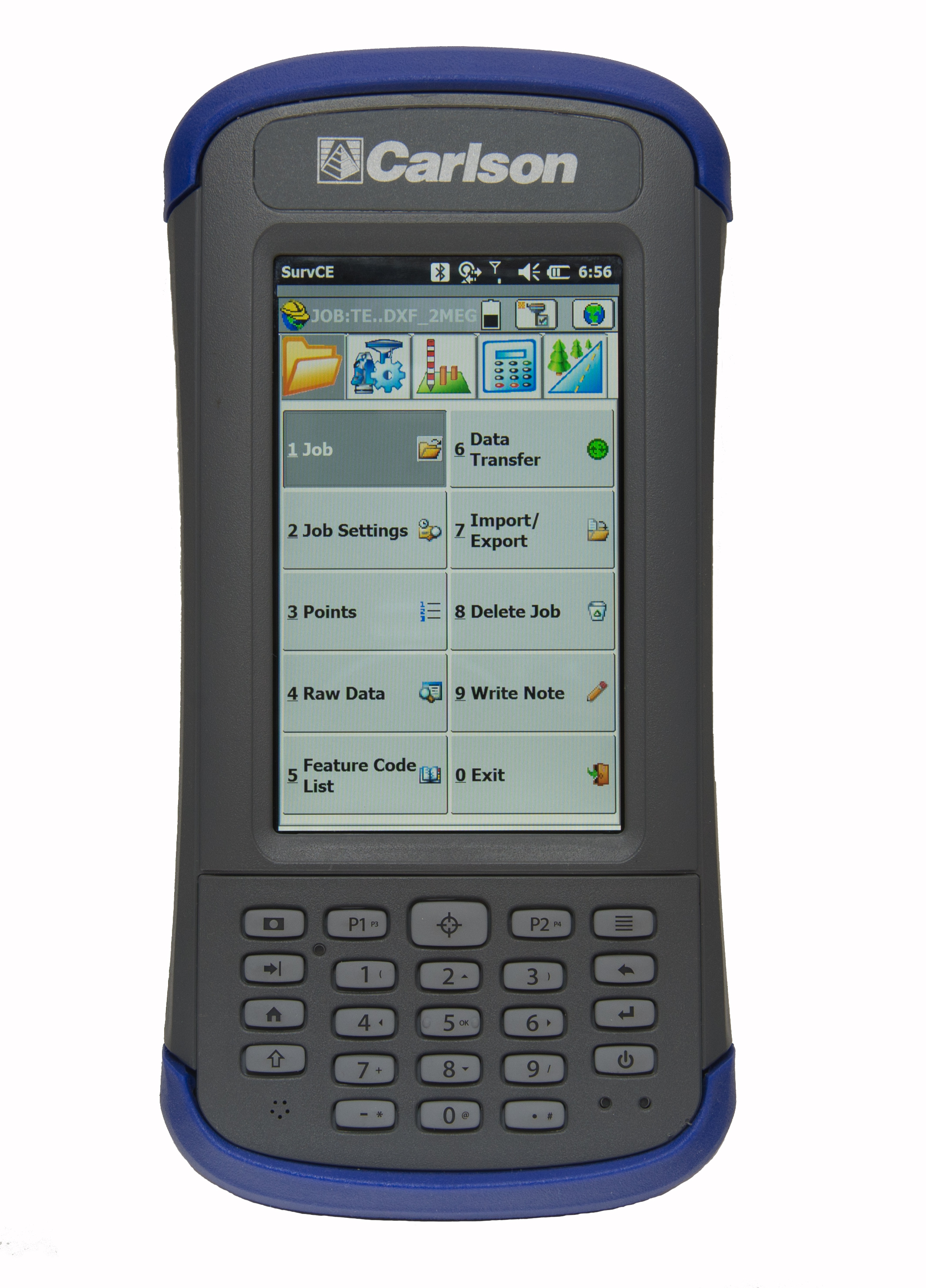
Starting June 19, Atlas will be available for subscription at the dedicated Atlas web portal across a range of Hemisphere’s multi-frequency, RTK-capable products, such as AtlasLink, R330u, V320 and VS330u. Atlas will also be available from a number of Hemisphere’s channel partners and OEMs such as Carlson Software, Inc.
“Since joining Hemisphere I have heard from customers large and small that they need a different option when it comes to high-accuracy corrections, one they can buy from their provider of choice and with little to no impact on their operating budgets,” said Chuck Joseph, Hemisphere GNSS CEO and president. “We listened hard to what they told us and built Atlas to answer their needs — a totally new service that delivers freedom of choice to our customers along with industry leading corrections at dramatically reduced prices.”
“We formed a team of our most experienced GNSS professionals with the task of developing a roadmap for the future of correction services business and technology in the world — assessing current needs, and also what users across the globe will be looking for over the next decade or two,” said Rodrigo Leandro, Hemisphere director of engineering. “Atlas not only introduces Hemisphere as a business and technology leader in the correction services industry today, it also provides an essential platform for delivering multiple levels of correction services to a very wide range of users spanning commercial business and consumer application use.”
Systems supporting Atlas utilize the newly released and proven Athena GNSS engine. To be able to utilize Atlas corrections, users of supported systems will simply need to update to Athena firmware and purchase a subscription through the Atlas portal.
To build Atlas, Hemisphere GNSS put together a team of seasoned developers whose collective experience matches the best in the GNSS industry. Together they have developed a GNSS correction service, available via L-Band satellite broadcast, which utilizes the most powerful technologies available to deliver a service that matches or exceeds competitive systems across a range of metrics:
- Positioning accuracy: Atlas provides competitive positioning accuracies down to 2 cm RMS in certain applications.
- Positioning sustainability: Position quality maintenance in the absence of correction signals, using Hemisphere’s Tracer technology.
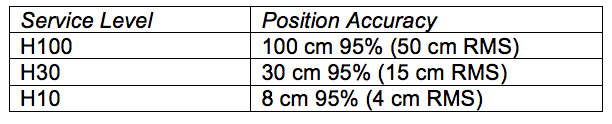
- Scalable service levels: Atlas is designed to serve all. It is capable of providing virtually any accuracy, precision and repeatability level in the 5 to 100 cm range.
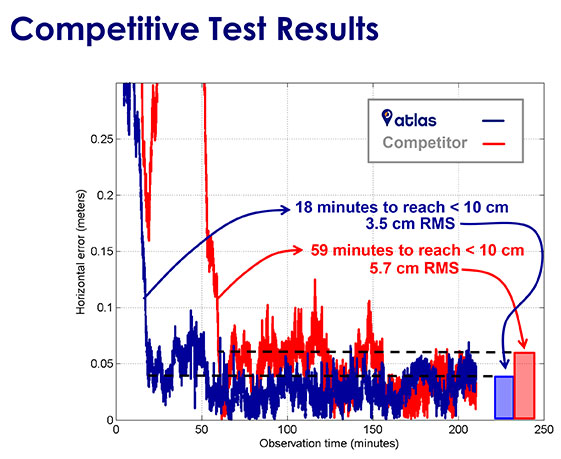
- Convergence time: Convergence times of 10-40 minutes.
- Exclusive agnostic capability: Atlas is an agnostic positioning system. SmartLink technology allows an AtlasLink antenna to be used as an Atlas signal extension for any GNSS system compliant with open communication standards.
- Network RTK augmentation: BaseLink technology allows Atlas-capable receivers to self calibrate, self-survey, and automatically manage the transmission of RTK correction data to augment or extend established or new GNSS reference networks in areas of poor Internet connectivity.
“High-quality corrections are essential to our customers,” said Randy Noland, director of Machine Control, Carlson Software, Inc. “The way all the existing services are purchased, delivered and supported is completely separated from the rest of the positioning ecosystem. We see Atlas as an opportunity for us to deliver corrections under our own brand as part of a holistic package — all of which means empowering our ability to provide a stronger solution and a better experience for our customers.”
“Atlas completely changes how augmentation services are delivered and supported,” said Andy Smith at Saderet Ltd. “For the first time, distributors and dealers can fully participate in selling to and supporting our customers, strengthening our relationships by providing them with a much better experience.”
“I’ve extensively tested Atlas, and the performance is exceptional, making it a great fit for our GIS and survey customers” said Jean-Yves Lauture at Eos Positioning Systems, Inc. “Even better, we can now offer global augmentation services with our Arrow GNSS receivers to our customers as part of an integrated solution. After many years in this industry, that’s a major change.”
Atlas service levels and position accuracies can be customized to meet OEM needs, the company said.
Exclusive Interview with Hemisphere’s Chuck Joseph and Rodrigo Leandro
A Startup Inside a Reinvention
“Atlas comes out of a change of culture and focus,” Hemisphere CEO Chuck Joseph told GPS World, in an extensive interview that also included Rodrigo Leandro, Hemisphere’s director of engineering, GNSS Positioning Systems. “We are reinventing a storied brand, and to do that we have to act more like the startups I have directed since leaving Trimble — move fast, be flexible, and focus on innovation. Effectively we are building a startup inside of a reinvention.”
“On my first day on the job, we divided the staff into five working groups and told them: you are now startup companies, entrepreneurs, with six people each team. Go away and come back with big ideas. Go build a business plan. Out of that we got Athena, released last month, Atlas, AtlasLink, and a couple more new products coming out in the months to come.”
A Different Kind of Corrections Service
Joseph and his colleagues at Hemisphere describe the distribution, pricing, and overall business model of Atlas as “disruptive.”
“Our approach comes directly from talking to customers in agriculture, machine control, and to our channel partners. Other corrections service providers did not allow them to participate, forced them to give up their end user list, and to buy directly from [the service provider] — who in some cases was their competitor in that market.”
“When you step back you can see the impact of those restrictions — after 10 plus years the corrections service marketplace generates probably $150 million in total revenue — it should be bigger than that by now. We think a different approach combined with a very aggressive price point will substantially broaden the marketplace.”
“We’ll be making announcements of OEM signings in the months to come. For us it’s all about what works for our partners — some of them will private-label the service, some will choose to use the Atlas brand. We really don’t care if our name is on the product or not — we’re an OEM play. Whatever brand they choose, we will provide them with the infrastructure to be successful, even down to the portal their customers will use to manage their devices and subscriptions — we will develop that for them, and provide the back-end e-commerce.”
A Look at the Technology
Rodrigo Leandro added, “The basic architecture is not extremely different from other L-band reference services. However, within that, we have really pushed to develop leading-edge technology. For example, our correction method format is well-developed for new constellations and different applications it can serve, and our corrections message structure is the most advanced of those available today. As a result, we have a number of patents pending on technologies included in Atlas.”
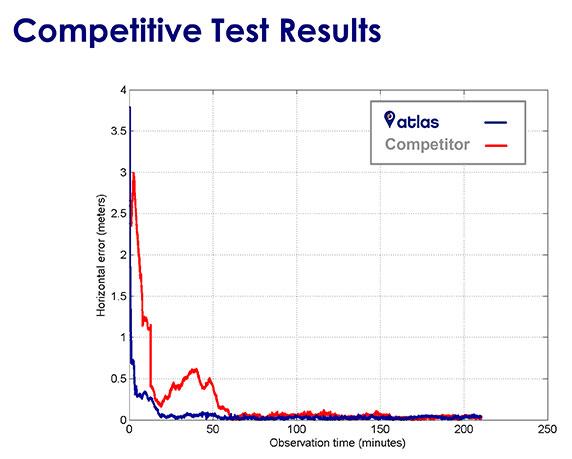
Chuck Joseph interjected, “When we were doing the initial planning for Atlas we agreed that it was absolutely critical that our performance meets or beats the competition’s, otherwise we wouldn’t want to offer it to customers out there. We have been benchmarking the competition at every stage of our development, and know that we are delivering a market leading product.”
“This slide shows the same, single antenna connected to Atlas and to a competitor, and it shows being able to converge down to decimeter level.
“This one gives more details on time to converge.
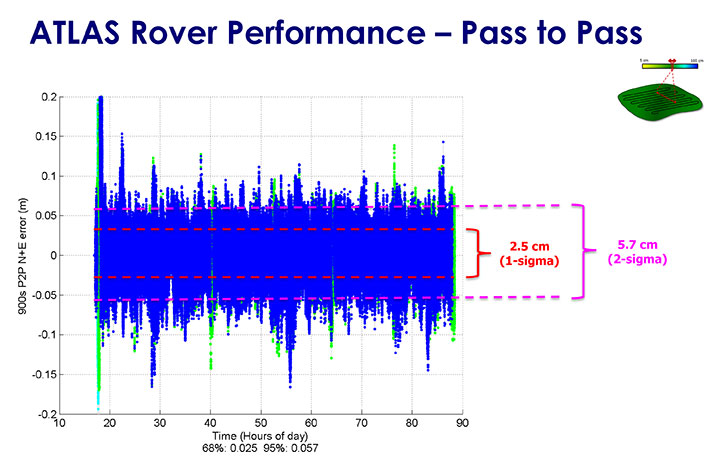
“And here, this one shows pass-to-pass results, the relative accuracy between 2 tracks of the tractor — this is important for people more interested in agriculture applications. We can get down to 2.5 centimeters.”
“The new AtlasLink antenna is designed to be a main channel for customers of our service. It can be used in GIS, machine control, marine applications and so on. Features inside it include a very big internal memory storage, a web server application, multi-GNSS multi-frequency capability, L-band and RTK — it supports Atlas and Athena out of the box. Other innovations will come later, for instance, incorporating Galileo. We believe it is the most powerful multi-purpose GNSS smart antenna in the industry.”
“At the same time there is easy support and easy configuration by the user. It takes literally about six clicks from log-in to register the receiver, out of the box. In 20 minutes you’re running Atlas. It’s very easy to get up and running.”
Broadening the Market
Leandro continued, “The Atlas service isn’t the only area of innovation however. We also spent a lot of time working on how we could deliver the service to the broadest possible audience, and the resulted in two key features of our AtlasLink antenna — SmartLink and BaseLink. Those features free customers from the restrictions of their current hardware and current service — they really change the game.”
“Customers don’t want to have to buy a new $10-$20K receiver [in order to get a corrections service]]. If you’re happy with the hardware you’re currently running, there’s no need to change it, you can still get this service. We are not in the business of using the service to sell hardware. We are using the hardware to sell the service.”
Joseph concluded, “This is all good for OEM customers. For them the SmartLink and BaseLink capabilities are huge. They can go back into their installed base and not have to push people to upgrade receivers or get a brand new receiver. At the same time, it enables them to go after their competitors installed base, and opens up markets that previously weren’t available such as recreational marine service, for example, the lower end of the marketplace. Fundamentally, we want to change this market — enable more users to get access to correction, and deliver real choice to those that have it already.”