Tag: CGSIC

  • CGSIC Issues Notice on Problem with Certain GPS Devices

    Flawed processing of GPS satellite data in some GPS receiver chipsets has caused concern, but the problem is not with the GPS constellation itself. “SVN 64 broadcasts a data message that clearly indicates SVN 64 is unusable for navigation. Nevertheless, the U.S. government has confirmed that certain GPS receivers are using data from SVN 64, in violation of GPS interface specifications, resulting in outages or corrupted, inaccurate position calculations,” Executive Secretariat Rick Hamilton, Civil GPS Service Interface Committee (CGSIC), said in a May 15 message.

    Read the full text of the message below.


    Known Problem with Certain GPS Devices

    May 15, 2014

    Recently, many GPS users have reported intermittent GPS outages in their devices.  After investigating, the U.S. government has linked the problem to flawed processing of GPS satellite data within certain GPS receiver chipsets.  The GPS satellite service continues to function as designed and is fully operational and available worldwide.

    The problem affects only user equipment that erroneously ignores the satellite health status information broadcast from every GPS satellite.  The problem is not related to the April 28, 2014, activation of civil navigation messages on the GPS L2C and L5 signals.

    Since March 15, 2014, the Air Force has been conducting functional checkout on a GPS satellite, designated Space Vehicle Number (SVN) 64. SVN 64 broadcasts a data message that clearly indicates SVN 64 is unusable for navigation. Nevertheless, the U.S. government has confirmed that certain GPS receivers are using data from SVN 64, in violation of GPS interface specifications, resulting in outages or corrupted, inaccurate position calculations.

    The Air Force testing is scheduled to end in mid-May 2014 at which time SVN 64 will begin normal operation.  At that point, these problems may stop occurring. Meanwhile, the U.S. government urges all GPS device makers to review their products for compliance with the GPS interface specifications, and if necessary, to issue software/firmware updates to users as soon as possible. View specifications.

    Users experiencing GPS outages should check with their device manufacturers for available software/firmware updates.  In addition, any civil user seeing unusual behavior in GPS user equipment should report it to the U.S. Coast Guard Navigation Center (NAVCEN).  Aviation users should file reports consistent with FAA-approved procedures. Military users seeing unusual behavior should report it the GPS Operations Center (GPSOC).

    Please direct any civil user questions to NAVCEN at (703) 313-5900,
    http://www.navcen.uscg.gov
    Please direct any military user questions to the GPSOC at (719)
    567-2541, DSN: 560-2541,
    [email protected]  https://gps.afspc.af.mil
    Military alternate: Joint Space Operations Center, (805) 606-3514,
    DSN: 276-3514, [email protected]


    See also: Technical explanation for device makers (PDF)

    V/R
    Rick Hamilton
    CGSIC Executive Secretariat
    GPS Information Analysis Team Lead
    USCG Navigation Center
    703-313-5930

  • Predicted Ephemeris: Waste of Time or an Untapped Resource?

    Predicted Ephemeris: Waste of Time or an Untapped Resource?

    GPS World contributing editor Eric Gakstatter gave a talk on predicted ephemeris at the Civil GPS Service Interface Committee (CGSIC) on Tuesday. The talk was invited and the topic was suggested by CGSIC coordinators. The 53rd meeting of the CGSIC was held Monday and Tuesday before the Institute of Navigation GNSS+ 2013 Conference. Here is Eric’s talk:

    Whenever I point a critical finger at the GPS folks, I apologize before I do so because it’s really a wonderful system.

    What I try to offer the community in general is a link between the GPS system operators and the civil community. It’s amazing when you think about it, two huge user bases of civil and military users, and a little strip called CGSIC that communicates between them. Rick [Hamilton of CGSIC] introduced me to this concept a couple months ago and asked me to investigate it and think about it.  This is what I researched and talked to some folks and came up with.

    First, I want to introduce you to some folks doing fascinating things with GPS.

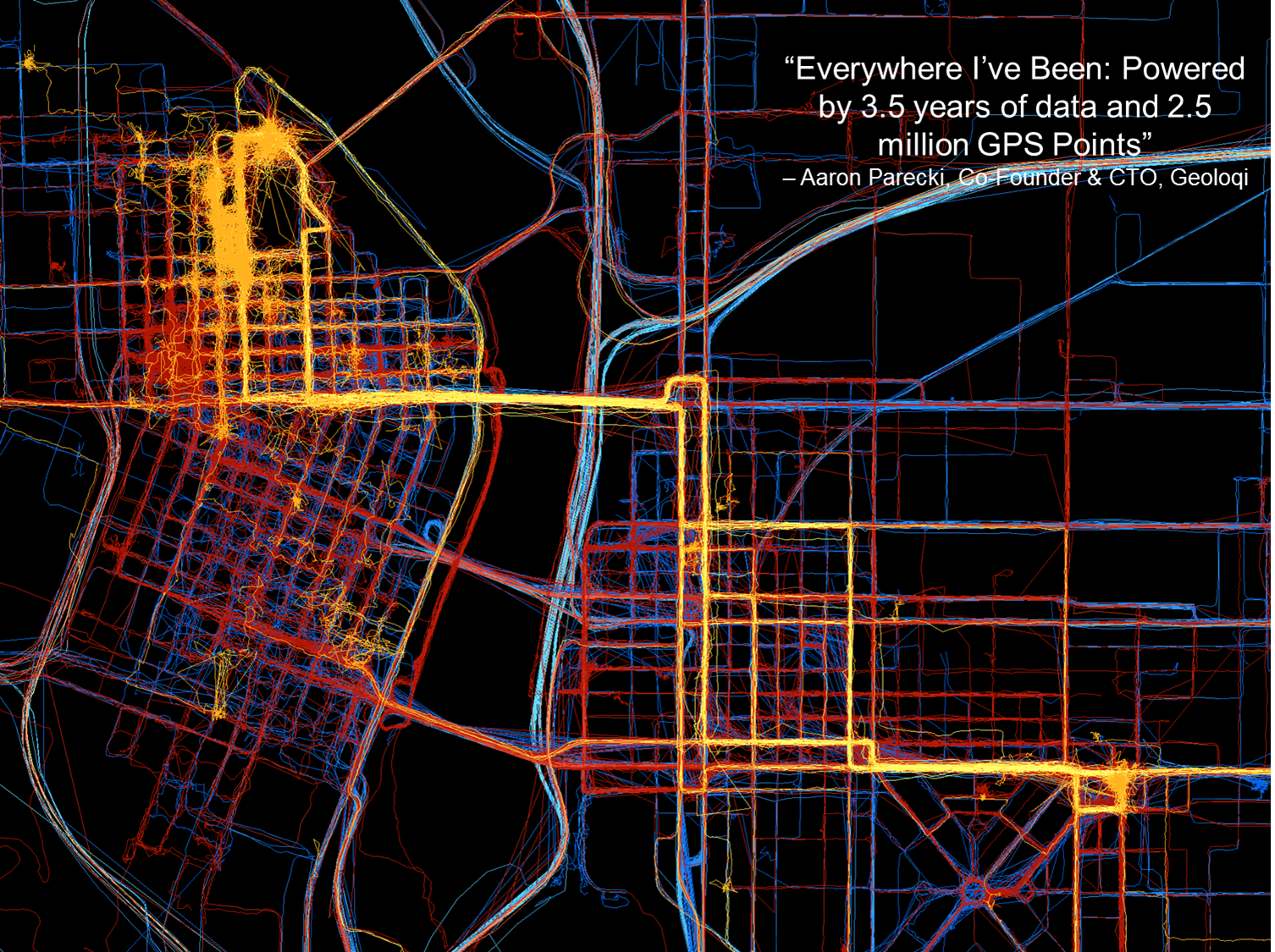
    Here’s a young company, Geoloqi, doing really interesting things in Portland. They don’t have any clue where GPS came from; they just have it on their smartphones. One of the founders collected GPS data everywhere he went for the last three and a half years. This map shows 2.5 million data points, and I think it’s fascinating.

    This map of Portland by Geoloqi has 2.5 million data points.
    This map of Portland by Geoloqi has 2.5 million data points.

    These folks interface between the GPS chipset in the mobile device and the apps that run on it. They sold their company to Esri last year.

    “Geolocation has the potential to become an indispensable part of our lives.  But to be a valuable service, the technology needs to be invisible yet opted into, private, and secure.”  — Amber Case, Geoloqi founder

    These kids just want to get things done, create ideas and create products: things like, check into a hotel when you get within 100 yards of the door; get your prescription prepared and ready for you when you come within a certain distance of a pharmacy. All these kinds of things are based on the geotrigger or geofence concept.

    Now, talking about my work, primarily in surveying and mapping, with companies like utilities with 15 million customers and a lot of infrastructure. To put that at the fingertips of a maintenance person, that’s pretty amazing.  I’ve been swimming in this soup for a long time, and I hadn’t heard of this concept — the predicted ephemeris (PRED) produced by GPSOC.

    Take a PRED state vector data file, which is currently generated every 15 minutes by the GPS Operations Center under For Official Use Only (FOUO), currently designated unclassified, but not accessible to the general public. If it were made available for public use, it could decrease time to first fix from 40 seconds when you turn on your mobile device, to 5 to 10 seconds.

    In the high-precision field like mine, surveying, it really doesn’t make too much difference because by the time you get out of your truck and set up your gear, 30 seconds has already gone by and it doesn’t make much difference.

    Now it could be more of an issue with mobile devices in GPS-impaired environments such as urban canyons or indoor environments, where 30 seconds could make the difference between getting a fix or not.

    If predicted ephemeris were available, developers could distribute it terrestrially via a wireless network to mobile devices.

    Problem: How to transfer PRED from a U.S. government FOUO environment to make it available to application developers?

    To me as a product developer or a product manager, interested in pushing products out to the community, that’s a really small speed bump.  But when I talk to colleagues who operate in that (government) space, that’s a significant undertaking, a real obstacle. We’re talking about a big change, and a big process to go through to effect that change.

    PRED from the horse’s mouth, so to speak, from the U.S. Air Force, really builds credibility. I can build it into a product, because I know it’s going to be there three or four or more years from now.

    PRED can be made available, but Civil GPS app developers need to speak up — because civil users won’t. They don’t know about it. They don’t know what is possible.

    “How does somebody know what they want if they haven’t even seen it?”  — Steve Jobs

    I’m trying to raise awareness here.  I’ll probably write about soon in the magazine or in my [Survey Scene] email newsletter.

    Frank van Diggelen, Broadcom.  We’ve been doing this in the commercial world for over a decade. You all have it in your cellphones, with about 90% likelihood provided by Broadcom or someone who’s licensed our patents. It doesn’t work properly unless you have the source of the data and the client side working very cooperatively.  The issue is the . . . gap between prediction and use. If the satellite is moved (in orbit or clock) then the prediction is wrong, and you need client-side software that is design cooperatively with the predictions. Our predictions are available in 2-, 4-, 7- or 30- day intervals. Think of a use case where you get a seven-day prediction, and then go away from network coverage for several days, meanwhile, say on Day 4, a satellite is moved or has its clock adjusted, on Day 5 it is set healthy, on Day 6 you turn on your handset and use the prediction from six days ago — it will be wrong and your client-side software has to catch that and know know how to invalidate the predictions.

    We deliver these orbital predictions at about the rate of a billion per month. It’s been there for 10 years, and its been working so well most people aren’t even aware that it’s there. If the Air Force puts these out, that sounds great, but if you don’t have client-side software looking for erroneous predicitions — when a satellite is adjusted or moved — then things would be a lot worse for the user community than they have for the last 10 years.

    Eric Gakstatter: I understand that, but that’s true for any technology. If a company implements it incorrectly, the market will reject it. Let the market decide.

    There may be a need for a non-proprietary solution (PRED) that is publicly available so it could be implemented by other developers, and level the playing field to increase market adoption of GPS.


  • CGSIC Agenda Released

    The 53rd meeting of the Civil GPS Service Interface Committee will be held Monday and Tuesday, September 16-17, before the Institute of Navigation GNSS+ 2013 Conference. Both events take place at the Nashville Convention Center, in Nashville, Tennessee.

    The meeting agenda is now available on the event website.

    Monday morning’s CGSIC concurrent sessions include the Timing Subcommittee and the Surveying, Mapping, and Geosciences Subcommittee. Monday afternoon’s sessions include the International Information Subcommittee and the U.S. States and Local Government Subcommittee.

    A plenary session will be held Tuesday.

  • Gakstatter Reports on CGSIC Meeting

    GPS World Survey and GIS editor Eric Gaskstatter attended the CGSIC (Civil GPS Service Interface Committee) State and Local Government subcommittee meeting in Seattle August 14, and provided a report in his Survey Scene editorial.

    The Civil GPS Service Interface Committee (CGSIC) was established to facilitate communication among civilian GPS users, identify civilian user community needs, and report to the Office of the Assistant Secretary for Transportation. The U.S. state and local government subcommittee meeting moves around to different parts of the U.S. The next meeting is the annual CGSIC meeting, typically held the two days prior to the Institute of Navigation (ION) GNSS conference. This year it’s being held in Nashville, Tennessee.

    Gakstatter reports on how GNSS receiver technology is moving much faster than GPS policymakers can keep up with, the National Telcommunications and Information Administration’s efforts to execute the National Broadband Plan, and a whether illegal jamming has been on the rise.

  • Thoughts on GPS/GNSS from the CGSIC Meeting Held Earlier this Week

    I attended the CGSIC (Civil GPS Service Interface Committee) State and Local Government subcommittee meeting in Seattle earlier this week. Following are some interesting observations you might be interested in.

    The Civil GPS Service Interface Committee (CGSIC) was established to facilitate communication among civilian GPS users, identify civilian user community needs, and report to the Office of the Assistant Secretary for Transportation. You are welcome to attend any of the CGSIC meetings. The U.S. state and local government subcommittee meeting moves around to different parts of the U.S. The next meeting is the annual CGSIC meeting that’s typically held the two days prior to the Institute of Navigation (ION) GNSS conference. This year it’s being held in Nashville, Tennessee.

    You can view the agenda for this week’s meeting by clicking here.

    Some take-away bullet point observations from this week:

    1. GNSS receiver technology is moving much faster than GPS policymakers can keep up with. If the policymakers can keep the various GNSS from interfering with each other, can protect the spectrum used by GNSS, and do their best to mitigate jamming/interference (intentional and unintentional), they’ve done their job.

    Rather than try to cage the GNSS animal, let it run wild and it will explore so many apps. Some will fail and many will succeed, but either way it’s a given that GNSS technology will contribute significantly to the world’s economy. With the introduction of the L5 civilian signal by the U.S. and Europeans, a new era of high-precision GNSS technology will emerge, along with countless new apps.

    2. The NTIA (National Telcommunications and Information Administration), while seemingly our friend when they recommended to the FCC last February that LightSquared not be allowed to move forward, did so because they had no choice. Make no mistake; the NTIA is trying to figure out a way to execute President Obama’s National Broadband Plan (which includes finding 500 MHz of wireless spectrum for high-speed Internet), which may mean trying to draw a tight box around the GNSS spectrum, via receiver standards. On the other hand, the FAA (Federal Aviation Administration) and RITA (Research and Innovative Technology Administration) are taking a different approach by developing a Spectrum Protection Plan. Which one will move faster? Likely the NTIA due to political pressure. While the LightSquared debate is seemingly on indefinite hold for now, the spectrum discussion is far from over. We might see draft proposal (for public comment) from the NTIA and FAA/RITA as soon as the end of this year, but could easily slip into 2013. Stay tuned.

    3. With all the talk about illegal GPS jammers and “jammagedon,” as Gavin Schrock (PLS) jokingly coins it, it was reported at the CGSIC meeting that there’s been no increase in reported incidences of GPS jamming and has stayed at the “couple of events” per year level. People are still talking about the 2007 San Diego event and the Newark airport event as the major ones. Unless the DoD is keeping something from us, jamming (intentional or unintentional) hasn’t panned out like one might have thought. The FCC is certainly cracking down on the distribution of GPS jammers (and cell-phone jammers). It is illegal to manufacture, import, distribute, and use GPS jammers in the United States.

    Not that jamming doesn’t occur and we shouldn’t be aware of it, but when your receiver isn’t working the way you think it should, jamming and solar activity shouldn’t be the first thoughts that cross your mind.

    4. Of the 12 Block IIF GPS satellites being built, two are in orbit with the first being launched in 2010 and the second one last year. A third is scheduled to launch later this year. That equates to one launch per year. Clearly, this pace cannot continue or it would be the year 2022 before all twelve were in orbit. What’s the problem? Part of the problem is that the legacy Block IIA model satellites have performed so well. In fact, one has been operational for 22 years. That’s an incredible feat for a satellite that was designed with an expected life of 7.5 years. Unfortunately for the IIF program (and the high-precision user community), it means that congress can defer a few hundred million dollars per year by delaying the IIF launches. In these budget-conscious economic times, it’s not difficult to understand the reasoning that if there are 31 operational GPS satellites in orbit, why spend $150-200M to launch each GPS satellite when we don’t need it yet? But, that won’t last for long. The many legacy GPS satellites are one component failure away from being unusable. That said, the word at the CGSIC meeting is that three IIF satellites will be launched in 2013.

    How important is the IIF satellite to the high-precision user community? It brings the new L5 civil GPS signal, which has huge implications on high-precision receiver performance and cost. Read here for more thoughts on L5.

    If you looked at the meeting agenda, you can see that I was on the agenda to make a 20-minute presentation. During my presentation, one of the messages I wanted to be clear on is that GPS is not in competition with GLONASS, Compass/BeiDou, Galileo, or any other GNSS. The GPS user community needs the other GNSS to succeed and the GPS program needs the other GNSS to succeed just as much as the other GNSS rely on GPS. Other GNSS, along with GPS, clearly provide a better solution for the user community than any one of them used by itself.

    I think it’s pretty clear, at this point in time, that the days of GPS-only receivers are numbered. Of course, they’ll still be around for a few years, but the trend is clear that even mobile phones are beginning to use GPS/GLONASS receivers.

    If you’re interested, click below and you can view a PDF of my presentation.

    Thanks, and see you next time.

    Follow me on Twitter for the latest GPS/GNSS news.

  • CGSIC Subcommittee to Hold Meeting August 14

    The CGSIC States and Local Government Subcommittee, chaired by the Federal Highway Administration, is conducting a meeting in downtown Seattle on August 14. CGSIC is chartered to be an information portal direct from the U.S. government’s GPS program to (and from) the world’s civil users of GPS.

    The Coast Guard’s Navigation Center is assigned responsibility as the operational arm and executive secretariat for the committee and assists the States and Local Government Subcommittee to bring this information to state government and private personnel in regional areas of the United States. View an agenda and directions to the meeting on the Navigation Center’s website.

    CGSIC meetings are free and open to all and present an opportunity to personally interact directly with the people that manage the GPS program. For more information, call CGSIC Executive Secretariat Rick Hamilton at 703-313-5930.

  • Steve Jobs’ Impact on Defense; plus CGSIC, ION

    Like many who had the pleasure of interacting with the genius that was Steven Paul “Steve” Jobs, I have been reflecting recently concerning his incredible impact on our lives. Indeed his impact on every aspect of our lives including GPS is almost beyond description.

    For example, our warfighters are increasingly using iPads and iPhones in theater for multiple functions, including some dedicated and warfighter-developed GPS applications that far outshine any GPS application provided by the government. When will we learn that we must provide our warfighters what they need or they will go elsewhere to find it because lives are at stake? Today many of our warriors are developing their own applications on their individual iPads and iPhones, exactly as Steve Jobs intended.

    NeXT, PIXAR, and USG

    My first interaction with Steve was after he had been summarily fired from Apple (the company he cofounded) in 1985 and began a new computer company called NeXT. All I can really say in this venue about that initial interaction is that the U.S. military bought a great many NeXTstation integrated/networked computers, and many of them are in still use today. Indeed, in many circles Steve Jobs credited the U.S. government (USG) with helping NeXT computer get its start. The hardware was definitely better than anything else on the market at the time, but the selling point was the incredibly powerful and user-friendly interface and software, known as NeXTSTEP, which proved to be an early version of the next step in the sequence leading to the modern-day Mac operating system that hundreds of millions of us use today.

    To put the power of the NeXT computer and Steve Jobs’ genius in the right context, think PIXAR Animation Studios. PIXAR was another of Steve’s successful collaborations (Steve was co-founder and CEO) when computer-intensive animation required powerful computers that artists as well as business people could understand and use — user-friendly, in other words — and few computers or software applications in the mid-1980s were up to the task. The U.S. government was not into animation but was into high-fidelity simulations and knew an excellent product when they saw it, hence the early supporting partnership. Those little black cubes were among the most powerful and user-friendly computers of their era, and many are still churning away today in settings befitting their hue.

    This comes to mind because recently I visited a secure government facility where NeXT computers and NeXTSTEP software are still being utilized, and the users think they have no equal. I have no idea what version of the operating system they are using, but regardless, this is quite a testament to the genius and foresight of Steve Jobs and the company that helped save Apple when Apple bought NeXT and Steve Jobs returned to Apple in 1996. The rest, as they say, is history.

    No Competition

    Every time I use a new application on my iPhone, iTouch, iPad, or iMac, I think about the clueless CEO of one of the world’s major phone companies who was interviewed about his views concerning the iPhone just before it was released. He foolishly said and probably really believed, “We are not worried about Apple and the iPhone, because they are not a recognized phone company.” Obviously underestimating the brilliance of Steve Jobs caught a great many companies and CEOs by surprise. As I wrote concerning a PC World magazine article listing the world’s best products a few years ago, “If Apple had a product in the category, it was always number one, without fail.” I know of no other company that can make that claim.

    Recently Bobby Zafarnia wrote in “Digital Exec”

    “How has Apple managed to stay so successful over 35 years? …no one can dispute that the company is the dominant American corporate brand, period. The hard numbers prove this, with Apple’s market capitalization recently surpassing Exxon-Mobile, making it the most valuable company in the world. Of course, the news always breathlessly captures Apple’s characteristics: Legendary CEO. Masterful marketing. Amazing stagecraft. Sexy products. Industry renegades. Tradition breakers. Cult-like devotion.”

    Even as I totally agree with this description of the Steve Jobs-led-Apple, I feel there is a glaring omission. Apple gives the consumer what they want and need, and they do it in such an intuitive way that consumers have come to expect only the best as well as the next great product from Apple. The fact that companies worldwide then attempt to emulate the latest Apple product or service is ample evidence that this is a working and successful strategy for Apple. Remember: “Imitation is the greatest form of flattery.”

    GPS on a Train

    I was thinking about this recently during the 30-plus-minute train ride from the greater Portland Airport to the Oregon Convention Center where I had the pleasure of attending ION GNSS 2011 September 17-23 (Institute of Navigation, Global Navigation Satellite Systems). During that train ride I was monitoring my GPS application on my iPhone and iPad, comparing the two and trying to determine the closet stop to my hotel. I originally thought my fellow passengers might consider my activities strange or excessive, being as I was on a train, until I noticed that actually most of the people in my train car were monitoring their travel with iPhones, iPads, or smartphones. A young couple across from me wanted to know what GPS application I was using. So even on a train I experienced the extra and sometimes comforting situational awareness that GPS can provide. I knew that on a long straight stretch we once hit a top speed of 68 miles per hour, the entire trip was going to take ~35 minutes, and I was sure I exited at the nearest stop to my hotel and then found my way there on foot without any wrong turns. So, you see, a GPS application on an iPhone or an iPad while traveling on a train does make sense, because when tunnels and buildings obstruct the sky view you still have Wi-Fi, telephone (3G), and SkyHook wireless applications to keep you oriented, and in a strange location it will give you peace of mind. That is indeed priceless, and I think Steve Jobs knew that. He thought about what was needed and what could be. He made our lives better.

    So when I think of Steve Jobs I will always remember the outside-the-box thinker that was never afraid to take on any challenge and who usually won simply because he gave us what we needed, sometimes even before we knew it.

    ION and CGSIC

    This was the second year for ION GNSS in Portland, Oregon and as with most ION events it was better this year than last. More than 1400 attended this year, which is a ten percent increase over last year and in this economic environment that is quite a feat and speaks well of the value that ION events bring to companies bottom lines. There were also more exhibitors this year; so many it was difficult to get by and visit them all because the paper presentations were so interesting.

    The whole international GNSS event actually began on September 19 with the 51st Civil GPS Service Interface Committee (CGSIC) meeting held in conjunction with ION GNSS. This is always a great venue for an exchange of ideas and an opportunity for the various federal and state agencies that deal with GNSS on a daily basis to present their latest projects and innovations. It is always an uplifting session for me because it demonstrates that even federal and state bureaucracies’ can be innovative when the people involved are passionate about what they do. If you ever have an opportunity to attend the CGSIC sessions I highly recommend them.

    You can become a member of the CGSIC, it is totally free of charge, by visiting the NAVCEN website registration page. In fact many people will erroneously but understandably tell you the CG stands for US Coast Guard because as a Service they are so heavily involved in the CGSIC. The NAVCEN CO (Commanding Officer) manages the committee, maintains membership roles, coordinates committee meetings, represents the committee chair at GPS related meetings, and coordinates responses to submitted issues, however the CG still stands for Civil GPS. However, just a reminder if you do have a question about the civil GPS signal or experience interference or outages then the place to call is the NAVCEN or U.S. Coast Guard Navigation Center at (703) 313-5900, or visit the very informative NAVCEN website.

    ION GNSS

    As much as I would like to highlight individual papers at ION GNSS, it is impossible. There are hundreds of papers and presenters, and whether or not you find them interesting depends on your area of interest, but I can say there is something for everyone. Name a GNSS topic and there is most likely a paper being presented at ION GNSS that addresses your specific interest in a cutting-edge manner.

    The exhibitors and their products were as always very informative, and I will be highlighting a few of those in the months to come. As a former marketing executive, I can tell you that if you have a cutting-edge GNSS product, hardware or software, and you aren’t exhibiting at ION GNSS, then you are missing the boat.

    As usual this event is extremely well organized, and it runs like clockwork. My hat is off to ION President Dr. Todd Walter and Executive Director, Lisa Beaty along with her fine staff, for another outstanding and informative GNSS event.

    LightSquared

    For the past year almost every meeting of GPS professionals has been dominated by the LightSquared (LSQ) fiasco; ION GNSS and CGSIC were no exceptions. The best-attended meetings at both events concerned the current status of the LSQ fiasco. There were LSQ updates from the Pentagon, the 50SW, SMC, and finally there was a forum with an invited LSQ executive moderated by Tom Stansell titled: “Can LightSquared and GPS Coexist? Current Status and Ongoing Activities.” An excellent question that, in my opinion, was answered firmly and clearly in the negative. In my opinion, shared by many, the first three presentations, including the presentation by the LSQ exec, were of dubious value and only the Trimble, Garmin, and John Deere presentations addressed the actual issues. My hat is off to Tom Stansell and ION for making the effort, and to the extent that a great many people are now more informed about the LSQ fiasco the session was a success, and it was the best attended individual session, standing room only, of the entire ION event.

    My Favorite and Most Unique Presentation

    My favorite and most entertaining presentation was by none other than Alan Cameron, the editor-in-chief of GPS World magazine. Alan’s presentation, “Out in Front: C’mon, People Now” was, now don’t be shocked, on the LightSquared fiasco, and was presented to the music and words of Sonny and Cher. The highlight, however, was when Alan actually sang the chorus and the audience joined in. Leave it to Alan to do the unexpected.  Most importantly, he more than made his point. This whole fiasco long along ceased to be about the laws of physics, no matter how hard LightSquared tries to change them. It is now unfortunately a sad tale full of sound and fury but not much else. It is all about politics, an embarrassed administration that attempts to tamper with congressional testimony, and a clueless FCC chairman trying to save face, his job, or both.

    GPS World Dinner

    To wrap up the conference’s after hours activities on Thursday night, GPS World magazine held its annual GPS gala and exclusive dinner. The GPS literati, dare I say cognoscenti, were present in all their finery, yours truly included, and a good time was had by all. Of course the LightSquared fiasco was again the main topic of discussion, and where I actually heard LightSquared used as a verb. As in, “You’ve been LightSquared!” A vision of a common fastening device comes to mind. It’s amazing but not even a couple glasses of vino rosso make that bitter LSQ pill any easier to swallow. Fortunately, the camaraderie and food were excellent as always. And once again there was record attendance.

    Personally, I can’t wait until we do this all again next year in Nashville, Tennessee. I hope to see you there September 17-21, 2012, at the Nashville Convention Center.

    Until next time, happy navigating!


  • ION GNSS/CGSIC annual conference

    I realize the GIS world doesn’t revolve around GPS but I’m going to spend some space on it this month. Currently, I’m in Savannah, Georgia at the annual ION GNSS/CGSIC conference.

    This is where one can peer into the future of where GPS technology (and positioning technology in general) is heading. This is where all of the GPS and GNSS brainpower get together every year. There are a lot of military folks here. The GPS Chief Engineer (Col. David Goldstein), GPS Wing Commander (Col. David Madden), Boeing scientists (GPS satellite builders), Lockheed Martin scientists (GPS satellite builders) and all companies and organizations involved in designing and building GPS infrastructure are here. These are the true rocket scientists. I bet the average IQ would be a pretty good bowling score.

    The way this conference works is that the CGSIC meetings take place on Monday and Tuesday. The ION GNSS meetings take place on Wednesday through Friday.

    CGSIC is an acronym for the Civil GPS Service Interface Committee. CGSIC is coordinated by the US Coast Guard. According to its website, it’s the “recognized worldwide forum for effective interaction between all civil GPS users and the U.S. GPS authorities. It was established and chartered to identify civil GPS user needs (e.g. navigation, timing, and positioning) in support of the Department of Transportation’s (DOT) program to exchange information concerning GPS with the civil user community as part of the GPS “outreach” program. In fulfilling this responsibility, the CGSIC reports its activities to the National Space-Based Positioning, Navigation, and Timing (PNT) Executive Committee and the Office of the Assistant Secretary for Transportation”.

    The CGSIC meetings on Monday and Tuesday consist of briefings from government officials on the status of GPS and various related programs like NDGPS, WAAS, OPUS/CORS and many more. You can view the CGSIC meeting agenda here. There are also many user presentations from various government and commercial entities discussing how they are using GPS/GNSS in their work.

    I’ve been blogging about the meetings while I’ve been in Savannah. You can read my blog here. Of particular interest was the focus on RTK Networks in the Surveying, Mapping and Geosciences Session. RTK is an acronym for Real-Time Kinematic. Essentially, it’s real-time positioning at the centimeter level.

    With respect to GIS and infrastructure mapping, RTK Networks are one of the most significant advancements in GPS you will encounter over the next few years in the Geospatial business. They have the potential to significantly transform the accuracy of infrastructure data that is collected. If you want to learn more about them, you can read some of what I’ve written before about RTK Networks as well as the webinar I conducted on the subject.

    RTK Networks: The Wild, Wild West

    What RTK Users Want; Prospects for Network RTK (Rob Lorimer)

    Webinar – RTK Networks: What, Where, Why

    Here were the subjects discussed regarding RTK Networks at CGSIC:

    PANEL SESSION: Guidelines for Real Time GNSS Networks (RTN)
    A. Site Considerations – Dan Martin, NOAA’s National Geodetic Survey
    B. Planning & Design – Gavin Schrock, Washington State Reference Network
    C. Administration – Gary Thompson, North Carolina Geodetic Survey
    D. Best Methods for Users – Bill Henning, NOAA’s National Geodetic Survey
    Question & Answer Session with Speakers

    Interactive Sessions within Small Discussion Groups
    Group 1. CORS/OPUS
    Group 2. RTN Site Considerations and RTN Planning & Design
    Group 3. RTN Administration and RTN Best Practices for Users
    As I wrote in my blog, this was the place to be if one is interested in Real-Time Networks, from the user perspective to the administrator perspective. There’s a tremendous amount of interest and activity on the RTN space right now.

    While the CGSIC meetings are all about what’s happening now, the ION GNSS meetings are all about what’s going to happen in the future. At ION GNSS, researchers present the results of their hard work. The result of some of this research will be the technology we are using tomorrow.

    Be sure to check my ION GNSS blog. There will be some lag time, but it should all be up by early next week.

    Thanks and see you next week.