Tag: dead reckoning

  • Inertial performance: Enhanced tightly coupled dead reckoning

    Inertial performance: Enhanced tightly coupled dead reckoning

    Exploring IMU specifications and correlating them to performance of a final product can be daunting, as differences between MEMS sensors are not always apparent. This article presents achievable performances in fusion technology across a range of IMUs among the best in their respective performance categories. 

    The number of available options in inertial navigation systems (INS) has grown substantially over the last several years. Major advances have been made not only in inertial measurement unit (IMU) technology, but also in the ability to exploit sensor information to its fullest extent. In both cases, the largest impact can be seen in the micro-electrical-mechanical systems (MEMS) sensors. MEMS sensors are typically much smaller, lower power and less expensive than traditional IMUs. The net result of these improvements is a proliferation of INS systems at much lower cost than were previously available and, therefore, greatly increased accessibility to technology that has historically seen limited deployment. Selecting the appropriate sensor and fusion solution for a particular application can be very challenging due to the large and confusing spectrum of solutions.

    The IMUs will be examined in the context of new enhancements to sensor fusion algorithms such as the use of INS profiles. The concept of INS profiles applies environment specific constraints to improve performance in certain types of vehicles, or motion profiles. External sensors such as odometers and dual antenna operation can also aid the solution considerably, but will be unused in this analysis except for occasional comparisons. These external aiding sensors are extremely helpful in many cases and are available to use with a proprietary tightly coupled GNSS+INS solution called SPAN, but this paper seeks to evaluate what performance can be achieved without such aids.

    Real-world test results will be examined using a selection of IMUs with the latest SPAN algorithms to illustrate what kind of performance can be achieved with different sensors in difficult conditions. Despite their major advances over the past few years, there are many challenges involved with utilizing MEMS technology to provide a robust navigation solution, particularly during limited GNSS availability or low dynamics. The measurement error characteristics of these devices have improved dramatically, but are still much larger and more difficult to estimate than traditional sensors. Advancements in SPAN sensor fusion algorithms have enabled these smaller sensors to achieve remarkable performance, especially in applications where environmental conditions allow for additional constraints to be applied.

    This testing focuses on the land profile, meaning the constraints applied to a fixed-axle vehicle. The test scenarios were selected in such a way as to provide results for ideal, poor and completely denied GNSS coverage.

    INS Profiles

    GNSS and IMU sensors are only one part of the overall INS system performance. The sensor fusion algorithms used to exploit the available sensor data to its utmost capability are equally as important. In this regard, several improvements have been made to the SPAN INS algorithms to enhance performance under a variety of scenarios.

    The largest addition to the SPAN product line is the introduction of INS profiles. That is, environment- and vehicle-specific modeling constraints can be utilized to enhance the filter performance. For example, the land profile, which will be examined in depth in this article, is intended for use with ground vehicles that cannot move laterally. The assumptions introduced for land vehicles, however, are not necessarily valid for different forms of movement, such as those experienced by a helicopter. Therefore, profiles have been implemented via command, and controlled as required by the user, allowing for maximum performance depending on the application at hand.

    The land profile is analogous to what has historically been identified as dead reckoning. It is a method that uses a priori knowledge of typical land vehicle motion to help constrain the INS error growth. In other words, it makes assumptions on how land vehicles move to simplify inertial navigation from a six-degree-of-freedom system to something closer to a distance/bearing calculation. The land profile takes the concept of dead reckoning, models it as an update type into the inertial filter and adds a few additional enhancements.

    Velocity Constraints / Dead Reckoning. Amongst other optimizations, the land profile enables velocity constraints based on the assumption of acceptable vehicle dynamics. This includes limiting the cross track and vertical velocities of the vehicle. Of all the enhancements, this is the one most colloquially referred to as dead reckoning.

    In its simplest form, dead reckoning is the propagation of a position without any external input. In this forum, external input generally refers to GNSS satellites. Without external input, dead reckoning is inherently dependent on assumptions of velocity and heading to propagate the position. These solutions have evolved by integrating inertial and directional sensors to provide more local input and improve the solution propagation. This also is not a perfect method, however, as inertial sensors have their own errors that grow exponentially over time. The land profile velocity constraints explain the bulk of optimizations SPAN has made to enable dead-reckoning performance in extended GNSS outage conditions.

    Explaining the velocity updates involves using the current INS attitude (  ); the vehicle attitude (  ) is estimated by applying the measured or estimated IMU body to vehicle direction cosine (  ). From this, the pitch and azimuth for the vehicle is estimated.Using the magnitude of the measured INS velocity in conjunction with the derived vehicle orientation, the vehicle velocity is computed, allowing the expected vertical velocity and cross-track to be constrained.

    A velocity vector update is then applied to the inertial filter to constrain error growth. The effects of this method are expected to be most apparent in extended GNSS outage conditions when the INS solution must propagate with no external update information.

    Phase Windup Attitude Updates. Some applications are inherently difficult for inertial sensors due to the fact that these systems are reliant on measuring accelerations and rotations in order to observe IMU errors. When traveling at a constant bearing and speed, separating IMU errors from measurements becomes challenging, so any application that does not provide meaningful dynamics is more demanding on inertial navigation algorithms. This type of condition commonly appears in applications such as machine control, agriculture and mining.

    Gravity is a strong and fairly well known acceleration signal, so the real difficulty in this type of environment is managing the attitude, and especially azimuth, errors. Attitude parameters become difficult to observe when the system experiences insignificant rotation rates about its vertical axis.

    External inputs can be used for providing input during low dynamic conditions when rotational observations are weaker. These are particularly helpful in constraining angular errors and include the same types used to assist in initial alignment: dual antenna GNSS heading, magnetometers, etc. However, as the goal of this testing is to demonstrate the achievable performance from a single antenna GNSS system, this type of external aid was specifically omitted.

    Utilizing a patented technique for determining relative yaw from phase windup, the system is able to distinguish between true system rotation and unmodeled IMU errors during times of limited motion. This is a novel way to extract additional information out of existing sensors rather than adding more equipment and complexity.

    The phase windup update is used to constrain azimuth error growth during low dynamic conditions that are typically not favorable to inertial navigation. However, it does require uninterrupted GNSS tracking and is therefore applicable only in GNSS benign environments. This approach is expected to show the greatest benefit in low dynamic conditions and be directly attributable to azimuth accuracy, but only in conditions where GNSS availability is relatively secure.

    Equipment and Test Setup

    We paired OEM-grade GNSS receiver cards with a selection of IMUs in different performance categories. Since the OEM GNSS platform is capable of tracking all GNSS constellations and frequencies, we configured each receiver to use triple frequency, quad-constellation RTK positioning. The receivers were coupled with a wideband antenna capable of tracking GPS L1/L2/L5, GLONASS L1/L2, BeiDou B1/B2 and Galileo E1/E5b signals.

    Three IMUs were tested: an entry-level MEMS IMU (UUT1), a tactical-grade MEMS IMU (UUT2) and a high-performance fiber-optic gyro-based IMU (UUT3).

    All GNSS receivers and IMUs were set up in a single test vehicle and collected simultaneously for all scenarios. IMUs were mounted together on a rigid frame, and all receivers ran the same firmware build that were connected to the same antenna.

    The tests were conducted using a single GNSS antenna with no additional augmentation sources, such as distance measurement instrument (DMI) or wheel sensor. These are extremely helpful in aiding the solution, but as previously mentioned, this testing seeks to demonstrate the possible performance without the benefit of additional aiding sources. Dependence on aiding sources is a very important distinction when comparing such systems.

    The GNSS positioning mode used was RTK via an NTRIP feed from a single base station with baselines between 5–30 kilometers. This was done to try to minimize GNSS positioning differences between the three systems. L-band correction signals were not tracked, and PPP positioning modes were not enabled.

    A basic setup diagram of each system under test can be seen in Figure 1.

    FIGURE 1. Equipment set-up (not to scale).


    Test Scenarios

    Four test scenarios will be examined using all the equipment and algorithms described above. They are: urban canyon, low dynamics, parking garage and extended GNSS outage.

    The urban canyon test is designed to show the performance of the system in restricted GNSS conditions. The challenge to this scenario is to maintain a high-accuracy solution when GNSS positioning becomes intermittent or even unavailable.

    The low dynamics test is intended to illustrate the benefits of the land profile, and specifically the phase windup azimuth updates in maintaining the azimuth accuracy.

    The parking garage test will show the efficacy of the velocity constraint models over the different IMU classes as the extended outage provides no external information to the INS filter whatsoever. Again, no other aiding sources were used.

    Urban Canyon Test. The urban canyon environment has been and remains one of the strongest arguments in favor of using GNSS/INS fusion in a navigation solution. Because urban canyons are common, densely populated and, of course, a demanding GNSS environment, they represent both an important and challenging location to provide a reliable navigation solution. Typically, they contain major signal obstructions, strong reflectors and complete blockages (depending on the city). For this reason, they provide an excellent use case for INS bridging to maintain stability of the solution.

    During most urban canyon environments, it is typically rare to incur total GNSS outages of more than 30 seconds. Therefore, this scenario examines the stability of the solution in continuously degraded, but not generally absent, GNSS. In this case, the coupling technique of the inertial algorithms rather than quality of the IMU dominates achievable position accuracy.

    The receiver platform is capable of tracking all GNSS constellations and frequencies. This provides a significant benefit to test scenarios, such as the urban canyon, where the amount of visible sky is significantly restricted. In this case, the more satellites that are observable, the more the tightly coupled architecture can exploit the partial GNSS information.

    Though position accuracy between IMUs is less apparent in this condition, attitude results remain separated by IMU quality, which is a major consideration for some mapping applications such as those using lidar or other sensors where a distance/bearing calculation must be done for distant targets.

    Test data for this scenario was collected in downtown Calgary, Canada. The trajectory (Figure 2) includes several overhead bridges for brief total outages and some very dense urban conditions.

    FIGURE 2. Urban canyon test trajectory.

    Table 1 shows the RMS error results of the three systems running both the default and land profiles. The first thing to notice is that the errors are differentiated by IMU category, though the differences are fairly small in the position domain thanks to the tightly coupled architecture. However, because GNSS information is partially available, the differences seen in activating the land profile are fairly modest, especially as the IMU performance rises.

    TABLE 1. RTK RMS errors for urban canyon.

    As the clearest benefits of the land profile are seen on the entry-level MEMS IMU (UUT1), these will be explored graphically in Figures 3 and 4. Figure 3 shows the position domain, and the RMS differences can be seen in a few cases where the default mode errors increased faster than the land profile. An example of this divergence is most obvious around the 1500-second mark of the test during periods GNSS is most heavily blocked.

    Low Dynamics Test. The low dynamics test is designed to emulate conditions experienced by machine control, agriculture and mining applications. In this situation, GNSS availability is generally not the limiting factor and can be used to control the low frequency position and velocity errors of the INS system. The difficulty is managing the attitude, especially azimuth, errors because attitude parameters are very hard to observe without significant rotations or accelerations (Figures 5 and 6).

    The low dynamics test was collected in an open-sky environment and consisted of traveling in a straight line on a rural road for roughly 2 km at an average speed of 10–15 km/h.

    As this type of scenario provides little physical impetus, the azimuth and gyroscope biases are not observable. The reason for this is due to the use of the first-order differential equations to estimate the navigation system errors. Essentially, the differential equations define how the position, velocity and attitude errors change (grow) over time based on each other and the IMU errors. The observability of a particular update is tied to additional states through the off-diagonal elements of the derived transition matrix with the accelerations and rotations experienced by the system.

    The overall RMS solution errors for RTK are provided in Table 2. As evident by the results presented, the position and velocity errors are clearly constrained by the continuous RTK-level GNSS position regardless of whether the land profile is enabled or not. The real differentiator in the land profile is the attitude performance due to the use of phase windup as a constraint. Moreover, the attitude improvements are certainly tied to IMU quality.

    TABLE 2. RTK RMS errors for low dynamics.
    TABLE 3. RTK RMS errors, parking garage (500s).

    UUT1 exhibited a noticeable improvement in the attitude performance, while the higher performance IMUs did not. This is not entirely unexpected as the precision of the phase windup is lower than that of the higher grade IMUs.

    Looking at the data graphically, Figure 7 shows the effect of land profile on positioning performance in this scenario. The two solutions are indistinguishable on the plot, and are all within standard RTK-level error bounds as was indicated in the RMS table.

    Figure 7 shows the attitude accuracy with and without the land profile enabled. Again, the largest gains are seen on the entry-level UUT1, so this is the graphic shown below. This shows how the error peaks of the azimuth estimates are constrained. All the sharp corrections in each plot correspond to the vehicle turning around at the end of each 2-Km line and illustrates how much more powerful a rotation observation can be in azimuth accuracy overall.

    FIGURE 7. UUT1 attitude error (std vs. land).

    Parking Garage Test. This test was carried out at the Calgary International Airport and was selected to show the INS solution degradation during extended complete GNSS outages. The test consisted of an initialization period in open sky conditions to allow the SPAN filter time to properly converge, followed by a 500-second period within the parking garage. During the interval within the parking garage there were no GNSS measurements available.

    Figure 8 provides a trajectory of the test environment. The time spent inside the parking structure is evident on the center bottom of the image.

    FIGURE 8. Parking garage test trajectory.

    Unlike urban canyon environments that contain partial GNSS information, this exhibits an extended period of complete GNSS outage. During this type of scenario, the IMU specifications become much more significant. IMU errors directly translate to the duration the solution can propagate before the accumulated low-frequency errors of the IMU grow to unacceptable levels. System performance during the outage degrades according to the system errors at the time of the outage and the system noise. The velocity errors increase linearly as a function of attitude and accelerometer bias errors. The attitude errors will increase linearly as a function of the unmodeled gyro bias error. The position error is a quadratic function of accelerometer bias and attitude errors.

    Position results from each IMU are shown for UUT 1 in Figure 9. This plot shows the error with the land profile on and off. Without the land profile, the second-order position degradation in an unconstrained system is clearly visible.

    FIGURE 9. UUT1 position error (std vs. land ).

    By enabling the land profile, the filter constrains IMU errors by utilizing a velocity model for wheeled vehicles. With the constraints, the position errors are startlingly reduced for UUT1 and then progressively less impactful as the IMU quality increases in UUT2 and UUT3, respectively. This makes sense as the IMU error growth is progressively smaller in those IMUs, so the effect of mitigating them is also reduced.

    Extended GNSS Outage Test. An extension of the parking garage test is to evaluate the performance in a much longer outage. Instead of 10 minutes, an outage of one hour was tested. Also, due to the extremely long GNSS outage bridging, the effects of adding a DMI sensor (odometer) will also be explored as they are able to be used as a major additional aiding source.

    Table 4. Percent error / distance traveled over 1-hour GNSS outage.

    The most common measure of dead-reckoning performance is error over distance traveled (EDT). Due to the very long duration outages in this test, the errors will be reported in error over distance traveled to conform to the typical reporting method. This test was conducted in a mixture of highways and suburban streets with an average speed of 65 Km/h, incorporating a moderate amount of dynamics.

    This effect can be seen over the duration of the entire outage as well in Figure 9. In this case, the points are the RMS error over several tests. and the light background shroud represents the one-sigma confidence as time progresses. The confidence increases over time as the overall distance traveled also increases.

    FIGURE 10. Land profile EDT with and without DMI aid over 1-hour GNSS outage.

    Results and Conclusions

    In testing a range of IMUs in some challenging scenarios, this paper has sought to illustrate what kind of performance is achievable using each kind of system. An added complexity is looking at what effect certain inertial constraint algorithms have on this solution.

    Although low-cost MEMs IMUs are continuing to greatly improve in quality and stability, the end application is still highly correlated to the overall performance of a selected INS system. For a great many applications, the MEMS devices in combination with a robust inertial filter can meet requirements and provide excellent value. However, some applications continue to require higher end sensors, and possibly post-processing to meet their needs.

    The ability of SPAN to utilize partial GNSS measurements such as pseudorange, delta phase and vehicle constraints means even low-cost MEMs are capable of providing a robust solution in challenging GNSS conditions. However, this tightly coupled integration is limited in cases where GNSS is completely denied or when in low dynamic conditions.

    INS profiles using velocity constraints, phase windup and robust alignment routines have been shown to provide substantial aid to the INS solution in tough conditions, such as GNSS denied or low dynamics. These improvements were shown to exhibit greater impact as the IMU sensor precision decreases. These abilities, in conjunction with the existing tightly coupled architecture of SPAN and the ever-increasing accuracy of MEMS, IMUs indicate that robust GNSS/INS solutions will continue to proliferate at lower cost targets. However, very precise applications such as mapping will continue to rely on higher quality sensors to meet strict accuracy requirements.

    ACKNOWLEDGMENTS

    The authors thank Trevor Condon and Patrick Casiano of NovAtel for collecting and helping to process the data presented in this article, and to Sheena Dixon for her tireless editing.

    Manufacturers

    NovAtel SPAN technology on the NovAtel OEM7 receiver is the testing and development platform for this research. NovAtel OEM7700 GNSS receiver cards and a NovAtel wideband Pinwheel antenna were employed. The inertial units under test were an Epson G320 (low-power, small-size MEMS IMU); Litef μIMU-IC (larger tactical-grade performance IMU still based on MEMS sensors); and a Litef ISA-100C (near navigation-grade IMU using fiber-optic gyros (FOG). Although all are excellent performers in their class and capable of providing a navigation-quality solution, the intent is to show the potential limitations that might arise due to the intended application.


    RYAN DIXON is the chief engineer of the SPAN product line at NovAtel Inc., leading a highly skilled team in the development of GNSS augmentation technology. He holds a BSc. in geomatics engineering from the University of Calgary.

    MICHAEL BOBYE is a principal geomatics engineer at NovAtel and has participated in a variety of research projects since joining in 1999. Bobye holds a BSC. in geomatics engineering from the University of Calgary.

  • Innovation: Checking the accuracy of an inertial-based pedestrian navigation system with a drone

    Innovation: Checking the accuracy of an inertial-based pedestrian navigation system with a drone

    I’m Walking Here!

    INNOVATION INSIGHTS with Richard Langley

    OVER THE YEARS, many philosophers tried to describe the phenomenon of inertia but it was Newton, in his Philosophiæ Naturalis Principia Mathematica, who unified the states of rest and movement in his First Law of Motion. One rendering of this law states: Every body continues in its state of rest, or of uniform motion in a straight line, unless it is compelled to change that state by forces impressed upon it. Newton didn’t actually use the word inertia in describing the phenomenon, but that is how we now refer to it.

    In his other two laws of motion, Newton describes how a force (including that of gravity) can accelerate a body. And as we all know, acceleration is the rate of change of velocity, and velocity is the rate of change of position. So, if the acceleration vector of a body can be precisely measured, then a double integration of it can provide an estimate of the body’s position. That sounds quite straightforward, but the devil is in the details. Not only do we have to worry about the constants of integration (or the initial conditions of velocity and position), but also the direction of the acceleration vector and its orthogonal components. Nevertheless, the first attempts at mechanizing the equations of motion to produce what we call an inertial measurement unit or IMU were made before and during World War II to guide rockets.

    Nowadays, IMUs typically consist of three orthogonal accelerometers and three orthogonal rate-gyroscopes to provide the position and orientation of the body to which it is attached. And ever since the first units were developed, scientists and engineers have worked to miniaturize them. We now have micro-electro-mechanical systems (or MEMS) versions of them so small that they can be housed in small packages with dimensions of a few centimeters or embedded in other devices.

    One problem with IMUs, and with the less-costly MEMS IMUs in particular, is that they have biases that grow with time. One way to limit these biases is to periodically use another technique, such as GNSS, to ameliorate their effects. But what if GNSS is unavailable? Well, in this month’s column we take a look at an ingenious technique that makes use of how the human body works to develop an accurate pedestrian navigation system — one whose accuracy has been checked using drone imagery. As they might say in New York, “Hey, I’m walking (with accuracy) here!”


    Satellite navigation systems have achieved great success in personal positioning applications.

    Nowadays, GNSS is an essential tool for outdoor navigation, but locating a user’s position in degraded and denied indoor environments is still a challenging task. During the past decade, methodologies have been proposed based on inertial sensors for determining a person’s location to solve this problem.

    One such solution is a personal pedestrian dead-reckoning (PDR) system, which helps in obtaining a seamless indoor/outdoor position. Built-in sensors measure the acceleration to determine pace count and estimate the pace length to predict position with heading information coming from angular sensors such as magnetometers or gyroscopes. PDR positioning solutions find many applications in security monitoring, personal services, navigation in shopping centers and hospitals and for guiding blind pedestrians.

    Several dead-reckoning navigation algorithms for use with inertial measurement units (IMUs) have been proposed. However, these solutions are very sensitive to the alignment of the sensor units, the inherent instrumental errors, and disturbances from the ambient environment — problems that cause accuracy to decrease over time. In such situations, additional sensors are often used together with an IMU, such as ZigBee radio beacons with position estimated from received signal strength.

    In this article, we present a PDR indoor positioning system we designed, tested and analyzed. It is based on the pace detection of a foot-mounted IMU, with the use of extended Kalman filter (EKF) algorithms to estimate the errors accumulated by the sensors.

    PDR DESIGN AND POSITIONING METHOD

    Our plan in designing a pedestrian positioning system was to use a high-rate IMU device strapped onto the pedestrian’s shoe together with an EKF-based framework. The main idea of this project was to use filtering algorithms to estimate the errors (biases) accumulated by the IMU sensors. The EKF is updated with velocity and angular rate measurements by zero-velocity updates (ZUPTs) and zero-angular-rate updates (ZARUs) separately detected when the pedestrian’s foot is on the ground. Then, the sensor biases are compensated with the estimated errors.

    Therefore, the frequent use of ZUPT and ZARU measurements consistently bounds many of the errors and, as a result, even relatively low-cost sensors can provide useful navigation performance. The PDR framework, developed in a Matlab environment, consists of five algorithms:

    • Initial alignment that calculates the initial attitude with the static data of accelerometers and magnetometers during the first few minutes.
    • IMU mechanization algorithm to compute the navigation parameters (position, velocity and attitude).
    • Pace detection algorithm to determine when the foot is on the ground; that is, when the velocity and angular rates of the IMU are zero.
    • ZUPT and ZARU, which feed the EKF with the measured errors when pacing is detected.
    • EFK estimation of the errors, providing feedback to the IMU mechanization algorithm.

    INITIAL ALIGNMENT OF IMU SENSOR

    The initial alignment of an IMU sensor is accomplished in two steps: leveling and gyroscope compassing. Leveling refers to getting the roll and pitch using the acceleration, and gyroscope compassing refers to obtaining heading using the angular rate.

    However, the bias and noise of gyroscopes are larger than the value of the Earth’s rotation rate for the micro-electro-mechanical system (MEMS) IMU, so the heading has a significant error. In our work, the initial alignment of the MEMS IMU is completed using the static data of accelerometers and magnetometers during the first few minutes, and a method for heading was developed using the magnetometers.

    PACE-DETECTION PROCESS

    When a person walks, the movement of a foot-mounted IMU can be divided into two phases. The first one is the swing phase, which means the IMU is on the move. The second one is the stance phase, which means the IMU is on the ground. The angular and linear velocity of the foot-mounted IMU must be very close to zero in the stance phase. Therefore, the angular and linear velocity of the IMU can be nulled and provided to the EKF. This is the main idea of the ZUPT and ZARU method.

    There are a few algorithms in the literature for step detection based on acceleration and angular rate. In our work, we use a multi-condition algorithm to complete the pace detection by using the outputs of accelerometers and gyroscopes.

    As the acceleration of gravity, the magnitude of the acceleration ( |αk|  ) for epoch k must be between two thresholds. If

    Source: GPS World

    (1)

    then, condition 1 is

      (2)

    with units of meters per second squared. The acceleration variance must also be above a given threshold. With

      (3)

    where   is a mean acceleration value at time k, and s is the size of the averaging window (typically, s = 15 epochs), the variance is computed by:

    .  (4)

    The second condition, based on the standard deviation of the acceleration, is computed by:

    .  (5)

    The magnitude of the angular rate ( ) given by:

      (6)

    must be below a given threshold:

      .  (7)

    The three logical conditions must be satisfied at the same time, which means logical ANDs are used to combine the conditions:

    C = C1 & C2 & C3.  (8)

    The final logical result is obtained using a median filter with a neighboring window of 11 samples. A logical 1 denotes the stance phase, which means the instrumented-foot is on the ground.

    EXPERIMENTAL RESULTS

    The presented method for PDR navigation was tested in both indoor and outdoor environments. For the outdoor experiment (the indoor test is not reported here), three separate tests of normal, fast and slow walking speeds with the IMU attached to a person’s foot (see FIGURE 1) were conducted on the roof of the Institute of Space Science and Technology building at Nanchang University (see FIGURE 2). The IMU was configured to output data at a sampling rate of 100 Hz for each test.

    FIGURE 1. IMU sensor and setup. (Image: Authors)
    FIGURE 1. IMU sensor and setup. (Image: Authors)
    FIGURE 2. Experimental environment. (Image: Authors)
    FIGURE 2. Experimental environment. (Image: Authors)

    For experimental purposes, the user interface was prepared in a Matlab environment. After collection, the data was processed according to our developed indoor pedestrian dead-reckoning system. The processing steps were as follows: Setting the sampling rate to 100 Hz; setting initial alignment time to 120 seconds; downloading the IMU data and importing the collected data at the same time; selecting the error compensation mode (ZARU + ZUPT as the measured value of the EKF); downloading the actual path with a real measured trajectory with which to compare the results (in the indoor-environment case).

    For comparison of the IMU results in an outdoor environment, a professional drone was used (see FIGURE 3) to take a vertical image of the test area (see FIGURE 4). Precise raster rectification of the image was carried out using Softline’s C-GEO v.8 geodetic software. This operation is usually done by loading a raster-image file and entering a minimum of two control points (for a Helmert transformation) or a minimum of three control points (for an affine transformation) on the raster image for which object space coordinates are known. These points are entered into a table. After specifying a point number, appropriate coordinates are fetched from the working set. Next, the points in the raster image corresponding to the entered control points are indicated with a mouse.

    FIGURE 3. Professional drone. (Photo: DJI)
    FIGURE 3. Professional drone. (Photo: DJI)

    For our test, we measured four ground points using a GNSS receiver (marked in black in Figure 4), to be easily recognized on the raster image (when zoomed in). A pre-existing base station on the roof was also used. To compute precise static GPS/GLONASS/BeiDou positions of the four ground points, we used post-processing software. During the GNSS measurements, 16 satellites were visible. After post-processing of the GNSS data, the estimated horizontal standard deviation for all points did not exceed 0.01 meters. The results were transformed to the UTM (zone 50) grid system. For raster rectification, we used the four measured terrain points as control points. After the Helmert transformation process, the final coordinate fitting error was close to 0.02 meters.

    FIGURE 4. IMU PDR (ZUPT + ZARU) results on rectified raster image. (Image: Authors)
    FIGURE 4. IMU PDR (ZUPT + ZARU) results on rectified raster image. (Image: Authors)

    For comparing the results of the three different walking-speed experiments, IMU stepping points (floor lamps) were chosen as predetermined route points with known UTM coordinates, which were obtained after raster image rectification in the geodetic software (marked in red in Figure 4).

    After synchronization of the IMU (with ZUPT and ZARU) and precise image rectification, positions were determined and are plotted in Figure 4. The trajectory reference distance was 15.1 meters.

    PDR positioning results of the slow-walking test with ZARU and ZUPT corrections were compared to the rectified raster-image coordinates. The coordinate differences are presented in FIGURE 5 and TABLE 1.

    FIGURE 5. Differences in the coordinates between the IMU slow-walking positioning results and the rectified raster-image results. (Chart: Authors)
    FIGURE 5. Differences in the coordinates between the IMU slow-walking positioning results and the rectified raster-image results. (Chart: Authors)


    Table 1. Summary of coordinate differences between the IMU slow-walking positioning results and the rectified raster-image results. (Data: Authors)
    Table 1. Summary of coordinate differences between the IMU slow-walking positioning results and the rectified raster-image results. (Data: Authors)

    The last two parts of the experiment were carried out to test normal and fast walking speeds. The comparisons of the IMU positioning results to the “true” positions extracted from the calibrated raster image are presented in FIGURES 6 and 7 and TABLES 2 and 3.

    FIGURE 6. Differences in the coordinates between the IMU normal-walking positioning results and the rectified raster-image results. (Chart: Authors)
    FIGURE 6. Differences in the coordinates between the IMU normal-walking positioning results and the rectified raster-image results. (Chart: Authors)
    FIGURE 7. Differences in the coordinates between the IMU fast-walking positioning results and the rectified raster-image results. (Chart: Authors)
    FIGURE 7. Differences in the coordinates between the IMU fast-walking positioning results and the rectified raster-image results. (Chart: Authors)
    Table 2. Summary of coordinate differences between the IMU normal-walking positioning results and the rectified raster-image results. (Data: Authors)
    Table 2. Summary of coordinate differences between the IMU normal-walking positioning results and the rectified raster-image results. (Data: Authors)
    Table 3. Summary of coordinate differences between the IMU fast-walking positioning results and the rectified raster-image results. (Data: Authors)
    Table 3. Summary of coordinate differences between the IMU fast-walking positioning results and the rectified raster-image results. (Data: Authors)

    From the presented results, we can observe that the processed data of the 100-Hz IMU device provides a decimeter-level of accuracy for all cases. The best results were achieved with a normal walking speed, where the positioning error did not exceed 0.16 meters (standard deviation). It appears that the sampling rate of 100 Hz makes the system more responsive to the authenticity of the gait.

    However, we are aware that the test trajectory was short, and that, due to the inherent drift errors of accelerometers and gyroscopes, the velocity and positions obtained by these sensors may be reliable only for a short period of time. To solve this problem, we are considering additional IMU position updating methods, especially for indoor environments.

    CONCLUSIONS

    We have presented results of our inertial-based pedestrian navigation system (or PDR) using an IMU sensor strapped onto a person’s foot. An EKF was applied and updated with velocity and angular rate measurements from ZUPT and ZARU solutions.

    After comparing the ZUPT and ZARU combined final results to the coordinates obtained after raster-image rectification using a four-control-point Helmert transformation, the PDR positioning results showed that the accuracy error of normal walking did not exceed 0.16 meters (at the one-standard-deviation level). In the case of fast and slow walking, the errors did not exceed 0.20 meters and 0.32 meters (both at the one-standard-deviation level), respectively (see Table 4 for combined results).

    Table 4. Summary of coordinate differences between the IMU slow-, normal- and fast-walking positioning results and the rectified raster-image results. (Data: Authors)
    Table 4. Summary of coordinate differences between the IMU slow-, normal- and fast-walking positioning results and the rectified raster-image results. (Data: Authors)

    The three sets of experimental results showed that the proposed ZUPT and ZARU combination is suitable for pace detection; this approach helps to calculate precise position and distance traveled, and estimate accumulated sensor error.

    It is evident that the inherent drift errors of accelerometers and gyroscopes, and the velocity and position obtained by these sensors, may only be reliable for a short period of time. To solve this problem, we are considering additional IMU position-updating methods, especially in indoor environments. Our work is now focused on obtaining absolute positioning updates with other methods, such as ZigBee, radio-frequency identification, Wi-Fi and image-based systems.

    ACKNOWLEDGMENTS

    The work reported in this article was supported by the National Key Technologies R&D Program and the National Natural Science Foundation of China. Thanks to NovAtel for providing the latest test version of its post-processing software for the purposes of this experiment. Special thanks also to students from the Navigation Group of the Institute of Space Science and Technology at Nanchang University and to Yuhao Wang for his support of drone surveying.

    MANUFACTURERS

    The high-rate IMU used in our work was an Xsense MTi miniature MEMS-based Attitude Heading Reference System. We also used NovAtel’s Waypoint GrafNav v. 8.60 post-processing software and a DJI Phantom 3 drone.


    MARCIN URADZIŃSKI received his Ph.D. from the Faculty of Geodesy, Geospatial and Civil Engineering of the University of Warmia and Mazury (UWM), Olsztyn, Poland, with emphasis on satellite positioning and navigation. He is an assistant professor at UWM and presently is a visiting professor at Nanchang University, China. His interests include satellite positioning, multi-sensor integrated navigation and indoor radio navigation systems.

    HANG GUO received his Ph.D. in geomatics and geodesy from Wuhan University, China, with emphasis on navigation. He is a professor of the Academy of Space Technology at Nanchang University. His interests include indoor positioning, multi-sensor integrated navigation systems and GNSS meteorology. As the corresponding author for this article, he may be reached at [email protected].

    CLIFFORD MUGNIER received his B.A. in geography and mathematics from Northwestern State University, Natchitoches, Louisiana, in 1967. He is a fellow of the American Society for Photogrammetry and Remote Sensing and is past national director of the Photogrammetric Applications Division. He is the chief of geodesy in the Department of Civil and Environmental Engineering at Louisiana State University, Baton Rouge. His research is primarily on the geodesy of subsidence in Louisiana and the grids and datums of the world.

    FURTHER READING

    • Authors’ Work on Indoor Pedestrian Navigation

    “Indoor Positioning Based on Foot-mounted IMU” by H. Guo, M. Uradziński, H. Yin and M. Yu in Bulletin of the Polish Academy of Sciences: Technical Sciences, Vol. 63, No. 3, Sept. 2015, pp. 629–634, doi: 10.1515/bpasts-2015-0074.

    “Usefulness of Nonlinear Interpolation and Particle Filter in Zigbee Indoor Positioning” by X. Zhang, H. Guo, H. Wu and M. Uradziński in Geodesy and Cartography, Vol. 63, No. 2, 2014, pp. 219–233, doi: 10.2478/geocart-2014-0016.

    • IMU Pedestrian Navigation

    “Pedestrian Tracking Using Inertial Sensors” by R. Feliz Alonso, E. Zalama Casanova and J.G. Gómez Garcia-Bermejo in Journal of Physical Agents, Vol. 3, No. 1, Jan. 2009, pp. 35–43, doi: 10.14198/JoPha.2009.3.1.05.

    “Pedestrian Tracking with Shoe-Mounted Inertial Sensors” by E. Foxlin in IEEE Computer Graphics and Applications, Vol. 25, No. 6, Nov./Dec. 2005, pp. 38–46, doi: 10.1109/MCG.2005.140.

    • Pedestrian Navigation with IMUs and Other Sensors

    “Foot Pose Estimation Using an Inertial Sensor Unit and Two Distance Sensors” by P.D. Duong, and Y.S. Suh in Sensors, Vol. 15, No. 7, 2015, pp. 15888–15902, doi: 10.3390/s150715888.

    Getting Closer to Everywhere: Accurately Tracking Smartphones Indoors” by R. Faragher and R. Harle in GPS World, Vol. 24, No. 10, Oct. 2013, pp. 43–49.

    “Enhancing Indoor Inertial Pedestrian Navigation Using a Shoe-Worn Marker” by M. Placer and S. Kovačič in Sensors, Vol. 13, No. 8, 2013, pp. 9836–9859, doi: 10.3390/s130809836.

    “Use of High Sensitivity GNSS Receiver Doppler Measurements for Indoor Pedestrian Dead Reckoning” by Z. He, V. Renaudin, M.G. Petovello and G. Lachapelle in Sensors, Vol. 13, No. 4, 2013, pp. 4303–4326, doi: 10.3390/s130404303.

    “Accurate Pedestrian Indoor Navigation by Tightly Coupling Foot-Mounted IMU and RFID Measurements” by A. Ramón Jiménez Ruiz, F. Seco Granja, J. Carlos Prieto Honorato and J. I. Guevara Rosas in IEEE Transactions on Instrumentation and Measurement, Vol. 61, No. 1, Jan. 2012, pp. 178–189, doi: 10.1109/TIM.2011.2159317.

    • Pedestrian Navigation with Kalman Filter Framework

    “Indoor Pedestrian Navigation Using an INS/EKF Framework for Yaw Drift Reduction and a Foot-mounted IMU” by A.R. Jiménez, F. Seco, J.C. Prieto and J. Guevara in Proceedings of WPNC’10, the 7th Workshop on Positioning, Navigation and Communication held in Dresden, Germany, March 11–12, 2010, doi: 10.1109/WPNC.2010.5649300.

    • Navigation with Particle Filtering

    Street Smart: 3D City Mapping and Modeling for Positioning with Multi-GNSS” by L.-T. Hsu, S. Miura and S. Kamijo in GPS World, Vol. 26, No. 7, July 2015, pp. 36–43.

    • Zero Velocity Detection

    “A Robust Method to Detect Zero Velocity for Improved 3D Personal Navigation Using Inertial Sensors” by Z. Xu, J. Wei, B. Zhang and W. Yang in Sensors Vol. 15, No. 4, 2015, pp. 7708–7727, doi: 10.3390/s150407708.

  • Telit autonomous nav module uses internal sensors, GNSS

    Telit autonomous nav module uses internal sensors, GNSS

    Telit has announced the commercial availability of the SL869-3DR, a GNSS module for global use that leverages information from internal gyros, accelerometers and a barometric pressure sensor to perform dead-reckoning navigation for application areas such as track and trace and in-vehicle systems.

    The module delivers accurate position data either directly from its multi-constellation receiver or from a fully autonomous dead-reckoning system, requiring no connections to external devices or components other than an antenna for satellite signal reception and power.

    The module allows integrators to design zero-installation, in-vehicle navigation and tracking devices for fleets and other commercial or consumer applications that operate perched on the dashboard, connected only to vehicle power.

    Photo: TelitThe SL869-3DR is a flash-memory based module capable of tracking three constellations simultaneously. The module integrates an array of micro electromechanical systems (MEMS) designed to provide it seven degrees of freedom. The innovative design of the internal sensor array in conjunction with the Telit MEMS-only Dead Reckoning (MoDR) software and intellectual property, deliver the host device unparalleled portable, turnkey dead-reckoning performance.

    The Telit MoDR solution ensures that reliable position, velocity and time information is constantly available to the host application even when GNSS coverage is compromised, without the need for connection to the vehicle for wheel-ticks for speed or reverse-gear data. Its standard footprint lets navigation and tracking system integrators reuse existing device designs, eliminating complexity from external sensors and other apparatus, getting to market quickly with updated designs or product innovation.

    “A significant number of the millions of commercial vehicles and fleets on the roads today are still operating with no or unreliable navigation systems because installation costs to connect the device to vehicle sensors are too high and require very specialized skills,” said Felix Marchal, executive vice president of GNSS and Short Range Wireless. “With the SL869-3DR we overcome that barrier because it enables devices that you simply connect to vehicle power and go. Up until now, ‘power-and-go’ navigation systems have largely relied on open-sky visibility, which is not typically where most commercial fleets operate. They are moving through tunnels, urban canyons and other environments where these systems cannot produce a position solution. Reliable MEMS-only dead reckoning, or MoDR as we call it, relies on very complex mathematical modeling and expert design of the sensor array. Developers must therefore, thoroughly scrutinize performance of the different products in the market. I am delighted that the SL869-3DR has outperformed competing products in its class across a wide range of test cases.”

    The SL869-3DR is designed to support GPS, QZSS, GLONASS, Beidou and is Galileo ready. Telit MoDR technology boosts position accuracy in areas with adverse satellite reception conditions like urban canyons, overhead foliage, tunnels and parking garages. It integrates an embedded array of sensors including accelerometers, gyroscopes and a barometer (pressure sensor).

    An antenna ON, antenna sense (open / short circuit) feature, allows the host application to inform the user of problems with the connection to the external antenna. An additional LNA delivers better sensitivity in harsh environments, better enabling devices with integrated antennas. The module also features fast calibration and is pin-to-pin compatible with the SL869, SL869-V3 and SL869-ADR.

    Below is a video where performance the autonomous SL869-3DR MoDR is compared with the SL869-ADR automotive navigation module connected to vehicle sensors (wheel ticks and reverse signal).

    https://youtu.be/H9V0tIM8CDw

  • u-blox unveils untethered dead-reckoning receiver for vehicles

    u-blox unveils untethered dead-reckoning receiver for vehicles

    UB049_u-blox_EVA-M8E_Urban_sky_view-Wu-blox’s has revealed its latest receiver, the miniature Untethered Dead Reckoning (UDR) EVA-M8E.

    Measuring 7 millimeters by 7 millimeters, the EVA-M8E is designed to provide positioning for small-sized vehicle trackers. It provides untethered dead-reckoning performance without any electrical connection to the vehicle, using low-cost inertial sensors.

    The EVA-M8E offers continuous positioning even before GNSS signals have been received, improves accuracy when GNSS signals are weak, and enables continuous low-latency positioning at 20 hertz to track highly dynamic events, the company said.

    The EVA-M8E enables maximum flexibility in end-product design, requiring only a direct connection with the micro-electro-mechanical (MEMS) inertial sensor and SQI Flash memory. It adapts automatically to installations anywhere within a vehicle. It supports very low stand-by current consumption.

    UDR with adaptive signal strength compensation helps reduce the effects of small antenna and poor installations, which means the EVA-M8E can support extremely small after-market road-vehicle applications such as usage-based insurance and theft alarms.

    Along with all u-blox M8 receivers, the EVA-M8E supports GPS, GLONASS, BeiDou, Galileo, QZSS and SBAS constellations. It further provides superior positioning accuracy in urban canyons, tunnels and parking garages.

    “The EVA-M8E enables innovative products and services for high-volume after-market telematics,” said Andrew Miles, product manager of dead reckoning at u-blox. “It also complements the main highlight of the NEO-M8U UDR module, which is ease-of-use.”

    The C93-M8E enables immediate evaluation of the u-blox’s Untethered Dead Reckoning technology in most vehicle applications.

    EVA-M8E samples and the C93-M8E are available now. The modules will be in full production in the fourth quarter of 2016.

  • Webinar probes future road: V2X communication, positioning and safety

    Webinar probes future road: V2X communication, positioning and safety

    Details of this Thursday’s Connected Car webinar emerged as speakers gathered today to share their presentation materials. (You can join this free webinar here.) A key concept is that no single technology can provide the required position accuracy in all environments. A combination of core GNSS technologies is needed: SSR-RTK with correction data (satellite and LTE), multi-GNSS for large number of measurements, Multi-band reception for minimal convergence time and 3D automotive dead reckoning.

    The webinar is sponsored by u-blox.

    Speakers from Renesas Electronics, Toyota InfoTechnology, u-blox and Denso will present technical material of interest to engineers and system integrators as well as product managers, strategic planners and executives.

    The topics covered in the webinar include:

    • Recent developments in – and the potential safety impact of – V2X technology, by Chaminda Basnyake, Renesas Electronics

    Driver and Pedestrian intent are both expressed Over-the-Air (OTA). Key: Basic Safety Messages (BSM) / Personal Safety Messages (PSM) / Signal Phase and Timing (SPAT). OTA also broadcasts an intersection map and GPS corrections.
    Driver and Pedestrian intent are both expressed Over-the-Air (OTA). Key: Basic Safety Messages (BSM) / Personal Safety Messages (PSM) / Signal Phase and Timing (SPAT). OTA also broadcasts an intersection map and GPS corrections.

    • The status of V2X standards (traditional DSRC and emerging 3GPP), and the status of US spectrum and NHTSA regulations, by John Kenney, Toyota InfoTechnology Center

    Spectrum choices and the possibility of unlicensed device spectrum sharing.
    Spectrum choices and the possibility of unlicensed device spectrum sharing.

    • Considerations for GNSS and cellular/short-range connectivity for autonomous vehicles, and examples of implementations for connected vehicles, by Nikolaos Papadopoulos, u-blox America

    There is no single technology capable of providing required position accuracy in all environments. A combination of core GNSS technologies is needed: SSR-RTK with correction data (satellite, LTE) brins accuracy of <<1m Multi-GNSS for large number of measurements Multi-band reception for minimal convergence time 3D automotive dead reckoning to smooth multipath effect, bridge obstructions, and maintain positioning in tunnels and parking.
    There is no single technology capable of providing required position accuracy in all environments. A combination of core GNSS technologies is needed:
    • SSR-RTK with correction data (satellite, LTE) brins accuracy of Multi-GNSS for large number of measurements.
    • Multi-band reception for minimal convergence time.
    • 3D automotive dead reckoning to smooth multipath effect, bridge obstructions and maintain positioning in tunnels and parking.

    • Connected and Automated Vehicles for Traffic Safety: How radar, lidar, cameras, dedicated short range communications (DSRC) and V2X will combine to create advanced Advanced Driver Assistance Systems (ADAS),by Roger Berg, Denso International

    Video demonstrates in-car system giving audio warning of a hard-braking directly vehicle ahead, hidden from the driver's view.
    Video demonstrates in-car system giving audio warning of a hard-braking directly vehicle ahead, hidden from the driver’s view.
  • GNSS dead-reckoning receiver offered by SkyTraq

    GNSS dead-reckoning receiver offered by SkyTraq

    SkyTraq Technology Inc., a fabless GNSS positioning technology company, has introduced the S1722DR8 GNSS dead-reckoning receiver, integrating a 3-axis gyroscope/accelerometer and barometric pressure sensor with a GNSS receiver.

    Using wheel/speed data from vehicle to perform sensor-fused solution, S1722DR8 achieves 100-percent coverage. It is designed for vehicles applications requiring high performance and reliable uninterrupted positioning.

    The S1722DR8 can be flexibly mounted in any orientation, and does not have to be placed horizontally as in conventional dead-reckoning solutions using single-axis gyroscope. The auto-calibration feature of S1722DR8 greatly simplifies installation procedure; the short calibration time upon first use also improves user experience.

    The S1722DR8 GNSS dead-reckoning receiver, compared to a U.S. penny.
    The S1722DR8 GNSS dead-reckoning receiver, compared to a U.S. penny.

    The on-board barometric pressure sensor provides highly accuracy altitude information, useful for differentiating floor levels of multi-story parking garages or stacked highways.

    The S1722DR8 is compact, measuring 17 x 22 millimeters. It offers continuous navigation even in GPS-signal-denied environments such as tunnels or underground parking lot. Augmented by gyroscope and accelerometer sensor data, it is also designed for vehicle insurance accident-reconstruction applications.

    An S1722DR8 engineering sample, evaluation kit and datasheet are available now. Volume delivery to customers begins in June. The S1722DR8 is manufactured in ISO/TS 16949 automotive-certified factory.

  • Innovation: Robustness to Faults for a UAV

    Innovation: Robustness to Faults for a UAV

    Integrated Navigation Systems Using Parallel Filtering

    The authors look at the development of a robust navigation system employing a GNSS receiver, accelerometers, gyroscopes, magnetometers, an airspeed device and dead reckoning to supply a blended navigation solution to a flight control system on a small, unmanned aerial vehicle.

    By Trevor Layh and Demoz Gebre-Egziabher

    INNOVATION INSIGHTS by Richard Langley
    INNOVATION INSIGHTS by Richard Langley

    THE NUMBER FOUR has special significance to humankind.  According to Penelope Merritt (a Samuel Beckett scholar) “[f]our has long been a number of completion, stability and predictability, as well as the representation of all earthly things.” And so it is with navigation systems. There are four important requirements of any navigation system: accuracy, availability, continuity, and integrity. To quickly review:

    Accuracy describes how well a measured value agrees with a reference value, typically the true value.

    Availability refers to a navigation system’s ability to provide the required function and performance within the specified coverage area at the start of an intended operation.

    Continuity is the ability of a navigation system to function without interruption during an intended period of operation.

    Integrity refers to the trustworthiness of a navigation system. A system might be available at the start of an operation, and we might predict its continuity at an advertised accuracy during the operation. But what if something unexpectedly goes wrong? If some system anomaly results in unacceptable navigation accuracy, the system should detect this and declare that it can no longer be used for navigation at the expected accuracy level. GPS, for example, has built into it various checks and balances to ensure a fairly high level of integrity. The same may be said of other global navigation satellite systems. Satellite performance is continuously monitored and a satellite is set unhealthy when an anomaly is detected. Some receivers have built-in receiver autonomous integrity monitoring to detect and isolate problematic satellite signals and navigation support systems (such as the Wide Area Augmentation System) independently monitor the health of satellite signals and supply a timely warning in the case of anomalous signal behavior.

    However, an aircraft, vessel, vehicle or some other platform still needs to be able to navigate if an independent primary navigation system becomes unavailable. This requires a back-up system of some kind and may take the form of an inertial navigation system, another radionavigation system such as eLoran, celestial navigation or just dead reckoning. Ideally, the platform’s navigation system should have multiple integrated sensors so that it continues to operate seamlessly even in the event of a sensor failure. We would call such a system robust. While we often use this word to describe a person with a strong healthy constitution, we can apply it to systems to refer to their ability to tolerate perturbations that might affect their functionality. A robust navigation system employs multiple sensors and uses appropriate filtering systems to autonomously detect anomalies, such as a failed sensor, and then to isolate it from the combined navigation solution.

    It is important to catch navigation sensor failures early, ideally instantaneously, to reduce integrity risk as much as possible. This is not a trivial operation, and it requires clever software design and operation.

    In this month’s column, we look at the development of such a robust navigation system employing a GNSS receiver, accelerometers, gyroscopes, magnetometers, an airspeed device and dead reckoning to supply a blended navigation solution to a flight control system on a small, unmanned aerial vehicle.

    While the number four has special significance in religion, science and other aspects of our lives, the number five may be considered equally important — denoting, for example, how many digits we have on our hands and feet. For those mathematically inclined, it is the first safe prime number. And perhaps we should use it to more fully characterize a navigation system, denoting its accuracy, availability, continuity, integrity and robustness.


    “Innovation” is a regular feature that discusses advances in GPS technology and its applications as well as the fundamentals of GPS positioning. The column is coordinated by Richard Langley of the Department of Geodesy and Geomatics Engineering, University of New Brunswick. He welcomes comments and topic ideas. Email him at lang @ unb.ca.


    Multi-sensor navigation systems generate an estimate of a vehicle’s state vector by fusing information from a disparate set of sensors. In many instances the sensors used in these systems provide redundant information. For example, in GNSS receivers, more than four (the minimum number required) satellite measurements are used to generate a position, navigation and time or PNT solution. This redundancy is beneficial because it enhances accuracy. It also enhances integrity or robustness because it allows the detection and possibly the isolation of failed sensors. However, fault detection and isolation schemes do not work instantaneously because once a sensor has failed, it takes some time before this can be detected. This is especially true for failures that are drift-like in nature as opposed to step-like. Drift-like errors grow slowly and, thus, fault detection schemes that monitor filter residuals cannot detect them until they have grown to a point where they are sufficiently large to exceed preset thresholds.

    The time between the onset of a fault and its detection — called the detection time — depends on the fault magnitude and thresholds of the fault detection algorithms. For a given fault magnitude, the length of the detection time represents a compromise between a navigation system’s continuity performance (or false alarm rate) and integrity risk (missed detection probability). The fact that faults cannot be detected instantaneously is an issue particularly for systems that have some form of dead reckoning (such as inertial navigation or velocity-based odometry) integrated with aiding sensors such as GNSS or radars. A failure in the aiding system (for example, a pseudorange fault in GPS) will lead to a corruption of the dead-reckoning solution. Once the GNSS fault has been detected and subsequently removed, the error induced by this failure has already propagated into the dead-reckoning solution. How does one deal with these types of errors? In this article, we discuss a solution to this challenge, which we call parallel filtering.

    Solutions for dealing with the problem exist. For example, one approach that has been used is based on the idea of delayed measurements. In this approach, integration of aiding sensor measurements in the navigation solution is delayed until a period equal to the fault detection time has elapsed. If no faults are detected during this period, then the delayed measurements are extrapolated forward in time and integrated into the navigation solution. Alternately, we can rewind the dead-reckoning solution backwards in time, integrate the delayed measurements and fast-forward the integrated solution up to the current time epoch. While this approach works, it has several shortcomings, of which we will mention just two. First, it requires buffering sensor data. Second, the most current navigation solution is not as accurate as it can be, because it does not incorporate the most recent sensor measurements (that is, the delayed measurements). The parallel filtering approach and fault tolerance we describe in this article deals with both of these shortcomings. Of course, like any other engineering solution, it represents a compromise between competing requirements. We will discuss these compromises and their impacts later in the article. For now, we will concentrate on describing the mechanics of parallel filtering and its performance when implemented in an integrated flight control system used for navigation, guidance and control of small unmanned aerial vehicles or UAVs.

    Parallel Filtering

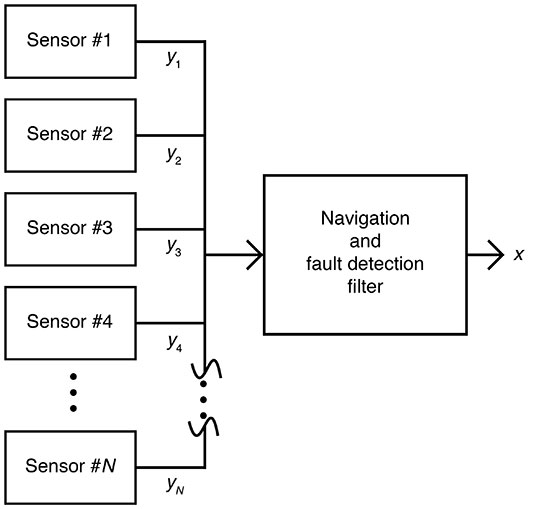
    To understand parallel filtering, consider the schematic in FIGURE 1, which represents the conventional way in which an integrated navigation system fuses the information from N sensors. All the measurements from the N sensors are integrated in a single sensor-fusion algorithm. In the context of what we are describing here, the algorithm consists of a navigation filter and a fault-detection filter. The sensor-fusion algorithm integrates the measurements from all N sensors and generates a single, optimal estimate of the navigation state vector.

    FIGURE 1. Conventional (centralized) sensor fusion architecture.
    FIGURE 1. Conventional (centralized) sensor fusion architecture.

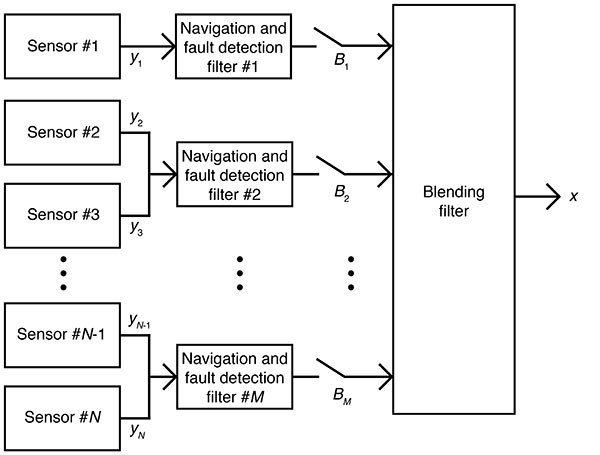
    In contrast to this, the schematic shown in FIGURE 2 is the parallel filtering approach introduced in this article. In this case, the same N sensors are divided up into M separate sensor clusters.

    FIGURE 2. Parallel filtering architecture.
    FIGURE 2. Parallel filtering architecture.

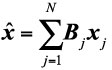
    The measurements from the sensors in the jth cluster is processed in a sensor-fusion algorithm to generate an estimate of the state vector denoted xj and a covariance matrix Pj. Each pair (xj, Pj) is then sent to a blending filter that generates a single optimal estimate Inn-x and P. The estimate  is a weighted sum of the estimates from the M filters:

    Inn-E1  (1)

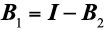
    where Bj are blending weights that function as switches, which can be “opened” (set to zero) to isolate a parallel filter momentarily or permanently when a failed sensor is detected. The analogy with a physical switch should not be taken literally, however, because they are not “hard on-off” switches. Instead, they are matrices, which serve to change the emphasis put on a particular parallel filter. The blending weights are calculated so that the estimate Inn-x is an unbiased minimum-variance estimate. In mathematical terms, this means that they minimize the trace of the final covariance P. We will give more detail on how to calculate the weights shortly, but before we do that, let us describe, at a high level, how all of this works.

    Consider that one of the sensors in the Inn-lth cluster fails. TheInn-lth fault detection filter will identify the fault and try to isolate it. If the fault is non-isolable, the Inn-lth fault detection filter will raise an alarm. This can be done in various ways including inflation of the Inn-lth filter covariance Inn-Pl. An increasing covariance matrix Inn-Pl leads to a decreasing value of the corresponding blending weight Inn-Bl . For a non-isolable fault, Inn-Bl  will eventually approach zero, which effectively isolates the Inn-lth cluster from the navigation solution. If the fault was just a momentary glitch, then Inn-x and Inn-xl  are reset. In the simplest case, Inn-xl  can be reset to a weighted sum of remaining M-1 parallel state estimates. This is then blended with all of the other parallel estimates for generating the new Inn-x. This does not require setting aside buffers to store delayed measurements. Neither does it require rewinding the solution back in time when recovering from a faulted sensor scenario.

    Mathematical Formulation

    Providing a detailed derivation of the parallel filter is beyond the scope of this short article. Instead, we will just summarize the steps in the parallel filtering algorithm with the key formulas that are used in determining the blending weights. For simplicity, we will assume that we are working with a system with two parallel filters (M = 2 in Figure 2). How this extends to systems with more parallel filters or complex interlinking between the filters will become apparent later in the article when we present the results from a case study.

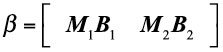
    To start, let us define some notation. We assume that the two parallel filters are extended Kalman filters (EKFs) generating estimates of the state vectors x1 and x2. We will denote these estimates Inn-x1 and Inn-x2. The covariances for these estimates are denoted by P1 and P2, respectively. The output of the blending filter is an estimate of the state vector x, which is a subset of x1 and x2. In mathematical terms, this means that we can define two mapping matrices M1 and M2 whose entries are either “1” or “0” and:

    Inn-E2   (2)

    The output of the blending filter Inn-x is, thus, given by:

    Inn-E3. (3)

    The blending weights are computed from:

    Inn-E4  (4)

    Inn-E5  (5)

    where

    Inn-E6  (6)

    Inn-E7 (7)

    Inn-E8. (8)

    The covariance of Inn-x is given by:

    Inn-E9(9)

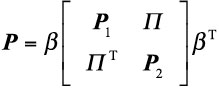
    where Inn-E9b  and Π is given by:

    Inn-E10(10)

    where P12 is the cross-correlation between the states of parallel filter #1 and #2. We will say more about this shortly. In the meantime, note that in Equation (9), P1 and P2 are the covariances computed by the parallel filters after the measurement update. This computation requires knowledge of K1 and K2, which are the EKF gains for parallel filters. The matrices H1 and H2 are the observation matrices for filters #1 and #2. They relate the measurements y1 and y2 of the two parallel filters to their respective state vectors as follows (refer to Figure 2):

    y= H1x1 + v1   (11)

    y= H2x2 + v2  (12)

    where v1 and v2 are the measurement noises. Thus, the blending filter has to have knowledge of the measurement model and the gains of each parallel filter.

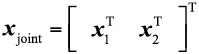
    Finally, note that P12 is zero if the dynamic models (time update equations) for the two parallel filters are completely independent. However, if they share sensors then there will be a correlation and P120. This is the case for the example we present later in this article. In this case, P12 needs to be propagated between measurement updates. This can be done with the covariance time update equation (Lyapunov equation) for the joint state vector

    Inn-joint.

    Note that the architecture depicted in Figure 2 is meant to be a high-level depiction of the idea of parallel filtering. It should not be interpreted as an actual system architecture schematic. This will become apparent in the case study we present later in this article. The system we will consider there consists of three filters of which two are run in series (cascaded so that the output of the first is the input of the second) and each, in turn, is run in parallel with the third filter.

    It is important to note that the proper blending of the various filters’ outputs hinges on an accurate estimate of the individual covariances. This is particularly true when a fault has occurred. An individual filter that has detected a failed sensor must inflate its covariance to reflect its faulted state. How a filter does this is the problem of fault-detection filter design and is beyond the scope of this short article. For the work presented here, we used fault-detection filters, which monitored the EKF measurement residuals to detect sensor faults. When these filters detected a fault, they immediately inflated the faulted sensor’s output noise covariance matrix. We cannot overemphasize, therefore, the importance of having a well-designed fault-detection filter that responds in a timely and accurate manner to sensor faults.

    Case Study: Small UAV Flight Control

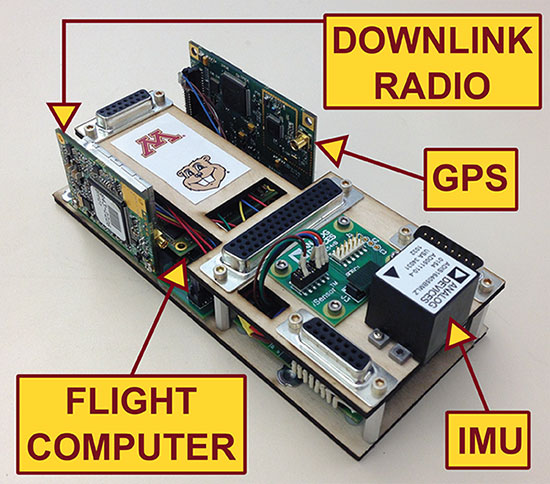
    detection/isolation scheme described above, we discuss the results of a blending filter, which was used on the University of Minnesota UAV Laboratory Goldy flight control system (FCS) shown in FIGURE 3. The Goldy FCS is used for navigation, guidance and control of small UAVs. The results presented below were obtained by post-processing flight test data.

    FIGURE 3. Goldy flight control system.
    FIGURE 3. Goldy flight control system.

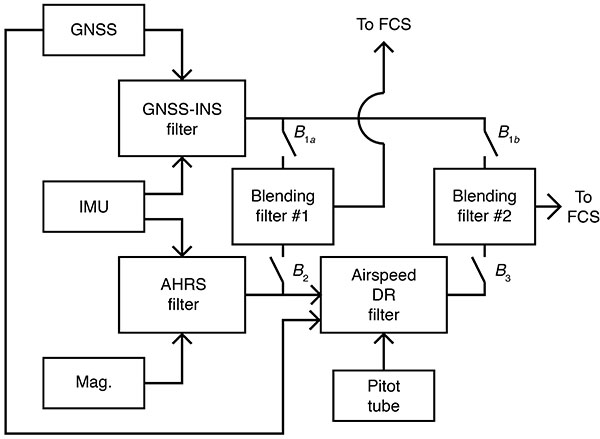
    The architecture of the parallel filtering scheme used is shown in FIGURE 4. There are three separate filters whose outputs are blended: a GNSS-aided inertial navigation system (INS) filter, an attitude heading reference system (AHRS) filter and an airspeed-based dead-reckoning (DR) filter. Two blending filters are used to fuse the outputs from these three filters. The first blending filter fuses the attitude estimates from a GNSS-aided INS and an AHRS. The second blending filter fuses the position solutions from the GNSS-aided INS and the airspeed-based DR system. The AHRS and the airspeed-based DR filters are a pair of filters, which are cascaded to generate an estimate of the UAV navigation state vector. Thus, in the case of GNSS-denied operations, it can provide a position, velocity and attitude estimate to the flight control system. All of the sensors and software required to run these filters are part of the Goldy FCS. Before we present results of the parallel filter’s performance, we will briefly describe these three systems below.

    FIGURE 4. Goldy parallel filtering architecture. The three-axis magnetometer (Mag.) feeding the attitude heading reference system (AHRS) filter is part of the inertial measurement unit (IMU) device. The device’s accelerometer and gyro outputs feed both the GNSS-INS and AHRS filters. A pitot tube device supplies airspeed measurements to the airspeed-based dead-reckoning (DR) filter.
    FIGURE 4. Goldy parallel filtering architecture. The three-axis magnetometer (Mag.) feeding the attitude heading reference system (AHRS) filter is part of the inertial measurement unit (IMU) device. The device’s accelerometer and gyro outputs feed both the GNSS-INS and AHRS filters. A pitot tube device supplies airspeed measurements to the airspeed-based dead-reckoning (DR) filter.

    The GNSS-aided INS uses a consumer/automotive grade inertial measurement unit (IMU) to generate a position, velocity and attitude solution at a rate of 50 Hz. A 1-Hz measurement update from GPS is used to arrest drift errors inherent in inertial navigation systems, especially those mechanized using low cost consumer/automotive grade sensors. The GPS position updates also allow estimation of the inertial sensor biases. The state vector for this GNSS-aided INS is denoted x1 and consists of the following 15 states: latitude (Λ), longitude (λ), altitude (h), north velocity (Vn), east velocity (Ve), down velocity (Vd), roll angle (φ), pitch angle (θ), yaw angle (ψ), three gyro biases (bp, bq and br) and three accelerometer biases (bax, bay and baz).

    The second and third filters are a pair of estimators connected in series. The AHRS filter generates attitude estimates, which are fed to the airspeed-based DR filter. The AHRS uses the same IMU as the GNSS-aided INS to estimate roll (φ), pitch (θ) and yaw (ψ) attitude states of the vehicle as well as the three gyro biases (bp, bq and br). This AHRS filter’s six-dimensional state vector is denoted x2. The attitude is then used to resolve airspeed measurements from the body frame of the UAV to the north-east-down coordinate frame. After adding an estimate of the local winds to this, a single integration yields a position solution. This is done at a rate of 50 Hz. A periodic 1-Hz update from GPS is used to arrest the inherent DR drift. It also allows estimation of the magnitude of the local winds. The state vector of the airspeed-DR is denoted x3 and consists of the following 11 states: latitude (Λ), longitude (λ), altitude (h), local north wind speed (Wn), local east wind speed (We), yaw angle offset (Δψ), pitch angle offset (Δθ), three airspeed-measurement biases (Ub, Vb and Wb), and altitude offset (Δh).

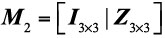
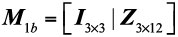
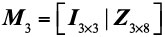
    In the UAV flight control system, the blended states of interest are position (Λ, λ and h) and attitude (φ, θ and ψ). This implies that four mapping matrices are required for the fusion. First, matrices are needed for the attitude blending using the GNSS-aided INS (M1a) and the AHRS (M2). Then, additional matrices are needed for the position blending using the GNSS-aided INS (M1b) and the airspeed-based DR (M3). The shaping matrices are given by:

    Inn-E13   (13)

    Inn-E14   (14)

    Inn-E15   (15)

    Inn-E16   (16)

    where Ij×k is a j × k identity matrix and Zj×k is a j × k matrix of zeros.

    Filter Performance

    Validation of the parallel filtering scheme was accomplished by post-processing data from a series of flight tests where the Goldy FCS was installed on a UAV flying around a box-shaped trajectory.

    The first set of results was from a case where GPS was available from the moment the FCS is turned on until shortly after takeoff. Thus, GPS was available during initialization, take off roll and initial climb of the UAV. Then, GPS services were interrupted for a three-minute period during flight and restored shortly before the UAV landed. The GPS interruption was simulated by cutting out the 1-Hz measurement updates to the GNSS-aided INS and the AHRS/airspeed-DR system. In the background, however, there was another GNSS-aided INS that had an uninterrupted GPS service throughout the entire flight. This additional GNSS-aided INS solution is referred to as the reference solution and is used as ground-truth for assessing the performance of the parallel filtering scheme. For example, error plots shown below were generated by taking the difference between the various filtering schemes under consideration and this reference solution.

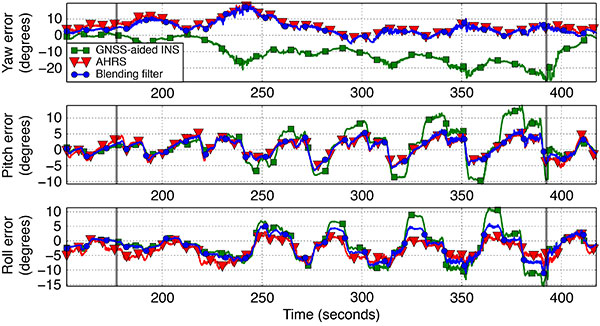
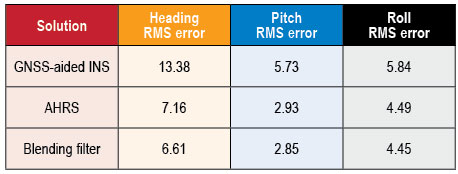
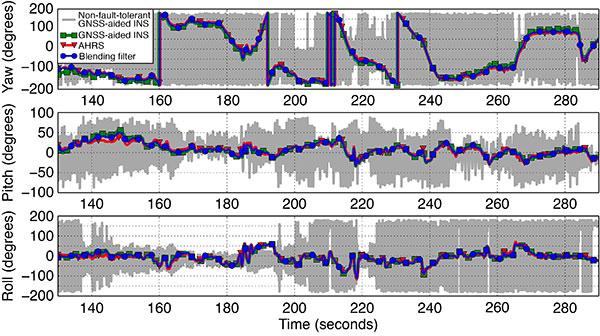
    FIGURE 5 shows the errors in the attitude of all three filters during this flight test. It shows that the blended estimates of heading, pitch and roll tend to oscillate closer to zero error than either of the individual filters themselves. This is reflected in TABLE 1, where it can be noted that the root-mean-square (RMS) error of the blended solution is lower than either the GNSS-aided INS or the AHRS in each of the three attitude solutions.

    FIGURE 5. Attitude errors. The gray vertical lines indicate when GPS availability was interrupted and then restored.
    FIGURE 5. Attitude errors. The gray vertical lines indicate when GPS availability was interrupted and then restored.
    Table 1. RMS orientation errors of different solutions (in degrees).
    Table 1. RMS orientation errors of different solutions (in degrees).

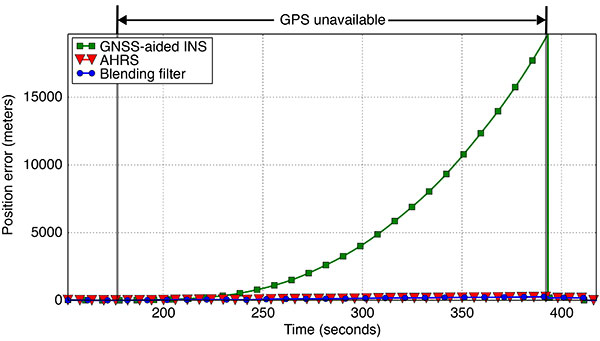
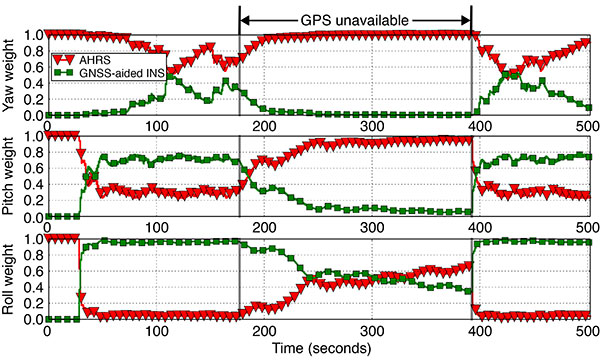
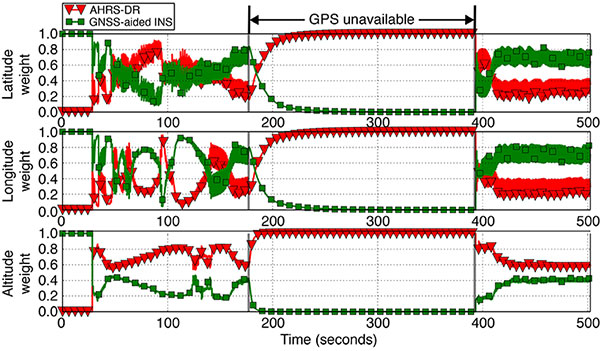
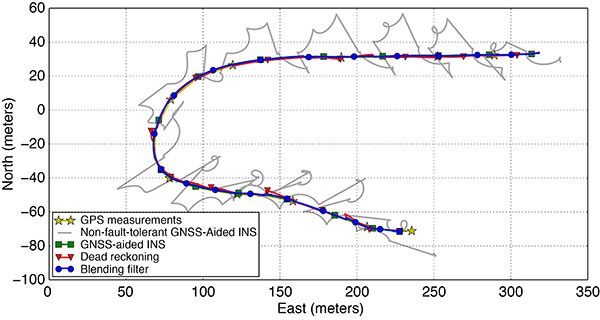
    FIGURE 6 shows the position errors of all three systems and illustrates one of the primary advantages of the proposed architecture. FIGURE 7 and FIGURE 8 show the blending weights matrices B1 and B2 before, during, and after the GPS outage. What is shown in these figures are the diagonal elements of these matrices.

    FIGURE 6. Position errors during a GPS outage.
    FIGURE 6. Position errors during a GPS outage.
    FIGURE 7. Attitude blending weights.
    FIGURE 7. Attitude blending weights.
    FIGURE 8. Position blending weights.
    FIGURE 8. Position blending weights.

    The INS exhibits extreme drift errors after only three minutes of unaided operation. The blending algorithm detects this inaccuracy and places more weight on the slow-drifting AHRS-DR solution, as shown in Figure 8. When GPS services are restored, the GNSS-aided INS error is “reset,” and the position weights are re-established to their pre-outage levels with minimal transient responses.

    We next show data from another flight test where an unplanned but fortuitous fault in the GPS sensor occurred. The cause of this fault has not been definitively determined, but potential reasons for it include loose cabling or outdated firmware. Nevertheless, this fault provided useful flight data for our architecture as no fictitious or simulated data was used. FIGURE 9 shows the GPS altitude measurements during this flight test. At t = 44 seconds a large oscillatory GPS error occurred. Similar errors were present in the GPS measurements of the velocities, latitude and longitude.

    FIGURE 9. GPS sensor errors during a fault.
    FIGURE 9. GPS sensor errors during a fault.

    Thus, all filters were initialized and operated correctly for the first 44 seconds. Between 44 and 132 seconds, the GPS receiver output was in error. This time period corresponds to the taxi, takeoff and initial climb phase of the UAV’s flight. A “reference” GNSS-aided INS, which did not employ the fault detection and isolation scheme that was employed in the parallel filtering system, was running in real time for this flight test. However, the UAV was under manual control (fortunately). As shown by the gray solution in FIGURE 10, the “reference” (non-fault-tolerant) system running in the background diverged and never converged.

    FIGURE 10. Attitude solution during an actual GPS sensor failure.
    FIGURE 10. Attitude solution during an actual GPS sensor failure.

    The dark traces in Figure 10 show the performance of the fault detection and isolation algorithm paired with the parallel filtering scheme described in this article. It is seen to be fault-tolerant and ignores the invalid measurements. Although nearly no aiding was provided until after the GPS sensor converged back to a stable state, the fault tolerant filter provided a much more accurate solution.

    A bird’s eye view of the ground track of the UAV shows a similar trend. This can be seen in the position plot of FIGURE 11, which shows a roughly 60-second segment of the flight.

    FIGURE 11. GPS sensor failure performance: north vs. east.
    FIGURE 11. GPS sensor failure performance: north vs. east.

    This north vs. east plot demonstrates that a non-fault-tolerant GNSS-aided INS provides an unstable position solution similar to the attitude shown in Figure 10. By contrast, the fault-tolerant system described in this article provides a smooth position estimate that ignores the “bad” GPS measurements and tracks the “good” measurements after they convergence back to the truth. Therefore, the safety of the aircraft would not have been in question, and the UAV could have completed multiple segments of fully autonomous waypoint navigation in spite of the faulty sensor measurements provided earlier.

    Summary

    The parallel filtering approach discussed in this article has the potential for providing a systematic way of designing multi-sensor navigation systems, which are robust to sensor faults. Unlike prior approaches, it obviates the need to maintain data buffers to store data, which can be played back in the event of a sensor fault. As noted earlier, like any engineering solution to problems, this one is a comprise between many competing requirements. As such, it has some drawbacks when compared to traditional approaches. We note two of them here as they are the focus of ongoing work. First, the computational overhead associated with this approach can be high especially if a large number of parallel filters are used. Thus, methods for streamlining the computations so that they are not computer-resource intensive will be important.

    The second issue that needs further exploration is the way in which blending weights are computed. A key input to calculating the weights (as well as the “triggers” for the fault detection and isolation algorithm) are the covariances estimated by the various parallel filters. This can be problematic if the covariances used by the parallel filters do not match the true statistics. This can lead to turning off a particular filter when no faults had occurred or, worse, retaining a filter with a failed sensor in the blended solution.

    For more detail about the Goldy FCS, go to www.uav.aem.umn.edu.

    Acknowledgments

    This article is based, in part, on the paper “A Fault-Tolerant, Integrated Navigation System Architecture for UAVs” presented at ION ITM 2015, the 2015 International Technical Meeting of The Institute of Navigation, Dana Point, Calif., January 26–28, 2015. The contents of this article reflect the views of the authors, who are responsible for the facts and the accuracy of the information presented herein. The authors acknowledge the United States Department of Homeland Security for supporting the work reported here through the National Center for Border Security and Immigration under grant number 2008-ST-061-BS0002. However, any opinions, findings, conclusions or recommendations in this article are those of the authors and do not necessarily reflect views of the United States Department of Homeland Security.

    Manufacturers

    The Goldy FCS uses a Hemisphere GNSS Crescent OEM board and an Analog Devices ADIS16405 iSensor MEMS inertial measurement unit.


    Trevor Layh is a M.S. candidate in the Department of Aerospace Engineering and Mechanics at the University of Minnesota in Minneapolis. He obtained his B.S. in mechanical engineering from South Dakota State University, Brookings, S.D., and his research interests include backup navigation systems to GPS-aided inertial navigation systems.

    Demoz Gebre-Egziabher is an associate professor in the Department of Aerospace Engineering and Mechanics at the University of Minnesota. His research focuses on the design of multi-sensor navigation systems. He holds a Ph.D. in aeronautics and astronautics from Stanford University, Stanford, Calif.

    FURTHER READING

    • Authors’ Conference Paper

    “A Fault-Tolerant, Integrated Navigation System Architecture for UAVs” by T. Layh and D. Gebre-Egziabher in Proceedings of ITM 2015, the 2015 International Technical Meeting of The Institute of Navigation, Dana Point, Calif. January 26–28, 2015, pp. 702–712.

    • Attitude Heading Reference System and Airspeed-Based Dead Reckoning Filters

    Correlated-Data Fusion and Cooperative Aiding in GNSS-Stressed or Denied Environments by H. Mokhtarzadeh, Ph.D. dissertation, University of Minnesota UAV Laboratories, 2014.

    “A Recovery System for SUAV Operations in GPS-Denied Environments Using Timing Advance Measurements” by T. Layh, J. Larson, J. Jackson, B. Taylor and D. Gebre-Egziabher in Proceedings of ITM 2015, the 2015 International Technical Meeting of The Institute of Navigation, Dana Point, Calif. January 26–28, 2015, pp. 293–303.

    • UMN UAV Research Lab and Goldy Flight Control System

    Infrastructure” website, University of Minnesota UAV Laboratories, July 2014.

    • Navigation in GPS-Denied Environments

    Impact and Mitigation of GPS-Unavailability on Small UAV Navigation, Guidance and Control by D. Gebre-Egziabher and B. Taylor, Technical Report 2012-2, University of Minnesota, Department of Aerospace Engineering and Mechanics, November 2012. Available through online request.

    • Avionics Reliability

    Introduction to Avionics Systems, 2nd Edition, by R.P.G Collinson. Published by Kluwer Academic Publishers, Boston, Mass., 2003.

    Civil Avionics Systems by I. Moir and A. Seabridge. AIAA Education Series. Published by American Institute of Aeronautics and Astronautics, Reston, Va., 2003.

    • Example of a Fault-Tolerant Avionics System

    “Performance of Honeywell’s Inertial/GPS Hybrid (HIGH) for RNP Operations” by  C. Call, M. Ibis, J. McDonald and K. Vanderwerf in Proceedings of PLANS 2006,  the Institute of Electrical and Electronics Engineers / Institute of Navigation Position, Location and Navigation Symposium, Coronado (San Diego), Calif., April 25–27, 2006, pp. 244–255, doi: 10.1109/PLANS.2006.1650610.

    • GNSS Integrity

    Digging into GPS Integrity: Charting the Evolution of Signal-in-Space Performance by Data Mining 400,000,000 Navigation Messages” by L. Heng, G.X. Gao, T. Walter and P. Enge in GPS World, Vol. 22, No. 11, November 2011, pp. 44–49.

    Integrity for Non-Aviation Users: Moving Away from Specific Risk” by S. Pullen, T. Walter and P. Enge in GPS World, Vol. 22, No. 7, July 2011, pp. 28–36.

    The Integrity of GPS” by R.B. Langley in GPS World, Vol. 10, No. 3, March 1999, pp. 60–63.

    • Multi-Sensor Systems

    Toward a Unified PNT — Part 1: Complexity and Context: Key Challenges of Multisensor Positioning” by P. D. Groves, L. Wang, D. Walter, H. Martin and K. Voutsis in GPS World, Vol. 25, No. 10, October 2014, pp. 18, 27–34, 47–49.

    Toward a Unified PNT — Part 2: Ambiguity and Environmental Data: Two Further Key Challenges of Multisensor Positioning” by P. D. Groves, L. Wang, D. Walter and Z. Jiang in GPS World, Vol. 25, No. 11, November 2014, pp. 18, 27–35.

  • Trimble Introduces New DR+GPS Module for Vehicle and Asset Tracking Applications

    Trimble has introduced the Aardvark DR+GPS module that combines dead reckoning (DR) with GPS technology on a single, compact board. The Trimble Aardvark DR+GPS module provides positioning information when GPS signals are limited or not available, such as in urban canyons and tunnels. The Aardvark DR+GPS module is being marketed as a solution for system integrators or OEMs who are adding dead reckoning capabilities to vehicle navigation, fleet management and asset tracking systems.

    Dead reckoning estimates position based on heading and distance traveled since the last known position. The more accurate the speed, time and heading inputs, the more accurate the dead reckoning. GPS contributes to accuracy by continuously calibrating the gyro and speed sensors to produce optimal dead reckoning.

    The 19 x 19 millimeter surface-mount module has an on-board gyro and collects speed and forward/reverse data from the vehicle’s sensors. Its DR+GPS algorithm automatically calibrates the gyro and external sensors’ inputs and blends this information with GPS measurements to produce accurate position and velocity outputs in hostile GPS environments such as urban canyons.

    The Aardvark DR+GPS module is available in two configurations: model number 88788-30 for flat installations; and model number 88788-50 with a feature supporting variable mounting installations. The 88788-50 self-determines the module’s orientation allowing the ultimate in installation flexibility.