Tag: disaster relief

  • OCG urges participation for new Disaster Pilot

    OCG urges participation for new Disaster Pilot

    (Image: OGC)
    Image: OGC

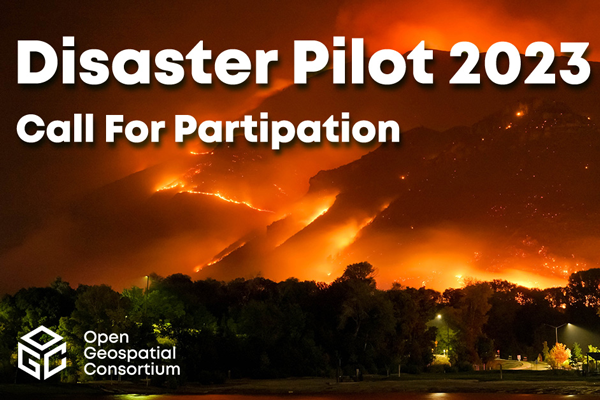
    The Open Geospatial Consortium (OGC) is calling for participants in Disaster Pilot 2023, which aims to reduce disaster preparation time and accelerate transforming data into decisions. All responses are due by Feb. 17.

    Disaster Pilot 2023 aims to enable key decision makers and responders to discover, manage, access, share and exploit location-based information to support disaster preparedness and response. The focus of this year’s pilot is to update the OCG Disaster Readiness Guides on flooding and landslides to include information on wildfires and droughts.

    The pilot provides the opportunity for participants to collaborate with a range of disaster stakeholders, including Earth observation data providers, relief organizations and field responders. The goal of the pilot is to help shape the future of disaster management systems through user-centric interoperability arrangements, identification of critical data sharing challenges, and the delivery of cloud computing scale and agility to field personnel and relief organizations.

    The Disaster Pilot 2023 is being conducted under OGC’s Collaborative Solutions and Innovation Program.

    A Q&A session is available on Feb. 1 for interested participants. For more information, visit the Disaster Pilot 2023 page.

  • NASA program aids with disaster relief efforts

    NASA program aids with disaster relief efforts

    Satellite imagery and mapping have proven to be critical technologies when it comes to disaster relief efforts.

    The NASA Earth Science Disasters Program has harnessed these technologies to help communities and governments recover from natural disasters like earthquakes, hurricanes and more.

    “[The goal of the program is to] try to prevent natural disasters or limit their impact and also help people recover from them more quickly,” Jeremy Kirkendall, senior GIS administrator for the NASA Disasters Program, told GPS World in an exclusive interview at the 2019 Esri User Conference in San Diego. “We provide the products free to anyone to use, and data is only available if there is a good satellite pass.”

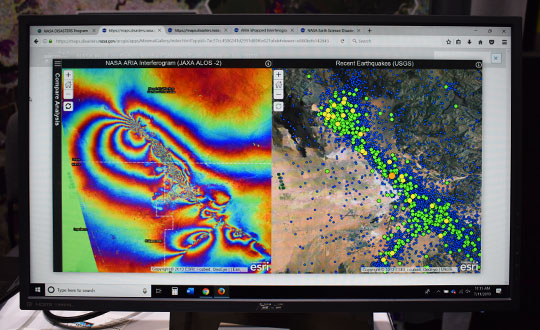
    When a natural disaster strikes, researchers at the NASA Disasters Program will take satellite imagery of the affected location and create a map to show what the area looks like from an aerial perspective. Authorities who request this information can then compare the disaster map with maps of what the area looked like before the disaster took place.

    “We do take requests from agencies or governments for disasters if they need help if data is available,” Kirkendall said. “We’ll create the products that show where the earthquake damage happened, where the fire burned or where the flooding is, and then users take that — combined with their local information — to determine what needs to be checked.”


    For example, the NASA Disasters Program was able to map out the magnitude 6.4 July 4 Southern California earthquake.

    “The earthquake that happened on July 4 caused a lot of deformation to the ground, so we mapped out that surface deformation and shared that information with other emergency managers, the Federal Emergency Management Agency, National Guard and U.S. Navy,” Kirkendall said. “You can look at things like roads, utilities, underground pipes for natural gas or geothermal wells, or fiberoptic cables. Then when you provide the product to these end users, they can overlay it with utility and infrastructure information to identify what’s the most at risk and what needs to be investigated.”

    Sometimes, when a natural disaster occurs over a longer period of time, data is mapped throughout the duration of the occurrence, as well. This can help with search-and-rescue missions, infrastructure repairs and post-disaster analysis.

    “We will create products during responses that can last a long time, like for Hurricane Florence or the flooding that recently happened in the Midwest,” Kirkendall said. “We’ll keep turning out flood products day after day when there’s good satellite passes that show that information.”

    Kirkendall added that the National Guard has used the live data, along with 911 calls, to find individuals trapped in flooded houses. The data also serves as a tool for post-disaster analysis to understand where damage occurred, ways to fix it and how to prevent it from happening again.

    “The program itself is gearing toward a resiliency effort, where we can provide these products when communities says, ‘We get flooded here all the time, over and over,’” Kirkendall said. “That’s where we need to be prepared to fix something. We need to do something to prevent that.”

  • Drones a valuable tool in hurricane recovery efforts

    Hurricane Harvey is the first major catastrophe in which drones have been used on a large scale by both government and commercial operators, said Ken Long, an analyst at the Freedonia Group.

    UAVs are also likely to find widespread use if Hurricane Irma either directly strikes or skirts the east coast of Florida early next week, as current projections show.

    In addition to helping keep emergency workers safe by allowing them to look for people trapped by floodwaters and inspect damage in high-risk areas, drone use can speed up the recovery process. Drones can be flown over structures such as fuel tanks, power lines and railroad tracks before they can be reached by land, enabling government agencies and utilities to identify what is in most urgent need of repair.

    They also allow insurance adjusters to more quickly process claims, enabling rebuilding efforts to get underway faster. Farmers Insurance reports that an insurance inspector using a drone can complete up to eight times the number of home inspections each day than he or she otherwise would be able to do.

    When Hurricane Harvey first made landfall in Texas on Aug. 25, the Federal Aviation Administration (FAA) set up a temporary but extensive no-fly zone over Houston and nearby areas to help protect first responders in helicopters and other manned aircraft. This flight ban included all drone operations except those specifically approved by the FAA.

    https://youtu.be/XRdUV4WqnDE

    In the 10 days that followed Hurricane Harvey, the FAA issued more than 100 separate authorizations for drone use in the Houston area, according to the Wall Street Journal. Some of the applications for drone use were reviewed and approved by the FAA within hours, an unusually fast turnaround time for an agency that typically takes days or weeks to make decisions.

    With the exception of a handful of flights conducted by media firms, all of the approved operations were for drones used in conjunction with, or on behalf of, government agencies. Drones were used to inspect bridges, roadways and power lines; assess the condition of oil refineries and water plants; and survey coastal damage.

    As the flood waters continued to recede and flight restrictions were eased or lifted, insurance companies — including Allstate, Farmers Insurance, Travelers and USAA — began to use drones to assess property damage and speed claims processing.

    However, drone use by insurance companies and other commercial users is limited by FAA rules that do not allow them to be flown above 400 feet, outside the visual line of sight of the operator, or above people not directly involved in their operation, unless a waiver is granted.

    These regulations could change with a 2018 FAA reauthorization bill being considered by Congress.

    “The demonstrated usefulness of drones in Hurricane Harvey response and recovery efforts could well influence the content of that legislation,” Long said.

    Even if the current FAA regulations remain in place, U.S. commercial drone demand will expand rapidly from what is currently an extremely small market base, according to the Freedonia Group’s Drones (UAVs) study. “Non-military government use of drones will also climb at a robust rate through 2020,” Long said.

    Both commercial and non-military government market gains will be fueled by further improvements in drone designs, making them more capable and easier to operate, customized for use in specific applications and cost-saving.
  • L3 system selected by Airbus Helicopters for militaries

    L3 system selected by Airbus Helicopters for militaries

    L3 Technologies’ WESCAM division has received an order from Airbus Helicopters to provide 37 MX-15 electro-optical and infrared (EO/IR) imaging systems for installation on multiple fleets of H225M Caracal helicopters.

    The systems will be installed in France before being delivered to two foreign governments for military deployment.

    “This order expands L3’s international business base while creating a new market opportunity for our leading WESCAM products,” said Michael T. Strianese, L3 chairman and chief executive officer.

    “L3 WESCAM is proud to have been chosen to supply its MX-15 systems, as it highlights our role as a trusted global supplier of advanced imaging technologies to the OEM marketplace,” added Mike Greenley, president of L3 WESCAM. “Additionally, it confirms that the highly specialized optics and leading technologies in L3’s systems continue to meet the needs of emerging mission portfolios, ranging from combative military to time-sensitive response and recovery operations.”

    The first delivery of 19 units will support a variety of missions, including search and rescue, aeromedical evacuation and assistance and disaster relief.

    The second delivery will provide a highly detailed, multispectral view of combat search and rescue, naval operations, medical evacuation and military transportation efforts to mission operators.

    L3’s MX-15 can be configured with up to six imaging and laser payloads, each of which shares the highest level of stabilization. It incorporates a GPS receiver and antenna, with options available for a GPS time sync interface and GPS data interface.

    Sensor options include a high-definition (HD) thermal imager, color low-light continuous zoom, daylight step zoom spotter, day/night spotter, laser rangefinder and a laser illuminator. L3’s MX-15 can be found on additional models of Airbus helicopters, including the H125 and UH-72A.

    L3 WESCAM serves all segments of the airborne, land and maritime markets with advanced EO/IR imaging and targeting systems (MX-Series) and modular system solution kits (MatriX).

    MX-Series turrets are operational across 74 countries and on more than 137 different types of platforms, and are supported by more than 14 globally deployed authorized service centers and a team of field service technicians who are available for dispatch 24/7 to anywhere in the world. L3 WESCAM is a unit of L3’s Sensor Systems business segment.

  • Trimble Launches VRS Now Service in New Mexico

    Trimble has launched its Trimble VRS Now correction service in New Mexico. The commercial subscription service provides surveyors, civil engineers and geospatial professionals in the region with instant access to real-time kinematic (RTK) GNSS corrections without the need for a base station.

    Using both the GPS and GLONASS constellations, the Trimble service delivers centimeter-level RTK corrections customized for each GNSS receiver’s location anywhere in the network via cellular communications. The Trimble VRS Now service supplies accurate, reliable and easy-to-use GNSS positioning for a variety of applications including surveying, urban planning, urban and rural construction, environmental monitoring, resource and territory management, disaster prevention and relief and scientific research, Trimble said.

    “As we continue to expand our VRS Now network infrastructure throughout the U.S., users in New Mexico now have increased reliability from both GPS and GLONASS corrections to enhance their work,” said Lisa Wetherbee, business area director of Trimble’s Positioning Services Division. “Our suite of correction services offers a variety of performance options, designed to meet the different requirements and budgets of our customers. VRS Now in New Mexico delivers centimeter-level accuracy to a wide range of industry professionals.”

    Service in New Mexico is a continuation of Trimble’s focus on providing solutions that enable customers to increase productivity by simplifying access to high-precision positioning around the world. Similar VRS Now services are operating in Illinois, Indiana, Iowa, Nebraska, Colorado, Florida, Alabama, Mississippi, Texas, Oregon and parts of Europe and Australia.