Tag: Esri

  • Esri partners with Waze on open data-sharing for governments

    Esri partners with Waze on open data-sharing for governments

    Global mapping company Esri is partnering with Waze to make it easier for governments to begin building intelligent transportation systems in their communities.

    Waze enables users to share and harness the power of anonymous, aggregated data to promote greater transportation efficiency, deeper insight into travel conditions, and safer roads.

    Governments already using the Esri ArcGIS platform can quickly and easily exchange data through the Waze Connected Citizens Program, a free two-way data share of publicly available traffic information.

    Governments that have not already subscribed to Esri technology or joined the Waze Connected Citizens Program can sign up online to start sharing road closure alerts and other information with their citizens right away.

    Waze Esri Traffic Alerts.
    Waze Esri Traffic Alerts.

    “Municipalities can now leverage real-time reports without having to invest in sensor networks or an Internet of Things infrastructure,” said Andrew Stauffer, manager of civic technology at Esri. “Waze allows local governments to share open data with a purpose — in an application that is already popular with constituents, commuters, and tourists.”

    The data feeds allow local governments to merge information into existing enterprise systems, such as emergency dispatch and street maintenance systems, to make their communities operate smarter and safer.

    The partnership also enables communities to extend the reach of the data they map and manage by sharing it with Waze, which has more than 65 million monthly active users worldwide. The public-private partnership allows greater government transparency and collaboration with citizens to help people better navigate their streets and highways.

    “The Waze Connected Citizens Program empowers municipalities to harness real-time driver insight to improve congestion and make better informed planning decisions,” said Paige Fitzgerald, head of new business development and data acquisition for Waze. “With 100 partners worldwide, Waze provides each partner with the same set of free, data-driven tools and resources to foster collaboration and communication between all partners. Working with Esri allows Waze to further scale the program and creates additional opportunities for our partners to collaborate, helping each other incorporate the power of crowdsourced data into their traffic management strategies.”

    In 2014, Waze pioneered data standards for road closure and incident reporting, which are embedded within customized data feeds provided to each partner. Established as a two-way data share, Waze provides partners with real-time, anonymous, Waze-generated incident and slowdown information directly from the source: drivers themselves. In exchange, partners provide real-time, government-reported construction, crash, and road closure data to Waze to return one of the most thorough records of current road conditions.

    For more information on how to get started, visit go.esri.com/pr-waze.

  • Esri launches Story Map Journal app contest for students

    esri-global-content-challengeEsri launched its new Global Content Challenge, where qualified students use the Esri Story Map Journal app to explore a variety of scientific themes. The contest is open from now until 5:00 p.m. PST on Nov. 11.

    With access to Esri content, students will tell their own compelling scientific stories using the Esri Story Map Journal app. Entrants will use personal geographic analyses, visualizations, predictive models and more, according to Esei.

    “Esri views science as helping us to understand not only how the earth works but also how the earth should look,” says Dawn Wright, Esri chief scientist, in a news release. “Science is the study of how we should look at the earth. GIS places scientific data in a visual context.”

    Esri says judges will select the best map journals to be awarded prizes, and the company will share the winning map journals on its Collaborative Resource portal, as well as feature them at Esri’s Federal GIS and Education GIS Conferences and Esri Young Professionals Network events.

    Esri’s Global Content Challenge is open to undergraduate or graduate students at colleges or universities and to high school students enrolled in an advanced-placement human geography or environmental science course. Esri’s land, ocean and population categories of premium content libraries will be made available to entrants.

    Three winners will be awarded their choice of a cash prize or Esri software in each category. The first-place winner will receive $10,000 or software of equivalent value. Second- and third-place prizes are $5,000 and $2,000, respectively, or software of equal value. The competition is open from Aug. 29 until 5:00 p.m. PST on Nov. 11.

  • Septentrio’s Altus NR2 GNSS receiver is now offered by Esri

    Esri customers in the United States can now purchase Septentrio’s Altus NR2 high-accuracy GNSS receiver, according to an announcement today from the two partner companies.

    Altus_APS-NR2_WThe open-architecture Altus NR2 is fully compatible with Esri’s new version of Collector for ArcGIS, giving Esri users a powerful combination for GIS data gathering in applications requiring centimeter-level positioning, the companies said in a news release.

    The intuitive web interface built into the NR2 allows for easy receiver configuration for Collector for ArcGIS using a standard web browser so that no additional device is needed to configure the receiver.

    “This new reseller agreement builds on our longstanding strategic alliance with Septentrio to develop high-accuracy GNSS/GIS solutions optimized for easy integration with our ArcGIS Online platform,” said Jeff Shaner, product manager. “The Altus NR2 GNSS receiver, coupled with Collector for ArcGIS, provides a seamless solution for high-accuracy, offline field data collection using the ArcGIS platform.”

    “We have worked closely with Esri to ensure our new-generation GNSS receiver technology integrates smoothly with Esri’s new high-accuracy Collector for ArcGIS,” said Neil Vancans, vice president of Septentrio Americas. “Our open architecture enables Esri users to record important parameters like height, horizontal coordinates, error variance and other attributes in the field using their familiar Collector workflows.”

    The Altus NR2 offers advanced features such as dual cellular antennae with automatic switchover, built-in Wi-Fi, hot-swappable batteries and open architecture to Esri ArcGIS Online. It has been thoroughly tested with the new high-accuracy version of Collector for ArcGIS.

    Septentrio’s advanced RTK engine delivers unbeatable accuracy at centimeter-level for GIS professionals in urban and regional planning, transportation, water industry, real estate, forestry, telecommunications and other sectors. The NR2’s integrated communication systems make for fast and easy field work. The Bluetooth module enables rapid data streaming into Collector. The built-in GSM/GPRS modem provides robust access to RTK data corrections, while the Wi-Fi provides access to Septentrio’s intuitive web user interface for easy status monitoring and straightforward configuration.

    The Altus NR2 GNSS Receiver is available now through Esri.

  • Esri’s disaster recovery tools at work in Louisiana, California

    Esri technology has been in full force in Louisiana during both the search-and-rescue phase and cleanup and disaster recovery efforts following massive flooding in Baton Rouge. Esri’s ArcGis Online is providing a way to collect, monitor and report field activities to be sure all departments are on the same page using real time imagery, data and apps.

    In an emergency situation, location is a key component in response efforts — from maps showing affected areas to first responders; to where relief supplies are located; to evacuation routes and impending weather.

    Baton-Rouge-Esri-disaster-O
    The Esri Story Map references the locations of civil air patrol photos.

    Esri’s Disaster Response Program provides software support, data support, and consulting/technical support for active disasters. The program is available to any agency supporting a disaster, regardless of whether they are an Esri customer.

    Currently, the Esri Disaster Response Program is supporting the efforts to respond to the wildfires in California as well as the flooding in Louisiana, but the tools are called into action on countless disaster situations and are available at any time.

    For the flooding, a Public Information Map is updated continuously with multiple data streams such as social media and weather reports. There are also a Flooding Story Map and a Local Impact Map available. Similar resources are available for the wildfire emergency.

  • Esri and Pokévision speed Pokémon Go hunting

    Pokévision, a third-party app for the viral mobile game Pokémon Go, uses Esri’s location-based data and mapping platform ArcGIS to help players of the game find Pokémon around them.

    Pokévision helps Pokémon Go players hunt more strategically by displaying location changes and time spent in each place; the length of time in a given location depends on the rarity of the character.

    A web map powered by ArcGIS services, Pokévision shows all Pokémon near user-requested locations. When visitors type an address or drop a pin on the map, Pokémon are displayed in real time.

    “When we created Pokévision, we chose Esri ArcGIS almost immediately because it was the only option that was able to scale at the rate we were growing,” said the Pokévision founder Y. Liu. “Using Esri alleviated many of the concerns we had with scaling, and helped us to quickly and seamlessly keep pace with our growing user base.”

    Pokévision had 20 million unique users in the first five days and is growing. Its peak usage exceeded 320,000 visitors with map requests reaching into the tens of millions.

    Pokévision developers chose Esri for its open-source, mobile-friendly interactive mapping capabilities. The developers first built the locator for a few friends, but the tool was so popular it quickly went viral. Within hours of creation, Esri experienced double the normal hit rates, and use of interactive maps used to display Pokémon rose by more than 30 percent.

    “The ArcGIS Online platform is designed to scale in high-performance, high-growth environments,” said Paul Ross, product manager for ArcGIS Online at Esri. “Even large data sets at high volume can be handled in real or near real time, as happened with the Pokévision locator.”

    Developers can bring the Pokévision location to their apps using ArcGIS regardless of their experience in creating geospatial applications. Web, mobile, and desktop apps can incorporate the same mapping, visualization, and analysis that hundreds of thousands of organizations around the world rely on every day.

    Learn more at go.esri.com/pr-developersarcgis.

  • GIS fundamental in battle against Zika virus

    Florida is home to more than 3.6 million women aged 15 to 44 years. With more than 400 Zika virus cases reported in Florida to date, the state has become a top focus in the public health battle to curb the spread of Zika infections in the U.S.

    Gathering and mapping such data ­using GIS software from Esri ­is part of the U.S. Department of Health & Human Services (HHS) Office of the Assistant Secretary for Preparedness and Response’s (ASPR) effort to combat this growing health risk domestically and internationally.

    Zika_Virus_Esri-O

    The health impacts of the Zika virus are greatest on developing fetuses. Drawing on U.S. Census data, Esri is showing experts at the ASPR and other agencies within HHS where best to target information and reach women of child-bearing age and their partners.

    To plan for the domestic assistance that states may need, ASPR also is using Esri software to monitor the spread of the Zika virus across the U.S. and in 34 other countries where infections have been found.

    Using Esri software, ASPR created a publicly available interactive map that shows the number of cases in each state. The information is automatically updated each week.

    Zika-mosquito-A.albopictus_TThe Zika virus is spread to people primarily through the bites of infected Aedes aegypti mosquitoes; however, the virus has also been found to be transmitted sexually. The virus can cause Guillain-Barré syndrome in adults and children and can cause a serious birth defect called microcephaly.

    “Prevention is the first course of action in protecting public health, but people need information to make decisions about what preventive actions to take,” said Este Geraghty, chief medical officer and health solutions director, Esri. “Using GIS technology to locate the most vulnerable populations is a first step in educating people on the risks of the Zika virus and about actions that can protect health and curb the spread of disease.”

    For more information on Esri and using GIS for vector-borne disease surveillance and control, visit go.esri.com/pr-zika.

  • U.S. Navy awards defense contract to Esri for support services

    SeapPort-e, the U.S. Navy’s electronic platform for acquiring support services, has awarded Esri a defense contract for its geographic information system (GIS) technology services. SeaPort-e provides a standardized, efficient means of soliciting services and support from businesses small and large.

    This indefinite delivery/indefinite quantity (IDIQ) contract simplifies the acquisition process for the federal government by facilitating multiple task orders for customers without forcing companies to recompete. The SeaPort-e platform acquires support services in 22 functional areas and conducts rolling admissions to encourage small business participation. Nearly 85 percent of SeaPort-e’s contract holders include small businesses.

    Esri collaborated with nine small business team members — Aerial Information Systems; APEX Expert Solutions LLC; Geographic Information Services, Inc.; Lynker Technologies, LLC; Metron Incorporated; Orca Maritime, Inc.; Punctuate Systems, Inc.; T3W Business Solutions; and VSolvit LLC — to participate in the contract. Each team member offers expertise that is complementary to Esri’s support program.

    Esri is committed to supporting small businesses in their objectives to grow their federal footprint and, earlier this year, launched Federal Small Business Specialty, a partner program to enable that mission.

    Partnering with Esri offers many opportunities for small businesses to provide consulting, implementation, and solutions to meet geospatial requirements and provide ArcGIS software related services, Esri said. SeaPort-e will allow Esri to leverage small business partners’ capabilities and also support their growth.

    “Our business model is to team up with Esri partners to serve U.S. Navy customers,” said Curt Hammill, Esri navy account executive. “Our goal is to make them both successful. SeaPort-e gives us a new vehicle to do that.”

    Esri joins other awardees in providing support to the U.S. Navy across areas such as research and development, systems engineering, modeling and simulation, software engineering, and quality assurance.

  • Esri and Leica partner to offer GIS/GPS grants to governments

    Geographic information system (GIS) provider Esri has partnered with Swiss-based spatial measurement instrument manufacturer Leica Geosystems to encourage innovation of mobile field data collection in government by offering grants totaling $143,250 in goods and services.

    Projects should combine GIS and GPS.

    esri-logo

    Known as the Smart Communities Innovation Challenge, 10 governments that submit detailed project proposals demonstrating increased efficiencies in collecting data for decision support or improved productivity in delivering governmental services will be selected to receive a grant.

    Project proposals will be accepted from Aug. 15, 2016, until the official submission deadline at 5 p.m. (Pacific daylight time) on Oct. 14, 2016. Grant recipients will be announced on Oct. 31.

    leica_logoTo be entered for consideration, proposal submissions must be uploaded in conjunction with the organization’s identifying information through a form on the Smart Communities Innovation Challenge landing page.

    So long as operations are based in the United States, any government or department, whether municipal, regional, special districts, state, city, county, or otherwise, is qualified to receive a grant.

    To be selected, it is necessary that a project confirm the value of combining GIS and Global Positioning System (GPS) technologies for data collection, optimizing workloads, and providing real-time information that supports field mobility. Proposal reviewers will look for ideas that support complete workflows extended to back-office processes such as operational dashboards.

    Priority will be given to projects that tie GIS and GPS to daily workloads, influence sharing of geographically enabled data across multiple jurisdictions or interdepartmental ventures, and clearly convey a perceived benefit or return on investment.

    The intent of the joint program is to supply governments with the tools to succeed as they implement progressive methods to streamline workflows. By providing technology, training, and technical support grants, Esri and Leica aim to inspire legislative bodies to devise transformational approaches to improving the efficiency of mobile fieldworkers.

    As innovative ideas from the government community are brought forward for solving real-world problems, the best applications will be those of universal appeal and the ability to be shared between governments through an open exchange hub.

    The challenge’s grant winners will be thought-leading governments that have plans in place to jump-start projects such as facility inspections, emergency reporting, asset inventory, environmental management and monitoring, efficient employee routing, code enforcement, population and housing enumeration, mosquito abatement and/or sign inventory.

    To learn more about the Smart Communities Innovation Challenge and other grants sponsored by Esri, visit go.esri.com/pr-mobilegrant.

  • Esri and Leica partner to offer grants to governments

    Geographic information system (GIS) provider Esri has partnered with Swiss-based spatial measurement instrument manufacturer Leica Geosystems to encourage innovation of mobile field data collection in government by offering grants totaling $143,250 in goods and services.

    esri-logo

    Known as the Smart Communities Innovation Challenge, 10 governments that submit detailed project proposals demonstrating increased efficiencies in collecting data for decision support or improved productivity in delivering governmental services will be selected to receive a grant.

    Project proposals will be accepted from Aug. 15, 2016, until the official submission deadline at 5 p.m. (Pacific daylight time) on Oct. 14, 2016. Grant recipients will be announced on Oct. 31.

    leica_logoTo be entered for consideration, proposal submissions must be uploaded in conjunction with the organization’s identifying information through a form on the Smart Communities Innovation Challenge landing page.

    So long as operations are based in the United States, any government or department, whether municipal, regional, special districts, state, city, county, or otherwise, is qualified to receive a grant.

    To be selected, it is necessary that a project confirm the value of combining GIS and Global Positioning System (GPS) technologies for data collection, optimizing workloads, and providing real-time information that supports field mobility. Proposal reviewers will look for ideas that support complete workflows extended to back-office processes such as operational dashboards.

    Priority will be given to projects that tie GIS and GPS to daily workloads, influence sharing of geographically enabled data across multiple jurisdictions or interdepartmental ventures, and clearly convey a perceived benefit or return on investment.

    The intent of the joint program is to supply governments with the tools to succeed as they implement progressive methods to streamline workflows. By providing technology, training, and technical support grants, Esri and Leica aim to inspire legislative bodies to devise transformational approaches to improving the efficiency of mobile fieldworkers.

    As innovative ideas from the government community are brought forward for solving real-world problems, the best applications will be those of universal appeal and the ability to be shared between governments through an open exchange hub.

    The challenge’s grant winners will be thought-leading governments that have plans in place to jump-start projects such as facility inspections, emergency reporting, asset inventory, environmental management and monitoring, efficient employee routing, code enforcement, population and housing enumeration, mosquito abatement and/or sign inventory.

    To learn more about the Smart Communities Innovation Challenge and other grants sponsored by Esri, visit go.esri.com/pr-mobilegrant.

  • Eos offers sub-meter and RTK for Esri’s Collector 10.4 for iOS

    Eos offers sub-meter and RTK for Esri’s Collector 10.4 for iOS

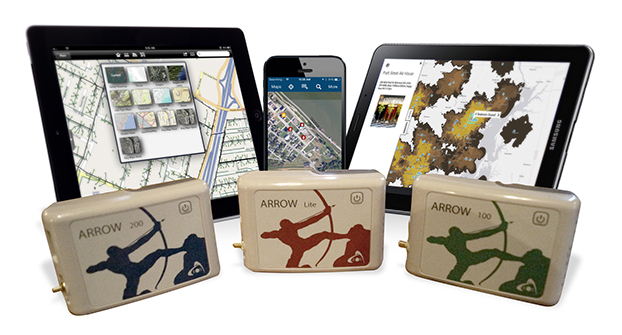
    Eos Positioning Systems has announced that its Arrow series of GNSS receivers is compatible with Esri’s Collector for ArcGIS running on iPads and iPhones. The Arrow receivers have been tested and certified as high-accuracy GNSS receivers compatible with Collector 10.4.0 for iOS.

    ipad-iphone-samsung-arrow-O

    The full range of Arrow GNSS receivers from sub-meter to decimeter to centimeter RTK accuracy all work flawlessly with Collector for ArcGIS running on all iPhones and iPads running iOS 8.x or later, according to the company. GNSS metadata — including estimated accuracy, correction status, correction age and number of satellites used — is displayed in real-time in Collector, so the user can monitor data quality in the field.

    “We worked closely with Esri during their development of Collector to ensure the best high-accuracy GNSS user experience with the Arrow GNSS series receivers, and I think we’ve achieved that,” said Eos CTO Jean-Yves Lauture. “Whether it’s our Arrow Lite, Arrow 100 or Arrow 200 receiver, they all work smoothly with Collector for iOS for sub-meter, sub-foot, decimeter and centimeter accuracy.”

    Eos Tools Pro.
    Eos Tools Pro.

    As a companion software to Collector, Eos offers a free iOS app called Eos Tools Pro that allows the user to connect to an RTK network and to set alarms for estimated accuracy, HDOP, correction age and others. If a threshold is exceeded (such as estimated accuracy greater than 10 centimeters), an alarm sounds on the iPhone or iPad to alert the user.

    “We have tested Arrow receivers and confirmed that Collector for ArcGIS (iOS) is completely compatible with the Arrow GNSS series receivers,” said Esri Product Manager Jeff Shaner. “The tight integration between Collector and Arrow GNSS receivers really enhances the high-accuracy user experience, and during our recent beta program, customers like Le-Ax Water District have shared their success using Collector and the Arrow receivers.”

    Collector for ArcGIS (iOS) is a geographic information systems (GIS) data collection program that runs on iPhone and iPads. It records data directly, in real time to ArcGIS Online, Portal for ArcGIS and ArcGIS Server at sub-meter, decimeter and centimeter accuracies when using the Arrow GNSS receivers. No post-processing or other specialty software is required.

    Collector 10.4.0 can be configured to automatically transform between horizontal datums on-the-fly, so no matter which datum the user’s GNSS data is referenced to, it can be configured to be compatible with the user’s geodatabase, and Esri provides scripts for transforming between vertical datums when back in the office.

    Eos GNSS Tools and Arrow receivers are targeted at high-accuracy applications such as GIS; environmental monitoring; agriculture; electric, gas, water utilities; surveying; machine control; and federal, state and local government.

  • SAP debuts Geographical Enablement Framework

    SAP debuts Geographical Enablement Framework

    SAP-geo-framework-W
    Insurance company Munich Re uses spatial data-processing capabilities in SAP HANA with predictive analytics to assess risk and identify natural hazard profiles for millions of locations around the globe, so that it can efficiently coordinate loss adjustors after a major catastrophe or calculate hospitals, schools and roads impacted by an impending hurricane or flood. (Image: SAP)

    SAP SE unveiled its SAP Geographical Enablement Framework, powered by SAP HANA, at the 2016 Esri User Conference, held June 27 to July 1 in San Diego, California.

    SAP Geographical Enablement Framework helps organizations enrich business applications with geographic data from geographic information systems (GIS), such as Esri ArcGIS.

    “In many asset-intensive industries such as energy, transportation and public sector, the ability to visualize business objects on maps is critical to improving efficiency and decision making,” says Irfan Khan, GM and global head, database and data management, SAP. “SAP Geographical Enablement Framework, powered by SAP HANA, can help organizations streamline the processing of both enterprise and spatial data for greater location awareness across business processes.”

    To develop spatially enabled business applications, organizations can use the framework to:

    • Enable smooth integration and bidirectional navigation between SAP applications and Esri ArcGIS. Developers can use application programming interfaces published by GIS to fetch geospatial data. Also, business data augmented with geometric attributes can be published as a service, so that GIS users can access SAP business data from within their GIS tools.
    • Embed a responsive map user interface in a business application to display both business and spatial data simultaneously to provide greater insight.
    • Store the geometry of any SAP business object in the SAP HANA platform and accelerate spatial data processing in memory to deliver real-time insights, enriched with spatial context, to improve decision making.
    • Visualize, filter and search for business objects — such as functional location, equipment, linear assets, notifications or work orders — on a map from within a spatially enabled application. From a desktop or a tablet, users can also drill down through multiple map layers to gain better insight.

    With continued collaboration between SAP and Esri, organizations can gain contextual insight from business and spatial data, enabling business and GIS users to work within the same multiuser access and editing environment, the company says.

    “At EDF Renewable Energy, we have built a truly innovative enterprise business intelligence and data warehouse platform that combines Esri geospatial data along with asset sensor data and ERP transactional data in SAP HANA,” says Devang Shah, manager of database and business intelligence, EDF Renewable Energy. “This provides us with near real-time insights to help us operate more efficiently.”

    As an open platform, SAP HANA is certified with the Open Geospatial Consortium, enabling organizations to easily consume spatial data from third-party spatial solutions that also adhere to the standard. SAP HANA also supports synchronous and asynchronous imports of data from any spatial reference system or coordinate reference system to ease access to local, regional or global geographic entities.

    Native geocoding delivered by SAP HANA smart data quality helps rapidly convert addresses to latitude and longitude within SAP HANA, the company says.

    “Munich Re is one of the leading reinsurance companies in the world,” says Andreas Siebert, head of geospatial solutions at Munich Re. “We use spatial data processing capabilities in SAP HANA, in conjunction with predictive analytics, to assess risk — such as to identify natural hazard profiles for millions of locations around the globe, to efficiently coordinate loss adjustors after a major catastrophe or to calculate how many hospitals, schools and roads may be impacted by an impending hurricane or flood.”

  • 3DR to integrate Site Scan with Esri Drone2Map

    Drone-maker 3DR is teaming up with Esri to integrate 3DR’s Site Scan software with Esri Drone2Map.

    3DR made the announcement at the Esri User Conference, held last week in San Diego.

    Designed for the field professional, Site Scan is an intuitive, powerful and open aerial data capture and analytics platform that delivers an end-to-end solution ready-made for existing mapping and survey workflows, 3DR said in a news release. With Site Scan and Drone2Map, Esri customers can safely, quickly and easily conduct surveys with the Solo smart drone and effortlessly deliver that data to ArcGIS and ArcGIS Online.

    “Aerial data capture technology is bringing about a revolution in surveying and mapping,” said Lawrie Jordan, Director of Imaging and Remote Sensing at Esri. “We are thrilled to partner with 3DR to streamline the creation of professional imagery products with Site Scan and Drone2Map for ArcGIS. Together we will accelerate the development and use of remote sensing across all industries.”

    Site Scan automatically calculates a flight plan and Solo autonomously executes both flight and image capture. Images are processed and integrated with Esri Drone2Map to create high-resolution georeferenced maps and digital elevation models to share as tile or feature services in ArcGIS and ArcGIS Online.

    “Capturing site data today is costly, time consuming and often dangerous. Drones can easily go where it’s inefficient or unsafe for field personnel, making it easier to accurately measure our world so we can better analyze and manage it,” said Chris Anderson, CEO of 3DR. “We’re delighted to partner with such a great industry leader and integrate Site Scan with Esri Drone2Map. Together, we offer a complete solution for site capture that will help our customers create maps that tell stories, record change over time and perform analysis all while saving time, saving money and keeping humans out of harm’s way.”

    Site Scan makes it safer and easier than ever for people in land management, GIS, mapping, energy, infrastructure and related fields to aggregate and process multiple forms of aerial imagery and data and easily incorporate them into the Esri tools they use every day, 3DR said.

    Engineering and survey firm McKim & Creed, based in Fort Worth, Texas, is one customer. “Utilizing the 3DR Solo and SiteScan allowed McKim & Creed to confidently collect accurate spatial information in dangerous and demanding environments where it would have been difficult to use traditional survey methods,” said Christian Stallings, R&D Manager at McKim & Creed.

    “Using Esri’s Drone2Map software, surveyed ground control and 3DR’s Solo, we were able to collect detailed elevation information and high-resolution orthophotography over a dredging containment pond operated by the United States Army Corps of Engineers (USACE). This approach proved to be accurate and kept people out of harm’s way — which would only be achievable using this approach,” Stallings said.

    3DR designed Site Scan as an open and extensible platform. On the hardware side, the Solo smart drone has open gimbal and accessory bays, which give both 3DR and their global technology partners the ability to integrate additional cameras and sensors.

    Additionally, Solo firmware updates optimize the drone’s flight profile and performance. On the software side, 3DR continually updates the Site Scan application so that customers can take advantage of the most recent and advanced analytics technologies.

    With Site Scan, even users new to drone technology will fly with confidence from day one. The Site Scan app includes 3DR’s airspace safety information software, which alerts users if they’re about to fly in restricted airspace. They can then pull up a map of the area with all restrictions around them clearly marked.

    To support enterprise customers further, 3DR offers Success Services, including the Premier Success Plan. Included with their purchase of Success Services, all Site Scan users will have access to experts on Site Scan and Solo. They will also have a Solo overnight replacement guarantee should anything go wrong with one of their drones.

    Site Scan with Solo Enterprise is available immediately for order on store.3dr.com, priced at $3249 with a monthly service fee of $499 paid annually with a 12-month commitment.