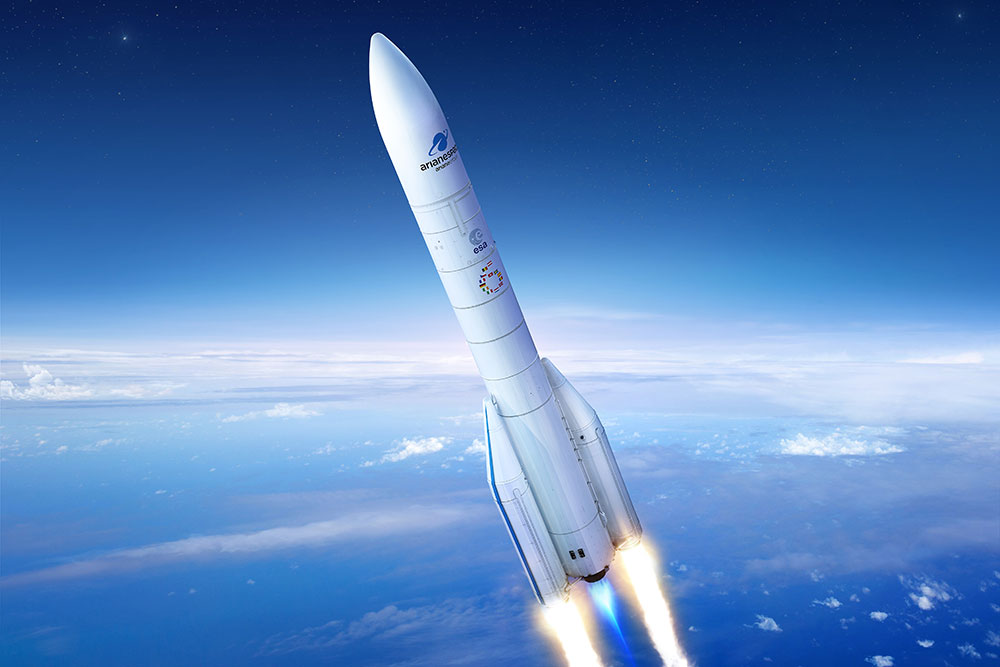
Arianespace will launch eight additional Galileo satellites, confirmed the European Union Agency for the Space Programme (EUSPA).
Arianespace will launch the first two satellites in 2022, leading to the Full Operational Capability of Galileo open service. Then, three successive launches on Ariane 62 in 2023, 2024 and 2025 will finalize the launch of the first generation of Galileo satellites and will increase the constellation resilience.
These will be the 13th to 16th Galileo missions by Arianespace, which has orbited all satellites in the constellation.
With this order, EUSPA takes over the role of placing launch services contracts for Galileo from the European Space Agency (ESA), which has acted so far in the name and on behalf of the European Commission and will continue to be the technical authority for these launches.
The order follows ESA’s order for the launch of four satellites in October 2021, and will complete the deployment of first-generation Galileo satellites.
The launches will take place from the Guiana Space Center, Europe’s Spaceport in Kourou, French Guiana. After a Galileo launch in the first half of this year, carrying satellites from a previous order, a second Soyuz launch this year will orbit the first two satellites from this latest order. The next three missions will orbit two satellites each on Ariane 62.
“I would like to thank ESA and EUSPA, along with the European Commission, for continuing to entrust us with their satellites,” said Stéphane Israël, CEO of Arianespace. “We’re very proud to once again be helping the EU deploy its own global navigation satellite system. This additional order to the service of Galileo once again confirms Arianespace’s assigned mission of ensuring reliable access to space for Europe.”
Each of the eight satellites under this order, built by OHB System AG in Bremen, Germany, will weigh less than 730 kg. They will join the 28 Galileo satellites already deployed to date, as well as the two to be orbited in early 2022 from the Guiana Space Center by Arianespace.
The Galileo Open Service Definition Document (OS SDD) was updated to reflect upgrades in the Galileo system since the publication of the previous version in May 2019. The latest version, 1.2, can be found on the GSC web portal.
This is the last update foreseen before Galileo Open Service reaches Full Operational Capability (FOC).
The SDD has been updated to include improvements of the Open Service, accounting for the current constellation and updates in the ground infrastructure that increase its robustness.
The updated SDD provides better minimum performance levels (MPLs) for signal and position availability and updated definitions of some timing MPLs. It also establishes a more stringent commitment on the time to publish Notice Advisories to Galileo Users (NAGUs). In addition, the concept of auxiliary satellites has been added, while some sections have been reworded to improve clarity.
An Info Note has been published with analytical information on the Galileo Open Service – Navigation Message Authentication (OSNMA). The note is available on the European Union Agency for the Space Programme (EUSPA) website or through the European GNSS Service Centre. To contribute to the detection of GNSS jamming and spoofing attacks, EUSPA together with the European Commission is testing OSNMA.
This forthcoming service is an authentication mechanism that allows Open Service users to verify the authenticity of GNSS information, making sure that the data they receive is indeed from Galileo and has not been modified in any way.
OSNMA is authenticating data for geolocation information from the Open Service through the Navigation Message (I/NAV) broadcast on the E1-B signal component. This is realized by transmitting authentication-specific data in previously reserved fields of the E1 I/NAV message. By using these previously reserved fields, OSNMA does not introduce any overlay to the system, thus the OS navigation performance remains untouched.
Authentication is set to further strengthen service robustness by increasing the capability of detecting spoofing events. However, it should be kept in mind that authentication does not prevent the occurrence of such an event, and does not protect against jamming. Nonetheless, this added layer of protection proposes to be one step ahead of evolving technological trends by amplifying the service’s overall robustness and resilience.
The Launch Readiness Review on Nov. 26 confirmed that the satellites, the supporting ground installations, and the early operations facilities and teams are ready for lift-off on the early hours of Thursday morning, central European time.
UPDATE: Arianespace has postponed today’s launch and is now targeting launch on Friday (Dec. 3). Liftoff is set for Dec. 3 at 7:23 p.m. EST (0023 GMT).
Galileo satellites 27 and 28 are scheduled to be launched by a Soyuz launcher from Europe’s Spaceport in French Guiana on Dec. 2 at 01:31 CET (Dec. 1 at 21:31:27 local Kourou time).
These satellites are the first of Batch 3, comprising 12 additional first-generation Galileo satellites commissioned in 2017 to bring the constellation to full operational capability. They will be used to further expand the constellation up to 38 satellites and act as backups and spares for satellites that reach their end-of-life.
Follow the launch live on ESA Web TV Two starting at 0104 CET.
“Friday’s Launch Readiness Review confirmed that the first two satellites in this final batch of 12 Galileo first-generation satellites, are good to go, provided no external circumstances come up between now and the night of 1-2 December,” said Bastiaan Willemse, ESA’s Galileo Satellite manager, from Europe’s Spaceport in Kourou, French Guiana. “Meanwhile the preparation for the launch campaign of the next two satellites has already started.”
The Launch Readiness Review is an ESA-led review with participation of the satellite manufacturer OHB, the launch service provider Arianespace, the Galileo operator SpaceOpal, the EU Space Programme Agency (EUSPA) and the European Commission, as well as the programme’s Security Accreditation Board.
Friday’s review was the last before the Arianespace-led RAL (Revue d’Aptitude de Lancement) takes place next week when the latest status of the launcher, the launch facilities and site, the global launch tracking facilities, the satellites and supporting ground infrastructure will be reviewed, most likely resulting in approval for launch countdown.
The satellites arrived in French Guiana in early October, kicking off a busy launch campaign, including initial dispenser fit checks and the filling with the hydrazine fuel that will be used to maneuver them during their 12 years of working life.
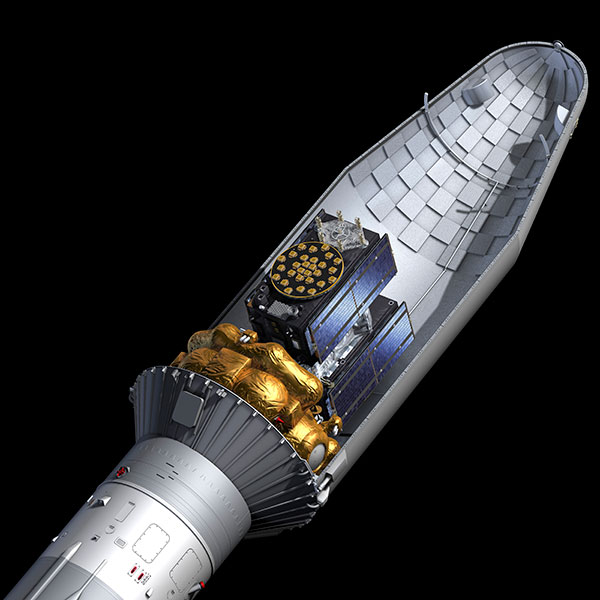
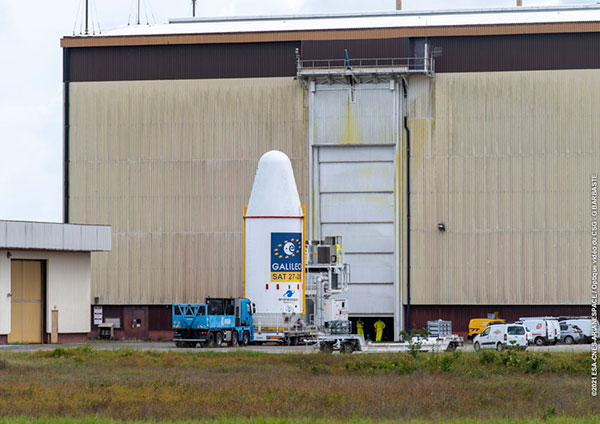
Galileos 27-28 seen atop their gold-wrapped Fregat upper stage within their Soyuz launcher fairing. (Photo: ESA)
The two satellites will add to the 26 satellites of the Galileo constellation already in orbit and delivering Initial Services around the globe.
This week’s lift-off will be the 11th Galileo launch in 10 years. Two further launches are planned for next year, to allow Galileo to reach Full Operational Capability in its delivery of services, to be followed by the launches of the rest of the Batch 3 satellites — all undergoing final integration at OHB facilities in Bremen and on-ground verification testing at ESA’s ESTEC Test Centre in the Netherlands.
In parallel to Batch 3’s completion of Galileo First Generation deployment, the new Galileo Second Generation satellites, featuring enhanced navigation signals and capabilities, are already in development with their deployment expected to begin by 2024.
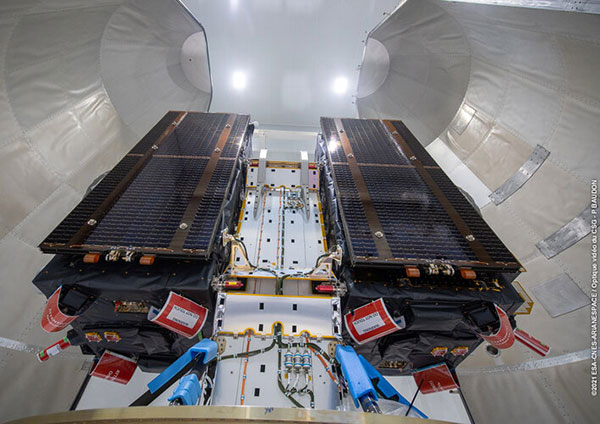
The combined upper composite for the Galileo launch being transported to the other three stages of the Soyuz at the launch site. (Photo: ESA)Galileos 27 and 28 are secured to the dispenser that holds them in place during launch. (Photo: ESA)The two Galileo satellites attached to the dispenser on which they will ride to orbit. (Photo: ESA)
On Nov. 15, the European Union Agency for the Space Programme (EUSPA) opened the Galileo Open Service Navigation Message Authentication (OSNMA) Public Observation test phase for the secured signal.
The OSNMA is a freely accessible data-authentication function for the Galileo Open Service worldwide. OSNMA provides receivers a first-level of protection against spoofing the Galileo Open Service, assuming that the receiver meets requirements. This is realized by transmitting authentication-specific data in previously reserved fields of the E1 I/NAV message.
Galileo OSNMA improves confidence on the user side by enabling the user to verify the authenticity of the Galileo navigation parameters required for positioning, navigation and timing. In particular, it will allow the user to authenticate geolocation information of the Open Service:
the ephemerides and clock corrections
the ionospheric corrections
the status flags
the Broadcast Group Delay
the GST to UTC parameters
TeleOrbit quickly authenticates with Goose
In late 2020 and the first half of 2021, TeleOrbit GmbH and Fraunhofer IIS worked on a project to implement the Galileo OSNMA capabilities onto its powerful and compact GNSS receiver lab “Goose”. This project, completed in May, successfully authenticated simulated OSNMA signals.
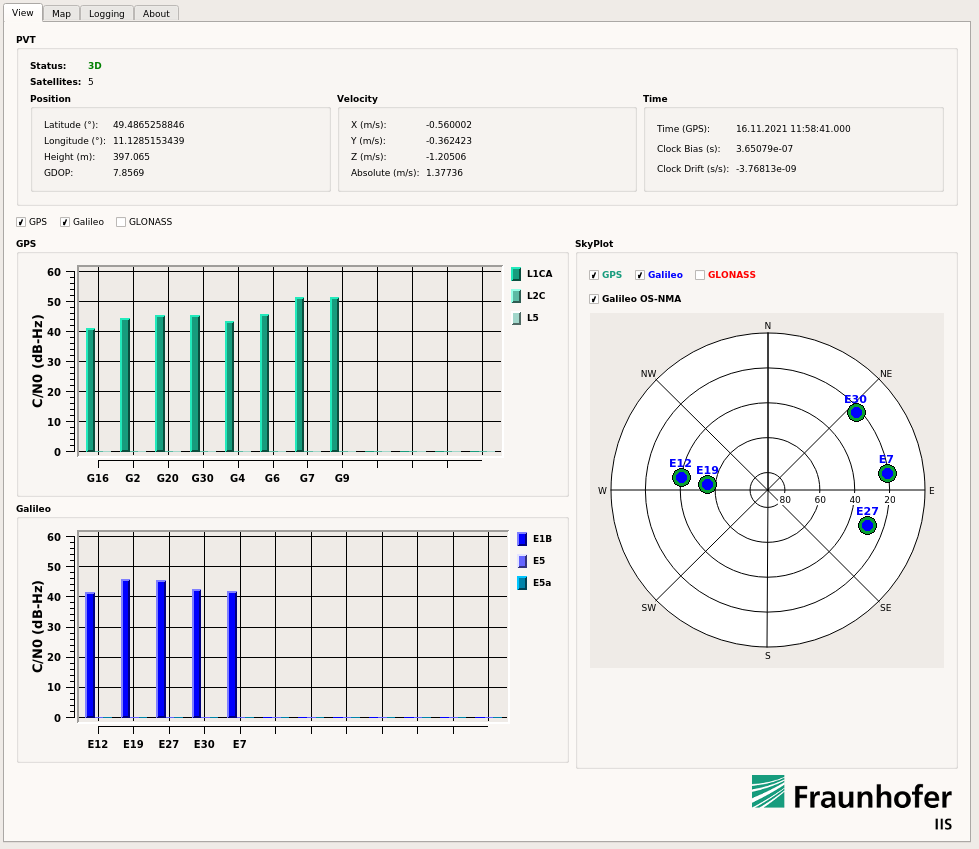
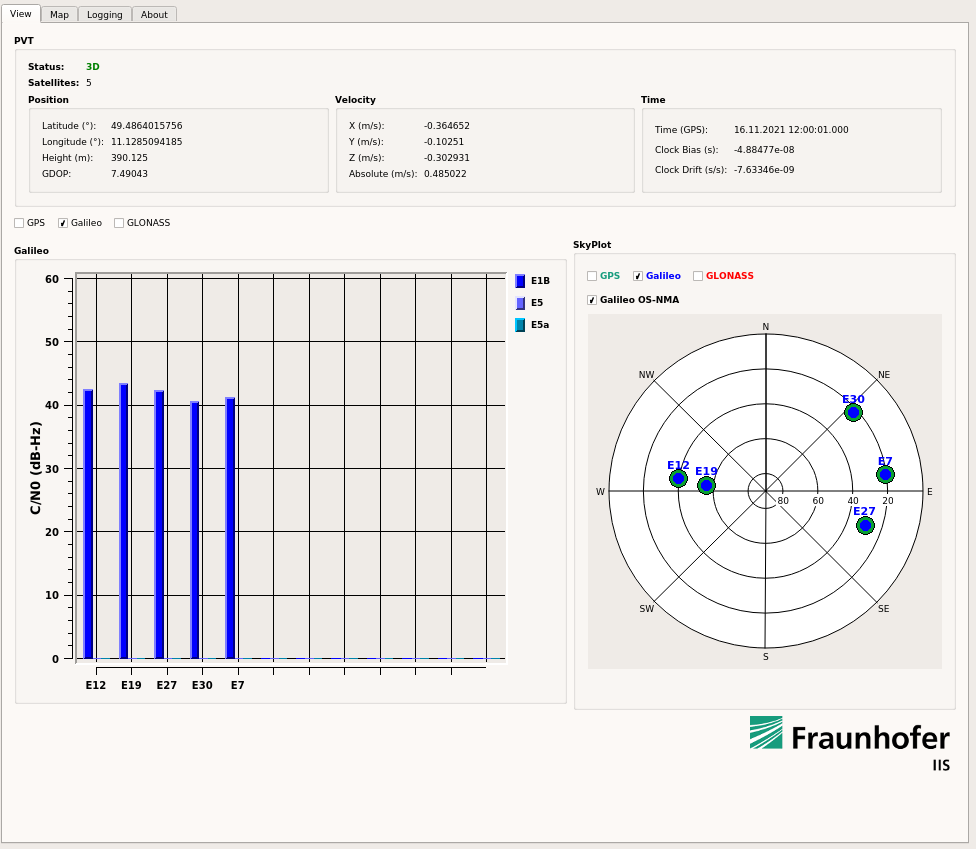
For the new phase, the team at Fraunhofer IIS adapted the setup to the newly published Interface Control Documents (ICDs) and receiver guidelines, and was able to authenticate the live signal on Nov. 16.
The screenshots below show snapshots of the Goose user interface with enabled OSNMA and successfully authenticated satellites, indicated by the green circle surrounding the blue Galileo satellites in the skyplot.
Interested users can sign up for this OSNMA test phase on GSC website. The site provides access to all corresponding documents and information, including the current ICD, receiver guidelines, OSNMA public key and Merkle Tree Root — both needed for the authentication process.
To learn about using GOOSE for your own tests and projects, contact [email protected].
Galileo Control Centre in Oberpfaffenhofen, Germany. (Photo: ESA)
Spirent Communications plc has launched a commercially available simulation test solution for the Galileo High Accuracy Service (HAS), via a beta interface implementation based on HAS ICD version 1.2. During the development of the solution, Spirent collaborated with GMV, a leader in cutting-edge GNSS high-accuracy technologies.
Galileo HAS will provide free-of-charge high-accuracy Precise Point Positioning corrections through the Galileo E6-B signal, with accuracy under two decimeters, offering real-time improved user positioning performance. Developers need to be able to test their devices against this new service to ensure they can optimally capture the emerging capability when it becomes available. By integrating HAS simulation and capabilities, Spirent’s latest simulation solution enables customers to utilize and incorporate Galileo HAS as early as possible.
In February 2021, the European Union Agency for the Space Programme (EUSPA) awarded GMV with the contract for the implementation of the Galileo High Accuracy Data Generator (HADG), which will be the facility in charge of generating the high-accuracy corrections data to enable the provision of HAS. Spirent’s collaboration with GMV will prove a key element in the early adoption of the service.
“The high accuracy, feature richness and flexibility of Spirent’s simulator platforms provides an ideal foundation for the testing of innovative new Galileo services such as our recent Galileo HAS capability,” said David Calle, section head of advanced GNSS services at GMV’s aerospace sector.
“The high level of expertise and in-depth understanding of Galileo HAS within GMV provided important guidance as we implemented HAS on our simulation platform,” said Jan Ackermann, Spirent’s director of product line management. “This enabled us to again be the first in the industry to offer a commercial solution to simulate and test these important new capabilities.”
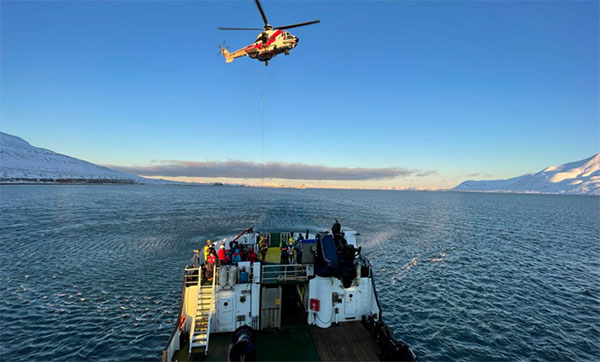
The AMRO 2021 exercise tested the rescue of 200 cruise-ship passengers using Galileo SAR. (Photo: EUSPA)
News from the European Union Agency for the Space Programme (EUSPA)
In freezing arctic waters 60 nautical miles off of Svalbard, a search-and-rescue enactment proved the capabilities of Galileo as a life-saving system.
The Arctic Mass Rescue Operation (AMRO 2021) took place on Oct. 8, organized by the Norwegian authorities. The scenario surrounded a cruise ship that caught on fire with around 200 passengers onboard, located northwest of Spitsbergen far from roads, cabins, rescue crews and other infrastructure.
The vessel’s crew activated a Galileo-enabled EPIRB compatible with Galileo’s Return Link Service. Once activated, it took only 2:20 minutes for the Galileo System to track down the ship with an accuracy below one kilometer and deliver an SOS acknowledgement to the active EPIRB.
Once the Mission Control Centers received the distress signal and established the location, two Super Puma helicopters from the Governor of Svalbard, a Sea King from the 330 squadron of the Royal Norwegian Air Force, and a Norwegian coast guard support vessel were scrambled to support the massive evacuation of the passengers.
‘’The AMRO 2021 exercise was an excellent opportunity for the European Union Agency for the Space Programme to showcase the power of Galileo SAR and the robust performance of Galileo at high latitudes in comparison to other GNSS constellations,’’ said Guerric Pont, Head of Galileo Department at EUSPA.
The Galileo RLS allows people in distress to receive an automatic acknowledgment that their signal has been picked up by the first responders. Galileo’s contribution to the Medium Earth Orbit Satellites Search and Rescue System (MEOSAR) — managed by the international COSPAS-SARSAT program — translates into 2,000 lives saved per year.
In support of Galileo’s SAR operations, the Copernicus Marine Service provides authorities and rescue centers input such as wave height, sea current direction as well as and water temperature among others.
A new video celebrates the first decade of Europe’s satellite navigation system Galileo, which celebrates its 10-year anniversary on Oct. 21.
Galileo delivers meter-level accuracy anywhere on Earth. It is also saving lives, by relaying distress calls for search and rescue. Today, 26 Galileo satellites orbit 23,222 km above the Earth. The first was launched on Oct. 21, 2011; nine more launches followed to create the constellation.
The satellites in space are supported by a globe-spanning ground segment. The system as a whole is set to grow, with the first dozen Batch 3 about to join the current satellites in orbit and Galileo Second Generation satellites in development.
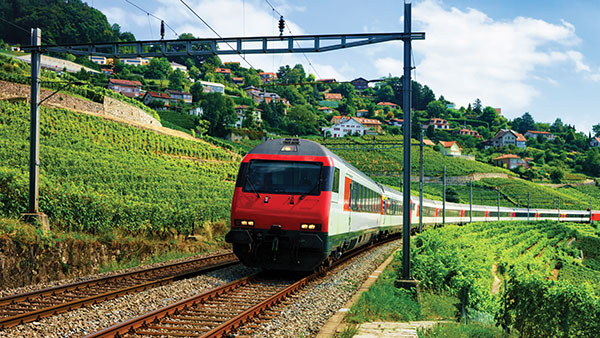
Three test trains, one per rail operator (SNCF, DBN Netz and SBB/Siemens), are used to collect real data. Above is an SBB train in the Lavaux-Oron district, Switzerland. (Photo: RomanBabakin/iStock/Getty Images Plus/Getty Images)
The European Railway Traffic Management System (ERTMS) could start using Europe’s space solutions to manage rail traffic.
A project funded by the European Union Space Program Agency (EUSPA) is taking steps toward providing a cost-efficient train-tracking solution based on satellite technology, together with other sensors and data.
Knowing the exact position of each train is at the heart of rail operations across the European Union (EU). ERTMS is a major industrial EU project to create a more efficient and safer interoperable railway system. It currently relies on a series of costly ground instruments. In the coming years, ERTMS could switch to EU space solutions.
In a project dubbed CLUG — short for Certifiable Localization Unit with GNSS — experienced rail operators and infrastructure managers came together to define a set of specifications and operational scenarios that meet the most stringent safety needs of the rail sector. The specifications are used by the architects of the CLUG consortium, who are in the process of rolling out the system.
The project’s goal is to assess the creation of a failsafe train localization onboard unit (TLOBU) interoperable across the entire European railway network. The TLOBU will provide trains and railway operators with critical information such as positioning and velocity, complemented by acceleration, heading and attitude for applications.
A new European project is researching automated collection of geodata and production of high-definition maps.
The GAMMS project is funded by the European Union Agency for the Space Programme (EUSPA), and will take place until the end of 2023. Galileo will be the main enabler of GAMMS, given its precise, multipath-resistant measurements and its upcoming high-accuracy service (HAS).
A European consortium, led by the French map service provider GEOSAT, will investigate how the combination of self-driving mapping cars (autonomous mobile-mapping systems) and artificial intelligence-based mapping software can automate the production of high-definition maps.
These maps are used by driverless vehicles and need to be provably accurate, complete and up to date. Fast, sustainable production of trustworthy maps is the goal.
Consortium members include:
GEOSAT — map-making and machine learning
GeoNumerics — multi-sensor fusion and accurate navigation
“It is as challenging as interesting to bring together the geodetic estimation methods with the navigation ones in multi-sensor systems powered by EGNSS and its differentiators, VDMs (vehicle data management systems) and visual features,” said Marta Blázquez, responsible for GAMMS at GeoNumerics. “GAMMS will boost the development of NEXA, our trajectory determination platform, and GENA, our adjustment platform for dynamic networks, in the direction of trustworthy navigation.”
GeoNumerics is responsible for computing the mapping vehicle trajectory (a time series of position, velocity and attitude coordinates) by integrating the manifold of sensors available in a mapping vehicle.
Measurements of inertial units and atomic clocks will be fused with measurements of all available navigation satellites (GPS, GLONASS, Galileo and BeiDou), odometers, cameras and laser scanners. For this purpose, GeoNumerics’ GENA and NEXA systems will be further developed to include new sensor mathematical models and to improve its robust estimation methods.
A new space agency launched in Europe today, taking the place of the European GNSS Agency (GSA) and adding responsibilities to encourage Europe’s space enterprises.
The European Union Agency for the Space Program (EUSPA) marks the start of a new era for European Union space, according to an agency statement. EUSPA will build on the legacy of the GSA, which was established to promote use of Galileo and EGNOS, with additional responsibilities to create even more opportunities from space for European Union citizens and its economy.
An April 27 space regulation established EUSPA. Under the new space regulation, EUSPA’s mandate includes promoting Galileo and EGNOS, but with increased responsibilities, including their service provision and operational security. The agency also will coordinate the user-related aspects of government satellite communication in close collaboration with Member States and other entities.
Including Copernicus
Rodrigo da Costa, executive director, EUSPA (Photo: EUSPA)
EUSPA is also responsible for the development of downstream markets and fostering of innovation based on Galileo, EGNOS, and now also commercial uses of Copernicus (Europe’s Earth observation satellite program), leveraging funding mechanisms such as Fundamental Elements and Horizon Europe.
EUSPA is also responsible for security accreditation of all the components of the EU Space Program. The European Commission may also decide to entrust the agency with other tasks.
“More and more, our economies, our society and our safety depend on space,” said EUSPA Executive Director Rodrigo da Costa, former director of GSA. “Europe has incredible opportunities ahead that cannot be missed. By creating EUSPA, the European Union will further increase the return on investment made by EU citizens in the EU Space Program by strengthening its contribution to the priorities of the union. We will achieve this primarily by leveraging synergies between the various program components — particularly navigation, Earth observation and secure communications — to drive innovation across a broad range of sectors.”
In particular, bringing management of downstream and combined applications based on Galileo, EGNOS and Copernicus under the umbrella of one agency will make it possible to leverage synergies, according to the agency statement. “On their own, these technologies can play a key role supporting a digital and green transformation, but leveraging their synergetic and combined use will facilitate the generation of innovative solutions that bring a higher societal impact,” the statement read.
Focus on security
“The teams of committed professionals we have in place at our sites in Europe — from the EGNOS center in Toulouse to the European GNSS Service Centre in Spain and the Galileo Reference Centre in the Netherlands — will continue to ensure the high quality, robustness and reliability of EUSPA’s service provision,” reads the statement. “This will be backed up Galileo security monitoring centers in France and in Spain, and the industrial teams managed by EUSPA in the Galileo control centers in Germany and Italy, along with facilities around the world.”
In addition, the Security Accreditation Board will continue to initiate and monitor implementation of security requirements to ensure a robust and uniform level of security for the entire EU Space Program.
“The new agency has a core role in the security accreditation of all the components of the EU Space Program,” said Bruno Vermeire, chair of EUSPA’s Security Accreditation Board.
Looking to the future
While EUSPA’s mission has expanded, its core aim remains the same – to link EU investment in space to the needs of users in the European Union and around the world.
“The agency remains committed to its traditional users and will continue to deliver the high level of GNSS services that users have come to rely on,” the agency stated. Copernicus and satellite communications will also benefit from the former GSA’s user-oriented focus and “the experience it has gained in developing markets for Galileo and EGNOS.”
Fucino, Italy, hosts a Galileo Control Centre. (Image: Telespazio/ESA)
Spaceopal and the European GNSS Agency (GSA, the future EUSPA, the European Union Agency for the Space Programme) have signed a contract for the development of an innovative reference algorithm and user terminal for the Galileo High-Accuracy Service (HAS).
Spaceopal is the prime contractor for Galileo’s operational services.
Spaceopal is an equal-share joint venture between Telespazio, a Leonardo (67%) and Thales (33%) company, and DLR Gesellschaft für Raumfahrtanwendungen (GFR) mbH. Spaceopal will develop the solution with the support of its shareholders DLR-GfR and Telespazio, and partners such as ANavS GmbH, the DLR IKN, IABG mbH and Iguassu Software Systems.
The project, awarded within the “Galileo Reference High Accuracy Service User Algorithm and User Terminal” Call, will develop the reference algorithm for HAS, which will be made publicly available and will be used for its validation. The user terminals at a high technology readiness level provided to GSA will serve as a blueprint and further facilitate the adoption of the European GNSS.
Spaceopal will develop the solution in the next 12 months, followed by a 6-month period of providing engineering support to the GSA for testing activities, training and demonstrating the performance of Galileo HAS.
Leveraging on the experience of the NAVCAST precise positioning services, on the commitment of Spaceopal’s shareholders and on the skills of its industrial partners, Spaceopal will build a close-to-market solution for the validation of the Galileo HAS service.
“This contract is a substantial milestone in Spaceopal’s path to innovation excellence and confirms our commitment to support the GNSS services of the future. We are delighted to be trusted by the European GNSS Agency to develop this service further facilitating the adoption of the European GNSS, that will provide an unmatched accuracy for the HAS users,” said Sebastian Fedeli, Spaceopal’s sales and procurement director.