
Tag: Exelis

  • The System: Ground Control Readied for GPS III

    The System: Ground Control Readied for GPS III

    rtn_iis_gps-ocx_banner4.jpg

    Raytheon Company reached several milestones recently in its development of the GPS Next -Generation Operational Control System (GPS OCX). Lockheed Martin’s GPS III Non-flight Satellite Testbed (GNST) — a full-sized, functional satellite prototype currently residing at Cape Canaveral Air Force Station — successfully established remote connectivity and communicated with OCX during pre-flight tests.

    GNST proved that it could connect with and receive commands from Raytheon’s Launch and Check Out System (LCS), a part of OCX that supports the satellite and mitigates risks prior to launch. The GNST received commands from Lockheed Martin’s Launch and Checkout Capability (LCC) node in Newtown, Pennsylvania via the OCX servers at Raytheon’s facility in Aurora, Colorado; the system then returned satellite telemetry to the control station. The tests mirror launch and early orbit testing planned for all flight vehicles.

    “While we have connected OCX with ground-based simulators before, these tests were the first time that OCX and a GPS III satellite have actually communicated,” said Keoki Jackson, vice president for Lockheed Martin’s Navigation Systems mission area.

    Ahead of Schedule. Raytheon received Interim Authorization to Test (IATT) security certification from the U.S. Air Force for OCX LCS four months ahead of schedule. The company received a one-year certification with no liens, meaning the government does not require any changes.

    “Typically, IATT certification is given for six-month increments,” said Matthew Gilligan, Raytheon’s GPS OCX program manager and a vice president in Raytheon’s Intelligence, Information, and Services business. “The LCS one-year accreditation speaks to the quality of the information assurance design and threat protection.” The IATT not only includes the LCS, but also Lockheed Martin’s GPS III satellite support systems, Exercise and Rehearsal Training Tool, and Upload Generation Tool.

    OCX is being developed in two blocks. There are seven iterations in Block 1 and one in Block 2. LCS is the fifth Iteration of Block 1; it successfully completed Critical Design Review in June 2013.

    Early Orbit Exercises. Lockheed Martin and Raytheon also completed the third of five planned launch and early orbit exercises to demonstrate launch readiness of GPS III and OCX.

    Exercise 3 demonstrated space-ground communications; first acquisition and transfer orbit sequences; orbit-raising maneuver planning and execution; and basic anomaly detection and resolution capabilities. In addition, the industry and Air Force GPS Directorate teams jointly executed mission planning activities, such as orbit determination and the generation of upload command files.

    Two additional readiness exercises and six 24/7 launch rehearsals are planned before launch of the first GPS III satellite. The first flight GPS III space vehicle (SV-01) is expected to be available for launch in 2014, and launched by the U.S. Air Force in 2015.

    Exelis Encryptors. Exelis delivered the first three of a planned 14 ground-based encryptors to Raytheon Company for OCX. Designed to automatically code and decode GPS signals, encryptors facilitate the exchange of user information by securely transmitting navigation payload data between the OCX ground station and the orbiting constellation of satellites.

    Delivery followed successful thermal, electromagnetic interference and security verification testing. Exelis provides critical elements of software in the navigation processing subsystem that will enable controllers to better understand the exact position of GPS satellites. This helps ensure accurate navigation information is securely broadcast to users. In addition to encryptors, Exelis is building high-precision receivers for use in GPS ground monitoring stations and satellite signal simulators for testing purposes.

    Exelis is also on contract with Lockheed Martin to provide the payloads for the GPS III satellites.


    Fire_engine_galileoEurope Tests Galileo Public Regulated Service

    European Union member states began their independent testing of the Public Regulated Service (PRS) broadcast by the four Galileo navigation satellites in orbit. Transmitted on two frequency bands with enhanced protection, PRS offers a highly accurate positioning and timing service, with access strictly restricted to authorized users, such as government defense, security, and emergency services.

    PRS access was initially considered for Galileo’s Full Operational Capability phase, but it has been enabled in 2013 in response to the strong interest of member states in this service. To allow early access to PRS during the current phase, the European Commission and ESA began the joint project PRS Participants To IOV (PPTI) in July 2012.

    ESA ensured the availability of several tools developed under ESA contracts, including test receivers and other qualification equipment. ESA’s PRS Laboratory, based at the Agency’s ESTEC technical centre in Noordwijk, the Netherlands, provided training, demonstrations and sample data.

    “Belgium, France, Italy, and the UK have now performed independent PRS acquisition and positioning tests. In parallel, ESA, through collaboration with Dutch and Italian authorities, is conducting PRS fixed and mobile validation in several locations in the Netherlands and Italy,” said Miguel Manteiga Bautista, head of ESA’s Galileo Security Office.

    The PRS tests have demonstrated a current autonomous positioning accuracy of less than 10 meters when in the correct geometrical configuration. This is an impressive result considering the small number of Galileo satellites in orbit and the limited ground infrastructure so far deployed.

    Italy has developed its own PRS receiver, and tests have confirmed the feasibility of independent PRS receiver development and verification based on specifications provided by ESA.

    “The PPTI project is still ongoing to test more advanced functionalities this coming autumn and to run the first aeronautical PRS tests in collaboration with the Dutch authorities. Other member states have also expressed their willingness to join the IOV PRS experimentation campaigns soon,“ concluded Miguel Manteiga.

    The project is a first step to ensure use of the PRS as soon as it becomes operational. It will be complemented by PRS pilot projects, focused on PRS applications, which are currently under definition in a common effort between European agencies.

    The United States has submitted a request to be able to use Galileo’s PRS. Other non-EU countries have also expressed a desire to be associated with the program.


    System Briefs

    Way to Go GAO, Part II. The Air Force should come up with better cost estimates and options for new GPS satellites, according to a September 9 report from the U.S. Government Accountability Office (GAO). The GAO was responding to an Air Force study on lower-cost space solutions for GPS.

    “More information on key cost drivers and cost estimates, and broader input from stakeholders would help guide future investment decisions,” the GAO concluded. Specifically, the key cost drivers include dual-launch capability, navigation satellites (smaller GPS-type satellites yet to be developed), and a nuclear detection capability.”

    New Birds by Fall. Galileo satellite-builder OHB AG said it should know by late September whether tests of the first Full Operational Capability (FOC) Galileo satellites are proceeding well enough to permit their delivery later this year. The first FOC satellite began testing at ESA’s European Space Research and Technology Centre in May, and the second arrived August 9.

    The OHB satellites either “bear a strong resemblance” or “are identical” to the four in-orbit validation spacecraft now in medium-Earth orbit, depending on the source. However, the on-board power of the OHB spacecraft exceeds that of the validation satellites built by a different manufacturer. According to one source, Galileo managers made the modification in part to enable Galileo’s encrypted Public Regulated Service signal to overcome a signal frequency overlap issue with China’s BeiDou constellation.
  • Exelis Signal Sentry Test Locates GPS Jamming Threats

    The Signal Sentry 1000.
    The Signal Sentry 1000.

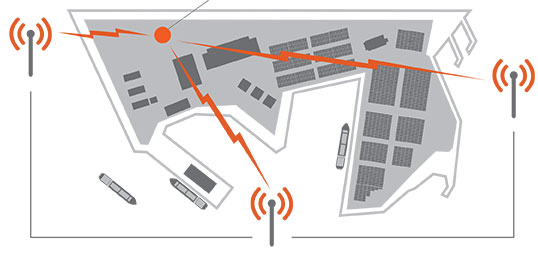
    Signal Sentry 1000, an Exelis product that detects and locates GPS interference sources in 3-D by using longitude, latitude and altitude has demonstrated successful results during a planned field testing event held last week at the Vidsel Test Range in Sweden.

    Taking advantage of the range’s remote location, Exelis was able to conduct tests of its Signal Sentry 1000 product using controlled jamming. The test was conducted without disrupting the GPS signal relied upon by civilian and military operations outside of the test range location. The test employed eight sensors positioned in an array pattern and showed that Signal Sentry was able to successfully detect and locate the jamming source. Having demonstrating interference detection and location capability, Signal Sentry 1000 can be deployed to collect actionable intelligence for law enforcement and protect GPS signal-dependent critical infrastructures.

    Signal Sentry 1000 technology is a network of threat-detection sensors, which is part of a centralized server executing Exelis-developed proprietary location algorithms. These sensors can be strategically located around different types of critical infrastructure, such as shipping ports, utilities and government facilities to automatically sense and locate any intentional or unintentional GPS jamming source. Should a threat be detected, users would receive location information and actionable intelligence in order to determine an interference-mitigation plan.

    “Exelis developed Signal Sentry 1000 to help protect critical infrastructure and to deliver intelligence to law enforcement operations that depend upon GPS availability,” said Mark Pisani, vice president and general manager of precision instruments and positioning, navigation and timing for Exelis Geospatial Systems. “Achieving this field test milestone proves that our detection technology works. The next step is to evolve this technology for our military customers.”

    Signal Sentry 1000 builds upon Exelis expertise in the field of GPS and positioning, navigation and timing. Exelis payloads and payload components have been on board every GPS satellite for nearly 40 years. Today, Exelis is involved in GPS modernization initiatives, building tomorrow’s GPS III satellite constellation by developing and integrating the navigation payloads. Exelis is also providing navigation processing components, precision monitor station receivers, and key components of the system security design for the GPS Operational Control System, known as OCX.

  • Exelis Completes Critical Data Security Work on GPS OCX System

    Exelis Completes Critical Data Security Work on GPS OCX System

    GPS OCX Logo Final_02-25-2010_large_jpgExelis has delivered three ground-based encryptors to Raytheon Company for the U.S. Air Force’s next-generation Global Positioning System Operational Control System, or GPS OCX.

    Designed to automatically code and decode GPS signals, encryptors facilitate the exchange of user information by securely transmitting navigation payload data between the OCX ground station and the orbiting constellation of satellites.

    “Following successful thermal, electromagnetic interference and security verification testing, Exelis delivered the first three of 14 encryptors,” said Kevin Farrell, positioning, navigation and timing general manager for Exelis Geospatial Systems. “Once integrated into the OCX system, the encryptors will help ensure that the next generation of GPS satellites will be ready for launch and provide advanced capabilities and security to both military and civilian users of the signal and the overall GPS modernization effort.”

    Exelis provides critical elements of software in the navigation processing subsystem that will enable controllers to better understand the exact position of GPS satellites. This helps ensure accurate navigation information is securely broadcast to users. In addition to encryptors, Exelis is building high-precision receivers for use in GPS ground monitoring stations and satellite signal simulators for testing purposes.

    As part of the overall GPS modernization effort, Exelis is also on contract with Lockheed Martin to provide payloads for GPS III satellites. Exelis is a major space technology provider, supporting both the satellite and ground portions of the GPS III modernization program.

    For nearly 40 years, Exelis payloads and payload components have been on board every GPS satellite and have accumulated more than 500 years of on-orbit life without a single mission-related failure due to Exelis equipment.

  • ITT Exelis Completes Signal Sentry 1000 Product Integration

    An ITT Exelis product that detects and locates GPS interference sources in 3-D by using longitude, latitude and altitude has successfully completed a significant integration milestone.

    Signal Sentry 1000, formerly known as GPS Interference, Detection and Geolocation, may now be deployed to collect actionable intelligence for law enforcement, such as tracking high-value targets and protecting critical infrastructure.

    Signal Sentry 1000 is a proprietary product that leverages GNSS signal domain knowledge; it is based upon patented technology developed by Exelis through many years of designing and fielding electronic intelligence systems, ITT Exelis said.

    “Exelis developed Signal Sentry 1000 to help protect critical infrastructure and to deliver intelligence to law enforcement operations that depend upon GPS availability,” said Kevin Farrell, positioning, navigation and timing general manager for Exelis Geospatial Systems. “Jamming devices can transmit signals capable of disrupting the synchronization of critical infrastructure, such as utility power grids, and timing information of financial transactions. This is why we are continually making improvements in our technology, and the latest milestone achievement is a testament to our goal to deliver actionable interference intelligence to agencies that rely upon GPS operational availability.”

    Signal Sentry 1000 technology is a network of threat-detection sensors, which are part of a centralized server executing Exelis‐developed proprietary location algorithms. These sensors can be strategically located around areas of critical infrastructure, such as shipping ports, utilities and government facilities to automatically sense and locate any intentional or unintentional GPS jamming source. Should a threat be detected, users would receive accurate location information and actionable intelligence in order to determine an interference-mitigation plan.

    “Signal Sentry 1000 builds upon Exelis expertise in the field of GPS and positioning, navigation and timing. Exelis payloads and payload components have been on board every GPS satellite for nearly 40 years,” said Farrell.  “Today, Exelis is involved in GPS modernization initiatives, building tomorrow’s GPS III satellite constellation by developing and integrating the navigation payloads. Exelis is also providing navigation processing components, precision monitor station receivers, and key components of the system security design for the GPS Operational Control System, also known as OCX.”

  • ITT Exelis Offers Signal Sentry to Detect Jamming Sources

    ITT Exelis Offers Signal Sentry to Detect Jamming Sources

    ITT Exelis is offering the Signal Sentry 1000, a proprietary product  that detects, geolocates, and characterizes sources of intentional and unintentional interference to the U.S. GPS signals, and provides actionable intelligence to the user.

    The system leverages GNSS signal domain knowledge, and is based upon patented technology developed through the company’s history of designing and fielding electronic intelligence systems, ITT Exelis said.

    Leveraging Exelis GNSS signal domain knowledge, the system is implemented using commercially available GPS receiver and computer server/data technology. Actionable intelligence is available in the form of pin mapping of interference sources in addition to longitude/latitude/altitude data, all available through a web-enabled graphical user interface.

    Signal Sentry 1000 can assist efforts to ensure GPS spectrum integrity and aid in law enforcement operations that require GPS availability. Benefits for users include:

    • Instantaneous identification and geolocation of jamming sources, improving situational awareness.
    • Detect multiple jamming occurrences, geolocate multiple jammers simultaneously in harsh electromagnetic environments.
    • Defend against disruption of GPS guidance, traffic and asset control systems.
    • Protect against interference of GPS tracking of high-value assets.
    • Quickly identify jamming sources in open forums and emergencies, detecting disruption of critical  communications.
  • Exelis Wins Air Force Contract to Research Low-Cost GPS Alternatives

    ITT Exelis has been awarded a $2.15 million contract by the Air Force Research Laboratory (AFRL) to research the development of a small satellite navigation payload to augment the current GPS program. The GPS NAVSAT (Navigation Satellite) program seeks to provide affordable capabilities to aid end-users located in tough-to-reach environments.

    “The development of smaller satellites — in terms of size, weight, power and cost — will yield greater affordability for our customers,” said Mark Pisani, vice president and general manager, Precision Instruments and Positioning, Navigation and Timing Systems, ITT Exelis Geospatial Systems. “A smaller satellite size will allow for improved launch vehicle selection flexibility.”

    The goal of the 18-month initial study is to identify innovative ways to increase affordability and sustainment of the GPS program through payload weight reduction, size and power. The GPS NAVSAT will maintain similar performance capability to the existing GPS system, but will aid GPS end-users in signal-constrained environments, located in urban or mountainous terrain.

    Work on GPS NAVSAT is performed in Clifton and Bloomfield, New Jersey.

    For nearly 40 years, Exelis payloads and payload components have been on board every GPS satellite with more than 500 years of on-orbit life without a single mission-related failure due to Exelis equipment.

  • ITT Exelis Completes Milestone for GPS III Constellation

     ITT Exelis has passed a major milestone for the U.S. Air Force’s Global Positioning System III (GPS III) program. The company has successfully completed acceptance testing of the navigation payload element for the GPS III Non-Flight Satellite Testbed (GNST), and shipped the pathfinder unit to prime contractor Lockheed Martin’s facility near Denver, Colo., for thermal vacuum testing and space vehicle integration.

    In March 2012, Exelis announced that it had been awarded a $32 million contract by Lockheed Martin to build the navigation payloads for GPS III space vehicles three and four.

    “The completion of this program milestone is testimony to the fact that we are focused on delivering GPS III capabilities to meet the needs of more than 1 billion users worldwide,” said Mark Pisani, vice president and general manager, Precision Instruments and Positioning, Navigation and Timing Systems, ITT Exelis Geospatial Systems. “We are excited for the next step in this program—delivering the Exelis navigation panel to Lockheed Martin for integration into the space vehicle.”

    Affordably replacing and improving the current GPS satellites, GPS III will deliver better accuracy and improved anti-jamming power while enhancing the spacecraft’s design life and adding a new civil signal designed to be interoperable with international global navigation satellite systems.

    “Completion of the GNST Navigation Panel Element is a very important milestone for this program,” said Keoki Jackson, vice president of Lockheed Martin’s Navigation Systems mission area. “This accomplishment was made possible by the tremendous teamwork between ITT Exelis, Lockheed Martin, the Aerospace Corporation and the U.S. Air Force. We look forward to integrating the panel onto our pathfinder vehicle and continuing to reduce risk early in the program, paving the way for very efficient and affordable satellite production.”

    For nearly 40 years, Exelis payloads and payload components have been on board every GPS satellite and have accumulated more than 500 years of on-orbit life without a single mission-related failure due to Exelis equipment.

    The GPS III team is led by the Global Positioning Systems Directorate at the U.S. Air Force Space and Missile Systems Center. Lockheed Martin is the GPS III prime contractor with teammates ITT Exelis, General Dynamics, Infinity Systems Engineering, Honeywell, ATK and other subcontractors. Air Force
    Space Command’s 2nd Space Operations Squadron (2SOPS), based at Schriever Air Force Base, Colorado, manages and operates the GPS constellation for both civil and military users.

  • ITT Exelis Announces New Capability in GPS Interference, Detection and Geolocation

    ITT Exelis has announced what it calls a significant development in the field of GPS technology. Exelis GPS Interference, Detection and Geolocation (IDG) will provide near real-time geolocation of intentional and unintentional GPS jamming sources through a network of sensors and advanced geolocation technology, the company announced at ION-GNSS, being held this week in Nashville, Tennessee.

    “From security to transportation and almost every sector of the economy, the world relies on receiving precise GPS timing and positioning data,” said Mark Pisani, vice president and general manager, Precision Instruments and Positioning, Navigation and Timing (PNT) Systems, ITT Exelis Geospatial Systems. “As GPS jamming devices become cheaper and more accessible, there is a greater need to protect military, commercial and industrial systems from a diverse range of threats. This technology is a major step forward in delivering actionable interference intelligence to an array of GPS users.”

    IDG technology is based upon a network of threat detection sensors that are networked to a centralized server running Exelis-developed geolocation algorithms. These sensors would be strategically located around high-risk areas, such as airports or utility grids, to instantaneously sense and triangulate the location of the jamming source. Should a threat be detected, users would receive pin-point geolocation information and actionable intelligence in order to respond.

    The Exelis solution would benefit a broad range of GPS customers and users. Jamming devices can send out signals capable of disrupting the synchronization of a utility power grid and creating significant infrastructure and economic damage. In each of these scenarios, IDG would detect, analyze and geolocate the hostile signal, sending the intelligence through a secure network in order for the user to mitigate the threat.

    Exelis payloads and payload components have been aboard every GPS satellite for almost 40 years. Today, Exelis is involved in developing and integrating the navigation payloads for GPS III. Exelis is also providing navigation processing components, precision monitor station receivers, and key components of the system security design for the GPS Operational Control System, also known as GPS OCX.

  • ITT Exelis Awarded Payload Contract for GPS III Satellites

    ITT Exelis has been awarded a $32 million contract by Lockheed Martin to build the navigation payloads for the Global Positioning System III space vehicles three and four. Exelis announced in December 2011 that it had successfully integrated and performed the initial power up of the full-size payload prototype known as GPS III Non-Flight Satellite Testbed (GNST) Navigation Payload Element.

    “Exelis payloads have been on board every GPS spacecraft — a period spanning nearly 40 years. We are tremendously proud to be a part of the next generation of GPS satellites,” said Mark Pisani, vice president and general manager, Precision Instruments and Positioning, Navigation and Timing Systems, ITT Exelis Geospatial Systems. “Together with Lockheed Martin, Exelis is committed to providing our warfighters and commercial and civilian users more accurate and reliable capabilities that improve interoperability and jam-resistance.”

    Exelis was selected along with Lockheed Martin in 2008 by the U.S. Air Force to build the next-generation GPS III program. The GPS III team is led by the Global Positioning Systems Directorate at the U.S. Air Force Space and Missile Systems Center.

    “The GPS III satellites and their superior navigation payloads are critical to sustaining and modernizing the GPS constellation and we are focused on delivering these spacecraft affordably and efficiently to meet the needs of more than one billion users worldwide,” said Keoki Jackson, Lockheed Martin’s GPS III program director.

    Scheduled for first launch in 2014, GPS III satellites will deliver significant improvements compared with current GPS space vehicles. The GPS III program will affordably replace aging GPS satellites while improving capability to meet the evolving needs of military, commercial and civilian users worldwide. GPS III satellites will deliver better accuracy and improved anti-jamming power while enhancing the spacecraft’s design life and adding a new civil signal designed to be interoperable with international global navigation satellite systems.

    For more than 37 years, Exelis payloads and payload components have been on board every GPS satellite. They have accumulated more than 500 years of on-orbit life without a single mission-related failure.

    ITT Exelis Geospatial Systems, headquartered in Rochester, N.Y., is a global supplier of innovative  night vision, remote sensing, and navigation solutions that provide sight and situational awareness at the space, airborne, ground, and soldier levels. Key applications include image intensification and thermal imaging; advanced power supplies; multi-spectral image systems; weather and climate monitoring; space science; intelligence, surveillance and reconnaissance; GPS-based positioning, navigation and timing systems; and image exploitation software.

  • ITT Exelis, Chronos Team on Offerings for Interference, Detection and Mitigation

    ITT Exelis and Chronos Technology Ltd. have agreed to jointly pursue and develop product offerings for the GNSS interference, detection and mitigation (IDM) market.

    Satellite-based positioning, navigation and timing (PNT) systems are vulnerable to many factors, such as signals jamming, resulting in potentially devastating system failures. The collaboration between ITT Exelis and Chronos Technology will allow both companies to respond to the IDM market by offering a set of complementary products and solutions.

    “The IDM threat is real and the risks are increasing,” said Charles Curry, founder and managing director, Chronos Technology Ltd. “ITT Exelis has recognized the technological innovation driven by the GAARDIAN research project into GPS jamming and interference detection, and will bring cutting-edge innovations to enhance the GAARDIAN platform.”

    GAARDIAN has largely concluded its three-year run to deliver prototype sensors and probes to detect interference and give alarms, as well as detailed analyses of the GNSS environment.
    The British, European, U.S., and global economies are vulnerable, by their dependence on GPS/GNSS, to interruption of the energy supply, breakdown of communications, transport, and financial services, and potential loss of life  — all with no operational monitoring, detection, recourse, or back-up, prior to GAARDIAN and SENTINEL.

    The follow-on SENTINEL is mid-way through its two-year life to take the next requisite steps:

    • Actually locating the interference;
    • categorizing it;
    • determining its extent;
    • giving a determination of trust in GNSS,
    • and addressing spoofing.

    The project has a large user base in law enforcement and government.

    For more than 37 years, ITT Exelis payloads and payload components have been on board every GPS satellite and have accumulated in excess of 500 years of on-orbit life without a single mission-related failure due to ITT Exelis equipment.

    ITT Exelis Geospatial Systems, headquartered in Rochester, N.Y., is a global supplier of innovative night vision, remote sensing and navigation solutions that provide sight and situational awareness at the space, airborne, ground and soldier levels. Key applications include image intensification and thermal imaging; advanced power supplies; multi-spectral image systems; weather and climate monitoring; space science; intelligence, surveillance and reconnaissance; GPS-based positioning, navigation and timing systems; and image exploitation software.

    Chronos Technology Limited is a world leader in timing synchronization solutions and GNSS jamming and interference detection, and is currently the lead for the UK Government sponsored SENTINEL research program, which followed on from the GAARDIAN GNSS interference detection project to research the location of GNSS jammers. Established in 1986, Chronos is a leading provider of technical solutions including time and timing for wireline and wireless telecom operators; highly versatile telecoms sync testing and monitoring systems and quality of service applications. Chronos also supplies GNSS (GPS) products from receivers for all application types including covert tracking, avionics and embedded systems, to test equipment (simulators) and GNSS infrastructure (antennas, splitters, repeaters) for the distribution of GNSS RF signals into sensitive environments. Chronos has developed a range of bespoke GPS timing products for time and frequency synchronization in power and communication systems.