Tag: Finland

  • Finnish Skyfora raises €6.5M to turn GNSS telecom into real-time weather sensors

    Finnish Skyfora raises €6.5M to turn GNSS telecom into real-time weather sensors

    Skyfora, a Finnish weather data company building a new global data layer for weather and AI, has raised €6.5 million to transform GNSS telecom infrastructure into a real-time atmospheric sensing network.

    The funding comes as demand for high-resolution weather data surges, driven by AI forecasting models, climate volatility, and the growing need for weather-resilient operations.

    GNSS metrology system

    Traditional weather forecasting relies on sparse networks of expensive ground stations, weather balloons, and radar systems — methods that leave vast gaps in coverage, particularly in urban areas and developing regions. Instead, Skyfora combines atmospheric physics, advanced signal processing, and artificial intelligence to extract weather intelligence from GNSS data.

    GNSS meteorology turns every GNSS receiver into a weather sensor. The more receivers in an area, the higher the resolution of atmospheric data achievable.

    GNSS signals traveling through the atmosphere are delayed by water vapor. By measuring these delays from multiple satellites and ground stations, Skyfora can create detailed 3D maps of atmospheric moisture — a critical input for weather forecasting.

    Once the atmospheric data is captured and reconstructed, the system uses AI and high-performance computing to turn it into accurate, actionable forecasts.

    Using existing GNSS receivers

    Skyfora’s core technology uses GNSS receivers already installed in telecom networks, complemented by StreamGNSS hardware where telecom GNSS is not available, to measure atmospheric humidity with high precision and frequency. The GNSS signal delays are processed into real-time weather data streams that power next-generation AI weather models and forecasting systems, enabling more accurate, earlier, and hyperlocal predictions.

    The company’s approach addresses a structural bottleneck in weather forecasting: most of the world’s atmosphere remains underobserved, and existing observation infrastructure cannot provide the data coverage and resolution required by modern AI models. Skyfora’s solution scales using existing infrastructure, requiring no new hardware at telecom sites.

    Skyfora operates active deployments across multiple countries, working with telecom operators, meteorological institutions, forecasting partners and weather-affected industries to build out real-time atmospheric sensing on a global scale.

    Latest capital round partners

    The new capital will be used to accelerate the commercial scale-up of Skyfora’s software platform and atmospheric data products, expand partnerships with telecom operators, forecasting providers, meteorological institutions and weather-affected industries, and grow the team. The primary focus is on scaling deployment and market adoption: bringing Skyfora’s real-time data, API and atmospheric intelligence dashboard to market.

    The round includes equity participation from Eviny Ventures, Ugly Duckling Ventures, Lumo Labs and the European Innovation Council (EIC) Fund, alongside non-dilutive funding from Business Finland.

    The company is actively working to deploy datasets and customer opportunities across several countries in Europe, the United States, Africa and the Middle East.


  • Finland seeks to criminalize unauthorized possession of GNSS jammers

    Finland seeks to criminalize unauthorized possession of GNSS jammers

    On Feb. 19, the Finnish government submitted a legislative proposal to parliament to criminalize possession and import of radio-frequency jammers and spoofers, including those blocking GNSS signals

    According to Ministry of Transportation and Communications, the amendments would be made to the Act on Electronic Communications Services. The government proposes to amend the provisions on equipment that jam or spoof radio communications.

    Unauthorized use of jammers is already banned. The government proposes to criminalize unauthorized possession of jammers, enabling confiscation and improving the authorities’ ability to intervene in the unauthorized possession and import of such devices. The proposal would introduce a distinct definition for jammers, separate from radio equipment, allowing for stricter regulation.

    The amendment would set clearer conditions for the use and possession of jammers for the authorities and other authorized parties. The possession and use of jammers for research and product development would be permitted under a license if certain conditions are met.

    The proposal would also introduce exceptions for NATO and its member states regarding the right of the Finnish Transport and Communications Agency (Traficom) to check radio equipment or jammers and confiscate them for inspection.

    Parliament will first hold a debate on the government proposal in a plenary session. The proposal will then proceed to a committee reading. Following the committee report, the debate will continue in a plenary session.

    The Act is scheduled to enter into force on July 1.

  • Robosat partners seek improved localization of autonomous machines

    Robosat partners seek improved localization of autonomous machines

    Researchers from Finland, Switzerland, Spain and Romania gathered at Tampere University in Finland for a workshop this month within the Robosat project focusing on localization of autonomous machines.

    Workshop participants discussed and demonstrated novel technical solutions to improve localization, particularly of autonomous machines operating in challenging and unconstrained environments, such as forests and mountainous regions.

    The Robosat project aims to change how autonomous robots navigate in the wild by integrating multi-sensor and multi-GIS data. During the Tampere workshop, partners from Tampere University (Finland), ETH Zürich (Switzerland), Universitat de València (Spain) and CITST (Romania) discussed strategies for sharing data, identifying relevant GIS and GNSS datasets, and leveraging AI for autonomous labeling of large-scale data. 

    Key topics included the integration of multi-sensor and multi-GIS data to enhance positioning accuracy, planning piloting tests with ETH’s ANYmal robot and TAU’s new I/Q GNSS grabber device, and discussing methods for AI-driven data labeling for massive datasets collected during field trials.

    The Tampere University project team includes Elena Simona Lohan and Jari Nurmi as supervisors and Ph.D. students Yelyzaveta Pervysheva and Muhammad Safi.   

    The Robosat efforts supports applications in robotics, environmental monitoring, and industrial automation. By combining expertise across Europe, Robosat intends to pave the way for smarter, safer and more efficient autonomous systems.

    It also aims to provide new open-access rich datasets to the research community. A first dataset enabling multimodal classification studies has already been published on Zenodo as a collaborative work between Tampere University and CITST teams.

    The Robosat project

    Autonomous robot navigation in the wild using satellite-based 3D geographical information (ROBOSAT) aims to provide a scalable MultiGIS high-quality data collection platform through the use of a quadrupedal robot that can autonomously perform long-distance missions in challenging environments, such as Alpes mountains or Finnish forests.

    Consortium organizations are comprised of three universities and one SME:

    • Tampere University, Finland. Expertise: GNSS, wireless positioning, sensing, and communications, RF Fingerprinting and interference mitigation. Coordinator: Elena Simona Lohan
    • ETH, Switzerland. Expertise: automation, mapping, control theory, and legged-robot research. PI: Marco Hutter
    • Universitat de Valencia, Spain. Expertise: computer science, database management, machine learning. PI: Joaquin Torres Sospedra
    • CITST, Romania. Expertise: machine learning/artificial intelligence, robotics, exploitation. PI: Irina Mocanu.
  • Russian electronic warfare base linked to GPS jamming across Baltic region

    Russian electronic warfare base linked to GPS jamming across Baltic region

    The Estonian news portal Delfi reports that a covert Russian military installation in the Królewiec region, just east of Poland’s border, is believed to be responsible for GPS interference affecting the Baltic states and the Gulf of Finland.

    According to confidential sources, the facility’s primary mission is to monitor satellites and NATO communications, with the goal of undermining allied intelligence operations. Documents obtained by Delfi indicate that the base, located in Pioniersk, is part of Russia’s “Tobol” electronic warfare network.

    The Tobol system is described as a network of surveillance, defense and command sites designed both to shield Russian satellite communications and navigation systems from NATO attacks and to disrupt NATO intelligence. The Królewiec facility, which focuses on satellite monitoring, was officially established in 2009 by the Russian Ministry of Defence. Similar installations are located across Russia, including near Moscow, Penza, Cheboksary and in Ulan-Ude, Siberia.

    In July, Estonian authorities detected new jamming equipment near the eastern border by Narva and along the Narew Gulf coast. Experts believe these measures are intended to protect Russian facilities from potential Ukrainian drone strikes.

    The Finnish newspaper Ilta-Sanomat, reports that Russia has been developing navigation jamming technology since the 1980s, initially as a counter to GPS-guided weapons. Those capabilities have since expanded in response to Western military equipment supplied to Ukraine.

    Since the start of Russia’s full-scale invasion of Ukraine in 2022, incidents of GPS interference have increased in countries bordering Russia. Aviation and maritime navigation have been particularly affected, with pilots and ship crews reporting inaccurate or lost positioning data.

  • Is Russia behind new GPS interference in Bulgaria?

    Is Russia behind new GPS interference in Bulgaria?

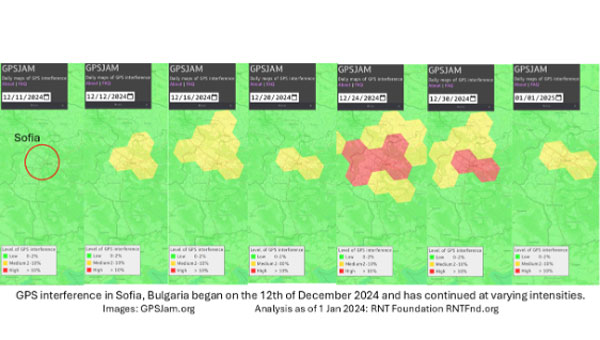
    On Dec. 12, 2024, the European Union decided to include Bulgaria and Romania in the Schengen visa-free zone. On the same day, Bulgaria’s capital, Sofia, began experiencing interference with GPS signals. The interference, as reflected in aviation ADS-B systems and reported on GPSJam.org, continued through the new year and is ongoing as of this writing. 

    While these two events may be entirely unrelated, Vladimir Putin has a history of using GPS jamming and spoofing to show his displeasure with his neighbors growing closer to the West.

    • On Dec. 15, 2023, Poland activated a U.S. Aegis anti-missile system near its border with Kaliningrad, Russia. On the same day, Russia began jamming and spoofing GPS signals in northern Poland and parts of the Baltic. That interference persists to this day.

    The interference in Sofia may be contributing to a prolonged Bulgarian political crisis. Politicians there have been struggling to form a new government since elections in October. Dec. 10 saw the beginning of a new attempt. Interference with GPS can undermine overall confidence in government systems and institutions — another of Putin’s goals for neighbors with whom he is displeased.

    Another, though less likely, impact may be on Bulgaria’s electrical service. On Dec. 25, 2024, 20,000 households in western Bulgaria (Sofia is in the far west) lost electrical power and the outage continued for days. Many grid operators use GPS timing to help manage their systems. While press reports put the outages down to heavy snow and fallen trees, increased difficulty managing the grid might also be a factor.

    Bulgaria’s GPS interference appears to be coming from somewhere in Sofia, not from Russian territory, as is the case in the Baltic. Yet Russia may still be involved, at least in a supporting role.

    On Dec. 11, the news outlet Balken Insight reported on five Bulgarians being tried by the United Kingdom as Russian spies. It also said the Bulgarian interim prime minister was being urged to investigate alleged links between the case and top officials in Sofia.

    GPS interference in Sofia, Bulgaria, began on dec. 12, 2024, and has continued at varying intensities. (Photo: GPSJam.org)
    GPS interference in Sofia, Bulgaria, began on Dec. 12, 2024, and has continued at varying intensities. (Photo: GPSJam.org)
  • KrattWorks awarded $6M for GNSS-free navigation

    KrattWorks awarded $6M for GNSS-free navigation

    Photo: Krattworks
    Photo: Krattworks

    The European Defense Fund (EDF) and the Ministries of Defense of Estonia and Finland have awarded a $6 million investment to Project BadB, a consortium led by KrattWorks, an Estonian defense technology company. The project focuses on developing advanced navigation solutions for land and aerial vehicles that operate independently of GNSS.

    Project BadB aims to address the challenges posed by rapidly evolving electronic warfare technologies, such as radio jamming and GNSS spoofing. The project seeks to ensure reliable navigation for unmanned systems operating in contested environments, enhancing their operational effectiveness in active war zones and other critical areas.

    Specific objectives of the project include the development of weather-independent up-to-date satellite imagery maps for unmanned aerial and ground vehicles, a machine vision module, an image recognition system and a path planning system, based on sensor data, cross-platform data sharing and swarming.

    GIM Robotics will develop GNSS-denied navigation software for land vehicles, designed to resist and detect jamming and spoofing so vehicles can navigate accurately — even when GNSS signals are unavailable. The company’s technology allows land vehicles to maintain precise navigation using alternative data sources, such as satellite imagery and sensor integration.

    According to EDF, the project has gained attention among European defense and innovation leaders, who see it as solving a burning issue for the rapidly growing unmanned systems sector. The situation on the technology front has changed significantly in the past two years, as the sector faces new obstacles and opportunities each day.

    “We are witnessing an unprecedented fundamental change in the character of war, and our window of opportunity to ensure that we maintain an enduring competitive advantage is closing,” said General (ret) Mark Milley.

    GNSS-free navigation and geolocation also possess potential for civic use – such as in applications for critical infrastructure management, natural disaster mitigation and autonomous transportation systems.

    Project BadB was selected during the EDF 2023 Calls for Proposals, with a project duration of 24 months. The EDF aims to boost cooperation between companies and research entities to enhance European defense capabilities.

    For more information on Project BadB, visit the EDF Project Overview.

  • From Russia with love for Christmas: Jamming Baltic GPS

    From Russia with love for Christmas: Jamming Baltic GPS

    Actions likely in response to U.S. and NATO moves

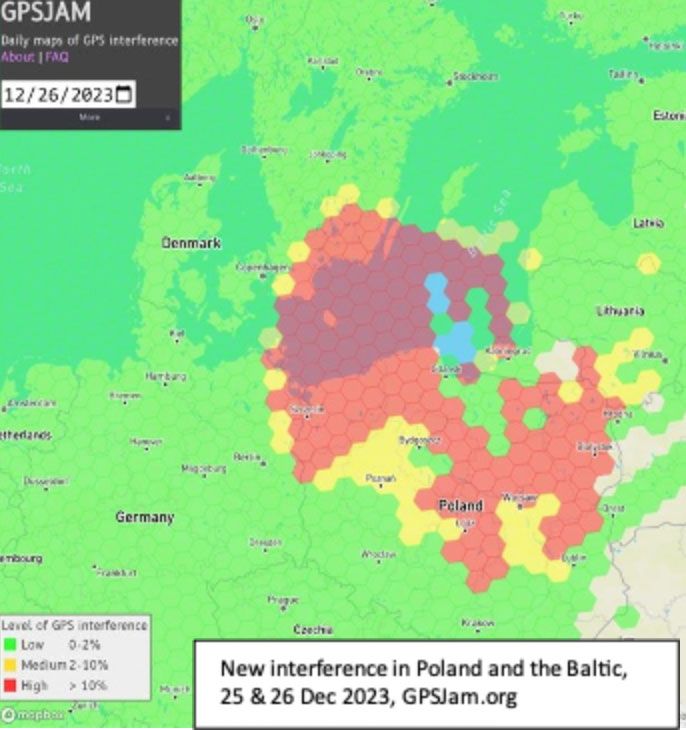
    Image: GPSJam.org
    Image: GPSJam.org

    Parts of Poland, Lithuania, southern Sweden, and other countries in the Baltic region had an unexpected Christmas present this year. GPS signals were disrupted and not available in many areas on the 25th and 26th of December. Poland seemed to be particularly impacted, with the northern two-thirds of the country affected and many users on the ground and in the air having to make do without reliable service.

    On New Year’s Eve, parts of Finland experienced significant jamming as well. The most visible impacts of the holiday events were seen in aviation and low navigation integrity reports from ADS-B systems. These were displayed on the GPSJam.org website.

    Experts in the United States and Poland point to Russia as the source of the interference. They say that Russian anger over the activation of a U.S. anti-missile system in northern Poland in mid-December, and Sweden’s progress toward NATO membership with a recent positive vote in the Turkish Parliament were likely motivations.

    Such a reaction by Russia is not unprecedented. In 2022 President Putin threatened Finland and Sweden with invasion if they sought to join NATO. Subsequently, Finnish President Niinistö met with President Biden to discuss improving defense ties. Shortly thereafter planes flying over Kaliningrad and nearby areas in the Baltic began reporting GPS jamming. Analyses of the event by graduate students at the University of Texas Radionavigation Laboratory and Stanford University have provided some details and will likely reveal more as time goes by.

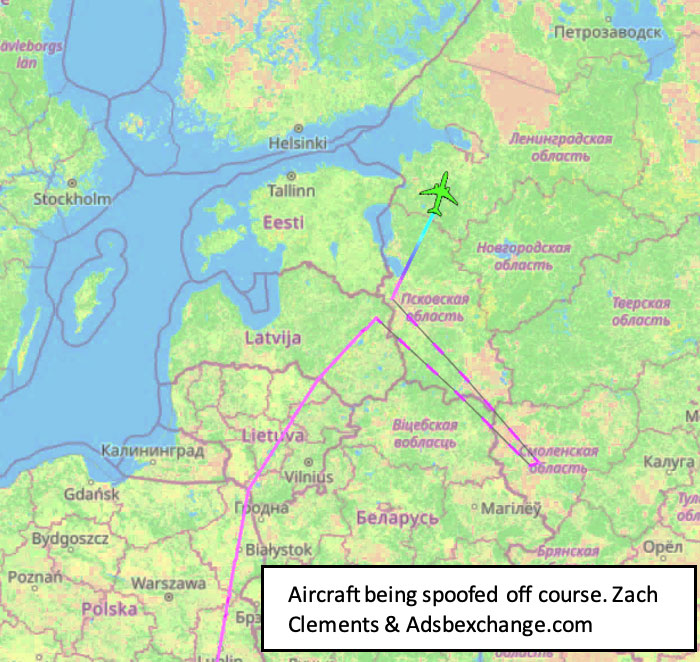
    Zach Clements at U.T. studied the disruption and discovered that it included several transmitters spread across a wide area. Some were simply jamming GPS signals to deny service. At least one transmitter was spoofing aircraft so their instruments would show them far from their actual location.
    While the phenomenon known as “circle spoofing” has been frequently observed with ships, this was the first time it was reported in aviation. With circle spoofing a receiver is electronically captured and “moved” to a different location. Then it is made to appear to move in circles, almost always in a clockwise direction

    Image: Zach Clements/ GPSJam.org
    Image: Zach Clements/ GPSJam.org

    Clements is reasonably sure the source of the circle spoofing was inside Russia. “The points at which the aircraft began to be impacted by the spoofing and where they regained authentic GPS indicate that the spoofer is somewhere in Western Russia. Interestingly, the location to which the aircraft were spoofed is a field about a kilometer from Russia’s decommissioned Smolensk military airbase.”

    Clements’ previous research has demonstrated how sources of GPS disruption can be located by satellites in low-Earth orbit.

    Zixi Liu at Stanford has discovered that the interference was actually two separate events. The first lasted from 9:30 PM on the 24th until 4:30 AM on the 25th, with the second beginning around 2:30 PM on the 25th and tapering off around midnight on the 26th.

    Liu’s previous research used aviation ADS-B data to geo-locate sources of GPS disruptions. She is continuing to examine these incidents to see whether the locations of one or more of the jammers can be determined.

    Aviation interests have become increasingly concerned about interference with GPS signals since 2019 when a commercial passenger aircraft flying through smoke nearly impacted a mountain. Since then, aviation groups have raised the issue, national authorities have been regularly issuing warnings, and the UN’s International Civil Aviation Organization has urged its member nations to take action to prevent interference.

    Intentional jamming and spoofing seem to be getting much more frequent, though, especially in and around conflict areas. In April, Eurocontrol, the European air traffic control organization, warned its members and aircraft using its airspace about these increasing trends.

    This fall a spate of aircraft being spoofed in the Middle East, and in at least one instance nearly entering Iranian airspace without clearance, caused particular alarm.

    “Aviation is always at greater risk when GPS signals are not available or are compromised in some way,” according to Joe Burns, a senior captain at a major international air carrier. Burns is also a member of a board that advises the U.S. government on GPS and related issues. “Interference with GPS increases the risks of accidents and almost always slows the system down, makes flights longer, and more expensive,” he said.

    The International Air Transport Association is meeting this month to discuss GPS interference. Most agree, though, that most meaningful short-term solutions will depend upon the cooperation of national governments across the globe.

  • oneNav to open European office in Finland

    oneNav to open European office in Finland

    Advanced GNSS digital receiver IP core developer seeks to add expertise to global engineering team with the establishment of new subsidiary oneNav Finland Oy

    oneNav logoSilicon Valley, California-based technology company oneNav is opening its first European office in Tampere, Finland.

    oneNav Finland Oy will be led by Florean Curticapean, director of position engineering. He has more than two decades of professional experience in GNSS and mobile communications.

    oneNav is developing a next-generation GNSS receiver for smartphones, wearables and tracking and augmented reality (AR) devices. The oneNav pureL5 GNSS solution was built from the ground up to fully leverage the modernized E5/L5/B2 signaling band deployed on multiple constellations including GPS, Galileo and BeiDou.

    The new E5/L5/B2 signal has considerable benefit over the legacy L1 signal that has been used since the 1980s, according to oneNav. E5/L5/B2 enables higher precision and better multipath mitigation, improves coverage and reliability, and is a unified signal, ensuring global interoperability.

    The oneNav pureL5 system utilizes machine learning and artificial intelligence to improve its solution by removing reflected signal errors that most commonly cause GNSS inaccuracy in deep urban environments.

    Devices powered by oneNav’s technology will produce high accuracy in challenging signal conditions while benefiting from reduced component bulk and complexity, oneNav said.

    “Talent is the key to attract such investments, but this does not appear overnight or by accident. Our businesses are benefitting from many years of research and education at Tampere University, more specifically in the Electrical Engineering Unit, in fields such as GNSS, system-on-chip, network-on-chip, embedded processor architecture, software-defined radio and more,” said Oliver Hussey, senior business advisor for the Tampere subsidiary.

    Tampere is the host of the ICL-GNSS Conference, welcoming a global audience to address the latest research on wireless and satellite-based positioning techniques to provide reliable and accurate position information with low latency.

  • Septentrio opens R&D center in Espoo, Finland

    Septentrio opens R&D center in Espoo, Finland

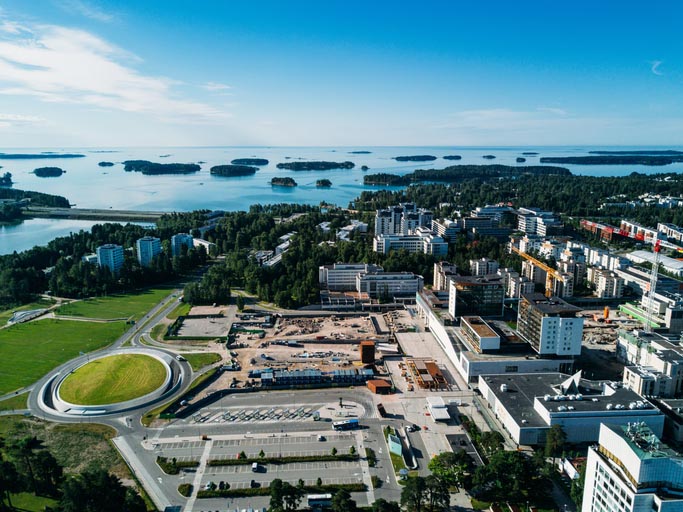
    Aerial shot of Espoo, Finland, from a drone. (Photo: izhairguns/iStock/Getty Images Plus/Getty Images)
    Aerial shot of Espoo, Finland, from a drone. (Photo: izhairguns/iStock/Getty Images Plus/Getty Images)

    Expansion enables company to further accelerate cutting-edge GNSS/INS solutions for professional and industrial applications

    Septentrio has opened a new Research & Development center in Espoo, Finland, to support the strong growth and ambitious expansion plans for its GNSS/INS solutions for professional and industrial applications.

    The new office is strategically located in Espoo, well known as a high-tech hub with a long history of state-of-the-art GNSS and INS development, housing many leading technology companies as well as Aalto University.

    “This new R&D center will support our strong growth and further accelerate our strategic agenda of becoming the leading independent GNSS/INS supplier for demanding applications in industrial, scientific and infrastructural domains,” said Antoon De Proft, CEO at Septentrio. “We also welcome Stefan Söderholm, who brings a wealth of experience to our team and will lead the new R&D center in Finland.”

    “I am really excited to join Septentrio,” added Söderholm. “I have always been impressed by its technology and I look forward to be part of this great team that develops unique positioning solutions for the industry.”

    Septentrio will be expanding its R&D team in the coming months with enthusiastic and highly qualified GNSS and INS engineers as well as software engineers. Stefan Söderholm will spearhead the establishment of the new R&D center and the recruitment efforts.

  • Rolls-Royce and Finferries demonstrate fully autonomous ferry

    Rolls-Royce and Finnish state-owned ferry operator Finferries have successfully demonstrated a fully autonomous ferry in the archipelago south of the city of Turku, Finland.

    The car ferry Falco used a combination of Rolls-Royce Ship Intelligence technologies to successfully navigate autonomously during its voyage between Parainen and Nauvo. The return journey was conducted under remote control.

    Finnish ferry Falco uses Rolls-Royce ship intelligence to dock. (Photo: Rolls-Royce)
    Finnish ferry Falco uses Rolls-Royce ship intelligence to dock. (Photo: Rolls-Royce)

    During the demonstration, the Falco, with 80 invited VIP guests aboard, conducted the voyage under fully autonomous control. The vessel detected objects utilizing sensor fusion and artificial intelligence and conducted collision avoidance. It also demonstrated automatic berthing with a recently developed autonomous navigation system. All this was achieved without any human intervention from the crew.

    The Falco is equipped with a range of advanced sensors which allows it to build a detailed picture of its surroundings in real time. The situational awareness picture is created by fusing sensor data and it is relayed to Finferries’ remote operating centre on land, some 50 kilometres away in Turku city centre. Here, a captain monitors the autonomous operations, and can take control of the vessel if necessary.

    During the autonomous operation tests in Turku archipelago, Rolls-Royce has so far clocked close to 400 hours of sea trials. The Rolls-Royce Autodocking system is among the technologies that have been successfully tested. This feature enables the vessel to automatically alter course and speed when approaching the quay and carry out automatic docking without human intervention. During the sea trials, the collision avoidance solution has also been tested in various conditions for several hours of operation.

    Earlier this year Rolls-Royce and Finferries began collaborating on a new research project called SVAN (Safer Vessel with Autonomous Navigation), to continue implementing the findings from the earlier Advanced Autonomous Waterborne Applications (AAWA) research project, funded by Business Finland.

    “Today marks a huge step forward in the journey towards autonomous shipping and reaffirms exactly what we have been saying for several years, that autonomous shipping will happen,” said Mikael Makinen, president – Commercial Marine at Rolls-Royce. “The SVAN project has been a successful collaboration between Rolls-Royce and Finferries and an ideal opportunity to showcase to the world how Ship Intelligence technology can bring great benefits in the safe and efficient operation of ships.

    “This is a very proud moment for all of us and marks our most significant milestone so far. Today’s demonstration proves that the autonomous ship is not just a concept, but something that will transform shipping as we know it.”

    “We are very proud that maritime history has been made on the Parainen-Nauvo-route once again,” added Mats Rosin, Finferries’ CEO. “First with our world-renowned hybrid vessel Elektra and now Falco as the world’s first autonomous ferry. As a modern ship-owner, our main goal in this cooperation has been on increasing safety in marine traffic as this is beneficial for both the environment and our passengers. But we are also equally excited about how this demonstration opens the door to the new possibilities of autonomous shipping and safety.”

    The Falco is a 53.8 metre double-ended car ferry, which entered service with Finferries in 1993. It is equipped with twin azimuth thrusters from Rolls-Royce.

  • Norway, Finland suspect Russia of jamming GPS

    Norway, Finland suspect Russia of jamming GPS

    Photo: NATO/Espen Hofoss, Forsvarets forskningsinstitutt
    Photo: NATO/Espen Hofoss, Forsvarets forskningsinstitutt

    NATO conducted its largest military exercise since the Cold War in the frigid waters and icy mountains of Norway Oct. 25-Nov. 7.

    During the final days of the Trident Juncture exercise, GPS signals guiding ships, aircraft, tanks, trucks and troops began to fail. Tracking screens flickered and positions were suddenly wrong from a few meters to hundreds of kilometers.

    Civilian airliners, cars, trucks, cargo ships and smartphones operating in and around Norway and Finland experienced similar disruptions. Norway-based airline Wideroe told The Barents Observer that its pilots were reporting the loss of GPS signals when flying to airports in northern Norway and Finland. Airfields affected ranged from Kirkenes, on Norway’s border with Russia, to Lyngen in Troms, much further west.

    Russia is the chief suspect of jamming the signals in reaction to the massive size and proximity of the military exercises. Russia also has recently conducted massive military exercises in the Baltics.

    “It is possible that Russia has been the disrupting party in this,” Finland’s Prime Minster Juha Sipila told local media. “Russia is known to possess such capabilities.”

    Trident Juncture involved all 29 NATO alliance members. Neutral Sweden and Finland also took part amid growing uncertainty over Russia’s ambitions in the tense region.

  • Challenges in Arctic navigation the focus of new conference

    The first Pan-Arctic Workshop: Challenges in Arctic Navigation will be held April 16-18 in Olos, Lapland, Finland.

    The workshop is part of the official Arctic Council calendar (Finland is the chairman for 2017-2019). It will gather academia, industry and authorities to discuss navigation challenges on land, air and sea in the Arctic.

    The experts will be looking for solutions and the next steps forward. One challenge is solving the problem  of suboptimal satellite navigation augmentation constellations in the Arctic, as well as scintillation affecting satellite navigation.

    The workshop is funded by the Finnish Ministry of Foreign Affairs and organized by the Finnish Ministry of Transport and Communications, but they have delegated the arrangements to FGI/Department of Navigation and Positioning.

    Speakers and participants from all Arctic Council states will take part, with participation expected to be around 100-150.

    The event is free of charge, but participants will have to cover their own travel and accommodation expenses.

    Olos is close to the snowtonomous ITS testing grounds Aurora Snowbox, and participants will also be given information and a demonstration about the site during the workshop.