Tag: From the Editor

  • Out in Front: Europa, Europa

    Not so long ago, we occasionally speculated on the order of GNSS preference for both manufacturers and end users. GPS first, of course. Only the most radical of future visions saw anything different. But after that? GLONASS, Galileo, BeiDou — or switch them around? A case could be made for almost any sequence, by virtue of active constellation size or geometry, code structure, interoperability, government funding, or national economies.

    It was once felt that a maximum of two GNSS could be made to fit cost-beneficially on a chip destined for mass-market devices; professional OEM boards had, of course, far more leeway and budget. Then engineering ingenuity found space for three on a chip.

    A wag noted during that timeframe that in GNSS as in the Olympics, one can win gold, silver, or bronze. There is no prize for fourth place.

    Lately, however, it seems there may be room for all. Our feature article this month affirms that “the silicon manufacturer must continue the path towards the fully flexible multi-constellation mass-market receiver.”

    Nevertheless, choices will be made in design and manufacturing: different choices by different manufacturers in different regions, on different products. I now think that market size and connectivity will be the strongest drivers for selection of GNSS in product design. Constellations, at least in their order of establishment, almost don’t matter. Government mandates to use the respective national (or regional) GNSS in official or officially linked applications will add to the weight of market size.

    These government-mandated applications encompass air, rail, and maritime navigation and management, survey and construction, road tolling, and road-user charging, just to start with. With emergency calling, it’s not hard to envision such mandates extending to telecomm as well, the most plentiful in end-user devices.

    In that light, consider the words of political scientist John McCormick from his book Why Europe Matters.

    “The European Union has a population of more than half a billion. It is the wealthiest marketplace in the world, is the biggest trading power in the world, is the biggest source of (and magnet for) foreign direct investment, and has shown that it is possible to wield influence without relying on military power.”

    Even should Galileo finish fourth in the race to establish a full constellation, smart money may put Galileo on every future GNSS chip, high precision or mass market.

  • Out in Front: Who’s Been Mining My Location?

    Out in Front: Who’s Been Mining My Location?

    Conventional wisdom holds that smartphone users will tolerate diluted privacy — specifically, privacy of their own location — in return for the many advantages delivered by the location-based services on their devices. This conventional wisdom, I put it to you, has been disseminated over the years by conventional wise men, that is, those selling the services and the devices. Users themselves have not, in the full awareness of their situation, been sounded or heard from. Now murmurs bubble to the surface.

    Five researchers at Rutgers University recently published a paper, “A Field Study of Run-Time Location Access Disclosures on Android Smartphones,” based on work supported by the National Science Foundation. The paper describes how they created an application to inform users which other apps are mining their GPS location data, and then asked users how they felt about this.

    Participants took various actions to manage their privacy. These included uninstalling apps, stopping the use of some apps, reducing the time using some apps, and searching through apps’ setups to disable location accesses.

    “[They] appreciated the transparency brought by our run-time disclosure method,” the researchers state. “They wanted to continue receiving the notifications after completing the study. Most participants reported having trade-offs between location privacy and the convenience of using their apps. We observed that some participants would rather give up the convenience to protect their location privacy.”

    First, the researchers had to figure out how to provide the information to project participants; in other words, how to let them know who was watching them and tracking their movements?

    “[Although] there is no obvious way for a normal Android app to monitor whether other apps are accessing location, we discovered we could exploit the method getLastKnownLocation available in the Android Location API for this purpose.”

    Participants — those in the know, at least — described the study as “an eye opener.” In one of the most telling details, delivered in the paper’s last sentence, we find out why. The study encompassed two groups: one was shown that other apps accessed their data, and the other group was only informed of this after the project was completed. “The No Disclosure group were generally not aware of what was happening on their own phones.”

    Caveat orator.

    Steve Copley, GPS World publisher.
    Steve Copley, GPS World publisher.

    In other news, I am happy and proud to announce that former associate publisher Steve Copley is now full-on publisher of this magazine. After a year in the traces (or should that be trenches?), Steve has ably reinvigorated business aspects of the operation, cleaned house, kicked buttstock, and taken names. It is due and fitting that he now tackle further challenges.

    As I shall also, in my new role of group publisher. While continuing to do what I do, my purlieu extends more fully over geographic information systems and Earth observation, as well as new initiatives in the European market. Specifically, the new EAGER newsletter, the EuropeAn GNSS and Earth Observation Report.

  • Out in Front: Complements of the Season

    Alan Cameron
    Alan Cameron

    In the wake of last month’s Expert Advice column on eLoran — “The Low Cost of Protecting America” by Dana Goward of the Resilient Navigation and Timing Foundation —  come several positive comments and encouraging developments. Rather than rehearse all the arguments why we should care about this, I’ll repeat the one word that I heard most often in GNSS circles in 2013: jamming. Followed closely by: spoofing.

    “I have been advocating strongly for reconsideration of the government’s domestic Loran decision for the last year or so,” writes one reader positioned on Washington’s Beltway, “and specifically working within the Department of Defense (DoD) to ensure it is aware of international developments for eLoran in the UK and South Korea, and the possibilities inherent in other former Loran chains.

    “The DoD is beginning to recognize the value of eLoran as a complement to GPS, not only for international missions, but in cooperation with the departments of Transportation and Homeland Security for domestic critical infrastructure.”

    Last fall, Don Jewell’s Defense PNT newsletter on the same subject drew this reply from another well-known expert:

    “One of the key short-term actions is to prevent the decommissioned [Loran] sites from being sold off for subdivisions. These sites are a national treasure with unique properties: soil conductivity, water content, metal content, and more that are hugely important in siting low-frequency positioning systems. Those long-gone engineers of the 1940s and ’50s knew this and chose accordingly.”

    Before last month’s issue appeared but after it had gone to press, President Obama signed the National Defense Authorization Act (NDAA) for 2014.  It contained several favorable New Year’s auguries for positioners, navigators, and timers.The act evinced an acute awareness of the vulnerability of space systems to disruption. The act is also a law governing the land. Through it Congress requires the administration to, among other things, explain biennially in its “Space Protection Strategy” report exactly how, in the event space systems are disrupted, DOD and the intelligence community “plan to provide necessary national security capabilities through alternative space, airborne, or ground systems.”

    Since said administration acted early in its first term to decommission Loran-C, the congressional directive is pointed.

    The next big thing coming up on the GNSS international horizon takes place in Rotterdam, the Netherlands, April 15–17: the European Navigation Conference, ENC-GNSS 2014. It includes a track session on “eLoran and other Low-Frequency Systems,” and I’ll be there with pencil sharpened.

    Brad Parkinson will give the ENC keynote, and he is on record as one of an august group of Institute for Defense Analyses experts who unanimously recommended that the existing Loran-C be greatly updated and modernized to eLoran. We should hear more from him on this subject amid the wharves, waterways, and docks of Europe’s largest port (world’s third busiest).

    There’s barely room left to report the successful tests of Enhanced Differential Loran (eDLoran) by Dutch specialists Reelektronika: absolute accuracy of 5 meters in the North Sea and in the Rotterdam Europort harbor area.

  • Out in Front: Above All, Leadership

    Out in Front: Above All, Leadership

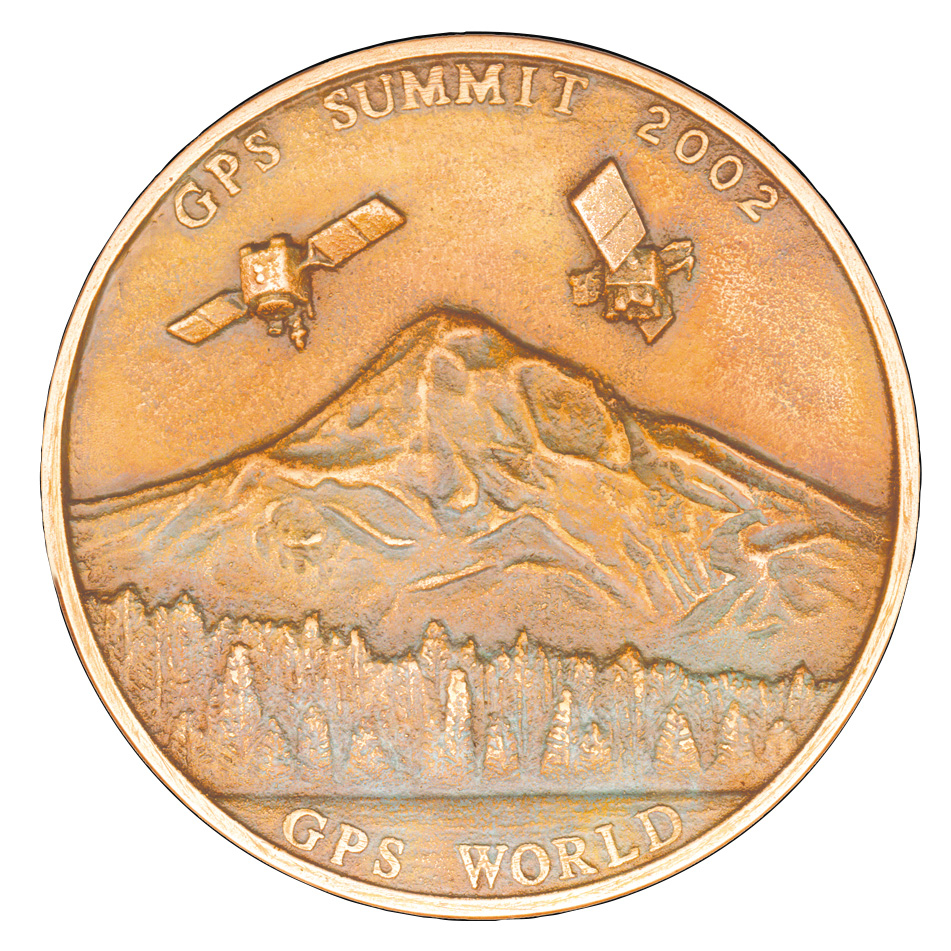
    GPS Summit 2002 award.
    GPS Summit 2002 award.

    Just took a stroll down memory lane, leafing through the pages of the December 2002 issue of this magazine. They contain predictive essays of that era — Directions 2003 — and a transcription of the panel discussion from the very first Leadership Dinner, then called the “GPS Summit.” I was there, running the door, riding the audio recorder, handing out bronze presenteaux (pictured here) to departing guests.

    We have carried on the tradition of that event, the brainchild of Glen Gibbons (whose December 2002 editorial headline I have repeated here) and Richard Fischer, nine times now. We carried the show, innovating as we go, from Long Beach to Fort Worth to Savannah, back to Portland and thence to Nashville. We shall convene again in Tampa next year. We’ve had spirited debates, campaigns and elections (the Satellite Party versus the Signal Party), a history of GPS origins from Brad Parkinson himself, a recognition of the pioneers from the early era who built the system from scratch, a Grand Game of GNSS negotiation and trading, horse racing, physics trivia, and this year, a spoofing simulation (see the back page of this magazine).

    Somehow amid the fun of each occasion, we managed to squeeze in a healthy dose of thought leadership. This year’s installments you will find on pages 28 to 49, including dinner remarks from the four recipients of this year’s Leadership Awards, and essays by upper-level if not the top-level executives at each of the four GNSSs.

    For added perspective, see these excerpts from the 2002 discussion high atop the Portland Hilton.

    Javad Ashjaee (then CEO and president of Javad Navigation Systems): “There is no end to the enhancement that we can do in signal processing, assuming that Intel and others will not stop giving us the tools that we need. As you see, the front line of this is microprocessors.”

    Kanwar Chadha (then founder and vice-president of marketing at SiRF Technology): “As far as the consumer is concerned, it comes down to what they are buying, and what’s the value proposition. I can tell you from personal experience, it’s not purely a technology decision.”

    Steve Moran (then director for civil space programs at Raytheon, where he still works as director, GPS mission solutions): “We manage a positioning and navigation system, rather than a positioning and timing service — and that’s a fundamental change that needs to come about in the way we look at GPS.”

    Bob Denaro (then vice-president and general manage at NavTeq): “One day soon we will have digital paper. A map with high-resolution addressable data on what looks and feels, and most importantly, costs like a sheet of paper. My position shows up as a bright spot moving along the paper as I move.”

  • Out in Front: Tell the Truth, Now

    Here are a few things about your colleagues that perhaps you did not know: they are a quite colorful, varied, and shall we even say motley crew. Hidden backgrounds came to light during the magazine’s Leadership event in Nashville, during a game called “Guess Who’s Spoofing the Dinner?” One person at each table, secretly recruited in advance, lied freely in response to three questions, while everyone else was bound to tell the strict truth. The table then had to identify the spoofer in their midst.

    The truths turned out to be stranger than the fictions. As ever. This is what’s known, appropriately, as a truism.

    The questions posed:

    • What is the farthest from your birthplace that you have traveled?
    • What was the shortest time you ever held a job? What job?
    • Who is the most famous person you have met?

    One person had met Hillary Clinton, another the first lady of China, and two people had met the Queen.

    One met Janis Joplin (throwing that table into a total tizzy), another had an audience with two popes, Benedict and John Paul II (not simultaneously), while yet another had met John Paul II and Sophia Loren (again, presumably, not on the same occasion).

    But the most elevated encounter was described by a soft-spoken gentleman who taught the Dalai Lama to play frisbee. His Holiness had never done, and evinced some curiosity as to how it worked.

    Janis Joplin’s crony claimed his shortest employment was installing fire alarms at a Catholic home for girls in a delicate way in the early Sixties. His table declared him the spoofer. But they were wrong. They were wrong.

    The shortest employment for one engineer at the dinner was also his longest, not to mention his most current: 30 years. He has never held another job.

    One young researcher worked briefly as a shepherdess, until getting trampled by a flock of sheep. Imagine your lab-coated colleague in a long white frock, ruffled cap, and crook stick.

    In their travels, folks had reached Tierra del Fuego, Tasmania, Everest Base Camp, China (and conversely, Nashville from China by a select few), and Capetown, South Africa, but the furthest flung had landed on Antarctic ice in a Hercules C-130, on skis.

    Ironically, one travel tale was challenged not because of the furthest destination but the start point. A well known GNSS scientist vowed that he came from Texas, but a gentleman from the European Commission — the same who had met John Paul and Ms. Loren — doubted this severely, because the teller did not sport cowboy boots nor a big belt buckle. Worse, he could not recall what Sam Houston’s boys cried out as they went into the Battle of San Jacinto, winning glory and Texas independence.

    Italians, it seems, are quite well versed in Texan history.

    There is a lesson in this for all of us, though our scientist claims it’s all just an invention of  the movies.

    Remember the Alamo!

  • Out in Front: Virtuosos

    Out in Front: Virtuosos

    Cover: Curiosity By Philip Ball
    Cover: Curiosity By Philip Ball

    An occasional reader of these pages forwarded a clipping from a summer Wall Street Journal, a book review of the new title, Curiosity: How Science Became Interested in Everything, by Philip Ball (University of Chicago Press, 465 pages, $35).

    The book covers scientific advances logged in the 1600s, a century that “began with an essentially medieval outlook and ended looking like the first draft of the modern age.” However, the book’s description by WSJ reviewer Timothy Ferris quickly called to my mind the current status of investigation — practiced with an overlay of capitalism and market advantage-seeking — by, guess who, the GNSS community.

    Not that I’m necessarily equating the scientists, engineers, and product managers who are responsible for most of the contents of this magazine with the “thousands of independent tinkerers, inventors, collectors and flat-out oddballs, the ‘virtuosos’ as they were called, [who] experimented with lenses, pumps, and biological specimens as much to satisfy their own inquisitiveness as to answer big questions.”

    Far from it. Perish the thought.

    And yet, and yet . . . .

    I sat in a Denver airport cafe on my way home from ION GNSS+, chatting with a couple of industry captains about the way forward. We joked about how our kids will look at us as old fogeys — heck, they already do — tentatively feeling our way to indoor navigation. This method, that method? This augmentation, that integration?

    The rising generations will simply take it for granted: indoor nav works everywhere, all the time, in the palm of your hand, or perhaps in the frame of your eyewear. How quaint were those early 21st-century inventors! Tinkering with different RF bands, trying to cobble together a solution.

    The smiles on the faces of these industry captains as they proudly showed each other their devices, running their latest prototypes, and curiously examined their competitors’ versions, betrayed an enthusiasm, not just for market share, but for intellectual stimulation, the thrill of the chase, the joy of solving a problem. In that way, they were not unlike the 16th century crew, an assemblage that included, among many minor and forgotten names, Galileo (!!!), Kepler, Newton, Descartes, and Leibniz.

    “The truth is that science works,” writes Philip Ball, “only because it can break its own rules, make mistakes, follow blind alleys, attempt too much — and because it draws upon the resources of the human mind, with its passions and foibles as well as its reason and invention.”

  • Out in Front: Geospatial on Everything

    Alan Cameron, GPS World and GSS publisher.
    Alan Cameron, GPS World and GSS publisher.
    GPS World Publisher Learns about GIS

    By Alan Cameron

    Everything has a geospatial aspect. Everything. Past, present, future.

    Over grits, coffee, and the airborne delicacy purveyed at the Flying Biscuit Cafe (right out of the oven, right into your mouth) in Sandy Springs, Georgia, I absorbed this high-tech homily.

    You’ve heard of the European financial crisis. Trace it back to geospatial, from the Greek banking collapse, which in turn had roots in the implosion of the Greek tax system, due to a plethora of gaps, inconsistencies, and exceptions filed in a largely uncontrolled property cadastre — the register of real property, including details of ownership, precise location (by GPS coordinates), and value of land parcels.

    Lose control of your cadastre (your GIS), lose the country. With global interconnections, soon the continent, if not perhaps the world economy.

    For want of a nail, the battle was lost.

    Jump forward, technologically, to flash lidar. Ball Aerospace created this ability to capture continuous rapid multiple laser interferometry detection and ranging (LiDAR) images/point clouds, merged with continuous high-resolution optical images, to create full-color 3D models in real time. Stitched together with GPS, this produces real-time full-motion video: interactive geo-referenced metric 3D models.

    In field application, this can yield time-critical 3D mapping for urgent missions, enhanced situational awareness, battlefield characterization, and tactical mission planning. It can help with disaster-response planning and event forensics. Real-time models could be communicated with the public through easily comprehended moving images via television or the Internet. of the actual progress of a fire or flood, together with evacuation routes.

    Jump again to fabfi. What’s a fabfi?

    FabFi is an open-source, lab-grown system out of MIT using common building materials and off-the-shelf electronics to transmit wireless Ethernet signals across distances up to several miles. Communities can build their own networks for high-speed Internet connectivity, and access to online educational, medical, and other resources.

    Simple, low-cost, and feasible in unstable environments: Afghanistan, Kenya, and any number of countries that leapfrogged telephone landlines to come quickly into the cellular era; now they can leapfrog Ethernet cable networks and even Wi-Fi for virtual connectivity. Implement with locally available materials. Print out a 2D design file and create the pieces out of wood, metal, acrylic, clay, stone, or ice, as long as you can attach a metallic RF reflective surface to the front.

    If you haven’t guessed the geospatial aspect of this, I assure you it’s there, but I’ve run out of room here.

    For these geospatial glimpses, I am indebted to contributing editor Art Kalinski. Read his monthly columns here.


    Alan Cameron is editor-in-chief and publisher of GPS World magazine, where he has worked since 2000. He also writes the monthly GNSS System Design e-mail newsletter and the Wide Awake blog.

  • Out in Front: A Star Is Born

    Welcome to the club, India, and happy Birth Day. With the July 1 launch of IRNSS-1A, India and the Indian Regional Navigation Satellite System have officially joined the GNSSS (Global Navigation Satellite Systems Society).

    With full membership, however, come some society duties and responsibilities. Chief and first among these is to provide all other society members and interested parties with an interface control document (ICD) defining the characteristics of the signal transmitted from one’s satellites to navigation receivers on the specified radio frequency(ies).

    IRNSS signal transmitters will operate in L5 band (1176.45 MHz) and S band (2492.028 MHz). The system targets provision of an absolute position accuracy of better than 10 meters throughout the Indian landmass and better than 20 meters in the Indian Ocean, as well as a region extending approximately 1,500 kilometers around India.

    Who needs an ICD now, you ask? Who wants to navigate the Straits of Hormuz or New Delhi’s traffic jams using one satellite? No one, of course.

    But nearly every GNSS product developer, designer, and manufacturer has a vested interest in quickly getting their hands on such a document, if they want to sell goods in India, a market of very significant size. Development, design, and manufacture cycles are long, especially when you begin with new and unknown quantities such as a new signal in space. IRNSS once posted a very aggressive schedule: beginning in 2011, it planned to launch two satellites per year, to achieve a full constellation of seven by the end of 2014. Of course, it has fallen a bit behind that curve with first launch in 2013. This would push its operational date to end of 2016. Not all that far out.

    As our OEM editor Tony Murfin wrote last year in a BeiDou context, developers are building digital signal processing application-specific integrated circuits with so-called generic reconfigurable channels to accommodate future add-ons — but RF front-end hardware and signal processing software still require lengthy research and development. Generic DSP channels and associated software decoding algorithms may not be generic enough for all the things that  might await in new modulation schemes yet to come online.

    So it’s not just rabid intellectuals like the Noble New Brunswegian, my friend, colleague, and GNSS mentor and our intrepid Innovation columnist, who prodded me up on this bully pulpit  to ask: O India, where is thy ICD?

    The world’s breadth and depth of GNSS wants to know.

  • Out in Front: Uh-oh for Information

    Back around 1992, in the early days of the World Wide Web, a starry-eyed pundit trumpeted “The Internet will do for information what TV did for entertainment!”

    “Uh-oh for information,” riposted an editorial cartoonist at the time.

    To be sure, television since the 1950s has brought a few new high points of entertainment into homes around the world, as well as faster and farther-reaching news coverage. It has also brought widespread new lows, entire days’ and evenings’ worth of dumb-down, and news that is broad but shallow. In the process television birthed the terms “a vast wasteland” and “sound bite.”

    The Internet followed a similar path. As a consequence, more information is far more widely available. But is it any better, more reliable, more accurate, or conducive to better decisions? A strong argument can be made for the position that it is not; that, on the contrary, it is actually worse, or at the very least, less robust.
    At the same time that the Web began climbing into society’s lap, nevermore to budge, the cellular telephone attached

    itself to the human ear, not merely in the accustomed indoor stationary position but on the street, in the supermarket aisle, at the restaurant, behind the wheel. Now the smartphone has taken over that role and staked its ownership to the field of view as well, if not to total sensory consciousness.

    And what do you know? Along came GPS in the technological bargain. All apps, if not all things, become possible when you combine: Internet, mobile phone, and satellite-based positioning.

    From the interbreeding of these three springs the latest guest to the party: Big Data.

    What the heck is big data?

    “Data sets . . .  gathered by ubiquitous information-sensing mobile devices, aerial sensory technologies (remote sensing), software logs, cameras, microphones, radio-frequency identification readers, and wireless sensor networks. The world’s technological per-capita capacity to store information has roughly doubled every 40 months since the 1980s; as of 2012, every day 2.5 quintillion (2.5×10¹⁸) bytes of data were created.”

    I had to check Wikipedia (I know, I know, the prophet hoisted by his own petard) because I had only a vague sense of it myself.

    According to Adam Jacobs, writing in the ACMQueue of the Association for Computing Machinery, big data is so hefty that “[its] analysis requires massively parallel software running on tens, hundreds, or even thousands of servers.”

    Sounds like a job for Biggest Brother.

    Indeed, the government has stepped forward to shoulder the burden; we have only just learned that it did so some time ago. Now not only our phone calls but our locations, our travels, our appointments, can be well known to anyone behind the giant curtain who has a curiosity. If they feel bothered enough to get a warrant, warrants can be got. Cases on record show that the government has opened personal cell-phone records both with and without warrants.

    To rehearse the evident, those records now contain our location data. Breadcrumbs. The granularity, the precision, and the hertz-rate of that location data will only increase over time.

    This time around, the “uh oh” comes from the information.

    Uh oh for us.

  • Out in Front: Ruminations Upon a Technical Program

    The Institute of Navigation’s (ION’s) advance program for the 2013 GNSS+ conference in September arrived in the mail the other day, and was avidly consumed. The technical sessions of this gathering are prime hunting ground for presentations that later become articles in this magazine, as are, to lesser extent, those of the European Navigation Conference, the Joint Navigation Conference, CTIA, ITS World Congress, and others.

    Something struck me as I scanned the 280-odd presentations listed under 36 session tracks: the frequency with which the word BeiDou appeared. To determine if there were any substance to this fleeting impression, I essayed a quantitative analysis. Naturally, GPS and the generic GNSS occurred times beyond measure, but this is how the others fared.

    IRNSS: 1
    QZSS: 3
    GLONASS: 10
    Galileo: 13
    BeiDou: 19.

    What does this signify? Little enough, possibly. Still, something. A satellite navigation system bursts seemingly out of nowhere and within a few short years virtually laps the field, putting 20 (14 usable) transmitters into space and establishing a regional operating capability, soon to be global. That sort of thing tends to get noticed.

    The titles of BeiDou-focused papers on tap this fall in Nashville — not all of them springing from the laptops of Chinese engineers, not by a long shot — add substance to this passing fancy.
    ◾    BeiDou Consumer Receiver Chips at Last.
    ◾    A Combined GPS/BeiDou Vector Tracking Algorithm for Ultra-tightly Coupled Navigation Systems.
    ◾    Towards the Inclusion of Galileo and BeiDou/Compass Satellites in Trimble CenterPoint RTX.
    ◾    New Assisted BeiDou Products from JPL’s Global Differential GPS System.
    ◾    BeiDou Integration in Cell Phones and Tablets.
    ◾    BeiDou — A System That is Now Ready for Applications.
    ◾    Augmenting GPS RTK with Regional BeiDou in North America.
    ◾    New Systems, New Signals, New Positions — Providing BeiDou Integration.

    The affiliations of some of the authors of the above read like a top-level directory of North American and European GNSS manufacturers. Clearly, the ground has been plowed and the fields lie ready — if they are not already planted. Unless that’s too mixed a metaphor for satellite radionavigation signals.

    The recent acquisition of one Western GNSS manufacturer by a major Chinese business concern has not gone unnoticed, either.
    For more intelligence, I consulted the newest member of this magazine’s Editorial Advisory Board. He replied to my emailed penny for his thoughts.

    “I would be happy to contribute a column for the July issue based on my observations here at the China Satellite Navigation Conference in Wuhan. The article would be titled: Little Tigers versus Wolves.”

    Wow. Now I wonder, who’s who?

  • Out in Front: The System, Simulated

    Wealth, breadth, and depth. That’s what this issue brings you, in signal simulation- and testing-related content. Unfortunately, the wealth on offer has to large extent elbowed out our two news sections, The Business and The System. The former is given short shrift in this issue and the latter even shorter herewith, in pithy precis with website shortcuts. And our apologies.

    Let’s all remember, brevity is the soul of wit.

    GPS III Flexible Signal Generator. With completion of the Delta Preliminary Design Review for the GPS III satellites, Lockheed Martin and the U.S. Air Force announced that “an innovative new waveform generator permits the addition of new navigation signals after launch to upgrade the constellation without the need to launch new satellites.”

    IGS Real-Time Service. The International GNSS Service, a worldwide federation of agencies involved in high-­precision GNSS applications, announced the launch of its Real-­Time Service (RTS). The RTS is a global-scale GNSS orbit and clock correction service that enables real-time precise point positioning and related applications requiring access to IGS low-latency products. The RTS is offered in beta as a GPS-­only service for the development and testing of applications.

    QZSS Will Grow to Four. The Japanese government has ordered three navigation satellites from Mitsubishi Electric Corp. to expand the Quasi-Zenith Satellite System, currently orbiting the sole Michibiki. QZSS augments GPS navigation signals for users in the Asia-Pacific region. NEC Corporation has been awarded a contract for the QZSS ground control segment.

    Real-Time PPP with Galileo. Fugro Seastar AS achieved this task within a week of all four Galileo satellites being activated. Fugro is now generating Galileo orbit and clock corrections, which can be used in conjunction with the Fugro G2 decimeter-level corrections associated with its GPS/GLONASS PPP service.

    BeiDou Ground System Approved. The BeiDou Ground-Based Enhancement System (BGBES), a network of 30 ground stations, an operating system, and a precision positioning system, was approved by a Chinese government evaluation committee. The system is expected to improve BDS positioning accuracy to 2 centimeters horizontal and 5 centimeters vertical via tri-band real-time precision positioning technology, and to 1.5 meters with single-frequency differential navigation technology.

    CNAV Test on GPS L2C and L5. The U.S. Air Force Space Command announced that CNAV capabilities on the GPS L2C and L5 signals will be tested in June. The civilian navigation message to be carried by modernized GPS will have similar data to the existing NAV message, but its structure will be different, with increased message bandwidth for greater information density. L2C and L5 users and receiver manufacturers are encouraged to review the test plan, provide comments, and participate in the evaluation process.

    GPS at the Smithsonian. Brad Parkinson’s presentation, “GPS for Humanity — The Stealth Utility,” is now available as video on UStream.The talk helped introduce the new Smithsonian National Air and Space Museum exhibit, “Time and Navigation: The Untold Story of Getting from Here to There,” which is now open and free to the public in Washington, D.C.

  • Out in Front: Galileo’s World

    Out in Front: Galileo’s World

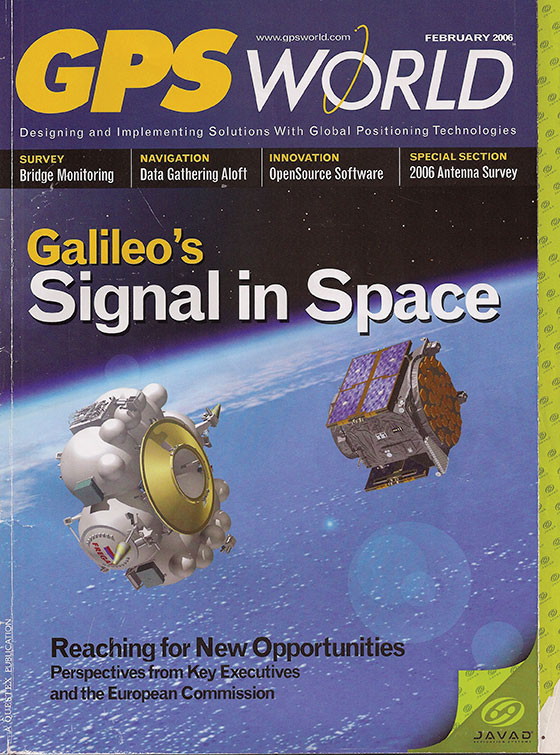
    GWpigeonIt’s been a long time coming. With the capability to make a position fix from four signal-broadcasting satellites, we can now say that Galileo has truly arrived. Of course, this is only one of many milestones (excuse me, kilometer markers) along the way, a trajectory that could be bounded at 23 years and counting, or possibly longer. Let’s not forget, GPS had an extended gestation period of its own, as did GLONASS; BeiDou appears to be maturing a bit faster.

    My acquaintance with the system began in July 2000, when I joined the staff of GPS World and received my first assignment, editing an article about GPS-bearing carrier pigeons in the sister publication Galileo’s World, from founding editor Glen Gibbons. We published Galileo’s World quarterly from 2000 to 2002, chronicling the ups and downs, forward steps and back, of the European GNSS. GWgreeceUnless you counted EGNOS — really telecom satellites with a piggyback SBAS payload — Galileo had no space vehicles as yet, but did encompass plenty of political and financial maneuvering, rhetoric, market projections, international negotiations, and technical blueprints. In short, the stuff of news. For application stories in the magazine, we filled with European uses of GPS, all of which would eventually integrate Galileo as well.

    In 2002, a UK-based travel agency of the same name began to assert its legal possession of the name Galileo, and sent a cease-and-desist shot across the bows to the corporate ownership of the two magazines, and to the European Union. The EU felt it had sufficient legal clout or standing of some kind, for it neither desisted nor renamed its space program. But our counsel at the time instructed us to quietly fold up our tent and steal away. The impending battle wasn’t worth our stake.
    GWferry

    And so Galileo’s World sadly ceased publication. Not for lack of interest, or support, or commitment. But because of someone else’s greed or turf belligerence in a completely unrelated market. Such is the way of the global economy.

    We have covered every step of Galileo’s way, technically, economically, and politically, in the pages of GPS World. Occasionally we ponder calling ourselves GNSS World, or even PNT World. But the brand, like the satnav system it is named after, is just so strong, it would be foolhardy to walk away from it, at this point in time at least.

    GPSgalsisWe continue to support European satnav progress at each successive stage. And so we say yet again: Welcome, Galileo!