The latest four Galileo satellites have been given the green light to begin working alongside the rest of Europe’s satellite navigation fleet, giving a further boost to worldwide Galileo service quality.
Galileo has grown to become Europe’s single largest satellite constellation, built up over 10 launches over the course of this decade. The first of seven double-satellite Soyuz launches took place in 2011, with three sets of four-satellite Ariane-5 launches during the last three years.
The latest quartet of Galileo satellites were launched together by Ariane 5 on July 25, bringing the number of satellites in orbit to 26.
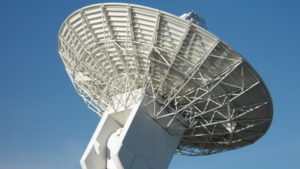
L-band antenna at Redu. (Photo: ESA)
Once safely in orbit the satellites entered their in-orbit test commissioning, overseen by a combination of facilities across Europe.
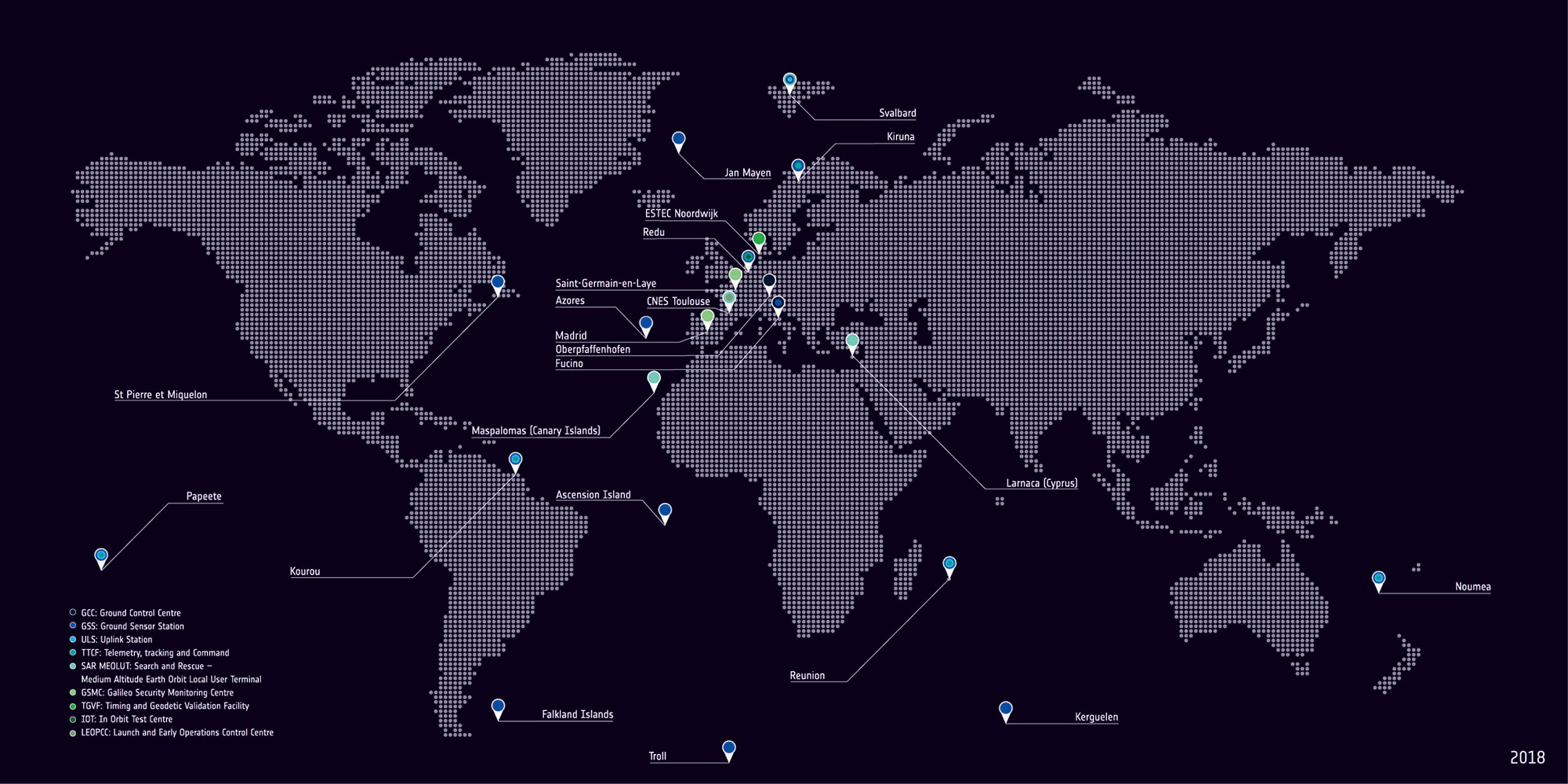
The Launch and Early Operations Phase team of France’s CNES space agency in Toulouse worked together with the two Galileo control centres in Fucino, Italy, and Oberpfaffenhofen, Germany and ESA’s Redu centre in Belgium.
Redu’s 20-m antenna played an important part during in-orbit testing, allowing for high-resolution monitoring of the L-band navigation signal coming from each satellite.
The two control centres participated by testing their control of the satellites. The operations teams confirmed their fully-trained status and their readiness to manage the fleet now it has swelled to 26 satellites in total.
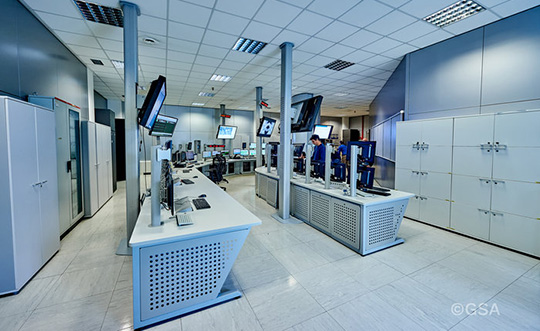
Galileo’s Control Centre in Fucino is used to oversee the satellites’ navigation payloads and services. (Photo: ESA)
David Sanchez-Cabezudo, ESA’s Galileo In-Orbit Testing manager commented: “All the lessons learned and experience gained in these last years through the Galileo satellite commissioning campaigns have led us to a high level of efficiency and effectiveness — not only in managing the technical aspects of the testing operations but the large number of interfaces at contractual and human levels. A complex network of teams has had to work together to make this activity work.”
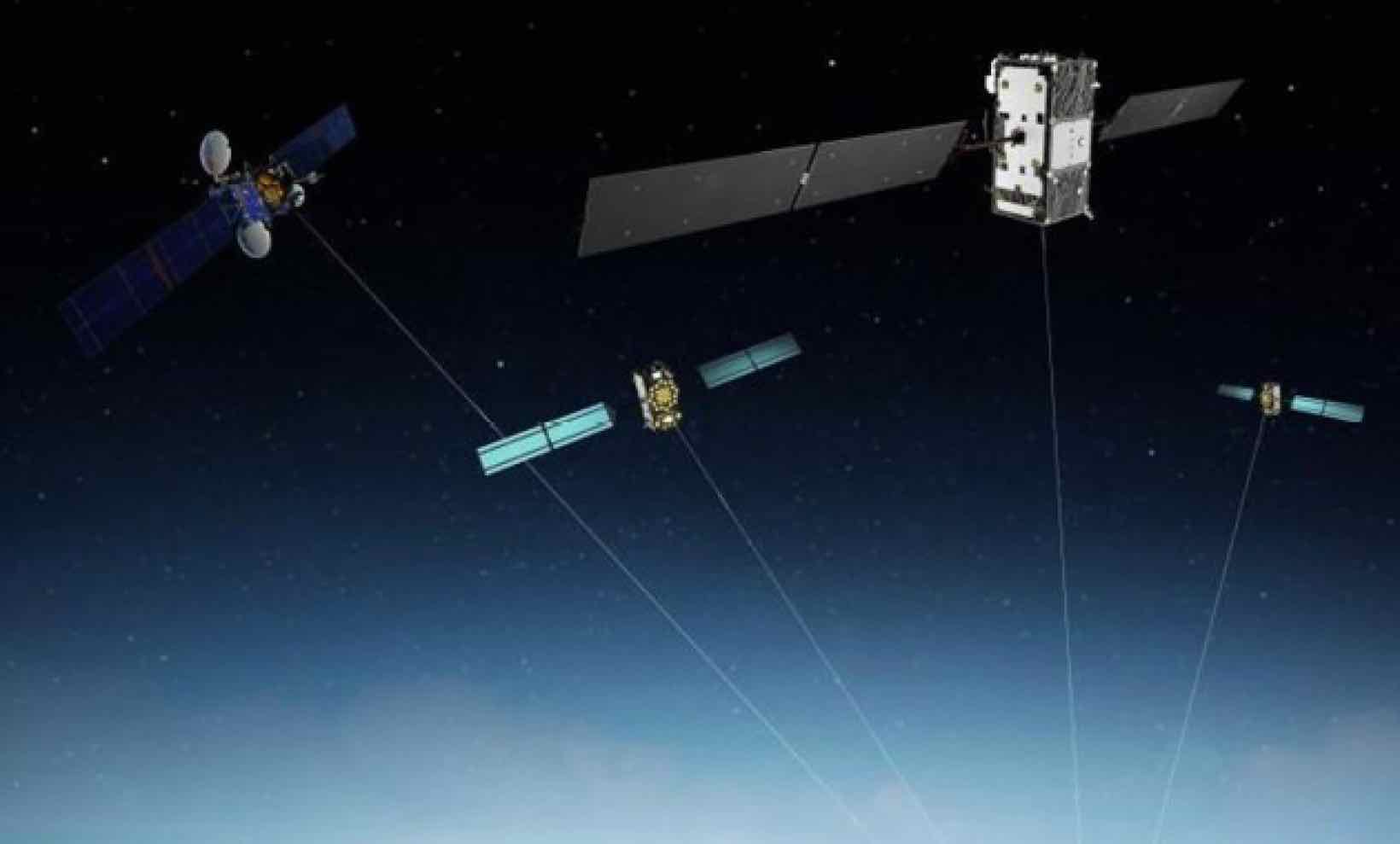
Galileo satellites orbit in three orbital planes in medium Earth orbit, 23 222 km up. The result is that at least four Galileo satellites should be visible from any point on Earth — the minimum needed to achieve a position fix.
Galileo’s Control Centre in Oberpfaffenhofen in Germany oversees the Galileo satellite platforms. (Photo: ESA)
Oberpfaffenhofen Control Centre
Galileo Initial Services commenced on Dec. 15, 2016, with each new addition to the working constellation serving to enhance the stability and speed of the system.
A further 12 Galileo satellites are currently in production by the same industrial consortium — with OHB manufacturing the satellite platforms and Surrey Satellite Technology Ltd the navigation payloads.
The next Galileo launch is schedule for 2020, the same year that Full Operational Capability is set to start.
The Galileo programme is funded and owned by the EU. The European Commission has the overall responsibility for the programme, managing and overseeing the implementation of all programme activities.
ESA is entrusted with Galileo’s deployment, the design and development of the new generation of systems and the technical development of infrastructure. The definition, development and in-orbit validation phases were carried out by ESA, and co‑funded by ESA and the European Commission.
The European Global Navigation Satellite System Agency (GSA) ensures the uptake and security of Galileo. Galileo operations and provision of services became the responsibility of the GSA in July 2017.
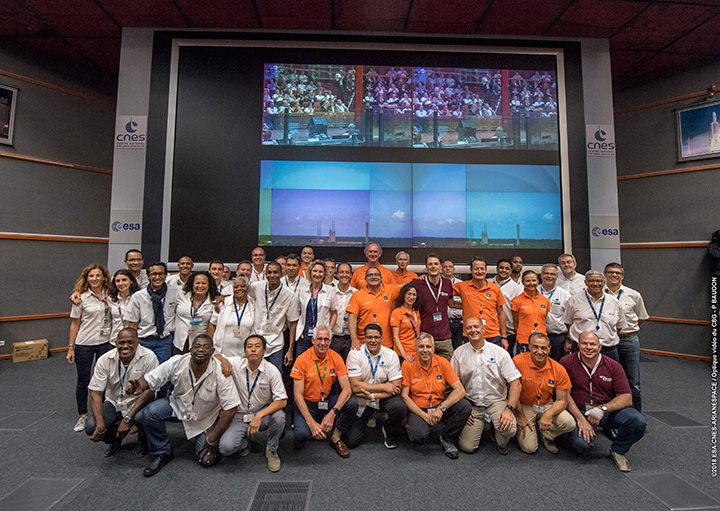
Countdown team at Kourou, Guiana control center for July’s four-satellite launch. (Photo: ESA/CNES/Arianespace, P. Baudon)
By Javier Benedicto Head, Galileo Programme department, European Space Agency
Since the declaration of initial services in December 2016, the European Space Agency (ESA) and the European GNSS Agency (GSA) have expanded Galileo’s system capabilities and service robustness with significant improvements of the ground segment and the last batch of four satellites launched by Ariane 5 in July. Once these satellites reach their final position and complete their in-orbit commissioning before the end of 2018, all 24 nominal slots of the Galileo constellation will be occupied.
Up to 22 satellites are planned to be commissioned in early 2019 and, eventually, the two FOC satellites injected in elliptical orbit should join the operational constellation after on-board software upgrade to provide for automatic health status flagging to users. This should lead to a total of 24 operational Galileo satellites supporting global PNT for users worldwide.
New Infrastructure Contracts
To further expand the system capabilities by 2020 and beyond, and reach Full Operational Capability (FOC), ESA has awarded new large industrial contracts in the context of the Exploitation Phase.
A contract to build and test another twelve Galileo satellites (so-called Batch-3) was awarded in 2017 to a consortium led by prime contractor OHB GmbH in Germany, with Surrey Satellite Technology Ltd in the UK as payload prime. These new satellites are based on the already qualified design of the previous Galileo FOC satellites. Production is advancing well, with first launch planned by late 2020.
With the Galileo constellation now expanded to 26 navigation satellites and plans to deploy additional Batch 3 satellites, the ground control infrastructure is undergoing a corresponding upgrades. In July, ESA awarded a new contract for the Galileo Ground Control Segment to GMV Aerospace and Defence, Spain. This contract includes upgrading the system architecture to manage a constellation of up to 41 Galileo satellites, updating obsolescent elements in the current system, improving operability linked to the provision of services and additional telemetry, tracking, and command capabilities to improve system robustness.
In October, Thales Alenia Space in France received a contract to upgrade the Galileo Ground Mission Segment and the Galileo Security Monitoring Centres (GSMC). This work includes upgrading Galileo’s system architecture to provide more accurate navigation products for broadcast by Galileo satellites, updating obsolescent elements in the current system and improving operability linked to the provision of services and enhanced robustness.
It will also include the construction of additional navigation message uplink and sensor stations. This contract will also augment the capabilities for implementation of the Public Regulated Service (PRS), the single most accurate and secure class of Galileo signals. Encrypted PRS signals will be made available only to authorized governmental users through approved national authorities. GSMCs in France and Spain will ensure the security monitoring functions for Galileo operational assets and manage PRS access and operations.
Growing Service Portfolio
The European Commission, GSA and ESA have jointly defined a broad range of service improvements and system capability enhancements to be deployed in 2019–2020, leading to FOC.
The newly qualified system infrastructure will support the broadcast of authentication information as part of the Open Service Navigation Message in E1; experimentation will start by end of 2019, leading to the possibility to offer trusted PNT to Galileo users.
Galileo will also be the first GNSS constellation to provide a Search and Rescue return link capability: as of 2019 the system will allow broadcast of acknowledgement of receipt message to users in distress with a very low latency, contributing to saving lives.
ESA has also started preparing the necessary modifications to the Navigation Signal Generation on-board the satellites to offer further capabilities to users after 2020. The signal-in-space will be enhanced with additional data transmitted in the I/NAV message, offering faster acquisition and more robust Galileo positioning on E1 and an encrypted navigation signal on E6 supporting authentication at signal level.
The new Galileo High Accuracy Service, soon entering the experimental phase, will consist in the delivery of un-encrypted high accuracy correction data in E6, enabling users to achieve sub-meter level positioning.
The usage of Galileo Open Service for aviation applications using horizontal advanced receiver-autonomous integrity monitoring techniques is being carefully assessed through measurements and review of the system design, including feared-events characterisation.
Longer Term Evolution
Galileo Second Generation has been the subject of technology pre-developments in the areas of platform and payload critical equipment, system techniques and processing algorithms, as well as system and segment Phase B studies over the past few years. We are now approaching the start of the implementation phase.
The European Commission, in close consultation with EU member states, has defined a decision roadmap aiming at very important future budget and programme implementation decisions in the course of 2019. In this context, ESA has launched a competitive procurement procedure for the first batch of so-called “Transition Satellites” with a broad range of enhanced and some new capabilities being considered. This includes improvements in the signal domain for faster acquisition and lower receiver power consumption, on-board clock technology, inter-satellite links, electrical propulsion, flexible payloads and power allocation by means of on-board digital technology and in-orbit re-configurability.
Transition satellites and related ground segment development contracts will begin by the end of 2019, aiming at in-orbit validation of second-generation capabilities from 2025 onwards.
EGNOS Evolution for Aviation
The adoption of Europe’s SBAS EGNOS by aviation is growing faster and faster. EGNOS will continue to evolve in the coming years. In particular, for 2019 and 2020, the evolutions under implementation focus on the obsolescence management of the hardware of some critical components, improvement of the system performances thanks to addition of new stations and system algorithms.
All these evolutions are planned to be qualified in 2021-2022, to continue to offer an excellent level of performance to Aviation Users until the operational take-over by the second generation of EGNOS V3,planned in 2025.
The European Performance-Based Navigation Implementing Regulation plans a growth from the current 35% to 66% in 2020 and 100% in 2024 of all European airports instrumental runways end-equipped with SBAS localizer performance with vertical guidance procedure.
On the aircraft manufacturer side, Airbus confirmed that it will continue equipping its aircraft; following the A350 family already equipped, both A320 and A330 families will be equipped for entry into service in summer 2020.
NAVISP
ESA’s Navigation Innovation and Support Programme (NAVISP), launched in 2017, will continue to boost member states’ industrial competitiveness and innovation in the upstream and downstream navigation sector, investigate the integration of satellite navigation with non-space technologies and complementary positioning and communication techniques, and study novel receiver-based techniques to counteract vulnerabilities and improve the robustness and reliability of GNSS.
Conclusion
The EU-built GNSS infrastructure systems EGNOS and Galileo are operational and serving users in Europe and worldwide. EC, GSA, ESA and European industries are committed to improvement plans over the next 2–3 years, with emphasis on endurance, resilience and robustness of the systems’ infrastructure, and delivering enhanced services.
For the longer term, the real challenge is to modernize the systems with new spaceborne and ground technologies, increase operational robustness and automation, and provide for additional system capabilities, while retaining a large degree of flexibility and in-orbit re-configurability to meet the long-term challenges and evolution of satellite-based navigation and timing.
Galileo satellites GSAT0215, GSAT0216, GSAT0217 and GSAT0218, launched in December 2017, were commissioned for operational use as of Oct. 12, with all signals usable: Open Service, Public Regulated Service and Search and Rescue Service.
This increases the number of Galileo satellites that are available for service provision to 18. Initial operational capability for the constellation was declared on December 15 2016.
The additions to the GNSS almanac include the following:
GSAT0215: space vehicle E21 aka Nicole, occupying slot A03 if the constellation, with its payload running on a phased hydrogen maser (PHM) clock.
GSAT0216: E25, Zofia, slot A07, PHM clock.
GSAT02017: E27, Alexandre, slot A04, PHM clock.
GSAT0218: E31, Irina, slot A01, PHM clock
Each satellite weighs 715 kilo; measures 2.7 x 1.2 x 1.1 meters with a deployed solar array span of 14.67 meters; has onboard power of 1,900 W; and broadcasts navigation signals in 3 bands: E5, E6 and E1. Design life of the new satellites is more than 12 years.
Satellites GSAT-219 (Tara), GSAT-220 (Samuel), GSAT-221 (Anna) and GSAT-222 (Ellen) were launched on July 25 and are currently listed as under commissioning.
Galileo status information
Updated information on the status of the Galileo constellation can be found in the Constellation Status section of the European GNSS Service Centre’s (GSC’s) website.
Delivery person uses Galileo on a mobile device to deliver a package. (Photo: GSA)
According the the European GNSS Agency (GSA), more than 100 million devices are using Galileo today.
To keep track of Galileo-enabled devices serving a variety of needs as they become available, visit usegalileo.eu.
The Galileo Initial Services allow the use of Galileo Open Service (OS), which enables a free of charge, global ranging, positioning and timing service for the OS users.
Galileo is interoperable with the GNSS constellations (GPS, GLONASS, Beidou). By offering dual frequencies as standard, Galileo is set to deliver real-time positioning accuracy down to the meter range.
For questions about Galileo, contact the GSC Helpdesk.
Four Galileo satellites were added to constellation in October 2018. (Image: GSA)
Arianespace will launch four new satellites for the Galileo constellation, using two Ariane 62 versions of the next-generation Ariane 6 rocket from the Guiana Space Center in French Guiana.
The Ariane 62 rocket. (Image: Arianespace)
The contract will be conducted by the European Space Agency (ESA) on behalf of the European Commission (DG Growth) and the European Union.
This is the first ESA first contract to use the company’s new rocket.
Stéphane Israël, Arianespace chief executive officer, and Paul Verhoef, director of Navigation at the European Space Agency (ESA), signed the launch contract for four new satellites to join the European satellite navigation system Galileo. The contract will be conducted by ESA on behalf of the European Commission (DG Growth).
These launches are planned between the end of 2020 and mid-2021, using two Ariane 62 launchers — the configuration of Europe’s new-generation launch vehicle that is best suited for the targeted orbit. The contract also provides for the possibility of using the Soyuz launch vehicle from the Guiana Space Center, if needed.
Both missions will carry a pair of Galileo spacecraft to continue the constellation deployment for Europe’s satellite-based navigation system. The satellites, each weighing approximately 750 kg, will be placed in medium earth orbit (MEO) at an altitude of 23,222 kilometers and be part of the Galileo satellite navigation constellation.
An ESA video about Ariane 6 is below:
Galileo is the first joint infrastructure financed by the European Union, which also will be the owner. The Galileo system incorporates innovative technologies developed in Europe for the greater benefit of citizens worldwide.
A total of 18 Galileo satellites already are in orbit. Fourteen of these satellites were launched two at a time by Soyuz launchers, with the last four orbited on a single Ariane 5 ES mission in November 2016. Two more Ariane 5 ES missions are planned on December 12, 2017 and in the summer of 2018.
Following the signing of this latest contract, Stéphane Israël, CEO of Arianespace, issued this statement:
“Arianespace is especially proud to have won this first launch contract for the Ariane 6 from its loyal customers and partners, the European Commission (DG Growth) and ESA. We are very pleased to have earned this expression of trust from the European Commission; by choosing to continue the deployment of the Galileo constellation with two Ariane 62 launches, they become the first confirmed customer for our next-generation heavy launcher, which is slated to make its initial flight in the summer of 2020. Through this decision, which adds two additional launches to follow the already-scheduled Ariane 5 ES flights, the European Commission and ESA are clearly indicating a key commitment to Arianespace’s next generation of launchers, which reaffirms more than ever its mission to ensure Europe’s autonomous access to space.”
Galileo satellites 13 and 14 have begun transmitting navigation signals as fully operational members of the constellation.
The pair were launched from Europe’s Spaceport in French Guiana on May 24.
After launch and maneuvers to reach their final orbital altitude, their navigation and search-and-rescue payloads were methodically switched on and checked out. Their performance was assessed in relation to the rest of Galileo system.
Europe’s 13th and 14th Galileo satellites being encapsulated inside their launcher fairing. (Photo: ESA)
This lengthy test phase saw the satellites being run from the second Galileo Control Centre in Oberpfaffenhofen, Germany, while their payloads’ output was assessed from the European Space Agency’s (ESA’s) Redu centre in Belgium, equipped for the tests with specialized antennas for receiving and uplinking signals.
The test campaign measured the accuracy and stability of the satellites’ atomic clocks — essential for the timing precision to within a billionth of a second as the basis of satellite navigation — as well as assessing the quality of the navigation signals.
Oberpfaffenhofen and Redu were linked for the entire campaign, allowing the team to compare Galileo signals with satellite telemetry in near-real time, according to ESA.
These two satellites were visible in the sky above Redu for a limited time each day, ranging from three to nine hours, so tests were scheduled accordingly.
Now that in-orbit testing is completed, the satellites are transmitting working navigation signals and are ready to relay any Cospas–Sarsat distress calls to emergency services.
The next four satellites, launched together on Nov. 17, are beginning the same in-orbit testing activity, with the aim of joining the network next spring.
This week’s Arianespace flight with four European Galileo navigation system spacecraft has been approved for a morning liftoff on Nov. 17 following the launch readiness review held Monday at the Spaceport in French Guiana.
Paul Verhoef, ESA Director Satellite Navigation, at the Kourou launch site to witness Thursday’s liftoff.
Designated Flight VA233 in Arianespace’s numbering system, the launch will deploy its quartet of Galileo spacecraft during a nearly four-hour flight, with liftoff set at exactly 10:06:48 a.m. local time in French Guiana on Thursday.
All four Galileo satellites are mated to the dispenser in readiness for the upcoming launch.
Monday’s launch readiness review validated the “go” status of the Ariane 5 ES launcher version, its Galileo passengers, as well as the Spaceport’s launch site infrastructure and the network of tracking stations.
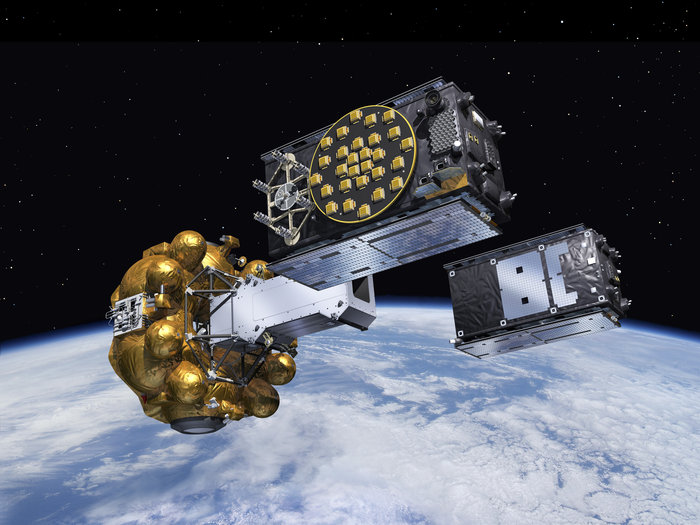
As a follow-up to Arianespace’s previous missions that used the medium-lift Soyuz to orbit Galileo satellites in pairs, the heavy-lift Ariane 5 enables four of the global positioning spacecraft to be accommodated on a single launch vehicle.
The four satellites are numbered Galileo 15 through 18.
Arianespace previously deployed 14 Galileo in-orbit validation and full operational capability spacecraft from the Spaceport in French Guiana on seven Soyuz missions, along with performing two other Soyuz flights from the Baikonur Cosmodrome in Kazakhstan with the GIOVE-A and GIOVE-B experimental satellites for the Galileo system.
Galileo will offer a guaranteed, high-precision positioning service for Europe under civilian control. Its constellation will comprise 24 operational satellites, along with spares.
The European Commission funds — and has overall responsibility — for Galileo’s management and implementation, with the European Space Agency assigned design and development of the new generation of systems and infrastructure.
OHB System in Bremen, Germany built the satellites to be orbited by Arianespace’s Flight VA233, and their navigation payloads were supplied by UK-based Surrey Satellite Technology Limited (SSTL), which is 99 percent owned by Airbus Defence and Space.
Launch kit
The four spacecraft carried by Ariane 5 are called Antonianna, Lisa, Kimberley and Tijmen – with their naming for winners of a European children’s drawing contest.
A video of the launch will be streamed here. Streaming starts at 12:36 GMT (13:36 CET)
One of four Galileo satellites being unloaded from its 747 after arriving at Cayenne–Félix Eboué Airport in French Guiana on Sept. 6. The satellites were then transported to Europe’s Spaceport.
News from the European Space Agency
A transatlantic flight delivered four Galileo satellites to French Guiana on Tuesday, in preparation for a shared launch this November by Ariane 5 — the first for Europe’s satnav constellation.
The satellites’ odyssey began the previous day, when they left ESA’s technical center in Noordwijk, the Netherlands, where every Galileo satellite is tested.
Each satellite was placed into protective containers before leaving the cleanroom environment of the test facility. These containers incorporate sophisticated environmental control, satellite monitoring systems and shock absorbers.
Four Galileo satellites leaving ESA’s technical centre in the Netherlands on Sept. 5, destined for Europe’s Spaceport in French Guiana for a scheduled November launch. (Photo: ESA)
They were then driven by separate lorries to Luxembourg Findel Airport. On Tuesday morning they were flown by 747 aircraft to Cayenne–Félix Eboué Airport in French Guiana, touching down around 10:30 local time.
They were taken to the S1A payload preparation building of the Guiana Space Centre, to be unboxed the following day.
The building will remain their home as their launch campaign begins. The first activity is a ‘fit check’ with the dispenser that will release them into orbit from the rocket’s upper stage.
The modified Ariane 5 that will carry the four Galileos into orbit arrived in French Guiana a fortnight ago.
Elements of Galileo’s specially customised Ariane 5 were unloaded from the MN Colibriroll-on/roll-off ship at French Guiana’s Pariacabo Port on Aug. 22. (Photo: ESA)
In development since 2012, this new variant has evolved from the Ariane 5 used to place ESA’s 20 tonne supply ferry for the International Space Station into low orbit.
This new version will carry a lighter payload — four fully fuelled 738 kg Galileo satellites plus their dispenser — but must take it up to the much higher altitude of 23,222 km.
November’s launch is a major step up for Galileo. The 14 Galileo satellites already in orbit have been launched two at a time, by Soyuz from French Guiana.
Four Galileo satellites left ESA’s technical centre in the Netherlands on Sept. 6, destined for Europe’s Spaceport in French Guiana, scheduled for a November launch. (Photo: ESA)
Having 18 satellites in orbit should enable initial Galileo operational services to begin, a decision that will be taken by the European Commission, the system’s owner.
Two more Galileo launches by Ariane 5 are due in the next two years.
A four-satellite dispenser for Galileo’s Ariane 5 is shown during shaker testing at Airbus Defence and Space near Bordeaux, France. The dispenser has had four Galileo engineering models attached to it for test purposes. (Photo: ESA)
In Geospatial Solutions’ sister publication, GPS World magazine, I’ve written quite a bit about how high-precision GNSS is going to significantly improve over the next few years.
Most GNSS users have receivers capable of using GPS (31 satellites) and Glonass (about 24 satellites). That generally equates to between 13 and 20 satellites in view with a clear sky and average terrain. However, add in variable terrain, some trees and perhaps a nearby building or two, and it can be a challenge to find enough solid satellites to track to obtain a high-precision GNSS position (less than a meter).
As the demand for high-precision GNSS positioning continues to grow, users are going to want to work in increasingly more difficult environments where high-precision GNSS struggles. More satellites will help, but they won’t come from GPS, nor GLONASS.
The GPS constellation is currently full, and is not going to grow any larger than 31 satellites (due to limitation in current GPS ground control software) in the foreseeable future. Even if GPS could fly more satellites, the orbit design accommodates only 27 satellites. GLONASS appears happy at 24 satellites and is not expanding anytime soon.
The answer lies in Europe, with China following.
After two decades of start, stop, restart, retool, regroup and start again, Europe’s Galileo constellation is real — very real. It’s all fun and games until Galileo starts launching four satellites at a time, which it is scheduled to start doing in a couple of months. Those four new satellites, added to the 12 in orbit (plus two in odd orbits), should be enough for Galileo to begin initial operation in Q4 of this year. Then, each new launch of four additional Galileo satellites will only improve the reliability and robustness of high-precision positioning. That’s a big deal for high-precision GNSS users.
Get ready for another jump in performance in high-precision GNSS positioning.
Do you remember the value that GLONASS added to GPS-only receivers 10-plus years ago? It was a premium feature on high-precision GNSS receivers in those days. Now, GLONASS is a standard feature on your smartphone.
Not very long from now, we’ll be making similar comments about Galileo. Satellite positioning in general, and high-precision GNSS positioning specifically, are satellite-hungry. As high-precision GNSS technology continues to embed itself deeper into a wide variety of industries, users will expect the technology to work. Some of those expectations, maybe many expectations, will be unreasonable. In dense urban environments? Under heavy tree canopy? In rugged terrain?
Unreasonable expectations are O.K. — that’s what pushes GNSS product managers and GNSS engineers to think outside of the box. More satellites will help meet some of the unreasonable user expectations.
What’s even better is that China’s global BeiDou system isn’t far behind Galileo. China’s regional BeiDou system (16 satellites in regional orbits over China) already makes China the best place in the world for high-precision GNSS positioning. Like Galileo, China’s global constellation is said to consist of 30 satellites.
That means in the not-too-distant future (about 2018 for Galileo and 2020 for BeiDou):
31 x GPS
24 x GLONASS
30 x Galileo 30 x BeiDou Total: 115
This translates into more than double the satellites in view that we have at this point in time. But, you don’t have to wait. Galileo satellites are usable this year if your receiver has been designed to use them. With each new Galileo launch, you’ll have access to four more satellites until the constellation reaches 30. The same goes for BeiDou.
Don’t take this wrong, GPS isn’t done. Not by a long shot. However, historically speaking, at one satellite per rocket launch, it’s only averaging about one launch every six months. To complicate things, the U.S. Air Force has launched all of the current GPS model (IIF) satellites and aren’t ready to launch GPS III satellites yet. See Don Jewell’s August column in GPS World magazine for details.
The good news is that the user community doesn’t have to rely on an expanded GPS constellation to improve performance any more than the “gold standard” it has become. The difference-makers are going to be Galileo beginning this year and BeiDou beginning in 2018. So, get ready folks, and fasten your seatbelt. The next generation of GNSS is about ready to begin, and your geodatabase is about ready to get a double-shot of Vitamin B.
It was not a big wager as wagers go, at least not in monetary value, but the underlying premise of the wager spoke volumes. It all began innocently enough in 2005 when the first test, or proof of concept, Galileo satellite known as GIOVE-A was launched.
In March of that year, a group of PNT experts made a simple wager that there will be:
10 or fewer operational Galileo satellites by 12/31/15
or
11 or more operational Galileo satellites by 12/31/15
Galileo’s GIOVE-A retired in June 2012.
About 20 PNT experts took the bet, evenly divided on both sides, which essentially said that given that the first test (GIOVE) Galileo satellites were launched in 2005 and 2008 respectively, surely there would be at least 10 operational satellites on orbit or about one per year by 2015.
The stakes were modest, but as I said, the import of the faith (or lack of faith) in the European Union and its ability and understanding of the difficulties involved in the Galileo endeavor spoke volumes. As the chief scientist at Air Force Space Command stated at the time, “This is rocket science; this is hard.”
Chutzpah and/or naïveté
But the Europeans refused to believe it was a very hard problem. Indeed, after the second GIOVE launch, GIOVE-B in 2008, the European ministers announced, with incredible chutzpah and/or naïveté, that the Galileo constellation would be fully operational (24 fully operational on-orbit satellites) by 2013.
Of course, nothing of the sort has happened. Following the in-orbit validation (IOV) satellites, the first operational satellite launch did not occur until October 2011, almost six years later.
As of May 2016, there were 12 operational Galileo satellites on orbit along with two in early orbit or checkout stages — a far cry from the predicted 24 operational satellites. This is not a criticism of the Galileo system; rather, a validation of those who took the pessimistic side of the wager and of the chief scientist who clearly stated the obvious: this is indeed, as a popular euphemism states, a DARPA hard problem.
So the Europeans have been going about this PNT business since the initial decision to proceed in 2003 — 13 years. The United States has been producing and launching GPS satellites continuously since the first test launch of a NAVSTAR satellite in 1977 (39 years), with a continuously fully operational system (FOC) since 1995 (21 years), and guess what? It is still a hard problem. No one denies that. Which brings us to GPS III.
GPS III Update
Since the United States — specifically the United States Air Force (USAF) — has been in the space-borne PNT business longer than any other nation, you would think we would have this down by now. But it is still a hard problem with, fortunately, a long string of successes and very few (only two) failures.
To date, the U.S. government has launched a total of 72 GPS satellites. There are 31 active operational GPS SVs (satellite vehicles) on orbit, with seven additional in residual or test status; 32 have been retired into a parking orbit where they will not interfere with the operational constellation. That equates to 1.85 GPS satellites launched per year on average, or one every 6.5 months — an enviable record, failures and all.
Plus, there are GPS IIA satellites still on orbit that have been there for more than 22 years. Not bad for a satellite built to last (contracted service life) for 7.5 years.
Amazingly, the payloads on every GPS satellite to date were built, in part, in partnership with or completely by one company, now known as Harris, nee Exelis, nee ITT. Of course, the complexity of the payloads being built by Harris for the GPS III satellites is a far cry from the payloads built in 1975 for launch in 1977. According to GPS III program manager and VP Mark Stewart and his cohorts at Lockheed Martin (LMCO), the aerospace company building the GPS III satellites, GPS III
“…will deliver three times better accuracy, provide up to eight times improved anti-jamming capabilities and extend spacecraft life to 15 years [ed. contracted life], 25 percent longer than the [ed. latest family of satellites on orbit today]. GPS III’s new L1C civil signal … will make it the first GPS satellite to be interoperable with other international global navigation satellite systems.”
While many of you may look upon that LMCO statement as marketing hype, in fact it is a rather incredible prophesy. To a PNT expert it translates to: almost all GPS users globally will have sub-meter level positional accuracy from a group of signals that will rarely if ever be completely jammed, from an SV with a projected lifetime of 30 years that has more signals and greater signal strength, flexibility and interoperability than ever before. By the numbers GPS is still, far and away, the world’s gold standard.
So exactly where are we in relation to a launch of the first evolutionary GPS III satellite? After all, the last IIF launch, number 12 in the series, built by Boeing, occurred in February, so by the law of averages we should have the first GPS III launch later this month. That is not going to happen, but then what is a few months among friends when iterated over 39 years?
Currently the first GPS III launch date, according to the USAF, is scheduled for May 2017. All indications are the government is on track to meet that date with, interestingly enough, the availability of a suitable launch vehicle being the LIMFAC (limiting factor), not the availability of an GPS III SV to launch.
SV 01 in testing at Lockheed Martin’s Denver facility. (Photo: LMCO)
According to my sources, GPS III SV-01 is fully integrated, has completed all environmental testing and is essentially ready to ship to Cape Canaveral,. It would be available for launch (AFL) sometime before the end of the calendar year if there were a launch vehicle, a ground control system and range availability.
GPS III SV-02 will undergo full integration (“core-mating”) completion sometime this fall and — following successful completion of its environmental tests — should certainly be AFL in 2017.
The complete navigation panel (from Harris) for GPS III SV-03 should arrive in the LMCO Denver facility early next year. Providing the vehicle stays on track through testing, it should be AFL in 2018.
The government has yet to complete the contract award process for GPS III vehicles SV-09 and SV-10 to LMCO, but I am assured the award is imminent.
My sources confirm that Harris is continuing to pump money, expertise and technology into the GPS III payload development process, a manufacturing tour de force, and the company should be back on schedule early next year.
As for OCX, the future GPS Ground Control Segment, that is another tale for another time. For all other GPS III segments, all in all it is a positive message for development and deployment. Which is an admirable feat — after all, it is rocket science!
By the way, the Galileo wager is open to interpretation. There were certainly more than 10 Galileo platforms on orbit on the last day of December 2015, but only nine of them were operational at the time. Both sides are claiming victory. What a surprise!
A product to save your hearing
The EB15LE with Hearing Defenders with accessories. (Photo: ERI)
Before I close, I want to mention a product I have tested as extensively as I can in a limited environment. I agreed to test this non-GPS product because of all the emails and letters I receive concerning tinnitus and how it negatively affects our warfighters. Several emails make clear the necessity and criticality of a good sight picture or display for GPS guidance, especially where exfiltration is concerned.
When warfighters or law enforcement officers are suffering the ill effects of extremely loud noises, it is often disorienting. Much like the effects of a flash-bang device, a victim can lose his bearings and needs to have a clear visual of how to exit the threat environment.
The best solution would be not to suffer the devastating effects of the loud noises in the first place. This is where a company named Etymotic Research Incorporated (ERI) comes into play. ERI has developed electronic hearing protection for law enforcement officers and military users.
The version I tested was designated the EB15 for law enforcement. It functioned well as electronic hearing protection and amplification where needed. The device is essentially an electronic hearing aid that amplifies natural or quiet sounds up to five times, and a hearing defender that electronically blocks loud, harmful sounds by up to 25 decibels.
While I was not able to test the hearing defenders in actual combat, the testing I did perform demonstrated that the EB15-LE is an impressive product with a plethora of earplugs for various noisy environments that may help save a user’s hearing. Our warfighters and law-enforcement officers deserve the best technology available, especially if it helps them retain their orientation in a dangerous environment and saves their hearing.
Until next time, happy navigating, and remember: GPS is brought to you free of charge courtesy of the USAF.
Galileos 13 and 14 are scheduled to lift off at 08:48:43 GMT (05:48:43 local time, 10:48:43 CEST) on May 24 from Europe’s Spaceport in French Guiana atop a Soyuz launcher.
The first three stages of the Soyuz rocket take the Galileo satellites and their Fregat upper stage into low orbit nine minutes after liftoff. Then the reignitable Fregat, as much a spacecraft as a rocket stage, takes over the task of hauling the satellites higher through a pair of burns.
The satellites will be released in opposite directions by their dispenser once they reach their target 22,522-kilometer-altitude orbit 3 hours and 48 minutes after launch.
On Wednesday, May 18, Europe’s latest Galileo satellites were placed atop their upper stage then enclosed within their protective rocket fairing. The encapsulation took place inside the Spaceport’s cleanroom, as a two-piece Soyuz fairing was closed around the satellites, attached to their carrier atop the Fregat upper stage.
Europe’s 13th and 14th Galileo satellites being encapsulated inside their launcher fairing. (Photo: ESA)
The satellites had been installed on Fregat the previous day. This versatile upper stage will haul them the bulk of the way to their target 23,500-kilometer-altitude orbit.
The sealed satellites, dispenser and upper stage are collectively known as the “upper composite.” Today, the plan is to roll out the first three stages of Galileo’s Soyuz to the launchpad, ready for mating with this upper composite.
This will be the seventh Galileo launch, set to bring the number of satellites in space up to 14. Four more Galileos are planned to take flight in the autumn, launched for the first time on a customized Ariane 5 to bring the total number of satellites in the constellation to 18.
Watch the launch live here. Streaming begins at 08:28 GMT (10:28 CEST) on 24 May for the liftoff, then resumes at 12:23 GMT (14:23 CEST) to cover the satellites’ separation.
For other upcoming GNSS satellite launches, see this page.
Early Operations Phase. According to the European Space Agency (ESA), a combined team of specialists is conducting final training at ESA’s ESOC mission control centre to prepare for the launch.
The team comprises over 40 experts drawn from ESA and from France’s CNES space agency, supported by additional specialists at both agencies in areas such as flight dynamics and ground stations.
Within the combined flight control team, each position is paired with its counterpart from the other agency and mixed CNESOC shifts will rotate to conduct operations around the clock.
The same team conducts all the Galileo early operations alternately from ESOC and from the CNES control centre in Toulouse, France.
By launch day, the teams will have completed a demanding series of joint simulation training sessions at ESOC, complemented by more specific training conducted separately at each control centre. Joint sessions are especially important to develop team bonds “on-console” — so individuals get to know who will be working beside them and can foster one-on-one teamwork and mutual support.
Three Flight Operations Directors and three Spacecraft Operations Managers will work together with their teams in each of three shifts during the nine-day early operations phase. From left: Hélène Cottet (CNES), Remi Lapeyre (CNES), Liviu Stefanov (ESA), Christelle Crozat (ESA), Thomas Cowell (ESA) and Hervé Côme (ESA).
Another pair of Galileo navigation satellites is scheduled for launch by a Soyuz rocket on May 24 from Europe’s Spaceport in French Guiana, bringing the Galileo system a step closer to operational use.
This video gives an overview of Galileo and shows Galileo 13 and 14 in preparation in Kourou. It includes an interview with Paul Verhoef, ESA director of the Galileo Programme and navigation-related activities.
The European Commission asked the European Space Agency (ESA) to speed up the deployment of the constellation and to increase it’s robustness for delivering initial services, according to ESA.
A total of 12 satellites has been deployed into orbit during the last four years — six in the last year alone.
Galileo Fregat upper stage flew the latest two Galileo satellites most of the way up to medium-Earth orbit before they finally separated. (Artist’s concept, courtesy of ESA).
Galileo satellites 11 and 12 lifted off together on Dec. 17 atop a Soyuz rocket, and successfully deployed in space four hours later. The pair effectively doubles the number of Galileo satellites in space over the last nine months.
Five satellites are now set operational to the user. Once 9 and 10 (launched in September 2015) as well as 11 and 12 are set operational, a total of nine usable satellites will be in orbit. Satellites 5 and 6 may be partially usable at some point.
“Along with the ground stations put in place around the globe, this brings Galileo’s completion within reach,” said Jan Woerner, director general of the European Space Agency.
“Production, testing and launch of the remaining satellites are now proceeding on a steady basis according to plan,” added Didier Faivre, ESA’s director of Galileo and navigation-related activities.
Starting with launches in the third quarter of 2016, four rather than two satellites at a time will rise into orbit. This accelerated deployment should bring 30 satellites on line — 24 operational and six orbit spares — by 2020 for full operational capability of the European GNSS. Initial operating capability is foreseen by the end of 2016.
“The target is initial service next year, with a reduced constellation, for the Open Service, Public Regulated Service and Search-and-Rescue,” said Carlo des Dorides, executive director of the European GNSS Agency (GSA). “We will also start proof-of-concept testing for the Commercial Service. The performance will be reduced in terms of availability and continuity because of the reduced number of satellites — but not in terms of accuracy.”
Fundamental Elements. For the benefit of users and industry on the ground, the GSA announced in September the provision of 100 million euros ($110 million) to promote development of chipsets and receivers. Slated for distribution between 2015 and 2020, the funds are to stimulate market reception for Galileo. The announcement followed a paper published by the Galileo Services industry consortium urged accelerated investment by European governments to safeguard competitiveness of European manufacturers with U.S. and Chinese industry in the satnav user equipment market.
Sensitivity on PRS. Sorting out access to the encrypted Public Regulated Service (PRS), even among the 28 EU member nations, involves some thorny issues. EU officials have grappled with so-called Common Minimum Standards that set rules on PRS access for national government agencies and PRS hardware manufacturers, with the goal of ensuring that the encrypted signal is not compromised. The diversity of EU nations’ security precautions is wide enough that the European Commission (EC) has reserved the right to conduct inspections of agencies and companies working with PRS to verify compliance. Each nation using PRS will create a specialized agency responsible for its use.
Due to the sensitive subject matter, the EU will not publish supporting documents for the Common Minimum Standards in the EU’s Official Journal. The standards were nonetheless approved in November.
Nations outside the EU face a more difficult path to PRS. Norway and the United States have applied. Both are members of the North Atlantic Treat Organization (NATO), and military use by all agreeing parties is a tacit aspect of the PRS. The next step to granting U.S. and Norwegian access is for the EU’s highest decision-making body, the European Council, to give the European Commission authority to open negotiations with U.S. and Norwegian authorities.
New ICD. In late November, the European Commission published a new release 1.2 of the Galileo Open Service Signal In Space Interface Control Document (OS SIS ICD v1.2).
GPS Fully Funded, Minus $2 Million
In late November, President Obama signed the National Defense Authorization Act (NDAA) for Fiscal Year 2016, after vetoing a previous version. The enacted NDAA complies with the two-year budget agreement, which called for a reduction in defense spending.
The act reduces the GPS IIF line item by $2 million, citing “unjustified support growth” from the U.S. House of Representatives Committee on Appropriations, but otherwise recommends full funding for the Air Force GPS program ($936.775 million).
Privacy Uptaken. In other Capitol developments, Sen. Al Franken (D-MN) reintroduced the Location Privacy Protection Act. According to the senator’s office, “The Location Privacy Protection Act of 2015 closes legal loopholes that allow stalking applications to exist on smartphones.
“Sen. Franken’s bill fixes this problem by requiring companies to get customers’ permission before collecting their location data or sharing it with third parties.”