Tag: Galileo constellation

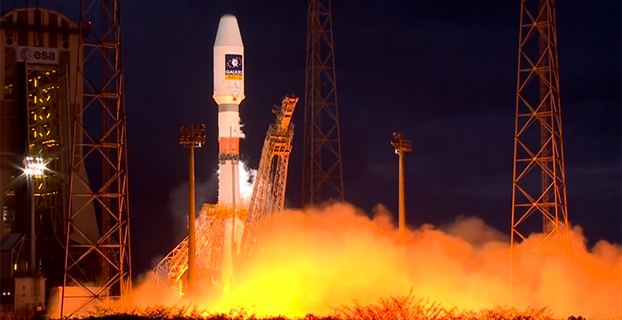
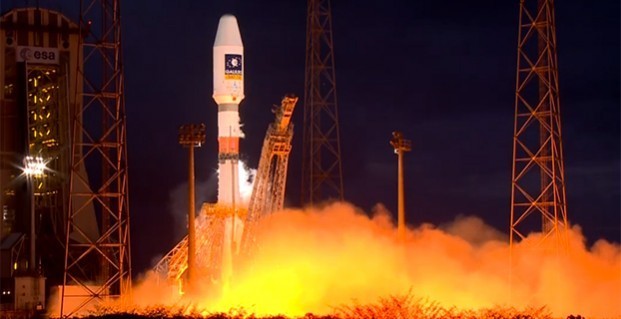
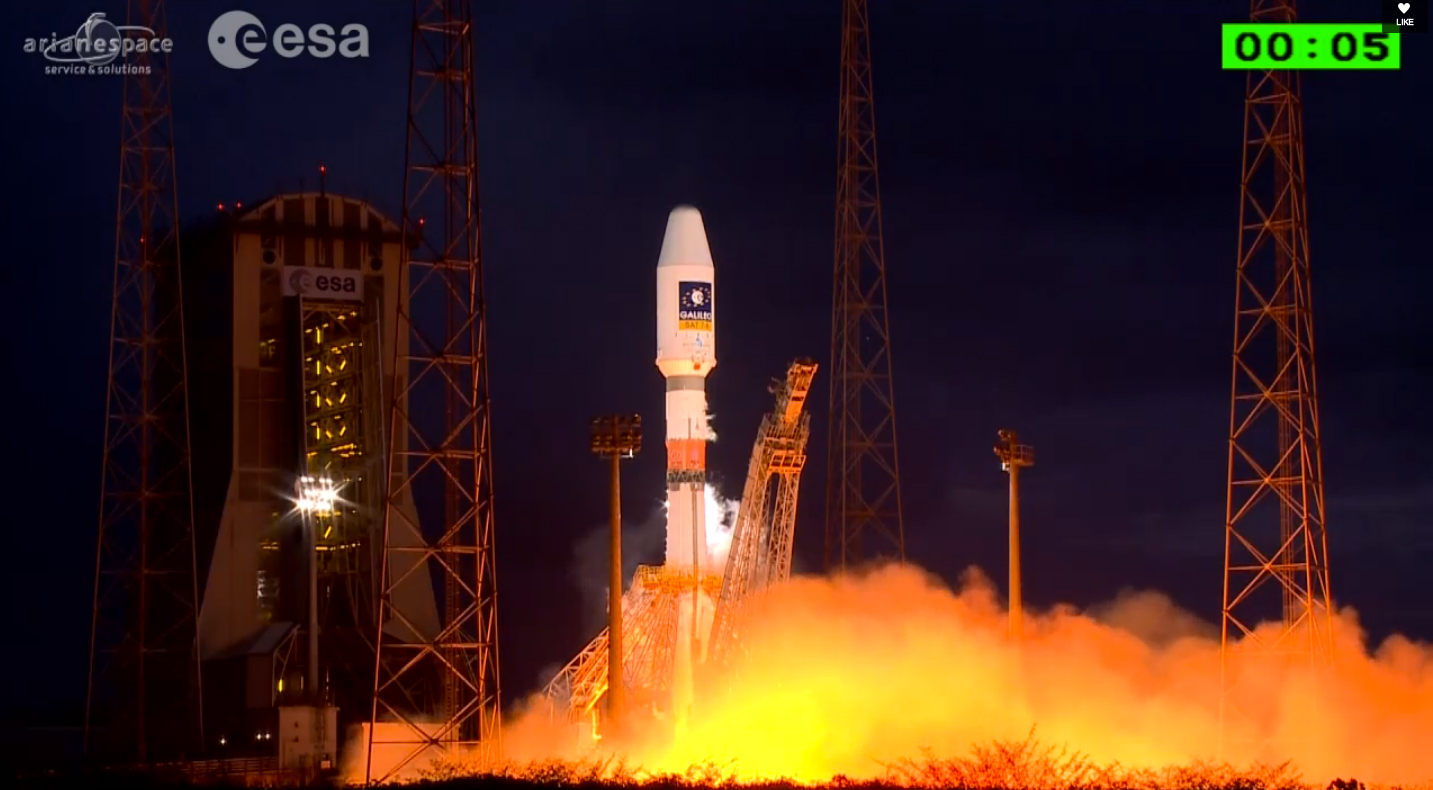
  • Watch the Launch of Galileo 9 and 10

    Watch the Launch of Galileo 9 and 10

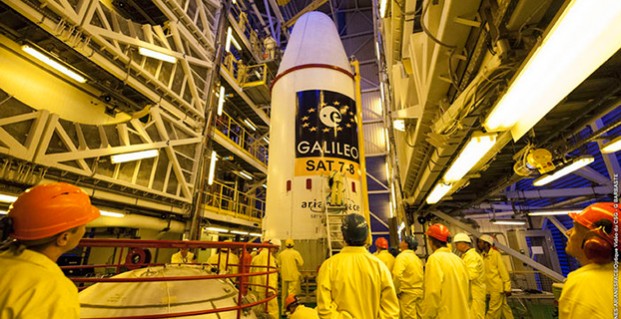
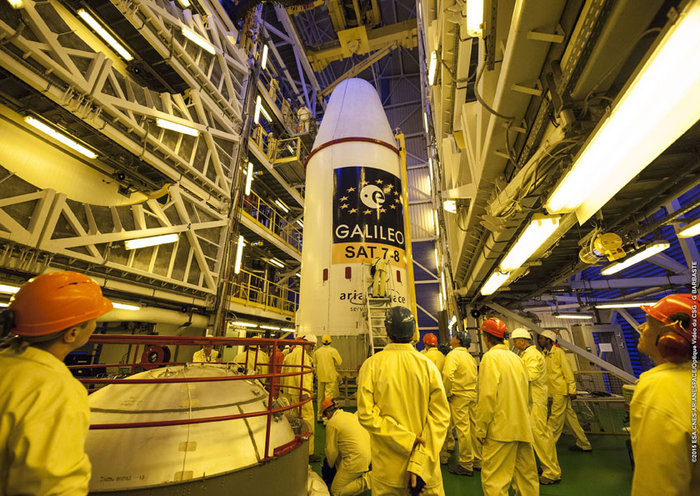
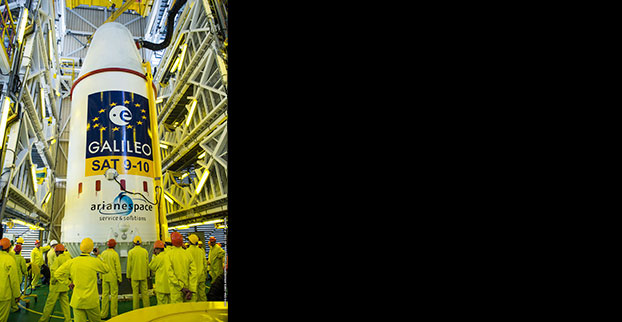
    On Sept. 7, the upper composite containing Galileos 9–10 was transferred to the launch pad, then hoisted up to the top of the Soyuz launch tower to be joined to the other stages.
    On Sept. 7, the upper composite containing Galileos 9–10 was transferred to the launch pad, then hoisted up to the top of the Soyuz launch tower to be joined to the other stages.

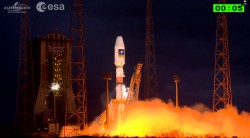
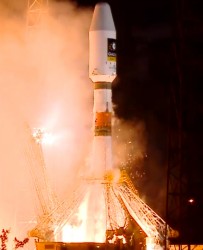
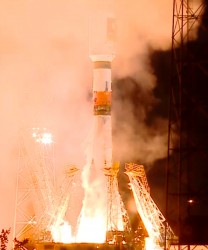
    Galileo 9 and 10 are due for launch atop a Soyuz rocket at 02:08 GMT on Sept. 11 (04:08 CEST; 23:08 local time, Sept. 10) from Europe’s Spaceport in French Guiana. Streaming starts at 01:48 GMT (03:48 CEST) on the European Space Agency website. Or watch at Arianespace’s website (with commentary in French or English), starting 15 minutes before liftoff. You can also follow the launch live on your iPhone or iPad using the free Arianespace.tv app.

    The first three stages of the Soyuz rocket take the Galileo satellites and their Fregat upper stage into low orbit. Then the reignitable Fregat, as much a spacecraft as a rocket stage, will take over the task of hauling the satellites higher through a pair of burns.

    The satellites will be released in opposite directions by their dispenser once they reach their set 22 522 km-altitude orbit 3 h 47 min 57 sec after launch.

    The webstream will cover the launch and orbital insertion in two parts, the first starting at 01:48 GMT (03:48 CEST) and ending at 02:40 GMT (04:40 CEST). The second part will begin at 05:43 GMT (07:43 CEST) and end at 06:50 GMT (08:50 CEST).


    Read Richard Langley’s update on the Galileo constellation.


    Two more satellites are scheduled for launch by end of this year. One is under test at ESA’s ESTEC technical centre in Noordwijk, the Netherlands, while the other has already completed its checks and is awaiting shipping to Kourou in the second half of October.

    In addition, the first satellite of the following batch (Galileo-13) is undergoing its thermal-vacuum test at ESTEC, while the second (Galileo-14) arrived on Monday.


    From ESA: Anatomy of a Galileo launch in pictures.
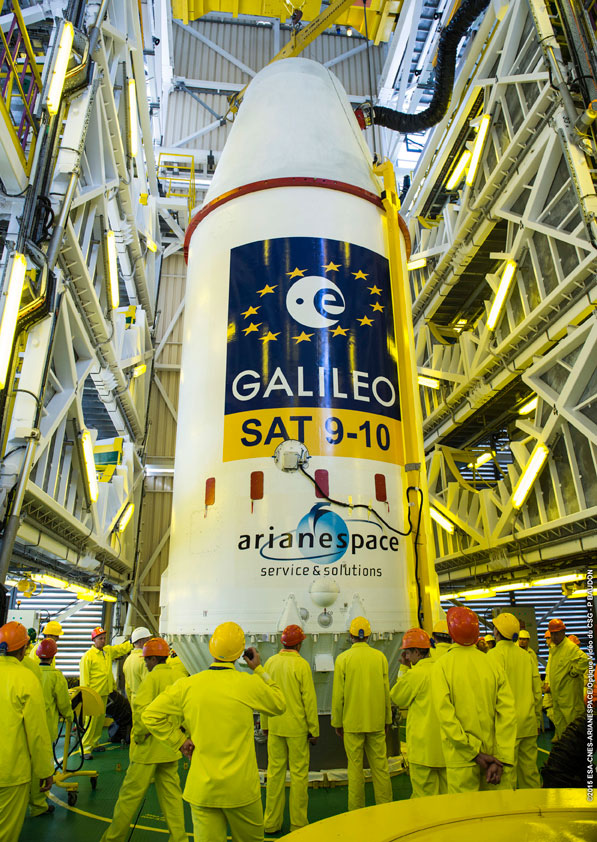

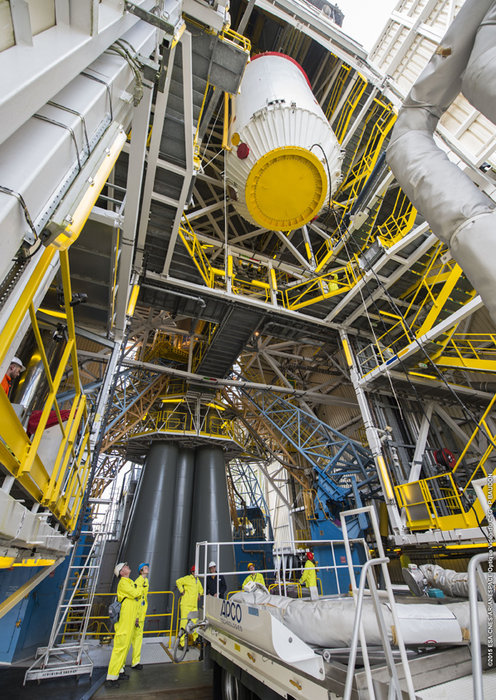
    Hoisting VS12 launcher integration and composite, on Sept. 7. (Photo: CNES)
    Hoisting VS12 launcher integration and composite, on Sept. 7. (Photo: CNES)

    Launch Details from Arianespace

    Orbit: circular medium Earth orbit (MEO)
    Altitude: 23,522 km
    Inclination: 57.4 degrees

    Liftoff is scheduled for Thursday, Sept. 10, 2015, at:

    11:08:10 p.m., local time in French Guiana
    10:08:10 p.m., in Washington, D.C.

    and on Friday, Sept. 11 at:

    02:08:10 UTC
    4:08:10 am, in Paris
    6:08:10 am, in Moscow

    The mission (from liftoff to satellite release) will last approximately 3 hours and 48 minutes.

    The launcher will be carrying a total payload of 1,601 kg, including 1,431 kg for the two Galileo satellites.

    The Launch Readiness Review (LRR) took place on Wednesday, Sept. 9, in French Guiana, to authorize the start of operations for the final countdown.
  • Latest Galileo Satellites Will Head to Plane A

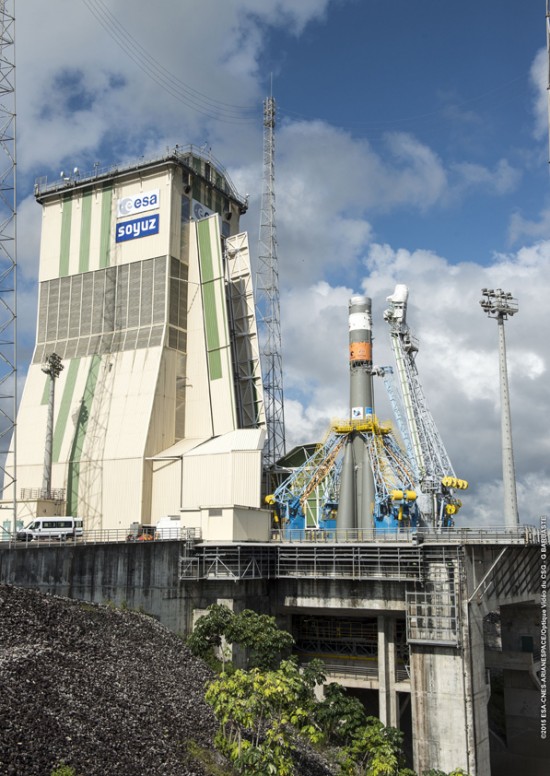
    The Soyuz launcher is transferred to the launch pad. (Credit: Arianespace)
    The Soyuz launcher is transferred to the launch pad. (Credit: Arianespace)

    I had the honour of the first question at today’s Galileo press conference hosted by the European Space Agency (ESA), and it was about the status of the satellites launched last March. The answer to that question and others are below.

    The satellites being launched this evening are destined for Plane A and will be its first occupants. They will occupy slots 5 and 8 in the plane. They will undergo a 76-day-long in-orbit test procedure before being made available to users.

    The satellites launched in March, Galileo satellites 7 and 8 (a.k.a. FOC-FM3 or GSAT0203 and FOC-FM4 or GSAT0204 using PRNs 26 and 22, respectively), have essentially completed in-orbit testing and should be available to users sometime this month.

    The ground segment is to be modified to enable the production of navigation messages for satellites 5 and 6 (a.k.a. FOC-FM1 or GSAT0201 and FOC-FM2 or GSAT0202 using PRNs 18 and 14, respectively) launched in August 2014 into wrong orbits (a “kind of Plane D” according to one of the ESA officials at the press conference). This will occur by the beginning of 2016 when these satellites will then be available for testing in navigation and positioning applications. They will not be included in the broadcast almanac as the orbits are too far from nominal to be represented by the standard almanac format. But the signals should be fully usable by those receivers and chipsets that can acquire and track Galileo satellites without an almanac. Testing will be carried out to see if the satellites can become part of the operational constellation.

    IOV-4 (a.k.a. FM4 or GSAT0104 using PRN 20), the in-orbit validation satellite that suffered a power failure in May 2014 and is only broadcasting on the E1 frequency, may become operational for single-frequency use if suitable ground segment modifications can be made.

    The next Galileo launch after this evening’s will be in December on a Soyuz launcher when another two satellites will be placed into orbit.

    In 2016, there will be one launch but using, for the first time, the Ariane 5 launcher, to place four satellites into orbit.

    In 2017, there will be two launches: a Soyuz launch orbiting two satellites, and an Ariane 5 launch, orbiting four satellites.

    A 30-satellite constellation will be in place by 2020, following ESA’s slogan “30 satellites by 2020,” with 10 satellites per plane with each plane having two spare satellites. This should be feasible as two satellites are now being manufactured every three months. Twenty-four satellites is the minimum for Galileo operational capability.

  • New Galileo Pair Head to Working Orbit

    New Galileo Pair Head to Working Orbit

    Galileo 7 and 8 were launched into orbit on time today. (Screenshot of  ESA/Arianespace livestream feed.)
    Galileo 7 and 8 were launched into orbit March 27. (Screenshot of ESA/Arianespace livestream feed.)

    Europe’s two newest Galileo satellites — launched March 27 — have carried out maneuvers to take them down to their working positions in orbit. Both satellites are performing well. Galileo 7 and 8 were launched into a circular 23,522 km altitude orbit about 300 km above their final orbit.

    Using their onboard thrusters, the two Galileo satellites have performed all their Launch and Early Operations Phase (LEOP) maneuvers, reports the European Space Agency (ESA). The maneuvers began as soon as the automatic initialization sequence was completed.

    A joint team of ESA and CNES personnel oversaw the LEOP process from the French space agency CNES in Toulouse. On March 28, the team ensured that the two satellites’ solar arrays deployed correctly and oversaw the gradual switch-on of the satellites systems.

    Once the two satellites passed inspection, control was passed to Galileo’s Oberpfaffenhofen-based Control Centre (run by SpaceOpal, a joint venture by DLR Gesellschaft für Raumfahrtanwendungen and Telespazio) to prepare for their final In-Orbit Testing (IOT) in two phases: commissioning for the host satellite platforms, and then their navigation and search and rescue payloads. Platform commissioning is now taking place.

    The Galileo satellites’ navigation and the search and rescue payloads will be switched on in few weeks and will begin detailed in-orbit testing, overseen from ESA’s Redu centre in Belgium, which is equipped with a 20-meter antenna for high-resolution acquisition of the navigation signals.

    The hosting of Galileo’s LEOP team alternates between CNES in Toulouse and ESA’s ESOC control centre in Darmstadt, Germany. Early operation of the next pair of Galileo satellites will be masterminded from ESOC — launch is scheduled for September.

  • Two Galileo Satellites Launched for Europe’s Navigation Constellation

    Two Galileo Satellites Launched for Europe’s Navigation Constellation

    Galileo 7 and 8 were launched into orbit on time today. (Screenshot of ESA/Arianespace livestream feed.)
    Galileo 7 and 8 were launched into orbit on time today. (Screenshot of ESA/Arianespace livestream feed.)

    UPDATE: The two Galileo satellites are confirmed separated from their Soyuz Fregat upper stage into 22,522 altitude orbit right on schedule, according to ESA. Both are in their planned orbits.


    Two more Galileo satellites were successfully launched today from Europe’s Spaceport in French Guiana. The seventh and eighth Galileo satellites were lifted aloft on time at 21:46:18 GMT (22:46:18 CET) atop a Soyuz ST-B rocket.

    The first three stages of the Soyuz rocket are delivering the Galileo satellites and their Fregat upper stage into low orbit. Then the reignitable Fregat, as much a spacecraft as a rocket stage, will take over the task of hauling the satellites higher through a pair of burns. The satellites will be released in opposite directions by their dispenser once they reach their set 22,522 kilometer-altitude orbit 3 hours, 47 minutes, 57 seconds after launch.

    The launch is designated VS11 in Arianespace’s numbering system. Flight VS11’s passengers — built by OHB System, with Surrey Satellite Technology Ltd. supplying the navigation payloads — are the third and fourth Full Operational Capability (FOC) satellites in the Galileo program, which is creating a European-operated space-based navigation system.

    The European Commission is managing and funding Galileo’s FOC phase, during which the network’s complete operational and ground infrastructure will be deployed. The European Space Agency has been delegated as the design and procurement agent on the commission’s behalf.

    Watch a replay of the launch here:

  • Watch Friday’s Launch of Galileo 7 and 8

    Watch Friday’s Launch of Galileo 7 and 8

    The upper composite containing the seventh and eighth Galileo satellites attached to their dispenser atop the Fregat upper stage inside the launcher fairing was hauled up the mobile launch tower then attached to the first three stages of its Soyuz ST-B launcher on March 24. (Photo courtesy of ESA)
    The upper composite containing the seventh and eighth Galileo satellites attached to their dispenser atop the Fregat upper stage inside the launcher fairing was hauled up the mobile launch tower then attached to the first three stages of its Soyuz ST-B launcher on March 24. (Photo courtesy of ESA)

    The seventh and eighth Galileo satellites are scheduled for launch Friday, March 27, at 21:46:18 GMT (22:46:18 CET) atop a Soyuz ST-B rocket from Europe’s Spaceport in French Guiana. Streaming starts at 21:24 GMT (22:24 CET) at the European Space Agency website.

    The first three stages of the Soyuz rocket will take the Galileo satellites and their Fregat upper stage into low orbit. Then the reignitable Fregat, as much a spacecraft as a rocket stage, will take over the task of hauling the satellites higher through a pair of burns. The satellites will be released in opposite directions by their dispenser once they reach their set 22,522 kilometer-altitude orbit 3 hours, 47 minutes, 57 seconds after launch.

    The webstream will cover the launch and orbital insertion in two parts. The first part begins at 21:24 GMT (22:24 CET) and ends at 22:19 GMT (23:24 CET). The second part begins at 01:22 GMT (02:22 CET) and ends at 02:17 GMT (03:17 CET).

  • Galileo 7 and 8 Fitted to Dispenser in Preparation for Launch

    Galileo 7 and 8 Fitted to Dispenser in Preparation for Launch

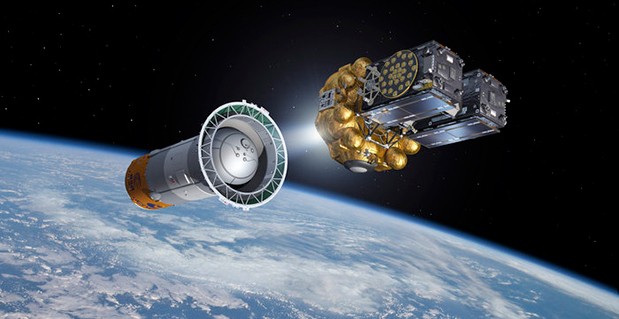
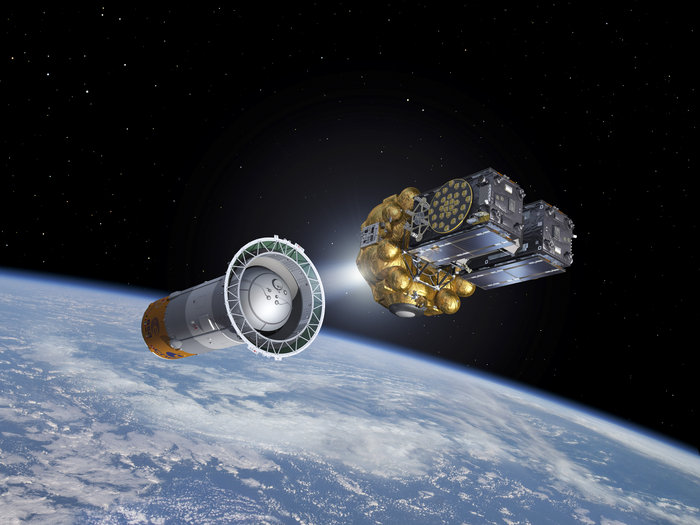
    Artist's view of Galileo satellites attached to their dispenser atop their Fregat upper stage separating from the Soyuz upper stage. The Fregat then flies them the rest of the way up to medium-Earth orbit.  (courtesy of ESA)
    Artist’s view of Galileo satellites attached to their dispenser atop their Fregat upper stage separating from the Soyuz upper stage. The Fregat then flies them the rest of the way up to medium-Earth orbit. (courtesy of ESA)

    News courtesy of the European Space Agency

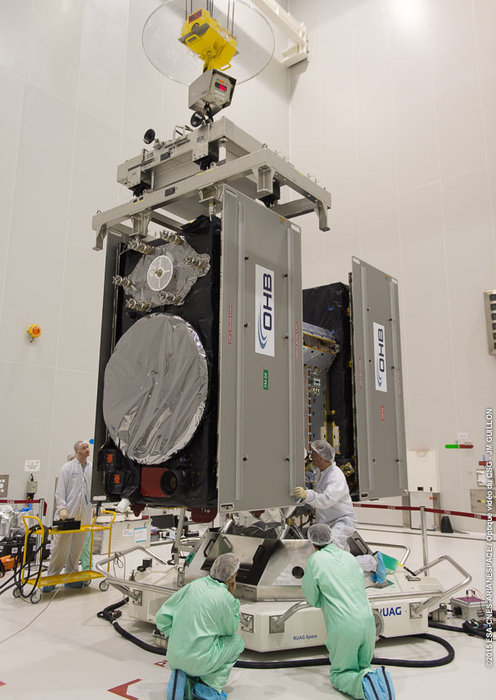
    The seventh and eighth Galileo satellites being fitted together onto the dispenser, March 16-17. (Photo courtesy of ESA)
    The seventh and eighth Galileo satellites being fitted together onto the dispenser, March 16-17. (Photo courtesy of ESA)

    The seventh and eighth Galileo satellites, set for launch together in nine days’ time, have been fitted together onto the dispenser that will carry them during their flight to orbit.

    The fueling of the two satellites was completed last week, leaving them ready to be placed into launch configuration. They were carefully lowered into place then attached to the dispenser. The operation went smoothly, the two satellites having previously gone through separate “fit checks” with the dispenser in advance of fueling.

    The specially designed carrier will hold the satellites in place during their four-hour flight into orbit some 22,300 km above our planet. Then, at the correct altitude, the two satellites are sprung away in opposing directions. Next, the dispenser plus satellites will be placed onto the Fregat upper stage of their Soyuz ST-B launcher.

    As much a spacecraft as a launch stage, the reignitable Fregat will haul the Galileo satellites most of the way up to their final orbital altitude, once the first three stages of the Soyuz have taken them up to their initial orbit.

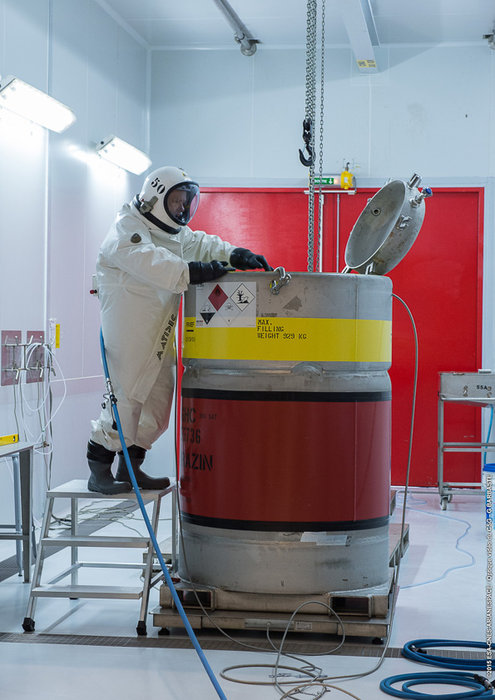
    Fuel for the seventh and eighth Galileo satellites, checked by an engineer in a protective SCAPE (Self Contained Atmospheric Protective Ensemble). Fuelling of the two satellites took place at the end of the second week of March 2015, allowing the satellites to be fitted to their launch dispenser ahead of the March 27 launch. (Photo courtesy of ESA)
    Fuel for the satellites is checked by an engineer in a protective SCAPE (Self Contained Atmospheric Protective Ensemble). (Photo courtesy of ESA)

    Note the protective metal panels covering the solar wings folded against the sides of the Galileo satellites. Protecting these delicate solar arrays during handling on the ground, these panels will be removed ahead of launch.

    The launch of the seventh and eighth Galileo satellites is scheduled for March 27.