Tag: GIS

  • 1Spatial Launches 1Edit Spatial Data Editing Solution

    1Spatial has launched 1Edit, a touchscreen compatible solution that offers fast and intuitive data-editing in the field or office, 1Spatial said.

    Trialed by Ordnance Survey Ireland (OSi), 1Edit incorporates a touchscreen for capture and editing of real-world data, making it a breakthrough for data collection in the field via touchscreen, stylus and survey devices, 1Spatial said. It can also be used in an office environment with mouse and keyboard. 1Edit’s “in the field” capabilities will benefit spatial data providers and industries such as utilities, transport, environment and government, the company said.

    “Ordnance Survey Ireland has been trialling 1Edit as a tool for maintenance of our PRIME2 product database,” said Lorraine McNerney, Spatial Data and Infrastructure Manager, Ordnance Survey Ireland. “PRIME2 is the OSi real-world feature database that ensures Ireland has accurate and up-to-date spatial datasets supporting improved government service delivery and economic development in Ireland. The facility for users to interact with 1Edit using a portable device touch screen with a stylus or as a desktop with a mouse, and the integration it provides with our existing survey equipment means that our surveyors out in the field and staff who are office based can utilise the same innovative tool for optimal efficiency. This means that we will be able to provide more accurate and up-to-date data to our customers more frequently.”

    1Edit provides fast and accurate topological editing to keep data connected, 1Spatial said. It allows change-only saving of data and supports rich real-world hierarchical data models, as well as intelligent management of inter-feature references.  1Edit is currently available on Windows 8 with other operating systems to follow.

    “We are delighted to launch 1Edit, which offers a powerful, fast and accurate tool to effectively manage real-world data,” said Marcus Hanke, CEO, 1Spatial. “1Edit maximises data output, because the touch screen capability means that whether organisations are using 1Edit on location or in the office, they will be able to use the same tool to edit information quickly and easily, saving them time and money on data capture. Organizations can also use aerial imagery or survey devices to ensure the quality and accuracy of the data they create and manage.”

  • Avenza Releases Geographic Imager 4.2 for Adobe Photoshop

    Avenza Systems Inc., producers of MAPublisher cartographic software for Adobe Illustrator and the PDF Maps mobile app, announces the release of Geographic Imager 4.2 for Adobe Photoshop. New formats are supported, including writing to the DEM TIFF format which saves raw DEM values and exporting web tiles to Google Maps or Microsoft Bing Maps format.

    This release is available at the Geographic Imager Basic license level which provides support for the geospatial framework in Adobe Photoshop as well as limited import and export abilities at an introductory price level. Also new in this release is the addition of the Georeference feature with the Geographic Imager Basic license.

    “We’ve been working on some very innovative features lately, one of them being the ability to export web tiles using Geographic Imager from Adobe Photoshop,” said Ted Florence, President of Avenza. “The web tiles are compatible with several online map services which allows our users to spend less time worrying about image referencing and more time creating online mapping solutions,“ he added. “Another great feature in this release is the new ability to save to the DEM TIFF format, which is interoperable and can be reopened in Geographic Imager or in other geospatial software packages. There has been a demand for extended format support and we’re continuing to listen to our users’ needs.”

    Features:

    • Available Geographic Imager Basic license
    • DEM TIFF write support, format saves raw DEM values
    • Ability to Export Web Tiles to Google Maps or Microsoft Bing Maps format
    • Geographic Imager panel improvements, including new Survey and Ruler tabs
    • Crop by Vector File Extents, use the geographic extents of a vector file to crop an image
    • Streamlined user interactions with command boxes and simpler messages
    • Various bug fixes and user experience enhancements.

    Geographic Imager is software for Adobe Photoshop that leverages the superior image editing capabilities of raster-based image editing software and transforms it into a powerful geospatial imagery editing tool, Avenza said. Work with satellite imagery, aerial photography, orthophotos, and DEMs in GeoTIFF and other major GIS image formats using Adobe Photoshop features such as transparencies, filters, and image adjustments while maintaining georeferencing and support for hundreds of coordinate systems and projections.

    Geographic Imager 4.2 is immediately available and free of charge to all Geographic Imager Maintenance Program members and at US$319 for non-maintenance upgrades. New fixed licenses start at US$699. Geographic Imager Basic licenses start at US$199. Academic and volume license pricing are also available. Geographic Imager 4.2 is compatible with Adobe Photoshop CS5, CS5.1 and CS6. Visit www.avenza.com/geographic-imager for more information.

  • Blue Marble Releases Global Mapper 14.2

    Blue Marble Geographics announces the release of Global Mapper version 14.2. This update to the company’s desktop GIS software offers many new and improved features and functions. Some of the major improvements include several scripting updates, improved Volume Measurement tools, new right-click option to the vector data Search dialog, many LiDAR enhancements and of course many new formats. Blue Marble’s geospatial data manipulation, visualization and conversion solutions are used worldwide by thousands of GIS analysts at software, oil and gas, mining, civil engineering, surveying, and technology companies, as well as governmental and university organizations.

    GlobalMapper_Augusta_LiDAR

    According to the announcement, the Global Mapper 14.2 release introduces many scripting updates and additions, including support for calculating attributes, splitting layers, interactively prompting users for files and folders, to name just a few. Global Mapper is a great tool for behind the scenes processing, whether it is simply batch data conversion or complex extract, transform and load processes such as attribute or geometry merging, clipping or editing. Users can find scripting samples with Global Mapper documentation, with the ability to edit and create them in any text editor. To make this work more easily, Global Mapper workspace files also can be saved as scripts.

    The company reports that the 14.2 release also includes many LiDAR enhancements such as search by elevations and the ability to color by return value, which allows users to easily see when there are multiple return values. This feature is excellent for performing vegetation analysis. There are also new point loading slider bar and reporting tools for point cloud density. 14.2 also has improved import and export options as well as support for exporting point clouds to DXF and DWG format files. 14.2 also introduces support for the new MrSID format files and exporting XYZI (XYZ + Intensity) files, typically from LiDAR data.

    “Certainly we are focused on continuing to expand our support for LiDAR and more geospatial formats,” stated Blue Marble President Patrick Cunningham. “But this release has some great new scripting capabilities and we like to remind our users that Global Mapper is a powerful extract, transform and load tool as well.”

  • Revised Kentucky and Tennessee USGS Maps Reveal New Design

    The United States Geological Survey announced that US Topo maps now have a crisper, cleaner design – enhancing readability of maps for online and printed use. Map symbols are easier to read over the digital aerial photograph layer whether the imagery is turned on or off. Improvements to symbol definitions (color, line thickness, line symbols, area fills), layer order, and annotation fonts are additional features of this supplemental release. Users can now adjust the transparency for some features and layers to increase visibility of multiple competing layers.

    USTopo

    According to the announcement, the new design is launched on new US Topo quadrangles for Kentucky (671 maps) and Tennessee (694 maps), which replace the first edition US Topo maps for those states. The replaced maps will be added to the USGS Historical Topographic Map Collection and are also available for free download from The National Map and the USGS Map Store website.

    “The new Kentucky and Tennessee US Topo maps demonstrate our commitment to improving the product design to meet our users’ needs”, said Mark DeMulder, Director of the USGS National Geospatial Program. “I encourage you to download these maps, compare them against the previous US Topo map and drop us your comments on the US Topo map product. Your input is important to us.”

    US Topo maps are updated every three years, with the initial round completed last September. Maps for Hawaii are currently in production with Alaska production starting later this year.

    Re-design enhancements and new features:

    • Crisper, cleaner design improves online and printed readability while retaining the look and feel of traditional USGS topographic maps
    • New functional road classification schema has been applied
    • A slight screening (transparency) has been applied to some features to enhance visibility of multiple competing layers
    • Updated free fonts that support diacritics
    • New PDF Legend attachment
    • Metadata formatted to support multiple browsers
    • New shaded relief layer for enhanced view of the terrain
    • Military installation boundaries, post offices and cemeteries

    US Topo maps are created from geographic datasets in The National Map, and deliver visible content such as high-resolution aerial photography, which was not available on older paper-based topographic maps. The new US Topo maps provide modern technical advantages that support wider and faster public distribution and on-screen geographic analysis tools for users.

    The new digital electronic topographic maps are delivered in GeoPDF image software format and may be viewed using Adobe Reader, available as a no cost download.

  • Humboldt State University Publishes the Geography of Hate Map Based on Tweets

    Homophobic

    Editor’s Note: The following is a blog post from a Humboldt State University Geography Lecturer Monica Stephens describing her students’ (Amelia Egle, Miles Ross, Matthew Eiben) tweet mapping project. While mapping Twitter content for disaster response is becoming commonplace, mapping cultural values is not. It’s a fascinating example of using GIS to map specific Twitter content.

    —————————————————————————————————————————————————-

    The Geography of Hate

    UPDATE (5/13/13 @ 10:45pm): We have written and published a FAQ to respond to some of the questions and concerns raised in the comments here and elsewhere. Please review our comments there before commenting or emailing.Following the 2012 US Presidential election, we created a map of tweets that referred to President Obama using a variety of racist slurs. In the wake of that map, we received a number of criticisms – some constructive, others not – about how we were measuring what we determined to be racist sentiments. In that work, we showed that the states with the highest relative amount of racist content referencing President Obama – Mississippi and Alabama – were notable not only for being starkly anti-Obama in their voting patterns, but also for their problematic histories of racism. That is, even a fairly crude and cursory analysis can show how contemporary expressions of racism on social media can be tied to any number of contextual factors which explain their persistence.The prominence of debates around online bullying and the censorship of hate speech prompted us to examine how social media has become an important conduit for hate speech, and how particular terminology used to degrade a given minority group is expressed geographically. As we’ve documented in a variety of cases, the virtual spaces of social media are intensely tied to particular socio-spatial contexts in the offline world, and as this work shows, the geography of online hate speech is no different.

    Rather than focusing just on hate directed towards a single individual at a single point in time, we wanted to analyze a broader swath of discriminatory speech in social media, including the usage of racist, homophobic and ableist slurs.

    Using DOLLY to search for all geotagged tweets in North America between June 2012 and April 2013, we discovered 41,306 tweets containing the word ‘nigger’, 95,123 referenced ‘homo’, among other terms. In order to address one of the earlier criticisms of our map of racism directed at Obama, students at Humboldt State manually read and coded the sentiment of each tweet to determine if the given word was used in a positive, negative or neutral manner. This allowed us to avoid using any algorithmic sentiment analysis or natural language processing, as many algorithms would have simply classified a tweet as ‘negative’ when the word was used in a neutral or positive way. For example the phrase ‘dyke’, while often negative when referring to an individual person, was also used in positive ways (e.g. “dykes on bikes #SFPride”). The students were able to discern which were negative, neutral, or positive. Only those tweets used in an explicitly negative way are included in the map.

    Tweets negatively referring to “Dyke”
    All together, the students determined over 150,000 geotagged tweets with a hateful slur to be negative. Hateful tweets were aggregated to the county level and then normalized by the total number of tweets in each county. This then shows a comparison of places with disproportionately high amounts of a particular hate word relative to all tweeting activity. For example, Orange County, California has the highest absolute number of tweets mentioning many of the slurs, but because of its significant overall Twitter activity, such hateful tweets are less prominent and therefore do not appear as prominently on our map. So when viewing the map at a broad scale, it’s best not to be covered with the blue smog of hate, as even the lower end of the scale includes the presence of hateful tweeting activity.
    Even when normalized, many of the slurs included in our analysis display little meaningful spatial distribution. For example, tweets referencing ‘nigger’ are not concentrated in any single place or region in the United States; instead, quite depressingly, there are a number of pockets of concentration that demonstrate heavy usage of the word. In addition to looking at the density of hateful words, we also examined how many unique users were tweeting these words. For example in the Quad Cities (East Iowa) 31 unique Twitter users tweeted the word “nigger” in a hateful way 41 times. There are two likely reasons for higher proportion of such slurs in rural areas: demographic differences and differing social practices with regard to the use of Twitter. We will be testing the clusters of hate speech against the demographic composition of an area in a later phase of this project.
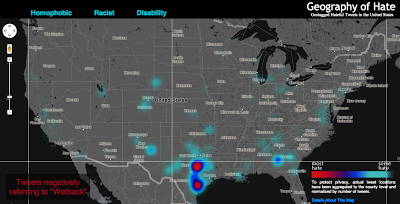
    Hotspots for “wetback” Tweets

    Perhaps the most interesting concentration comes for references to ‘wetback’, a slur meant to degrade Latino immigrants to the US by tying them to ‘illegal’ immigration. Ultimately, this term is used most in different areas of Texas, showing the state’s centrality to debates about immigration in the US. But the areas with significant concentrations aren’t necessarily that close to the border, and neither do other border states who feature prominently in debates about immigration contain significant concentrations.

    Ultimately, some of the slurs included in our analysis might not have particularly revealing spatial distributions. But, unfortunately, they show the significant persistence of hatred in the United States and the ways that the open platforms of social media have been adopted and appropriated to allow for these ideas to be propagated.

    Funding for this map was provided by the University Research and Creative Activities Fellowship at HSU. Geography students Amelia Egle, Miles Ross and Matthew Eiben at Humboldt State University coded tweets and created this map.

    The full interactive map is available here:http://users.humboldt.edu/mstephens/hate/hate_map.html

    Photo: Humboldt State University

  • Autodesk to Acquire Tinkercad

    Autodesk has signed a definitive agreement to acquire Tinkercad, an easy-to-use browser-based 3D design tool. The addition of Tinkercad to Autodesk will help broaden the popular Autodesk 123D family of apps and supports Autodesk’s vision to help anybody imagine, design and create anything. The acquisition will also revive the Tinkercad service and community, despite a previously announced shutdown by its founders and creators.

    “Tinkercad is a natural extension of the Autodesk 123D family as well as our other apps and services for consumers, as it is already used alongside Autodesk products”
    “We are excited to have reached an agreement with Autodesk that will provide a solid home and bright future for Tinkercad,” said Kai Backman, founder of Tinkercad. “We found in Autodesk a shared vision for empowering students, makers and designers with accessible and easy to use software, and with their global reach and expertise in democratizing design, we’re confident in their ability to introduce Tinkercad to new audiences around the world.”

    According to the announcement, Autodesk intends for the Tinkercad service to remain available as part of its consumer portfolio. The company also intends to incorporate elements of the Tinkercad technology and user experience into the Autodesk 123D family of products as part of its ongoing effort to make 3D design easier and more accessible to everyone. The transaction is expected to close within the next 30 days.

    “Tinkercad is a natural extension of the Autodesk 123D family as well as our other apps and services for consumers, as it is already used alongside Autodesk products,” said Samir Hanna, Autodesk vice president, consumer products. “We look forward to welcoming the Tinkercad community to Autodesk and to continuing their mission of accessible 3D design for all.”

  • Skobbler Introduces GPS Navigation and Maps App for Android

    The Berlin-based software company skobbler introduces GPS Navigation & Maps for Android. Available starting today, Skobbler’s Android app is the first on-and offline-enabled mapping and navigation app for Android smartphones and tablets. Skobblertypisch is offered at a competitive price. For only one euro customers receive the full global online functionality and a whole country of choice for offline installation, which it is available without an Internet connection. Owners of the full version can expand additional areas offline at any time. OpenStreetMap maps used in the app can be stored locally on the smartphone or deleted and available online after purchase – depending on requirements and storage capacity of the mobile device.

    Skobbler1


    The features of GPS Navigation & Maps at a glance:

    – Fully-fledged navigation with voice guidance for car navigation (turn-by-turn)
    – Fully interactive OpenStreetMap Map
    – A single card with worldwide coverage
    – Hybrid: Full functionality with and (after installation) without internet connection (online + offline)
    – Installability whole countries included the City Maps (WiFi recommended)
    – super fast reloading the map – zoom, rotate, etc. without reloading
    – Continuous free map updates
    – Powerful card technology (NGx)
    – route display (cars, pedestrians)
    – Convenient route options for adequate routing (fastest, shortest, most efficient route )
    – Multiple map styles (day, night, outdoor) for the best possible user experience in any situation
    – 2D and 3D view (with navigation)
    – Various search options (address search, category search, proximity search)
    – IdeaLog for feedback to the developers
    – Comfortable favorites lists
    – Optional Synchronization of favorites with the web portal maps.skobbler.com
    – “avoid highway” function
    – “Avoid toll roads” function
    – App works in portrait and landscape format
    – Full compatibility with smart phones and tablets
    – one land card with purchase already included

    “Our users can rejoice: Instead of having to fumble around with annoying hundreds of individual maps, GPS Navigation & Maps offers the whole world as a map and navigation from within an app,” said Marcus Thiel King of skobbler.

    Photos: Skobbler

  • Spatial Energy, Geoimage Partner for Australian Energy Industry

    Spatial Energy has signed a partnership agreement with Geoimage, headquartered in Brisbane, Australia. According to Spatial Energy, the partnership will build capacity and expand access to greater spatial content within the oil and gas industry in Australasia, enhancing the capabilities of Australian customers who operate nationally and globally and allowing them to derive more value from their existing and new geospatial datasets.

    Spatial Energy provides, hosts and disseminates spatial imagery and derived content to the oil and gas industry through its online system Spatial on Demand. Geoimage is a provider of satellite imagery and processing services to the mining, oil and gas, and engineering sectors in Australia. Through this partnership, Geoimage augments its existing capabilities by providing Australian customers with the hosting and dissemination technologies that Spatial Energy brings, offering local expertise and services to global customers operating in the Australian region. This will bring new products, capacity and technology to the Australian energy sector, allowing customers to extract even more benefit from their imagery and derived spatial data layers, the companies said.

    “By bringing together two culturally and technically similar organizations to better service the energy market in Australia, Geoimage and Spatial Energy will better meet the needs of both our customers. We are very excited to introduce the Spatial on Demand online hosting and delivery facility to Australian customers,” said Wayne Middleton, CEO of Geoimage Pty Ltd.

    “By offering new technology, services and high value content coverage globally and for Australasia, we see our partnership providing both of our customer bases with better services, and increased content, access and collaboration capabilities to help them solve their exploration and production challenges,” said Michael McCarthy, Vice President Corporate Development of Spatial Energy.

  • President Obama Signs Executive Order to Make Government Data More Accessible

    The White House Blog announced that President Obama signed an Executive Order directing historic steps to make government-held data more accessible to the public and to entrepreneurs and others as fuel for innovation and economic growth. The Executive Order declares that information is a valuable resource and strategic asset for the Nation.

    Under the terms of the Executive Order and a new Open Data Policy released today by the Office of Science and Technology Policy and the Office of Management and Budget, all newly generated government data will be required to be made available in open, machine-readable formats, greatly enhancing their accessibility and usefulness, while ensuring privacy and security.


    According to the announcement, during his visit to Austin, President Obama will meet with technology entrepreneurs who are hiring workers with cutting-edge skills and creating the tools and products that will drive America’s long term economic growth. This includes technology entrepreneurs utilizing government data to grow their company. Under the President’s Open Data Executive Order, more data will be made available allowing these types of entrepreneurs and companies to take advantage of this information, fueling economic growth in communities across the Nation.

    Through the Data.gov platform, which launched in 2009, users can access government datasets about a wide array of topics. Thousands of datasets have already been added to Data.gov and more than half-a-million data downloads have occurred in the last year alone, and we’re working to make the site even better.

    The Blog reports that as part of the Administration’s Digital Government Strategy and Open Data Initiatives in health, energy, education, public safety, finance, and global development, agencies have been hard at work unlocking valuable data from the vaults of government. The Health Data Initiative, for instance, has opened growing amounts of health-related information in open, machine-readable formats. Hundreds of companies and nonprofits have used these data to develop new products and services that are helping millions of Americans and creating jobs of the future in the process.

    As part of the Administration’s work to make health care system more affordable and accountable, the Department of Health and Human Services released new data on fees that hospitals charge, a major step in creating greater price transparency.

    “We’ve also collaborated with the private and nonprofit sectors through a series of White House datajams and datapaloozas to help spark activity by entrepreneurs and innovators to use open data to build new products, services, and innovations. As a result, there are private companies using open data to fight credit card fraud; consumers using open data to save on their energy bills; families leveraging open data to compare health care options; and a host of new apps and tools in areas ranging from public safety, to financial planning, to education, and more.”

    The Blog reports hat many government datasets are still hard to find or are locked-up in unusable formats. By requiring that government agencies provide newly generated government data in machine-readable formats like CSV, XML, and JSON and, when appropriate, expose data via Application Programming Interfaces (APIs), the new Executive Order and Policy will further accelerate the liberation of government data.


  • MDA to Develop Monitoring Plan to Track Illegal Discharges of Oil from Vessels

    MDA’s Information Systems group has signed a contract valued at $1.7 million with the U.S. National Fish and Wildlife Foundation (NFWF). NFWF is working to protect delicate ecological environments by funding a satellite monitoring pilot program designed to detect illegal discharges of oil from vessels operating in the U.S. Exclusive Economic Zone (EEZ) and to reduce the number of those incidents.

    The United States’ EEZ is the largest in the world, spanning three oceans, the Gulf of Mexico, and Caribbean Sea. It routinely has thousands of vessels traversing its area. With remote locations that are difficult to access, massive areas to monitor, and thousands of vessels to screen, deterring the illegal dumping of oil by boats at sea is a significant challenge. To help solve this problem, NFWF has partnered with MDA to develop a comprehensive satellite-based solution for marine environmental monitoring.

    Building on extensive global experience providing ship and oil detection, MDA’s RADARSAT-based wide area monitoring solutions form the core of the initiative and are ideally suited for this type of program, MDA said. To complement the RADARSAT-based solutions, MDA has assembled Automatic Identification System (AIS), Synthetic Aperture Radar (SAR) and optical satellite sensors from the leading geospatial providers to deliver a versatile solution for maritime domain awareness.

    The monies for the monitoring program originated from community service funds directed to NFWF following to a sentence issued in the successful prosecution of an environmental crimes case involving the illegal dumping of oil from vessels, the bypassing of onboard pollution prevention equipment, and improper oil record-keeping. Over the course of the 18-month program, MDA and NFWF, in consultation with the U.S. Coast Guard, will coordinate to develop a detailed monitoring plan. In executing this plan, MDA will identify possible oil pollution sources. Trained analysts will review the satellite-based information and produce a report with the analysis of location, timing, amount, and source (naturally occurring seep vs. vessel-sourced oil).

    When man-made spills are identified, MDA’s maritime domain awareness solutions help authorities identify the source of the spill and the responsible operator. For vessels that are caught illegally polluting, the U.S. government can impose significant fines that will act as a deterrent. From the information generated by this program, monitoring baselines will be developed for future programs that are designed to help promote environmental compliance within the U.S. EEZ and to prevent these environmental crimes from recurring.

  • OpenStreetMap Launches Enhanced Map Editor

    OpenStreetMap, the user-created map used by many of the biggest sites on the web, has today unveiled an entirely new editor that makes it easier to contribute than ever before.

    According to the announcement, the new editor, codenamed ‘iD’, boasts an intuitive interface and clear walk-throughs that make editing much easier for new mappers. By lowering the barrier to contributions, we believe that more people can contribute their local knowledge to the map – the crucial factor that sets OSM apart from closed-source commercial maps.

    OSM_id_animated

    To accompany the expected growth in OSM’s contributor base, the OpenStreetMap Foundation is launching an appeal to fund new hardware for the project. The appeal aims to make the editing experience more resilient, so that the OSM community can continue producing the most extensive and up-to-date map of the world. You can donate online at donate.openstreetmap.org.

    “OpenStreetMap’s growth in the past two years has been phenomenal,” explained Simon Poole, chairman of the OSM Foundation. “We’ve seen an explosion in the amount of local knowledge our mappers contribute to the map. This has encouraged more and more big-name websites and apps to switch to OpenStreetMap, while also enabling map hackers and geo enthusiasts the world over to build startling, imaginative visualisations from our open data.”

    “Now, with the new editor and our plans for new hardware, we’re stepping up another level to make OpenStreetMap, not Google, the default choice for mapping and map data.”

    OpenStreetMap reports that the new iD editor is a pure HTML5 experience, using the cutting-edge D3 visualisation library. Behind the clear design and intuitive interface is a sophisticated back-end that automatically recommends the most popular ‘tagging’ conventions used by the OSM community.

    According to the announcement, development began as a community project in July 2012, and has since been taken forward thanks to a $575,000 grant from the Knight Foundation, with development being co-ordinated by MapBox – one of several companies which offer commercial services on OpenStreetMap’s open data.

    From later today, new OpenStreetMap reports that users with a modern browser will automatically use the new iD editor. Users can switch between this and the existing Flash-based Potlatch 2 editor (which is being refocused as a tool for intermediate users) using their settings page or the drop-down ‘Edit’ menu. Advanced desktop-based editors are also available.

    The editor software is entirely open source, with code available on github under an ultra-permissive licence.

  • Critigen Announces Medicare Mapper App

    Demonstrating how location analytics can use big data, Critigen LLC along with partners Social & Scientific Systems, Inc., and Esri, has developed an informative Medicare application called Medicare Mapper. Just released in the Apple App Store, it is a free download for the iPad. Based on a publicly available data set from the U.S. Department of Health & Human Services’ Centers for Medicare & Medicaid Services (CMS), the application allows consumers to see where people in their area are going for Medicare services, and service providers to see where their patients live along with the relative amount of services they received. It quickly and easily illustrates geographic patterns in Medicare hospital inpatient expenditures and exemplifies the power of location analytics for healthcare.

    Critigen_comparison

    According to the announcement, based on the 2011 version of the Hospital Service Area file, the application makes anonymous data available on health services, service providers, utilization, and costs in an intuitive tablet interface. A total of 990,455 records, represented by a string of numbers, were decoded and geo-enabled with help from the U.S. Census Bureau’s ZIP code file and population data from Esri. It describes every Medicare Hospital Inpatient Admission that occurred in the country in 2011. Included is the residency (ZIP code) of the beneficiary, the hospital provider that received the reimbursement, the total amount of the reimbursement, the total length of stay, and the total number of cases that originated from within the respective ZIP code. Using the totals described by the data, two more categories of data were averaged and included for each record.

    Critigen reported that users can select a specific hospital and display its impact in terms of which ZIP codes their 2011 Medicare beneficiaries came from. If a ZIP code is selected, pins appear on the map to show what facilities were used by the beneficiaries living there. Another built-in capability compares two hospitals or two ZIP codes in a side-by-side manner. The differences of each category can then be viewed numerically or by percentage. These capabilities enable users to build the stories they need to produce understanding, build knowledge, research, or manage.

    Medicare Mapper follows the 2012 release of Critigen’s Health Indicators app.