Tag: GIS

  • Leica Announces Airborne Digital Sensor ADS100

    Leica Announces Airborne Digital Sensor ADS100

    Leica Geosystems today announced the new generation of its airborne digital sensor, the Leica ADS100. Introducing a unique focal plate design, the Leica ADS100 offers a swath width of 20,000 pixels for all multispectral bands (RGBN) and multispectral capability in forward, nadir and backward.

    The Leica ADS100 provides a large format CCD line with TDI (Time Delay and Integration) to increase sensitivity despite a smaller pixel size. By doubling the cycle rate, high-resolution images can now be acquired at much higher ground speeds. To provide the best stabilization performance, the new Leica PAV100 gyro-stabilized mount is equipped with adaptive control technology, Leica said. In addition to the Leica PAV100, the Leica ADS100 shares all aircraft installation components such as camera controller, operator displays and flight control software with the Leica RCD30 medium format camera.

    “There are several reasons our customers will be pleased with this development, explains Ruedi Wagner, VP Imaging Geospatial Solutions. “The current Leica ADS80 has been proven to be one of the most reliable airborne sensors on the market. It’s combination of superior hardware design and dedicated workflow have led to record sales in 2012. With the Leica ADS100 we are now nearly doubling productivity while maintaining reliability and highly automated workflows, that are so well accepted in the market. In addition, by introducing the common platform concept using a unified aircraft installation and shared peripherals between the Leica ADS100 and the Leica RCD30, we are not only simplifying operation but significantly reducing cost of ownership across our sensor portfolio. The best of all, we can now offer our cost-effective upgrade path to both existing ADS and RCD30 standalone customers.”

    The new Leica ADS100 airborne digital sensor together with Leica XPro 6.0 will be released and shipped in the second quarter of 2013.

    Photo: Leica Geosystems

  • SuperPad 3.1 Supports Comune di Ovodda for Accurate Field Boundary and Prosperity Assessment

    Supergeo Technologies, a provider of GIS mapping software and solutions, announced that SuperPad 3.1 was selected by Comune di Ovodda to complete field data collection for accurate field boundary and prosperity assessment.

    Ovodda is a comune (municipality) in the Province of Nuoro in the Italian region of Sardinia.

    Today, economic development and governmental policy were the main driving factors of land-using change. In this procurement, Superpad 3.1, the mobile GIS software, is used by Comune di Ovodda to frequently update and improve the survey results and consequently promote the efficient land use of boundaries.

    SuperPad 3.1 allows field surveyors to effortlessly collect, update, and obtain various reliable field data such as the land use information, road conditions, and landforms to improve administrative efficiency and make better decisions, according to Supergeo.

  • RapidEye Imagery-Based MALAREO Project Complete

    RapidEye, a specialist in high-resolution, wide area repetitive coverage of earth through its constellation of five satellites, announced today that the African Malaria Control Project, MALAREORapidEye_coverage, which incorporates RapidEye data, has come to a close and results are now available on the project’s website.

    MALAREO, which began just over two years ago, was funded by the European Commission under FP7 and run by a mixed European-African comailnsortium, which incorporated years of experience in malaria control, with the Global Monitoring for Environment and Security (GMES) Earth Observation expertise.

    Remote Sensing Solutions GmbH (RSS) near Munich was responsible for data processing and the development of EO products for the project, which explored the spatial variability of malaria-relevant environmental factors at local level and supported the work of the National Malaria Control Programs in South Africa, Swaziland and Mozambique. The MALAREO study area, about 43,000 square kilometers, was imaged by the RapidEye satellite constellation, and data was provided via the EC/ESA GMES Space Component Data Access (GSC-DA).

    After completion of the project in January, a final meeting with end-users from the Southern African National Malaria Control programs and the MALAREO project team took place in Durban, South Africa, where the products derived from the RapidEye imagery were presented. The end-users emphasized the benefit of these products and the resulting Map Atlas for malaria control, as it greatly improves planning of malaria control measures. It also complements the approach of linking environmental and epidemiological data, which is a first step towards an early warning system for malaria.

    The MALAREO Map Atlas, summarizing the EO-based mapping approaches and additional information about the project can be found at the project website.

  • ikeGPS Shortlisted for GE Low Carbon Challenge

    ikeGPS, a maker of remote measurement and 3D modeling hardware and software solutions, has announced it has been shortlisted for the GE Australia & New Zealand Low Carbon Ecomagination Challenge. The challenge is an open call to businesses, entrepreneurs, innovators and students in Australia and New Zealand with breakthrough ideas for reducing our carbon footprint. Out of 191 entries, ikeGPS was selected to the shortlist of 35 finalists that will vie for five Innovation Awards of $100,000 and potential investment opportunities of up to $10 million from GE and its venture capital partners.

    ikeGPS’s entry,  ikeGPS Augmented Reality Network Management Solution, uses ikeGPS technology to make distribution network assets more efficient by enabling field crews to see network database information and models overlaid on the real-world assets, in real-time. ikeGPS has developed an end-to-end solution for electric utilities that combines the ikeGPS device (integrating laser rangefinder and camera technologies) with software for measuring and modeling pole infrastructure.

    “We are delighted to have been chosen by GE for the Ecomagination Challenge shortlist,” said Glenn Milnes, CEO of ikeGPS, headquartered in Wellington. “As a company, ikeGPS is committed to making a difference to reduce carbon emissions locally and globally. We are excited to be part of GE’s very important initiative.”

    54

  • 3D Mapping & 3D Modeling Market worth $7.7 Billion by 2018

    According to a new market research report “3D Mapping Market: Global Advancements, Business Models, Technology Roadmap, Forecasts and Analysis (2013 – 2018)“, the 3D mapping and 3D modeling market is expected to reach $7.7 billion by 2018 at a CAGR of 47.9% from 2013 to 2018.

    According to the announcement, 3D mapping technology is one of the fastest and most complete ways to build 3D-environments in the market today. 3D mapping solutions enabled the user to swiftly build three-dimensional maps of the surroundings with supreme accuracy and clarity, ready to plug into professional visualization systems. With investments towering up for 3D maps applications to be introduced to smartphones, market players such as Nokia, Samsung and other smartphone companies have indicated string interest in this market. The 3D-enabling devices like sensors, cameras, scanners, GPS components, and other acquisition devices create huge potential in this market. The improvised 3D experience on smartphones, tablets, notebooks, PCs, cars, etc. is set to revolutionize the mobile device market and other GPS-enabled device market by broadening the horizons for the users to locate things easily using any device.

    The report stated that the 3D mapping and 3D modeling total market is expected to grow from $1.1 billion in 2013 to $7.7 billion by 2018, at an estimated Compound Annual Growth Rate (CAGR) of 47.9% from 2013 to 2018. North America, the first mover in the 3D mapping and modeling market, is expected to remain as the major market by 2018. Meanwhile, we also observe the Asia Pacific (APAC) and Middle East and Africa (MEA) regions to grow at a significant rate, mainly driven by opportunities in countries such as China and India. In 2013, Europe is expected to account for about 33.1% of the global market, and is expected to grow at a CAGR of 43.2% from 2013 to 2018. APAC is estimated to be a $1.6 billion market by 2018; at a CAGR of 66.38% 2013 to 2018. The market players include Tier 1 companies such as Google, Apple, Amazon, Saab and Hover.

    The report provides an in-depth analysis of the various industry verticals such as healthcare, automotive, transport and logistics, aviation and space, building and construction, defense and public safety, retail, others. It also analyzes the emerging trends in the 3D mapping and 3D modeling market across geographies.

    The past decade witnessed a giant leap in various industries, with 3D technology being implemented in various electronic devices and other objects. The need for 3D mapping arose after an attempt to make 2D maps more advanced and look more real. This was done by introducing sensors, cameras, scanners, GPS components, and other acquisition devices to capture the real time 3D images which are created into models incorporated into maps. This type of technology is often used in modern computer programs to provide a lifelike view of a place or thing on a map.

    Portable GPS devices use 3D mapping technology to provide automated directions. These devices have small screens that display a three-dimensional view of roads and maps. This is a good tool for people who travel or go for hiking to unfamiliar areas because the device uses satellites to pinpoint its exact location. Building schematics are blueprints used for the construction of houses. 3D mapping technology is often used to create construction schematics. This tool makes it easy to draw a three-dimensional version of a house plan. These plans are typically used to get building permits and construction material before any building starts.

    The improvised 3D experience in smartphones, tablets, notebooks, PCs, cars, etc. is set to revolutionize the mobile device market and other GPS-enabled device market by broadening the horizons for the users to locate things easily using any device. This report looks at the various applications of 3D modeling and mapping applied in various business verticals. It analyzes the challenges and opportunities for 3D mapping and modeling as well as its impact in the marketplace. The report also gives insights into the global adoption trends, key market players, future scope, drivers, and restraints in the market, along with growth potential across different geographies. It also analyzes various factors that will drive and restrain the market over the next 5 years.

    Scope of the Report

    This report segments the 3D modeling and mapping market by applications, business verticals, 3D-enabled devices, 3D-enabling devices, and geographies. The market forecasts in terms of revenues for all the segments and unit shipment forecasts are provided for the 3D-enabled device segment.

    On the basis of applications:

    The market by application type in 3D mapping is classified into 3 segments:

    • 3D projection mapping,
    • Mapping and Navigation
    • Other applications (3D mobile mapping, 3D laser mapping, 3D texture mapping, 3D video mapping, etc.)

    On the basis of Business verticals:

    The 3D modeling and 3D mapping market by verticals is classified on the basis of 7 segments:

    • Healthcare
    • Automotive, Transport and Logistics (ATL)
    • Aviation and Space
    • Building and Construction
    • Defense and Public safety
    • Retail
    • Others

    On the basis of 3D devices market:

    The 3D Modeling market by 3D-enabled device unit shipments is classified on the basis of 4 segments:

    • 3D-enabled smartphones
    • 3D-enabled tablets
    • 3D-enabled notebooks
    • Other 3D-enabled devices

    We have analyzed other 3D devices (3D sensors, 3D cameras, 3D displays, GPS components) in terms of market attractiveness.

    On the basis of geographies:

    The report segments the market geographically into

    • North America
    • Latin America
    • Europe
    • Middle East & Africa (MEA)
    • Asia Pacific (APAC)

    Each section provides market data, market dynamics (drivers, restraints, trends and opportunities), key players, and competitive outlook. This report provides 100+ market tables covering all sub-segments and micro-markets. In addition, the report provides 20 company profiles representing various sub-segments.
  • Bentley Announces InspectTech Collector Software for iPad

    Bentley Systems, Inc., has announced the immediate availability of InspectTech Collector Mobile for use on the iPad. This new iWare app underscores Bentley’s commitment to providing a broad range of apps for mobile devices that increase information mobility with integrity across engineering disciplines and the infrastructure lifecycle, the company said.

    InspectTech Collector Mobile works with Bentley’s InspectTech software-as-a-service offering, which helps asset owners streamline the process of planning inspections, collecting and managing inspection data, and complying with government reporting requirements — reducing inspection times by up to 25 percent. The new app empowers inspectors of transportation and infrastructure assets — from bridges and culverts to signs, light poles, antenna towers, storm water networks, and more — to quickly and effectively collect a range of inspection information, including photos and audio, in the field on their iPads. By expediting these inspections, InspectTech Collector Mobile enhances inspector productivity and saves owner-operators time and money.

    According to the announcement, through the app users simply sign in to their InspectTech system, and anyone can try the app’s capabilities with access to sample data via Bentley’s new “Explore” trial services program. The app is available for download at no additional charge.

    InspectTech_Collector_ss3The key advantages of InspectTech Collector Mobile include:

    • enhanced inspection efficiency — A streamlined interface delivers valid fields and drop-down boxes as the inspector works through a logical and thorough collection of inspection data;
    • improved inspection quality — Inspectors enhance inspections with the ability to capture photos, audio, and video as they inspect individual assets;
    • reduced inspection costs — Inspectors need no longer travel back to the main office to upload reports, and they enjoy the efficiency associated with the use of a single inspection device that takes the place of multiple inspection tools, including paper and pen, GPS, camera, and audio recorder;
    • increased productivity and reduced errors — Inspectors create comprehensive reports, working quickly and accurately with agency-specific forms and historical asset information;
    • enhanced inspection flexibility — Like all Bentley apps, InspectTech Collector Mobile enables inspectors to work with or without an Internet connection;
    • inspection compliance — Calculations are performed based on National Bridge Inventory (NBI) and other inspection standards;
    • enhanced accuracy – InspectTech Collector Mobile rapidly pinpoints assets using GPS technology;
    • time savings — Synchronization with the organization’s home InspectTech solution via cloud services and automatic generation of high-quality reports speed inspection completion;
    • powerful support for analysis and planning — Inspection data can be provided for planning, performance monitoring, and risk-based analysis and decision making.

    “SCDOT is excited to be testing InspectTech Collector Mobile for bridge inspection data collection,” Lee Floyd, PE, State Bridge Maintenance Engineer, South Carolina Department of Transportation, said. “The Department’s Director of Maintenance Office has been pushing the use of iPads for some time now. We believe that the iPad hardware, along with its stable environment, is an excellent choice for bridge inspection applications. Our early indications are that the InspectTech Collector Mobile software from Bentley is easy to use and will improve our bridge inspection workflow.”

    “InspectTech provides a secure and managed shared source of information for the inspection, inventory, maintenance, and management of transportation physical assets,” Jeremy Shaffer, Bentley director of Transportation Asset Management, said. “It generates savings through better efficiency — from capturing and reviewing inspection data to turning needs into actionable plans – and empowers maintenance management to make the best use of asset inspection information for maintenance planning, prioritization, scheduling, and capital-project decision making. Our new InspectTech Collector Mobile further enhances the flexibility of InspectTech, advancing information mobility within inspection workflows and giving inspectors yet another way to conveniently gather their crucial asset inspection information in the field. This app will also be available to all InspectTech users as an optional data collection add-on for use with the AASHTO Pontis Bridge Management transportation asset management system – as part of the Bentley and AASHTO ongoing partnership.”

  • eSpatial Launches Free Edition of Mapping Software

    eSpatial announced the launch of a free edition of their flagship mapping software, also called eSpatial.

    According to the announcement, eSpatial mapping software lets users convert spreadsheet data into map form. This visualization provides immediate insights into market trends and challenges.

    The new free edition of eSpatial is available to anyone who signs up for an account at www.espatial.com. Once logged on, users can create maps from their existing data and then post them on websites as interactive maps.

    Sales Mapping Software

    Paid editions (including Basic, Pro and Team) of the application with greater functionality – including the ability to handle increased amounts of data, reporting and sharing options – start at $399 for an annual subscription.

    Launching the free edition of eSpatial, company CEO Philip O’Doherty said he hoped this availability of the product would increase awareness of the potential impact of sales mapping software.

    “I think this is a bold move and one that shows us to be an innovator in the mapping market,” he said. “We hope the free edition of our already-successful product will encourage businesses and organizations to think differently about their data and how they can use it to achieve new or continued success.”

  • Esri Introduces Collector for ArcGIS App for Android and iOS

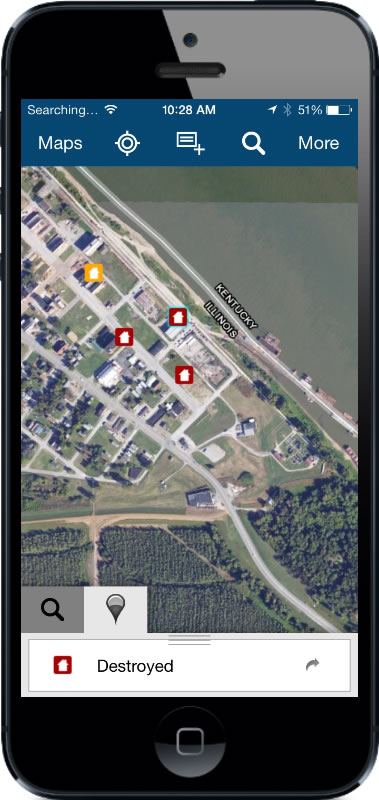
    Esri introduced Collector for ArcGIS, which allows users to capture and report spatial and/or tabular information directly from their iPhone or Android smartphone in the field.
    The Collector for ArcGIS application simplifies data collection in the field. Data can be recorded using GPS or by tapping on the map. The Collector app provides the ability to plan routes, generate directions, capture photos and video, and seamlessly integrate information back into an organization’s GIS. The app can also be configured for use with various tools to help tailor data collection workflows to users’ specific needs.

    The Collector for ArcGIS is available for download from the Apple App Store and Google Play (formerly Android Market).

    The Operations Dashboard and Collector applications are available to organizations that have either a 30-day trial or have purchased an ArcGIS Online subscription..

  • GIS Crucial to Australian Flood Response

    A leading water management adviser in Australia has said that the use of mapping and surveying technology is crucial to help the country protect itself against frequent severe floods, reports Doug Murphy of SurveyEquipment.com.

    Georgina Race, spatial analyst at Flood Prevention Experts, told an audience of 200 spatial professionals in Melbourne that GIS technology must become integral flooding event preparation and response.

    This past year, heavy rainfall has caused flooding in several regions in Australia, necessitating mass evacuations and costing hundreds of millions of dollars in insurance claims.

    Captain Charlie Mansfield, Lance Corporal Ken Leahy and Sapper John Wainwright help remove debris from the Balonne River bridge in St George, Queensland.
    Australian Army Captain Charlie Mansfield, Lance Corporal Ken Leahy and Sapper John Wainwright help remove debris from the Balonne River bridge in St George, Queensland.

    “GIS technology enables us to map the massive amounts of data that must be taken into consideration when projecting the outcome of large rainfall events,” she said. “This data includes land elevation and characteristics, past flood levels, infrastructure building information and seawater levels. The technology brings all this information together and allows us to run modelling of the impacts of various rainfall scenarios — such as storm events, sea level rises and even new building and infrastructure developments — to understand the level of inundation that may take place.”

    Australia Prime Minister Julia Gillard announced in February that the federal government will invest $100 million over two years into flood mitigation projects to help reduce flood risk and bring about reductions in insurance premiums.

  • Shark in the Water! Find out Where

    Shark in the Water! Find out Where

    Did you just watch Jaws? Are you worried your trip to the beach might be interrupted by an unwelcome guest? Now you can go online and see if any great white sharks are visiting nearby waters (the tagged sharks, at least.)

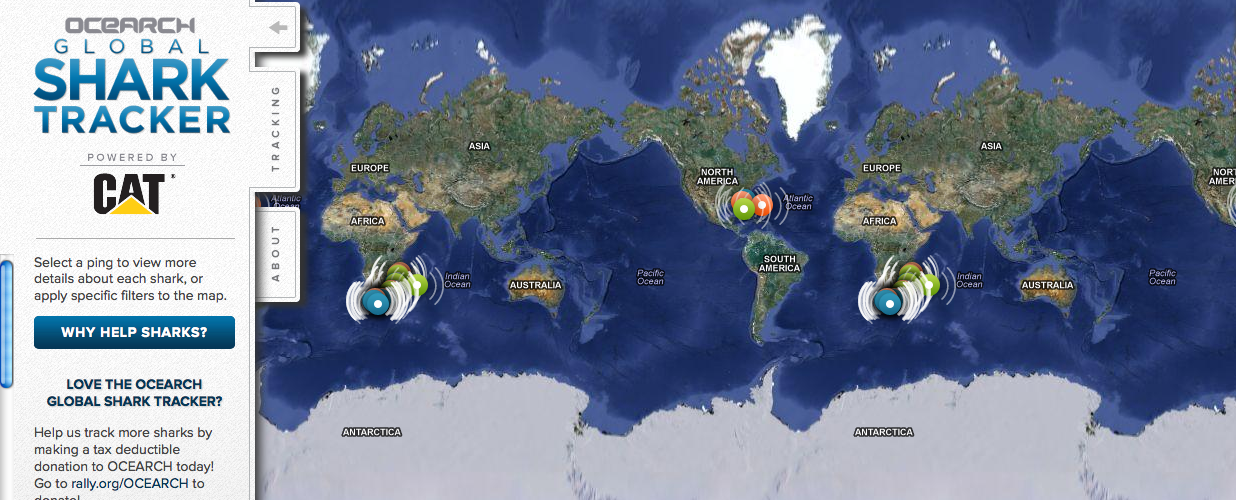
    The Ocearch Global Shark Tracker is a global project to tag and track the navigational patterns of great white sharks in the world’s oceans. The team is currently tracking nearly 40 sharks. The team of scientists have 15 minutes to pull a shark from the water, tag it, and release it, a process which was highlighted in an ABC Nightline feature.

    Ocearch’s founder is Chris Fischer, former star of the History Channel reality TV show “Shark Wranglers.” Ocearch is “seeking to attain groundbreaking data on the biology and health of sharks, in conjunction with basic research on shark life history and migration,” according to its website.

    On the Shark Tracker, sharks that have been tagged appear as bright colored dots. Orange means a ping is less than 72 hours old, green means a ping is less than 30 days old and blue means a ping is more than 30 days old.


  • senseFly eBee Drone Demonstrates Mapping Capabilities in Swiss Alps

    senseFly successfully demonstrated the 3D mapping capabilities of its fully autonomous mini drone under extreme conditions. In mid-February, the eBee conducted a mapping mission in the mountains above Zermatt at altitudes of up to 3000 meters. Several flights were conducted to map small hamlets and valleys at temperatures below -10 degrees Celsius (14°F).

    “Zermatt village, the starting point of this excursion, is a car-free zone, therefore all transportation of equipment had to be done manually,” said Andrea Hildebrand, co-founder of senseFly. “On top of this, the only means of transportation to reach the takeoff locations, some at altitudes as high as 2800 meters, were ski lifts and skis. Luckily the eBee only weighs 630 grams and fits with all its accessories in a carry-on case, so we could easily carry it with us and even ski down the slopes with it.”

    The entire mapping of a small valley, including the takeoff, flight, landing and resulting geo-referenced orthomosaic and 3D elevation map, is documented in a video available online.

  • National Geographic Maps Now Off-Line, Yet Still GPS Interactive

    National Geographic Maps has joined with Avenza Systems to offer a new channel to access its map content. The alliance enhances Avenza’s digital map database by adding more than 500 maps from National Geographic and furthers National Geographic Maps’ established reach with mobile consumers.

    The Avenza PDF Maps app takes advantage of geospatial technology and allows users to view, acquire and interact with maps on their mobile devices, including iPhone and iPad, without needing a mobile data connection or being accessed international roaming charges. PDF Maps offers an in-app store to facilitate the transaction and delivery of the maps, consolidating, in a digital format, consumers’ access to hundreds of maps from multiple publishers.

    “In the last decade, advances in technology have shifted how consumers receive and use information, and we have responded by making our rich map content available on a variety of platforms,” said Charles Regan of National Geographic Maps. “Avenza’s PDF Maps app provides a unique way for consumers to access our content with an easy-to-use in-app map store and a set of robust features that will enhance the map user’s experience.”

    Hundreds of maps from National Geographic Maps’ extensive library are now available in Avenza’s PDF Maps system, including travel and destination titles covering five continents, historical and thematic maps, and educational and reference titles. The app provides constant access to geographic information and points of interest, with additional interactive tools such as measuring, place marking and location tagging. PDF Maps operates without the risk of lost reception, due to cell tower proximity, and does not rely on an Internet connection.