Tag: GIS

  • Story map navigates cause and effects of climate change

    Climate-Change-O

    Esri has released an interactive map illustrating the earth’s natural and human systems and how they have changed — and will change — over time. With the Atlas for a Changing Planet story map, scientists, policy makers, planners and activists can examine detailed spatial information that is critical for adapting to a warmer future.

    “Mitigating the effects of climate change is a global, geographic challenge,” said Jack Dangermond, president of Esri. “Understanding how the earth’s systems interact and transform is an essential first step in measuring the threat of climate change and making informed decisions to reduce it.”

    Atlas for a Changing Planet explores a sample of maps, imagery and data from Esri ArcGIS Online. The story map covers five themes: understanding natural systems, mapping human systems, mapping ocean impacts, predicting the future, and international cooperation.

    Complex issues, processes, and concepts — such as biomass and ocean acidification — are clearly and succinctly explained with maps and multimedia, Esri said. For example, users visualize the density of carbon stored in living plants (biomass) with an explanation of how this information is key to estimating how land-use change affects the climate. Interactive maps illustrate which areas will be severely affected by rising sea levels, the changes in sea ice extents in the Arctic Ocean, and population growth in urban cities around the world.

    The story map also models data from the National Center for Atmospheric Research (NCAR) in three scenarios. With this data, users navigate the story map to see projected changes in temperature and precipitation based on the level at which greenhouse gas emissions increase or decrease over time.

    Esri created the story map in time for the Nov. 30 start of the United Nations 21st Conference of the Parties (COP21). World leaders are gathering at the annual meeting to negotiate an international agreement with the goal of keeping global warming’s increase below 2 degrees Celsius.

  • GeoMobile Innovations hosts ‘Evaluating the Mobile GIS Landscape’ workshop

    Mobile GIS expert GeoMobile Innovations is hosting an Evaluating the Mobile GIS Landscape workshop on Jan. 14, 2016. The inaugural course will provide an extensive overview and best practice assessment for those seeking solutions in an often confusing menu of choices for Mobile GIS.

    The workshop, which will be conducted via live instruction at GeoMobile’s headquarters in Corvallis, Oregon, will be led by GeoMobile’s Technical Director Craig Greenwald. Greenwald is a highly experienced ESRI/Mobile GIS expert and software developer, the company said.

    When asked about the impetus for the class, GeoMobile President Rich Ash responded, “We are hearing about a lot of confusion in the Mobile GIS marketplace. There are many new offerings being aggressively marketed to organizations and it can be tempting to jump in to a new tool without a clear line of decision making. Advancements and new options are exciting, but Mobile GIS tools are not a one size fits all proposition; professional organizations need to adequately assess their project needs, considering multiple criteria.”

    Evaluating the Mobile GIS Landscape is a consultative workshop that is proposed to offer meaningful real-world information without the sales pitch, the organizers said. It will help an organization assess appropriate GIS workflows and ask meaningful questions about deploying software and hardware tools suitable for their projects.

    Lead instructor and mobile GIS software developer Craig Greenwald emphasized his approach in the workshop is helping students in seeking practical solutions. “Having provided consulting and professional software services to organizations large and small, I’m often brought in after decisions have already been made about software and hardware,” Greenwald said. “By being proactive, we can save folks headache and expense in having to make significant adjustments mid-project. The beauty of this course is in that in a short, focused period of time, each student will have a chance to assess their own requirements and we will take them through a decision-making worksheet “

    The class is $195 per participant and includes lunch. More information and a downloadable registration form is available at the event website, or by email if requested from [email protected].

  • Field Technology Conference: The forest and the fish

    PORTLAND, Ore. — Two weeks ago, I attended (and hosted) the Field Technology Conference here in Portland, Oregon. This is the fifth year of the conference. In years past, it’s had a forestry emphasis primary because the Western Forestry and Conservation Association has been a major partner in organizing it.

    This year, the Pacific States Marine Fisheries Commission and Pacific Northwest Aquatic Monitoring Partnership joined the organizing committee. The result was a 50-percent increase in attendance and a more diverse audience.

    Another newcomer to the conference was a Civil GPS Service Interface Committee (CGSIC) U.S. State and Local Government Subcommittee meeting, which was co-located with the Field Technology Conference, offering a direct connection between civil GPS users and U.S. government representatives who are involved in GPS.

    The conference was a two-day event comprised of three technology tracks: a track for general field technology and two tracks for industry-specific (forestry and fisheries) subjects, hands-on technology demonstrations and a field trip. Although forestry and fisheries professionals were the featured user groups, nearly all of the subject matters — GPS, UAVs, smartphones, tablets, laser rangefinders, lidar, photogrammetry, and field data-collection software — is applicable for a wide range of natural resource users involved with GIS (geographic information systems) technology.

    As one of the hosts of the conference, I started out moderating the general session with all of the attendees in one room. This year, my general session topics include geospatial awareness and growth, GPS/GNSS technology, mobile devices (smartphones and tablets) and UAVs.

    Something new I tried this year, which worked out really well, was using audience response “clickers.” These small handheld devices were given to each audience member and allowed them to answer multiple choice questions that I posed in my Powerpoint presentation. I’ve always been a fan of audience input, and started polling the audience during webinars I conducted many years ago. For this conference, I used an audience polling system from Turning Technologies. I’d like to share with you the questions I asked the audience and the responses that I received.

    Question #1: Are you here?


    Comment: This was a test question to see if the audience response system was working properly. I’m still not sure if the audience just had a great sense of humor or a technical problem. I think the former was true. ☺

    Question #2: Have you attended this conference before?


    Comment: This was great news that the conference is attracting new attendees. It’s an annual event held in November, so keep your eyes on it for next year!

    Question #3: After a brief discussion about the availability of higher accuracy geospatial data (eg. GNSS, UAVs, etc.), I was curious about the level of accuracy the audience required in their typical tasks.

    What geospatial data accuracy do your typical tasks require?

    Microsoft PowerPoint - FTCGeneralPlenary2015 [Compatibility Mode

    Comment: I wasn’t sure what to expect with this question, but since I’ve polled a fisheries audience before, I had a feeling accuracy requirements would vary, and they did. Previously, a fisheries audience had told me that they were satisfied with 5-meter accuracy.

    Question #4: The last question leads to this one. I wondered if the audience accuracy requirement was driven by requirement or by availability.

    Are you satisfied with the accuracy of the geospatial data you use?

    Microsoft PowerPoint - FTCGeneralPlenary2015 [Compatibility Mode


    Comment: The answer is clear that, generally speaking, the audience would use higher accuracy geospatial data if it was available.

    Question #5: The next question was a pure technology one. In the day of BYOD (Bring Your Own Device), I’ve been very interested in monitoring the trends in mobile devices. The question about operating systems is relevant because it determines which data collection software you can use. For example, if a specific data-collection software is written only for Windows, it will not run on an Android or Apple (iOS) device.

    Which operating system do you use on your mobile device(s)?

    Microsoft PowerPoint - FTCGeneralPlenary2015 [Compatibility Mode

    Comment: These responses surprised me a bit. They certainly don’t match the global market share figures that I’ve read. Following are the latest mobile device operating system market share numbers reported by IDC and Statista.

    Microsoft PowerPoint - FTCGeneralPlenary2015 [Compatibility Mode


    Microsoft PowerPoint - FTCGeneralPlenary2015 [Compatibility Mode

    Question #6: The next part of my presentation discussed unmanned aerial vehicle (UAV, also known as UAS or drone) technology. UAVs were a significant part of the conference this year. We had many presentations and some static demonstrations on UAV technology. On this subject, I had several questions for the audience.

    Do you currently use a UAS?

    Microsoft PowerPoint - FTCGeneralPlenary2015 [Compatibility Mode

    Comment: These answers were not surprising. Flying UAVs commercially in the U.S. requires a special permission from the Federal Aviation Administration (FAA). To date, the FAA has only issued about 2,000 such exemptions.

    Question #7: Do you anticipate using a UAS?

    Microsoft PowerPoint - FTCGeneralPlenary2015 [Compatibility Mode

    Comment: These answers surprised me a bit. I had no idea the audience would be so interested in personally flying a UAV. This has me thinking about this the same way I think about GPS receivers — just another tool in the toolbox.

    Question #8: How much are you willing to spend on a UAS?

    Microsoft PowerPoint - FTCGeneralPlenary2015 [Compatibility Mode

    Comment: These responses don’t surprise me, although I polled another audience at a different venue that was more engineering-oriented, and the answers were a bit different. The engineering-oriented audience was willing to spend more for a UAV.

    Furthermore, in speaking with various attendees during the conference, there was quite a bit of interest in attaching different sensors to UAVs for various requirements. For example, lidar, multi-spectral and thermal (temperature) sensors were commonly mentioned as payloads they would like to see. The challenge is that the cost of a UAV rises sharply when these types of payloads are accommodated, and conflicts with the audience’s response about how much they are willing to pay for a UAV.

    UAV-tablet-W

    In next month’s column, I’ll post links to the papers presented at the Field Technology Conference as well as videos of papers presented by the CGSIC folks.

    See you next month.

    Follow me on Twitter at https://twitter.com/GPSGIS_Eric

    Source: FTC

  • Proteus Strengthens Satellite Imagery Procurement Service

    Proteus, a provider of satellite derived mapping, bathymetry and geospatial products, said it has strengthened its Professional Satellite Imagery Procurement Service by signing up as a reseller with international satellite imagery provider Airbus Defence and Space. Proteus is now an official reseller of Airbus’s satellite imagery data and value-added products.

    “We are very excited to formalise our relationship with Airbus Defence and Space,” said Proteus CEO David Critchley. “We are currently providing our clients with a successful Satellite Imagery Procurement Service, adding the large product portfolio of Airbus Defence and Space to our current catalogue of data provides our customers with even more choice of high quality product and satellite tasking services.”

    Proteus has been delivering geospatial solutions for mapping and classification projects using multispectral satellite imagery since 2011 and their experienced staff have all been working in the geospatial industry for over 15 years. Proteus’s satellite imagery projects have been delivered for environmental consultancies, oil and gas, engineering and other coastal zone applications in Europe, USA, the Middle East and Caribbean.

  • USGS completes triennial update to US Topo maps

    This graphic represents the planned US Topo map production schedule for the next three- year revision cycle. The US Topo project repackages data from national GIS (geographic Information system) databases as traditional maps, primarily for the benefit of non-GIS users. Unlike traditional topographic maps, US Topo maps are mass-produced from secondary sources, on a programmed refresh cycle, using the best available data at the time of production.
    This graphic represents the planned US Topo map production schedule for the next three- year revision cycle. The US Topo project repackages data from national GIS (geographic Information system) databases as traditional maps, primarily for the benefit of non-GIS users. Unlike traditional topographic maps, US Topo maps are mass-produced from secondary sources, on a programmed refresh cycle, using the best available data at the time of production.

    With the release of new US Topo maps for Illinois and South Dakota, the USGS has completed the second, three-year cycle of revising and updating electronic US Topo quadrangles. Since the project’s inception in late 2009, the USGS has updated nearly every map in the conterminous U.S. twice.

    “The USGS and NGP are proud of our history and legacy of topographic mapping in the U.S.,” said Mike Tischler, director of the USGS National Geospatial Program. “This latest cycle of US Topo production is a testament to the professionalism and capability of our staff and keeps that legacy alive. We’ve revised more than 110,000 maps in the last six years to include higher quality data across the country, and have been able to deliver those maps in an easy to use format to suit the diverse needs of our users. While reaching the end of the second cycle is an important achievement, we look forward to the next cycle of US Topo production, and investigating emerging technologies to better serve the needs of the country.”

    In the past year the production staff of the NGP has updated, revised and uploaded 18,767 US Topo quads covering 18 states, most recently for Illinois and South Dakota. Its staff created more than 635 new 1:24,000-scale maps for Alaska as part of the Alaska Mapping Initiative. All of the new US Topo maps are digital and offered for free download, as the USGS no longer prints topographic maps using traditional printing technologies.

    Other improvements to the state maps in the second cycle include the inclusion of National Scenic Trails, “crowdsourced” trail data from the International Mountain Bike Association, increased parcel land data (PLSS) and trail data from the U.S. Forest Service.

    The complete new map sets for Illinois and South Dakota join Maine, Alabama, Arizona, Nebraska, Nevada, Missouri, California, Louisiana, Mississippi, New Hampshire, Vermont, Connecticut, Massachusetts, Rhode Island, Wyoming and Florida as revised states for fiscal year 2015.

    All of these new US Topo maps replace the first edition US Topo maps and are available for download from The National Map, the USGS Map Locator & Downloader website and several other USGS applications.

    The first three-year production cycle ended in September 2012, and the second cycle ended in September 2015.

    To compare change over time scans of legacy USGS topo maps, some dating back to the late 1800s, can be downloaded from the USGS Historical Topographic Map Collection.

  • Hexagon launches M.App Chest cloud app

    Hexagon Geospatial has officially launched M.App Chest, a cloud-based application associated with Hexagon Smart M.App.

    In September, Hexagon Geospatial introduced the M.App Chest Early Access Program, which provided an opportunity for users to test out the new cloud-based innovation for storing, managing and distributing large volumes of geospatial data.

    M.App Chest provides a means to quickly upload, organize and share imagery and point cloud data in the cloud. It also provides optional compression capabilities along with streaming and delivery via web services.

    “Since 2003, we have created the equivalent of five exabytes of data. Clearly, today’s organizations need the right tools for managing and leveraging high volumes of data,” said Mladen Stojic, President of Hexagon Geospatial. “M.App Chest provides a better experience for easily uploading, storing and sharing geospatial data in ways that can transform any organization.”

    Following are key features and benefits of M.App Chest:

    • View M.App Chest Data Online: The free M.App Reader allows users to view data online with interactive roam and zoom tools. Data from M.App Chest can also be consumed into other applications via web services.
    • Availability and Access: M.App Chest flexibly ingests a variety of data types and provides secure data access, even to teams who are dispersed across the globe.
    • Big Data Support: M.App Chest supports large files and provides advanced compression, helping to solve Big Data problems.
    • 360-Degree Geospatial Content Management: Manage data, including business data like documents, spreadsheets, and multimedia files, all in the same secure cloud-based system.
    • No Installation: No installation is required. Users can sign up, and pay as they go.
  • Mapillary creates 3D models with users’ photographs

    Mapillary has released a video showing 3D models of locations its users photograph. The company said this gives users “the power to virtually explore their own photos like never before.”

    According to a Mapillary blog, “Our users have taken over 40 million photos to date. Each of these are stitched together with computer vision – a type of artificial intelligence that extracts information from images. For every single photo uploaded, we can automatically match features to the ones in photos from the same geographic vicinity so that we can compute how the images relate to each other and how to navigate from one to the other. This is how users navigate between photos in the Mapillary app and web browser.

    “Taking it one step further, we can also recover a 3D model of every area photographed. What began as a means to improve positioning of each photo beyond the GPS accuracy given by smartphones turned out to be quite an magical viewing experience.

    “We couldn’t keep this to ourselves so now users can explore our underlying 3D data by simply clicking the ‘show point clouds’ option in the sidebar in your web browser. We’ve also added full support for panoramas, which enables users to move seamlessly between regular photos and panoramas in 3D, giving them a smooth and other-worldly viewing experience.”

    The video shows the 3D data collected from a user walking across the courtyard at the Alcazar Palace in Seville, Spain. The camera positions are shown as white rectangular frames.


    (Point clouds from Mapillary on Vimeo.)

  • Storm surge maps: Saving more lives during hurricane season

    Storm surge maps: Saving more lives during hurricane season

    Storm Surge in downtown New York City in the aftermath of Hurricane Sandy. (Photo: USACE)
    Storm Surge in downtown New York City in the aftermath of Hurricane Sandy. (Photo: USACE)

    By JoAnne Castagna
    U.S. Army Corps of Engineers

    Hurricane Sandy led to one of the largest-scale U.S. evacuations in recent history, according to Edward Schneyer, director of Emergency Preparedness, Suffolk County (N.Y.) Office of Emergency Management.

    “During Sandy, we rescued 250 people from their flooded homes, evacuated two major hospitals and several adult care homes,” Schneyer said.
    Schneyer was able to do this effectively because his agency uses storm surge maps created by the U.S. Army Corps of Engineers, New York District. Storm surge is when a significant amount of water is pushed from the sea onto the land caused by a hurricane.

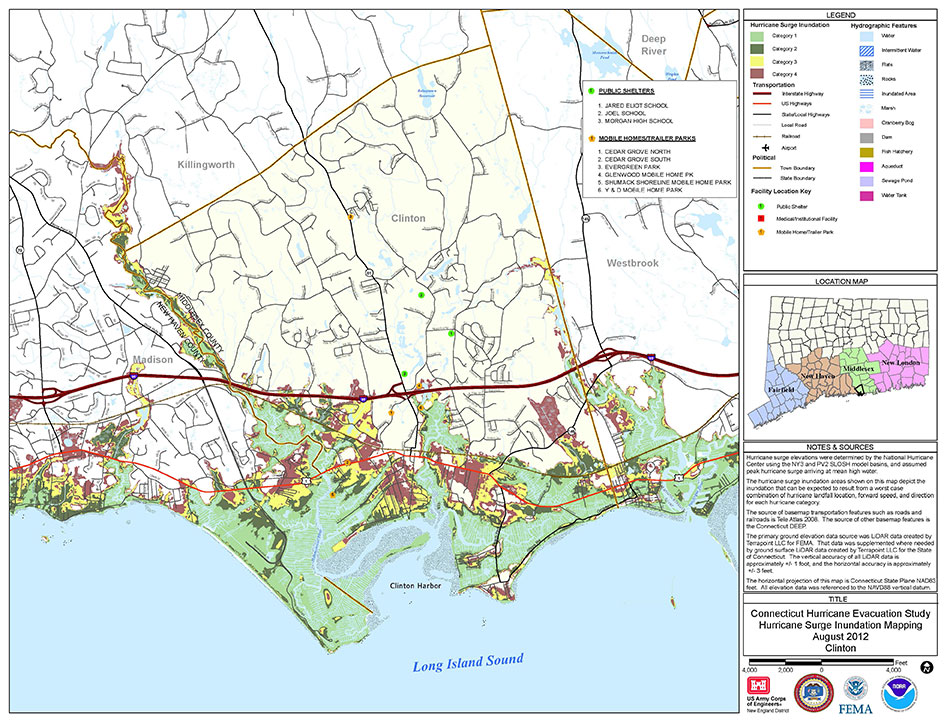
    The maps provide emergency managers in hurricane-prone states with an understanding of storm surge potential that could occur for worst-case Category 1 to 4 storms, identifying areas from which people should evacuate if faced with the threat of storm surge.

    The Army Corps is updating these maps with higher resolution modeling and topography performed by NOAA’s National Hurricane Center’s Storm Surge Unit, so agencies will have more accurate information to educate the public — reducing risk to themselves and their property.

    Hazard Analysis

    “Historically, 49 percent of human causalities from hurricanes are due to storm surge,” said Donald E. Cresitello, the Corps’ Hurricane Evacuation Study program manager for the New York District. “Other impacts like riverine flooding due to rainfall, falling trees due to high winds, and indirect impacts like carbon monoxide poisoning and electrocution can cause deaths. The development of these maps is the first step in the hazard analysis for the hurricane evacuation study process.”

    The “New York Hurricane Evacuation Study Hurricane Surge Inundation Maps” are being produced in collaboration with the Army Corps’ New England and Baltimore Districts and provided to emergency managers. The Army Corps also guides emergency managers on using the maps in the decision-making software 
HURREVAC (Hurricane Evacuation), developed by Sea Island Software for the National Hurricane Program.

    “Agency officials can use these maps to help reduce risk to the public,” Cresitello said. “They can use them for evacuation planning, to redefine their hurricane evacuation zones, identify where shelters should be located and identify where assets should be staged prior to impact from a storm.”

    The new maps will not only show the extent of inland storm surge, but also the depth of the water — in ranges of feet — during different categories of storms, enabling emergency managers to better focus limited resources.

    “In the initial stages of a response, our recovery resources are limited, especially for an event the size of Sandy. If resources are dispatched to areas that were not impacted, valuable time is lost mobilizing and reassigning those resources,” Schneyer said.

    At press time, Schneyer’s agency is entering information from the maps into an interactive program viewable on its county’s website, so the public can see whether their home is in a storm surge zone and which designated shelter is nearby. During Sandy, people who should have evacuated were stranded and faced dangers such as electrocution from downed power lines and fires from gas leaks.

    “This very valuable resource is an excellent tool for public education, emergency management planning, and emergency preparedness in general,” Schneyer said.

    Connecticut shoreline: This example of a storm surge map shows the extent of surge that can be expected as a result of a worst-case scenrio that combines hurricane landfall location, forward speed and direction for each hurricane category. (Credit: USACE)
    Connecticut shoreline: This example of a storm surge map shows the extent of surge that can be expected as a result of a worst-case scenrio that combines hurricane landfall location, forward speed and direction for each hurricane category. (Credit: USACE)

    Using GIS to Create Higher Resolution Maps

    Geographic information systems (GIS), which capture, store, analyze and display location information, are being used to create higher resolution storm surge maps.

    To create the maps, the Corps of Engineers uses the SLOSH model (Sea, Lake, Overland Surges from Hurricanes) provided by the National Oceanic and Atmospheric Administration (NOAA). The SLOSH data is layered over lidar-based topography in Esri ArcGIS software.

    “To come up with the actual depth of water through GIS, we are overlaying the data out of NOAA’s SLOSH model and subtracting out the ground elevations using digital elevation models and coming up with an actual depth of water in feet,” said Donald E. Cresitello, USACE Hurricane Evacuation Study program manager for the State of New York, U.S. Army Corps of Engineers, New York District.


    JoAnne Castagna is a public affairs specialist and writer for the U.S. Army Corps of Engineers, New York District.

  • Abu Dhabi to host Esri Middle East and North Africa User Conference

    MENAUC-logo
    Abu Dhabi, United Arab Emirates, will host the Esri Middle East and North Africa User Conference (MENAUC) Nov. 17–19 to commemorate the emirate’s success and propagate the smart government model throughout the region. For nearly a decade, Abu Dhabi, has typified smart government — primarily due to its wide application of geographic information system (GIS) technology across the enterprise — according to a news release from Esri.

    “I am proud of how far the Abu Dhabi Spatial Data program has come since its inception in 2007, growing to more than 70 stakeholders who contribute to the development of the emirate,” said H. E. Rashed Al Mansouri, director general at Abu Dhabi Systems & Information Centre (ADSIC). “Here in Abu Dhabi, GIS has provided us [with] the tools to plan effectively and comprehensively, make informed decisions and carry out the results of those decisions in a coordinated and efficient way. Everyone who attends the MENAUC comes with the singular mindset of improving life for end users through GIS technology. It is an inspiring event that pushes all of us to think creatively and execute efficiently in the years ahead.”

    Keynote speaker and Esri’s president Jack Dangermond will open MENAUC by showing how GIS as a location platform underpins the planning, operations and management of smart communities, including transportation, social services, public safety, economic development and citizen engagement.

    “One of the most thrilling achievements of my career has been Esri’s collaboration with Abu Dhabi to create a spatial data infrastructure (SDI), which drives ADSIC’s vision to serve Abu Dhabi’s citizens with spatially enabled e-government services,” Dangermond said. “Government GIS expresses all that data in maps, connecting the divisions of government and engaging all participants for fully informed decision making. That’s what we call ‘future proofing’ and what makes organizations resilient to the inevitable flux of a dynamic world. Abu Dhabi perfectly exemplifies that integration model.”

    Examples of smart government initiatives in Abu Dhabi include the New Unified Addressing and Wayfinding System, or Onwani (“My Address”). Onwani is a smart addressing system that makes navigation and location finding easier than ever. Previously, a formal addressing system didn’t exist in Abu Dhabi, so Onwani was initiated based on international best practices. An example of smart technology is the QR Code that will be placed on every street sign pole and building and can then be scanned using smartphones to reveal details about the location. The Onwani system meets many key smart government objectives, such as improving emergency response times, reducing travel times and environmental impact and stimulating economic development.

    Another example of geospatial enablement is the Abu Dhabi Department of Transport (ADDOT). ADDOT released a smart mobile app called Darb that provides real-time data through maps showing traffic jams and accidents. Darb allows motorists to choose alternative routes and navigate the city more easily, and it includes a feedback feature that engages citizens to report infrastructure problems, such as downed light poles. The app has already had a positive impact on transportation and quality of life in the emirate.

    Having a geospatially enabled government has had such a beneficial impact that GIS has become a required curriculum for all K–12 students in the Abu Dhabi school system.

    Dangermond’s address will highlight the above-mentioned examples and be followed by a presentation by Khawla Al Fahim, executive manager of ADSIC and the key figure who supervised and oversaw these geospatial advancements, Esri said. Fahim will detail the benefits of smart government and present the next step in Abu Dhabi’s journey to become a smarter and more resilient emirate.

    Many other users from around the region will also present at MENAUC about their transition to smarter government. As the stories of those successes are told, the number of local and national smart government models will multiply exponentially.

  • Autodesk partners with Skycatch on UAV data capture

    Autodesk is joining with Skycatch, an aerial data-capture company, to make it easier for designers, engineers, architects, BIM managers, owners and operators to capture and use aerial data. Autodesk is a design and engineering software company for the manufacturing, building, and media and entertainment industries.

    Autodesk and Skycatch will use high-resolution aerial data collected by Skycatch to transform the way industrial sites are surveyed. A Skywatch blog said this would mean “allowing companies to make smarter data-driven decisions, while saving time and drastically reducing costs, while Autodesk ReCap delivers an easy, cost-effective solution to process the collected data.”

    “Industry professionals using Autodesk software can leverage highly accurate visual intelligence captured and processed by Skycatch’s end-to-end UAV technology to provide invaluable insights into their projects and improve overall efficiency and collaboration across their teams.”

    Read more on the Skycatch website.


  • SimActive strengthens enterprise UAV offering with version 6.3

    Photogrammetry software developer SimActive has announced Correlator3D version 6.3 with an expanded UAV enterprise offering. A new floating licensing option allows computers on the same network to seamlessly borrow licenses from a pool, increasing transferability for enterprise requirements.

    Because of the worldwide client base of Correlator3D, SimActive has also introduced multi-language support with this version. Users can now operate the software in multiple languages, along with the default English option. Examples of the increased selection include Chinese, Japanese and French.

    “With users in over 50 countries, including many with enterprise requirements, we continue adding features to meet the immense industry demand for the product,” said Louis Simard, CTO of SimActive. “With processing speed at least 10 times faster than entry-level UAV software, Correlator3D is the only affordable global enterprise solution.”

    For a live demonstration at the Capturing Reality Forum (Nov. 23-25, Salzburg, Austria), visit booth 37 or send an email to [email protected].

  • FAA grants Sentera exemption for commercial UAV use

    Sentera LLC, a designer of sensors, software, and unmanned aerial vehicles (UAVs), has been granted a Section 333 exemption from the Federal Aviation Administration (FAA) to operate multiple types of commercially available UAVs. Applications for these systems include crop survey, infrastructure inspection, geospatial mapping and other aerial imaging missions.

    “We are excited to receive the exemption,” said Sentera CEO, Eric Taipale. “While most exemption holders focus on providing revenue-generating flight services, Sentera flies primarily to demonstrate our products to customers and to gather and analyze aerial data which helps us enhance our OnTop Platform, a data management system designed specifically to support the thousands of images collected during a typical UAV flight.”

    Sentera’s exemption for both fixed-wing and quadcopter UAVs ensures the company can capture a wide range of data types that are relevant to customer applications, including very high-resolution visual, multispectral, and thermal imagery, as well as specialized non-image information. Customers use Sentera input data to perform many tasks, such as developing planting and crop management advice for growers, building 3D models of buildings, structures, and terrain for asset owners, and monitoring environmental regulatory compliance for public agencies.

    Comprehensive data management solutions are crucial to successful UAV inspections, asset audits, safety inspections, agriculture data collections, and point-cloud collection activities.

    “Clients use a myriad of UAV-captured data types to increase safety, assess crop health, and boost ROI (return on investment),” explained Taipale. “Sentera already provides some of the most precise sensors and leading UAV solutions in the industry. Our Section 333 exemption allows us advance our OnTop Platform more rapidly, which ultimately helps our customers manage all of this data most efficiently.”

    The FAA authorization allows Sentera to fly UAV platforms built by Lockheed Martin, DJI and Sentera.