Tag: government contract

  • Fugro signs survey contract with US government

    Fugro has been awarded a five-year survey contract by the United States Army Corps of Engineers (USACE). Task orders under this indefinite delivery, indefinite quantity (IDIQ) type contract will support architect and engineering survey and mapping support services for the military, civil and federal agencies of the corps team, Mobile District.

    Using a variety of airborne sensors and systems, including topographic lidar, bathymetric lidar, digital cameras and multispectral/hyperspectral imagers, Fugro will provide integrated data collection and processing in support of the USACE’S National Coastal Mapping Program.

    Other services within the scope of the contract include photogrammetry, vessel based hydrographic surveying, topographic and boundary surveying, conventional and GNSS surveying, terrestrial and mobile lidar scanning and geographic information system (GIS) development and production.

  • US Air Force releases GPS III-3 launch services RFP

    US Air Force releases GPS III-3 launch services RFP

    The Air Force has released a Request for Proposal (RFP) for launch services for the GPS III-3 mission, scheduled to launch in 2019. Proposals are due Sept. 19; the contract will be a standalone contract for a single GPS III launch.

    The United Launch Alliance (ULA) and SpaceX are expected to compete for the contract. In April, SpaceX was chosen to launch the GPS III-2 satellite in May 2018. ULA chose not to compete.

    The RFP seeks an Evolved Expendable Launch Vehicle (EELV) Launch Service. The draft RFP was released on June 14 to obtain industry feedback to inform the Final RFP.  After extensive industry engagements, the Final RFP was released on Aug. 3 with proposals due back to the Air Force no later than Sept. 19 in accordance with the solicitation instructions.

    After evaluating proposals through a competitive, best-value source selection process, the Air Force will award a firm-fixed price contract that will provide the government with a total launch solution including launch vehicle production, mission integration and launch operations for the GPS III-3 satellite.

    Artist's concept of the nextgen GPS III satellite (courtesy of the USAF).
    Artist’s concept of the nextgen GPS III satellite (courtesy of the USAF).

    The Air Force’s acquisition strategy for this solicitation achieves a balance between mission success/operational needs, and lowering launch costs, through reintroducing competition for national security space missions, the Air Force said in a press release.

    “Launch system certification is a key element (high technical bar) within this solicitation to provide insight into the technical capabilities and rigorous processes that demonstrate a launch vehicle contractor’s ability to design, develop, manufacture, and launch national security space missions and contributes to the overall flight worthiness process,” said Lt. Gen. Samuel Greaves, Space and Missile Systems Center commander and Air Force program executive officer for Space.  Prior to contract award, the contracting officer will verify that the Offeror has a certified launch system as part of a responsibility determination resulting in a high technical bar.

    “Through this competitive solicitation for GPS III launch services, we hope to continue fostering competition in order to promote innovation and reduce cost to the taxpayer while maintaining our laser focus on mission success,” Greaves said.

    GPS III is expected to provide improved anti-jamming capabilities as well as improved accuracy for precision, navigation, and timing. It will incorporate the common L1C signal which is compatible with the European Space Agency’s Galileo global navigation satellite system and compliment current services with the addition of new civil and military signals.

    The first GPS III satellite undergoes system-level thermal vacuum testing. (Photo: Lockheed Martin)
    The first GPS III satellite undergoes system-level thermal vacuum testing. (Photo: Lockheed Martin)

    This is the second competitive launch service solicitation under the current Phase 1A procurement strategy. The Phase 1A procurement strategy reintroduces competition for national security space launch services.  Under the previous Phase 1 strategy, ULA was the only certified launch provider. In 2013, ULA was awarded a sole-source contract for launch services as part of an Air Force “Block Buy” of 36 rocket cores that resulted in significant savings for the government through FY 2017.

    In May 2015, Space Exploration Technologies (SpaceX) was certified for EELV launches resulting in two launch service providers that are qualified to design, produce, qualify and deliver a launch capability and provide the mission assurance support required to deliver national security space satellites to orbit.

  • U.S. Navy awards defense contract to Esri for support services

    SeapPort-e, the U.S. Navy’s electronic platform for acquiring support services, has awarded Esri a defense contract for its geographic information system (GIS) technology services. SeaPort-e provides a standardized, efficient means of soliciting services and support from businesses small and large.

    This indefinite delivery/indefinite quantity (IDIQ) contract simplifies the acquisition process for the federal government by facilitating multiple task orders for customers without forcing companies to recompete. The SeaPort-e platform acquires support services in 22 functional areas and conducts rolling admissions to encourage small business participation. Nearly 85 percent of SeaPort-e’s contract holders include small businesses.

    Esri collaborated with nine small business team members — Aerial Information Systems; APEX Expert Solutions LLC; Geographic Information Services, Inc.; Lynker Technologies, LLC; Metron Incorporated; Orca Maritime, Inc.; Punctuate Systems, Inc.; T3W Business Solutions; and VSolvit LLC — to participate in the contract. Each team member offers expertise that is complementary to Esri’s support program.

    Esri is committed to supporting small businesses in their objectives to grow their federal footprint and, earlier this year, launched Federal Small Business Specialty, a partner program to enable that mission.

    Partnering with Esri offers many opportunities for small businesses to provide consulting, implementation, and solutions to meet geospatial requirements and provide ArcGIS software related services, Esri said. SeaPort-e will allow Esri to leverage small business partners’ capabilities and also support their growth.

    “Our business model is to team up with Esri partners to serve U.S. Navy customers,” said Curt Hammill, Esri navy account executive. “Our goal is to make them both successful. SeaPort-e gives us a new vehicle to do that.”

    Esri joins other awardees in providing support to the U.S. Navy across areas such as research and development, systems engineering, modeling and simulation, software engineering, and quality assurance.

  • FAA awards NextGen contract to Lockheed Martin

    The Federal Aviation Administration (FAA) has awarded a contract to Lockheed Martin worth $344 million to develop and implement a new NextGen technology that will improve the efficiency of departures and arrivals, as well as the movement of aircraft on the ground.

    The new technology is expected save time for the flying public and lessen the impact on the environment by reducing emissions and noise.

    Terminal Flight Data Manager (TFDM) will replace the paper flight strips that air traffic controllers currently use at most airports to share flight plans with electronic flight strips that will enable faster and more informed tactical decisions. The electronic strips will improve work efficiency, making it easier for controllers to accommodate traffic volume changes, bad weather and other evolving situations.

    With TFDM, the digital flight plans used to estimate arrivals, gate push-backs, routings, departures and overall airport demand will be shared in real time among air traffic controllers, aircraft operators and airports to improve the handling of more than 40,000 flights each day.

    The shared awareness of aircraft on the ground and in the air will enable arrivals, departures and surface flow to be managed more efficiently, providing accurate, predictive modeling tools to improve flight efficiency from gate to gate.

    Other benefits include improved aircraft traffic flow on the ground, which maximizes airport efficiency, reduced taxi-time delays, and enhanced safety through an increase in controllers’ heads-up time.

  • SpaceX awarded GPS III satellite launch contract

    SpaceX awarded GPS III satellite launch contract

    A SpaceX Falcon 9 stands ready for launch from Cape Canaveral Air Force Station, Fla. The Air Force awarded a contract for GPS III Launch Services to SpaceX.
    A SpaceX Falcon 9 stands ready for launch from Cape Canaveral Air Force Station, Fla. The Air Force awarded a contract for GPS III Launch Services to SpaceX.

    The U.S. Air Force has awarded SpaceX the first competitively sourced National Security Space (NSS) launch services contract in more than a decade.

    Space Exploration Technologies Corporation (SpaceX) was awarded a contract for GPS III Launch Services. This is a firm-fixed price, standalone contract with a total value of $82,700,000.

    SpaceX will provide the government with a total launch solution for the GPS-III satellite, which includes launch vehicle production, mission integration and launch operations and spaceflight certification. The launch will be the second GPS III launch and is scheduled to launch from Cape Canaveral Air Force Station, Florida, in May 2018.

    “This GPS III Launch Services contract award achieves a balance between mission success, meeting operational needs, lowering launch costs, and reintroducing competition for National Security Space missions,” said Lt. Gen. Samuel Greaves, Air Force Program Executive Officer for Space and SMC commander.

    Another launch service provider, United Launch Alliance (ULA), chose not to compete for the contract.

    GPS III is the next generation of GPS satellites that will introduce new capabilities to meet the higher demands of both military and civilian users. The satellite is expected to provide improved anti-jamming capabilities as well as improved accuracy for precision navigation and timing. It will incorporate the common L1C signal, which is compatible with the European Space Agency’s Galileo global navigation satellite system and compliment current services with the addition of new civil and military signals.

    This is the first of nine competitive launch services planned in the FY 2016 President’s Budget Request under the current Phase 1A procurement strategy, which covers awards with FY 2015-2018 funding. The next solicitation for launch services will be for a second GPS III satellite. This award marks a milestone in the Air Force’s ongoing efforts to reintroduce a competitive procurement environment into the Evolved Expendable Launch Vehicle (EELV) program as directed by Frank Kendall, Under Secretary of Defense for Acquisition, Technology and Logistics.

    The Phase 1A procurement strategy reintroduces competition for national security space launch services. Under the Phase 1 strategy, United Launch Alliance (ULA) was the only certified launch provider. In 2013, ULA was awarded a sole-source contract for launch services as part of an Air Force “block buy” of 36 rocket cores that resulted in significant savings for the government through FY 2017.

    In May 2015, Space Exploration Technologies (SpaceX) was certified for EELV launches resulting in two launch service providers that are capable to design, produce, qualify, and deliver a launch capability and provide the mission assurance support required to deliver national security space satellites to orbit. The certified baseline configuration of SpaceX’s Falcon 9 Launch System to Falcon 9 Upgrade was recently updated for use in National Security Space (NSS) missions.

    The Air Force Space Command’s Space and Missile Systems Center, located at the Los Angeles Air Force Base, Calif., is the U.S. Air Force’s center of excellence for acquiring and developing military space systems. Its portfolio includes the Global Positioning System, military satellite communications, defense meteorological satellites, space launch and range systems, satellite control networks, space based infrared systems and space situational awareness capabilities.

  • System of Systems: GPS III bidding, testing

    GPS III Bidding Opens — Again

    The GPS Directorate at the Space and Missile Systems Center (SMC) continues to look for someone to build 22 GPS III satellites in the near future.

    SMC issued a request for proposals on Jan. 8, with rather complicated terms. The first eight GPS III satellites are already under contract, and two have been built, but delivery and launch schedules have dragged. The Air Force incorporated several other payload requirements for the satellites, beyond those of new GPS signals themselves.

    This is the Air Force’s third effort to find a builder.

    The RFP is for “11+ Phase 1 Production Readiness Feasibility Assessment. “ It covers GPS III space vehicles 11 and beyond. The process, if followed as the Air Force envisions, will award up to three relatively small fixed-price contracts.

    According to an Air Force press release, “The scope of this effort includes the current GPS III SV01–08 technical baseline with the addition of redesigned Nuclear Detonation Detection System (NDS), Search and Rescue/GPS (SAR/GPS), and Laser Retroreflector Array (LRA) payloads, Unified S-Band (USB) compliance, Regional Military Protection capability No changes are allowed to the GPS Next Generation Operational Control System (OCX) or Military GPS User Equipment (MGUE) interfaces.”

    The first Air Force effort to recompete the contract for future GPS III satellites came in 2014. A 2015 initiative lowered the bar as far as requirements, but also lowered the award very dramatically, from $200 million each for two companies to $6 million each for three companies.

    The 2016 announcement appears to replicate the terms of the 2015 campaign. There has been no official explanation as to why the terms changed between 2014 and 2015, and why they did not between 2015 and 2016.


    First GPS III Satellite Passes Critical Test

    The first GPS III satellite has passed a critical on-ground, in-lab test, according to Lockheed Martin.

    Rick Ambrose, executive vice president of Lockheed Martin Space Systems, tweeted on Jan. 13 that the satellite had successfully completed its thermal vacuum test (TVAC).

    Lockheed Martin Space Systems is the prime contractor on the GPS III program to build a total of eight GPS IIIs. The contract includes options for up to four more satellites, and the Air Force has told Congress it expects to execute options for at least two of those satellites.

    The first GPS III satellite is expected to launch in 2017.


    USCG-Alert-W

    Coast Guard Issues Jamming Alert

    The U.S. Coast Guard issued a safety alert on Jan. 16, warning mariners of the potential detrimental impact to navigation caused by GPS interference or jamming. The warning emphasizes the importance of understanding how vessel equipment could be impacted by the loss of a GPS signal.

    The Coast Guard states that this past summer, multiple outbound vessels from a non-U.S. port suddenly lost GPS signal reception. The net effect was various alarms and a loss of GPS input to the ship’s surface search radar, gyro units and ECDIS, resulting in no GPS data for position fixing, radar over ground speed inputs, gyro speed input and loss of collision avoidance capabilities on the radar display.

    Fortunately, the vessels were able to safely continue theirvoyage using radar in heads up display, magnetic compass and terrestrial navigation. Approximately six nautical miles later, the vessels’ GPS units resumed operation. Although the vessels had back-up systems to allow a safe transit, the consequences could have been severe, warns the Coast Guard.


    IRNSS Launches Fifth Satellite

    The fifth satellite in India’s Regional Navigation Satellite System rode into orbit Jan. 20, joining a growing fleet of spacecraft to provide positioning services to users across South Asia.

    “With this satellite in place, within our country we will be able to get, 24 x 7, a good positional accuracy,” said A.S. Kiran Kumar, chairman of the Indian Space Research Organisation (ISRO).”

    IRNSS 1E will raise its orbit to an altitude of nearly 36,000 kilometers (22,300 miles) over the next few weeks, entering an orbit centered on 111.75 degrees east longitude and oscillating up to 28.1 degrees north and south of the Equator.

    Two more IRNSS spacecraft are due for launch bythe end of March to complete the constellation.

    The seven satellites — four in inclined geosynchronous orbits like the one intended for IRNSS 1E, and three in equatorial geostationary orbit — will give India an independent navigation system with coverage over Indian territory and regions extending up to 1,500 kilometers (932 miles) from its borders.

    India started launching its navigation satellites in 2013. Each spacecraft is designed to operate for 12 years.

  • SpaceX Falcon 9 Certified for GPS Launches

    SpaceX Falcon 9 Certified for GPS Launches

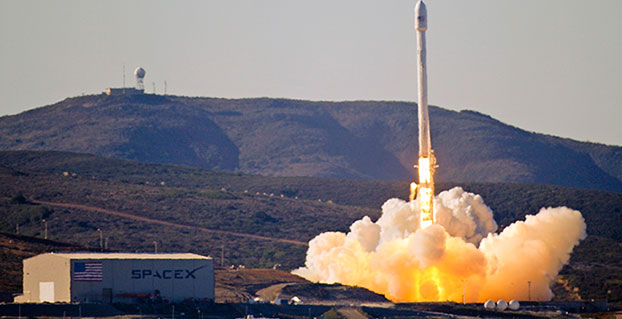
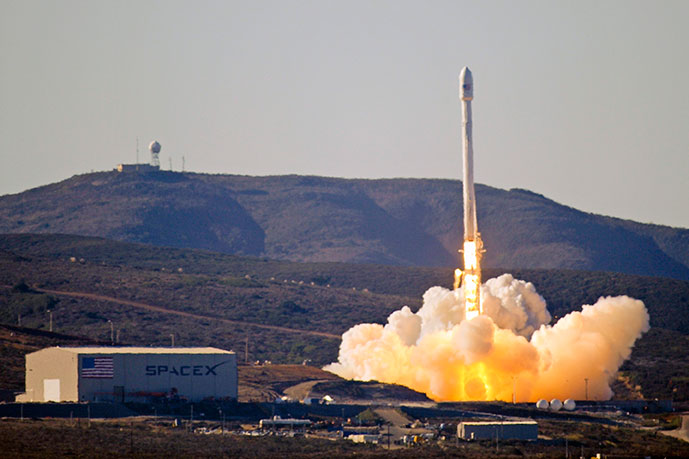
    Team Vandenberg launches its first SpaceX launch from Space Launch Complex-4 Sept. 29, 2013. 30th Space Wing's 1st Air and Space Test Squadron was the lead for all launch site certification activities at Vandenberg for SpaceX as an Evolved Expendable Launch Vehicle New Entrant. The squadron evaluated SpaceX's flight and ground systems, processes and procedures for the upgraded Falcon-9 rocket. (U.S. Air Force photo/Airman Yvonne Morales)
    Team Vandenberg launches its first SpaceX launch from Space Launch Complex-4 Sept. 29, 2013. 30th Space Wing’s 1st Air and Space Test Squadron was the lead for all launch site certification activities at Vandenberg for SpaceX as an EELV New Entrant. The squadron evaluated SpaceX’s flight and ground systems, processes and procedures for the upgraded Falcon-9 rocket. (U.S. Air Force photo/Airman Yvonne Morales)

    The U.S. Air Force has certified SpaceX’s Falcon 9 rocket to launch military satellites, clearing the way for SpaceX to bid on launches of GPS III satellites. The Air Force announced the decision May 26, which completed a nearly two-year process and establishes a competitor to United Launch Alliance.

    SpaceX, based in Hawthorne, Calif., is now eligible for award of qualified national security space launch missions as one of two currently certified launch providers. The first upcoming opportunity for SpaceX to compete to provide launch services is projected to be in June when the Air Force releases a Request for Proposal for GPS III launch services.

    “This is a very important milestone for the Air Force and the Department of Defense,” said Secretary of the Air Force Deborah Lee James. “SpaceX’s emergence as a viable commercial launch provider provides the opportunity to compete launch services for the first time in almost a decade. Ultimately, leveraging of the commercial space market drives down cost to the American taxpayer and improves our military’s resiliency.”

    This milestone is the culmination of a two-year effort on the part of the Air Force and SpaceX to execute the certification process and reintroduce competition into the Evolved Expendable Launch Vehicle (EELV) program. The Air Force invested more than $60 million and 150 people in the certification effort which encompassed 125 certification criteria, including more than 2,800 discrete tasks, three certification flight demonstrations, verifying 160 payload interface requirements, 21 major subsystem reviews and 700 audits in order to establish the technical baseline from which the Air Force will make future flight worthiness determinations for launch.

    “The SpaceX and SMC teams have worked hard to achieve certification, said Lieutenant General Samuel Greaves, commander of the Air Force Space and Missile Systems Center. “And we’re also maintaining our spaceflight worthiness process supporting the National Security Space missions. Our intent is to promote the viability of multiple EELV-class launch providers as soon as feasible.”

    “This is an important step toward bringing competition to National Security Space launch. We thank the Air Force for its confidence in us and look forward to serving it well,” said Elon Musk, SpaceX CEO and lead designer.

    The certification process provides a path for launch-service providers to demonstrate the capability to design, produce, qualify and deliver a new launch system and provide the mission assurance support required to deliver national security space satellites to orbit. This gives the Air Force confidence that the national security satellites being delivered to orbit will safely achieve the intended orbits with full mission capability.

    The SMC, located at Los Angeles Air Force Base, Calif., is the U.S. Air Force’s center for acquiring and developing military space systems. Its portfolio includes GPS, military satellite communications, defense meteorological satellites, space launch and range systems, satellite control networks, space based infrared systems and space situational awareness capabilities.

  • Air Force to Award Additional GPS III Satellite Contracts

    The U.S. Air Force plans to award multiple contracts for companies to demonstrate their ability to build GPS III satellites, according to a report by Mike Gruss of Space News.

    The Air Force expects to award the contracts — worth up to $6 million — during this calendar year. Lockheed Martin Space Systems of Denver is the current GPS III satellite contractor, building the first eight GPS III satellites. The first satellite is expected to launch in 2017.

    The GPS III program is nearly two years behind schedule.

  • Air Force Orders Two More GPS III Satellites

    The United States Air Force plans to order two more GPS III satellites from contractor Lockheed Martin, according to SpaceNews. Lockheed Martin is under contract to build eight GPS III satellites, with the first planned to be launched in 2016. The contract includes options for up to four more satellites.

    However, the Air Force plans to open up construction of subsequent GPS satellites for competitive bidding with GPS III space vehicle 11, reports Aviation Week.

    The satellites are part of the Air Force’s $167.3 billion budget request for fiscal 2016, up from $152.8 billion provided by Congress for fiscal 2015.

    The Air Force also intends to buy only one GPS satellite — from Lockheed Martin or a different contractor — in 2017 rather than the three included in the current budget blueprint, according to the SpaceNews.

  • GSA Kicks Off EGNOS GEO Transponder Service Contracts

    On November 25, the European GNSS Agency (GSA) kicked off the contracts for two new EGNOS GEO transponder services provided by SES.

    The kick-off was done with the support of the European Space Agency (ESA) and the EGNOS service provider ESSP. Initially awarded and signed by the European Commission, in line with a new delegation agreement  between the commission and the GSA, responsibility for the oversight of the contracts has been assigned to ESA.

    The contracts regard the provision of signals from two EGNOS transponders embarked on-board the SES-5 and ASTRA-5B geostationary satellites, both operated by Luxembourg-based SES. The ground-based signals are generated via redundant uplink stations located in Betzdorf, Luxembourg and Redu, Belgium.

    The signals include the navigation messages computed by the EGNOS Mission Control Centers. Both satellites are capable of transmitting dual-frequency signals compliant with GPS L1/L5 and Galileo E1/E5 signal specifications. The signals will be introduced into the EGNOS service provision (L1-only signals) between 2015 and 2016.


  • ESA Awards Contract to IFEN to Develop Advanced GNSS Signal Test Bed

    A contract to design and to deliver an advanced multi-GNSS constellation signal simulator and interface environment testbed was awarded by the European Space Agency (ESA) to IFEN GmbH on October 28, 2013. This contract is concluded in the context of the Signal Test Bed (SIGTB) activities of the European GNSS Evolution Programme (EGEP).

    In addition to addressing the second generation of Galileo, which is planned to provide higher accuracy and signal robustness, the GNSS Signal Test Bed will include the following capabilities:

    • Flexible adaptability to all signal and message standards, whatever the future may bring.
    • Extensive investigation of intentional signal interferences.
    • Testing of GNSS signal performance in newly evolving standards.
    • Generation of even more realistic test scenarios that include background and intentional interference.
    • Refined scenarios of various distortions of GNSS signals.
  • ITT Exelis Awarded Payload Contract for GPS III Satellites

    ITT Exelis has been awarded a $32 million contract by Lockheed Martin to build the navigation payloads for the Global Positioning System III space vehicles three and four. Exelis announced in December 2011 that it had successfully integrated and performed the initial power up of the full-size payload prototype known as GPS III Non-Flight Satellite Testbed (GNST) Navigation Payload Element.

    “Exelis payloads have been on board every GPS spacecraft — a period spanning nearly 40 years. We are tremendously proud to be a part of the next generation of GPS satellites,” said Mark Pisani, vice president and general manager, Precision Instruments and Positioning, Navigation and Timing Systems, ITT Exelis Geospatial Systems. “Together with Lockheed Martin, Exelis is committed to providing our warfighters and commercial and civilian users more accurate and reliable capabilities that improve interoperability and jam-resistance.”

    Exelis was selected along with Lockheed Martin in 2008 by the U.S. Air Force to build the next-generation GPS III program. The GPS III team is led by the Global Positioning Systems Directorate at the U.S. Air Force Space and Missile Systems Center.

    “The GPS III satellites and their superior navigation payloads are critical to sustaining and modernizing the GPS constellation and we are focused on delivering these spacecraft affordably and efficiently to meet the needs of more than one billion users worldwide,” said Keoki Jackson, Lockheed Martin’s GPS III program director.

    Scheduled for first launch in 2014, GPS III satellites will deliver significant improvements compared with current GPS space vehicles. The GPS III program will affordably replace aging GPS satellites while improving capability to meet the evolving needs of military, commercial and civilian users worldwide. GPS III satellites will deliver better accuracy and improved anti-jamming power while enhancing the spacecraft’s design life and adding a new civil signal designed to be interoperable with international global navigation satellite systems.

    For more than 37 years, Exelis payloads and payload components have been on board every GPS satellite. They have accumulated more than 500 years of on-orbit life without a single mission-related failure.

    ITT Exelis Geospatial Systems, headquartered in Rochester, N.Y., is a global supplier of innovative  night vision, remote sensing, and navigation solutions that provide sight and situational awareness at the space, airborne, ground, and soldier levels. Key applications include image intensification and thermal imaging; advanced power supplies; multi-spectral image systems; weather and climate monitoring; space science; intelligence, surveillance and reconnaissance; GPS-based positioning, navigation and timing systems; and image exploitation software.