Tag: grandmaster clock

  • Siemens offers breakthrough time synchronization to fortify digital substations

    Siemens offers breakthrough time synchronization to fortify digital substations

    Siemens has unveiled its latest innovation for energy infrastructure: the Siprotec 5 Precision Time Protocol (PTP) Grandmaster Clocks (GMC).

    Built to secure the backbone of modern power grids, the GMC ensures resilient, fail-safe time synchronization for digital substations, safeguarding critical protection functions from disruption, shielding against external disturbances, and strengthening cybersecurity to boost overall grid reliability.

    Avoiding GNSS disruptions. Conventional digital substation architectures often rely on redundant GNSS-based grandmaster clocks. However, even with redundancy, they remain vulnerable: disturbances to GNSS signals, whether from natural phenomena like solar storms or intentional interference such as jamming and spoofing, can cause disruptive “‘jumps” in the time base. Such disruptions force merging units to resynchronize, temporarily disabling critical protection functions and can lead to unnecessary removal of equipment from service or even cause false tripping events, impacting grid stability and increasing operational costs. Siemens’ new solution mitigates these risks, ensuring uninterrupted, secure operation. 

    Siemens’ solution separates sample synchronization from global time synchronization using specialized internal time sources. The Siprotec 5 devices, equipped with integrated PTP Grandmaster Clocks compliant with IEEE 1588v2/PTP standard, operate independently from external GNSS signals, using internal oscillators as time references for precise synchronization.

    Changeover technology. A key feature of this approach is Siemens’ patent-pending Seamless PTP grandmaster changeover technology, built into Siprotec 5 devices. This ensures that when primary clocks return, they first align with active backup clocks before resuming their role. In doing so, disruptive time base jumps during switchovers are prevented, keeping protection functions continuously available. 

    The specialized synchronization enables process bus networks in digital switchgears to operate autonomously without external access points, significantly strengthening cybersecurity by isolating the process bus from the station bus network. 

  • Microchip’s TimeProvider 4500 v3 grandmaster clock enables terrestrial alternative to GNSS

    Microchip’s TimeProvider 4500 v3 grandmaster clock enables terrestrial alternative to GNSS

    Microchip Technology has released the TimeProvider 4500 v3 grandmaster clock (TP4500) designed to deliver sub-nanosecond accuracy for time distribution across 800 km long-haul optical transmission.

    Most current deployments require GNSS at grandmaster sites, but the TP4500 enables highly resilient synchronization without relying on GNSS, providing critical infrastructure operators with complementary positioning, navigation and timing (PNT). The TP4500 is a resilient, terrestrial solution for the absence of GNSS in precise timing, alleviating physical obstruction, security and signal interference costs associated with GNSS-dependent deployments.

    The TP4500 supports time reference provided by UTC(k) UTC time provided by national labs. It offers a premium capability that delivers High Accuracy Time Transfer (HA-TT) as defined by ITU-T G.8271.1/Y.1366.1 (01/2024) to meet 5 nanoseconds (ns) time delay over 800 km (equating to 500 picoseconds (ps) average per node, assuming 10 nodes), setting a new industry benchmark for accuracy.

    The TP4500 system can be configured with multiple operation modes to form an end-to-end architecture known as virtual PRTC (vPRTC), capable of delivering PRTC accuracy over a long-distance optical network. vPRTC is a carrier-grade architecture for terrestrial distribution of HA-TT, which has been widely deployed in operator networks throughout the world.

    TimeProvider 4500 v3 is a key steppingstone towards support of the ITU-T G.8272.2 standard, which defines a coherent network reference time clock (cnPRTC) in amendment 2 (2024). An cnPRTC architecture ensures highly accurate, resilient, and robust timekeeping throughout a telecom network. This allows stable, network-wide ePRTC time accuracy, even during periods of regional or network-wide GNSS unavailability or other failures and interruptions.

  • Adtran launches Oscilloquartz SFP grandmaster clock for precise edge timing in 10G networks

    Adtran launches Oscilloquartz SFP grandmaster clock for precise edge timing in 10G networks

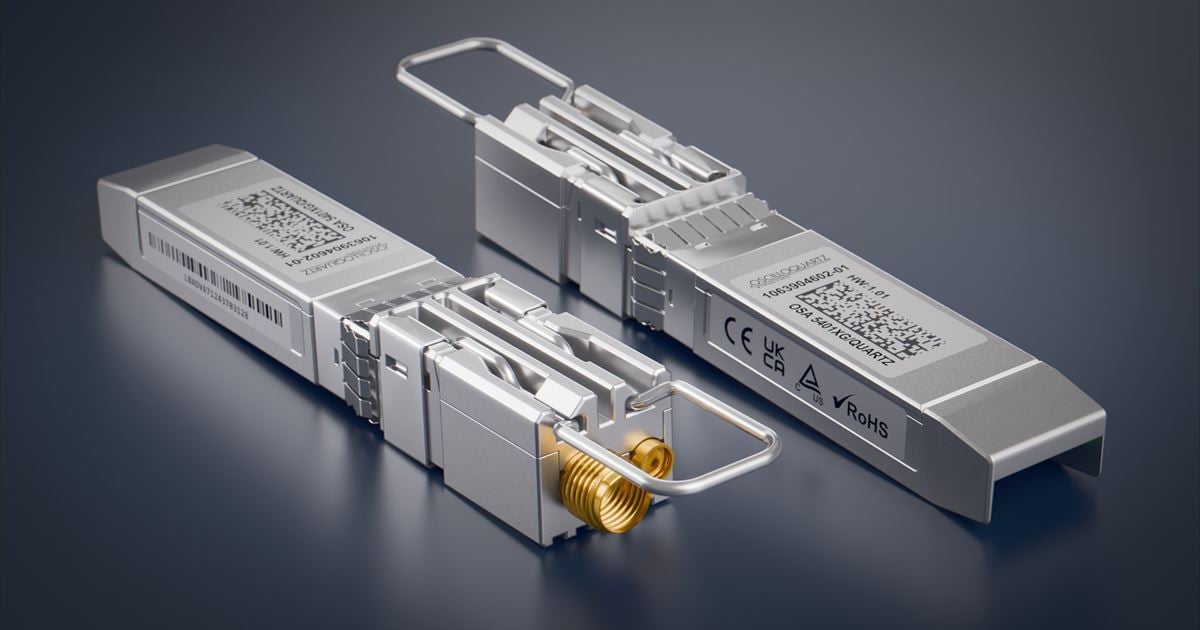
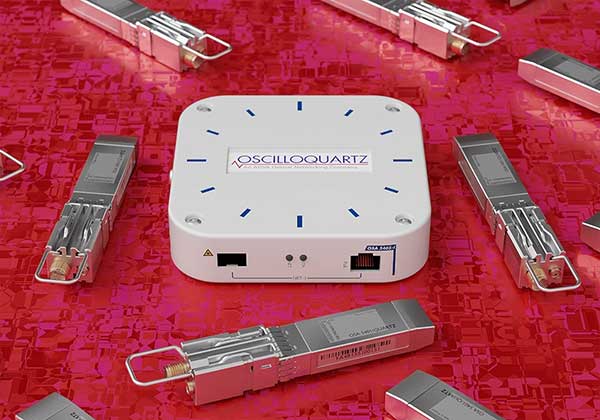
    Adtran has launched the OSA 5401XG SyncPlug, an SFP-based grandmaster clock that delivers precise PTP and NTP synchronization for 10Gbit/s edge and access networks. The new Oscilloquartz device enables timing distribution through a compact, plug-in form factor that requires no rack space or complex installation, empowering network operators to extend synchronization into space- and power-limited deployments.

    With multi-band GNSS support, compliance with PRTC‑B and compatibility with 10Gbit/s-only host platforms, it offers an efficient way to upgrade timing capabilities across sectors, including telecom, energy, defense, enterprise and more, according to Adtran.

    “As networks evolve, precise timing has to reach further, faster and into more constrained environments. That’s exactly what the 5401XG SyncPlug is built for. It’s a no-compromise solution that fits directly into existing infrastructure, requires almost no space or power and delivers the performance needed for next-generation services,” said Gil Biran, GM of Oscilloquartz, Adtran. “By integrating advanced GNSS capabilities in a 10Gbit/s-ready SFP module, we’re giving our customers an easier, smarter way to deploy resilient timing, whether modernizing legacy sites, extending coverage at the edge or rolling out new, timing-critical applications.”

    The OSA 5401XG SyncPlug is a fully featured SFP-based synchronization device that supports PTP grandmaster, boundary and slave clock modes, Stratum 1 NTP server functionality, and SyncE for frequency synchronization. It plugs directly into standard 1Gbit/s or 10Gbit/s ports and consumes less than 2.5W, making it ideal for space- and power-sensitive locations. With multi-band GNSS (L1 and L5), the device enables compliance with enhanced timing standards such as PRTC-B and supports regional systems, including India’s IRNSS. It also offers advanced spoofing and jamming detection, extended holdover and up to 500,000 NTP transactions per second, ensuring performance and security at scale.

    “Demand for precise synchronization is growing rapidly across edge and access networks, and it has to be delivered with minimal footprint and maximum resilience,” commented Igal Pinhasov, VP of product line management at Oscilloquartz, Adtran. “From mobile backhaul and energy grids to secure government and business networks, the OSA 5401XG SyncPlug fits directly into existing infrastructure to deliver full grandmaster functionality over 10Gbit/s. There’s no need for extra cabling, appliances or rack space. It’s an ideal solution for operators looking to modernize timing in challenging environments while simplifying deployment and strengthening performance.”

  • Brandywine and ADVA partner to provide defense M-code device

    Brandywine and ADVA partner to provide defense M-code device

    Image: ADVA
    Image: ADVA

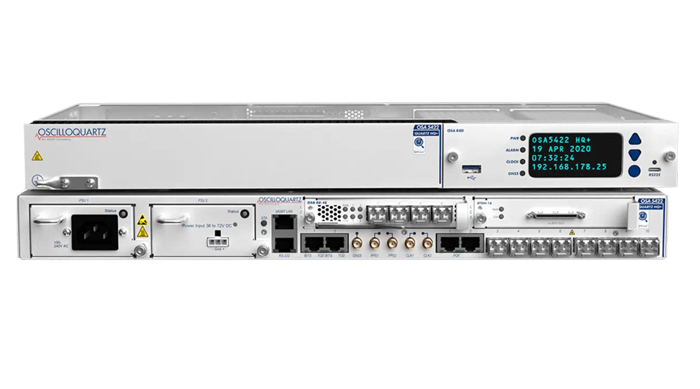
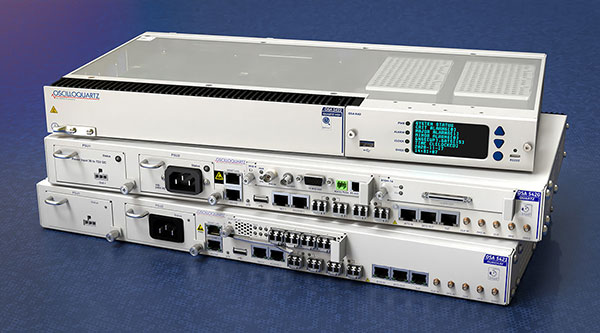
    ADVA and Brandywine Communications have partnered to provide a defense-grade M-code device with advanced timing, the OSA 5422 grandmaster clock, for military applications. ADVA’s OSA 5422 meets key requirements of military networks by providing advanced positioning, navigation and timing (PNT) capabilities and improved resilience.

    ADVA’s OSA 5422 grandmaster clock is integrated with a highly reliable M-code receiver, which meets stringent frequency and phase synchronization needs. The device is equipped with multi-band, multi-constellation GNSS receivers for when M-code is not available. OSA 5422 also has long holdover and precision time protocol backup, which enables it to maintain accurate timing even in the event of M-code disruption.

    The OSA 5422 supports legacy interfaces such as BITS and IRIG and features eight field-upgradable 10G bit/s ports and 1G bit/s interfaces. The device is suitable for most demanding military edge applications.

  • PGE selects assured PNT clocks for smart-grid infrastructure

    PGE selects assured PNT clocks for smart-grid infrastructure

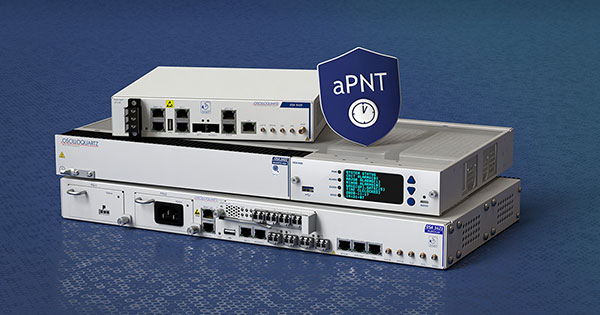
    ADVA’s aPNT platform is key for the development of PGE’s critical network infrastructure (Photo: Business Wire)
    ADVA’s aPNT platform is key for the development of PGE’s critical network infrastructure (Photo: Business Wire)

    Portland General Electric (PGE) is deploying Oscilloquartz PTP grandmaster clock technology as it upgrades to packet-based synchronization and protects its network against GNSS vulnerabilities and cyberattacks. The upgrades also conform to PNT Executive Order 13905.

    PGE, one of the largest power utilities in the Western United States, is using the ADVA scalable timing solution to enable a smooth transition from legacy synchronization and ensure new levels of accuracy, reliability and resiliency. The new system will  timestamp data and control grid substations at the edge.

    With multi-band GNSS receivers and artificial-intelligence (AI) threat detection, ADVA’s assured PNT (A-PNT) platform helps maintain resilient timing, even in challenging circumstances such as deliberate jamming and spoofing attacks. It also provides multi-source backup, including PTP network timing and in-device holdover oscillators for when GNSS signals are unavailable or disrupted.

    The solution is built on the OSA 5410 and OSA OSA 5420 series of edgeSync+ grandmaster clocks. It features multi-band, multi-constellation GNSS receivers and supports multiple PTP profiles, including substation power and core telecom backup sync, while also allowing conversion between them and supporting legacy interfaces.

    The products are part of ADVA’s new aPNT platform, integrating threat detection, multi-source backup and ADVA’s intelligent Ensemble Sync Director.

  • UrsaNav trials eLoran as GNSS backup with ADVA grandmaster clock

    UrsaNav trials eLoran as GNSS backup with ADVA grandmaster clock

    Successful eLoran field trial using ADVA’s OSA 5420 Series demonstrates same accuracy and stability as GPS with much-improved resilience

    UrsaNav and ADVA have conducted an enhanced long-range navigation (eLoran) field trial using UrsaNav’s eLoran receiver and ADVA’s Oscilloquartz grandmaster clock technology. The successful demonstration shows that eLoran offers a robust and reliable backup for GPS and other GNSS, and could be used to provide an assured position, navigation and timing (PNT) service.

    The trial follows U.S. PNT Executive Order 13905 aimed at strengthening national resilience through PNT services, including protecting critical infrastructure such as electrical power grid and communication networks from rising cyber threats. By harnessing ADVA’s flexible OSA 5420 series, designed with assured PNT (A-PNT) technology, UrsaNav has shown that eLoran can provide a new layer of protection and significantly boost timing resilience and security.

    “The success of this field trial demonstrates how eLoran, as part of ADVA’s assured PNT solution, can serve as a crucial backup for GPS,” said Charles Schue, CEO, UrsaNav. “We have shown how our technology enables ADVA’s grandmaster clock to receive UTC timing from the eLoran system for a period of several days with the same accuracy and stability as GPS. Of course, this capability is extensible to other GNSS as well. eLoran is far less vulnerable to unintentional jamming and spoofing disruptions or intentional attacks, thereby delivering nanosecond precision with even more resilience.”

    “By partnering with ADVA, we’ve been able to show that our eLoran receiver interoperates with the best network timing toolkit available,” Schue said. “The OSA 5420 Series is a great product — highly efficient and easy to operate. Together with ADVA, we’re paving the way for tomorrow’s more robust assured PNT synchronization architecture. Now that UrsaNav has demonstrated the power of our OSA 5420 Series to utilize eLoran in the event of outages, we have another very important tool to ensure the quality and availability of time-sensitive services.”

    UrsaNav’s latest trial used the OSA 5420 series grandmaster clock with built-in GNSS receiver. Timing stability from GPS was measured for several days. This was then replaced with eLoran for the same period with no loss of stability.

    The test was conducted indoors where GNSS signals are not usually available, potentially extending the availability of precise UTC timing to many more environments.

    “Commercially available GNSS jammers and spoofers are easy and cheap for attackers to acquire,” explained Nir Laufer, VP, product line management, Oscilloquartz, ADVA. “That’s part of the reason why we’re seeing a growing number of incidents across the world of blocked or misleading signals. If power utilities, enterprises, service providers and governments continue to rely on GNSS alone, it’s only a matter of time before the consequences become very serious. That’s why we’re committed to tackling GNSS vulnerabilities with advanced technologies like our ePRTC offering, cesium atomic clocks and our optical timing channel solution. Now that UrsaNav has demonstrated the power of our OSA 5420 series to utilize eLoran in the event of outages, we have another very important tool to ensure the quality and availability of time-sensitive services.”

    A demo showed how ADVA’s synchronization technology enables protection for critical infrastructure that needs ultra-reliable aPNT solutions. (Photo: Business Wire)
    The demo showed how ADVA’s synchronization technology enables protection for critical infrastructure that needs ultra-reliable aPNT solutions. (Photo: Business Wire)

  • Orolia unveils EdgeSync network timing platform

    Orolia unveils EdgeSync network timing platform

    The new cost-effective small form factor is designed for NTP and PTP functionality

    Photo: EdgeSync
    Photo: EdgeSync

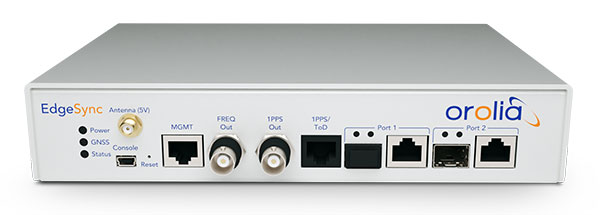
    Orolia has introduced EdgeSync, a new cost-effective network timing platform that provides Network Time Protocol (NTP) and Precision Time Protocol (PTP) Grandmaster and Boundary Clock functionality for real-time edge applications.

    High performance, scalability, ease of use and manageability make EdgeSync particularly suitable for a wide range of applications, including data centers, finance, mobile edge computing, enterprise, smart grid, industrial internet of things (IoT), process control or telecommunications.

    “EdgeSync is a great addition to Orolia’s timing product line because it’s ideally suited to meet the demanding requirements of today’s modern networks, including 5G infrastructure,” said Jeremy Onyan, director of Time Sensitive Networks at Orolia. “It delivers NTP and PTP capability to industries like process control, broadcast and telecom in a cost-efficient form factor that doesn’t sacrifice performance while taking advantage of the growing demand for edge applications.”

    EdgeSync uses a multi-GNSS receiver (GPS, Galileo, GLONASS, Beidou and QZSS), PTP and Synchronous Ethernet (SyncE) as input references and generates PTP, SyncE, NTP and timing signals (10 MHz, 1 PPS and Time of Day message) as outputs. It features dual 1 GbE ports for both copper RJ45 and optical network timing connections.

    EdgeSync also can provide IEEE 1588-2008 (PTP) Grandmaster and Boundary Clock functionality. The device leverages unique PTP algorithms to deliver stringent timing for demanding, precise applications and supports multiple industry PTP profiles for interoperability. An enhanced oscillator and PTP slave capacity option allow users to choose the EdgeSync performance level to meet their specific needs.

    EdgeSync is available both in the Orolia Online Store (shipping to U.S. addresses only) and directly from Orolia technical sales representatives.

  • Adva launches grandmaster clock with multi-band GNSS receiver

    Adva launches grandmaster clock with multi-band GNSS receiver

    Adva’s OSA 5405-MB provides nanosecond timing at a network's edge. (Photo: Business Wire)
    Adva’s OSA 5405-MB provides nanosecond timing at a network’s edge. (Photo: Business Wire)

    Adva has launched the OSA 5405-MB, a compact outdoor precision time protocol (PTP) grandmaster clock with multi-band GNSS receiver and integrated antenna.

    Part of the OSA 5405 series of smart synchronization devices for indoor or outdoor deployment, the OSA 5405-MB ensures timing accuracy by eliminating the impact of ionospheric delay variation. This empowers communication service providers and enterprises to deliver the nanosecond precision needed for 5G fronthaul and other emerging time-sensitive applications.

    The GNSS receiver and antenna enable the OSA 5405-MB to meet PRTC-B accuracy requirements (+/-40 nanosec0nds) even in challenging conditions. For the first time, the technology is available in an edge timing device with minimal footprint, helping operators achieve unprecedented accuracy and reliability as they roll out wide-spread small cell networks.

    “Our multi-band, multi-constellation GNSS receiver provides an extremely cost-efficient way to achieve PRTC-B UTC-traceable network timing with the levels of accuracy needed for next-generation use cases,” said Gil Biran, general manager, Oscilloquartz, Adva. “By adding this technology to our versatile, small-form-factor OSA 5405 series, we’re offering a route to precision synchronization at the network access without significant investment.”

    “A ruggedized design and minimal visibility make our OSA 5405-MB easy to install in almost any outdoor location,” Biran said.  “With the power to compensate for ionospheric delay variations and resilience against jamming and spoofing, our compact edge solution really is the key to 5G synchronization.”

    The OSA 5405 series is a versatile timing solution for deployment deep in urban canyons, where advanced end applications require stringent synchronization. With its small form factor, the OSA 5405-I indoor variant can be positioned on windows to avoid multipath signal interference.

    Offering both electrical and optical interfaces and with cost-effective Ethernet cabling, the OSA 5405 series avoids RF feeds of traditional GNSS installations by integrating an antenna, receiver and PTP grandmaster in a single device.

    Ionospheric Delays. With multi-band GNSS technology, the OSA 5405-MB also protects against timing inaccuracies caused by ionospheric disturbance. By receiving GNSS signals in two frequency bands and using the differences between them to calculate and compensate for delay variation, the OSA 5405-MB eliminates inaccuracy and ensures ultra-precise synchronization whatever the space weather conditions.

    It can work with up to four GNSS constellations concurrently (GPS, Galileo, GLONASS and BeiDou), increasing the number of observable satellites in urban canyons. A comprehensive set of Syncjack PTP and GNSS jamming and spoofing monitoring features in combination with Adva’s Ensemble Controller and Sync Director assures high synchronization quality and provides transparency for simple operation of large synchronization networks.

    The OSA 5405-MB also offers network-delivered timing backup to further mitigate GNSS vulnerabilities and make synchronization more robust and resilient.

  • ADVA brings next-gen synchronization

    ADVA brings next-gen synchronization

    Enhanced Oscilloquartz portfolio enables seamless transition to PTP timing from the core to the substation

    The OSA 5401 and OSA 5405 now enable power utility and broadcast networks to achieve sub-microsecond synchronization. (Photo: Business Wire)
    Photo: Business Wire/Oscilloquartz

    ADVA has upgraded its portfolio of Oscilloquartz PTP grandmaster clocks, enabling power utilities to smoothly transition to packet network synchronization.

    The enhanced technology will empower electricity providers to evolve their infrastructure into smart grids based on precision time protocol (PTP) power profiles, while at the same time supporting all legacy timing signals.

    Updates to ADVA’s Oscilloquartz pluggable solution, its compact small cell device, its mid-size PTP grandmasters and its fully redundant core timing technology ensure ultra-precise timing throughout a utility network.

    The technology also removes the risk of relying purely on satellite-based time sources through continuous monitoring, jamming and spoofing detection and AI-assisted analytics.


    ADVA’s entire range of Oscilloquartz grandmaster clocks has been upgraded to meet the latest PTP profiles for time, frequency and phase synchronization in power utility networks. This includes:

    • OSA 5401 small form-factor pluggable,
    • OSA 5405 for indoor and outdoor substation deployments,
    • OSA 5420 Series,
    • Highly scalable OSA 5430 and 5440 with 10Gbit/s interfaces and fully redundant hardware.

    The technologies enable an easy migration to an Ethernet-based timing network with support for PTP, Network Time Protocol and SyncE, as well as IRIG-B, PPS and BITS legacy interfaces.

    PTP-based backup combined with multi-band GNSS receivers and advanced monitoring capabilities ensure that the upgraded solutions provide highly reliable delivery of precise timing information even during long GNSS outages.

    To create an ePRTC solution, ADVA’s Oscilloquartz cesium clocks can also be combined with the OSA 5420, 5430 or 5440. This delivers extended holdover of up to 70 nanoseconds for 14 days, even when GNSS signals are unavailable.

  • Adva brings sub-microsecond synchronization to utility and broadcast networks

    Adva brings sub-microsecond synchronization to utility and broadcast networks

    The OSA 5401 and OSA 5405 now enable power utility and broadcast networks to achieve sub-microsecond synchronization. (Photo: Business Wire)
    The OSA 5401 and OSA 5405 now enable power utility and broadcast networks to achieve sub-microsecond synchronization. (Photo: Business Wire)

    Upgraded PTP grandmaster clocks deliver precise, robust timing in compact form factor

    Adva has extended the capabilities of its compact Oscilloquartz PTP timing technology to enable power utility and broadcast networks to achieve sub-microsecond synchronization.

    Now electricity companies can harness the accuracy needed for smart power grids, and media enterprises can meet key timing challenges, the company said.

    The two upgraded solutions are the pluggable OSA 5401, a small PTP grandmaster clock, and the versatile OSA 5405, an integrated PTP grandmaster with dual GNSS antenna and receiver.

    Both technologies have proved critical in the telecommunications industry, where they have been widely deployed across the globe. They offer outstanding precision and design density. Thanks to unique spoofing and jamming detection capabilities, they also provide high availability.

    “This upgrade is big news for utility and media network operators looking to harness the most advanced innovation in their field. With our OSA 5401 and 5405 bringing new levels of accuracy and resilience to their infrastructure, they can reap the benefits of emerging bandwidth-intensive, latency-sensitive applications”

    “This upgrade is big news for utility and media network operators looking to harness the most advanced innovation in their field. With our OSA 5401 and 5405 bringing new levels of accuracy and resilience to their infrastructure, they can reap the benefits of emerging bandwidth-intensive, latency-sensitive applications,” said Nir Laufer, senior director, product line management, Oscilloquartz, Adva.

    “These devices are feature rich and incredibly efficient. But as well as their versatility, what really sets them apart is their extremely small footprint and low power consumption. This is key to bringing packet time distribution to the edge of network. With our technology ensuring sub-microsecond synchronization, smart grids can perform flexible, real-time decision making, as well as monitoring and automated maintenance. And for media companies, the possibilities for high-quality, interactive broadcasting from any location are enormous.”

    The OSA 5401 and OSA 5405 now comply with the latest PTP profiles for time, frequency and phase synchronization in both power utility and broadcast networks. These include the IEC/IEEE 61850-9-3 Power Utility Profile for precise time distribution and clock synchronization in electrical grids with an accuracy of 1μs, and SMPTE 2059 for synchronizing video and audio equipment over packet networks.

    By supporting NTP, both solutions also enable enterprises to run an on-premises NTP server for high levels of accuracy and uncompromised availability. What’s more, the OSA 5401 and OSA 5405 include advanced GNSS jamming and spoofing detection mechanisms, which are integrated in a centralized AI-based GNSS assurance toolkit.

    Taking up zero real estate and using very little power, the OSA 5401 can be deployed in the most space-restrictive locations. Its capabilities include multi-constellation GNSS (GPS/GLONASS/BEIDOU) and accurate time and frequency recovery, even in challenging environments such as urban canyons.

    Available in both indoor and outdoor variants, the OSA 5405 radically simplifies and extends the reach of GNSS antenna installation by allowing operators to forget about archaic and expensive RF cables and instead use simple Ethernet over copper cables or optical fiber.

    With the OSA 5405, highly precise GNSS-sourced synchronization is supported by network-based SyncE and PTP backups for highly stable sub-microsecond timing accuracy.

    “Our mission is to make precise, resilient and affordable timing available in every industry. Both our OSA 5401 and OSA 5405 have had a significant impact on communication service provider networks, supporting mass small cell rollout and the transition to 5G connectivity. Now we’re ready to bring accurate, reliable and cost-efficient PTP timing to the edge of power and broadcast networks,” commented Ulrich Kohn, director, technical marketing, Adva.

    “One feature of these devices that will prove key to network operators in these industries is their unique spoofing and jamming detection capabilities. These work on two layers. Firstly, network elements identify disruption autonomously. Then, on top of that, a layer powered by AI analyzes information from multiple devices. Using machine learning, this delivers the highly sophisticated and extremely robust protection needed for machine type communication applications in energy grid protection and control,” Kohn said.

    Further information can be found in these slides.

    A supporting solution brief is also available.

  • Microsemi’s TimeProvider 4100 provides for 4G and 5G base stations

    Microsemi Corporation has launched the TimeProvider 4100, a flexible IEEE 1588 Precision Time Protocol (PTP) grandmaster clock designed to scale from the edge to the aggregation layers of both mobile infrastructure and access networks.

    The TimeProvider 4100 is a gateway clock, a new class of synchronization product which accepts multiple inputs from GNSS, Synchronous Ethernet (SyncE), 1588 PTP and E1/T1 digital transmission links, and distributes timing flows to multiple endpoints such as base stations.

    It supports the GNSS constellations GPS, Beidou, GLONASS and Galileo.

    Mobile and future markets

    Primarily targeting the mobile market, operators and data centers for mobile operator environments, over time the TimeProvider 4100’s platform will also serve mobile network needs associated with machine-to-machine (M2M), internet of things (IoT) and autonomous vehicle applications.

    A gateway clock benefits from multiple layers of protection leveraging other assets in the core of the network. TimeProvider 4100 is a best-in-class 1588 grandmaster complemented by extensive port fan-out for PTP, Network Time Protocol (NTP), SyncE and legacy building integrated timing supplies (BITS), the company said.

    With multiple ports for current, legacy and future networks which can be connected to multiple base stations for 4G and 5G deployments, the device offers customers a cost-effective solution that can be adapted for a wide variety of use cases.

    Mobile operators face tough requirements to drastically increase mobile bandwidth while efficiently leveraging the available spectrum. Cellular networks using only frequency synchronization waste significant spectrum, whereas newer deployments require phase synchronization for efficient spectrum usage and interference mitigation in increasingly densified networks.

    Phase synchronization

    Phase synchronization is imperative for next-generation service deployment. To that end, operators need timing solutions capable of supporting legacy infrastructure and evolving network needs. Microsemi’s TimeProvider 4100 is engineered to provide phase to today’s 4G, LTE and LTE-Advanced (LTE-A) deployments, as well as tomorrow’s cRAN evolutions and 5G networks.

    The device’s platform can be expanded through an internal module, providing customer savings such as power and rack space, and enables great scalability through sub-tenancy mechanisms. TimeProvider 4100 also features port fan-out which can be flexibly used for PTP, NTP, E1/T1, 1 pulse per second (PPS), time of day (ToD) and 10 megahertz (MHz) at the aggregation layer.

    “With our ongoing commitment to delivering system products, Microsemi has demonstrated our leadership in the IEEE 1588 grandmaster market with more than 400 operator deployments worldwide,” said Eric Colard, director of product line management for Microsemi. “We are pleased to leverage this expertise to deliver the TimeProvider 4100. With eight Ethernet ports and four BITS E1/T1 ports in the base unit, TimeProvider 4100 provides a very feature-rich gateway clock device.”

    Microsemi’s TimeProvider family serves the mobile infrastructure market, which is expected by market research firm IHS Markit to be approximately $48 billion in 2018, with hardware expected to account for approximately 62 percent of the market.

    The TimeProvider family is designed to capitalize on growth opportunities related to 5G installations, beginning with trial installations in 2018, growing to a market size of $2.8 billion by 2021 according to the firm’s “Mobile Infrastructure Intelligence Service – 3Q17 Market Tracker.”

    The new device’s flexibility does not compromise its performance and feature set, and meets stringent precise timing requirements, including complying with primary reference time clock (PRTC) and the latest time and phase ITU-T and IEEE industry standards.

    Available upgrades include oscillator options for enhanced holdover performance and an internal expansion module which adds 16 E1/T1 BITS ports to the device. The TimeProvider 4100 also accepts PTP input with assisted partial timing support (APTS) to back up the GNSS signal in case of signal loss for high resiliency of the solution by leveraging 1588v2 grandmasters already deployed at the core of the network.

    Timing and synchronization platform

    TimeProvider 4100 can be managed through Microsemi’s timing and synchronization management platform, TimePictra. In addition, for phase, service providers require more visibility about performance and health of the various network elements participating in the synchronization chain. TimeProvider provides advanced monitoring capabilities, especially for IEEE 1588v2 PTP for phase, and leverages a WebGUI to present results and calculations for easier interpretation.

    In addition to its TimeProvider family, Microsemi also offers highly comprehensive and cost-effective IEEE 1588 and SyncE network synchronization silicon solutions providing time stamping, ultralow jitter (for up to 100G PHYs), IEEE 1588 protocol support (including the ITU-T telecom profile for frequency and phase) and one of the industry’s most established client servos used by numerous carriers worldwide.

    The solutions offered are used by all major equipment vendors across the globe in a variety of wireless and wireline applications and work seamlessly with Microsemi’s full range of TimeProvider equipment.


  • Microsemi updates TimeProvider 5000 to support multi-GNSS, IPv6 protocol

    Microsemi Corporation has updated the hardware on its TimeProvider 5000 IEEE 1588 Precision Time Protocol (PTP) grandmaster clock. The update enables the clock to support Internet Protocol version 6 (IPv6) and multi-GNSS constellations to ensure better reception and higher security in a wide variety of telecommunications network applications.

    “As our global wireless customers drive mobile infrastructure forward with LTE-Advanced (LTE-A) and 5G services, support for IPv6 and alternate GNSS constellations is rising in importance for deploying a robust, secure and future-proof synchronization network,” said Barry Dropping, senior director of product line management for Microsemi.

    “The addition of GLONASS and Galileo support on the TimeProvider 5000 system greatly enhances the robustness and security of this widely adopted synchronization platform for global carriers,” Dropping said. “We will continue to invest in this technology to ensure reliable long-term roadmap support is provided for telecommunications customers.”

    Microsemi TimeProvider 5000 PTP grandmaster clock.

    An increasing number of global operators are now looking at solutions such as Microsemi’s enhanced TimeProvider 5000, because the device offers multiple constellations in accordance with the directives in certain countries to remove their sole dependency on GPS. Having support for GLONASS and Galileo constellations also makes systems more robust and secure to certain GNSS vulnerabilities.

    Microsemi’s TimeProvider family has been installed in more than 350 networks across the globe, enabling communications service providers to build stable, high performance and reliable network infrastructures.

    Along with new support for IPv6 and multi-GNSS constellations, the recently enhanced TimeProvider 5000 provides redundant hardware, user configurable PTP profiles and Synchronous Ethernet (SyncE) support with optical small form-factor pluggable (SFP) modules.

    The TimeProvider 5000 is a carrier-grade IEEE 1588 PTP grandmaster clock with a Network Time Protocol (NTP) server option and expansion shelf capabilities that include SyncE and an advanced PTP profiles, making the timing and synchronization system capable of supporting network needs today and in the future. Its flexible design is vital to enable circuit to packet network migration for high-speed data services and wireless backhaul, and to deliver 3G, 4G/LTE, LTE-A and 5G wireless services.

    Microsemi’s TimeProvider family is a part of the carrier routing and switching equipment market, which was approximately $43 billion in 2016 according to market research firm IHS Infonetics. The firm also expects this market to see sales growth as more carriers start and expand their 4G services along with the introduction of 5G deployments toward the end of 2019.