Tag: grandmaster clock

  • Oscilloquartz unveils dual-antenna GNSS SyncReach for small cells

    Oscilloquartz has launched the OSA 5405 SyncReach, an integrated PTP grandmaster and GNSS receiver with a patent-pending dual antenna and receiver to enable the mass roll out of small cells.

    The new technology has been specifically engineered to provide accurate and affordable phase synchronization for the rapidly growing small-cell market and meet the stringent timing requirements of 4.5G and 5G connectivity.

    With the OSA 5405, operators can migrate from legacy GNSS RF antennas and cables to standard, cost-effective copper and fiber Ethernet cabling, reducing capital expenditure and operating expenses, Oscilloquartz said.

    Available in both indoor and outdoor variants, the OSA 5405 can be deployed in challenging environments, including urban canyons where GPS signals fail. The OSA 5405’s miniscule form factor also enables it to be positioned on indoor windows to avoid multipath signal interference from objects within the building.

    The OSA 5405 uses a unique dual GNSS antenna and receiver algorithm to mitigate interference from multipath signals that can affect accuracy, particularly in urban canyons, according to the company.

    “We’re at the start of a new era. With the internet of things (IoT) connecting more wireless devices and 5G just around the corner, small cells will have a big role to play,” said Gil Biran, general manager at Oscilloquartz. “This market is set to grow exponentially in the next few years. Small cells will soon be everywhere and that makes precise synchronization essential. Operators urgently need a way to reliably and affordably deliver new levels of phase accuracy.

    “We’ve created our OSA 5405 to effectively deliver small cell synchronization in any environment and eliminate all restrictions,” Biran said. “Our new technology radically simplifies GNSS antenna installation. The use of PTP removes the need to compensate for cable delay and extends the reach of GNSS. It enables operators to forget about archaic and expensive RF cables and use simple copper cabling or optical fiber for longer distances. And, with variants that can be positioned in almost any location, it provides strictly accurate timing precisely where it’s needed.”

    The compact design and power-over-Ethernet capabilities of the indoor- or outdoor-mounted OSA 5405 enable synchronization at the edge of the mobile network. This creates dramatic reductions in complexity and power requirements as well as lower costs for installation and operation.

    Another feature of the new technology is IP connectivity, so that synchronization becomes another element of the internet of things.

    The OSA 5405’s highly precise GNSS-sourced synchronization is supported by network-based Sync-E and PTP backups. In high-rise buildings it can also deliver synchronization recovered from the GNSS smart receiver over optical fiber.

    The ADVA FSP Network Manager with comprehensive Syncjack assurance guarantees efficient operation.

    “Make no mistake; the launch of our OSA 5405 is a major milestone in the progress towards mass-scale small cell deployment,” said Nir Laufer, product line director at Oscilloquartz. “With its plug-and-play simplicity, miniscule form factor and multiple timing functions in a single device, this is a key technology for 5G networks and the IoT.

    “Currently deployed in trials with major carriers, it will shortly be available to all operators looking to harness next-generation synchronization precisely where it’s needed,” Laufer said.

  • Spectracom’s VelaSync offers grandmaster, server and sync in one

    Spectracom’s VelaSync offers grandmaster, server and sync in one

    Spectracom's VelaSync time server and grandmaster clock.
    Spectracom’s VelaSync time server and grandmaster clock.

    Spectracom’s VelaSync high-speed time server offers high-performance synchronization for time-sensitive networks. It is designed for high frequency trading and other low-latency network applications.

    Matching network speeds between timing and data on a single low-latency high-throughput network enhances synchronization accuracy and eliminates queuing delays and hidden time errors caused by slower connections. The availability of a network timing appliance with 40 GbE interfaces benefits deployment of critical network infrastructure at high-speed data rates.

    When the VelaSync time server platform was introduced in 2014, it met the needs of financial trading networks’ move to 10 gigabit-per-second networking. Spectracom’s precision GPS timing technology, software from its partner FSMLabs and modular server hardware enable it to meet the needs of high-frequency trading and other low-latency network applications.

    VelaSync Features

    • PTP + NTP on all ports
    • Low hundreds of nanoseconds accuracy
    • 1G/10G/25G/40G Ethernet solves network queueing problems (silent time errors)
    • High-quality GPS-disciplined clock source
    • Rubidium atomic clock option
    • Single-pane-of-glass enterprise sync management
    • Time Intelligence Platform gathers statistics from clients, detects problems
    • Map time network topology
    • Multiple time sources for redundancy/security
    • Configuration via web interface
  • Oscilloquartz Offers Pluggable Grandmaster Clock and GNSS Receiver

    Oscilloquartz Offers Pluggable Grandmaster Clock and GNSS Receiver

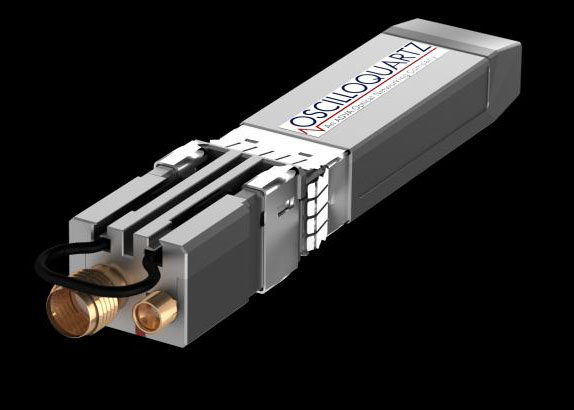
    The OSA 5401 Syncplug by Oscilloquartz.
    The OSA 5401 Syncplug by Oscilloquartz.

    Oscilloquartz, an ADVA Optical Networking company, has launched its OSA 5401 Syncplug, an accurate and efficient small-form-factor pluggable grandmaster clock and GNSS receiver.

    The device has a small footprint and compact design. It complements the existing portfolio of Oscilloquartz products, driving precise IEEE 1588v2 Precision Time Protocol (PTP) frequency and phase synchronization as well as Synchronous Ethernet deeper into access networks, including radio access and small cell networks.

    With its miniature form factor and low-touch provisioning, the new synchronization solution can be deployed in space-restrictive environments. It operates at low cost, consumes minimal energy and requires no additional power source or real estate, Oscilloquartz said.

    The OSA 5401 Syncplug supports the creation of a new time distribution architecture to meet the stringent phase-synchronization requirements of today’s access networks, the company said.

    “In terms of efficiency, precision and density of design, our OSA 5401 Syncplug miniature grandmaster is a major development for our industry,” said Kenneth Hann, senior director, R&D, Oscilloquartz. “It’s possibly the world’s smallest grandmaster clock and yet it generates phenomenally precise PTP frequency and phase synchronization for radio access and small cell networks. Now network operators have a cost-effective migration path for deploying robust phase and frequency synchronization deeper into access networks. Our OSA 5401 Syncplug integrates with existing network elements and its small form factor and rich feature set enable a versatile range of deployment options for enhanced synchronization network performance. Its timing-optimized, dual-frequency GNSS receiver achieves excellent performance even in urban canyons where small-cell deployments are often made and it can also work with a single satellite.”

    The OSA 5401 Syncplug is the first new product to be jointly engineered by Oscilloquartz and members of the recently acquired Time4 Systems. It easily conforms to all relevant PTP telecom profiles and, when locked to global navigation systems, meets the stringent requirements of G.8272 and G.811 specifications. The device functions as a Synchronous Ethernet source, GNSS receiver and a grandmaster clock. It can support both Layer 2 and Layer 3 PTP transport and is capable of unicasting and multicasting simultaneously. Advanced design and network redundancy techniques provide resiliency against local GNSS jamming. It also boasts an impressively wide operational temperature range of -40 to 85 Celsius. But the key benefits that the OSA 5401 Syncplug provides are space and energy efficiency for significant savings in installation and engineering costs. It also fully complies with multi-source agreements for total interoperability.

    “An enormous amount of expertise and passion has gone into designing this device. It’s been driven by our strategic understanding of what’s most needed in the synchronization space,” said Gil Biran, general manager, Oscilloquartz.

    “This first member of our miniature sync product family has already won great feedback from major mobile operators. What makes our ultra-compact OSA 5401 Syncplug so special is that it combines small size with high performance,” Biran said. “Make no mistake, there’s a vast amount of advanced functionality squeezed into this device. That’s what enables it to deliver highly accurate timing distribution with the smallest available footprint. This level of agility and efficiency creates a new range of solutions for service providers to deploy phase synchronization even in the most difficult network scenarios. There’s no doubt that this is an exciting time for network synchronization technology and this new product will extend our position in the market as a one-stop shop for all synchronization solutions. The new generation of mobile networks demands more small cells and a higher density of radio heads and we’re addressing this challenge in the most energy-efficient and cost-effective way possible.”

    Watch ADVA Optical Networking’s latest video on assisted partial timing support for more information.

  • Trimble Thunderbolt PTP Grandmaster Clock Designed for Next-Generation Networks

    Trimble has introduced a new grandmaster clock to address the synchronization needs of the fast growing next-generation LTE-Advanced and small cell network market. The Thunderbolt PTP Grandmaster Clock (GC), coming in the first quarter of 2016, was introduced at the ITSF 2015 Time and Synchronization in Telecoms Conference, held in Edinburgh, UK, Nov. 2-5.

    Trimble said it value-engineered the industry-standard grandmaster clock, focusing on the features required in next-generation networks, including dual gigabit Ethernet ports and a small form-factor pluggable module port for optical connections. Its low price point enables network architects to move the timing source from the core to the edge of the network, enabling higher phase and frequency precision at the Precision Time Protocol (PTP) clients.

    “Trimble entered this market to expand on our success in GNSS timing solutions for telecom networks,” said Karen Guldan, general manager of Trimble’s Time & Frequency Division. “The design and development of the GC focused on creating an optimized solution for network providers — at a price point of less than $2,000, it is intended to be a game-changer in small-cell network design. The GC’s features provide superior value to service providers.”

    With flexible network interface protocols and easy integration, Trimble optimized the GC to deliver precise frequency and phase synchronization signals for LTE-Advanced and small cell networks supporting IEEE 1588 PTP, Network Time Protocol (NTP) and Synchronous Ethernet simultaneously. The GC supports up to 250 simultaneous PTP clients and 5,000 NTP transactions per second, and is designed for small- and medium-scale deployment.

    With a small form factor of half rack 1RU, users may deploy the Trimble GC either indoors or outdoors. In a server room, the Trimble GC deploys in a side-by-side configuration to provide timing redundancy. For outdoor applications, the Trimble GMC also features an extended operating temperature range for use in non-typical networking environments such as a telecom cabinet. The Trimble GC configures for AC and DC power.

    The GC was designed to provide continuous availability of traceable time. The GC includes an embedded, multi-GNSS (GPS, GLONASS, BeiDou and Galileo-ready) receiver to generate precise 10MHz and pulse per second outputs. Utilizing the latest in GNSS technology combined with a precision oscillator, the GC provides better than 3 microsecond phase holdover over a 24-hour period.

    The Trimble Thunderbolt PTP Grandmaster Clock is expected to be available in the first quarter of 2016.

  • Schweitzer Labs Adds PTP Support to Network Clock

    Schweitzer Labs Adds PTP Support to Network Clock

    Graphic: Schweitzer Labs

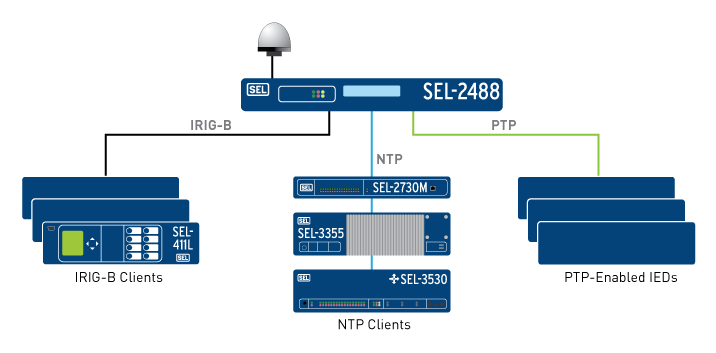
    Schweitzer Engineering Laboratories, Inc. (SEL) has added support for the Precision Time Protocol (PTP) to its SEL-2488 Satellite-Synchronized Network Clock. In a single clock, users can now synchronize end devices with sub-microsecond accuracy using demodulated IRIG-B and/or PTP. The SEL-2488 can meet all the timing needs of industrial and utility applications.

    The SEL-2488 offers security features, including Satellite Signal Verification in which the clock uses two satellite constellations to validate time signals, providing a layer of protection from GPS spoofing attacks. For fault tolerance, customers can opt for a second, redundant hot-swappable power supply, which can be connected to a second power input source. If GPS is lost, the clock switches to a standard TCXO holdover with 36-microsecond-per-day accuracy or an optional OCXO holdover with 5 microsecond average accuracy. The clock operates over a wide temperature range of –40° to +85°C (–40° to +185°F) and is backed by SEL’s 10-year, no-questions-asked worldwide warranty.

    In addition to providing IRIG-B and NTP outputs, the SEL-2488 can now serve as a PTP grandmaster clock, supporting both the default profile (IEEE 1588-2008) and the power system profile (IEEE C37.238). The SEL-2488 is capable of synchronizing time for up to four independent networks with a time-stamp accuracy of 100 nanoseconds. Existing users of the SEL-2488 can purchase this as a firmware upgrade.

    “Now there’s a choice,” said Shankar Achanta, R&D manager for precise time and wireless networks at SEL. “You can use different timing protocols based on your infrastructure and application needs. The SEL-2488 is the one network clock that can meet all our customers’ timing needs.”

    The SEL-2488 was first released in September 2014. SEL included several security features such as Syslog, the Ethernet standard for event messaging, which allows the SEL-2488 to integrate smoothly into a customer’s existing event system; role-based accounts and Lightweight Directory Access Protocol (LDAP) for user authentication; and a secure HTTPS web interface, which provides a graphical SkyView display for troubleshooting signal or antenna issues. The SEL-2488 also meets and exceeds IEEE 1613 Class 1, an electric transient and interference standard for communications products.

    Designed, tested and manufactured in Pullman, Wash., a standard SEL-2488 configuration, including a dual-constellation, high-gain GNSS antenna, retails for $2,700. The PTP firmware upgrade option for existing users costs $1,750. To learn more about the PTP enhancement in the SEL-2488, visit www.selinc.com/p222.

  • MWC 2015: RAD Demonstrates IEEE 1588 Grandmaster

    RAD-grandmaster-MiCLK
    Photo: RAD

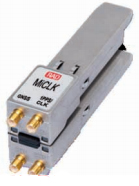
    Telecom company RAD will be expanding the timing synchronization capabilities of its Service Assured Access (SAA) solution when it introduces MiCLK, an IEEE 1588 grandmaster clock with a built-in GNSS receiver.The grandmaster clock is SFP-based (small form-factor pluggable).

    RAD is demonstrating the MiCLK at Mobile World Congress 2015, being held this week in Barcelona, Spain.

    “LTE and LTE-A’s stringent synchronization requirements and the growing use of small cells in 4G networks create synchronization challenges in the backhaul segment, but existing solutions are either too expensive or do not provide full network coverage,” said Ulik Broida, RAD’s vice president of marketing and business development. “With the revolutionary MiCLK, RAD makes it easy to upgrade existing backhaul networks to support LTE-A at an affordable price.”

    Many network operators prefer to use IEEE 1588-2008 (also known as Precision Time Protocol, or PTP) and synchronous ethernet to deliver accurate frequency and time throughout 4G backhaul networks. They are reluctant to install GNSS at every cell site because of practical and cost reasons, as well as concern about possible GNSS jamming and spoofing. However, accurate time distribution requires every network element between the time reference — the grandmaster — and the cell site to support IEEE 1588. This could be an expensive and complex endeavor when the grandmaster is located in a central PoP. “MiCLK allows network operators to avoid costly upgrades by bringing the grandmaster to the base station,” said Broida.

    RAD’s patent-pending MiCLK is a miniature pluggable device that responds to the needs of next-generation cellular backhaul networks, the company said. Its SFP design allows simple installation to upgrades any network device with a fully featured IEEE 1588 grandmaster, including a GNSS receiver and various redundancy options to sustain its operation in case of GNSS failure, RAD said.

    “Easily installed with minimal technical intervention, MiCLK is a versatile add-on anywhere in the network,” Broida concludes. “It is a valuable addition to mobile equipment vendor portfolios, and an ideal solution for 4G service providers in search of a quick, cost-effective way to bring accurate synchronization to small cell backhaul.”

    RAD  is exhibiting at Hall 2, Stand 2D50 at Mobile World Congress.