Tag: imagery

  • Global Mapper SDK updated for greater geospatial intelligence

    Version 20 of the Global Mapper Software Development Kit (SDK) is now available, along with the accompanying Lidar Module SDK. Mirroring the most important capabilities of the desktop version of the software, the powerful developer’s toolkit provides software engineers with the means to embed the latest geospatial technology into their custom applications, according to software maker Blue Marble Geographics.

    An elevation contour image in Global Mapper SDK. (Screenshot: Blue Marble)
    An elevation contour image in Global Mapper SDK. (Screenshot: Blue Marble)

    Among the highlights of the version 20 release are dramatically improved vector data performance in both the 2D and 3D environments, updated 3D mesh rendering with colors now displayed in the 2D view, and faster display and export of online tiled datasets, the company said.

    For more than 25 years, Blue Marble’s affordable, user-friendly GIS software has been meeting the needs of users in industries including software, oil and gas, mining, civil engineering, surveying and technology companies, as well as government departments and academic institutions.

    The Global Mapper GIS application can display, convert and analyze virtually any type of geospatial data. The Global Mapper SDK and Lidar Module SDK provide software developers with a toolkit for accessing much of this functionality from within an existing or custom-built application.

    The SDK also enables the creation of custom toolbars and extensions to enhance the data processing and analysis functionality of the standard version of Global Mapper. This capability allows in-house developers to create a unique version of the application to meet their specific needs or for software companies to build custom products for commercial distribution.

    The functional highlights of the latest version of the SDK effectively illustrate the continued evolution of 3D GIS technology and Blue Marble’s commitment to providing a superior data processing engine for managing, visualizing and analyzing increasingly large 3D datasets. Such is the case with the improvements that have been made to the display performance of vector files with faster rendering in both 2D and 3D Views.

    The display of 3D meshes or models, such as those created in Global Mapper’s Pixels-to-Points tool, has been improved with the photo-realistic colors now displayed in the top-down view. Online data processing has also seen improvements with significant speed increases when loading and exporting tiled data sources.

    Additional upgrades to the SDK functionality include improved box resampling of color images, especially those with palettes; several new supported formats, including Cyclone PTX and Autodesk Recap (RCP and RCS) point clouds; new projections and datums, including GDA2020 (Australia) and TUREF (Turkey); and support for Intermap’s online NextMap worldwide elevation dataset.

    For users of the Global Mapper Lidar Module, the version 20 SDK release also introduces a wealth of new and updated functionality. Point clouds can now be thinned, from both a 2D and 3D perspective, reducing file size and improving efficiency; a gridded layer can now be created from the classification values associated with lidar points; and a new scripting option has been added to apply colors to a point cloud from underlying imagery.

    “The Global Mapper SDK has become one of the most important components of Blue Marble’s suite of geospatial products,” stated Patrick Cunningham, Blue Marble President. “Motivated by the rapid emergence of the desktop software as a major player in the GIS industry, developers are increasingly turning to the corresponding SDK to leverage the software’s powerful geoprocessing tools in a wide variety of third party applications. The improved data handling capability of the version 20 release demonstrates our commitment to providing tools that work efficiently with even the largest datasets.”

  • NASA releases satellite damage map of Camp Fire

    The Advanced Rapid Imaging and Analysis (ARIA) team at NASA’s Jet Propulsion Laboratory in Pasadena has produced a map showing the damage caused by the Camp Fire in Northern California.

    After two and a half weeks of historic destruction, the fire is now 100 percent contained. Teams continue to search the destruction — including the destroyed town of Paradise — for remains. As of Sunday, the death toll is 85, making it California’s deadliest fire.

    The map shows the damage as of Nov. 16.

    Credits: NASA/JPL-Caltech
    Credits: NASA/JPL-Caltech

    The map was developed using synthetic aperture radar images from the Copernicus Sentinel-1 satellites operated by the European Space Agency.

    The map covers an area of 48 miles by 48 miles (78 by 77 kilometers), outlined in red on left. A closeup view of damage to the town of Paradise is inset on right, outlined in white. The color variation from yellow to red indicates increasingly more significant changes in the ground surface.

    The ARIA team creates its maps by comparing before-and-after satellite images of the fire region to see the extent of change between the two images. For this map, they compared the data for the image to a Cal Fire map for preliminary validation.

    Although the maps may be less reliable over vegetated terrain, such as forests, they can help officials and first responders identify heavily damaged areas and allocate resources as needed.

    Sentinel-1 data were accessed through the Copernicus Open Access Hub. The image contains modified Copernicus Sentinel data (2018), processed by ESA and analyzed by the NASA-JPL/Caltech ARIA team.

  • DigitalGlobe provides satellite imagery of Paradise fire

    Update: The Camp Fire is now the deadliest fire in California history, claiming more than 50 lives.


    DigitalGlobe’s WorldView-3 satellite collected new imagery of the deadly Camp Fire near Paradise, California.

    The Camp Fire, which broke out Nov. 8, destroyed 90 percent of the town of Paradise. At least 29 people have died, making it the deadliest wildfire in the state’s history in more than 85 years, while more than 200 people are unaccounted for. Firefighters are still trying to contain the roaring blaze.

    Here is a link to download a set of satellite images as well as a map graphic (PDF file). The satellite images include a couple of different views of the fire including:

    • A natural color overview of the area. The smoke from the wildfire obscures much of the area around Paradise and the surrounding communities.
    • Shortwave Infrared (SWIR) images of the area. SWIR images from our satellite can penetrate smoke caused by the fire and help clearly identify the fire lines and areas that have burned/are burning.
    • A rotated SWIR view of the fires, in case the orientation would be more useful for your graphic teams.
    • A reference image/map graphic (see PDF file) that should help you correlate the images to the locations on the ground.
  • Aquabotix granted patent for underwater camera

    UUV Aquabotix Ltd. has been granted a United States patent for a “Remotely Operated Vehicle Camera Apparatus.”

    Many underwater vehicles operate with a single stationary camera, an interior-based moveable camera or multiple cameras. Each of these configurations may have significant drawbacks and ultimately limit their functionality and usefulness, the company said.

    For example, a forward-facing camera can be used for navigation but is limited if the operator would like to record information around the vehicle in a reconnaissance mission.

    To address this challenge, Aquabotix developed a fully rotatable camera apparatus for attachment to its own or other vehicles. The camera apparatus can be mounted to the side of a vehicle and configured to rotate, enabling an operator to have a completely unobstructed 360-degree view in an underwater environment. This connector can also be used for mounting rotatable underwater light sources.

    Based in Sydney, Australia, and Fall River, Massachusetts, Aquabotix is an underwater robotics company that manufactures and sells commercial and industrial-grade underwater drones for commercial, high-end consumer and military applications. It also offers commercially available swarming underwater drones.

  • Datumate offers updated imagery software

    Datumate offers updated imagery software

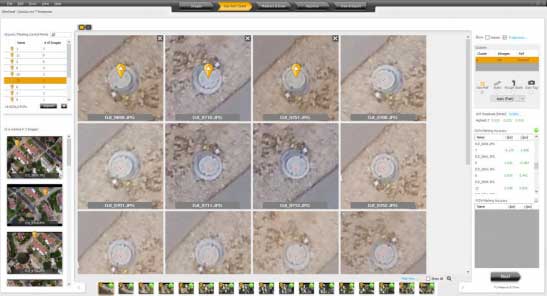
    Datumate's DatuSurvey 5.5 software offers 2D vectorized measurements and 3D point clouds models. (Screenshot: Datumate)
    Datumate’s DatuSurvey 5.5 software offers 2D vectorized measurements and 3D point clouds models. (Screenshot: Datumate)

    Datumate, a photogrammetry solution and 3D mapping software developer, has released its updated DatuSurvey 5.5 software, which offers 2D vectorized measurements and 3D point cloud models.

    According to the company, with the updated software, users can now process thousands of images locally in an accelerated mode while maintaining survey-grade accuracy and professional engineering results. Organizations can also deploy Datumate’s solutions on single or multiple computers and take advantage of the accelerated and user-friendly processing of the project field data.

    In addition, DatuSurvey 5.5 can process large amounts of drone imaging data locally and quickly. The software can also achieve survey-grade accuracy and geo-reference the model quickly and easily, the company added. Finally, it can plan and execute consecutive drone missions on unmapped and frequently changing areas.

    According to Datumate, its team improved the geo-referencing workflow of the software when using ground control points. Users can now quickly and easily mark ground control points using zoomed-in image projections.

    The company also added the ability to import coordinates to DatuFly Professional in addition to on-site or on-map mission planning. This will enable an efficient and accurate drone mission execution on specific and designated areas without depending on satellite and map source views, Datumate said.

  • NCTech to unveil iSTAR Pulsar developments at Intergeo

    Photo: NCTech
    Photo: NCTech

    NCTech, a developer of reality imaging systems, will showcase its iSTAR Pulsar mobile 360-degree data capture system at Intergeo in Frankfurt, Germany.

    Companies at Intergeo, including GeoSLAM and Orbit Geospatial Technologies, will also unveil innovative developments that incorporate iSTAR Pulsar.

    iSTAR Pulsar is NCTech’s professional edge-to-cloud big data system, optimized for capture on the move. iSTAR Pulsar is designed to capture 360-degree data while mounted on a vehicle, drone or on foot.

    At Intergeo, NCTech will be showing a demonstration of a future feature in its cloud-based processing software VR.WORLD that uses artificial intelligence and image recognition to analyse the images captured by iSTAR Pulsar. This means that objects like cars, trucks, traffic lights, road signs, pedestrians and cyclists can be automatically identified in images, the company said.

    Photo: NCTech
    Photo: NCTech

    Handheld 3D mobile mapping company GeoSLAM also will introduce new developments at Intergeo, including an innovation that integrates with iSTAR Pulsar.

    “We immediately saw the potential for collaboration when NCTech introduced the iSTAR Pulsar,” said Mark Reid, head of strategic business development, GeoSLAM. “And now we’re excited to show the attendees at Intergeo what we’ve been working on.”

    Orbit GT has updated its mobile mapping software to enable iSTAR Pulsar data to be integrated into its smart 3D mapping solutions.

    “We’re very pleased to announce that Orbit GT solutions now support data from NCTech’s iSTAR Pulsar,” said Peter Bonne, CEO, Orbit GT. “We’ll be showcasing the great 360-degree imagery captured by iSTAR Pulsar at our booth.”

    “We launched iSTAR Pulsar earlier this year, so it’s great to see that key industry players like GeoSLAM and Orbit GT are already leveraging its capabilities in their own developments,” said Andrew Baddeley, technical sales director, NCTech. “Combined with the exciting new AI developments from our labs, we look forward to showing everyone at Intergeo how we are helping to virtualize the world.”

  • How we might navigate on Mars

    How we might navigate on Mars

    Images: NASA
    Images: NASA

    Researchers from NASA’s Frontier Development Lab (FDL) and Intel are proposing a way to navigate on a new planet using artificial intelligence (AI).

    The researchers presented their planetary navigation research during an Intel event on Aug. 16.

    The immense challenge of building GPS-similar constellations around every planet or moon could be avoided by using imagery, according to researchers Andrew Chung, Philippe Ludivig, Ross Potter and Benjamin Wu.
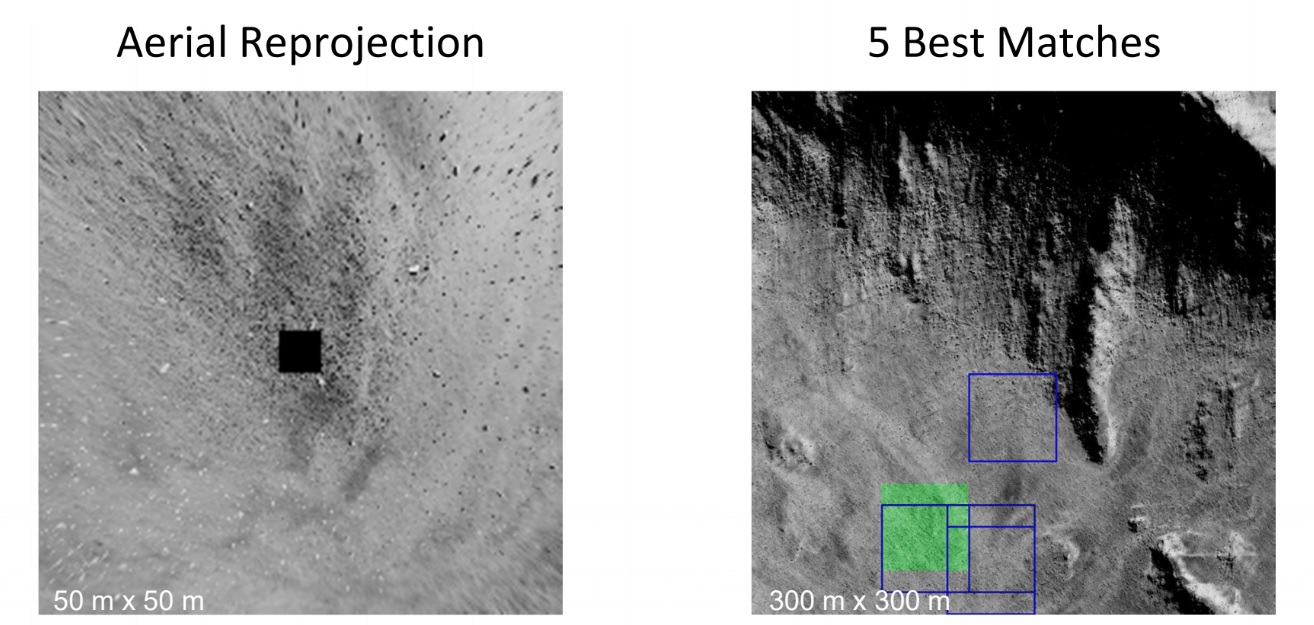
    The team developed a system for simulating the Moon’s surface so that AI could be used for navigation on the surface.

    How It Works. The researchers created a highly detailed digital model of a virtual moon using 2.4 million images of its surface. The images represent ones that might be taken by a rover.

    The AI learned what this moon looks like by being fed the millions of images, and then used its neural network to create a model of the virtual moon.

    According to the team’s presentation, this was enough to effectively enable navigation on the virtual moon’s surface.

    With the model in place, a person merely needs to take a photo of their surroundings on the surface. Based on the photo, the AI determines the person’s location and shows how to navigate to a destination. The AI would even understand the distortions of known features from the point of view of the camera.

    The team wants to try to do the same thing with a real celestial body: Mars. They think they have enough satellite images to make it work.

    If they’re right, the first Martian visitors could navigate the Red Planet by photo.

  • Esri to monitor illegal activities in Argentine waterways

    Argentina’s coast guard Prefectura Naval and Aeroterra S.A. have partnered to implement Esri’s ArcGIS platform for a real-time tracking system.

    The new system, called Guardacostas Pro, uses a combination of satellite imaging and signal processing to monitor vessels for illegal activities such as drug smuggling and fish poaching in the coastal waters of Argentina’s exclusive economic zone (EEZ).

    As Argentina’s coast guard, Prefectura Naval deploys patrol vessels, helicopters and airplane spotters to protect its economic interests and to guard against the decline of its fishery.

    This year, the Guardacostas Pro system allowed Prefectura Naval to track a Spanish vessel that entered the EEZ and attempted to return to international waters. The coast guard was able to catch the ship, which had poached roughly $380,000 worth of fish; escort it back to port; impound it; and fine the crew.

    The captain had little ground to refute the charges because the coast guard had the data to prove the illegal activity.

    “As of five years ago, we had very little information about the use of our seas,” said Ernesto Miguel Klocker, Prefectura Naval director of informatics and communications. “Now we have a good picture, which gives us electronic control of the sea, allowing us to send our air and naval units directly to the places where ships operate.”

    Until recently, its primary enforcement tool was constant patrolling and investigation of all ships. Now Guardacostas Pro monitors signals that every vessel transmits to avoid collision and to provide data on vessel type, speed, and location. It combines this with satellite imaging and Esri’s spatial analytics capabilities to give coast guard personnel real-time alerts when a vessel is entering their waters.

    “Prefectura Naval is setting a truly cutting-edge example of a forward-thinking organization,” said Dean Angelides, Esri head of international alliances and partners. “The best way to effectively enforce laws over such a large scale as the EEZ is to know exactly where things are happening and when, and Argentina is now leading the way in data-driven public safety.”

    After being successfully proven at sea, the Guardacostas Pro system has been moved ashore and is now a multiagency tool to aid Argentina’s Ministry of Security’s homeland security mission. The Ministry of Security will use the system to track and locate its operative units through mobile phones, radio equipment, vehicles with location sensors, and search and rescue aircraft.

  • Hurricane Florence impact revealed in Nearmap aerial imagery

    Newly captured aerial maps show before and after images to support cleanup efforts by public safety organizations, utility companies and insurance agencies.

    Aerial mapping company Nearmap has flown and captured aerial imagery in the areas in North and South Carolina impacted by Hurricane Florence.

    The imagery is already supporting the extensive cleanup and reconstruction efforts for public safety, utility companies, insurance agencies and numerous contractors in many industries.

    High-resolution captures from the Wilmington and Myrtle Beach areas are now online and available for immediate use with more areas scheduled to come online over the next several days.

    The post-hurricane coverage includes about 4,530 square kilometers around the coastline from Newport, N.C., to Myrtle Beach, S.C., covering a population of about 752,000 people.

    High-resolution imagery shows the impact of Hurricane Florence at Southport, North Carolina, comparing September 2017 to September 2018. (Image: Nearmap)
    High-resolution imagery shows the impact of Hurricane Florence at Southport, North Carolina, comparing September 2017 to September 2018. (Image: Nearmap)

    Before the hurricane, Nearmap had already covered more than 30,000 square kilometers in North and South Carolina with ortho imagery and more than 12,000 square kilometers with oblique imagery. With previous aerial maps taken at least once a year totaling over 140,000 square kilometers online, some of them dating back to 2014, users are able to compare current imagery with historical photos.

    “A key element to the recovery efforts is having access not only to high-resolution imagery from after the storm, but also to historical aerial captures from before the storm hit,” said Rob Newman, CEO and managing director of Nearmap. “Historical captures provide consistency and contrast, enabling crews to look at the current truth on the ground and compare it to previous time periods to help assess the damage along the coastlines.”

    All pre- and post-hurricane imagery can be accessed through a standard web browser using Nearmap’s MapBrowser, through Nearmap partners or via APIs to integrate with common GIS, CAD and other applications.

    All the Nearmap pre- and post-hurricane imagery is published at sub-3-inch ground sampling distance, which allows users to see great detail on the ground. At this resolution, they can clearly identify important ground conditions such as roof blow-off, property damage and flooding. The same is true for streets and all other ground features, providing details for users to complete analysis both pre and post storms.

    “Our thoughts are with the residents of North and South Carolina recently impacted by the hurricane,” Newman said. “We are pleased that Nearmap customers are using our imagery to help restore these neighborhoods, and help residents fix and rebuild after rooftop, flooding and other damage.”

    Nearmap customers use aerial imagery to assist in the following aspects of post-disaster cleanup:

    • Public Safety: Access to immediate, crystal-clear aerial imagery of areas affected by storm damage for emergency response routing and safety.
    • Utilities: View all areas where above-ground utilities have been affected and also see where infrastructure is down or damaged and causing hazards.
    • Reconstruction Efforts: Compare historical image captures with post-event imagery to see structure elements and provide proper measurements to rebuild.
    • Insurance: View impacted properties to see first-hand damage and potential structural damage.
  • Extensis and LizardTech unite as one company

    logos

    Extensis and LizardTech are uniting as one global company to help organizations increase their return on investment and the value of their digital assets, fonts and large imagery.

    In 2017, Extensis and LizardTech collaborated on the development of new portfolio asset geo-referencing capabilities for applications in the geospatial, infrastructure, architecture/engineering/construction and building information modeling segments.

    With Extensis’ market leadership in digital asset and font management combined with LizardTech’s expertise in image management and image compression technology, the united company is situated to provide a suite of solutions and support for digital asset challenges.

    “Organizations today are investing in imagery of all kinds, including photography, aerial, and spatial, to name a few,” said Osamu Ikeda, CEO of Extensis. “Fully leveraging these digital files means having an easy and efficient way to organize, store, access and distribute them.”

    Ikeda continued, “Uniting Extensis and LizardTech strengthens our ability to support our customers’ success and give them effective and time-tested solutions for maximizing the value of digital assets of all kinds.”

    The combined company will operate under the Extensis brand, headquartered in Portland, Oregon, with an office presence in Seattle.

    Starting now, LizardTech products (GeoExpress, Express Server, GeoViewer) will become part of the Extensis suite of solutions, which spans digital asset management, font asset management, brand asset management, image management and image compression.

  • Imagery works for growing city

    Image: Nearmap
    Image: Nearmap

    Location content provider Nearmap has partnered with the City of Durham, North Carolina, Public Works Department to upgrade its imagery on numerous projects.

    Using real-time imagery from Nearmap in the field, the department streamlines data collection and saves time and money.

    The department manages all infrastructure data for the city, including mapping the impervious area (structures that resist water infiltration) for the city’s $16 million a year Stormwater Utility Fee fund. “That is half a billion square feet of impervious area that we manage through digitization and review daily,” said Edward Cherry, city GIS administrator.

    After using several satellite imagery systems with low resolution and infrequent captures, Cherry and his 14-member GIS staff determined the city needed far superior quality in their mapping imagery to accommodate the city’s explosive growth.

    Captured every six months at a 2.8-inch ground sample distance, Nearmap now supplies Durham with up-to-date images accessible through web-based cloud servers.

    With Nearmap, the Durham Public Works Department has achieved better monitoring of pavement conditions; time savings and documentation of road repairs; more detailed maps of city riparian zones; and accurate and detailed customer billing.

    “With Nearmap, we’ve been able to update development processes and policies to support the revitalization of the downtown district as well as rapid city growth,” Cherry said.

  • Airbus, Orbital Insight partner on OneAtlas analytics platform

    Europe-based Airbus Defence and Space has entered into a partnership with Orbital Insight, a U.S.-based geospatial analytics company, to build a suite of geospatial analytics services and tools.

    The agreement will provide Orbital Insight with access to Pleiades and SPOT satellite imagery at scale, and provide Airbus with analytics services, making Orbital Insight the first analytics partner for the Airbus Digital Platform OneAtlas.

    The OneAtlas Platform is a collaborative environment enabling users to easily access constantly updated satellite imagery, perform large-scale image processing, extract industry-specific insights, and benefit from Airbus assets to develop tailored solutions for a wide range of markets in both commercial and government sectors, the company said.

    “Under this agreement, we will offer premium analytics capabilities to a large range of users, powered by Orbital Insight’s services and tools,” said François Lombard, director of the Intelligence Business at Airbus Defence and Space. “The OneAtlas Platform is definitively the cornerstone to leverage both Airbus and partner assets to support our customers’ business development and growth.”

    “We’re proud to be Airbus’ first geospatial analytics partner on the OneAtlas Platform,” said James Crawford, Orbital Insight’s CEO and founder. “Along with our new satellite imagery agreement, this partnership drives customer value for those looking to better understand what’s happening on and to Earth.”