Tag: Institute of Navigation

  • Registration Opens for ION PTTI 2013 Conference

    Registration is now open for the Institute of Navigation’s (ION) Precise Time and Time Interval Meeting (PTTI) to be held December 2-5, 2013 (Tutorials will be held December 2) at the Hyatt Regency Bellevue, Bellevue, Washington. Registration and program information will be available online only.

    PTTI is an annual conference sponsored by ION with a technical program designed to disseminate and coordinate PTTI information at the user level, review present and future PTTI requirements, inform government and industry engineers, technicians, and managers of precise time and frequency technology and its problems, and provide an opportunity for an active exchange of new technology associated with PTTI.

    This year’s conference will feature a technical program around important PTTI issues including:

    • Advanced Atomic Frequency Standards Applications
    • High Performance Time and Frequency Transfer via Fiber
    • Next Generation PTTI Applications
    • Network Synchronization and IEEE 1588, NTP
    • PTTI in Space
    • PTTI Time and Frequency Laboratory Activities
    • State of the Art GNSS Timing Receiver
    • Metrology and Applications
    • Time and Frequency Transfer Applications –
    • Milliseconds to Picoseconds
    • Time Scales and Algorithms

    In addition to a commercial exhibit, this year’s program includes a Panel Discussion on Near-term GNSS deployments and the impact on PTTI Applications and Performance Current and future status of: GPS, GLONASS, Galileo, BeiDou/Compass, QZSS, WAAS, EGNOS and INRISS.

    This year’s conference will also feature pre-conference tutorials December 2, including

    • Introduction to Precise Time and Frequency
    • Time and Frequency Transfer
    • Two-Way Satellite Time Transfer (TWSTT)
    • Global Navigation Satellite Systems (GNSS) I & II
    • IEEE 1588: The Precision Time Protocol – An Overview
    • Introduction to Atomic Clocks


  • ION Joint Nav Conference 2014 Accepting Abstract Submissions

    Abstract submissions are now being accepted for the Institute of Navigation (ION) 2014 Joint Navigation Conference (JNC) to be held June 16-19, 2014.

    For Official Use Only (FOUO) U.S.-only sessions will be held June 16-18 at the Renaissance Orlando at SeaWorld, Orlando, Florida; and the 4-EYES CLASSIFIED sessions will be held June 19 at Shades of Green Walt Disney World.

    The conference, sponsored by the ION’s Military Division, is the largest U.S. military positioning, navigation and timing conference of the year with joint service and government participation. The event will focus on technical advances in guidance, navigation, and control (GN&C) with emphasis on joint development, test and support of affordable GN&C systems, logistics and integration.

    The 2013 Joint Navigation Conference was canceled, so this will be the first time the conference has been held in two years.

    From an operational perspective, the conference will also focus on advances in battlefield applications of GPS; critical strengths or weaknesses of fielded navigation devices; warfighter PNT requirements and solutions; and navigation warfare.

    The ION JNC features more than 200 operational presentations on a diverse array of topics including:

    • Advanced Security Technologies/SAASM
    • Alternate Navigation Technologies: I, II & III
    • Atomic Clocks and Timing Applications
    • Autonomous Navigation
    • Aviation Applications
    • Battlefield Smart Phone Applications
    • Celestial Navigation and Star-Tracker Technology
    • Collaborative Navigation Techniques
    • GPS Constellation Performance
    • GPS in Military Applications/NAVWAR
    • GPS Modernization
    • Land Applications
    • Marine Applications
    • MEMS Inertial Measurement Unit
    • Micro Navigation Applications
    • Military GPS Receivers and Military GPS Receiver Technology
    • Military GPS Use and Experiences
    • Military GPS/Antenna Technologies and Interference Mitigation
    • Missile Applications
    • Modeling and Simulation
    • Multi-GNSS Receivers for Military Applications
    • Multi-Sensor Solutions for Guidance, Navigation, and Control
    • Navigating in Challenged Environments (e.g. Urban, Indoor and
    • Sub-Surface Navigation)
    • Precision Azimuth Sensing
    • Precision Navigation Capabilities for Test and Training
    • Robust Navigation Systems/Solutions
    • Space and Satellite Applications
    • Warfighter Requirements and Solutions

    Abstracts are being accepted through March 4, 2014.

    Technical Exhibit and Operational Product Demonstrations. JNC also features a technical exhibit and showcase of Guidance, Navigation and Control technology products and services and Operational Product Demonstrations. For more information on exhibiting and product demonstrations at the ION Joint Navigation Conference, call ION at 703-366-2723 or go to www.ion.org/jnc.

    Attendance Restricted. FOUO U.S. ONLY. JNC conference attendance (June 16-19) will be controlled by the Joint Navigation Warfare Center and will be restricted to U.S. ONLY.  The classified sessions will have 4-Eyes access (June 19) for citizens of U.S.A., Australia, Canada, and the United Kingdom. All participants must establish a need to know and be approved by the Joint Navigation Warfare Center security office.

  • IEEE/ION PLANS 2014 Issues Call for Abstracts

    Abstracts are now being accepted for the IEEE/Institute of Navigation (ION) Positioning, Location and Navigation Symposium (PLANS) 2014 to be held May 5-8 at the Hyatt Regency Monterey Hotel in Monterey, California. The deadline for submitting abstracts is November 1, 2013.

    Instructions on submitting your abstract can be found at www.plansconference.org.

    PLANS 2014 is the fifth biennial conference co-sponsored by the IEEE, AESS and the ION. The conference features researchers and engineers from around the globe who present their latest work in positioning and navigation technologies. Presentations range from fundamental research, to applications, to field test results with a particular emphasis on inertial navigation. Technical sessions cover a range of subjects for both beginners and seasoned professionals.

    IEEE/ION PLANS 2014 technical program will be centered around four technical tracks including Inertial Sensing and Technology, GNSS Technologies and Systems, Integrated Applications of Sensors and Technology and Systems Technology.

    Technical papers will be presented on current position, location and navigation issues:

    • High-Performance Inertial Sensor Technologies
    • Low-Cost Inertial Sensor Technologies
    • Multisensor Integrated Systems and Sensor Fusion Technologies
    • Sensor Manufacturing, Error Modeling & Testing
    • Emerging Atom-Based Sensor Technologies
    • Micro-technology for PNT
    • Receiver and Antenna Technology
    • High Assurance GNSS
    • Interference, Spectrum Issues and Robust Navigation
    • Precise Positioning, Weak Signal, and Advanced Processing
    • Algorithms
    • Modernized GNSS
    • GNSS Augmentation Systems
    • Indoor Personal and First-Responder Navigation
    • Urban Personal and Vehicular Navigation
    • Vision/Integrated Navigation Systems
    • Adaptable Navigation System Technology
    • Environmental Features and Novel Navigation Sensors
    • Terrestrial Radionavigation and RF-Positioning
    • Commercial Aviation Positioning and Navigation Applications
    • Small UAV Positioning and Navigation Applications
    • Consumer, Smartphone and Personal Navigation Applications
    • Marine Positioning and Navigation Applications
    • Terrestrial and Automotive Positioning and Navigation Applications
    • Robotic Guidance, Navigation and Control Applications

    In addition to a commercial exhibit, this year’s program includes half-day, pre-conference tutorials on:

    • Fundamentals of Inertial Navigation
    • Sensor Integration for Personal Navigation
    • Fundamentals of Kalman Filtering
    • Alternative Navigation Methods
    • NonLinear Kalman Filtering
    • Multi-constellation GNSS – Similarities/differences between GPS, Galileo, BDS, and GLONASS
    • Image-Aided Navigation

    The deadline for submitting abstracts is November 1, 2013. Submit your abstract today at www.plansconference.org.

  • Out in Front: Ruminations Upon a Technical Program

    The Institute of Navigation’s (ION’s) advance program for the 2013 GNSS+ conference in September arrived in the mail the other day, and was avidly consumed. The technical sessions of this gathering are prime hunting ground for presentations that later become articles in this magazine, as are, to lesser extent, those of the European Navigation Conference, the Joint Navigation Conference, CTIA, ITS World Congress, and others.

    Something struck me as I scanned the 280-odd presentations listed under 36 session tracks: the frequency with which the word BeiDou appeared. To determine if there were any substance to this fleeting impression, I essayed a quantitative analysis. Naturally, GPS and the generic GNSS occurred times beyond measure, but this is how the others fared.

    IRNSS: 1
    QZSS: 3
    GLONASS: 10
    Galileo: 13
    BeiDou: 19.

    What does this signify? Little enough, possibly. Still, something. A satellite navigation system bursts seemingly out of nowhere and within a few short years virtually laps the field, putting 20 (14 usable) transmitters into space and establishing a regional operating capability, soon to be global. That sort of thing tends to get noticed.

    The titles of BeiDou-focused papers on tap this fall in Nashville — not all of them springing from the laptops of Chinese engineers, not by a long shot — add substance to this passing fancy.
    ◾    BeiDou Consumer Receiver Chips at Last.
    ◾    A Combined GPS/BeiDou Vector Tracking Algorithm for Ultra-tightly Coupled Navigation Systems.
    ◾    Towards the Inclusion of Galileo and BeiDou/Compass Satellites in Trimble CenterPoint RTX.
    ◾    New Assisted BeiDou Products from JPL’s Global Differential GPS System.
    ◾    BeiDou Integration in Cell Phones and Tablets.
    ◾    BeiDou — A System That is Now Ready for Applications.
    ◾    Augmenting GPS RTK with Regional BeiDou in North America.
    ◾    New Systems, New Signals, New Positions — Providing BeiDou Integration.

    The affiliations of some of the authors of the above read like a top-level directory of North American and European GNSS manufacturers. Clearly, the ground has been plowed and the fields lie ready — if they are not already planted. Unless that’s too mixed a metaphor for satellite radionavigation signals.

    The recent acquisition of one Western GNSS manufacturer by a major Chinese business concern has not gone unnoticed, either.
    For more intelligence, I consulted the newest member of this magazine’s Editorial Advisory Board. He replied to my emailed penny for his thoughts.

    “I would be happy to contribute a column for the July issue based on my observations here at the China Satellite Navigation Conference in Wuhan. The article would be titled: Little Tigers versus Wolves.”

    Wow. Now I wonder, who’s who?

  • ION Cancels 2013 Joint Navigation Conference

    The Institute of Navigation (ION) Military Division has canceled this year’s Joint Navigation Conference (JNC), which was scheduled to take place in Orlando, Florida, June 10-13.

    “This decision has not been taken lightly but due to the DOD’s recent policies detailing actions to be taken to prepare for drastic budget cuts, the curtailment of travel, fallout from a scandal with GSA conferences this past year, the current sequestration, and possible furloughs for federal employees, it is no longer possible for ION to ensure the JNC will be able to maintain a high-quality technical program and sufficient networking opportunities that makes the JNC so valuable to DOD/DHS employees and their supporting organizations,” wrote Lisa Beaty, ION executive director, in a statement.

    “While it is impossible for us to predict the duration of the current federal climate, the ION is committed to keeping the Institute on a sure and steady track,” Beaty wrote. The 2014 JNC is still scheduled for June 16-19, 2014, at the Renaissance Orlando at SeaWorld, Orlando, Florida, with the classified session and warfighter panel being held at Shades of Green at Walt Disney World Resort on June 19.

    All JNC 2013 registered attendees, exhibitors, and sponsors will receive a full refund of fees paid. Registrants and exhibitors are reminded that they are responsible for cancelling their own hotel reservations, and other travel-related arrangements. To cancel reservations at the Renaissance Orlando at SeaWorld, call 1-407-351-5555 or 1-800-327-6677, or cancel your reservation online.

  • It’s Snow Problem: Ohio University Team Wins ION Autonomous Snowplow Competition

    It’s Snow Problem: Ohio University Team Wins ION Autonomous Snowplow Competition

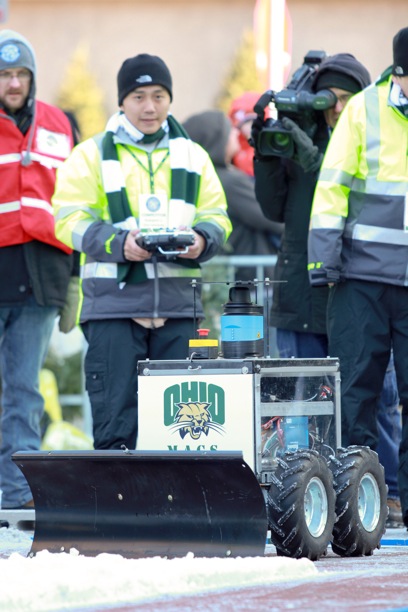
    The Institute of Navigation (ION) Satellite Division held its third annual ION Autonomous Snowplow Competition January 24-27 at Rice Park in downtown Saint Paul, Minnesota, as part of the 127th Saint Paul Winter Carnival.

    Sponsored by The ION Satellite Division and held in cooperation with the ION North Star Section, the ION Annual Autonomous Snowplow Competition is a national event open to college and university students, as well as the general public, that challenges teams to design, build, and operate a fully autonomous snowplow using navigation and control technologies to rapidly, accurately and safely clear a designated path of snow.

    Eight teams participated in the four-day competition, each using state-of-the-art navigation systems to plow two different snowfields. Teams included students, partners from private industry and faculty advisors from Case Western Reserve University; Dunwoody College of Technology; Miami University (Ohio); Ohio University; The University of Michigan – Dearborn, and The University of Minnesota.

    Teams were judged based on their cumulative scores earned throughout the competition phases: 75 percent of the total score was based upon the plowing competition; and 25 percent of the total score was based on the presentations and pre-event report.

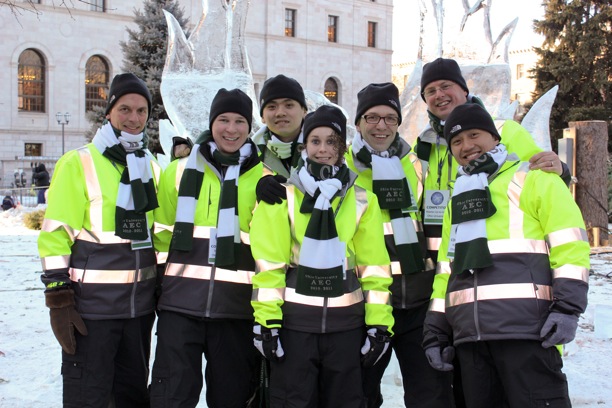
    First place was awarded to Ohio University’s Avionics Engineering Center with students Samantha Craig, Ryan Kollar, Adam Naab-Levy, Pengfei Duan and Kuangmin Li with support from faculty advisors Dr. Frank van Graas, Dr. Wouter Pelgrum and Dr. Maarten Uijt de Haag who submitted their four-wheeled Monocular Autonomously Controlled Snowplow (M.A.C.S.).  The first place prize included $5,000 and a golden snow globe trophy. Ohio University also captured the Best Student Presentation Award that included $500 and the “Golden Shovel” Award and the Best Written Report that included $500 and the “Golden Pen” Award.

    Second place was awarded to the Miami University team “RedBlade” that included students Mark Carroll, Chad Sobota, Robert Cole, Richard Marcus, Harrison Bourne, Jamie Morton and Michael Harris with support from advisors Dr. Yu (Jade) Morton, Dr. Peter Jamieson, Steve Taylor. The second place prize included $4,000 and a silver snow globe trophy.

    Third place was awarded to the University of Michigan (Dearborn) team “Yeti 3.0” that included students Angelo Bertani, Zachary DeGeorge, Ahmed Alkirsh, Abdelqwee Yaffai, Mark Bajor, Craig Cowling, Cody Schmitt, Jacob Mack and Mengxing (Simon) Chen with support from faculty advisor Narasimhamurthi (Nattu) Natarajan. The third place prize included $3,000 and a bronze snow globe trophy.

    In addition, the first place team, Ohio University, has been invited to display its winning snowplow during ION GNSS+ 2013 conference September 16-20 in Nashville, Tennessee.

    Sponsors of the second annual ION Autonomous Snowplow Competition included Honeywell, Inc., Alliant Techsystems Inc., Lockheed Martin Corporation, ASTER Labs, Inc., Space Exploration Technologies Corp., The Toro Company, Proto Labs, Inc. and U.S. Bank.

    The Fourth Annual ION Autonomous Snowplow Competition will be held in January 2014 at the Saint Paul Winter Carnival, St. Paul, Minnesota.

    ohio-university-2013-W
    Ohio University’s winning team.
  • Report from ION ITM: Faster, Smaller, Cheaper

    And more of them!

    That’s been one of the mantras — a controversial one, granted — of technological advance in the late 20th and early 21st centuries. It has succeeded in penetrating the global positioning, navigation, and timing vanguard, as evidenced by a handful of key presentations on the first day of the Institute of Navigation (ION) International Technical Meeting in San Diego on Monday.

    Skybox Imaging, a company that is “passionate about bringing Moore’s Law to space via disruptive microsatellite technology, rapid development cycles, and a scalable web-based delivery platform,” spoke to the ION ITM plenary session in the person of Ronny Votel, an engineer leading the company’s guidance, navigation and control division. Skybox’s goal is to provide “easy access to reliable and frequent high-resolution images . . . through a “constellation of imaging microsatellites delivering high-resolution imagery of any spot on Earth multiple times per day.”

    To achieve that goal, Skybox is developing a low-cost imaging satellite system:

    • design life of the satellites, 3 years;
    • size of the satellites, a mini-fridge;
    • size of the constellation, in the tens.

    Skybox will pair that flying system with web-accessible big data processing platform to capture video or images of any location on Earth within a couple of days — an unheard of delivery turnaround in the current global imaging industry, unless you happen to be a government (as in central, high, federal, perhaps military) customer.

    The low-cost nature of the satellite opens the possibility of deploying tens of satellites which, when integrated together, have the potential to image any spot on Earth within an hour. Votel several times made the analogy in his talk of using an iPhone camera to capture desired imagery, and indeed that could be a next logical step in FBC development: just throw a bunch of camera phones up into orbit.

    Skybox expects to launch its first two satellites later this year.

    In April of last year, Wired published a fascinating history and analysis: “Smaller, Quicker, Secret, Robotic: Inside America’s New Space Force.” Between Between 1992 and 1999, the U.S. National Aeronautics and Space Administration (NASA) launched 16 faster, smaller, cheaper missions, including Mars probes and space telescopes. Ten missions succeeded; six failed. Analysts declared the initiative a failure, and to a large extent it has been forsaken. Recent public writings, though, show second thinking. “I would like to respectfully suggest that success-per-dollar is a more meaningful measurement of achievement than success per-attempt,” stated one Air Force lieutenant colonel in a treatise on program management lessons from NASA.

    Could such an approach work for GNSS satellites, some of which are burdened with extraneous non-PNT payloads that make them far from FSC? Time will tell the wiser.

    Microtechnology

    In that FSC vein, at one of the afternoon’s technical sessions, Andrei Shkel of UC-Irvine had been scheduled to deliver a paper on “Precision Navigation and Timing Enabled by Microtechnology,” but apparently something came up and he was not able to appear. I had looked forward very much to what I anticipated would be an update to his September 2011 article in GPS World, “Microtechnology Comes of Age,” which was itself an update to a plenary talk he gave at ION ITM back in 2011. For now, that article will have satisfy us.

    Other presentations in the same MEMS, atomic clock, and MicroPNT session:

    Michael Bulatowicz of Northrop Grumman talked about a DARPA-backed project, the nuclear magnetic resonance (NMR) gyroscope. Northrop’s development and research has shown a viable solution to producing a small (size of a U.S. quarter coin) low-power navigation grade gyro using non-vibratory technology. The company has produced two prototypes and is at work on two more. Feed the NMR gyro into Shkel’s work and who knows what you’ll get in terms of FBC PNT? Well, maybe not cheaper in the immediate future. Bulatowicz said that as an assembled device he expected its cost, at least initially, to be substantially higher than MEMS technology.

    Richard Waters of Lumedyne Technologies spoke on next-generation MEMS inertial sensors with white-noise characteristics, a new paradigm based on time-domain switching for how MEMS sensors might work. TDS inertial sensors provide some key benefits: a purely digital approach, recalibration due to bias drift is not required, output is independent of oscillator conditions. Power is low, less than 1 millwatt. The device demonstrated switch stability under static conditions to –170 db. The same TDS concept can also be applied to a mechanical gyro.

    QZSS

    In other ION ITM first-day news, H. Tokura of the Tokyo University of Marine Science and Technology talked about “The Possibility of Precise Automobile Navigatin using GPS/QZS and Galileo E5 Pseudoranges.” Currently, research and prototype automobile high-precision PNT is done with real-time kinematic (RTK) networks, but this has some disadvantages, as discussed in an article by authors from the University of Nottingham, UK, in the February issue of GPS World.

    Japan’s QZSS now broadcasts L5 signals. Japan has essentially leapfrogged the United States, since the L5 signals with full CNAV message is already broadcast by satellite QZSS-1. Currently, three U.S. GPS satellites are L5 CNAV-capable, but none are broadcasting such a signal.

    Tokura showed results demonstrating that pseudorange observables from L5 are basically robust enough for this task. Further investigation for L5 is required because manufacturers are still developing the tracing technique for the new L5 signal. A software-defined receiver is indicated for usage.

    Hideki Yamada of Japan’s Electronic Navigation Research Institute spoke about the possibility of using only the QZSS constellation, “in case of GPS failure,” for RTK positioning in precision ag and machine control, with 4 to 7 QZSS satellites that could be launched in a future version of the constellation. QZSS has been shown to provide 10-meter accuracy in absence of GPS; now the research looks at an RTK method.

    With only one satellite in orbit, RTK-QZSS cannot be tested in the field. The researchers simulated a fuller constellation by using QZS-1, Multifunctional Transport Satellites (MTSAT), a set of geostationary weather and aviation control satellites, and GPS signals. Using a JAVAD Alpha receiver, Trimble and NovAtel antennas, they obtained results with low multipath error (about 30 centimeters) in a Tokyo environment. Multi-epoch processing is necessary for RTK-QZSS. This solution can work well as a minimum backup system of high-precision position under relatively moderate DOP condition.

    __________________

    Living may be easy, dying may be hard. But I’m wide awake, staying up late, sending my regards.

  • Ohio University Team Wins Second ION Autonomous Snow Plow Competition

    IMG_6300
    Photo: Ohio University

    An Ohio University team won the Institute of Navigation (ION) Satellite Division’s second annual ION Autonomous Snowplow Competition. The competition was held January 26-29, at Rice Park in downtown Saint Paul, Minnesota, in conjunction with the 126th Saint Paul Winter Carnival.

    Sponsored by The Institute of Navigation Satellite Division and held in cooperation with the ION North Star Section, the ION Annual Autonomous Snowplow Competition is a national event open to college and university students, as well as the general public, that challenges teams to design, build, and operate a fully autonomous snowplow using state of the art navigation and control technologies to rapidly, accurately and safely clear a designated path of snow.

    Six teams participated during the four-day competition, each using unique vehicle design approaches.

    Teams included students, partners from private industry and faculty advisors from Dunwoody College of Technology; Miami University (Ohio); Ohio University; The University of Michigan, Dearborn; and The University of Minnesota.

    Teams were judged based upon their cumulative scores earned throughout the competition phases: 75% of the total score was based upon the plowing competition; and 25% of the total score was based upon the presentations and pre-event report.

    First place was awarded to Ohio University students Samantha Craig, Ryan Kollar, Kuangmin Li and Pengfei Duan with support from faculty advisors Frank van Graas, Woulter Pelgrum and Maarten Uijt de Haag. The first place prize included $3,000 and a golden snow globe trophy.

    Second place was awarded to Miami University students Chad Sobota, Mark Carroll, Robert Cole, Mark Stratis, with support from student advisors Steve Taylor, Ryan Wolfarth and Harrison Bourne and faculty advisors Jade Morton, Peter Jamieson and Janet Burge. The second place prize included $2,000 and a silver snow globe trophy.

    Third place was awarded to the University of Michigan (Dearborn) students Angelo Bertani, Zach DeGeorge, Mark Lawrence, Doris Kotori, Alf Williams, with support from student advisors Benjamin Craig,  Jhonatan Ferrer,  and faculty advisor Narasimhamurthi Natarajan. The third place prize included $1,000 and a bronze snow globe trophy.

    In addition, the first place team, Ohio University, will be invited to display their winning snowplow during ION GNSS 2012 Conference September 17-21, 2012 in Nashville, Tennessee.

    Sponsors of the second annual ION Autonomous Snowplow Competition included Lockheed Martin Corporation, ASTER Labs, Inc, Honeywell, Inc., Alliant Techsystems Inc., U.S. Bancorp, Hitching Post Motorsports, Space Exploration Technologies Corp., and The Toro Company.

    The Third Annual ION Autonomous Snowplow Competition will be held in January 2013 at the Saint Paul Carnival, St. Paul, Minnesota.

    The First Place team from Ohio University. Photo: Ohio University
    The First Place team from Ohio University. Photo: Ohio University