Organized by Professor Zak Kassas from the University of California, Riverside, the workshop will feature presentations and panels by experts and leaders from government (National Science Foundation, Office of Naval Research, Air Force Research Laboratory, Department of Transportation), industry (Google, Daimler, and Ford) and academia (The Ohio State University, UC San Diego, University of Southern California).
The workshop will discuss opportunities and challenges (technical, commercial, ethical, and legal) associated with developing fully autonomous systems that are cognizant and trustworthy for safety-critical applications. Examples include unmanned aerial vehicles (UAVs), self-driving cars and unmanned underwater and surface vehicles.
Kassas, director of the Autonomous Systems Perception, Intelligence, & Navigation Laboratory (ASPIN), leads a team of researchers developing reliable and accurate navigation that exploits existing signals of opportunity, rather than GPS, to meet the stringent requirements of fully-autonomous systems, such as UAVs and self-driving cars.
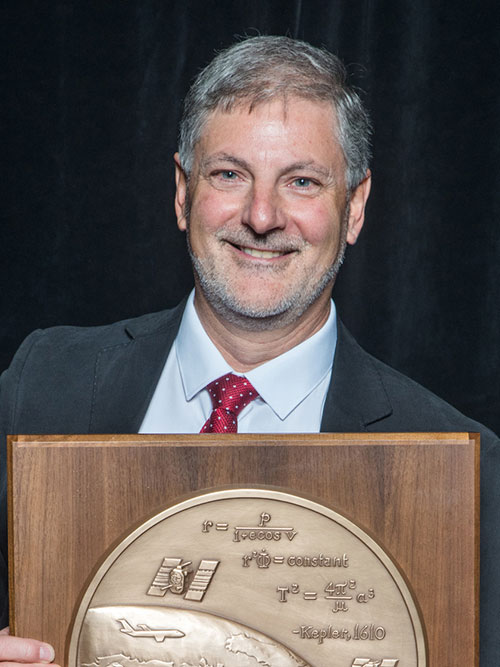
The Institute of Navigation’s (ION) Satellite Division presented Professor Terry Moore with its Johannes Kepler Award for his outstanding contributions to the development of satellite navigation through a sustained and distinguished professional career devoted to research and teaching.
Moore received the award Sept. 29 at the ION GNSS+ Conference in Portland, Ore. Moore is a member of the GPS World Editorial Advisory Board.
Terry Moore has more than 30 years of research experience in surveying, positioning and navigation technologies, and is a consultant and advisor to European and U.K. government organizations and industry.
He has taken a leading role in national and European initiatives aimed at integrating academic research and teaching activities in GNSS and interacting closely with industry.
Moore is credited with extensive work on the introduction and implementation of WGS 84 as the standard reference systems for air and marine navigation, as well as the development of standard software tools for coordinate transformations and map projections used extensively through the aviation industry.
Additionally, he is known for the development of GRINGO software that pioneered the use of raw GPS code and carrier phase data from low cost Garmin receivers. His work has also includes the pioneering of novel methods and algorithms for GPS orbit relaxation; which led to reduced dynamic GPS-based orbit determination for LEO spacecraft, with a real-time implementation.
Moore is the Director of the Nottingham Geospatial Institute (NGI) at the University of Nottingham where he has responsibility for all of NGI’s research and teaching. He is also the founding Director of GRACE, the GNSS Research and Applications Centre of Excellence, which was jointly funded by the University of Nottingham and East Midlands Development Agency, and targets knowledge transfer between the NGI and business. Additionally, he leads the university-wide Aerospace and Transport Technology Research Priority Area.
Moore has supervised numerous research projects funded by industry, research councils, the European Space Agency and the European Commission, and has supervised more than 30 Ph.D. students.
Moore is involved in the volunteer activities of numerous international professional and scientific bodies. He is currently a Royal Institute of Navigation (RIN) Vice-President (now also President Elect) and a member of their Technical Committee, while simultaneously serving on the ION Council as a Technical Representative and as a co-chair of the ION’s Satellite Division’s Technical Peer Review Committee.
He has served on the ION’s Satellite Division Executive Committee on numerous occasions and is a past ION GNSS+ program and general chair.
Moore is a Fellow of both the Institute of Navigation and the Royal Institute of Navigation (RIN). He is also a Fellow of the Chartered Institution of Civil Engineering Surveyors, a Fellow of the Royal Astronomical Society and an Associate Fellow of the Remote Sensing and Photogrammetry Society. In 1999 and 2008 he was awarded the RIN Richey Medal (best paper in the RIN Journal of Navigation), in 2013 was awarded the RIN Harold Spencer-Jones Gold Medal (outstanding contributions to navigation), and in 2016 the RIN J.E.D. Williams Medal (contributions to the RIN).
He holds a BSc degree in Civil Engineering and Ph.D. degree in Space Geodesy, both from the University of Nottingham, where he was promoted to the U.K.’s first Chair of Satellite Navigation in 2001.
The Johannes Kepler Award recognizes and honors an individual for sustained and significant contributions to the development of satellite navigation. It is the highest honor bestowed by the ION’s Satellite Division.
In recent years there has been a proliferation of software-defined radio (SDR) data-collection systems and processing platforms designed for GNSS receiver applications or those that support GNSS bands. For post-processing, correctly interpreting the GNSS SDR sampled datasets produced or consumed by these systems has historically been a cumbersome and error-prone process.
This is because these systems necessarily produce datasets of various formats, the subtleties of which are often lost in translation when communicating between the producer and consumer of these datasets.
This specification standardizes the metadata associated with GNSS SDR sampled data files and the layout of the binary sample files.
The GNSS SDR Metadata Standard defines parameters and schema to express the contents of SDR sample data files. The standard is designed to promote the interoperability of GNSS SDR data collection systems and processors.
The metadata files are human readable and in XML format. A compliant open source C++ API for reading metadata and binary samples is also officially supported to promote ease of integration into existing SDR systems.
Review the formal standards document and click on Submit a Comment to provide feedback. Comments will be accepted through December 31, 2017.
Navigation, a journal published by The Institute of Navigation, has experienced continued growth according to the latest Journal Impact Factor (JIF) report.
The JIF of an academic journal is a measurement tool used to calculate the yearly average number of citations to recent articles published in a journal and is an indication of the relative importance of the journal within its field. It is generally recognized that journals with higher impact factors are deemed more important than those with lower ones due to its citation rate.
Navigation’s Journal Impact Factor is now 1.604, an increase from 0.979 last year and 0.562 the year before. Total citations have increased by more than 270 percent over the past two years.
“We are especially pleased with our strong performance,” said Boris Pervan, Navigation‘s editor. The increase in Navigation‘s impact factor is reflective of ION’s commitment to improve the quality and content of the papers published in the journal.
ION extends its gratitude to its esteemed editorial board, which includes: Penina Axelrad, Pau Closas, Paul Groves, Christopher Hegarty, Changdon Kee, Jiyun Lee, Gary McGraw, Michael Meurer, Thomas Pany, Boris Pervan (editor), Jason Rife, Andrey Soloviev, Maarten Uijt de Haag, Todd Walter, Lisa Beaty (managing editor) and Fiona Walter (administrative editor).
Navigation is indexed in the Thomson Reuters Science Citation Index Expanded (also known as SciSearch), Thomson Reuters Journal Citation Reports/Science Edition and Thomson Reuters Current Contents/Engineering Computing and Technology.
Additionally, Navigation is abstracted in Electrical and Electronics Abstracts. Citations and abstracts of articles in Navigation can be found using the INSPEC online database. Navigation is published by ION in partnership with Wiley.
The Institute of Navigation is the world’s premier professional society dedicated to the advancement of the art and science of positioning, navigation and timing. The institute is a national organization whose membership spans worldwide.
According to ION, JNC is the largest U.S. military positioning, navigation and timing (PNT) conference of the year with joint service and government participation. The event will focus on technical advances in PNT, emphasizing joint development, test and support of affordable PNT systems, logistics and integration.
From an operational perspective, the conference will focus on advances in battlefield applications of GPS; critical strengths and weaknesses of field navigation devices; warfighter PNT requirements and solutions; and navigation warfare.
The event, which will feature a technical exhibit and showcase of guidance, navigation and control technology products, will include more than 200 operational presentations, ION reports.
The ION Joint Navigation Conference will take place at the Dayton Convention Center, as well as a classified environment on June 8 at the Air Force Institute of Technology.
The Institute of Navigation (ION) has announced its Executive Committee and Council for 2017-19. The ION Executive Committee and Council consists of a wide range of professionals in the field of positioning, navigation and timing.
“ION is excited with the talented and distinguished group of professionals that hail from all segments of the PNT community who are giving their time to serve on the ION Executive Committee and Council,” said Lisa Beaty, executive director of ION.
ION Executive Committee
President: John Raquet, Air Force Institute of Technology
Executive Vice President: Jade Morton, Colorado State University
Treasurer: Frank van Graas, Ohio University
Eastern Region Vice President: Anthea Coster, MIT Haystack Observator
Western Region Vice President: Gary McGraw, Rockwell Collins
Satellite Division Chair: Frank van Diggelen, Google
Military Division Chair: Elliott Kaplan, The MITRE Corporation
Immediate Past President: Dorota Grejner-Brzezinska, The Ohio State University
2017–19 Council Members
Eastern Council Member-at-Large: Francine Vannicola, U.S. Naval Research Laboratory
Eastern Council Member-at Large: Keith McDonald, The MITRE Corporation
Western Council Member-at-Large: Neil Gerein, NovAtel Inc., Canada
Western Council Member-at-Large: Paul Benshoof, Locata Corporation
Technical Representatives
José Ángel Ávila Rodríguez, European Space Agency, The Netherlands
Sunil Bisnath, York University, Canada
Mathieu Joerger, The University of Arizona
Olivier Julien, ENAC, France
Allison Kealy, The University of Melbourne, Australia
O’Keefe (left). Grid cells form networks with the place cells in the hippocampus, a circuitry that creates a comprehensive positioning system — an inner GPS — in the brain.(Source: Nobel Committee)
The Institute of Navigation Satellite Division looked deeply inward for its keynote speaker at this year’s ION GNSS+ conference, held Sept. 12–16 in Portland, Oregon.
Nobel Laureate John O’Keefe provided insight into how our brains determine position. In 1971, O’Keefe recorded signals from individual nerve cells in the hippocampus of rats roaming about a room. He found that a type of nerve cell in the hippocampus was always activated when a rat was at a certain place, and other nerve cells were activated when the rat was at other places.
O’Keefe concluded that these “place cells” formed a map of the room. The place cells were not just registering visual input, but building an inner map of the environment. The hippocampus generates numerous maps, which can be seen by the activity of place cells activated in different environments. The memory of an environment can be stored as a specific combination of place-cell activities in the hippocampus.
In 2005, co-laureates May-Britt and Edvard Moser discovered another key component of the brain’s positioning system. “Grid cells” generate a coordinate system and allow for precise positioning and pathfinding. Their research showed how place and grid cells make it possible for rats — and presumably us — to find our way around, determining where we are in the world and which way to go.
Recent investigations show that place and grid cells also exist in humans. In patients with Alzheimer’s disease, the hippocampus is frequently affected, causing those afflicted to lose their way. Knowledge about the brain’s positioning system may help us understand the mechanism underpinning the disease.
The Institute of Navigation (ION) has announced the recipients of the 2016 fellow memberships and annual awards during the ION International Technical Meeting (ITM) and Precise Time and Time Interval Systems and Applications (PTTI) in Monterey, California, held Jan. 25-28.
2016 Fellows
Election to Fellow membership recognizes the distinguished contributions of ION members to the advancement of the technology, management, practice and teaching the arts and science of navigation, as well as lifetime contributions to the Institute.
Karl Kovach has been elected for significant contributions to the development of GPS, its signals, interface and specifications and performance standards.
Anthea J. Coster has been elected for contributions to the development of global GPS TEC database and for utilizing GPS measurements for ionospheric and space weather studies.
Gary McGraw has been elected for sustained contributions to the development of high accuracy and high-integrity positioning, navigation and timing technologies for a variety of military and civil aviation applications.
2015 Annual Awards
ION also presented its Annual Awards during the ITM/PTTI meeting. The awards program recognizes individuals making significant contributions or demonstrating outstanding performance relating to the art and science of navigation.
Alexander A. Trusov received the Early Achievement Award for research, development and demonstration of ultra-low dissipation inertial MEMS sensors that may enable low-cost IMUs with North-finding and inertial navigation grade performance. The Early Achievement Award is presented in recognition of outstanding contributions made early in one’s career.
Captain Nicholas Rayl received the Superior Achievement Award for performing above and beyond the call of duty navigating hostile airspace to engage a hostile AAA piece that represented a threat to aircraft. The Superior Achievement Award is presented to an individual demonstrating outstanding accomplishments as a practicing navigator.
Ramsey M. Faragher and Robert K. Harle received the Dr. Samuel M. Burka Award for their paper “Towards and Efficient, Intelligent, Opportunistic Smartphone Indoor Positioning System” published in the Spring 2015 issue of NAVIGATION: Journal of The Institute of Navigation, Vol. 62, No. 1,pp. 55-72.The Dr. Samuel M. Burka Award recognizes outstanding achievement in the preparation of a paper contributing to the advancement of the art and science of positioning, navigation and timing.
Inder J. Gupta received the Captain P. V. H. Weems Award for pioneering theoretical and experimental work on anti-jam antennas and signal processing techniques for interference suppression in GNSS receivers. The Captain P. V. H. Weems Award is presented to individuals for continuing contributions to the art and science of navigation.
James L. Garrison received the Tycho Brahe Award for contributions to developing and applying GNSS and other signals-of-opportunity, reflectometry methods for space-based and airborne remote sensing, in oceanography, agriculture, and hydrology. The Tycho Brahe Award is presented to recognize outstanding contributions to the science of space navigation, guidance and control.
Carolyn McDonald received the Norman P. Hays Award for the development and production of over thirty years of engineering tutorials in the field of satellite navigation, timing and inertial navigation; and for development and sustained support of the ION’s conference programs. The Norman P. Hays Award is given in recognition of outstanding encouragement, inspiration and support contributing to the advancement of navigation.
Tim Murphy received the Thomas L. Thurlow Award for significant contributions to Global Navigation Satellite Systems for aviation. The Thomas L. Thurlow Award recognizes outstanding contributions to the science of navigation.
Donald Mitchell received the Distinguished Service Award for his coordination between the PTTI user community and hardware developers, and contributions to the organization and operation of the PTTI meeting. The Distinguished Service Award is presented for extraordinary service to The Institute of Navigation.
Francine Vannicola received the Distinguished Service Award for representing the timing community and facilitating the incorporation of the Precise Time and Time Interval (PTTI) Systems and Applications Meeting into the ION’s meeting programs. The Distinguished Service Award is presented for extraordinary service to The Institute of Navigation.
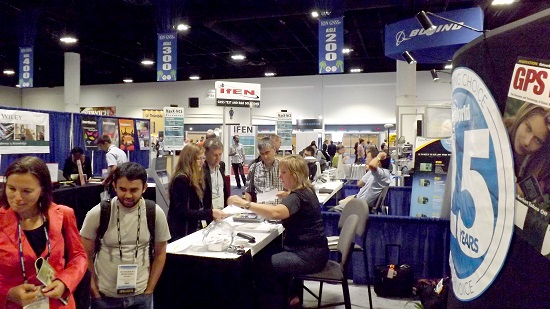
Crowds gather at the GPS World booth at ION GNSS+ 2014.
ION GNSS+ 2015 is the 28th International Technical Meeting of the Institute of Navigation’s Satellite Division and the world’s largest technical meeting and showcase of GNSS technology, products and services and other sensors in today’s marketplace. The conference will be held Sept. 14-18 (tutorials Sept. 14-15) at the Tampa Convention Center in Tampa, Fla.
James L. Green, director of Planetary Science for NASA, will take the audience on a journey navigating through the solar system during his keynote address. He will show new worlds and new discoveries through the eyes of NASA’s planetary spacecraft.
This year’s conference will feature panels of industry experts, policy updates, the world’s largest GNSS commercial exhibit and more than 300 technical presentations presented through both Peer-Reviewed Tracks (Multisensor Navigation and Applications; Algorithms and Methods; and Advanced GNSS Technologies) and Systems and Application Tracks (Mass-Market Applications; High Performance & Safety-Critical Applications; and System Updates, Plans and Policies).
GPS World staff will be moderating the Lightning Talks section of the plenary session, as well as hosting a booth in the Exhibit Hall.
Tap into our up-to-the-minute show coverage here at gpsworld.com and via Twitter (@GPSWorld).
Alan Cameron, GPS World Editor and Publisher, provides the following video introduction to the conference.
In late June, I had the honor and privilege of attending and participating in the Institute of Navigation’s Joint Navigation Conference (ION-JNC) in Orlando, Fla. This year attendance was up by 20 percent. The entire event was FOUO (For Official Use Only) with a classified (SECRET) day on Thursday held at, as improbable as it seems, a joint military and Walt Disney location known as Shades of Green. It gives Mickey Mouse and the military a whole new meaning!
The classified day included a remarkable War Fighter Panel, which, full disclosure, I have had the honor along with my colleague Jim Doherty at IDA (Institute For Defense Analyses) of co-chairing for the last several years. It is always heart-warming and invariably enlightening to hear our warfighters discuss capabilities that GPS enables for them in times of peace and war. You could even say this was the theme of the conference: “The capabilities that GPS technology enables.”
You might assume an FOUO- and SECRET-level conference would be slim pickings for a journalist. If that is all that transpired, then you would be correct; however, all the conversations outside the official sessions, especially around the displays and exhibitors’ booths, make it more than worthwhile. Not to mention all the tidbits you pick up at breakfast, lunch, dinner and evening socials. One of the most common phrases I heard all week was, “Now don’t quote me on this, but…” or the one I like to hear, “OK, this is on the record” or “You are recording this, right?” Everyone has a message!
ION-JNC in Dayton, Ohio
For the next two years (2016-17) ION-JNC will be held in beautiful downtown Dayton, Ohio, at the Dayton Convention Center. Dayton is home to the famous Wright Brothers Cycle Shop and the Wright Flyer.
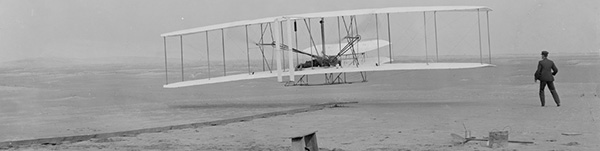
Take-off of the 1903 Wright Flyer, the world’s first powered, sustained and controlled heavier-than-air flight on Dec. 17, 1903.
Dayton also hosts the world-famous National Museum of the USAF (United States Air Force) located on Wright-Patterson Air Force Base (WPAFB). The classified day will be held at the prestigious USAF Institute of Technology (AFIT), also on WPAFB, where many an Air Force officer has earned a master’s and or Ph.D. The papers and sessions should be outstanding in view of the venue and the presence of the Air Force Research Laboratory (AFRL) at WPAFB, which is known as the Air Force’s only organization wholly dedicated to leading the discovery, development and integration of warfighting technologies for air, space and cyberspace forces.
Register early and send your clearance if you have one; it just gets better every year.
SpaceX and Falcon 9
Elon Musk,CEO Space Exploration Technology Corp. (Photo Courtesy of Tesla Motors)
I arrived in Orlando on Sunday, June 21 (yes, I traveled on Father’s Day) because events start bright and early Monday morning, to hear about the Falcon 9 launch failure, the first for that family of launchers. Even though it occurred 130+ seconds into the launch segment, if the rocket fails to deliver the payload or supplies to orbit or their destination, it is generally referred to as a launch failure. Technicians and subject-matter experts will be debating for some time exactly what caused the failure, but there can be no doubt this is a big blow to the Space Exploration Technology Corporation — better known as SpaceX.
I have known Elon Musk and experienced his outsize ego casually for more than 20 years, and I am constantly amazed at his accomplishments and would never bet against him. I do not mean the ego remark in a negative way, because history proves that if Elon says he will accomplish the seemingly impossible, then he will do just that. Can you say Tesla Motors? Setbacks just make him and his team more determined.
“It is difficult to say what is impossible, for the dream of yesterday is the hope of today and the reality of tomorrow.” — Dr. Robert Goddard
Gwynne Shotwell, COO Space Exploration Technology Corp. (Photo Courtesy of SpaceX)
However, launch setbacks are played out on a national stage where lives may well be at stake. SpaceX President and COO (Chief Operating Officer) Gwynne Shotwell, the brains of the outfit, who is as alluring as she is brilliant, said following the launch failure, “I’m sure we will find the cause rapidly and resume normal launch operations within a year.”
Reportedly, SpaceX is already a bit tardy in scheduled launches with an enviable backlog totaling approximately $7B, many of which are government payloads. In the end, this merely highlights that the launch business is a tough nut to crack, and attention to detail is paramount. Every little detail must be scrutinized numerous times.
BAR
In the mid 1990s, Dr. John Darrah and I (then AFSPC Chief Scientist and Deputy respectively) under the auspices of Air Force Space Command and the Institute For Defense Analyses (IDA) formed a high-level group of subject matter experts (SMEs) to review why the U.S. government, in the matter of a few months, put several billion dollars worth of space hardware into saltwater instead of the vacuum of space. The group was labeled the BAR, or Broad Area Review, and its task was to euphemistically “bar” this type of abnormal launch activity from ever happening again. I can honestly say the BAR has been wildly successful.
There have been five separate BARs to date, and there has not been a military or national security space launch failure since the BAR’s inception. There have begen more than 120 successful launches by Lockheed Martin, Boeing and the combined organization known as ULA or United Launch Alliance. I am not at liberty to reveal the findings of the various BARs, but obviously attention to detail is key to any successful endeavor.
SpaceX vaulted from an upstart small company with a few employees to a certified government space launch contractor with more than $7 billion in contracts and 3,000+ personnel on the payroll in only 13 years. SpaceX previously successfully launched two cargo resupply missions to the space station. To date, it is the only predominantly commercial space company to accomplish that task.
Therefore, I am sanguine without a doubt (now I sound like Elon) that SpaceX will quickly discover the malfunction that caused the launch failure and correct it immediately. This is not to say that anyone at SpaceX has been intentionally careless, but the successful space launch business today is by necessity an OCD (obsessive compulsive disorder) culture of attention to detail where items are checked not once or twice but 20 times to make sure nothing has been overlooked or assumed. However, for SpaceX the critical task, for the success of the company and future astronauts’ lives, depends on SpaceX’s assurance there will be no more failures for any reason. The U.S. military has proven for the last 16 years — 16 years without a single national security space launch failure — that it is an achievable goal. Note: Currently SpaceX launches do not fall under the purview of the BAR, a situation easily rectified.
Assured Access to Space
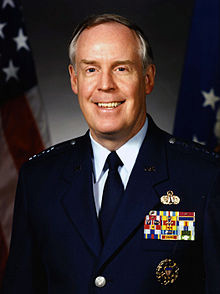
General (USAF, Ret) Thomas S. Moorman Jr. (Photo Courtesy of the USAF)
Lest we forget, behind all the technological arguments and/or failures is the crux of the matter, which is nothing less than assured access to space and all that capability enables, which of course includes GPS. In 2006, General (USAF Retired) Thomas S. Moorman Jr., former AFSPC commander and VCSAF, wrote in the highly esteemed AFSPC publication High Frontier regarding a Senior Leader’s Perspective on Assured Access to Space. He stated clearly that
“Assured access [to space] is a requirement for critical national security, homeland security and civil missions, and is defined as a sufficiently robust, responsive and resilient capability to allow continued space operations, consistent with risk management and affordability.”
In referring to his now famous and eponymous study, he stated that,
“The study found that most people wanted to describe assured access in terms of reliability. As the study team progressed in our analysis, it became apparent that often what people were describing was the need for resiliency rather than reliability. Reliability describes the dependability of a specific booster while resiliency considers the collective ability of all available launch systems to meet national security need.
“While our recent launch record…is indeed impressive, we should not rest on our laurels. Assured access is not a destination, but rather a journey. As a nation, we need to continue to adequately fund space launch operations and develop the next-generation technologies that will increase responsiveness, improve reliability, and reduce costs. Through these actions, we can ensure the nation will have continuous, uninterrupted access to space for decades to come.”
In that light it is possible — even probable — that SpaceX will help us strive, reach and continue with that vaunted goal; contrarily, you may remember a few months ago SpaceX sued the U.S. government because the government was not moving quickly enough for Space X with certifications and validations for SpaceX launch vehicles. The U.S. government knows first hand how difficult the space launch business can be, and it wanted to ensure that not only was SpaceX ready but that their family of vehicles were reliable. The government’s caution has unfortunately been validated, as this was the second SpaceX launch failure, although the first and hopefully the last in the Falcon 9 family of vehicles. All is not lost, and the future actually looks bright for SpaceX if it will just put egos aside, listen to the launch subject matter experts and pay attention to every little detail.
Competition may well be viewed as a “good thing” in the space launch business. However, it is always trumped by assured access to space, which is a critical national security requirement. Competition and national security needs must be balanced with the emphasis on what is gained by assured access to the high ground of space. Elon Musk, Gwynne Shotwell and the SpaceX team may well be capable of showing the rest of us “how it is done,” but first they must demonstrate unerring dependability, reliability and resiliency. I wish SpaceX the best of luck and every success.
Nascent Leadership Paradigm — People on the Move
For some unfathomable reason, at least intellectually, all the USAF Leadership Schools, or at least the majority, are located in Montgomery, Ala. Now personally I happen to like Montgomery and its laid-back southern charm. It was also once the capitol of the Confederacy, which is apropos nothing except it seems to be a hot topic or trigger word these days. Be that as it may, Montgomery and Air University are not exactly Oxford, Cambridge or Eton, and yet the university in its many incarnations has produced outstanding military leaders in its 95-year history. And yet in my numerous tenures at this prestigious institution, it has been made clear by the staff that this is an institution with bipolar tendencies.
On the one hand, it is made clear to every officer and student that the national military establishment thrives on rules and regulations, and those wishing to abuse or ignore them can readily and rapidly be replaced. Some instructors I encountered (not all certainly, and probably not the cream of the crop) would have you believe that individualism has its place — just not in the U.S. military. Then, in the next class or session, you hear stories about visionaries such as Claire Chennault, Jimmy Doolittle and William “Billy” Mitchell, who never colored within the lines. Not to disparage Air University, but I have always had a problem with this school tenet, as it tends to disregard personality, relationships and leadership. I often think of General Dwight Eisenhower’s comments concerning his rebellious, unorthodox and rule-breaking friend U.S. Army General George Patton. Eisenhower made numerous famous comments about Patton’s rebellious nature, his inability to follow orders and his swashbuckling uniforms that once paraded 24 general’s stars at one time on one non-standard uniform, and yet in official comments written after Patton’s untimely death Eisenhower wrote:
“He [Patton] was one of those men born to be a soldier, an ideal combat leader whose gallantry and dramatic personality inspired all he commanded to great deeds of valor. His presence gave me the certainty that the boldest plan would be even more daringly executed. It is no exaggeration to say that Patton’s name struck terror at the heart of the enemy.”
In other words personality, individualism, reputation and leadership do make a difference, and in times of war, leaders bearing those qualities are difficult if not impossible to replace. But in times of peace, those qualities still matter, and we should never take those leaders for granted. I mention this because in the past several months, several Air Force leaders considered key to the GPS program have either retired, been promoted or left government service for personal reasons.
USAF General Ellen Pawlikowski is only the third female four-star general in USAF history, and she recently left SMC (Space and Missile Systems Center) for a job at the Pentagon, where she worked space and GPS acquisition and policy issues. From there she was promoted to four stars and now sits as just the ninth commander of Air Force Materiel Command. Gen. Pawlikowski was replaced at SMC by Lt. Gen. Samuel Greaves (USAF).
Brigadier General William Cooley (USAF) recently pinned on his first star while serving as the director of the GPS Directorate at SMC. He was recently selected for reassignment as program executive, Programs and Integration, Office of the Under Secretary of Defense for Acquisition, Technology and Logistics, Missile Defense Agency (MDA), Redstone Arsenal, Alabama —an organization where Lt. Gen. Sam Greaves once served as the deputy commander. Can you say career broadening? Brig. Gen. “Wild Bill” Cooley is being replaced by USAF Colonel Steve Whitney, who has distinguished himself with yeoman service at the directorate as the GPS Military User Equipment (MUE) guru.
David W. Madden serves as a member of the Defense Intelligence Senior Executive Service and functions as the executive director, Space and Missile Systems Center, Air Force Space Command, Los Angeles Air Force Base, Calif. He is the senior civilian executive and the deputy program executive officer for Space. His responsibilities include managing the research, design, development, acquisition and sustainment of satellites and the associated ground command and control systems and user terminals. In his military career, Dave served as the GPS Wing Commander at SMC. For personal and professional reasons, Dave has decided to leave government service soon, and my sources tell me he will take up a position in Denver, Colo. Unfortunately, I am not currently at liberty to say where. I have been told the name of Dave’s replacement, but it was in an FOUO session and therefore not currently releasable. Suffice it to say, the individual is eminently qualified.
Each of the individuals mentioned has a very strong personality and a certain way of doing business. I have known them all for years and can honestly say their personalities and personal leadership styles dominated their successful careers to date. Frankly, I don’t see that changing. So, when you hear that military personnel are interchangeable and personalities don’t matter, as I unfortunately heard a very senior official say publicly recently, please take that with a huge grain of salt and skepticism. People, personalities and leadership styles do matter, especially outside-the-box thinkers and leaders. Let’s wish everyone the best in their new endeavors.
Until next time, Happy Navigating, and remember: GPS is brought to you courtesy of the United States Air Force.
Two of the Institute of Navigation’s (ION’s) conferences — the International Technical Meeting (ITM) and the Precise Time and Time Interval (PTTI) Meeting — will be co-located for 2016. One registration fee gives attendees access to both technical events and a commercial exhibit. The co-located conferences will take place Jan. 25-28, 2016, at the Hyatt Regency Monterey in Monterey, Calif.
Abstracts are due Oct. 2, 2015. Submission requirements have changed, and depend on the session the abstract is submitted for. Review the call for abstractsfor more information.
This year’s joint ITM/PTTI Plenary Session is “Autonomous Vehicles – Beyond the Navigation Technology.” The session will address issues outside of navigation technology, including legal issues, regulatory challenges, transitional periods, markets enabled by autonomous operation and similar topics beyond the core navigation technology.
ITM is ION’s winter meeting, which features peer-reviewed technical papers related to positioning, navigation and timing, and includes the ION Fellows and Annual Awards presentations.
PTTI is the annual technical conference designed to disseminate and coordinate PTTI information at the user level, review present and future PTTI requirements, inform government and industry engineers, technicians and managers regarding precise time and frequency technology and its problems, and provide an opportunity for an active exchange of new technology associated with PTTI.
The co-located 2016 ITM and PTTI meetings will feature a technical exhibit and showcase of products and services related to positioning, navigation and timing. For more information on exhibiting, contact ION or go to www.ion.org.
This year, unlike in previous years, the technical program (registration brochure) will only be distributed online. Users can search and sort the program online or download and print a PDF version. A printed on-site guide book will still be available to attendees.
ION GNSS+ 2015 is the 28th International Technical Meeting of the ION Satellite Division and the world’s largest technical meeting and showcase of GNSS technology, products and services and other sensors in today’s marketplace.
Attendees who book a hotel room first will save $200 by entering the hotel confirmation number from the Tampa Marriott Waterside Hotel and Marina at the start of the registration process. Attendees will need a valid hotel confirmation number to claim this discount during registration.
ION GNSS+ brings together international leaders in GNSS and related positioning, navigation and timing fields to present new research, introduce new technologies, update current policy, demonstrate products and exchange ideas. The focus of this meeting is the growing emphasis on GNSS and the rapidly evolving field of alternative navigation methods.
This year’s conference will feature panels of industry experts, policy updates, the world’s largest GNSS commercial exhibit and more than 300 technical presentations presented through:
Peer-Reviewed Tracks
Multisensor Navigation and Applications
Algorithms and Methods
Advanced GNSS Technologies
Systems and Application Tracks
Mass-Market Applications
High Performance & Safety-Critical Applications
System Updates, Plans and Policies
GPS World Editor and Publisher Alan Cameron discusses the importance of the annual ION GNSS Conference at the 2014 event, also held in Tampa.


 The Institute of Navigation’s