Tag: ION GNSS+ 2018

  • How to integrate autonomous CPS

    Screenshot: United Artists
    Screenshot: United Artists

    Dull, dirty and dangerous — those used to be the jobs relegated to autonomous systems. But a decade-plus of improvement in sensor and computing technology has brought autonomy into the mainstream as a defining technology of the future.

    At September’s ION GNSS+ conference, I attended a panel titled “Autonomous Cyber-Physical Systems — The Way Ahead.” I came away astounded by how much is changing, and how fast, because of autonomous CPS.

    The panel was chaired by John Raquet of the Air Force Institute of Technology and Zak Kassas of the University of California Riverside. It featured presentations covering topics such as the Columbus Smart City Challenge (Dorota Grejner-Brzezinska, The Ohio State University), benefits of precision agriculture (Steve Rounds, John Deere), robotic teammates on the battlefield (Brett Piekarski, U.S. Army), and UAV design and certification (Demoz Gebre-Egziabher, University of Minnesota).

    Autonomous cyber-physical systems (CPS) include unmanned aerial vehicles, self-driving cars and unmanned underwater vehicles. The panel addressed the state of autonomous CPS as well as challenges that need to be addressed as we integrate these systems into our environment.

    Rather than discuss a specific application, Michael Veth, CEO of Veth Research Associates, tackled a difficult question: Just how much autonomy do we give machines?

    “Rigorous risk assessment is the most critical component of machine-controlled autonomous systems,” Veth said. He said the scope of the machine’s autonomous decisions should be limited to the minimum necessary — in other words, avoid the scenario depicted in the movie WarGames.

    Another rule: “Don’t put beta software on the street,” he said, recalling the Tesla autosteer system that resulted in a death. Instead, follow DARPA’s example, with its extensive sandbox testing.

    Summing up his presentation, Veth provided five guidelines for developing autonomous machines:

    1. Perform rigorous risk assessments;
    2. limit range of action to the minimum required;
    3. use generative models whenever possible;
    4. train and evaluate using maximum available data; and
    5. always prefer the simplest models.
  • Averna offers GNSS simulation for RP-6500 RF Record and Playback platform

    Averna’s David Brace offers a rundown on the company’s RP-6500 RF Record and Playback platform at ION GNSS+ 2018, which took place Sept. 24-28 in Miami. According to the company, real-time GNSS simulation and SATCOM signal generator toolkits will now be available for its RP-6500 RF Record and Playback platform, making it an all-in-one solution to support advanced satellite navigation applications.

  • Oliver Montenbruck honored with ION’s Kepler Award

    Oliver Montenbruck honored with ION’s Kepler Award

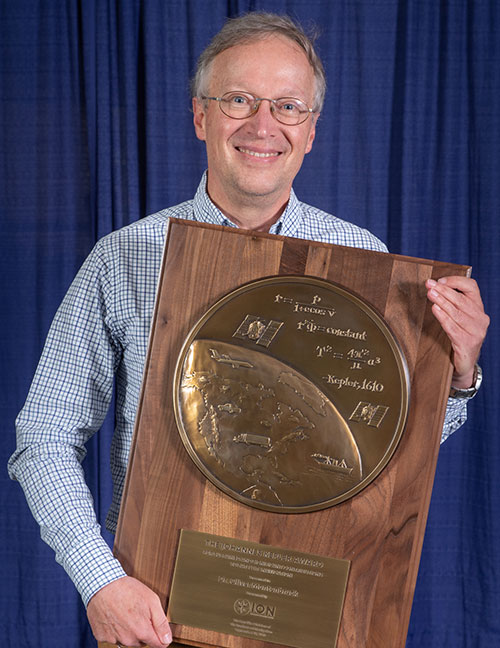
    The Institute of Navigation presents Dr. Oliver Montenbruck with prestigious Johannes Kepler Award at the ION GNSS+ 2018 Conference. (Photo: ION)
    The Institute of Navigation presents Dr. Oliver Montenbruck with prestigious Johannes Kepler Award at the ION GNSS+ 2018 Conference. (Photo: ION)

    The Institute of Navigation’s (ION) Satellite Division presented Oliver Montenbruck with its Johannes Kepler Award on Sept. 28 at the ION GNSS+ Conference in Miami. The Kepler Award recognizes and honors an individual for sustained and significant contributions to the development of satellite navigation. It is the highest honor bestowed by the ION’s Satellite Division.

    Montenbruck was honored for his pioneering contributions to GPS for navigation of space vehicles, the advancement of multi-GNSS understanding, and tracking networks to support scientific and societal benefit.

    He is head of the GNSS Technology and Navigation Group at DLR’s German Space Operations Center and an affiliated professor for GNSS at the Technical University of Munich. His research activities have been devoted to spaceborne GNSS applications, where he made contributions in the fields of receiver technology, autonomous navigation systems, spacecraft formation flying and precise orbit determination.

    These range from development of the first meter-level autonomous navigation system for micro-satellites based on Kalman-filtered GPS observations, to detailed modeling of user spacecraft antenna phase-center variations, non-gravitational forces and ambiguity fixing techniques that support GNSS-based POD precision to the 1-centimeter level in support of space geodesy.

    His unique expertise in the field has resulted in numerous consultancy tasks for national and European space industry and agencies. Focusing on the new satellite navigation systems, he has pioneered the advancement of monitoring networks, characterization of new navigation signals, GNSS performance assessment and multi-GNSS processing.

    A GPS World Leader

    In 2014, Montenbruck was honored with the GPS World Leadership Award, Products Category, for “Bringing SatNav Future into View: A Platform for Early Familiarization with New Constellations” (see his remarks here.) He also has authored several articles for the magazine, including:

    He pioneered the expansion of global monitoring networks for new and modernized GNSS, initiating the Cooperative Network for GNSS Observation (CONGO), which has been a primary source of information for early assessment of Galileo, BeiDou, GPS L2C and L5 signals. His leadership and research have contributed to a thorough understanding of new GNSS constellations, enabled the full exploitation of new signals, advanced satellite technology and made multi-GNSS available to a wider community.

    Montenbruck is an active member ION and past member of council. He serves on the IGS Governing Board and key working groups. Within the International GNSS Service (IGS), Montenbruck chairs the Multi-GNSS Working Group and coordinates the performance of the Multi-GNSS Project (MGEX).

    Montenbruck is widely recognized for his frequently cited textbooks, ~100 publications in peer-reviewed journals, more than 250 conference papers and the Springer Handbook of Global Navigation Satellite Systems, which he co-edited and authored/co-authored. He is a recipient of the ION’s Tycho Brahe Award and the DLR Senior Scientist Award as well as the GPS World Leadership Award.

    Montenbruck received his Ph.D. in 1991 and Habilitation in 2006 from the Technical University of Munich. He has supervised more than 25 master and a dozen Ph.D. theses, and served on defense committees at several international universities. As a visiting scientist, he conducted joint research projects at various international institutions, including the University of Texas at Austin, the European Space Agency, and the University of Bern.

  • Spirent Federal Systems discusses upcoming release of SimMNSA at ION GNSS+ 2018

    Spirent Federal Systems’ Tyson Gurney discusses the company’s upcoming release of SimMNSA at ION GNSS+ 2018 in Miami. According to the company, SimMNSA implements the Modernized Navstar Security Architecture, taking the next step in GPS signal modernization.
     
     
    (Background image: iStock.com/imaginima)

  • Skydel introduces new features for software-defined GNSS simulator at ION GNSS+ 2018

    Skydel CEO and co-founder Stéphane Hamel discusses the company’s latest updates, which include new features for its software-defined GNSS simulator, at ION GNSS+ 2018 in Miami. Hamel also talks about a new feature to deploy the solution in anechoic chambers.
     
     
    (Background image: iStock.com/imaginima)

  • SBG Systems presents Ellipse 2 Micro Series at ION GNSS+ 2018

    SBG Systems’ Alexis Guinamard discusses the company’s Ellipse 2 Micro Series at ION GNSS+ 2018 in Miami. The series includes the Ellipse 2 Micro IMU, Ellipse 2 Micro AHRS and Ellipse 2 Micro INS.
     
     
    (Background image: iStock.com/imaginima)

  • Rohde & Schwarz showcases EVSG1000 at ION GNSS+ 2018

    Rohde & Schwarz’s Paul Denisowski offers an overview on the company’s EVSG1000 VHF/UHF Airnav/Com Analyzer at ION GNSS+ 2018 in Miami. According to the company, the EVSG1000 is a portable signal level and modulation analyzer specifically designed for commissioning and servicing ILS, VOR and marker beacon ground stations and for analyzing ATC COM signals.
     
     
    (Background image: iStock.com/imaginima)

  • Rohde & Schwarz exhibits SMW200A Vector Signal Generator

    Rohde & Schwarz’s Paul Denisowski discusses the company’s latest GNSS simulator, which is based on its SMW200A Vector Signal Generator, at ION GNSS+ 2018 in Miami. According to the company, the SMW200A has an optional integrated fading simulator with up to 160 MHz bandwidth, as well as options for all important digital communications standards.
     
     
    (Background image: iStock.com/imaginima)

  • Rohde & Schwarz reviews E911 location-based services test system

    Rohde & Schwarz’s Stefan Maier gives GPS World an overview of the company’s progress on its E911 location-based services test system at ION GNSS+ 2018 in Miami.
     
     
    (Background image: iStock.com/imaginima)

  • Rockwell Collins releases latest GB-GRAM-M ground-based receiver at ION GNSS+ 2018

    Rockwell Collins’ Mike Shepherd discusses the company’s GB-GRAM-M M-code ground-based embedded receiver at ION GNSS+ 2018, which took place Sept. 24-28 in Miami. According to the company, the GB-GRAM-M delivers geolocation and precise positioning capabilities for space-constrained applications while providing increased security and anti-jam capabilities.
     
     
    (Background image: iStock.com/imaginima)

  • Racelogic demos VBOX indoor positioning system at ION GNSS+ 2018

    Racelogic’s Julian Thomas describes and demos the company’s VBOX indoor positioning system at ION GNSS+ 2018, which took place Sept. 24-28 in Miami. According to the company, the solution is designed to provide accurate position and velocity in the absence of GNSS signals.

    Read more on Racelogic’s demo here.
     
     
    (Background image: iStock.com/imaginima)

  • NovAtel presents SPAN CPT7 receiver at ION GNSS+ 2018

    NovAtel’s Sandy Kennedy offers an overview of the company’s SPAN CPT7 at ION GNSS+ 2018 in Miami. According to the company, the SPAN CPT7 is is a single enclosure GNSS and INS receiver powered by NovAtel’s OEM7 technology, which can deliver up to centimeter-level accuracy.
     
     
    (Background image: iStock.com/imaginima)