Tag: ION

  • ION Seeks Abstracts for Pacific PNT 2015, PTTI Registration Opens

    Abstract submissions are now being accepted for The Institute of Navigation’s (ION) Pacific PNT Conference, to be held April 20-23, 2015, at the Waikiki Beach Marriott, Honolulu, Hawaii. Abstracts are due November 14, 2014.

    Pacific PNT, where “East Meets West in the Global Cooperative Development of Positioning, Navigation and Timing Technology,” brings together policy and technical leaders from Japan, Singapore, China, South Korea, Australia, the United States, and more for policy updates, program status and technical exchange.

    “Global cooperative interoperability” will frame the technical program. Leaders representing academia, government, industry and the scientific community will convene to solve PNT challenges that impact Pacific Rim development.

    Pacific PNT 2015 is organized by a Pacific Rim advisory board and will feature technical papers presented on a diverse array of topics including:

    • Aircraft Navigation and Surveillance
    • Agricultural, Construction and Mining
    • Algorithms and Methods
    • Alternative Navigation and Signals of Opportunity
    • Aviation Applications of GNSS
    • Challenging Navigation Problems
    • Collaborative Navigation Topics
    • Earthquake & Tsunami Prediction and Monitoring with GNSS
    • GNSS Augmentations
    • GNSS Correction and Monitoring Networks
    • GNSS Environmental Monitoring
    • GNSS Policy/Status Updates
    • GNSS Signal Structures
    • Inertial Navigation Technology and Applications
    • Interference and Spectrum
    • Ionosphere Monitoring with GNSS
    • Magnetic Field Navigation and Mapping
    • Maritime Navigation
    • Nature-Inspired Navigation
    • PNT and Automobile Safety
    • PNT and Social Media
    • PNT for Domestic and Healthcare Applications
    • Precision Agriculture and Machine Control
    • Time and Frequency Distribution
    • UAS Technologies

    Abstracts are being accepted through November 14, 2014.  For more information the ION’s Pacific PNT 2015, visit www.ion.org/pnt.

    PTTI 2014 Registration Opens

    Registration is now open for the ION Precise Time & Time Interval Meeting (PTTI) 2014 to be held December 1-4 at the Seaport Boston Hotel, Boston, Massachusetts. The technical program is available online.

    The annual PTTI conference has a technical program designed to disseminate and coordinate PTTI information at the user level; review present and future PTTI requirements; inform government and industry engineers, technicians, and managers of precise time and frequency technology and its problems; and provide an opportunity for an active exchange of new technology associated with PTTI.

    The Distinguished PTTI Service Award, which recognizes outstanding contributions related to the management of PTTI systems, will be presented on Thursday, December 4.

  • ION International Technical Meeting 2015 Now Accepting Abstracts

    Abstract submissions are now being accepted for The Institute of Navigation’s (ION) International Technical Meeting (ITM), set for January 26-28, 2015, at the Laguna Cliffs Marriott Hotel, Dana Point California. Abstracts are being accepted through October 3, 2014.

    This year’s plenary session will focus on “The Human Factor: Interpreting and Acting on Navigation Data,” and will explore how navigation data is viewed through the lens of human perception and how novel sensing technologies will impact the human experiences.

    This year for the first time, all technical papers for ITM 2015 will be peer reviewed. Manuscripts will be designated as a primary paper, or as an alternate paper, in the onsite program based on the session chairs’ peer review of the full manuscripts.

    ITM 2013 features more than 150 technical papers presented on a diverse array of topics including:

    • Advanced RAIM and Autonomous Integrity
    • Alternative Sensors and Emerging Navigation
    • Technologies
    • Augmentation Systems (SBAS and GBAS)
    • Aviation and Marine Applications
    • Collaborative Sensing and Multisensor Fusion
    • Emerging GNSS and Modernization
    • GNSS Processing and Integration
    • Human-Centered Navigation
    • Interference, Spectrum Management, and
    • Backups to GNSS
    • MEMS, Timing and Micro PNT
    • Quasi-Zenith Satellite System
    • Receivers and Antenna Technology
    • Robot and Autonomous Vehicle Navigation
    • Space and Atmospheric Weather
    • Urban, Indoor and Terrestrial Applications

    For more information about ION’s International Technical Meeting 2015, please visit .


  • ION Announces Annual Award Winners, Fellowships

    ION_logo_TThe Institute of Navigation (ION) presented its Annual Awards during the ION International Technical Meeting (ITM) 2014 in San Diego, California, January 27-29.

    ION also announced the recipients of the 2014 fellow memberships.

    Awards

    The ION Annual Awards Program is sponsored by The Institute of Navigation to recognize individuals making significant contributions or demonstrating outstanding performance relating to the art and science of navigation.

    • Dr. Jacques Georgy received the Early Achievement Award for contributions to portable and indoor navigation using MEMS inertial sensors on consumer devices. The Early Achievement Award is presented in recognition of outstanding contributions made early in one’s career.
    • Captain Alexander Dufault received the Superior Achievement Award for his dedication as MC-130P Navigator in developing and executing new techniques, increasing the full range employment and navigation prevision of the MC-130P Combat Shadow.  The Superior Achievement Award is presented to an individual demonstrating outstanding accomplishments as a practicing navigator.
    • Dr. Young Chang Lee received the Dr. Samuel M. Burka Award for his paper “New Advanced RAIM with Improved Availability for Detecting Constellation Wide Faults, Using Two Independent Constellations” published in the Spring 2013 issue of NAVIGATION, Journal of The Institute of Navigation, Vol. 60, No. 1, pp. 71-83. The Dr. Samuel M. Burka Award recognizes outstanding achievement in the preparation of a paper contributing to the advancement of the art and science of positioning, navigation and timing.
    • Dr. Mikel Miller received the Captain P. V. H. Weems Award for his contributions to the management and encouragement of advanced navigation research and for his service to The Institute of Navigation. The Captain P. V. H. Weems Award is presented to individuals for continuing contributions to the art and science of navigation.
    • Dr. Mark Psiaki received the Tycho Brahe Award For exceptional contributions to the theory and practice of spacecraft attitude and orbit determination and to the advancement of GNSS algorithms for satellite navigation. The Tycho Brahe Award is given in memory of Mary Tornich Janislawski, developer of the Mark II Plotter, a charter member of The Institute of Navigation, the first woman to have received an ION Annual Award, a civilian aviation instructor, a teacher at the University of California at Berkeley and Stanford and a respected author. This award has been generously endowed by Col. Leonard Sugerman (USAF, Ret.), a past president of The Institute of Navigation (1970–1971).
    • Dr. Yu (Jande) Morton received the Thomas L. Thurlow Award for significant contributions to the understanding of ionospheric effects on navigation satellite signals, development of several innovative signal processing algorithms and dedication to navigation education.  The Thomas L. Thurlow Award recognizes outstanding contributions to the science of navigation.
    • Mr. Ronald Braff received the Distinguished Service Award in recognition of more than 24 years of service to NAVIGATION, The Journal of The Institute of Navigation. The Distinguished Service Award is presented for extraordinary service to The Institute of Navigation.
    • A special recognition was given to the GPS III SLR Implementation Team in grateful recognition for the multi-year effort to make the implementation of laser retro-reflector on GPS III a reality and enhance its performance and interoperability for generations to come. GPS SLR Implementation Team Members included Adde, Barbara, Ballenger, Allan, Col (Ret.), Bar-Sever, Yoaz, Dr., Beard, Ronald L., Bolden, Charles Jr., Honorable, Buckman, David, Col (Ret.), Carter, David, Davis, Mark, Dobson, Craig, Freilich, Michael, Dr., Garver, Lori, Honorable, Gruber, Bernard, Col (Ret.), Hothem, Larry, Hudnut, Kenneth, Dr., Johnson, Thomas, Dr., Kaye, Jack, Kehler, Robert, Gen, Koch, Janelle, Maj, LaBrecque, John L., Dr., Lewis, Kirk, Long, Letitia, Madden, David, Col (Ret.), Malys, Stephen, Merkowitz, Stephen, Dr. Miller, James J., Moreau, Michael, Dr., Oria, A.J., Dr., Pace, Scott, Dr., Pavlis, Erricos, Dr., Pearlman, Michael, Dr., Puhek, James, Col, Rosenberg, Robert, Maj Gen (Ret.), Scolese, Christopher Shelton, William, Gen, Skalski, Hank, Slater, James, Standley, Vaughn, Dr., Thomas, Linda, Dr. Weinberg, Norm, Wetzel, Scott, Whelan, Martin, Maj Gen, Yelle, Ray, Younes, Badri, National Space-Based PNT Advisory Board co-chaired by: Dr. James Schlesinger and Dr. Bradford Parkinson.

    Fellow Membership

    Election to fellow membership recognizes the distinguished contributions of The Institute of Navigation members to the advancement of the technology, management, practice and teaching the arts and science of navigation; and/or for lifetime contributions to the Institute.

    • Dr. Mark Psiaki has been elected for contributions to GNSS signal processing, software receivers, ionospheric scintillation modeling, and for satellite orbit and attitude determination.
    • Mr. Logan Scott has been elected for contributions to GNSS signal processing, anti-jam antennas, anti-spoofing measures, and crowd sourcing to locate jammers.
    • Prof. Peter Teunissen has been elected for invention of the LAMBDA method, the current standard for integer ambiguity resolution in GNSS carrier phase measurements, and for reliability theory of integer estimation.
  • ION Joint Nav Conference 2014 Accepting Abstract Submissions

    Abstract submissions are now being accepted for the Institute of Navigation (ION) 2014 Joint Navigation Conference (JNC) to be held June 16-19, 2014.

    For Official Use Only (FOUO) U.S.-only sessions will be held June 16-18 at the Renaissance Orlando at SeaWorld, Orlando, Florida; and the 4-EYES CLASSIFIED sessions will be held June 19 at Shades of Green Walt Disney World.

    The conference, sponsored by the ION’s Military Division, is the largest U.S. military positioning, navigation and timing conference of the year with joint service and government participation. The event will focus on technical advances in guidance, navigation, and control (GN&C) with emphasis on joint development, test and support of affordable GN&C systems, logistics and integration.

    The 2013 Joint Navigation Conference was canceled, so this will be the first time the conference has been held in two years.

    From an operational perspective, the conference will also focus on advances in battlefield applications of GPS; critical strengths or weaknesses of fielded navigation devices; warfighter PNT requirements and solutions; and navigation warfare.

    The ION JNC features more than 200 operational presentations on a diverse array of topics including:

    • Advanced Security Technologies/SAASM
    • Alternate Navigation Technologies: I, II & III
    • Atomic Clocks and Timing Applications
    • Autonomous Navigation
    • Aviation Applications
    • Battlefield Smart Phone Applications
    • Celestial Navigation and Star-Tracker Technology
    • Collaborative Navigation Techniques
    • GPS Constellation Performance
    • GPS in Military Applications/NAVWAR
    • GPS Modernization
    • Land Applications
    • Marine Applications
    • MEMS Inertial Measurement Unit
    • Micro Navigation Applications
    • Military GPS Receivers and Military GPS Receiver Technology
    • Military GPS Use and Experiences
    • Military GPS/Antenna Technologies and Interference Mitigation
    • Missile Applications
    • Modeling and Simulation
    • Multi-GNSS Receivers for Military Applications
    • Multi-Sensor Solutions for Guidance, Navigation, and Control
    • Navigating in Challenged Environments (e.g. Urban, Indoor and
    • Sub-Surface Navigation)
    • Precision Azimuth Sensing
    • Precision Navigation Capabilities for Test and Training
    • Robust Navigation Systems/Solutions
    • Space and Satellite Applications
    • Warfighter Requirements and Solutions

    Abstracts are being accepted through March 4, 2014.

    Technical Exhibit and Operational Product Demonstrations. JNC also features a technical exhibit and showcase of Guidance, Navigation and Control technology products and services and Operational Product Demonstrations. For more information on exhibiting and product demonstrations at the ION Joint Navigation Conference, call ION at 703-366-2723 or go to www.ion.org/jnc.

    Attendance Restricted. FOUO U.S. ONLY. JNC conference attendance (June 16-19) will be controlled by the Joint Navigation Warfare Center and will be restricted to U.S. ONLY.  The classified sessions will have 4-Eyes access (June 19) for citizens of U.S.A., Australia, Canada, and the United Kingdom. All participants must establish a need to know and be approved by the Joint Navigation Warfare Center security office.

  • IEEE/ION PLANS 2014 Issues Call for Abstracts

    Abstracts are now being accepted for the IEEE/Institute of Navigation (ION) Positioning, Location and Navigation Symposium (PLANS) 2014 to be held May 5-8 at the Hyatt Regency Monterey Hotel in Monterey, California. The deadline for submitting abstracts is November 1, 2013.

    Instructions on submitting your abstract can be found at www.plansconference.org.

    PLANS 2014 is the fifth biennial conference co-sponsored by the IEEE, AESS and the ION. The conference features researchers and engineers from around the globe who present their latest work in positioning and navigation technologies. Presentations range from fundamental research, to applications, to field test results with a particular emphasis on inertial navigation. Technical sessions cover a range of subjects for both beginners and seasoned professionals.

    IEEE/ION PLANS 2014 technical program will be centered around four technical tracks including Inertial Sensing and Technology, GNSS Technologies and Systems, Integrated Applications of Sensors and Technology and Systems Technology.

    Technical papers will be presented on current position, location and navigation issues:

    • High-Performance Inertial Sensor Technologies
    • Low-Cost Inertial Sensor Technologies
    • Multisensor Integrated Systems and Sensor Fusion Technologies
    • Sensor Manufacturing, Error Modeling & Testing
    • Emerging Atom-Based Sensor Technologies
    • Micro-technology for PNT
    • Receiver and Antenna Technology
    • High Assurance GNSS
    • Interference, Spectrum Issues and Robust Navigation
    • Precise Positioning, Weak Signal, and Advanced Processing
    • Algorithms
    • Modernized GNSS
    • GNSS Augmentation Systems
    • Indoor Personal and First-Responder Navigation
    • Urban Personal and Vehicular Navigation
    • Vision/Integrated Navigation Systems
    • Adaptable Navigation System Technology
    • Environmental Features and Novel Navigation Sensors
    • Terrestrial Radionavigation and RF-Positioning
    • Commercial Aviation Positioning and Navigation Applications
    • Small UAV Positioning and Navigation Applications
    • Consumer, Smartphone and Personal Navigation Applications
    • Marine Positioning and Navigation Applications
    • Terrestrial and Automotive Positioning and Navigation Applications
    • Robotic Guidance, Navigation and Control Applications

    In addition to a commercial exhibit, this year’s program includes half-day, pre-conference tutorials on:

    • Fundamentals of Inertial Navigation
    • Sensor Integration for Personal Navigation
    • Fundamentals of Kalman Filtering
    • Alternative Navigation Methods
    • NonLinear Kalman Filtering
    • Multi-constellation GNSS – Similarities/differences between GPS, Galileo, BDS, and GLONASS
    • Image-Aided Navigation

    The deadline for submitting abstracts is November 1, 2013. Submit your abstract today at www.plansconference.org.

  • It’s Snow Problem: Ohio University Team Wins ION Autonomous Snowplow Competition

    It’s Snow Problem: Ohio University Team Wins ION Autonomous Snowplow Competition

    The Institute of Navigation (ION) Satellite Division held its third annual ION Autonomous Snowplow Competition January 24-27 at Rice Park in downtown Saint Paul, Minnesota, as part of the 127th Saint Paul Winter Carnival.

    Sponsored by The ION Satellite Division and held in cooperation with the ION North Star Section, the ION Annual Autonomous Snowplow Competition is a national event open to college and university students, as well as the general public, that challenges teams to design, build, and operate a fully autonomous snowplow using navigation and control technologies to rapidly, accurately and safely clear a designated path of snow.

    Eight teams participated in the four-day competition, each using state-of-the-art navigation systems to plow two different snowfields. Teams included students, partners from private industry and faculty advisors from Case Western Reserve University; Dunwoody College of Technology; Miami University (Ohio); Ohio University; The University of Michigan – Dearborn, and The University of Minnesota.

    Teams were judged based on their cumulative scores earned throughout the competition phases: 75 percent of the total score was based upon the plowing competition; and 25 percent of the total score was based on the presentations and pre-event report.

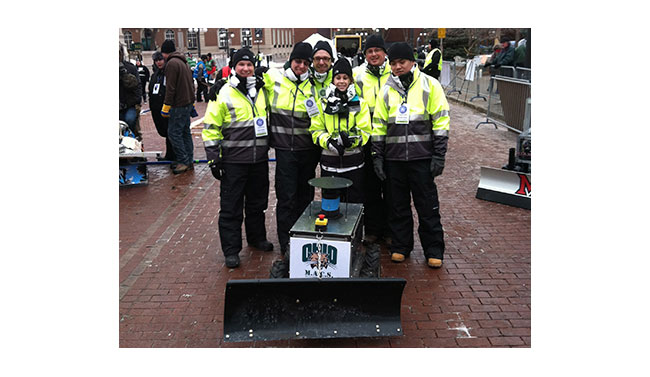
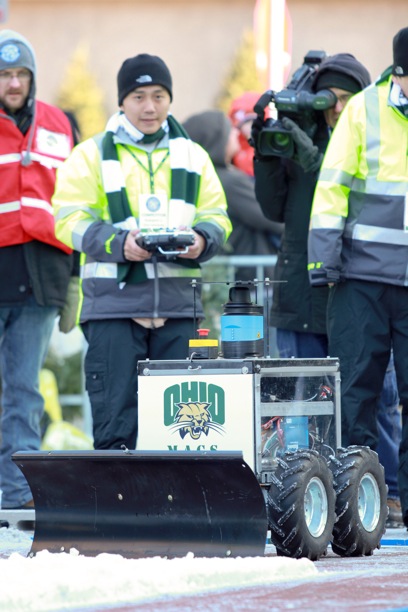
    First place was awarded to Ohio University’s Avionics Engineering Center with students Samantha Craig, Ryan Kollar, Adam Naab-Levy, Pengfei Duan and Kuangmin Li with support from faculty advisors Dr. Frank van Graas, Dr. Wouter Pelgrum and Dr. Maarten Uijt de Haag who submitted their four-wheeled Monocular Autonomously Controlled Snowplow (M.A.C.S.).  The first place prize included $5,000 and a golden snow globe trophy. Ohio University also captured the Best Student Presentation Award that included $500 and the “Golden Shovel” Award and the Best Written Report that included $500 and the “Golden Pen” Award.

    Second place was awarded to the Miami University team “RedBlade” that included students Mark Carroll, Chad Sobota, Robert Cole, Richard Marcus, Harrison Bourne, Jamie Morton and Michael Harris with support from advisors Dr. Yu (Jade) Morton, Dr. Peter Jamieson, Steve Taylor. The second place prize included $4,000 and a silver snow globe trophy.

    Third place was awarded to the University of Michigan (Dearborn) team “Yeti 3.0” that included students Angelo Bertani, Zachary DeGeorge, Ahmed Alkirsh, Abdelqwee Yaffai, Mark Bajor, Craig Cowling, Cody Schmitt, Jacob Mack and Mengxing (Simon) Chen with support from faculty advisor Narasimhamurthi (Nattu) Natarajan. The third place prize included $3,000 and a bronze snow globe trophy.

    In addition, the first place team, Ohio University, has been invited to display its winning snowplow during ION GNSS+ 2013 conference September 16-20 in Nashville, Tennessee.

    Sponsors of the second annual ION Autonomous Snowplow Competition included Honeywell, Inc., Alliant Techsystems Inc., Lockheed Martin Corporation, ASTER Labs, Inc., Space Exploration Technologies Corp., The Toro Company, Proto Labs, Inc. and U.S. Bank.

    The Fourth Annual ION Autonomous Snowplow Competition will be held in January 2014 at the Saint Paul Winter Carnival, St. Paul, Minnesota.

    ohio-university-2013-W
    Ohio University’s winning team.
  • Report from ION ITM: Faster, Smaller, Cheaper

    And more of them!

    That’s been one of the mantras — a controversial one, granted — of technological advance in the late 20th and early 21st centuries. It has succeeded in penetrating the global positioning, navigation, and timing vanguard, as evidenced by a handful of key presentations on the first day of the Institute of Navigation (ION) International Technical Meeting in San Diego on Monday.

    Skybox Imaging, a company that is “passionate about bringing Moore’s Law to space via disruptive microsatellite technology, rapid development cycles, and a scalable web-based delivery platform,” spoke to the ION ITM plenary session in the person of Ronny Votel, an engineer leading the company’s guidance, navigation and control division. Skybox’s goal is to provide “easy access to reliable and frequent high-resolution images . . . through a “constellation of imaging microsatellites delivering high-resolution imagery of any spot on Earth multiple times per day.”

    To achieve that goal, Skybox is developing a low-cost imaging satellite system:

    • design life of the satellites, 3 years;
    • size of the satellites, a mini-fridge;
    • size of the constellation, in the tens.

    Skybox will pair that flying system with web-accessible big data processing platform to capture video or images of any location on Earth within a couple of days — an unheard of delivery turnaround in the current global imaging industry, unless you happen to be a government (as in central, high, federal, perhaps military) customer.

    The low-cost nature of the satellite opens the possibility of deploying tens of satellites which, when integrated together, have the potential to image any spot on Earth within an hour. Votel several times made the analogy in his talk of using an iPhone camera to capture desired imagery, and indeed that could be a next logical step in FBC development: just throw a bunch of camera phones up into orbit.

    Skybox expects to launch its first two satellites later this year.

    In April of last year, Wired published a fascinating history and analysis: “Smaller, Quicker, Secret, Robotic: Inside America’s New Space Force.” Between Between 1992 and 1999, the U.S. National Aeronautics and Space Administration (NASA) launched 16 faster, smaller, cheaper missions, including Mars probes and space telescopes. Ten missions succeeded; six failed. Analysts declared the initiative a failure, and to a large extent it has been forsaken. Recent public writings, though, show second thinking. “I would like to respectfully suggest that success-per-dollar is a more meaningful measurement of achievement than success per-attempt,” stated one Air Force lieutenant colonel in a treatise on program management lessons from NASA.

    Could such an approach work for GNSS satellites, some of which are burdened with extraneous non-PNT payloads that make them far from FSC? Time will tell the wiser.

    Microtechnology

    In that FSC vein, at one of the afternoon’s technical sessions, Andrei Shkel of UC-Irvine had been scheduled to deliver a paper on “Precision Navigation and Timing Enabled by Microtechnology,” but apparently something came up and he was not able to appear. I had looked forward very much to what I anticipated would be an update to his September 2011 article in GPS World, “Microtechnology Comes of Age,” which was itself an update to a plenary talk he gave at ION ITM back in 2011. For now, that article will have satisfy us.

    Other presentations in the same MEMS, atomic clock, and MicroPNT session:

    Michael Bulatowicz of Northrop Grumman talked about a DARPA-backed project, the nuclear magnetic resonance (NMR) gyroscope. Northrop’s development and research has shown a viable solution to producing a small (size of a U.S. quarter coin) low-power navigation grade gyro using non-vibratory technology. The company has produced two prototypes and is at work on two more. Feed the NMR gyro into Shkel’s work and who knows what you’ll get in terms of FBC PNT? Well, maybe not cheaper in the immediate future. Bulatowicz said that as an assembled device he expected its cost, at least initially, to be substantially higher than MEMS technology.

    Richard Waters of Lumedyne Technologies spoke on next-generation MEMS inertial sensors with white-noise characteristics, a new paradigm based on time-domain switching for how MEMS sensors might work. TDS inertial sensors provide some key benefits: a purely digital approach, recalibration due to bias drift is not required, output is independent of oscillator conditions. Power is low, less than 1 millwatt. The device demonstrated switch stability under static conditions to –170 db. The same TDS concept can also be applied to a mechanical gyro.

    QZSS

    In other ION ITM first-day news, H. Tokura of the Tokyo University of Marine Science and Technology talked about “The Possibility of Precise Automobile Navigatin using GPS/QZS and Galileo E5 Pseudoranges.” Currently, research and prototype automobile high-precision PNT is done with real-time kinematic (RTK) networks, but this has some disadvantages, as discussed in an article by authors from the University of Nottingham, UK, in the February issue of GPS World.

    Japan’s QZSS now broadcasts L5 signals. Japan has essentially leapfrogged the United States, since the L5 signals with full CNAV message is already broadcast by satellite QZSS-1. Currently, three U.S. GPS satellites are L5 CNAV-capable, but none are broadcasting such a signal.

    Tokura showed results demonstrating that pseudorange observables from L5 are basically robust enough for this task. Further investigation for L5 is required because manufacturers are still developing the tracing technique for the new L5 signal. A software-defined receiver is indicated for usage.

    Hideki Yamada of Japan’s Electronic Navigation Research Institute spoke about the possibility of using only the QZSS constellation, “in case of GPS failure,” for RTK positioning in precision ag and machine control, with 4 to 7 QZSS satellites that could be launched in a future version of the constellation. QZSS has been shown to provide 10-meter accuracy in absence of GPS; now the research looks at an RTK method.

    With only one satellite in orbit, RTK-QZSS cannot be tested in the field. The researchers simulated a fuller constellation by using QZS-1, Multifunctional Transport Satellites (MTSAT), a set of geostationary weather and aviation control satellites, and GPS signals. Using a JAVAD Alpha receiver, Trimble and NovAtel antennas, they obtained results with low multipath error (about 30 centimeters) in a Tokyo environment. Multi-epoch processing is necessary for RTK-QZSS. This solution can work well as a minimum backup system of high-precision position under relatively moderate DOP condition.

    __________________

    Living may be easy, dying may be hard. But I’m wide awake, staying up late, sending my regards.

  • Wright State Wins 2012 ION Robotic Lawn Mower Competition

    Wright State Wins 2012 ION Robotic Lawn Mower Competition


    Photo: The Institute of Navigation (ION)

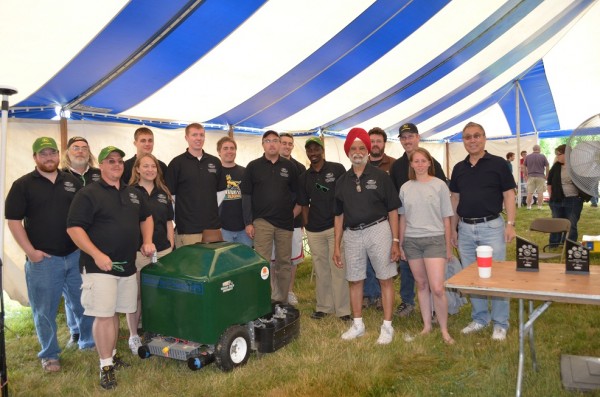
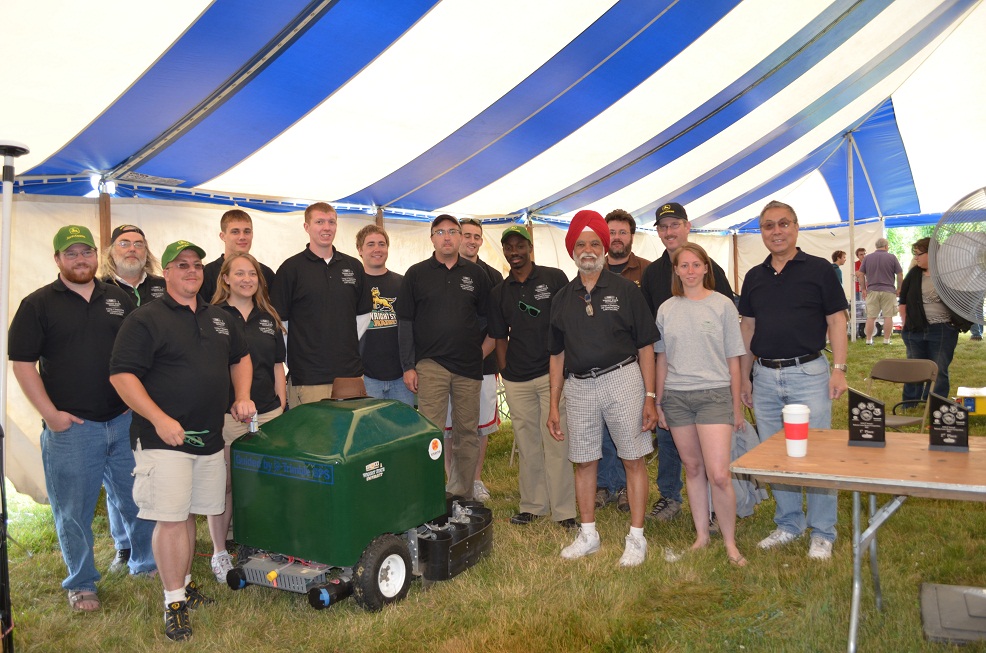
    The Institute of Navigation (ION) announces that Wright State University won top prize at the ninth annual 2012 Robotic Lawn Mower Competition held May 31 – June 2 at Siebenthaler’s Beaver Valley Garden Center in Dayton, Ohio.

    Sponsored by the Institute of Navigation Satellite Division and the Air Force Research Laboratory (AFRL) Sensors Directorate, the ION Annual Robotic Lawn Mower Competition is a national event for college and university students, future engineers and problem solvers, that challenges them to design and operate a robotic, unmanned lawn mower using the art and science of navigation to rapidly and accurately mow a field of grass.

    Eleven teams participated during the three day competition, each using unique design approaches. Teams included students and faculty advisors from Auburn University, Auburn, Alabama; Case Western Reserve University, Cleveland, Ohio; University of Florida, Gainesville, Florida (two teams); California State University, Fullerton, Fullerton, California; Miami University, Oxford, Ohio; University of Michigan Dearborn, Dearborn, Michigan; University of North Florida, Jacksonville, Florida; Syracuse University, Syracuse, New York; Southern Polytechnic State University, Marietta, Georgia; and Wright State University, Dayton, Ohio.

    The 2012 ION Robotic Lawn Mower Competition consisted of two separate categories: Basic Autonomous Mowing (Static) and Advanced Autonomous Mowing (Dynamic). The teams were judged in each category based on their total scores; 80% of the total score was  based on the mowing competition and 20% of the total score was based on the presentation and report.

    First place in the advanced Dynamic Competition, with $15,000 in prize money, was awarded to Wright State University, Dayton, Ohio. Second place in the Dynamic Competition, with $10,000 in prize money, was awarded to Miami University, Oxford, Ohio. Third place in the Dynamic Competition, with $5,000 in prize money, was awarded to Case Western Reserve University, Cleveland, Ohio.

    First place in the beginning Static Competition was awarded to the California State University, Fullerton, California. Second place prize in the Static Competition was awarded to the Syracuse University, Syracuse, New York. Third place in the Static Competition was awarded to the University of Michigan, Dearborn, Dearborn, Michigan.

    In addition to The Institute of Navigation Satellite Division and the Air Force Research Laboratory, sponsors included Honeywell, John Deere, The Joint Services Data Exchange, Northrop Grumman and Siebenthaler’s Garden Center.

    The Tenth Annual ION Robotic Lawn Mower Competition will be held May 30 – June 1, 2013, in Dayton, Ohio.


  • Live Blogging from U.S. Joint Nav Conference

    Alan Cameron, publisher and editor, and Don Jewell, contributing editor for defense, will be blogging live from the 2012 JSDE/ION Joint Navigation Conference. The conference will be held June 12-15 in Colorado Springs, Colorado. Cameron and Jewell will be blogging twice a day with all the news from the defense-oriented conference.

    Among many other matters, we’ll be taking a close-up look at NovAtel’s and L-3’s new SAASM receiver. This is a classified piee of hardware, of course, but we should be able to glean some details on this and other new defense products and services being rolled out at the exhibit accompanying the conference.

    In addition, we’ll have a top-level view of the Warfighters’ Panel on June 15. A similar session was the undisputed highlight of the GPS Partnership Council in late April, and we expect more of the same here. GPS World columnist Don Jewell is organizing this panel.

    According to organizers, JNC 2012 will be the largest U.S. military navigation conference of the year with joint service and government participation. The event will focus on technical advances in positioning, navigation and timing (PNT) with emphasis on joint development, test and support of affordable PNT systems, logistics, and integration. From an operational perspective, the conference will also focus on advances in battlefield applications of GPS, critical strengths or weaknesses of fielded navigation devices, warfighter PNT requirements and solutions, and navigation warfare.

    Watch the home page Top Story for the blogs, beginning Tuesday, June 12.

  • South Miami Senior High Wins 2012 ION Mini-Urban Challenge

    muc-2012-1st-place

    The Institute of Navigation (ION) announces that South Miami Senior High School won the 2012 ION Mini-Urban Challenge held May 26 at the Smithsonian’s Lemelson Center for the Study of Invention and Innovation at the National Museum of American History.

    Sponsored by the Institute of Navigation and the Air Force Research Laboratory (AFRL), the ION Mini-Urban Challenge is a national event that challenges high school students to work in teams to design and operate a robotic car, built from a LEGO Mindstorms NXT kit, that can accurately navigate autonomously through a model city. The competition is intended to expose students to the areas of science, technology, engineering, and mathematics (STEM).

    More than 600 students from 66 high schools competed in five regional competitions held in Louisiana, Florida, California, Washington, D.C., and Ohio. First- and second-place winners from each of the five ION Mini-Urban Challenge Regional Competitions were invited to compete in the National Competition. Each team was judged based on their cumulative scores earned throughout the competition phases: 30% of the total score was based on a technical presentation, and 70% of the total score was based on the course navigation portion of the competition.

    First place was awarded to the “Legotron” Team from South Miami Senior High School, Miami, Florida. The first place prize included $2,500 for the winner’s school and a trophy. Second place was awarded to the “305” Team, also from South Miami Senior High School. The second place prize included $1,000 for the winner’s school and a trophy. Third place was awarded to Perry High School, Perry, Ohio. The third place prize included $500 for the winner’s school and a trophy. Best in Show went to the “Legotron” Team from South Miami Senior High School and Best Presentation went to West High School, Torrance, California, who won based on their ambulance robot, complete with working siren.

    Sponsors for the 2012 ION Mini-Urban Challenge included: the Air Force Research Laboratory Munitions Directorate, The Smithsonian’s Lemelson Center for the Study of Invention and Innovation at the National Museum of American History, Boeing, John Deere, the Joint Services Data Exchange (JSDE), Northrop Grumman, Raytheon, the Consortium of Ohio Universities on Navigation & Timing (COUNT), CSR, JAVAD GNSS, Overlook Systems, The University of Calgary, Schulich School of Engineering, UrsaNav, and Lego.

  • Ohio University Team Wins Second ION Autonomous Snow Plow Competition

    IMG_6300
    Photo: Ohio University

    An Ohio University team won the Institute of Navigation (ION) Satellite Division’s second annual ION Autonomous Snowplow Competition. The competition was held January 26-29, at Rice Park in downtown Saint Paul, Minnesota, in conjunction with the 126th Saint Paul Winter Carnival.

    Sponsored by The Institute of Navigation Satellite Division and held in cooperation with the ION North Star Section, the ION Annual Autonomous Snowplow Competition is a national event open to college and university students, as well as the general public, that challenges teams to design, build, and operate a fully autonomous snowplow using state of the art navigation and control technologies to rapidly, accurately and safely clear a designated path of snow.

    Six teams participated during the four-day competition, each using unique vehicle design approaches.

    Teams included students, partners from private industry and faculty advisors from Dunwoody College of Technology; Miami University (Ohio); Ohio University; The University of Michigan, Dearborn; and The University of Minnesota.

    Teams were judged based upon their cumulative scores earned throughout the competition phases: 75% of the total score was based upon the plowing competition; and 25% of the total score was based upon the presentations and pre-event report.

    First place was awarded to Ohio University students Samantha Craig, Ryan Kollar, Kuangmin Li and Pengfei Duan with support from faculty advisors Frank van Graas, Woulter Pelgrum and Maarten Uijt de Haag. The first place prize included $3,000 and a golden snow globe trophy.

    Second place was awarded to Miami University students Chad Sobota, Mark Carroll, Robert Cole, Mark Stratis, with support from student advisors Steve Taylor, Ryan Wolfarth and Harrison Bourne and faculty advisors Jade Morton, Peter Jamieson and Janet Burge. The second place prize included $2,000 and a silver snow globe trophy.

    Third place was awarded to the University of Michigan (Dearborn) students Angelo Bertani, Zach DeGeorge, Mark Lawrence, Doris Kotori, Alf Williams, with support from student advisors Benjamin Craig,  Jhonatan Ferrer,  and faculty advisor Narasimhamurthi Natarajan. The third place prize included $1,000 and a bronze snow globe trophy.

    In addition, the first place team, Ohio University, will be invited to display their winning snowplow during ION GNSS 2012 Conference September 17-21, 2012 in Nashville, Tennessee.

    Sponsors of the second annual ION Autonomous Snowplow Competition included Lockheed Martin Corporation, ASTER Labs, Inc, Honeywell, Inc., Alliant Techsystems Inc., U.S. Bancorp, Hitching Post Motorsports, Space Exploration Technologies Corp., and The Toro Company.

    The Third Annual ION Autonomous Snowplow Competition will be held in January 2013 at the Saint Paul Carnival, St. Paul, Minnesota.

    The First Place team from Ohio University. Photo: Ohio University
    The First Place team from Ohio University. Photo: Ohio University